Federal Court, Kota Kinabalu
Rhodzariah Bujang, Nordin Hassan, Azmi Ariffin FCJJ
[Criminal Appeal No: 05(L)-77-05-2025(S)]
11 August 2026
Criminal Law: Trafficking in dangerous drugs — Appeal by prosecution against Court of Appeal's decision substituting conviction for trafficking and sentence of life imprisonment with 15 strokes of whipping, with conviction for possession and sentence of 12 years' imprisonment — Omission by trial Judge at close of prosecution's case to state whether defence was called based on actual or presumed trafficking — Whether trial Judge required to state presumption when calling for defence and to make formal, spoken declaration regarding specific mode of trafficking at that stage — Whether omission occasioned miscarriage of justice and vitiated conviction — Whether omission an irregularity curable under s 422 Criminal Procedure Code
The respondent and a co-accused, Aspal Hussam (Aspal), were jointly charged with trafficking 137.03 grammes of methamphetamine under s 39B(1)(a) of the Dangerous Drugs Act 1952 (DDA) read with s 34 of the Penal Code (Code). The drugs were recovered from a black plastic package that Aspal had thrown under a mango tree as he alighted from a vehicle driven by the respondent and attempted to flee upon a team of police officers approaching him and the respondent and identifying themselves. The respondent also attempted to flee but was arrested after a scuffle. At the close of the prosecution's case, the trial Judge found a prima facie case and called on both accused to enter their defence, without indicating whether they were required to answer a case of actual trafficking or presumed trafficking. The trial Judge rejected the defence's case as being inherently implausible and held that both accused had failed to rebut the presumption of trafficking and to raise a reasonable doubt on the prosecution's case. The trial Judge accordingly convicted and sentenced them to life imprisonment of 30 years with 15 strokes of whipping, with the sentence of imprisonment to run from the date of arrest. Only the respondent appealed against the said decision, seeking to set aside the conviction and sentence. The Court of Appeal agreed with the trial Judge's finding of possession but allowed the appeal on the ground that the trial Judge's failure to specify whether the respondent was required to answer a case of actual trafficking or presumed trafficking was fatal and had occasioned a miscarriage of justice. The Court of Appeal accordingly substituted the trial Judge's decision with a conviction for possession under s 12(2) of the DDA punishable under s 39A(2) of the DDA read together with s 34 of the Code and sentenced the respondent to 12 years' imprisonment from the date of his arrest with no order of whipping as he was over 50 years old. Hence the instant appeal by the prosecution against the whole of the Court of Appeal's decision. The issues that arose for determination were whether the trial Judge ought to have informed the respondent at the close of the prosecution's case, whether the defence was being called upon to answer a case of actual trafficking or presumed trafficking; and whether the omission to do so had occasioned a miscarriage of justice and vitiated the respondent's conviction.
Held (allowing the appeal):
Per Azmi Ariffin, FCJ (Majority)
(1) There was no statutory or legal requirement to state the presumption when calling for the defence, nor was there any provision in the Criminal Procedure Code (CPC) or the DDA which required a trial judge to make a formal, spoken declaration regarding the specific mode of trafficking at that stage. It was not obligatory or even necessary for the trial Judge to do so. (para 31)
(2) The trial Judge's statutory duty at the close of the prosecution's case was governed by s 180 of the CPC, which required the trial Judge to determine if a prima facie case had been made out on the ingredients of the charge before calling for the defence. Demanding a formal verbal label for an evidentiary rule at the close of the prosecution's case was unnecessary as the trial Judge only needed to apply the prima facie test in PP v. Mohd Radzi Abu Bakar (supra) and comply with s 180 of the CPC. Although it would be good practice for the trial Judge, when calling for the defence, to state whether a case involved actual or presumed trafficking, the court should not set a strict rule making it mandatory for the trial Judge to do so. (paras 32, 42 & 52)
(3) The trial record explicitly contradicted the Court of Appeal's finding that the respondent was unaware of the nature of the case, as both the prosecution and the defence clearly understood the operation of the presumption under s 37(da) of the DDA throughout the proceedings. The absence of an explicit statement from the trial Judge had not caused any prejudice as the respondent was clearly aware of the applicable burden of proof required to escape a trafficking conviction, actively litigated the statutory presumption, and ultimately suffered no miscarriage of justice. Additionally, the presumption of trafficking under s 37(da) of the DDA was triggered as the weight of the drugs was above the statutory weight stipulated thereunder and no challenge was made by the defence in this regard. (paras 43, 49 & 50)
(4) In the circumstances, the apparent omission by the trial Judge to expressly record his finding at the end of the prosecution's case as to whether it was a case of actual or presumed trafficking did not vitiate the respondent's conviction. The trial Judge's failure to either make or record such a finding did not ipso facto render the decision to call for the defence fatally flawed or cause a miscarriage of justice. What would be fatal was failing to comply with s 180 of the CPC.
On the totality of the evidence, the conviction of the respondent was safe. (paras 51 & 53)
Per Rhodzariah Bujang, FCJ (Dissenting)
(5) The principle in Junaidi bin Abdullah v. Public Prosecutor (Junaidi) that '... there is no statutory provision requiring a Judge sitting alone to expressly record his reason before calling the Accused to enter his defence' applied in the determination of the run-of-the-mill kind of criminal offences. That nonrequirement did not encompass drug trafficking cases or any other criminal cases where the criminal offence could be both an actual or presumed one under the law, given the unassailable burden of proof on the accused to prove his innocence. Thus, at the very least, there must be a pronouncement by the trial Judge at the close of the prosecution's case as to whether the defence was called for actual or presumed trafficking. Junaidi was distinguishable from the present case as it concerned the offence of illegal possession of a firearm and did not involve any presumption of criminality or illegality as in the present case. (paras 58, 59 & 63)
(6) The prosecution's indication to the trial Judge upon being queried, that it was relying on actual possession, could not be equated with the one adopted by the trial Judge given the absence of any express pronouncement by the trial Judge on whether it was actual or presumed trafficking that the defence had to answer. The words 'possession' and 'trafficking' used by the trial Judge were two totally distinct legal concepts, and although the former was an essential element for the latter in certain provisions of the DDA, it could not be assumed that the respondent's defence was called based on presumed trafficking without a clear and expressed pronouncement by the trial Judge that it was so. (para 60)
(7) The legal proposition in Abdullah Atan v. Public Prosecutor & Other Appeals that s 180(4) of the Criminal Procedure Code did not exclude the use of presumption, inferences or anything other than direct evidence to establish a prima facie case, was of no legal significance in the present appeal since the issue was not that the presumption of trafficking could not be raised, but simply whether when it was raised at the close of the prosecution's case, the respondent here or an accused person, generally, must be informed of its invocation given the higher evidential burden resting on his shoulders to rebut the same. (para 64)
(8) The ratio in Public Prosecutor v. Ishak Hj Shaari (Ishak Shaari) did not assist the prosecution because the failure to indicate to the respondent whether the case against him was based on actual or presumed trafficking was not a mere irregularity but one which has occasioned a substantial injustice to him because of the strictly different evidential burden placed upon his shoulders when presenting his defence, and as that substantial injustice was at the very core of the decision in Ishak Shaari. The omission in the present case was not an irregularity which was curable under s 422 of the CPC. Accordingly, the appeal was without merit and ought to be dismissed. (paras 65-66)
Case(s) referred to:
Abdullah Atan v. PP & Other Appeals [2020] 6 MLRA 28 (folld)
Bong Sing Seng v. PP [2024] 1 MLRA 1 (not folld)
Caniete Robelyn Mastelero lwn. Pendakwa Raya [Criminal Appeal No: 05(M)-240-10- 2018] (refd)
Junaidi Abdullah v. PP [1993] 1 MLRA 452 (folld)
Low Song Kim v. PP [Criminal Appeal No: 05(M)-227-10-2019(P)] (refd)
Masih Perviaz (W/Pakistan) v. PP [2022] 3 MLRA 341 (refd)
PP v. Ishak Hj Shaari & Other Appeals [2003] 1 MLRA 522 (refd)
PP v. Mohd Radzi Abu Bakar [2005] 2 MLRA 590 (folld)
PP v. Sanderasegaran Nithenanham [2024] 3 MLRA 798 (folld)
PP v. Zulkifli Arshad [2010] 1 MLRA 560 (folld)
Roman Zolotarov v. PP [2020] 7 MLRA 376 (refd)
Rozman Ibrahim lwn. Pendakwa Raya [Criminal Appeal No: 05(M)-205-09-2019(B)] (refd)
Sathya Vello v. PP [2022] 5 MLRA 74 (folld)
Seyedalireza Seyedhedayatollah Ehteshamiardestani v. PP [2014] 5 MLRA 705 (refd)
Yap Chai Chai & Anor v. PP [1973] 1 MLRA 469 (folld)
Legislation referred to:
Criminal Procedure Code, ss 180(4), 422
Dangerous Drugs Act 1952, ss 2, 12(2), 37(da), (xvi), 39A(2), 39B(1)(a), (2)
Internal Security Act 1960, s 57
Penal Code, s 34
Counsel:
For the appellant: Mohd Amril Johari; AG's Chambers
For the respondent: Kamarudin Mohmad Chinki; M/s Chang & Kamarudin
[For the Court of Appeal judgment, please refer to Julasiri Akilmara v. PP [2026] 3 MLRA 267]
JUDGMENT
Azmi Ariffin FCJ (Majority):
Introduction
[1] The Appellant and another accused, Aspal bin Hussam, were jointly charged for trafficking 137.03 grams of methamphetamine under s 39B(1)(a) of the Dangerous Drugs Act 1952, read together with s 34 of the Penal Code.
[2] The charge against the Appellant and Aspal bin Hussam read as follows:
"That you both, on the 16th day of December 2018, at about 12.30 pm., located at the roadside in front of Sekolah Menengah Kebangsaan Datuk Panglima Abdullah, in the District of Semporna, in the State of Sabah, in furtherance of common intention of you both, did on your own behalf traffic in a dangerous drug to wit 137.03 grams of Methamphetamine and that you have thereby committed an offence under s 39B(1)(a) of the Dangerous Drugs Act 1952 (Act 234), and punishable under s 39B(2) of the same Act, read with s 34 of the Penal Code."
[3] In support of its case, the prosecution had called six (6) witnesses to testify against them.
[4] At the end of the prosecution's case, the learned High Court Judge ordered both the accused to enter their defence.
[5] Both accused elected to give their evidence on oath as a sole witness for their defence.
[6] At the end of the defence case, the learned High Court Judge found both accused guilty of the charge; accordingly, they were convicted and sentenced to life imprisonment (30 years) and ordered to be given 15 strokes of whipping each. The imprisonment sentence is to run from the date of their arrest, 16 December 2018.
[7] Being dissatisfied with that decision, only the Appellant, Julasiri bin Akilmara, on 18 July 2022, filed a Notice of Appeal to the Court of Appeal against his conviction and sentence.
[8] On 19 May 2025, the Court of Appeal unanimously allowed the Appellant's appeal against his conviction and sentence under s 39B(1)(a) of the Dangerous Drugs Act 1952 ("the Act") read with s 34 of the Penal Code and substituted it with a conviction under s 12(2) of the Act punishable under s 39A(2) of the Act read together with s 34 of the Penal Code. The Appellant was sentenced to twelve (12) years' imprisonment from the date of his arrest, 16 December 2018, with no order of whipping, as he is over 50 years old.
[9] Being dissatisfied with the decision, the learned Deputy Public Prosecutor appealed to the Federal Court against the entire decision of the Court of Appeal on 23 May 2025.
[10] In this appeal, the Public Prosecutor will be referred to as the Appellant, and Julasiri bin Akilmara as the Respondent.
[11] After hearing submissions from the parties, both oral and written, the panel came to a split decision. Nordin Hassan FCJ and Azmi Ariffin FCJ formed the majority judgment, whilst Rhodzariah Bujang FCJ dissented. The majority allowed the Public Prosecutor's appeal, set aside the order of the Court of Appeal, and restored the conviction and sentence entered by the High Court against the Respondent under s 39B(1)(a) of the Dangerous Drugs Act 1952.
[12] We hereby state our reasons for the decision. This would form the majority judgment of the Court.
The Prosecution's Case
[13] The background facts leading to the charge can be briefly summarised as follows:
(i) On 16 December 2018, at approximately 12.30 pm., a police team led by Inspector Mohd Shahrul Tarmizi bin Sahffiee (PW6) observed a dark blue Honda CRV bearing registration number WFJ 2278 parked at the roadside near Sekolah Menengah Kebangsaan Datuk Panglima Abdullah, Semporna, Sabah. The police observed the vehicle for approximately 10 to 15 minutes before approaching it.
(ii) Upon approach, PW6 and his team identified themselves as police officers. The co-accused, Aspal bin Hussam ("Aspal"), who sat in the front passenger seat, alighted from the vehicle and attempted to flee, throwing a black plastic package under a mango tree. The Respondent, who was seated in the driver's seat, also attempted to flee, which led to a scuffle before he was subdued and arrested. The police team recovered the black plastic package from beneath the mango tree. The chemist (PW1) who analysed the substance confirmed that it weighed 137.03 grams of methamphetamine.
The Defence At Trial
[14] Both the Respondent and Aspal gave sworn evidence.
[15] Their defence was that they had left the Respondent's house in the Honda CRV to go for a drive. During the drive, Aspal received a telephone call from a friend named "Kaisar". Aspal directed the Respondent to drive to SMK Datuk Panglima Abdullah, Semporna, and wait there as Kaisar wished to meet Aspal. While waiting in the vehicle, Kaisar approached the car and threw a black plastic bag inside. Shortly thereafter, the police approached and arrested them.
[16] The Respondent denied attempting to flee, maintaining that he had voluntarily switched off the engine and surrendered the keys to the police.
[17] In short, the Respondent's defence was that:
(i) He had no knowledge of the drugs;
(ii) He never tried to run from the car;
(iii) He did not sign the police search list;
(iv) An unknown man suddenly threw the plastic bag into the car and punched him; and
(v) He was framed by the police and a third party named "Kaisar".
The Trial Judge's Finding At The End Of The Prosecution Case
[18] Based on the Notes of Proceedings (Enclosure 12 Appeal Record Vol 3 p 193-194), the learned trial judge concluded inter alia as follows:
"Applying the case set out in Balachandran and Radzi, the Court finds that the prosecution has made a prima facie case against both the 1st and 2nd accused who are thus called upon to enter their defence. There are 3 options available to the accused."
Findings Of The Learned Trial Judge At The Close Of The Defence's Case
[19] At the end of the defence's case, the learned trial judge dismissed their narratives as inherently implausible. The court found Kaisar to be a fictitious character because the Appellant and Aspal did not provide any details about him, and Kaisar's existence was not put to the prosecution's witnesses during the trial. Consequently, the High Court held that Aspal and the Appellant failed to rebut the presumption of trafficking and did not raise a reasonable doubt.
[20] The learned trial judge concluded inter alia as follows:
"The prosecution has proven its case of trafficking against both the accused under s 39B(1)(a) as per the charge, beyond reasonable doubt. It has proven the identity and the weight of the drugs, common intention, and actual possession, which triggered the statutory presumption of trafficking. The accused persons failed to rebut the statutory presumption of trafficking on a balance of probabilities or to cast a reasonable doubt on the prosecution's case in all other material respects. The 1st and 2nd accused are accordingly convicted as per the charge."
(See Notes of Proceedings (Enclosure 12 Appeal Record Vol 3, pp 195-196))
The Trial Judge's Written Judgment
[21] Based on the Notes of Proceedings (Enclosure 11 Appeal Record Vol 2 p 35-36), the learned trial judge concluded by stating inter alia as follows:
"77. Having considered the evidence as a whole as required by s 182A of the Criminal Procedure Code, having heard the witnesses and perused the submissions, the court finds that the prosecution has proven its case against the accused persons beyond reasonable doubt. The essential ingredients of the offence have been proven beyond reasonable doubt: identity and weight of the drugs (137.03 grams of methamphetamine) and actual possession, which triggered the statutory presumption of trafficking under s 37(da)(xvi) of the Dangerous Drugs Act 1952.
The accused persons failed to rebut the presumption of trafficking on a balance of probabilities or to cast a reasonable doubt on the prosecution's case in other material respects. Both the accused are accordingly convicted of the offence in s 39B(1)(a) of the Dangerous Drugs Act 1952 with which they were charged."
Proceedings In The Court of Appeal
[22] The Respondent appealed to the Court of Appeal, raising two issues:
(i) the High Court's finding on possession; and
(ii) the learned High Court Judge's failure to inform the Respondent whether he was required to answer a case of direct trafficking or presumed trafficking.
[23] The Court of Appeal found no merit in the first issue on possession but allowed the appeal on the second issue, holding that the failure to specify was fatal and had occasioned a miscarriage of justice.
[24] The Court of Appeal held as follows:
"18. We agree with the High Court's finding on possession. As indicated earlier, our judgment will focus on whether the High Court should have informed the appellant of whether he needed to answer in relation to a case of actual or presumed trafficking.
19. In the case of Bong Sing Seng (supra), the appellant was charged with trafficking under s 39B(1)(a) DDA 1952. He was found guilty by the High Court. The appellant in that appeal argued that his conviction was unsafe, as the High Court had failed to make a finding at the end of the prosecution's case whether it was a case of actual or presumed trafficking. This was a point of law. It was submitted that the omission had prejudiced the appellant, as he would not know whether he had to raise a reasonable doubt or rebut the presumption on a balance of probabilities. This court, in agreeing with the appellant's submissions, set aside the appellant's conviction for trafficking under s 39B(1)(a) DDA 1952 and substituted it with a conviction for possession under s 12(2) DDA 1952.
20. The decision in the Bong Sing Seng case binds us. We would adopt a similar stance. In a drug trafficking case, it is incumbent on the trial judge to make a finding and indicate whether the defence must answer a case of actual or presumed possession or whether the trafficking was presumed or actual. The burden imposed on the appellant is different for both scenarios, as he would need to discharge the burden on a balance of probabilities if the presumption is invoked against him. In contrast, the burden for actual trafficking would be to raise a reasonable doubt. Without being informed, the appellant would be significantly prejudiced, as he would be unable to prepare his defence without knowing the burden imposed.
21. The court in Bong Sing Seng referred to several decisions by the Federal Court on this matter. These included Caniete Robelyn Mastelero lwn. Pendakwa Raya [2019] 7 MLRA 411 [Criminal Appeal No: 05(M)-240-10-2018], Rozman Ibrahim lwn. Pendakwa Raya [2019] MLRAU 321 [Criminal Appeal No: 05(M)-205-09-2019(B)], and Low Song Kim v. PP [2020] 3 MLRA 289 [Criminal Appeal No: 05(M)-227-10-2019(P)]. In all these cases, the apex court held that the trial judge's failure to specify whether the defence was called on actual or presumed trafficking resulted in a miscarriage of justice. The convictions for trafficking were therefore set aside and replaced with convictions under s 12(2) DDA 1952. None of these cases was reported in the Law Reports. However, the learned counsel for the appellant provided excerpts from the Notes of Proceedings, which this Court accepted as an accurate account of what transpired during the appeals.
22. We are of the view that although it is not mandatory for the trial judge to give reasons for concluding that the prosecution has established a prima facie case, it remains necessary for the judge to inform the accused of whether they are facing actual or presumed trafficking. This determination is crucial because the burden of proof varies. An accused must meet a higher burden in cases of presumed trafficking compared to actual trafficking.
23. We are therefore resolute that the appellant suffered a miscarriage of justice due to the learned High Court Judge's failure to make a clear finding and inform the appellant whether he needed to answer a case of direct or presumed trafficking. We therefore find his conviction for trafficking under s 39B(1)(a) DDA 1952 unsafe.
24. As indicated earlier, we are satisfied that the evidence supported the High Court's finding of possession against the appellant and Aspal. We therefore find that the prosecution has succeeded in proving an offence under s 12(2) DDA 1952."
Proceedings In The Federal Court
[25] Before us, the learned Deputy Public Prosecutor argued that the Court of Appeal erred in law and in fact in allowing the Respondent's appeal, finding that the learned High Court Judge was obliged to inform the Respondent, at the close of the prosecution's case, whether the defence was being called upon to answer a case of actual trafficking under s 2 of the Act or presumed trafficking under s 37(da) of the Act, and that such non-indication was fatal, occasioned a miscarriage of justice and prejudiced his conviction. However, the High Court's notes of proceedings revealed that the parties were not misled by this omission.
[26] In response, the learned counsel for the Respondent submitted that if the case proceeds on presumed trafficking under s 37(da), the Respondent bears the burden of rebutting the statutory presumption on a balance of probabilities. Conversely, if the case proceeds on the basis of actual trafficking under s 2, the accused needs only to raise a reasonable doubt in the prosecution's case. Without being informed of the specific legal basis upon which the defence is called upon, the Respondent cannot know the legal burden he must discharge, thus causing ambiguity and prejudice to the Respondent in the preparation and presentation of his defence.
Our Decision
[27] On the High Court's finding of possession, after considering all the facts and circumstances of this case and the subsequent conduct of the Respondent in attempting to distance himself from the said drugs by fleeing the scene, we agree with the Court of Appeal that overwhelming evidence proved the elements of custody, control, and knowledge, and that actual possession of the impugned drugs was established. Hence, we see no reason to disturb this conclusion and find that the element of possession of the drugs was duly proven by the prosecution against the Respondent.
[28] Now, the central issue in this appeal is whether the learned High Court Judge should have informed the Respondent, at the close of the prosecution's case, whether the defence was being called upon to answer a case of actual trafficking or presumed trafficking.
[29] The point of law raised in these appeals concerns the interpretation of sub-sections (1) and (4) of s 180 of the Criminal Procedure Code, which read:
Procedure after conclusion of case for prosecution
180. (1) When the case for the prosecution is concluded, the Court shall consider whether the prosecution has made out a prima facie case against the accused.
...
(4) For the purpose of this section, a prima facie case is made out against the accused where the prosecution has adduced credible evidence proving each ingredient of the offence which if unrebutted or unexplained would warrant a conviction.
[30] The Court of Appeal held that this obligation exists. It ruled that the trial judge's failure to expressly record this indication in the notes of evidence before calling for the defence was fatal, as it occasioned a miscarriage of justice to the Respondent.
[31] With respect, we disagree. There is no statutory or legal requirement for the trial judge to state the presumption when calling for the defence. Neither the Criminal Procedure Code nor the Dangerous Drugs Act 1952 contains any provision requiring a trial judge to make a formal, spoken declaration regarding the specific mode of trafficking at that stage. It is not obligatory or even necessary to do so.
[32] The statutory duty of a trial judge at the close of the prosecution's case is strictly governed by s 180 of the Criminal Procedure Code. Section 180 requires the court to determine whether the prosecution has made out a prima facie case against the accused. If the court finds that a prima facie case has been established on the ingredients of the charge, the court must call upon the accused to enter their defence.
[33] In Yap Chai Chai & Anor v. PP [1973] 1 MLRA 469 in an appeal to the then Federal Court against conviction on a murder charge, it was argued that it was mandatory for the trial Judge at the close of the prosecution case to enter on the record his opinion that there was a case to answer and that his failure to do so rendered the trial a nullity. In dismissing the appeal, Ong CJ said at p 471:
"Leaving aside for the moment the 2nd appellant's statement, we are clearly of opinion that the facts which were indisputable had established a clear prima facie case, and that the learned trial Judge would have been wrong to withdraw the case at that stage from the jury. We do not think that the provisions of s 204(2) of the Criminal Procedure Code (S.S.) had any application, nor do we agree with the contention of Datuk S.P Seenivasagam that it was mandatory for the Judge at the close of the prosecution to enter on the record his opinion that there was a case to answer the failure to do so rendering the trial a nullity.
As authority for this proposition, two cases were cited to us, being the judgments delivered by Willan CJ in Ng Peng Choon v. Public Prosecutor [1947] 1 MLRH 592 and S Govindasamy v. PP [1948] 1 MLRA 308. In our opinion the provisions relating to trials with assessors, as in those cases, have no application to jury trials; in any event, we must say, with all respect, that we unanimously disagree with the learned Chief Justice. What is always of paramount importance in the administration of criminal justice is a fair trial — not such excessive legalism as to give the ordinary meaning of words the sacrosanctity of a ritual."
[34] The principle in Yap Chai Chai's case was endorsed by the Supreme Court in Junaidi Abdullah v. PP [1993] 1 MLRA 452, where Mohamed Azmi SCJ (as he then was) stated:
"In our opinion, there is also no statutory provision requiring a Judge sitting alone to expressly record his reason before calling the Accused to enter his defence or to state his findings on the credibility of main prosecution witnesses. But, as a matter of practice, where there is a particular reason for doing so, such as where a submission of no case to answer has been made in a complex case or where the Accused is called to enter a defence on a lesser or alternative charge, Judges do sometimes give their reasons.
In uncomplicated cases, such as in the instant appeal, it is not obligatory or even necessary to do so. By calling an Accused to enter his defence, it should be assumed that the trial Judge, must on evaluation of the evidence, has been satisfied that the prosecution has, at that stage of the trial, established a prima facie case, which, if unrebutted would warrant a conviction of the Accused. To arrive at such a conclusion, it is inherent that the Judge must consider all the evidence adduced by the prosecution as tested in crossexamination on a prima facie basis.
In this appeal the establishment of a prima facie case of unlawful possession of a firearm under s 57 of the Internal Security Act was so obvious even to the defence Counsel that it became academic and unnecessary for the Court to consider an order of acquittal under s 180 of the Criminal Procedure Code. Thus, when the learned Judge called for the defence in the present case, he must have been satisfied that there was a prima facie case to answer, which, if unrebutted would warrant a conviction, and it was not mandatory for him to record the reasons for his satisfaction, even if there had been no concession made by the defence Counsel.
However, whether the Judge was actually correct in law in calling for the defence was, of course, open for review on appeal to this Court. Be that as it may, we hold the view that mere failure or omission on the part of a trial Judge to record his grounds for calling for the defence or to record his findings on credibility of witnesses at that stage of the trial is not sufficient by itself for allowing an appeal, particularly when considered in the light of the provisions of ss 60 and 72 of the Courts of Judicature Act read together with s 167 of Evidence Act and s 422 of the Criminal Procedure Code."
[Emphasis Added]
[35] It is pertinent to emphasise that statutory presumptions are not separate, independent offences; they are simply evidentiary rules built into the DDA 1952 to determine how the core element of "trafficking" is legally proven. As affirmed by the Federal Court in Abdullah Atan v. PP & Other Appeals [2020] 6 MLRA 28 (Abdullah Atan), a presumption is a rule of evidence stating how a particular fact can be proved. Under s 180(4) of the Criminal Procedure Code, the prosecution is fully entitled to establish a prima facie case by invoking these statutory rules of evidence.
"(1) The purpose of s 180(4) of the CPC was to not exclude the use of presumptions, inferences or anything other than direct evidence to establish a prima facie case. Reading s 180(4) in light of its context and legislative purpose, the phrase 'credible evidence proving each ingredient of the offence' means that the prosecution may prove each ingredient of the offence either: (i) by adducing credible direct evidence of that ingredient; (ii) by drawing inferences of fact, ie. adducing credible circumstantial evidence, from which the ingredient can be inferred; or (iii) by invoking presumptions of law, ie by adducing credible evidence of the relevant basic facts, to invoke a statutory presumption that the ingredient exists. (paras 41-43)
(2) A presumption is not evidence; rather, it is a rule of evidence stating how a particular fact can be proved. This court has endorsed the use of the presumption under s 37(da) of the DDA by the prosecution to establish a prima facie case of drug trafficking. What is required of the prosecution is to adduce credible evidence of the basic facts in order to rely on the presumption of trafficking in s 37(da). (paras 46 & 47)."
[36] In the case of PP v. Zulkifli Arshad [2010] 1 MLRA 560, the Federal Court, through the judgment delivered by Hashim Yusoff FCJ (as he then was), held as follows:
"[2] The respondent was charged with, convicted and sentenced to death by the Muar High Court on 23 April 2004 on two charges of trafficking in dangerous drugs contrary to s 39B(1)(a) of the Dangerous Drugs Act 1952 ("the Act").
...
[5] The respondent's appeal to the Court of Appeal was allowed in part, ie the convictions under s 39B(1)(a) were substituted with that under s 6 read with s 39A(2) of the Act. He was then sentenced to 18 years imprisonment on each charge and also ordered to be given 10 strokes of the rattan. The sentences of imprisonment were ordered to run concurrently.
...
[11] Issue (iii): Whether the presumption of trafficking should have been invoked?
On this issue, both parties raised the question of the failure by the learned trial judge to invoke the presumption of trafficking under s 37(da)(vi) of the Act.
...
[14] Learned counsel for the respondent then submitted that since the learned trial judge did not invoke the statutory presumption under s 37(da)(vi) of the Act, there was a misdirection by the trial judge and it was therefore correct for the Court of Appeal to intervene and found a conviction on mere possession and not trafficking.
[16]... In the instant appeal, the learned trial judge found as a fact that the respondent was in actual possession of the drugs in the car and in the house PS31-3. So, did the Court of Appeal. The only flaw, as submitted, is that both the High Court and the Court of Appeal did not invoke the presumption under s 37(da)(vi) of the Act. But on the facts and evidence of this case that should not be fatal to the prosecution. We are of the view that having been established as a fact by the trial judge that there was actual possession of the drugs by the respondent, the weight of which exceeded 200 grams of cannabis, then the statutory presumption under s 37(da)(vi) must come into play.
[18] No injustice could have been occasioned to the respondent as he had every opportunity to raise a reasonable doubt in the prosecution case although the learned trial judge did not invoke the presumption. And the learned trial judge did consider the respondent's defence in detail, at the end of which His Lordship concluded that (p 76 Appeal Record 2):
There is no gap in the prosecution case. There is no doubt that the accused was trafficking. The prosecution had proved that it could not have been anything else, beyond all reasonable doubt. All evaluation of the prosecution case and then of the defence gave that same result. Accordingly, on both counts, the accused is convicted and sentenced to the only punishment mandated by law.
[19] The same applies to the failure of the Court of Appeal for not applying the presumption under 37(da)(vi). Be that as it may, we feel that on the evidence adduced by the prosecution, and upon the failure by the learned trial judge as well as the Court of Appeal to invoke the presumption, it is incumbent upon us to do so in accordance with the provision of s 37(da)(vi) of the Act.
[20] Having done that, we also agree with the finding of the learned trial judge that upon all evaluation of the prosecution case and then of the defence it gave the same result ie, that the prosecution had proved its case beyond all reasonable doubt that the respondent was trafficking in drugs as per the two charges. We are satisfied that the learned trial judge had given a maximum evaluation of all the evidence before him and came to the right conclusion. The defence failed to rebut the presumption and also failed to raise a reasonable doubt."
[Emphasis Added]
[37] In Sathya Vello v. PP [2022] 5 MLRA 74, the Federal Court, through the judgment delivered by Abdul Rahman Sebli FCJ (as he then was) held as follows:
"[38] The complaint in the first ground of appeal was that when calling for the appellant to enter on his defence, the learned trial judge ought to have but failed to inform him whether his defence was called on presumed trafficking or on direct trafficking and whether any of the presumptions had been invoked. According to learned counsel, this was necessary to enable the defence to have "clarity of the court's position" in preparing for his defence.
...
[55] Coming back to the appellant's first ground of appeal, the procedure to be followed at the close of the prosecution case in a trial before the High Court is prescribed by s 180 of the Criminal Procedure Code ("the CPC"), which is as follows:
Section 180. Procedure after conclusion of case for prosecution
(1) When the case for the prosecution is concluded, the Court shall consider whether the prosecution has made out a prima facie case against the accused.
(2) If the Court finds that the prosecution has not made out a prima facie case against the accused, the Court shall record an order of acquittal.
(3) If the Court finds that a prima facie case has been made out against the accused on the offence charged, the Court shall call on the accused to enter on his defence.
(4) For the purpose of this section, a prima facie case is made out against the accused where the prosecution has adduced credible evidence proving each ingredient of the offence which if unrebutted or unexplained would warrant a conviction.
[56] Sub-section (3) read with sub-section (4) of the section makes it mandatory for the trial court to call for the defence if the prosecution has adduced credible evidence to prove each ingredient of the offence charged. In a prosecution under s 39B(1)(a) of the DDA, the ingredients of the offence are:
(i) the accused is in possession of the drug;
(ii) the drug is a dangerous drug listed in the First Schedule to the DDA; and
(iii) the accused does any act of trafficking, including those acts defined as "trafficking" by s 2 of the DDA.
[57] There is no requirement in s 180 of the CPC that when calling for the accused to enter on his defence, the trial judge must inform him verbally or in writing of the reason or reasons why he is calling for him to enter on his defence. What is required is for the trial judge to be satisfied that the prosecution has adduced credible evidence to prove each ingredient of the offence charged. There is no other requirement, and the law reports are replete with authorities on what constitutes a "prima facie case".
[58] In fact the trial judge is not even required to provide any reason for calling for the defence. The authority for this proposition is the decision of this court in Junaidi Abdullah v. PP [1993] 1 MLRA 452.
[59] I see no reason why this panel should depart from this decision, which was based on sound policy considerations. The decision was reaffirmed by this court in PP v. MohdRadzi Abu Bakar [2005] 2 MLRA 590 where Gopal Sri Ram JCA (as he then was) in a separate judgment said:
The failure by the trial court either to make or to record such a finding does not in our judgment occasion a miscarriage of justice. It is sufficient for the judicial arbiter - be the judge or magistrate - to give his reasons in his written grounds of judgment for requiring an accused to make his defence.
[60] The case was also applied in the Court of Appeal case of Yap You Jee v. PP & Other Appeals [2015] 4 MLRA 542 through the judgment of Tengku Maimun Tuan Mat JCA (as the Right Honourable Chief Justice then was). So, if the law does not require the trial judge to give any reason for calling for the accused's defence, there is no reason why he is required to inform the accused at the close of the prosecution case whether any presumption of law applies against him. In any case, even if there is a failure to do so at this stage of the trial, it does not ipso facto and for that reason alone, render the decision to call for the defence fatally flawed. What will be fatal is not to comply with s 180 at all.
[61] The danger of placing such a burden on the trial judge is that he may invoke the wrong presumption and in the process, mislead the accused and thus causing a miscarriage of justice. For example, the trial judge may tell the accused that his defence is called on presumed trafficking when there is no evidence that the accused had knowledge of the drug to trigger the presumption of trafficking under s 37(da). This will mislead the accused into preparing his defence with a view to rebutting the presumption of trafficking under s 37(da) on the heavier burden of proving his case on the balance of probabilities when no such burden is imposed on him by law.
...
[74] I fail to understand how the failure by the learned trial judge to inform the appellant whether his defence was called on presumed trafficking or on direct trafficking had prejudiced him in the preparation of his defence. First of all, the law does not require the trial judge to do so when calling for his defence. The fact that the appellant would have to bear the burden of rebutting the presumption of trafficking under s 37(da) of the DDA if his defence was called on presumed trafficking is neither here nor there and is not a valid reason in law for imposing such duty on the trial judge if on the evidence the presumption applied against him.
[75] In this regard, it must be remembered that the presumption of trafficking under s 37(da) operates by operation of law and the court has no discretion not to invoke it once affirmative evidence of knowledge is proved against the accused and the weight of the drug is of or above the minimum prescribed by the section. It is therefore irrelevant whether or not the accused is told that the presumption applies against him. In any case, on the state of the evidence established by the prosecution at the close of its case, the accused in a drug trafficking trial should be able to know whether the presumption of trafficking under s 37(da) applies against him without having to be told about it. Surely the presumption would apply if, for example, the evidence is that he threw away the drug on being pursued by the police.
...
[98] ... I find no merit in the argument advanced by learned counsel for the appellant that in view of the different standards of proof that the appellant was required to discharge in a case of presumed trafficking and in a case of direct trafficking, the learned trial judge erred when she did not indicate at the end of the prosecution case whether the appellant's defence was called on direct trafficking or on presumed trafficking and whether any of the presumptions had been invoked."
[Emphasis Added]
[38] In PP v. Sanderasegaran Nithenanham [2024] 3 MLRA 798, the Federal Court, through the judgment delivered by Nordin Hassan FCJ, held as follows:
"[29] There is nothing under ss 180, 182A or other related provisions of the CPC that requires the trial judge to state specifically which limb of s 300 of the Penal Code that the prosecution has proved, in particular before calling the accused to enter his defence. Further, the trial judge is also not required to give any reason for calling the accused to enter his defence. Any decision of the court that requires such, would add something that is not required under the law or put words in a plain and unambiguous provision of the law. The court's duty is to interpret law passed by the Parliament but not to interpret the subjective intention of the Parliament.
...
[34] Hence, based on the statutory provisions and authorities cited above, what is pertinent for the trial judge at the end of the prosecution case is to determine whether the prosecution has established a prima facie case and a prima facie case is established if all elements of the charge have been proved by credible evidence. Next, if the defence is called, the trial judge has to decide whether the defence has raised a reasonable doubt on the prosecution case. At the risk of repetition, the trial judge is not required to give any reason for calling the accused to enter his defence and in the context of the present case, to state specifically that the prosecution has proved one of the limbs of s 300 of the Penal Code, although it is a good practice to do so to make it clear in the grounds of judgment the particular limb of the section that the trial judge found has been proved by the prosecution."
[39] Having regard to all these considerations, we see no reason why we should depart from the above-quoted decisions.
[40] The Court of Appeal relied on another Court of Appeal decision in Bong Sing Seng v. PP [2024] 1 MLRA 1, where it was held that trial judges must specify whether an accused faces a case to answer for actual or presumed trafficking at the prima facie stage, and failing to do so causes a miscarriage of justice. In that case, the High Court's conviction for trafficking was overturned and replaced with a conviction for possession under s 12(2) DDA 1952.
[41] The court in Bong Sing Seng referred to several Federal Court decisions on this matter, including Caniete Robelyn Mastelero lwn. Pendakwa Raya [Criminal Appeal No: 05(M)-240-10-2018], Rozman Ibrahim lwn. Pendakwa Raya [Criminal Appeal No: 05(M)-205-09-2019(B)], and Low Song Kim v. PP [Criminal Appeal No: 05(M)-227-10-2019(P)]. In all these cases, the apex court held that a trial judge's failure to specify whether the defence was called on actual or presumed trafficking resulted in a miscarriage of justice. Consequently, the trafficking convictions were set aside and replaced with convictions under s 12(2) of the Dangerous Drugs Act 1952. Unfortunately, these are ex tempore judgments which do not constitute the written grounds of the court. Without a written judgment, it is our view that it is purely speculative and cannot be regarded as authoritative and/or binding. Hence, we therefore missed the opportunity to know the reason or reasons why this court in that case unanimously substituted these convictions.
[42] As we have also mentioned, demanding a formal verbal label for an evidentiary rule at the close of the prosecution's case is unnecessary as the trial judge only needs to apply PP v. Mohd Radzi Abu Bakar (supra) prima facie test and comply with s 180 of the Criminal Procedure Code.
[43] The Court of Appeal's finding that the Respondent was unaware of the nature of the case is explicitly contradicted by the trial record. Both the prosecution and the defence clearly understood the operation of the statutory presumption under s 37(da) of the Dangerous Drugs Act 1952 throughout the proceedings.
[44] First, the Deputy Public Prosecutor explicitly clarified during oral submissions at the close of the prosecution case that they were relying on actual possession. The High Court notes of proceedings record a direct exchange between the bench and the Deputy Public Prosecutor:
"Court: The prosecution is relying on presumed or actual possession?
DPP: Actual possession."
[45] Second, the prosecution's written submission at the end of the prosecution stage could not have been clearer, stating:
"The prosecution submits that it has adduced enough evidence to prove actual possession independent of 37(d) so as to enable the Court to invoke the presumption under 37(da)."
[46] Third, the Respondent's own legal counsel explicitly acknowledged and argued against the invocation of this specific presumption. In their comprehensive written submissions at the close of the prosecution case, the defence stated:
"The prosecution had no strong evidence to suggest that the 2nd accused knew the drugs in P14(a); therefore, the prosecution failed to prove possession and consequently, the presumption of trafficking under s 37(da) of the Dangerous Drugs Act 1952 cannot be invoked."
[Enclosure 15 Appeal Record Vol 5(1) p 108]
[47] These excerpts prove that the Respondent was fully aware of the prosecution's case regarding actual physical possession of 137.03 grams of methamphetamine, which triggers the statutory presumption of trafficking under s 37(da)(xvi) of the Dangerous Drugs Act 1952, where the legal burden shifted to the defence to rebut the presumption of trafficking on the balance of probabilities.
[48] A conviction is only overturned on appeal if a procedural error, omission, or irregularity causes a failure of justice. Section 422 of the Criminal Procedure Code protects criminal proceedings from being derailed by technical irregularities that do not affect the merits of the case. Refer PP v. Ishak Hj Shaari & Other Appeals [2003] 1 MLRA 522.
[49] The absence of an explicit statement from the learned trial judge caused no prejudice. The Respondent clearly understood the case, was aware of the applicable burden of proof required to escape a trafficking conviction, actively litigated the statutory presumption under s 37(da) of the Dangerous Drugs Act 1952, and ultimately suffered no miscarriage of justice.
[50] In addition, the presumption of trafficking under s 37(da) was triggered in this case, as the weight of the drugs is 137.03 grams, above the statutory 50 grams stipulated under the provision. Throughout the trial, the defence made no challenge to the weight of the drugs. The defence presented by the Respondent was that the Respondent had no knowledge of the drugs, as they were thrown into the car by one "Kaisar". Hence, we do not see how the issue of a different burden to be shouldered by the Respondent, either to rebut the presumption on the balance of probability or to raise a reasonable doubt, has prejudiced the Respondent's defence. In fact, as the records show, from the very beginning of the case, all parties were fully aware that the prosecution's case hinges on actual possession and presumed trafficking under s 37(da).
Conclusion
[51] While we accept that there was an apparent omission by the learned trial judge to expressly record his finding at the end of the prosecution's case as to whether it was a case of actual or presumed trafficking, we are of the view that such an error did not vitiate the conviction of the Respondent and did not occasion a miscarriage of justice. At the risk of being repetitive, it needs to be reiterated that there is no statutory provision requiring a judge sitting alone to expressly record that finding before calling the Respondent to enter his defence. Having taken the liberty to examine the appeal records, we find that, on the totality of the evidence, the conviction of the Respondent under s 39B(1)(a) of the Dangerous Drugs Act 1952 is completely safe.
[52] The court should not set a strict rule making it mandatory for a trial judge to state whether a case involves actual or presumed trafficking when calling for the defence, though doing so is good practice. Mere failure or omission on the part of a trial judge to do so is not fatal, particularly in the light of overwhelming evidence, as it is in this appeal.
[53] Hence, if the law does not require the trial judge to give any reason for calling for the Respondent's defence, there is no reason why he is required to inform the Respondent at the close of the prosecution's case whether any presumption of law applies against him. In any case, the failure by the trial court either to make or to record such a finding does not ipso facto and for that reason alone render the decision to call for the defence fatally flawed or cause a miscarriage of justice. The law does not require a mini-judgment or detailed legal reasons at that stage. What will be fatal is failing to comply with s 180 of the Criminal Procedure Code.
[54] For the aforesaid reasons, we allow this appeal. The order of the Court of Appeal is set aside, and the conviction and sentence of the High Court against the Respondent under s 39B(1)(a) of the Dangerous Drugs Act 1952 are hereby restored. My learned brother, Nordin Hassan FCJ, has read this judgment and agreed to it.
Rhodzariah Bujang FCJ (Dissenting):
[55] The appellant herein, namely the Public Prosecutor, was aggrieved by the decision of the Court of Appeal (COA) on 19 May 2025 which reversed that of the High Court in convicting the respondent (a co-Accused in the High Court) for the charge of trafficking in 137.03 grams of methamphetamine under s 39B(1)(a) of the Dangerous Drugs Act 1952 (DDA) on 16 December 2018 at about 12.30pm by the roadside of a school in Semporna, Sabah. At the conclusion of the hearing of the appeal before us against the acquittal of the respondent by the COA, a panel comprising myself together with my learned brothers, Dato' Nordin bin Hassan and Dato' Azmi bin Ariffin, delivered our decision, which was not unanimous. Both my learned brothers decided to allow the appellant's appeal, whereas I decided otherwise, and this judgment elucidates my reasons for that.
Background Facts
[56] These facts have been succinctly laid out by my learned brother Dato' Azmi bin Ariffin in the majority judgment which I shall not repeat because the facts which led to the commission of the offence are not in dispute at all before us or at the lower courts because our non-concurrent decisions here and that below were solely based on a legal premise, which is, whether the learned High Court Judge should have informed the respondent whether his defence was called based on actual or presumed trafficking. As indicated by my learned brother, Dato' Azmi bin Ariffin in the majority judgment, the COA here decided that the learned trial Judge should do so based on a previous COA's decision in Bong Sing Seng v. PP [2024] 1 MLRA 1 and the failure to do so justifies the respondent's acquittal. It is a reasoning which I wholeheartedly agree with, and I will now explain why. However, before doing so and for the sake of clarity, I wish to reproduce the notes of proceedings before the High Court on the very day that decision to call upon the respondent and his coAccused to give their defence, and that is at pp 153-155 Vol 3 of the Appeal Record, which obviously does not indicate the crucial decision I mentioned above.
"Monday, 14 March 2022 @ 9.41 am
Interpreter/s: Mr Djermias Hermanus
Transcriber: Madam Rusmah Binti Saleh
For Public Prosecutor: DPP Hurman Hussain
For the 1st accused: (Aspal Bin Hussam) Mr Abdul Ghani Bin Zelika of Messrs Johari, Zelika & Amin (Appointed Counsel)
For the 2nd accused: (Julasiri bin Akilmara) Mr Kamarudin Bin Mohmad Chinki of Messrs Chang & Kamarudin (Appointed Counsel)
1st Accused: Produced in Court
2nd Accused: Produced in Court
DPP: Today is fixed for decision at the end of prosecution's stage
Court: Applying the case set out in Balachandran and Radzi, the Court finds that the prosecution has made a prima facie case against both the 1st and 2nd Accused who are thus called upon to enter their defence.
There are 3 options available to the Accused persons.
(1) The accused can give evidence on oath from the witness box and their testimony will be subject to cross-examination.
(2) The accused's second option is to give an unsworn statement from the dock.
(3) The accused's third option is to remain silent.
Whichever option the accused choose, they are at liberty to call witnesses to testify on their behalf.
If the accused persons remain silent, they will be convicted as a prima facie case has already been established against them.
Court: Can the counsels explain to their respective clients the 3 options.
DC1: The 1st Accused elects to give evidence on oath.
DC2: The 2nd Accused opted for the first option which is to give evidence on oath.
Court: Adjourn to 10.30 am.
9.50 am
Court resumes @ 11.19 am
Parties as before.
DPP: The prosecution has approached the defence prior to today on the status of the witnesses offered, and both defence counsels have informed the prosecution that they do not wish to call any of the witness offered.
DC1: I confirm.
DC2: I confirm."
[Emphasis Added]
[57] I wish to amplify the word "crucial" here because, it is beyond doubt that there are two different standards of proof for the finding of actual or presumed trafficking and the need to appraise an accused person of the same, despite him being represented by a legal counsel at the commencement and throughout the proceeding, is in my view of little or no significance to the strict requirement of making that express declaration. This is because, in order to discharge his legal and professional duty properly and efficiently, his learned counsel too must be appraised of the legal burden resting on his client's shoulders.
[58] In this regard, I fully appreciate the learned Deputy Public Prosecutor's (DPP) submission and reliance on the Supreme Court's decision in Junaidi Abdullah v. PP [1993] 1 MLRA 452 which noted that "there is no statutory provision requiring a Judge sitting alone to expressly record his reason before calling the Accused to enter his defence" and held that a mere failure or omission on the part of a trial judge to do so is not a reason to allow the appeal against the conviction of an accused.
[59] I have no issue at all on the correctness of this ratio decidendi in a determination of the run-of-the-mill kind of criminal offences, but as everyone in the legal fraternity is and should be aware, that of drug trafficking under the DDA is one of the special offences which employs the distinction in the crime committed based on the evidence adduced, that is actual or presumed trafficking. The law on a crime which is presumed upon the proof of its evidential elements is trite; that is, an accused's burden to discharge that presumption is on a balance of probabilities, whereas in a case where there is none, it is merely raising a reasonable doubt, which is evidentially a lesser legal burden than the former. The said distinction is thus significant because of the different evidential burden resting on an Accused's shoulders, which carries a totally different weight. Junaidi's case (supra) is clearly distinguishable because in the said case the appellant was charged with an offence of illegal possession of a firearm, i.e., a revolver, under s 57 of the Internal Security Act 1960, and obviously there is no presumption of criminality or illegality as in our present case. This distinction, which is material and similar to the central issue raised in this appeal, was expressly noted by the COA in Bong Sing Seng's case (supra) upon which the respondent now before us relied heavily and is one which I would allude to in greater detail subsequently.
[60] In this regard too, I fully appreciate the legal point made by the learned DPP in his written submission by reproducing the notes of proceedings before the learned trial Judge where the learned DPP in replying to the precise question posed by His Lordship, had indicated that the prosecution is relying on actual possession which stance is repeated in the prosecution's written submission at the end of the prosecution's case. I will now reproduce these quoted excerpts below:
"Court: The prosecution is relying on presumed or actual possession?
DPP: Actual possession
The prosecution submits that it has adduced enough evidence to prove actual possession independent of 37(d) so as to enable the Court to invoke the presumption under 37(da)"
However, despite the clarity of the prosecution's legal stance, that in my considered view cannot, with respect, be equated with the one adopted by the learned trial Judge here in this appeal given the absence of any express pronouncement by His Lordship on whether it was actual or presumed trafficking that the respondent has to answer and even more importantly, the word used by His Lordship is "possession" and not "trafficking" which very obviously are two totally distinct legal concepts in criminal law, although, the former is essential for the latter in the DDA, so one cannot simply assume, again I stressed, that the respondent's defence was called based on presumed trafficking without a clear and expressed pronouncement by the learned trial Judge that it was so. Thus, with respect, there is simply no merit in the appellant's reliance on this unequivocal stance of the prosecution.
[61] It is now appropriate for me to elaborate further reasons for my contrary decision and that is to state that there were three earlier decisions of this court as highlighted in Bong Sing Seng's case (supra) which is consonant with my legal stand, that is:
1. Caniete Robelyn Mastelero Iwn. Pendakwa Raya [Criminal Appeal No: 05(M)-240-10-2018];
2. Rozman Ibrahim lwn. Pendakwa Raya [Criminal Appeal No: 05(M)- 205-09-2019(B)]; and
3. Low Song Kim v. PP [Criminal Appeal No: 05(M)-227-10-2019(P)]
[62] Albeit there are no written grounds of judgment by this court in these three decisions, but the broad grounds of the first two decisions were reproduced in full by the COA in Bong Sing Seng's case (supra) and in view of that, I am not inclined to do it again here, so accordingly I will only reproduce the notes of proceedings for the third case ie that of Low Song Kim's case:
[Emphasis Added]
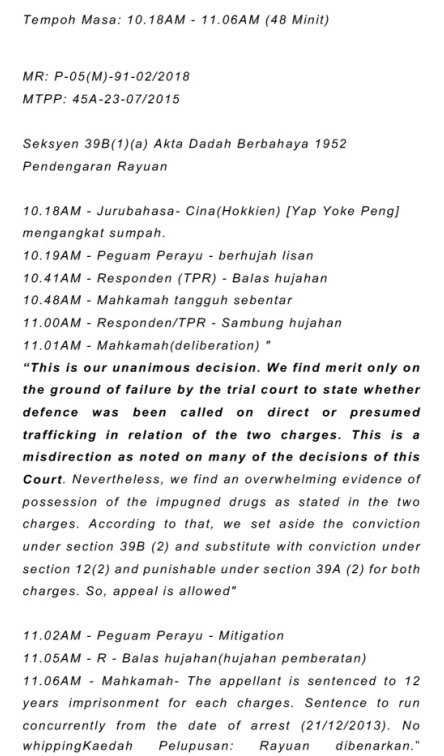
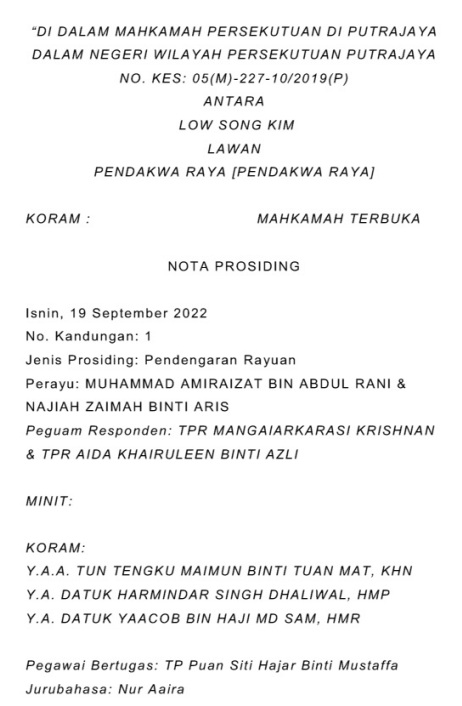
Of equal importance is again to highlight and stress, as noted by the COA in Bong Sing Seng's case (supra), that this court had affirmed the decision of Seyedalireza Seyedhedayatollah Ehteshamiardestani v. PP [2014] 5 MLRA 705, which too had made the same legal stand.
[63] It is also incumbent upon me to highlight the fact that the two COA cases cited in Bong Sing Seng's case (supra) are decisions which were consistent with it and with the one I am making here, Roman Zolotarov v. PP [2020] 7 MLRA 376 and Masih Perviaz (w/Pakistan) v. PP [2022] 3 MLRA 341. Masih's case went on appeal to the Federal Court, and from an online search in our Federal Court's database in respect of the said case, the appeal was fixed for hearing on 27 February 2023 and on the said date, learned counsel for the appellant informed the court that, as per his client's instruction, the appeal against conviction was withdrawn, though not that against sentence. However, for the latter case of Roman (supra), a similar search conducted failed to produce any result, so it's likely that no appeal was filed against that decision. I must, however, expressly make clear that this determination of mine in this case and in the said litany of cases cited above is not an authoritative proposition that a trial Judge must give his reasons for calling the defence in all criminal cases, and the reason for this non-requirement has been made clear in Junaidi's case (supra), which has been consistently followed by our courts. The excerpt from the said judgment is reproduced below:
"In our opinion, there is also no statutory provision requiring a judge sitting alone to expressly record his defence or to state his findings on the credibility of main prosecution witnesses. But, as a matter of practice, where there is a particular reason for doing so, such as where a submission of no case to answer has been made in a complex case, or where the Accused is called to enter a defence on a lesser or alternative charge, Judges do sometimes give their reasons. In uncomplicated cases, such as in the instant appeal, it is not obligatory or even necessary to do so. By calling an Accused to enter his defence, it should be assumed that the trial Judge must on evaluation of the evidence, have been satisfied that the prosecution has, at that stage of the trial, established a prima facie case, which if unrebutted would warrant a conviction of the Accused. To arrive at such a conclusion, it is inherent that the Judge must consider all the evidence adduced by the prosecution as tested in cross-examination, on a prima facie basis."
[Emphasis Added]
However, that aforesaid non-requirement, in my considered view, does not encompass a drug trafficking case or any other criminal cases where the criminal offence can be both an actual or a presumed one under the law, given the unassailable burden of proof lying on the accused person's shoulders to prove his innocence. Thus, at its very least there must be a pronouncement by the trial Judge at the close of the prosecution's case, whether the defence is called for actual or presumed trafficking.
[64] As for the respondent's citation of this court's decision in Abdullah Atan, the legal proposition made in the said case that s 180(4) of the Criminal Procedure Code does not "exclude the use of presumption, inferences or anything other than direct evidence to establish a prima facie case..." is of no legal significance to our case here because the issue is not that the presumption of trafficking cannot be raised, but simply whether when it is raised at the close of the prosecution's case, the respondent here or an accused person, generally, must be informed of its invocation given the higher evidential burden resting on his shoulders to rebut the same as I have just alluded to above.
[65] As for the COA's case of PP v. Ishak Hj Shaari & Other Appeals [2003] 1 MLRA 522 also cited by the learned DPP in his written submission, with respect, I fail to see how the ratio in the said case is of any assistance to the appellant because, in order to reverse the decision of the COA here, a failure to indicate to the respondent whether the prosecution's case against him was based on actual or presumed trafficking was not a mere irregularity but one which has occasioned a substantial injustice to him because of the strictly different evidential burden placed upon his shoulders when presenting his defence. That substantial injustice was at the very core of the decision in Ishak's case (supra) when considering whether a misdirection on the standard of proof was curable under s 422 of the Criminal Procedure Code, which provides as follows:
"Irregularities not to vitiate proceedings
422. Subject to the provisions contained in this Chapter no finding, sentence or order passed or made by a Court of competent jurisdiction shall be reversed or altered on account of:
(a) any error, omission or irregularity in the complaint, sanction, consent, summons, warrant, charge, judgment or other proceedings before or during trial, or in any inquiry or other proceedings under this Code;
(b) the want of any sanction; or
(c) the improper admission or rejection of any evidence, unless such error, omission, irregularity, want, or improper admission or rejection of evidence has occasioned a failure of justice."
[Emphasis Added]
Very obviously, my decision is that the omission here is not an irregularity which is curable under the aforesaid provision.
[66] Thus, based on the aforesaid reasons, my considered view is that the appellant's appeal is without merit and should be accordingly dismissed.