High Court Malaya, Kuala Lumpur
Collin Lawrence Sequerah J
[Case Nos: MTJ(1)WA-45-7-11-2018 & MTJ(1)WA-45-8-11-2018]
15 June 2026
Criminal Law: Corruption — Money laundering — Accused was former Prime Minister of Malaysia and Minister of Finance serving concurrently as Chairman of Board of Advisers of 1Malaysia Development Berhad — Charges of using position for gratification and engaging in money laundering arising from allegations that accused procured transactions diverting considerable sum of funds into personal accounts — Whether accused took actions in matters where he had vested interests triggering presumption of gratification under s 23 Malaysian Anti-Corruption Commission Act 2009 ("MACC Act") — Whether accused rebutted presumption of gratification on balance of probabilities — Whether accused entitled to statutory defence under s 23(4) MACC Act — Whether prosecution proved traceable link between predicate offence and funds forming subject matter of money laundering charges under s 4 Anti-Money Laundering and Anti-Terrorism Financing Act 2001 ("AMLATFA") — Whether accused possessed requisite mens rea or was wilfully blind regarding unlawful origin of funds — Whether accused precluded by issue estoppel from relying on Arab donation defence following findings in prior trial — Whether tape recordings and foreign documents obtained through mutual legal assistance were admissible under specific statutory provisions excluding operation of general provisions in Evidence Act 1950 — Whether sentences for 21 offences under s 4(1)(a) AMLATFA should run concurrently with each other and with sentences imposed under MACC Act — Whether MACC Act offences were separate and distinct from offences for which accused was already serving sentence such that sentences should commence only upon expiry of existing imprisonment
The accused, Mohd Najib Hj Abd Razak, was the former Prime Minister of Malaysia and concurrently held office as Minister of Finance from April 2009 until May 2018. By virtue of his office as Minister of Finance, he exercised control over Minister of Finance (Incorporated) ("MOF Inc"), the sole shareholder of 1 Malaysia Development Berhad ("1MDB"), and also served as Chairman of 1MDB's Board of Advisers under art 93(2)(a) of the company's memorandum and articles of association. 1MDB was a company wholly owned by MOF Inc, incorporated as a strategic development company to promote national economic growth, and fell within the definition of 'public body' under s 3(k) of the Malaysian Anti-Corruption Commission Act 2009 ("MACC Act"). Charges were first preferred against the accused at the Kuala Lumpur Sessions Court on 20 September 2018 and were transferred to the Kuala Lumpur High Court on 31 October 2018. An application by the then Attorney General to delay commencement of trial pending conclusion of a separate prosecution (PP v. Mohd Najib Hj Abd Razak, WA-45-2-7-2018, WA-45-3-7-2018 and WA-45-5-08-2018, commonly known as the SRC case) was rejected by the court. Trial commenced on 19 August 2019 but was suspended from 19 March 2020 by reason of the COVID-19 pandemic and the consequent Movement Control Order. After approximately six years in total, 50 prosecution witnesses and 26 defence witnesses were called. The accused faced four charges under s 23(1) of the MACC Act of using his office or position for gratification for himself ("the MACC Act charges"), and 21 charges under s 4(1)(a) of the Anti-Money Laundering and Anti-Terrorism Financing Act 2001 ("AMLATFA") of engaging in money laundering ("the AMLATFA charges"). The 21 money laundering charges comprised nine charges of receiving proceeds of unlawful activity, five charges of using proceeds of unlawful activity, and seven charges of transferring proceeds of unlawful activity. The charges arose from allegations that the accused used his position to influence and procure a series of decisions and transactions undertaken by 1MDB and its subsidiaries. The prosecution alleged that these transactions were carried out in four phases, namely the PetroSaudi joint venture and subsequent Murabaha financing arrangements; the acquisitions of two independent power producers, Tanjong Energy Holdings Sdn Bhd and Mastika Lagenda Sdn Bhd; the ADMIC joint venture between 1MDB and Aabar Investments PJS ("Aabar") for the development of the Tun Razak Exchange and the related USD3 billion bond issuance by 1MDB Global Investment Limited; and the buy-back of Aabar options financed through Deutsche Bank loans. It was alleged that funds arising from those transactions were diverted through a network of intermediary entities and bank accounts before a considerable sum was transferred into the accused's personal accounts as gratification, following which portions of the monies were received, transferred, utilised and moved between accounts in transactions forming the basis of the money-laundering charges. The prosecution contended that at the very heart of this nefarious scheme, lay a personality by the name of Low Taek Jho, more popularly known as Jho Low. The prosecution alleged that Jho Low was in fact the alter ego of the accused. The defence raised preliminary objections to the validity of the charges and the admissibility of certain documentary and testimonial evidence relied upon by the prosecution, including documents obtained through domestic investigations and mutual legal assistance processes, as well as evidence relating to communications involving Jho Low and other individuals. The court rejected those objections, held that the charges were valid and that the impugned evidence was admissible, and proceeded to determine the case on its merits. At the conclusion of the prosecution's case, the court found that a prima facie case had been established on all 25 charges and called upon the accused to enter his defence. The accused denied all allegations and contended that the monies credited into his bank accounts were donations from Saudi sources ("Arab donation defence"). The issues before the court were whether (i) the prosecution had established that the accused, as an officer of a public body, had taken decisions or actions in relation to matters in which he had a direct or indirect interest so as to trigger the presumption under s 23(2) of the MACC Act, and, if so, whether that presumption had been rebutted or whether the accused was entitled to the statutory defence under s 23(4) of the MACC Act; (ii) whether the prosecution had proved a traceable link between the alleged abuse of position offences and the funds forming the subject matter of the 21 money-laundering charges under s 4(1)(a) of the AMLATFA; (iii) whether the accused possessed the requisite knowledge or was wilfully blind as to the unlawful origin of those funds; (iv) whether the Arab donation defence was barred by issue estoppel arising from the earlier SRC proceedings; (v) whether tape recordings of conversations and foreign documents obtained through mutual legal assistance requests and overseas investigations, and testimonial evidence of communications involving Jho Low and other individual were admissible under s 41A of the MACC Act and s 71 of the AMLATFA; and (vi) whether the sentences imposed for the MACC Act and AMLATFA offences should run concurrently or consecutively, and whether a fine equivalent to the value of the laundered property should be imposed under s 55(2) of the AMLATFA.
Held (convicting the accused on all four charges under s 23(1) of the MACC Act and all 21 charges under s 4(1)(a) of the AMLATFA):
(1) The evidence, when viewed as a whole, amounted to cogent evidence that the accused had taken action in relation to matters in which he had vested interests, constituting sufficient basis for the raising of the rebuttable legal presumption under s 23(2) of the MACC Act. The accused had a direct, overwhelming interest in the approvals, and his contention of having no personal interest could not hold true, as the evidence of the money trail showed that substantial sums originating from the fundraising were ultimately traced to the personal account of the accused. On a totality of the evidence adduced, the accused had not rebutted the presumption of gratification under s 23(2) of the MACC Act on a balance of probabilities, and neither had the defence raised a reasonable doubt in the prosecution's case. (paras 904, 1895, 1901 & 1966-1967)
(2) The evidence presented by the prosecution through the money trail showed that there were considerable sums of monies generated from the transactions by 1MDB, which found its way into the personal bank accounts of the accused and that these sums were used by the accused on matters related to his own benefit. The evidence showed that the accused had vested private interest in 1MDB. The Government had to incur further costs and expenses to pay back the bonds and loans taken up by the company. Ultimately, there were no benefits that the actions of the accused had brought to the Government of Malaysia, and no interest or advantage had accrued to the Government. Under all the circumstances, therefore, there was no merit in the contention by the defence that the accused was entitled to the defence under s 23(4) MACC Act. (paras 907-911)
(3) The combined effect of the prosecution's Money Trail Report, the First In, First Out ("FIFO") methodology, and the evidence of the prosecution witnesses showed a traceable link between the predicate offence and the funds that formed the subject matter of all the 21 money laundering charges. The misappropriated funds originating from the 1MDB bond issuances were channelled through Tanore Finance Corporation's ("Tanore's") Falcon Bank account into the accused's AmIslamic bank account, which constituted the proof of the predicate offence under s 23(1) of the MACC Act. (paras 1981 & 1984-1985)
(4) The accused was wilfully blind with regard to his failure to inquire into the origin of the funds when the circumstances were such that he ought to have done so. Given the enormous scale of the transactions and the less-than-credible evidence to substantiate the Arab donation defence, the accused had every reason to believe the inflow of such large funds warranted inquiry. By deliberately shutting his eyes to the obvious, the accused had every reason to believe that the property was proceeds from an unlawful activity, and the prosecution had therefore proven the mens rea in respect of all the AMLATFA charges. (paras 1021-1022 & 2089-2091)
(5) The affirmative finding made by the High Court and subsequently affirmed by the Federal Court in the prior SRC trial, that the Arab donation defence was incapable of belief, constituted an issue estoppel against the accused. The accused was estopped from bringing it up again or relitigating the same defence which had been found in a previous trial between him and the Public Prosecutor to be a concoction that was completely bereft of any credibility. The principle of estoppel applied to bar the defence from raising and relying upon this defence. (paras 1576-1578)
(6) The tape recordings and foreign documents, as well as the testimonial evidence concerning communications involving Jho Low, Datuk Azlin Alias, Terence Geh and Nik Faisal Ariff Kamil, were admissible under s 41A of the MACC Act 2009 and s 71 of the AMLATFA, as the common law definition of a "document" was wide enough to encompass tape recordings. Following the maxim generalibus specialia derogant, the specific provision under s 41A of the MACC Act excluded the operation of the general provisions governing the admission of documentary evidence in the Evidence Act 1950, and the method of obtaining these documents, even if done by improper means, would not affect the admissibility of evidence relevant to facts in issue. (paras 315, 321, 328, 340-341 & 336-337)
(7) While the offences under the MACC Act charges satisfied the one transaction rule and each therefore could run concurrently with the others, they were nevertheless distinct offences and wholly separate from the offences for which the accused was presently serving sentence for and did not derive from or form part of the same single transaction. For each of the four charges, the accused was sentenced to 15 years imprisonment and a fine of no less than five times the sum of the gratification, in default of payment of each fine, 10 years imprisonment. All the sentences of imprisonment in all the four charges under the MACC Act were to run concurrently with each other, but should only commence at the expiration of the imprisonment to which he had been previously sentenced. In respect of each of the 21 charges under the AMLATFA, a prison sentence of the maximum number of five years was imposed to run concurrently with each other and concurrently with the terms of imprisonment imposed in the four charges under the MACC Act, but should only commence at the expiration of the imprisonment to which he had been previously sentenced. Furthermore, pursuant to s 55(2) of the AMLATFA, a fine of RM2,081,476,926.00 was imposed, which was equivalent to the value of the property, received from proceeds of unlawful activity (Charges 1 to 9 under the AMLATFA), with a default imprisonment term of two years and six months in respect of the relevant charges. (paras 2226-2228, 2230-2231 & 2238)
Case(s) referred to:
Adel Muhammed El Dabbah v. Attorney-General Of Palestine [1944] 2 All ER 139 (refd)
Ahmad Zubair v. PP [2014] 3 MLRA 617 (refd)
Ariff Arhannan Che Udin v. PP & Another Appeal [2022] 4 MLRA 172 (refd)
Arulpragasan Sandaraju v. PP [1996] 1 MLRA 588 (refd)
Asia Commercial Finance (M) Berhad v. Kawal Teliti Sdn Bhd [1995] 1 MLRA 611 (refd)
Aswini Kumar v. Arabinda Bose AIR [1952] SC 369 (refd)
AWG Group Ltd & Anor v. Morrison & Anor [2006] 1 All ER 967 (distd)
Azmi Osman v. PP & Another Appeal [2015] MLRAU 459 (folld)
Bachik Abdul Rahman v. PP [2004] 1 MLRA 323 (folld)
Balachandran v. PP [2004] 2 MLRA 547 (folld)
Balasingham v. PP [1959] 1 MLRH 585 (folld)
Chandrasekaran & Ors v. PP [1970] 1 MLRH 37 (folld)
Chu Boon Yeh & Anor v. Kerajaan Malaysia [2015] 4 MLRH 612 (refd)
Dal Chand v. State of Uttar Pradesh [2000] Cri LJ 4579 (refd)
Dato' Sri Mohd Najib Abd Razak V. PP & Other Appeals (No 2) [2022] 6 MLRA 173 (refd)
Dato' Sri Mohd Najib Abd Razak v. PP [2020] 6 MLRH 156 (refd)
Dato' Sri Mohd Najib Hj Abd Razak v. PP & Another Appeal [2023] 2 MLRA 220 (refd)
Dato' Sri Mohd Najib Hj Abd Razak v. PP [2019] 4 MLRA 263 (refd)
Dato' Sri Mohd Najib Abd Razak v. PP & Other Appeals (No 3) [2022] 6 MLRA 179 (folld)
Devi Singh v. Phulma AIR [1961] HP 10 (refd)
Duis Akim & Ors v. PP [2014] 1 MLRA 92 (refd)
Francis Phillip Nunis v. Public Prosecutor [1982] 1 MLRA 281 (refd)
Glomac Resources Sdn Bhd v. Majlis Agama Islam Wilayah Persekutuan & Anor [2016] 4 MLRH 642 (folld)
Goldsmith v. Sandilands And Others [2002] HCA 31 (folld)
Government Of Malaysia v. Low Taek Jho [2022] MLRHU 2174 (refd)
Grant v. Southwestern Properties [1975] 1 Ch 185 (refd)
Haji Abdul Ghani Ishak & Anor v. PP [1981] 1 MLRA 649 (folld)
Harun Abdullah v. PP [1998] 1 MLRA 251 (refd)
Ho Tack Sien & Ors v. Rotta Research Laboratorium Spa & Anor And Another Appeal; Registrar Of Trade Marks (Intervener) [2015] 3 MLRA 611 (folld)
Hock Hua Bank (Sabah) Berhad v. Yong Liuk Thin & Ors [1995] 1 MLRA 311 (folld)
Husdi v. PP [1979] 1 MLRH 208 (folld)
Husdi v. PP [1980] 1 MLRA 423 (folld)
Johnson Tan Han Seng v. PP & Other Appeals [1977] 1 MLRA 290 (refd)
Kamal Hisham Ja'afar v. PP [2016] MLRHU 1680 (folld)
Kuruma v. The Queen [1955] AC 197 (folld)
Lee Chow Meng v. Public Prosecutor [1978] 1 MLRA 607 (refd)
Lew Cheok Hin v. Regina [1956] 1 MLRH 227 (folld)
Lim Yoon Fah v. PP [1970] 1 MLRH 544 (refd)
Long Samat & Ors v. PP [1974] 1 MLRA 412 (refd)
Majlis Perbandaran Pulau Pinang v. Syarikat Bekerjasama Serbaguna Sungai Gelugor Dengan Tanggungan [1999] 1 MLRA 336 (folld)
Mansor Meyon v. PP [2006] 4 MLRH 148 (refd)
Mat v. PP [1963] 1 MLRH 400 (folld)
Mawaz Khan v. Reg [1967] 1 All ER 80 (folld)
Md Zainudin Raujan v. PP [2013] 3 MLRA 351 (refd)
Michael Chow Keat Thye v. Suruhanjaya Sekuriti Malaysia & Anor [2012] MLRHU 1678 (folld)
Mohamed Ezam Mohd Nor & Ors v. Ketua Polis Negara [2001] 1 MLRA 630 (folld)
Mohamad Radhi Yaakob v. PP [1991] 1 MLRA 158 (refd)
Msimanga Lesaly v. PP [2004] 2 MLRA 429 (refd)
Munusamy Vengadasalam v. PP [1986] 1 MLRA 292 (folld)
New Tuck Shen v. PP [1981] 1 MLRH 227 (refd)
PP v. Abdul Wahab Abd Jabar & Anor [2002] 2 MLRH 79 (refd)
PP v. Billion Nova Sdn Bhd & Ors [2016] 4 MLRA 226 (refd)
PP v. Dato' Sri Mohd Najib Abd Razak [2019] 6 MLRH 138 (refd)
PP v. Dato' Sri Mohd Najib Hj Abd Razak [2020] 5 MLRH 232 (refd)
PP v. Dato' Waad Mansor [2005] 1 MLRA 1 (folld)
PP v. Datuk Haji Harun Bin Haji Idris (No 2) [1976] 1 MLRH 562 (refd)
PP v. Datuk Haji Harun Haji Idris [1976] 1 MLRH 559 (folld)
PP v. Ee Boon Keat [2006] 2 MLRH 194 (folld)
PP v. Heng You Nang [1949] 1 MLRH 489 (refd)
PP v. Ho Sek Kong [2005] 4 MLRH 59 (refd)
PP v. Lin Lian Chen [1992] 1 MLRA 297 (refd)
PP v. Loo Choon Fatt [1976] 1 MLRH 23 (refd)
PP v. Mahanthiran Durasamy [2007] 5 MLRH 1 (refd)
PP v. Mohd Radzi Abu Bakar [2005] 2 MLRA 590 (refd)
PP v. Morah Chekwube Chukwudi [2017] MLRAU 276 (refd)
PP v. Ooi Wang San [1998] 1 MLRA 273 (refd)
PP v. Raymond Chia Kim Chwee & Another Case [1982] 1 MLRH 395 (folld)
PP v. Saimin & Ors [1971] 1 MLRH 91 (refd)
PP v. Teh Ah Cheng [1976] 1 MLRH 76 (refd)
Prasit Punyang v. PP [2014] 1 MLRA 387 (refd)
Public Prosecutor v. Chot Saik Kam [1990] 4 MLRH 647 (refd)
Public Prosecutor v. Tan Kim Kang & Ors [1962] 1 MLRH 99 (folld)
Public Prosecutor v. Yuvaraj [1968] 1 MLRA 606 (refd)
R (Quintavalle) v. Secretary of State for Health [2003] 2 AC 687 (refd)
R v. Carr-Briant [1943] 1 KB 607 (refd)
R v. George Thomas Johnson [1945] 2 All ER 105 (refd)
R v. Gough [1993] AC 646 (folld)
R v. Kenneth John Ball [1951] (35) App R164 (folld)
R v. Sargeant [1974] 60 Cr App R 74 (folld)
Ravindran Ramasamy v. PP [2015] 3 MLRA 112 (refd)
Robert Corradino v. Barbara Corradino Court of Appeals of the State of New York 48 N.Y 2d 894 [1979] (refd)
Saw Kim Hai & Anor v. Regina [1955] 1 MLRH 404 (folld)
Subramaniam v. PP [1956] 1 MLRA 59 (refd)
Sugden v. Lord St Leonards & Others [1875] 1PD 154 (refd)
Sukma Darmawan Sasmitaat Madja v. PP [2006] 2 MLRA 752 (refd)
Tan Mooi & Ors v. Tengku Mohd Saad & Ors And Other Appeals [2011] 1 MLRA 1 (folld)
Tang Ka Wak v. PP [2017] MLRHU 1482 (refd)
Tay Choo Foo v. Tengku Mohd Saad Tengku Mansur & Ors And Another Appeal [2008] 3 MLRA 188 (folld)
Wong Swee Chin v. PP [1980] 1 MLRA 125 (refd)
Zulkiflee Mohd Dom v. Public Prosecutor [1996] 2 MLRH 1 (folld)
Legislation referred to:
Anti-Money Laundering, Anti-Terrorism Financing And Proceeds Of Unlawful Activities Act 2001, ss 3(aa), 4(1)(a), 21, 32, 55(2), 71, Second Schedule
Capital Markets and Services Act 2007, ss 179(c), 370(c)
Companies Act 1965, ss 132C,147(1), (6)
Criminal Procedure Code, ss 51, 51A,152, 153, 154, 155, 156, 157, 158, 159, 160, 161, 162, 163, 180, 182A(1), 282(d), 292(1), 376(1), (3), 400, 417(1)(e), 422, 425
Evidence Act 1950, ss 3, 8, 32(1)(b), 56, 57(1)(h), 60(3), 90F, 114(g), 126, 132, 159, Chapter V
Federal Constitution, arts 5(1), 8(1), 43(2)(a), 121, 145(3), 160(1)
Firearms (Increased Penalties) Act, ss 3, 3A
Interpretation Acts 1948 and 1967, ss 17A, 66, Part II
Loans Guarantee (Bodies Corporate) Act 1965, s 6
Malaysian Anti-Corruption Commission Act 2009, ss 3, 16, 23(1), (2)(b), (4), 24(1), (4), 30(8), 41A, 52, 53(3)
Mutual Assistance in Criminal Matters Act 2002, s 8(3), (4)
Penal Code, s 409
Counsel:
For the prosecution: Gopal Sri Ram (Kamal Baharin Omar, Ahmad Akram Gharib, Mohamad Mustaffa P Kunyalam, Deepa Nair Thevaharan, Nadia Mohd Izhar, Najwa Bistamam, Hazmida Harris Lee & Siti Aina Rodhiah Shikh Md Saud with him); DPPs, AG’s Chambers
For the accused: Muhammad Shafee Md Abdullah (Tania Scivetti, Muhammad Farhan Muhammad Shafee, Wan Azwan Aiman Wan Fakhruddin, Hartrisha Kaur Sandhu, Effa Azuin Aidrul Hisham, Wan Mohammad Arfan Wan Othman, Naresh Mayachandran, Muhammad Alif Lamra Mansor, Lim Zun Kang & Sarah Maalini Abishegam with him)
JUDGMENT
Collin Lawrence Sequerah J:
A) Introduction
[1] The accused is a former Prime Minister of Malaysia and also held the post of Minister of Finance. He held both positions concurrently.
[2] The accused was charged with 4 (four) offences under s 23(1) of the Malaysian Anti-Corruption Commission Act 2009 (MACC Act) and 21 offences under s 4(1)(a) Anti-Money Laundering and Anti-Terrorism Financing Act 2001 (AMLATFA) (Act 613).
[3] This trial has a chequered history. The charges were first preferred against the accused on 20 September 2018 at the Kuala Lumpur Sessions Court, after which the case was transferred to the Kuala Lumpur High Court on 31 October 2018. The trial however, did not proceed then due to several factors, one of which was the prosecution of the accused in criminal trials nos. WA-45-2-7/2018, WA-45-3-7/2018 and WA-45-4-8/2018 (PP v. Dato' Sri Mohd Najib Hj Abd Razak [2020] 5 MLRH 232) at the Kuala Lumpur High Court (more commonly known as the SRC case). An application was also made by the then Attorney General to delay the commencement of the trial until the conclusion of the SRC case. This application was rejected by the court. Grounds of decision were written in respect of the application and this is reported in PP v. Dato' Sri Mohd Najib Abd Razak [2019] 6 MLRH 138.
[4] After what seemed like an eternity, the trial finally commenced on 19 August 2019. After the trial progressed for a while, and hope appeared to spring eternal, the nation and indeed the whole globe were plunged into the abyss of the COVID-19 pandemic and the resulting Movement Control Order (MCO) in this country, which resulted in the court having to place the trial on hold from 19 March 2020. As a result of the lockdown, a total of 19 days of trial were lost, while another 9 dates of trial were lost due to someone or other involved in the proceedings testing positive for COVID-19 or someone coming into close contact with a person or persons testing positive for COVID-19.
[5] The trial finally resumed and one would have thought that the worst, as far as the progress of the trial was concerned, was over. What followed, however, made what was past, pale in comparison. A total of 50 prosecution witnesses and 26 witnesses for the defence were called. The trial took a total of approximately 6 years to conclude. It has, in all probability, surpassed the length of any other trial in the annals of Malaysian court history, an unenviable record.
[6] The financial scandal that led to the charges being preferred against the accused was described in the press, locally and worldwide, as the largest episode of kleptocracy in the world. The scale of the plunder that took place (financially speaking, of course) made Attila the Hun look like a choirboy by comparison.
[7] At the conclusion of this trial, the court found the accused guilty of all the charges and convicted him accordingly. These are the grounds of judgment of the court in respect of the charges preferred against the accused.
B) Pertinent Facts
[8] The pertinent facts, in summary, that gave rise to the charges being instituted against the accused were alleged to have originated from the funds of a company known as 1Malaysia Development Berhad, commonly known as 1MDB. The company started life as Terengganu Investment Authority or TIA. It was alleged that the accused had caused steps to be taken to change its name to 1 Malaysia Development Berhad ("1MDB").
[9] It was also alleged that he had caused amendments to be made to the articles of association of the company to place himself in sole control of vital and major financial matters and decisions.
[10] The accused at the material time was both the Prime Minister (PM) and the Minister of Finance (MOF) and it was asserted by the prosecution that he had brought to bear his influence in that regard over the Board of Directors of 1MDB to cause them with haste to make certain decisions with the ultimate objective of obtaining gratification for himself.
[11] The prosecution contended that the accused carried out this objective in four (4) phases, which corresponded to the 4 charges under the MACC Act and that at the very heart of this nefarious scheme lay a personality by the name of Low Taek Jho, more popularly known as Jho Low.
[12] The prosecution goes much further and claims that Jho Low was in fact the alter ego of the accused and his mirror image.
[13] The prosecution further alleged that the accused took advantage of his position as both PM and MOF as well as the sole shareholder of 1MDB to execute several steps that led to part of 1MDB's funds being channelled into his account through a circuitous route to prevent detection of its source. The accused was thereby alleged to have used his position for gratification. In each of these phases, the accused was asserted to have acted as one with Jho Low.
The Charges Under Section 23(1) Of The Malaysian Anti-Corruption Commission Act 2009
[14] The 1st Phase which corresponded to the 1st Charge related to a so-called joint venture created by the accused (acting through Jho Low and one Tarek Obaid, a close associate of Jho Low) between 1MDB and a company called PetroSaudi International Ltd or PSI.
[15] This 1st Phase, it was alleged, involved 1MDB borrowing USD1 billion purportedly to invest in a joint venture company called 1MDB PetroSaudi Ltd. PetroSaudi International was to take up 60% of the shares in the alleged joint venture by injecting certain assets which was described as being of dubious value. The USD1 billion was meant to represent 1MDB's contribution for a 40% shareholding. However, the so-called Joint Venture Agreement was entered into not with PSI but with a company called PetroSaudi Holdings (Cayman) Ltd.
[16] However, claims the prosecution, USD700 million out of the USD1 billion, instead of being paid into the joint venture company's account was diverted into the account of a company called Good Star Ltd (which was controlled by Jho Low) which was an entity which had nothing to do with the joint venture.
[17] In March 2010, 1MDB entered into a so-called Murabaha financing agreement under the terms of which an alleged USD1 billion equity in the joint venture company was converted into worthless Murabaha notes and 1MDB was required to make available to the joint venture company a sum of USD1.5 billion. In September 2010, a sum of USD500 million was sent to the Joint Venture Company.
[18] In May 2011, a further sum of USD330 million which was supposed to be the second tranche of the investment into the Murabaha financing, was diverted to Good Star. The prosecution contended that the accused took positive steps to put through this transaction through which he received monies into his account in tranches.
[19] According to the prosecution, the 2nd Phase which formed the subject matter of the 2nd Charge concerned the acquisition of assets of dubious value by 1MDB in which the accused, acting through Jho Low, took positive steps and caused 1MDB to enter into two transactions as a result of which the accused obtained a sum of RM90,899,927.28 as gratification.
[20] These two transactions concerned the acquisition of two independent power producers namely, Tanjong Energy Holdings Sdn Bhd and Mastika Lagenda Sdn Bhd. Mastika owned 75% shares in Genting Sanyen Sdn Bhd. To make the purchase, 1MDB acted through its subsidiaries 1MDB Energy Holdings Ltd, 1MDB Energy Ltd and 1MDB Energy (Langat) Ltd (all Labuan companies) as well as through Malaysian registered companies, namely, 1MDB Energy Sdn Bhd and 1MDB Energy (Langat). These companies were used to raise finance for both acquisitions.
[21] Through an elaborate series of transactions, which involved certain funds going to Aabar Investments PJS Ltd (BVI), purportedly as a security deposit for Aabar's holding company IPIC issuing a guarantee for structured loan notes, and then to certain investment fund entities and finally through a company known as Blackstone, the prosecution alleged that monies were ultimately transferred to the accused's account.
[22] The 3rd Phase which corresponded to the 3rd Charge concerned another purported joint venture between 1MDB and Aabar in equal shares. The joint venture company was called ADMIC.
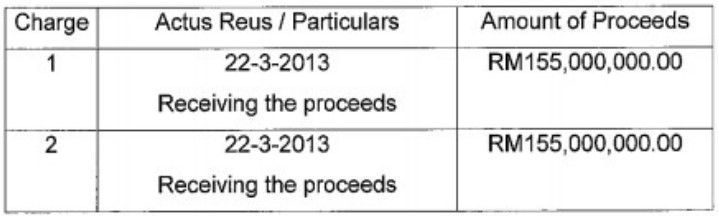
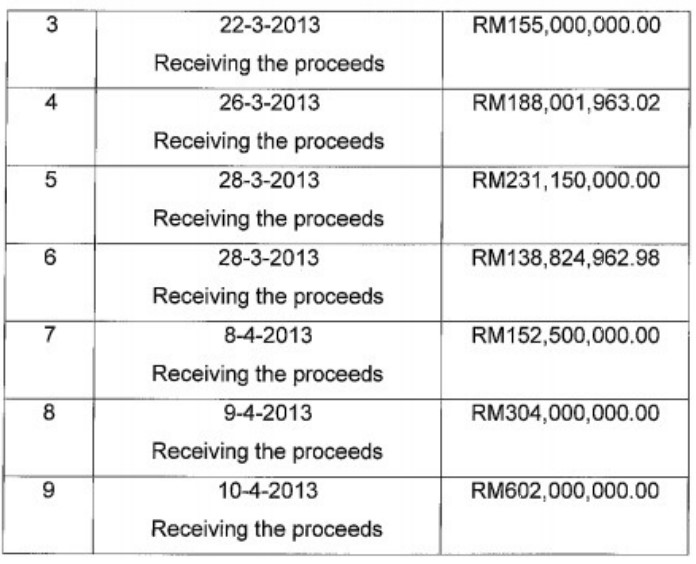
[23] The purpose of this alleged joint venture was to develop TRX or the Tun Razak Exchange in Kuala Lumpur where IPIC was to guarantee Aabar's investment. The prosecution contended that the Ministry of Finance of which the accused was Minister guaranteed 1MDB's investment by way of a letter of support. A loan of USD3 billion was raised for this alleged purpose.
[24] On 14 March 2013, the accused signed a letter of support to raise a loan through the issue of bonds by 1MDB from the Bank of New York Mellon Group in the sum of USD3 billion. On 19 March 2013 a sum of USD2.721 billion was disbursed into the account of 1MDB Global Investment Limited with BSI Bank at Lugano in Switzerland.
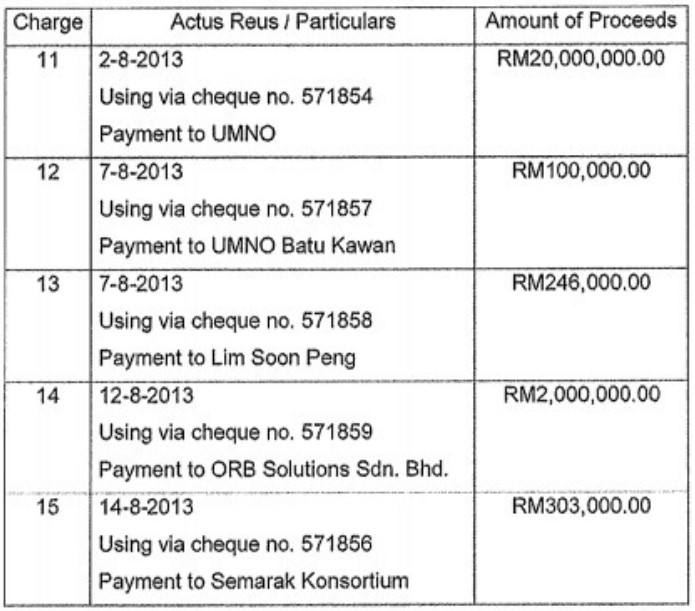
[25] Out of the sum of USD2.721 billion, a sum of USD1,060,606,065.00 was paid into the accounts of two fiduciary fund entities, namely, Devonshire Funds Ltd and EEMF.
[26] Devonshire transferred certain funds to Granton Property Holding Ltd which is a company controlled by Eric Tan, who was said to be Jho Low's shadow. Granton then transferred the whole of that sum to Tanore Finance while Devonshire also transferred certain sums of monies to Tanore Finance Corporation.
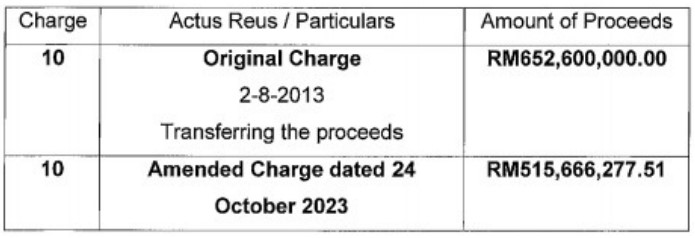
[27] EEMF also transferred sums to Tanore which in turn transferred monies to the accused's account.
[28] The 4th Phase corresponding to the 4th Charge concerned the purchase of the Aabar options by 1MDB. These options were given to Aabar in 2012 as alleged part consideration for IPIC's guarantee for the notes that raised USD3.5 billion which formed part of the 2nd Phase.
[29] In May and August 2014, 1MDB through its subsidiary 1MDB Energy Holdings Ltd obtained two loans from Deutsche Bank Singapore in which it was alleged that the accused approved. The loans were secured by guarantees provided by 1MDB Energy and 1MDB Langat.
[30] There was a bridging loan and a facility loan. From the first loan of USD250 million a sum of USD239,939,970.00 was paid into 1MDB Energy Holdings Ltd's account with Falcon Bank Hong Kong on 28 May 2014. Out of this sum, 1MDB Energy Holdings paid Aabar Investments PJS Ltd BVI USD175 million to its account in BSI Lugano, Switzerland allegedly to part-redeem the option given as additional security mentioned earlier in respect of the 2nd Phase.
[31] Out of the sum of USD175 million a sum of USD19 million was paid by Aabar to the account of a company called Affinity Equity International Partners Ltd held at DBS Bank Ltd, Singapore. Of the USD19 million, a sum of USD1.89 million was transferred to a company called Blackrock Commodities (Global) Ltd at its account held in DBS, a company controlled by Eric Tan. On 23 June 2014, a sum of GBP750,000.00 equivalent to RM4,093,500.00 was allegedly transferred to the accused's account.
[32] The second loan of USD975 million was made available on 1 September 2014, out of which USD250 million was utilised to discharge the bridging loan which left USD725 million.
[33] On 3 September 2014, a sum of USD223,333,000.00 was transferred to Aabar Investments PJS Ltd (incorporated in Seychelles) at its account with UBS Singapore.
[34] On 30 September 2014, USD457,984,607.00 was paid to Aabar Investments PJS Ltd (incorporated in Seychelles) at its account with UBS Singapore. Between 16 October 2014 and 17 November 2014 Aabar transferred a sum of USD226 million to Aabar International Investment PJS Ltd to its account in Barbados.
[35] Between 16 October 2014 and 17 November 2014, Aabar Barbados transferred USD225,500,000.00 to Vista Equity International Partners Ltd (Barbados), a company owned and controlled by Eric Tan.
[36] Between 23 October 2014 and 19 December 2014, Vista Equity through five tranches in sterling currency allegedly transferred a sum equivalent to RM45,837,485.70 to the accused's account. This sum together with the RM4,093,500.00 earlier mentioned formed the subject matter of the 4th Charge.
The Charges Under Section 4(1)(a) Of The Anti-Money Laundering And Anti-Terrorism Financing Act 2001 ("AMLATFA")
[37] The accused was also charged for twenty-one charges for money laundering offences under the AMLATFA.
[38] The first nine charges relate to the receiving of RM2,081,476,926.00 which formed the subject matter of the amended 3rd Charge under the MACC Act. These monies were transferred into the accused's account ending 9694 with AmIslamic Bank.
[39] Between 2 August 2013 and 23 August 2013, the accused transferred a sum of RM2,034,350,000.00 to Tanore Singapore. Simultaneously, the accused used the balance of RM22,649,000.00 to pay four entities and one individual. The prosecution's case is that all these payments benefited the accused.
[40] After making these payments, the accused transferred the balance into a new account ending 1880 with AmBank through two transfers amounting to RM161,411,646.34 and closed his account ending 9694.
[41] The 10th Charge and charges sixteen to nineteen relate to the transfers made by the accused to Tanore involving RM2,034,350,000.00.
[42] Charges eleven to fifteen relate to the use by the accused of the funds earlier referred to through payments to the four entities and one individual. All these payments were made by cheques signed by the accused.
[43] Charges twenty and twenty-one concern the transfer of funds from the 9694 account to the 1880 account.
[44] All the assertions by the prosecution, in so far as they implicated the accused, were denied by him.
C) Parties Submissions
[45] The summary of the prosecution case against the accused and the key contentions of the defence are set out hereunder.
[46] In order to avoid unnecessary repetition, the prosecution's submission here also serves as the unfolding of the prosecution's narrative in their case against the accused together with the relevant evidence adduced by the prosecution witnesses, in other words, they comprise the prosecution's case against the accused.
Prosecution
[47] The prosecution submitted that the evidence showed that the accused was instrumental in changing the name of Terengganu Investment Authority's ("TIA") name to 1 Malaysia Development Berhad ("1MDB"). The evidence showed that the accused had caused amendments to be made to the articles of the company to place himself in sole control of important matters concerning the business and affairs of the company.
[48] The prosecution contended that the accused was shown to have been the plenipotentiary of 1MDB. Being the Chairman of the company's Board of Advisers, the prosecution submitted that he used that position and that of the office of Prime Minister and Minister of Finance to do certain acts and to exert influence over the board of 1MDB to carry out certain abnormal transactions with undue haste with the ultimate aim of obtaining gratification for himself and it was contended that the evidence showed that he succeeded in achieving that aim.
[49] An elaborate charade was employed for that purpose, it was asserted. The prosecution contended that the charade was acted out in four phases in which several characters played a part but it was contended that it was the accused who played the pivotal role and that his ultimate objective was to enrich himself.
[50] It was submitted that Jho Low was involved in TIA and later in 1MDB and that the accused, by his words and conduct made it clear to 1MDB's officers, its Board and others that Jho Low was his alter ego. The prosecution submitted that Jho Low was the accused's mirror image. The prosecution submitted that the evidence gave rise to an irresistible inference that Jho Low and the accused acted as one at all material times.
[51] It was submitted that although this case concerned four phases, the events in respect of them were to be considered as part of a consecutive series of events culminating in the pre-arranged plan by the accused to enrich himself.
[52] The four charges under s 23 of the MACC Act correspond with each of the four phases. In respect of these charges, the prosecution submitted that direct and circumstantial evidence showed that the accused, first in his capacity as the Deputy Prime Minister and Minister of Finance, and later as Prime Minister of Malaysia and Minister of Finance took several steps that led to part of 1MDB's funds being channelled into his account through a circuitous route to prevent detection of its source. The accused thereby used his position for gratification. In each of the phases, the accused acted as one with Jho Low.
[53] The prosecution submitted that in order to prove the charges under s 23(1) MACC Act, it must be proven firstly, that the accused was an officer of a public body at the material time and secondly, that he used his position in the manner described in each of the charges for the gratification specified in the respective charges for himself.
[54] It was submitted that in respect of the first ingredient which is common in all four charges, the evidence of PWs 1, 2 and 3 was sufficient to prove that the accused was an officer of a public body at the material time. The defence in any event has not seriously challenged this fact and it was therefore submitted that the first element has been proved beyond a reasonable doubt.
[55] In respect of the second ingredient, which is also common to all 4 charges, it must be proven that firstly, the accused did make any decision or take any action and secondly, that the decision made or action taken was in relation to any matter in which the accused had an interest, whether direct or indirect.
[56] This is also necessary in order to invoke the rebuttable presumption under s 23(2).
1st Phase
[57] In respect of this 1st Phase, there were four actions said to have been taken by the accused which triggered the said presumption.
[58] It was submitted that evidence was adduced by PW11 (Tan Sri Mazidah), Deputy Head Secretary (Cabinet) in the Prime Minister's Department to show that the accused took the 1st Action when on 1 April 2009, he:
i. attended the Cabinet Meeting;
ii. presented Memorandum of the Ministry of Finance No 216/2639/2009 (exh P242A);
iii. obtained the consent of the Cabinet for the provision of a guarantee by the Government of Malaysia to Terengganu Investment Authority Berhad (TIA) to enable TIA to obtain domestic and foreign market loans of up to RM5,000,000,000.00 by way of Islamic Medium-Term Notes Programme.
[59] In respect of 2nd Action in the 1st Charge, PW11 gave evidence that the accused had on 29 July 2009:
i. attended and chaired the Cabinet Meeting;
ii. presented Nota Jemaah Menteri No H553/2009 entitled "Nota daripada Menteri Kewangan: Penubuhan Malaysia Investment Berhad" (exh P857) signed by the accused in his capacity as the Minister of Finance and
iii. approved the acquisition of TIA by the Government of Malaysia and further caused TIA's name to be changed to 1 Malaysia Development Berhad (1MDB).
[60] In respect of the 3rd Action, PW15 testified as to the impact of the phone call he had with the accused on his mind in relation to the JV with PetroSaudi. From the evidence, the prosecution has proven that the accused, on 26 September 2009:
i. had a tele-conversation with PW15 who was about to chair the 1MDB Board of Directors ("BOD") meeting; and
ii. directed the BOD of 1MDB which was having a special meeting at The Royale Bintang Damansara to pass a resolution authorising 1MDB to participate in a joint venture with PetroSaudi International Limited.
[61] In order to show that the accused took the 4th Action in the 1st Charge, the evidence of PW9 (Datuk Shahrol Azral), PW13 (Tan Sri Ismee) and PW50 (Jasmine Loo) were relied upon, which clearly proved that the accused had on 16 May 2011:
i. signed the Minutes by Representatives of Holding Company — Investment of An Additional RM1,000,000,000.00 under the Murabaha Financing Agreement with 1MDB PetroSaudi Limited (exh P418) and Special Rights Redeemable Preference Shareholder Resolution in Writing — Investment of An Additional RM1,000,000,000.00 under Murabaha Financing Agreement with 1MDB PetroSaudi Limited (exh P419); and thereby
ii. caused the Board of Directors of 1MDB to pass a Circular Resolution (exh P417) authorising an investment of an additional RM1,000,000,000.00 (or equivalent in USD) under the Murabaha Financing Agreement dated 31 March 2010 with 1MDB PetroSaudi Limited.
[62] In respect of whether the decision was made or action taken in relation to any matter in which the accused had an interest in, the prosecution submitted that the accused was very much interested from the inception of TIA Berhad and was instrumental in having TIA being taken over by the Federal Government and subsequently changing its name to 1MDB.
[63] The prosecution also contended that the accused played a major role in getting the Cabinet to consent to the provision of a guarantee by the Government of Malaysia to enable TIA to obtain the RM5,000,000,000.00 IMTN loan.
[64] In August 2009, the accused received two letters, the purpose of which was to realise a prior discussion between the accused and King Abdullah of Saudi Arabia for a Joint Venture (JV) between Malaysia and the Kingdom of Saudi Arabia.
[65] On 18 September 2009, a BOD meeting chaired by PW15 was held which discussed the investment proposal in 1MDB-PetroSaudi Limited Joint Venture (JVCo). However, the BOD was not satisfied with the presentation and directed the management team to conduct certain further actions and to update the BOD at the next meeting on 26 September 2009.
[66] Before the commencement of the meeting on 26 September 2009, Jho Low passed his mobile phone to PW15, who confirmed that it was the accused who was on the other line. After the said call, PW15 informed the BOD that the accused had instructed the BOD to expedite the matter as the JV will be executed soon during King Abdullah's visit to Malaysia. The BOD eventually approved the said JV at the conclusion of the meeting.
[67] The prosecution submitted, however, that the Joint Venture Agreement was entered with a company called PetroSaudi Holdings (Cayman) Ltd not with PSI. The BOD instructed 1MDB to subscribe for 1,000,000,000 ordinary shares in the JVCo with a total consideration of USD1 billion, and the money to be paid into the account of the JVCo.
[68] It was submitted that out of the USD1 Billion to be paid into the JVCo's account, USD700 million was diverted into the account of a company owned by Jho Low called Good Star Ltd, which was described as the wholly owned subsidiary of PSI. The JV Agreement referred to this payment as a loan payable by the JVCo to PetroSaudi Holdings (Cayman).
[69] It was the prosecution's contention that the investment in the JVCo would not be executed without the approval and instruction of the accused to PW15 and the BOD to expedite the matter and firm up to approve the JV with PetroSaudi.
[70] The prosecution also submitted that 1MDB then entered into a so-called Murabaha Financing Agreement under the terms of which the alleged USD1 billion equity in the JVCo was converted into Murabaha notes. 1MDB then proposed to sell their 1.2 billion shares in JVCo and this was approved by the accused by signing exhs P389 and P390. Through this Murabaha Agreement, 1MDB was required to make available to the JVCo a sum of USD1.5 billion.
[71] On 18 February 2011, Tarek Obaid wrote a letter to the accused, supported by a cover letter from Prince Turki, requesting a further loan of 750 million from 1MDB. One of the letters was later sent to Tan Sri Lodin, who by then was the Chairman of 1MDB, with a notation from the accused at the bottom of the page stating "Saya tiada halangan dengan cadangan ini, sila ambil tindakan".
[72] After negotiations and further meetings, PSI agreed to reduce the drawdown amount to USD330 million. This request by PSI for further drawdown of USD330 million was approved by the accused by signing the SRRP and Minutes by Representatives.
[73] The Murabaha Investment was later replaced to equity holding with PSI. The Murabaha termination took place on 20 June 2012.
[74] The termination of Murabaha Financing was approved by the accused by signing exhs P439 and P440.
[75] The total investment of USD2.3 Billion were converted to an equity holding that gave 1MDB 49% issued share capital in PetroSaudi Oil Services Limited (PSOSL) and this was approved by the accused by signing exhs P544 and P545.
[76] In August 2012, 100% of the equity interest of 1MDB in PSOSL were sold to Bridge Partners International Investment Limited and the accused consented that the proceeds of the proposed disposal be re-invested in one or more funds which were managed by licensed fund management. The proceeds from the sale were to be invested in the account of Brazen Sky and the purchase consideration was paid in 6 Promissory Notes totaling USD2.3 billion.
[77] Brazen Sky then invested the 6 Promissory Notes into a fiduciary fund the value of these assets amounting to USD2.318 billion. These were then invested in 6 SPCs. Brazen Sky did not earn any return or profits through the USD2.318 billion investment. Certain actions were undertaken in 2013 by Bridge Partners to give the impression that dividends were earned on the investment.
[78] Certain structuring actions were also undertaken involving a company known as Affinity Partners that injected cash into the Bridge Partners fund which was subsequently declared as a dividend by Bridge Partners. There was a partial redemption of the Brazen Sky investments in 2015 which were from the USD975 million loan obtained by 1MDB in 2014. The USD2.318 billion paid by 1MDB to PSI was eventually wiped out leaving nothing to the company.
[79] The prosecution submitted that the actions taken by the accused was motivated by the sole reason that the accused had personal vested interests in 1MDB.
[80] The prosecution therefore submitted that the actions taken by the accused had triggered the invocation of the presumption under s 23(2) MACC Act to the effect that the accused was legally presumed to have used his position for gratification as per the 1st Charge.
[81] In order to prove gratification, the prosecution submitted that the evidence by PW47 and the Money Trail Report marked as exh P1565 identified the link between the proceeds raised by 1MDB in the four phases and the funds received in the accused's two AmBank accounts known as "AmPrivate Banking-MR" and "AmPrivate Banking-1MY" which constituted the "gratification" obtained by the accused as a result of using his position.
[82] Based on the findings by PW47, it was submitted that between 23 February 2011 and 14 June 2011, a total sum of approximately USD20 million equivalent to RM60,629,839.43 of the proceeds that were credited into the accused's account at AmIslamic Bank, specifically AmPrivate Banking-MR (account no 211-202-200969-4) from an account at Riyadh Bank, Saudi Arabia were found to be traceable to the issuance of the IMTN bond in 2009 and the Syndicated Term Loan in 2010.
[83] In other words, the prosecution submitted that they had proven that the funds totalling RM60,629,839.43 that were credited into the accused's AmPrivate Banking-MR account ending '9694' originated from 1MDB.
2nd Phase
[84] The 2nd Charge related to the acquisition of two (2) Independent Power Producers (IPPs) namely, Tanjong Energy Holdings Sdn Bhd and Mastika Lagenda Sdn Bhd. The prosecution submitted that the accused took positive steps and caused 1MDB to enter into these 2 transactions and obtained a sum of RM90,899,927.28 as gratification.
[85] In respect of the first acquisition (1st Action), the prosecution said that the accused approved the acquisition through Minutes of Representatives in his capacity as the Finance Minister.
[86] The accused had also issued SRRP minutes in his capacity as a holder of Special Rights of the Company on the same date approving the said acquisition for a bid price amounting to RM10,600,000,000.00 (P456 and P457). The accused further to that also signed a letter in his capacity as the Minister of Finance dated 26 March 2012 which effectively allowed 1MDB to incur further indebtedness pursuant to s 6 of the Loans Guarantee (Bodies Corporate) Act 1965 (P469).
[87]1 Malaysia Energy Ltd (1MEL) received USD907,500,000.00 out of the first USD1,750,000,000.00 bond in May 2012 for the Tanjong acquisition and transferred USD576,943,490.00 to Aabar-BVI.
[88] The 2nd Action taken involved the acquisition of Genting Sanyen / Mastika Lagenda IPP, where another USD1.75 billion bond was issued by the Bank of New York Mellon. Out of this bond issuance, USD1,640,000,000.00 was paid into 1 Malaysia Energy (Langat) Limited (1MELL) bank account on 19 October 2012.
[89] After 1MELL received the proceeds, its bank statement and records show that it transferred USD790,354,855.00 to Aabar-BVI whose bank statement and records recorded the receipt of the funds amounting to USD790,354,855.00 from 1MELL on 23 October 2012 and credited into Aabar-BVI's account on value date 22 October 2012.
[90] On 22 October 2012, Aabar-BVI gave instructions to BSI Bank Limited, Singapore, in relation to its account with BSI SA, Lugano to invest into Cistenique Investment Fund ("Cistenique") the amount of USD290,816,327.00.
[91] The prosecution submitted that it adduced proof that on 22 October 2012, Aabar-BVI gave instructions to BSI Bank Limited, Singapore, in relation to its account with BSI SA, Lugano, to invest into Cistenique Investment Fund ("Cistenique") the amount of USD290,816,327.00.
[92] Aabar-BVI subsequently booked the transaction again via Citco Bank Nederland N.V. ("Citco") for the amount of USD291,243,827.00. The prosecution submitted that Blackstone's bank statement and records with Standard Chartered Bank show that Cistenique then transferred USD285 million on 24 October 2012 to Blackstone and Blackstone's account recorded the receipt of the funds on 25 October 2012 amounting to USD285,000,000.00.
[93] The prosecution said that on 2 November 2012, Aabar-BVI gave additional instructions to invest USD96,938,776.00 via Citco into the Enterprise Emerging Markets Fund ("EEMF").
[94] The prosecution submitted that EEMF then transferred the amount of USD95 million on or about 8 November 2012 to Blackstone who then, from the receipt of the two deposits from Cistenique and EEMF transferred approximately USD30 million to the accused on 30th and 31 October 2012, comprising a sum of USD5 million into the accused's account at AmPrivate Bank, and then on 19 and 20 November 2012, a further sum of USD25 million was paid into the accused's account at the same bank.
[95] The prosecution submitted that based on the money trail by PW47, it confirmed that the money that ended up in the accused's 9694 account (RM90,899,927.28) originated from the two USD1.75 billion (totalling USD3.5 billion) bond issuance meant for acquisitions of Tanjong Energy's IPP (1MEL) and Mastika Lagenda's IPP (1MELL).
3rd Phase
[96] The prosecution submitted that the 3rd Phase related to a purported joint venture (ADMIC) between 1MDB and Aabar where IPIC was to guarantee Aabar's investment. The accused, as Minister of Finance guaranteed 1MDB's investment by way of a letter of support. A loan of USD3 billion was raised and Goldman Sachs acted as the arranger of the loan.
[97] It was contended that there were 2 actions taken by the accused as follows:
i. accused had approved the Joint Venture Agreement between 1MDB and Aabar by signing P530 and P531 in his capacity of sole shareholder of 1MDB
ii. the accused signed a Letter of Support (P526) as the Minister of Finance.
[98] The prosecution pointed out that this 3rd Phase began when Aabar sent a letter to the accused proposing a joint venture with 1MDB. PW9 wrote a letter (P525) to the accused conveying the intention of having a joint venture between Aabar and 1MDB worth USD6,000,000,000.00. It was also proven by the prosecution that the accused had minuted to Tan Sri Irwan Serigar (PW42) to expedite the matter.
[99] It was further submitted by the prosecution that the accused, as Minister of Finance, had approved two sets of internal memos approving the fundraising by the Government. The first internal memo (P860C) dated 18 February 2013 shows approval by the accused to issue a letter of support for the fundraising of USD6 billion. On the same day, a 'Memorandum Jemaah Menteri daripada Menteri Kewangan' was sent to the Cabinet to be tabled (P860) which was approved on 20 February 2013.
[100] It is the prosecution's contention that in March 2013, the accused had agreed to all terms and conditions proposed by Goldman Sachs which were unfavourable to the Government. Yet another 'Memorandum Jemaah Menteri daripada Menteri Kewangan' was sent to the Cabinet (P861).
[101] The accused then signed the Minutes by Representatives (P530) in his capacity as Minister of Finance Incorporated and the Special Rights Redeemable Preference Shareholder's Resolution in writing (P531) in his capacity as sole shareholder of 1MDB and in doing so approved the execution of a Joint Venture Agreement between 1MDB and Aabar amounting to USD6 billion and corresponding with the 1st Action taken.
[102] In respect of the 2nd Action taken, the prosecution contended that on 14 March 2013, the accused signed a Letter of Support ("LOS") (P526) to raise a loan through the issuance of bonds by 1MDB in the sum of USD3 billion.
[103] On 19 March 2013, the disbursement was made immediately by the Bank of New York Mellon Group to 1MDBGIL's account.
[104] The prosecution said that the evidence on the speed of the fundraising transaction was given by PW26 (Datuk Siti Zauyah Md Desa), PW42 (Tan Sri Irwan Serigar), PW9 (Datuk Shahrol) and PW10 (Mohd Hazem).
[105] The prosecution further submitted that the accused proved to be the ultimate decision maker in 3 different capacities as well as stages with respect to the USD3 billion bond issuance as follows:
i. 1MDB stage — sole shareholder in 1MDB
ii. MOF stage — approved the internal memos
iii. Cabinet stage — Prime Minister
[106] According to the evidence of PW47, on 19 March 2013, a sum of USD2.721 billion was disbursed into the account of 1MDBGIL, out of which a sum of USD1,060,606,065.00 was paid into account of three fiduciary funds, namely, Devonshire Funds Ltd, Enterprise Emerging Markets Fund and Cistenique Investment Fund.
[107] The prosecution submitted that the evidence of PW47 showed that between 21 March 2013 and 10 April 2013, Tanore transferred USD681 million to the accused's account. In reality, the so-called joint venture never materialised.
4th Phase
[108] The 4th Phase submitted the prosecution, involved the purchase of the Aabar options by 1MDB given to Aabar in 2012 as alleged part consideration for IPIC's guarantee for the notes that raised USD3,500,000,000.00, better known as the "option buy back" phase.
[109] The prosecution submitted that in 2014, 1MDB through its subsidiary company undertook an Initial Public Offering (IPO) on its Energy Division but in order to undertake the IPO, the company must ensure that it was free from any financial interest. During the acquisition of the key energy assets, the company granted options for participation of up to 49% in certain of the key energy assets (Aabar Option) to Aabar Investments PJS Group Limited.
[110] The Option Buy Back involved redeeming Aabar's 49% stake in 1MDB Energy Sdn Bhd under 1MDB Energy Limited (1 MEL) and also 49% in 1MDB Energy (Langat) Sdn Bhd under 1MDB Energy (Langat) Limited (1MELL), which were executed as part of Phase 2. In an effort to redeem the holding (option) held by Aabar, 1MDB had to seek out financial sources to finance the termination option payment to Aabar because 1MDB did not have any other financial sources.
[111] It is the prosecution's case that the proposal to obtain a loan from Deutsche Bank AG originated from Jho Low. Thereafter, the accused approved 2 loans to buy back the shares from Aabar.
[112] 1MEHL entered into two-term loan agreements with Deutsche Bank Hong Kong as follows:
(a) USD250,000,000.00 (first loan — 1st Action)
(b) USD975,000,000.00 (second loan — 2nd Action)
[113] In respect of the 1st Action, it was submitted that on 22 May 2014, the BOD approved P559. According to PW10 the BOD received the Directors Circular Resolution (DCR) (P559) together with SRRP and Minutes of Representative which had been approved by the accused. PW10 further testified that it was established practice in 1MDB that when the BOD received the DCR, the Shareholder's Resolution and Minutes by Representative already signed by the accused were attached together.
[114] The prosecution submitted that evidence was also adduced to show that the requirement to obtain approval from the accused for every 1MDB transaction involving financial interests was in line with art 117 of 1MDB's Memorandum and Articles of Association ("M&A") and that the first loan would not have materialised without the approval by the accused.
[115] The second loan of USD975,000,000.00, corresponding to the 2nd Action, was made available on 1 September 2014 and its purpose was to refinance the USD250 million and also to pay the remaining outstanding payment to Aabar.
[116] The prosecution explained the manner in which this arose was that according to PW10, he received an e-mail from Jho Low on 14 August 2014 informing the intention of obtaining a further USD975 million loan with Deutsche Bank AG to facilitate the termination of Aabar Option.
[117] Attached together in the e-mail was the approval given by the accused as Minister of Finance (Incorporated) in the form of Minutes by Representative of Holding Company Relating to Proceedings of Subsidiary Company Pursuant To s 147(6) of the Companies Act 1965 and Special Rights Redeemable Preference Shareholder's Resolution In Writing signed by him.
[118] PW10 also confirmed attending the 1MDB Meeting of the Board 6/2014 dated 18 August 2014 at 3.35pm. In the said Minutes, there is an Appendix B titled "Final Decisions on 1MDB Energy Group IPO" emailed to him by Jho Low on 14 August 2014 (P561A). PW10 confirmed bringing the document to the meeting. PW13 confirmed attending the BOD meeting where they deliberated on exh P561A. PW13 confirmed that Appendix B was included in the minutes of the meeting.
[119] The prosecution contended that on 21 August 2014, PW10 confirmed that the 1MDB BOD and the accused as Minister of Finance (Incorporated) approved 1MDB Energy Holdings Limited to take a loan of USD975 million from Deutsche Bank. PW10 further testified that both documents, signed by the accused, were received on 14 August 2014 via e-mail from Jho Low, and were obtained without any discussion and without the knowledge of the BOD.
[120] PW10 confirmed that the BOD signed the DCR for the USD975 million loan. When this DCR was received by the directors, the Shareholders Resolution and Minutes by Representative exhs P563 and P564 were already signed by the accused. This corresponded to the 2nd Action in the 4th Charge. The prosecution submitted that the loan amounting to USD975 million would not have materialized without the accused's approval.
[121] Although the prosecution omitted to tender the said SRRP and MR containing the approvals by the accused, it was submitted that the oral testimony of witnesses to this would be sufficient as well as the proven prior knowledge of the accused regarding the existing USD250 million loan obtained by 1MEHL.
[122] The prosecution submitted that out of the first loan of USD250 million, a sum of USD239,939,970.00 was paid into 1MDB Energy Holdings Ltd's account with Falcon Bank Hong Kong. 1MEHL paid Aabar Investments PJS Ltd BVI a sum of USD175 million to its account in BSI Lugano, Switzerland.
[123] On 10 June 2014, Aabar-BVI instructed BSI SA to transfer USD19 million to account no 0003-015871-01-9 at DBS, held under the name 'Affinity Equity International Partners Limited'. On or about 18 June 2014, Affinity Equity's bank statement also recorded an internal transfer withdrawal of USD1.89 million. Blackrock's bank statement for account no 0003-014670-01-7-022 USD with DBS, recorded a corresponding deposit of USD1.89 million on the same day with the same transaction reference number.
[124] The prosecution said that the evidence showed that Blackrock transferred GBP750,000 to AmPrivate Banking-1MY. On 23 June 2014 the accused received RM4,093,500.00 in his account at AmIslamic Bank, specifically AmPrivate Banking-1MY (account no 211-202-201188-0) (an amount equivalent to GBP750,000) that was credited from an account at DBS Bank, Singapore held in the name of Blackrock Commodities (Global) Limited which was proven to be traceable to the USD250 million loan proceeds of 1MEHL in 2014.
[125] The prosecution submitted that the accused received RM40,477,420.70 by approving 1MEHL to obtain a loan through a Term Loan Facility up to USD975,000,000.00 from Deutsche Bank AG for the purpose of 1MDB Energy Group IPO.
[126] On or about 2 September 2014, 1MEHL made a utilization request to Deutsche Bank AG, Hong Kong branch in respect of the USD975 million Facility Agreement, to drawdown USD500 million of the loan on 2 September 2014 and instructed to pay USD223,333,000.00 from the proceeds of the loan to Aabar-Seychelles's account number 827758 with UBS AG.
[127] On 29 September 2014, the prosecution said that 1MEHL made another utilization request, this time to drawdown the remaining USD475 million on 30 September 2014 and instructed to pay USD457,984,607.00 from the proceeds to the same Aabar Seychelles's account with UBS AG.
[128] The prosecution said that between 2nd and 30 September 2014, the bank statement and records of Aabar Seychelles account number 1/827,758/00,15 with UBS AG shows that Aabar-Seychelles received a total sum of USD681,317,607.00 (USD223,333,000.00 + USD457,984,607.00).
[129] Between 16 October and 17 November 2014, Aabar-Seychelles's bank statement and records showed a total sum of USD226 million being transferred to Aabar International's account at Amicorp, Barbados which Aabar International then transferred in the sum of USD225,500,000.00 to Vista Equity's account in the same bank.
[130] The prosecution then submitted that between 17 October 2014 and 17 December 2014, Vista Equity transferred approximately GBP 8.7 million (USD13.97 million equivalent) to AmPrivate Banking-1MY.
[131] The prosecution submitted that the bank statement and records for account no 211-202-201188-0 maintained in the name of 'Amprivate Banking-1 MY Dato' Sri Mohd Najib Bin Hj Abd Razak' provided by AmIslamic, confirm the receipt of those funds.
[132] According to the prosecution, it was proven that between 23 October 2014 and 19 December 2014, RM40,477,420.70 of the proceeds that were credited into the accused's account at AmIslamic Bank, specifically AmPrivate Banking-1MY (account no 211-202-201188-0) from an account at Amicorp Bank, Barbados held in the name of Vista Equity International Partners Limited, was found to be traceable to the USD975 million loan proceeds of 1MDB in 2014. The prosecution contended that as a result of the actions taken by the accused, in the year 2014 alone, he received gratification amounting to RM44,570,920.70.
[133] The prosecution submitted that the evidence adduced in respect of the actions taken by the accused in respect of all the 4 charges had triggered the invocation of the presumption under s 23(2) MACC Act to the effect that the accused was legally presumed to have used his position for gratification unless rebutted.
Conduct Of The Accused In Relation To Matters In Which He Had An Interest
[134] The prosecution further submitted that the conduct of the accused in respect of certain matters related to 1MDB which included him taking certain action showed that the accused had vested interests in 1MDB and which in turn caused the invocation of the presumption under s 23(2) MACC Act.
[135] The prosecution had already alluded to the accused being instrumental in changing the name of TIA to 1MDB and in causing amendments to be made to arts 117, 68 and 93 of 1MDB’s Memorandum & Articles of Association to place himself in sole control of important matters concerning the business and affairs of the company.
[136] The impact of the "phone call" between PW15 and the accused through the mobile phone of Jho Low has also been referred to.
[137] The prosecution submitted that the other evidence of conduct was the accused's attempt to interfere with the outcome of the Public Accounts Committee (PAC) meetings and the accused's holidaying on board yachts together with his family, where he met certain individuals who would later play a part in the 1MDB transactions.
[138] The prosecution also alluded to the evidence of PW8 who testified that he was instructed personally by the accused to go to China and offer infrastructure projects in return for money to bail out 1MDB and SRC as well as the attempts by the accused to settle the dispute between 1MDB and International Petroleum Investment Co (IPIC) outside the International Court of Arbitration by assigning PW8 on a mission to Abu Dhabi.
[139] The prosecution submitted that the accused had further brought to bear his influence upon the auditors KPMG by terminating their services due to their unwillingness to sign off the 1MDB accounts due to lack of documentation.
[140] It was also contended by the prosecution that the accused had taken steps to exclude the then 2nd Finance Minister, PW20 (Dato' Seri Husni), from 1MDB affairs when the latter attempted to caution the accused.
[141] The prosecution further submitted on the speed in which the Government Guarantee for 1MDB's USD3 billion bond was issued, as well as the accused unceremoniously showing PW43 (Tan Sri Tong Kooi Ong) the door upon his seeking clarification with respect to certain problems arising in 1MDB and the role of Jho Low as evidence of interest.
[142] The prosecution finally alludes to the disbanding of a Task Force appointed to investigate 1MDB by the accused, the Top Down approach adopted where instructions regarding transactions would only be implemented upon receiving the blessing of the accused, the meetings held by the Chairman of the Board of Advisors (CBOA) which indicated that the accused did exercise such powers, and the 9 audio recordings which evidenced attempts to cover-up issues arising in respect of 1MDB.
Article 117 Of 1MDB's M&A
[143] The prosecution submitted that the accused, through art 117 of 1MDB's Memorandum & Articles of Association (M&A) played a significant role in pushing through major fund-raising exercises in 1MDB in relation to all four charges under the MACC Act.
[144] The prosecution said that a number of circumstances were referred to which showed that the accused had acted pursuant to art 117 of the M&A in allowing major financial commitments in 1MDB, as enumerated in the four charges under s 23 of the MACC Act to be carried out.
The Charges Under Section 4(1)(a) Of The Anti-Money Laundering And Anti-Terrorism Financing Act 2001 [Act 613] (AMLATFA)
[145] The accused was charged with 21 charges on money laundering amounting to RM2,081,476,926.00 under s 4(1)(a) of the AMLATFA for a span of period from 22 March 2013 until 30 August 2013.
[146] The prosecution submitted that there was evidence that the accused had opened a bank account number 2112022009694 with AmIslamic Bank Berhad, Cawangan Raja Chulan, Wilayah Persekutuan Kuala Lumpur, on 13 January 2011, which was also known as AmPrivate Banking-MR. (Account 9694).
[147] It was contended that a sum of USD681,000,000.00 which originated from a bank account number 8550299001 registered under the name of Tanore Finance Corporation, at Falcon Private Bank, Singapore was transferred to the Accused's Account 9694 on 21 March 2013 and 25 March 2013.
[148] The prosecution submitted that in respect of the 9 charges of receiving proceeds of an unlawful activity, there was evidence to show the following:
(i) They were committed at AmIslamic Bank Berhad, Cawangan Raja Chulan, Wilayah Persekutuan Kuala Lumpur;
(ii) The proceeds of an unlawful activity originated from a bank acc. number 8550299001 registered under Tanore Finance Corporation (Tanore), at Falcon Private Bank, Singapore; and
(iii) The said proceeds were deposited into the accused's bank account number 2112022009694 with AmIslamic Bank.
[149] The prosecution set out in the following diagrammatical format the 9 charges of receiving proceeds of an unlawful activity as follows:
[150] The prosecution submitted that in respect of the 5 charges of using proceeds of an unlawful activity, through Account 9694, there was evidence to show the following:
(i) They were committed at AmIslamic Bank Berhad, Cawangan Raja Chulan, Wilayah Persekutuan Kuala Lumpur;
(ii) The proceeds of an unlawful activity were used via AmIslamic Bank Berhad cheques; and
(iii) The said proceeds were used for payments to various parties and an individual.
[151] The prosecution set out in the following diagrammatical format the 5 charges of using proceeds of an unlawful activity as follows:
[152] The prosecution submitted that in respect of the 7 charges of transferring proceeds of an unlawful activity, there was evidence to show the following:
(i) It was committed at AmIslamic Bank Berhad, Cawangan Raja Chulan, Wilayah Persekutuan Kuala Lumpur;
(ii) The proceeds of an unlawful activity were transferred from the accused's acc. no 2112022009694 with AmIslamic Bank; and
(iii) The said proceeds were transferred into a bank account number 8550299001 registered under the name of Tanore Finance Corporation, at Falcon Private Bank, Singapore.
[153] The prosecution submitted that the accused transferred a total of RM2,034,350,000.00 to Tanore through 5 tranches starting on 2 August 2013 and ending on 23 August 2013.
[154] In respect of charges 20 and 21 (amended), a total of RM161,411,646.34 was transferred by the accused from Account 9694 to Account 1880 through 2 transactions.
[155] The prosecution set out in the following diagrammatical format the 7 charges of transferring proceeds of an unlawful activity as follows:
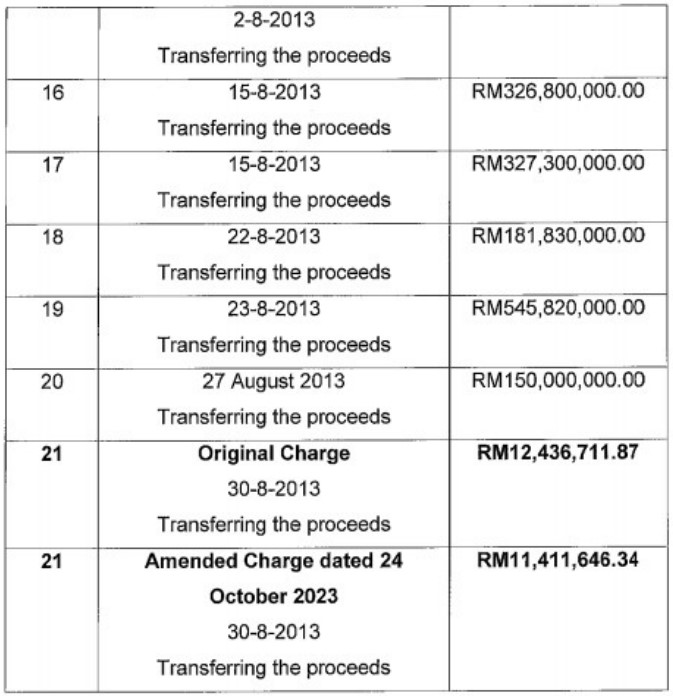
[156] The prosecution submitted that by virtue of the fact that it had been proven that the accused used his position to obtain gratification which is an offence under s 23 of the MACC Act, the said offence being one as specified in the Second Schedule of AMLATFA, they had proven that the monies which originated as a result of the charges and which were then deposited into the bank account of the accused were proceeds of unlawful activity.
[157] They also pointed out that the evidence of PW47 and his analysis of the Money Trail as well as the FIFO method employed by PW48, had sufficiently shown the trail or the link of the gratification obtained from its source or origin and the subsequent receipt of the monies by the accused into his bank accounts.
[158] The prosecution further alludes to the evidence with regard to the proximity of time from the dates of the accused's actions in using his office, as stated in the 3rd (amended) Charge of s 23 MACC Act, namely:
i. on 25 February 2013, approving 1MDB to enter into a Joint Venture Agreement with Aabar Investments PJS; and
ii. on 14 March 2013, approving a Letter of Support to 1MDB Global Investment Limited for the issuance of bond amounting to US$3,000,000,000.00 (3 billion) on behalf of 1MDB, with the obtaining of the proceeds of an unlawful activity (offence under s 23 of Act 694) starting from 22 March 2013 until 10 April 2013 which they submit is a gap of approximately 8 days.
[159] The prosecution still further submitted that in order to prove that the monies received by the accused in his Account 9694 from 22 March 2013 to 10 April 2013 were as a result of his actions on 25 February 2013 and 14 March 2013 (charge 3 of s 23 MACC Act), the clear evidence is shown in Adam (PW47)'s Money Trail Report (P1565), at pp 29–36, and Phase 3 Chart (P805).
[160] The prosecution also produced a chart as follows which set out the flow of funds from its source until the receipt of the funds into the account of the accused:
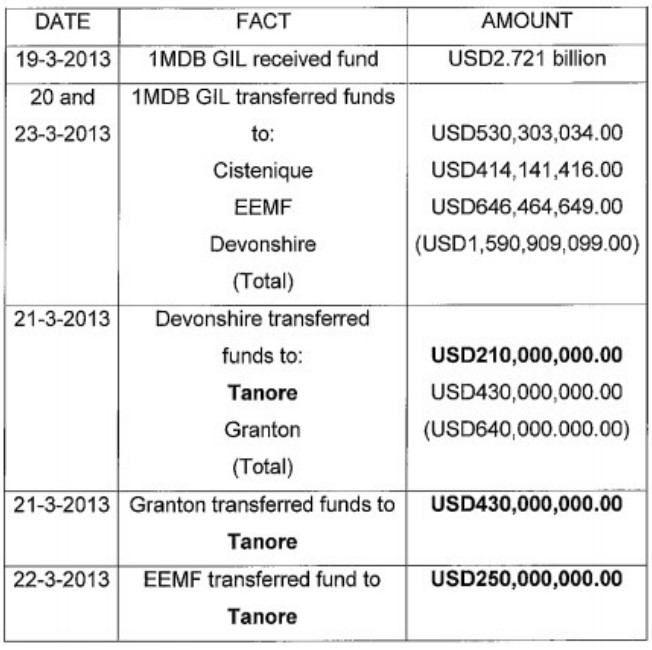
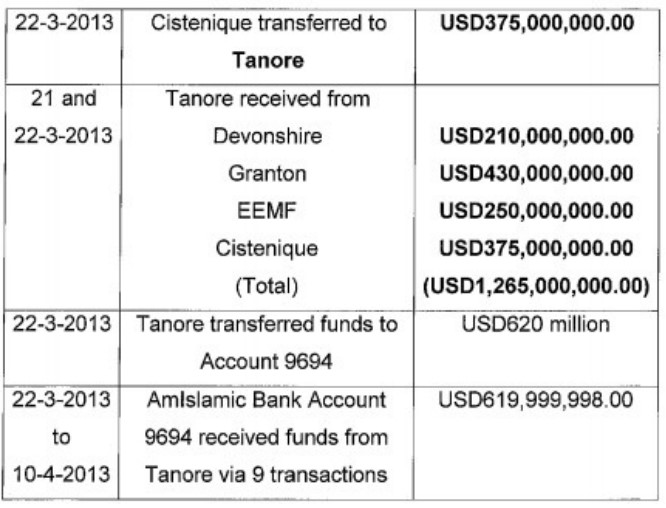
[161] In respect of the mens rea of the accused, the prosecution submitted that this can be inferred from the objective factual circumstances, adduced by the evidence during the trial.
[162] The prosecution also submitted that the conduct of the accused, as adduced by the evidence and rendered admissible under s 8 of the Evidence Act 1950, and the circumstances of this case, prove that the accused had the requisite knowledge in respect of the proceeds of unlawful activity from Tanore.
[163] Based upon the above, the prosecution submitted that they had sufficiently made out a prima facie case against the accused in respect of all charges under s 23(1) of the MACC Act and all the charges under s 4(1)(a) of the AMLATFA.
Defence
The Four Charges Under Section 23(2) Of The MACC Act
[164] The defence at the outset contended that all the "basic facts" through the four purported "decisions or actions" taken by the accused could not have triggered the presumption under s 23(2) of the MACC Act.
[165] However, they also submitted that even assuming that the presumption had been rightly invoked and had in fact arisen, the presumptions have been rebutted by the evidence in the prosecution's case itself.
1st Charge
[166] In respect of the 1st Charge the defence submitted that as for the 1st Action alleged to have been taken by the accused, the idea for the inception of TIA and its federal Government guarantee came from the 'ilham' of His Majesty Tuanku Mizan and that the tabling of the Memorandum (P242A) on 1 April 2009 was a follow-up to the Cabinet's earlier decision on 12 December 2008 approving TIA and the RM5,000,000,000.00 Government Guarantee which was made 110 days before the Memorandum's presentation.
[167] It was submitted that the idea for TIA and the Government guarantee was first presented by Dato' Seri Abdullah bin Hj. Ahmad Badawi on 12 December 2008 to the Cabinet.
[168] The defence further pointed to the evidence of Amhari (PW8), Shahrol (PW9), and Tan Sri Ismee (PW13) who testified that the idea for the formation of TIA and the provision of the Guarantee came from His Majesty Tuanku Mizan and not the accused.
[169] In respect of the 2nd Action, it was submitted that although the accused informed the Cabinet that he favoured the option which entails Menteri Besar Terengganu Incorporation (MBTI) to exercise complete control of TIA with the back-to-back guarantee by the Federal Government maintained, it was Shahrol who kept pushing for TIA's federalization.
[170] The defence also submitted that MOF Inc.'s acquisition of TIA's shares was for the interest and advantage of the Ministry of Finance and the Government of Malaysia which decision and action entitled the accused to the defence provided under s 23(4) of the MACC Act.
[171] The defence submitted in respect of the third limb or action that the Board of Directors' deliberation and decision to participate in the joint venture was made earlier on 18 September 2009.
[172] The accused only advised the Chairman of the BOD to firm up the decision on the JV, not to enter or to execute the JVA on unfavorable terms to 1MDB and P361 demonstrates that despite the purported direction on 26 September 2009, the BOD's approval was still conditional upon a valuation of PSI's assets by management.
[173] Notwithstanding the conditional approval, Shahrol executed the Joint Venture Agreement (P363), a mere two days after the conditional approval, without valuation of the assets. Shahrol also executed the JV with the wrong entity approved by the BOD, ie PetroSaudi Holdings (Cayman) Limited.
[174] The defence also submitted that Shahrol also did not inform the BOD or the accused of the USD700 million indebtedness by the JVCo and on 30 September 2009, had remitted the USD700 million to Good Star Limited without the BOD's approval or knowledge and further represented to Deutsche Bank that Good Star Limited is 100% owned by PSI.
[175] As for the 4th Action, it was submitted that the additional RM1,000,000,000.00 investment was made under the Murabaha Financing Agreement agreed by 1MDB's Board of Directors on 31 March 2010 vide Directors Circular Resolution (DCR) P388 dated 22 March 2010.
[176] The defence submitted that by way of exh P388 it was resolved to grant PSI an additional tranche of USD1.5 billion without authorization by the Special Shareholder, MOF Inc and that exhs P389 and P390 only approved the sale of 1MDB's 40% equity in the JVCo for USD1.2 billion. The additional tranche of USD1.5 billion in Murabaha facilities was solely the BOD's decision.
[177] On 1 June 2010, the BOD unilaterally decided to embark on raising RM15,000,000,000.00 in funds for 1MDB vide P392. P392 was passed without any approval from the Special Shareholder, MOF Inc.
[178] It was submitted that the resolution to grant an additional RM1,000,000,000.00 in investment was pre-prepared by the Management in Kuala Lumpur even before the BOD flew to London to meet with PSI.
[179] As a result of the above, the defence submitted that it was clear that no personal interest, direct or indirect, could have been presumed against Dato' Sri Najib to invoke the presumption of abuse of office or position for personal gratification under s 23(2) of the Act.
[180] The prosecution had also failed to specify the direct or indirect interest to be had by the accused in any of the four impugned decisions or actions to trigger the presumption under s 23(2) of the Act.
[181] The defence submitted that the evidence had uncovered Shahrol's unlawful and unauthorized actions time after time and that if any of his superiors should be blamed, 1MDB's Board of Directors should be first in line.
[182] The accused's decisions or actions as 1MDB's sole shareholder were made in the interest and advantage of the other public bodies he represented, namely, the Ministry of Finance and the Government of Malaysia in pursuit of the Government to Government (G-to-G) relationship with the Kingdom of Saudi of Arabia. The actions of the accused fell under the exclusion in s 23(4).
[183] It was submitted that there was also no evidence led by the prosecution to show that the accused was present at AmIslamic Bank Berhad, Jalan Raja Chulan, anywhere between the 24 February 2011 and the 14 June 2011 in order to abuse his official position there.
[184] With respect to whether the RM60,629,839.43 was, in fact, a gratification for the purported acts by the accused, the prosecution had failed to prove any nexus between the remittances to the four purported infractions.
[185] It was finally submitted that the prosecution had also failed to disprove that it was, in fact, a donation by the Saudi monarch, King Abdullah, remitted through two princes to the accused.
2nd Charge
[186] The defence submitted that in respect of the official acts by MOF Inc, 1MDB's Special Shareholder, in approving the proposed acquisitions of Tanjong Energy (through the executions of P456 and P457) and Mastika Lagenda (through the executions of P497 and P498), the accused's official acts were made with the underlying intent to 'menguasai dua IPP ini, pengguna elektrik di Malaysia dapat kadar bayaran yang lebih rendah dan ini memberikan faedah kepada rakyat.'
[187] It was therefore submitted that the approvals for the two acquisitions were made in the interest and advantage of the Ministry of Finance and the Government of Malaysia.
[188] It was accordingly submitted that these approvals fall squarely within the exclusion envisaged under s 23(4) of the MACC Act which immunises and excludes its application against any public officer who concurrently serves two public bodies and decides in the represented public body for the greater good of the other controlling public body.
[189] The defence also contended that the approvals came only after the Management and the Board of Directors had deliberated on their acquisitions.
[190] In respect of both Tanjong Energy and Mastika Lagenda, the accused's approvals through P456, P457, P497, and P498 were made strictly in compliance with ss 132C and 147(6) of the Companies Act 1965 and the accused was only giving his seal of approval to the acquisitions of local independent power producers from local companies on behalf of the company wholly owned by the Ministry of Finance.
[191] The defence pointed to the circumstances surrounding the appointment of Goldman Sachs which was that Shahrol agreed to their appointment and fees as financial advisor long before the Board of Directors had a chance to deliberate the matter.
[192] The defence said that both acquisitions used the purported Aabar's procurement of IPIC's guarantee as a conduit to siphon money from the proceeds of the notes raised.
[193] The notes issued by 1MEL for the Tanjong Energy acquisition were purportedly also guaranteed by IPIC through Aabar's assistance to increase their saleability and in exchange, 1MDB would grant Aabar an option to acquire 49% of the equity of 1MDB Energy Sdn Bhd.
[194] The defence further submitted that, as if the 49% option was not enough consideration for the purported IPIC Guarantee, Shahrol, Jasmine Loo and Goldman Sachs devised and executed a Collateral Agreement for Credit Enhancement with Aabar Investments PJS Limited to pay additional consideration for the credit enhancement by way of cash payment.
[195] This agreement and the subsequent cash remittance of USD576,943,490.00 to Aabar Investments PJS Limited, an entity wholly unconnected to IPIC, were kept from the Board of Directors and MOF Inc.'s knowledge and approval.
[196] It was further submitted that the Management of 1MDB, with the help of Goldman Sachs, also played the IPIC/Aabar Credit Enhancement card to siphon off proceeds raised by 1MELL earmarked to fund the acquisition of Mastika Lagenda.
[197] The defence said that Jasmine Loo prepared, and Shahrol executed P511, the Collaboration Agreement for Credit Enhancement with Aabar Investments PJS Limited in consideration of Aabar procuring IPIC's guarantee.
[198] It was submitted that P511 allowed USD790,354,855.00 to be remitted from 1MELL's Falcon Bank account to Aabar Investments PJS Limited. Again, both P511 and the USD790,354,855.00 remittance were made without the Board's or MOF Inc's knowledge or approval.
[199] With regard to gratification, the defence submitted that the prosecution failed to prove that at the time of the two approvals, the accused had the intention to receive gratification from Blackstone Asia Real Estate Partners through Aabar Investments PJS Limited.
3rd Charge
[200] In respect of the 3rd Charge, the defence again submitted that although the accused is said to have abused his office as the Finance Minister through his execution of exh (P530), Minutes by Representative of Holding Company ("MR") and exh (P531), Special Rights Redeemable Preference Shareholder's Resolution ("SRRPS") presented to him, his execution of the two documents was made purely pursuant to his statutory duties under the Companies Act 1965.
[201] The defence submitted despite Shahrol's allegation that the accused, in signing P530 and P531, had influenced the Board to agree to the Joint Venture, that both P530 and P531 were brought together with DCR, P529, and Shahrol had no choice but to sign P529 because he saw that the Finance Minister had already agreed to the Joint Venture with Aabar, the truth is that Shahrol in fact knew about the Joint Venture proposal even before he sighted the MR and SSR, and he knew them through the secret action plans communicated to him by Jho Low and further knew that Jho Low had instructed Jasmine Loo to prepare the DCR, MR, and SSR and fed the details to be included therein.
[202] The defence submitted that even if Shahrol's assertion was true, the accused was only approving what was presented to him by the Management.
[203] The defence pointed out that on 21 June 2012, there was already a Board-level discussion on the proposed JV with Aabar (P492) and that on 27 June 2012, the Board of Directors received a letter (P517) from Al-Qubaisi of Aabar proposing the joint venture to develop KLFID.
[204] On 9 July 2012, the Board of Directors passed a DCR (P518) and agreed to a proposed joint development of KLFID with Aabar and on 15 October 2012, the Board had discussed about renegotiating the terms of the proposed collaborations with Aabar (P505).
[205] Further to that, on 4 December 2012, during the Board's General Meeting, it was agreed that a due diligence exercise be carried out on Aabar's proposal (P521) while on 29 January 2012, the Board again passed a subsequent resolution approving the proposed joint venture with Aabar (P522).
[206] The defence submitted therefore that given that the decision to collaborate with Aabar emanated from the 1MDB's management and that the Board of Directors had discussed the prospect of the Joint Venture with Aabar, there is no reasonable basis to infer that the accused's approval of the Joint Venture with Aabar was motivated by a personal interest so as to invoke the presumption under s 23(2) of the MACC Act.
[207] The defence submitted that in respect of the Letter of Support for 1 GIL, this originated as a result of Shahrol's request on 15 January 2013 through his letter P525 to the accused requesting for his support in 1MDB's proposal to form the USD6 Billion strategic acquisition funds with Aabar. Shahrol sought the Ministry of Finance's support through a joint letter of comfort by MOF Inc 'with no implied or express guarantee'.
[208] The letter had also set out a tight timeline of two weeks because His Highness Sheikh Mohamed Zayed Al-Nahyan had wished for the Joint Venture Agreement to be concluded during his official visit to Malaysia in early February 2013.
[209] The defence submitted that Shahrol insinuated that the accused had planned to issue the Letter of Comfort because he minuted on P525 to Tan Sri Irwan 'sila uruskan perkara dengan segera'.
[210] Subsequently, the Letter of Comfort was required to be changed into a Letter of Support at the request of Goldman Sachs, the lead arranger for 1 GIL's USD3 Billion Notes and that this process went through a series of discussions at Ministry of Finance ("MOF") with all stakeholders, including the Peguam cara Perbendaharaan and there was no evidence that the accused had desired the conversion of the Letter of Comfort into a Letter of Support.
[211] It was submitted that the Cabinet approved the first Letter of Support (P1103C) after it went through the procedures put in place by MOF while the 2nd Letter of Support (P526) was executed by the Minister of Finance on 14 March 2013 after the Cabinet approved it on 13 March 2013.
[212] The defence submitted that the evidence clearly showed that the joint venture was just another ruse by the management of 1MDB to raise funds and misappropriate them.
[213] They pointed out that Hazem and Azmi, 1MDB's CEO and CFO, respectively and also directors of 1 GIL, testified that Jho Low had specifically handpicked them to be directors at 1GIL to do his bidding and so it was not surprising that the resolution to appoint Hazem and Azmi was made before 1MDB's Board of Directors and MOF Inc's approval of the same.
[214] The defence also pointed out that Hazem, Azmi and Terence opened an account at BSI Bank supposedly for 1 GIL to be able to receive the USD3 Billion dollars raised and that immediately after the funds were successfully raised, Azmi transferred USD1,590,909,099.00 into three fiduciary funds which were neither authorised by the Board of Directors or allowed by 1 GIL's offering circular whereas the whole funds raised by 1 GIL was meant to go to ADMIC.
[215] The defence submitted thus that given the clear misconduct of 1MDB's rogue officers and the disconnect between the accused's approvals and the unauthorised diversion of 1 GIL's funds, the entire charge fails.
[216] The defence submitted further to this that in any event, the only interest to be had by the accused was a national interest in the inherent benefits of the G-to-G collaboration with a Government-owned entity from the oil-rich gulf state.
[217] It was accordingly submitted that the defence under s 23(4) of the MACC Act was available to the accused and the 3rd Charge had failed to be proven.
4th Charge
[218] In respect of the 4th Charge, the defence submitted that the approvals given by the accused to 1MDB were not driven by personal interest or gratification as the approvals by MOF Inc were sought by the Company, 1MDB itself.
[219] It was submitted that the accused had nothing to do with the loans sought to be approved by 1MDB and that he was only approving what was proposed by 1MDB's management.
[220] The defence submitted that the decision to obtain the Initial US$250,000,000.00 Term Loan Facility and the Additional US$975,000,000.00 Term Loan Facility did not emanate from the accused but as a result of the DCR P559 dated 22 May 2014.
[221] The defence submitted that according to the prosecution's witnesses, the Directors were led into executing P559 because they were presented with the signed MR and SSR agreeing to the same resolutions as the DCR.
[222] It was contended that the accused executed no corresponding MR or SSR to the resolutions in DCR P559.
[223] The defence said that the contents of P559 did not mention obtaining the prior approval of the Company's Special Shareholder and that Tan Sri Ismee and Shahrol's allegations that they had to sign P559 because of the undated but signed MR and SSR by the accused, only displayed their malice toward the accused by electing to blame him first and to conjure up the basis later.
[224] It was submitted that Hazem even executed two separate Agreements relating to Option Agreements with Aabar Investments PJS Limited, one for practice and the other as the real deal.
[225] It was contended that by employing the proceeds of the USD975 million loans, Hazem, Azmi, Jho Low, Jasmine Loo, and others were able to liquidate the already dissipated overseas investments made by 1MDB.
[226] It was finally contended by the defence that the prosecution against the accused was nothing more than a witch-hunt against a former political rival, and the alleged abuse of positions was nothing more than hollow allegations and excuses to drag a former Prime Minister to Court.
[227] The farcical allegations against him were nothing more than an attempt to pin the criminal misconducts and illegal enterprise of others ie Shahrol, Jasmine Loo, Jho Low, Terence Geh, Azmi Tahir, Nik Faisal on one singular individual on the pretext that he had exercised supreme control over the affairs at 1MDB.
The Charges Under Section 4(1)(a) Of The Anti-Money Laundering And Anti-Terrorism Financing Act 2001 [Act 613] ("AMLATFA")
[228] Besides the defence contending that AMLA Charges are defective and illegal, it was contended that there was no proof of a predicate offence to establish that the funds involved are "proceeds of an unlawful activity", which is essential for an AMLA offence.
[229] In support thereof, the case of PP v. Billion Nova Sdn Bhd & Ors [2016] 4 MLRA 226, was referred to where it was held that without proof of the predicate offence, funds cannot be considered proceeds of unlawful activity.
[230] The defence submitted that the prosecution in respect of the predicate charge had failed to prove the nexus between the accused's approvals of the Joint Venture with Aabar Investments PJS Limited and the Letter of Support to 1 GIL to the funds received in his AmBank Account.
[231] It was also contended that there was no evidence to show that the accused personally conspired with Aabar Investments to propose the Joint Venture to obtain gratification, that he had conspired with Goldman Sachs to insist on the Letter of Support for the Notes and that he had directly instructed Hazem and Azmi to immediately remit the proceeds of 1 GIL's USD3 Billion Notes into the three fiduciary funds instead of being injected into ADMIC.
[232] There was also no evidence to show that the accused had caused the funds in the three fiduciary fund entities to be remitted to Tanore and later into his AmBank Account, and that in respect of the approvals given for the Joint Venture and the Letter of Support, he had acted beyond or contrary to his official and statutory duties under the Companies Act 1965 and the Federal Constitution.
[233] The defence further asserted that there was no evidence to show that the accused as an officer of a public body, i.e., as the Minister of Finance at the material time, had abused his position when he approved 1MDB to enter into a Joint Venture Agreement with Aabar Investments PJS and approved the Letter of Support to 1MDB Global Investment Limited for the purpose of supporting bond issues amounting to USD3 billion on behalf of 1MDB and that these actions were carried out for the purpose of obtaining RM2,000,000,000.00 'gratification'.
[234] To the contrary, submitted the defence, the evidence revealed that the Board of Directors were not suddenly thrust into the position to accept the Joint Venture with Aabar and that the matter was in fact discussed at the Board level some 9 months prior to 25 February 2013 and that the CEO of Aabar had even written to the Board of Directors to propose a joint venture between the two entities.
[235] Prior to 25 February 2013, the Board of Directors had earlier passed another resolution agreeing to collaborate with Aabar in a joint venture and had earlier agreed to conduct a due diligence exercise on Aabar's proposal.
[236] With regards to the Letter of Support, it was contended that the accused had gone through the proper procedures at the MOF and Cabinet level and that the Letter of Support went through a series of discussions at MOF with the stakeholders, including Goldman Sachs.
[237] From the evidence, it was asserted that the accused had to obtain the Cabinet's approval twice, initially, for approving a guarantee of USD6 Billion, and later, seeking the Cabinet's approval for a guarantee of USD3 Billion.
[238] The accused had given no direction on the utilisation of the USD3 Billion to go into the three Fiduciary Funds instead of ADMIC and that, in reality, the officers of 1MDB were hatching and executing secret plans with Jho Low and each other behind the Board of Directors', MOF, and the accused's backs.
[239] The defence thus argued that the prosecution failed to prove the necessary connection between the accused's actions and the RM2,081,476,926.00 ("RM2 billion"). Consequently, the defence submits that the prosecution has failed to prove the predicate offence beyond reasonable doubt and on this ground alone contended that an order of acquittal on all the twenty-one AMLA charges were justified.
[240] The defence submitted that the RM2,000,000,000.00 received in the 9694 account is not traceable to 1 GIL and that the flow of funds in and out of the 1 GIL account, ultimately showed that the funds received by the accused did not originate from 1GIL.
[241] The defence submitted that the source of funds in the 9694 account were in fact from an overdraft facility which the accused genuinely believed to be a donation from Saudi Arabia, as pledged by King Abdullah.
[242] The defence also submitted that the accused had absolutely no control over the 1 GIL Account as the 1 GIL Account was purely in control by Hazem and Azmi, the authorised signatories, who then invested into the 3 fiduciary funds without the knowledge of the accused.
[243] In support of the fact that the USD620,000,000.00 remitted to the 9694 Account from Tanore was from an overdraft facility extended by Falcon Bank to Tanore and not from 1GIL, the defence points to the following evidence:
a. The Tanore Bank Statement, P1613 clearly shows that the material time when USD620,000,000.00 was debited from the Tanore account to the 9694 Account, the Tanore account was in deficit.
b. In P1613, the first entry is a remittance to AmPrivate banking MR of USD (-) 620,000,000.00 on the 21 March 2013. As the USD (-) 620,000,000.00 was first and only entry since 1 January 2013, obviously the balance of the account at the time of the remittance was zero.
c. It is plain and obvious, that the minus sign indicated that the Tanore account was in deficit at the time of the remittance of the USD (-) 620,000,000.00.
d. The application for opening an account with Falcon Bank P1614 confirms that the authorised person of the company (i.e, Tanore) could incur indebtedness by way of an overdraft.
e. A service fee payment of USD300,000,000.00 was made by Tanore on 26 March 2013. Due to the proximity between the extension of the overdraft facility (21 March 2013) and the payment of this service fee (26 March 2013), it can be inferred that the said payment by Tanore to Falcon Bank was for extending the USD620,000,000.00 overdraft facility.
f. On 21 March 2013, there was an incoming payment from Devonshire Funds Limited with a credit of USD210 million, which brought the balance from USD (-) 620,000,000.00 to USD (-) 410,000,039.96, still leaving the account in deficit; and only after the incoming payment from Granton with a credit of USD430 million, the balance in the account was USD19,999,960.04, i.e., from a deficit to a surplus.
g. The next incoming payment from EEMF on 25 March 2013 is a credit of USD250 million bringing the balance to a total of USD269,999,960.04.
h. On 25 March 2013, a payment was made to AmPrivate Banking MR 9694 Account with a debit of USD61,000,040.04 reducing the balance to USD208,999,920.00.
i. On the same day, 25 March 2013, there was a debit of USD189,000,000.00 from Place Fiduciary Time reducing the balance to USD19,999,920.00. The next entry is an incoming payment from Cistenique of USD375,000,000.00, and the balance in the account is USD394,999,920.00.
j. Adam's testimony that no portion of the monies received by Tanore from Cistenique were received into the 9694 Account.
[244] The defence submitted that the conclusion was that Adam's chart exh P805 was therefore inaccurate.
[245] The defence further contended that the first entry on 21 March 2013 was a payment to AmPrivate Banking (the 9694 Account), with a debit of USD620,000,000.00, leaving a final balance, the "baki akhir" of negative USD (-) 620,000,000.00. This negative balance resulted from an overdraft facility and on this basis, it is clear that the opening balance as of 21 March 2013 was zero and not USD620,000,000.00.
[246] A negative balance on a bank statement indicated that the account was in deficit, meaning that more money went out than came in. ACP Foo's testimony claiming a balance of USD (-) 620,000,039.96 in the Tanore account on 21 March 2013 was therefore inaccurate, as it was obvious that prior to the USD620,000,000.00 being remitted, the opening balance would have been zero.
[247] The defence also referred to the Granton bank statement, P1611, showing that the statement period from 1 March 2013 to 31 March 2013, shows the only transaction being a USD (-) 430 million remittance to Tanore Finance Corporation on 21 March 2013, indicating that the account was in deficit before the transaction. This deficit, marked by the minus sign, suggests the Granton account operated on an overdraft facility, not from funds traceable to 1 GIL, as supported by P1612. The defence thus argued that both the Tanore and Granton accounts were overdrawn, using bank money through overdraft facilities, rather than as a result of any unlawful activity.
[248] The defence yet again assailed the analysis by Adam as being flawed and biased, as he ignored the deficits in the accounts and incorrectly reported surpluses, as shown in P1611 and P1613. The defence submitted that Adam's report, P1565, should be disregarded as it was evident that the USD620,000,000.00 remitted to the 9694 Account came from an overdraft facility, not from 1 GIL, thus negating the prosecution's claim that the funds were linked to any illicit activity.
[249] The defence also attacked the investigation conducted by ACP Foo as being biased and one-sided as although he found that the Tanore account, beneficially owned by Eric Tan (a proxy for Jho Low, and not the accused), received funds allegedly traceable to 1 GIL, the defence contended that missing documentation makes his conclusion flawed.
[250] The defence submitted that ACP Foo's FIFO analysis was flawed because he did not have the statements of 1 GIL, Devonshire Capital, EEMF, Cistenique, Granton, and Tanore when conducting his analysis and these statements were imperative for performing a thorough FIFO analysis.
[251] Without this, contended the defence, ACP Foo could not support the claim that the funds in the 9694 Account originated from 1GIL.
[252] According to ACP Foo's findings, Azmi, a Director of 1 GIL, assisted Terence, "orang beliau Jho Low," in misappropriating funds for Jho Low, potentially committing criminal breach of trust under s 409 of the Penal Code, a predicate offence under s 4(1) AMLATFA for which, contended the defence, Azmi should have been charged.
[253] The defence further attacked the money trail analysis conducted by Adam (PW47) as Adam also did not analyse the accounts of Cistenique and EEMF nor the Devonshire Funds Ltd ("3 Fiduciary Funds"). Adam had confirmed in P1565, in para 3 that he only relied on the information set out in Appendix 1, and the 3 fiduciary funds statements were not listed in the said Appendix 1.
[254] The defence also said that Adam did not rely on IDD873 and IDD874 as they were in the Dutch language and that there was no evidence that Adam was fluent in Dutch nor was there a translation of the bank statement. Even if Adam did, the defence contends that these statements are from ING Bank and appear from the bottom of the page to be a print out from a website and not a bank statement.
[255] The defence also pointed out that IDD873 and IDD874 were not the statements furnished by Adrian Orlando Downes ("Adrian") as per the MACMA request and that this is evident from IDP1726 which is the Attestation of Authenticity of Records Obtained under Form 2, wherein Adrian confirmed that he is the compliance, governance and risk officer of Amicorp Bank and Trust Limited in Barbados and where in para 3, Adrian confirmed that he is responsible for keeping/maintaining/holding the records among others of Cistenique and EEMF.
[256] In conclusion, the defence submitted that Adam's money trail report (P1565) is flawed because he did not have the statements from the three Fiduciary Funds (EEMF, Cistenique, and Devonshire Capital Growth Fund) necessary to support his analysis.
[257] The defence asserted that this flaw also extended to ACP Foo, who relied on Adam's report in his investigation to link the funds in the 9694 Account to 1 GIL. The defence contends that without analysing these crucial documents, the prosecution's case is critically undermined, as the money trail investigation lacks essential documentation and is therefore unreliable.
[258] The defence further submitted that the accused did not possess the requisite mens rea in respect of the charges under the AMLATFA. In their endeavour to prove the same, the defence alluded to the fact that the accused was very transparent as to the purpose of opening the account.
[259] The defence points to the evidence that the accused had disclosed this to Cheah (PW39) on the day they met at the former's residence. This disclosure was confirmed by Cheah in his witness statement (WS-SP39) at para 14, where he stated that the accused explained the account was to receive donations from Saudi Arabia.
[260] The defence also alluded to D1801, at p 5, where the accused had explained to the recording officer that the reason for opening the AmBank accounts was to receive donations from King Abdullah, the King of Saudi Arabia.
[261] It was also pointed out that the accused had candidly explained to ACP Foo in D1691 at p 4 in question 10 and 11 that the purpose of opening the 9694 Account and 1880 was for Corporate, Social, Responsibility ("CSR") and political purposes and that he was free to use the money at his own discretion.
[262] With regard to the designated names given to the AmPrivate Banking accounts, namely AmPrivate Banking-MR for account 9694 and AmPrivate Banking-1MY for account 1880, the defence contends that Cheah (PW39) confirmed the designated names were assigned by AmBank.
[263] The defence said that PW39 stated that he was not sure if the accused was informed of the designated names as it involved the bank's internal policy and operations and thus, it was the responsibility of the operations team to select the code name.
[264] The defence therefore submitted that the designated names assigned to the accounts was AmBank's internal decision and no request was made by the accused to AmBank and neither did he request this purported "special treatment."
[265] The defence further submitted that after Cheah met with Tan Sri Zeti (TS Zeti) to inform her that the accused was opening a personal bank account with AmBank in order to receive donations from Saudi Arabia, he wrote to TS Zeti informing her that a designated account name for the Ringgit Operations Monitoring System (ROMS) was assigned for reporting purposes to Bank Negara and that the designated name was "Am-Private Banking — MR.
[266] The defence said that all of the accounts of the accused therefore were opened transparently under his name, with the details as per his national registration identity card, with no concealment of his identity as the beneficial owner, unlike Jasmine, Amhari, or TSZeti's husband, who opened offshore accounts under company names in order to obscure their identities.
[267] The defence submitted that the fact that the accused received funds into the same AmBank accounts within the country was conduct that showed that he did not have any motive to conceal the funds and that he had nothing to hide consistent with his belief that the funds he was receiving were a donation from Saudi Arabia.
[268] The defence asserted that the belief of the accused was justified because he had met with King Abdullah in Riyadh in 2010, where his Majesty made a pledge to the accused that would provide support to the accused.
[269] King Abdullah assured the accused that he would provide support to him to enable him to carry on leading the country as a moderate Muslim nation and this assurance was also supported by the donation letters, tendered and marked as exhs D1439, D1447, D1448 and D1451 respectively. The accused thus had no reason to doubt the source of funds, as he was the Prime Minister and the pledge was made by the King of Saudi Arabia, and the above remittances confirm the source.
[270] This belief was further justified as the support pledged by King Abdullah was received into the 9694 Account and although not directly from King Abdullah's account, he did receive a total of USD79,999,976.00 (RM243,699,926.32) from the Ministry of Finance, Riyadh. It was pointed out that the swift remittances D1442 and D1443 showed that the ordering customer was the Ministry of Finance, Riyadh, and the ordering institution was the Saudi Arabian Monetary Agency.
[271] In addition to receiving funds from the Ministry of Finance in Riyadh, the accused also received a total of USD99,999,919.00 (RM311,122,245.94) from Prince Faisal, the grandson of King Abdullah and the prosecution had produced no evidence indicating that these substantial funds received by the accused from the Ministry of Finance, Riyadh, and Prince Faisal were in any way connected to 1MDB.
[272] Under the circumstances, the defence submitted that the application of the doctrine of wilful blindness, as contended for by the prosecution, would also fail.
[273] The defence pointed out that ACP Foo explained that after analyzing the entire 9694 Account, he carried out a FIFO analysis only on the monies received from the Tanore account into the 9694 Account commencing from 21 March 2013 and explained that the balance in the 9694 Account, on 20 March 2013 prior to receiving funds from Tanore was RM879,812,627.27, and confirmed that this sum was clean money.
[274] It was also pointed out that ACP Foo explicitly stated that the money in the 9694 Account before 2013 should be treated as 'wang bersih' and that this is evident from his testimony where he amended P1675, changing his classification of all funds transferred into the 9694 Account before 2013 from "wang haram" to "wang bersih".
[275] The defence asserted that in light of the fact that ACP Foo and the prosecution agreed that the RM879,812,627.27 was clean money, this would include the following monies purportedly received into the accused's 9694 Account:
a. RM60,629,839.43 related to the first s 23(1) Charge,
b. RM90,899,927.28 related to the second s 23(1) Charge,
c. amounting to a total of RM151,529,766.00.
[276] Accordingly, it was further asserted that, as ACP Foo's analysis confirmed that at the time of these approvals, the 9694 Account had a substantial balance of RM879,812,627.27 in clean money, this would suggest that the accused's approvals were based on his view of the joint venture as a beneficial Government-to-Government initiative for Malaysia and not for any illicit purpose, since he was not financially constrained.
[277] The defence submitted that based upon the objective factual circumstances, the further proof that the accused had no reason to believe that the proceeds were from unlawful activity but rather a donation from the Kingdom of Saudi Arabia, as pledged to him by King Abdullah for political and CSR purposes is evidenced by his use of the USD2 billion in the 9694 Account in relation to Charges 12 to 15, and the prosecution witnesses who testified that the cheques issued by Dato' Sri Najib were for political and CSR purposes. Charges 10, and 16 to 19 were also asserted to be for CSR and political purposes.
[278] With regard to the 11th Charge, it was submitted that the prosecution did not call any witnesses from UMNO who would have confirmed that it was utilised for the purpose it was received and that was for political purposes.
[279] It was accordingly asserted that the adverse inference under s 114(g) of the Evidence Act 1950 ought to be drawn against the prosecution.
[280] In respect of the 20th and 21st Charges, which are in relation to purportedly transferring proceeds of unlawful activity from 9694 account to 1880 account, the defence submitted that it does not meet the definition of 'transaction' under s 3 of AMLATFA because for a transaction to take place within the meaning of the section, it must occur between 2 parties whereas the accused here was merely transferring from his own 9694 Account to his own 1880 Account and in the same bank.
D) Analysis And Findings At The Conclusion Of The Prosecution Case
i) Duty Upon The Court At The Conclusion Of The Prosecution Case
[281] After the prosecution had closed its case, the duty upon the court is stipulated in s 180 of the Criminal Procedure Code ("CPC") which reads as follows:
"180. "Procedure after conclusion of case for prosecution
(1) When the case for the prosecution is concluded, the Court shall consider whether the prosecution has made out a prima facie case against the accused.
(2) If the Court finds that the prosecution has not made out a prima facie case against the accused, the Court shall record an order of acquittal.
(3) If the Court finds that a prima facie case has been made out against the accused on the offence charged the Court shall call upon the accused to enter on his defence.
(4) For the purpose of this section, a prima facie case is made out against the accused where the prosecution has adduced credible evidence proving each ingredient of the offence which if unrebutted or unexplained would warrant a conviction."
[282] The duty upon the court at this stage as required by law under s 180 of the CPC, is to subject the totality of the evidence of the prosecution to a positive and maximum evaluation of the credibility and reliability of all the evidence adduced in order to determine whether credible evidence in respect of each of the elements or ingredients of the offences as framed in the charges have been established.
[283] In the Federal Court case of Balachandran v. PP [2004] 2 MLRA 547, it was held as follows:
"[21] Section 180(1) makes it clear that the standard of proof on the prosecution at the close of its case is to make out a prima facie case................ Section 180(2) provides that the court shall record an order of acquittal if a prima facie case has not been made out while s 180(3) provides that if a prima facie case has been made out the accused shall be called upon to enter his defence. A prima facie case is therefore one that is sufficient for the accused to be called upon to answer. This in turn means that the evidence adduced must be such that it can be overthrown only by evidence in rebuttal. The phrase 'prima facie case' is defined in similar terms in Mozley and Whiteley's Law Dictionary 11th edn as: A litigating party is said to have a prima facie case when the evidence in his favour is sufficiently strong for his opponent to be called on to answer it. A prima facie case, then, is one which is established by sufficient evidence, and can be overthrown only by rebutting evidence adduced by the other side.
[22] The result is that the force of the evidence adduced must be such that, if unrebutted, it is sufficient to induce the court to believe in the existence of the facts stated in the charge or to consider its existence so probable that a prudent man ought to act upon the supposition that those facts exist or did happen. On the other hand, if a prima facie case has not been made out it means that there is no material evidence which can be believed in the sense as described earlier. In order to make a finding either way the court must, at the close of the case for the prosecution, undertake a positive evaluation of the credibility and reliability of all the evidence adduced so as to determine whether the elements of the offence have been established. As the trial is without a jury it is only with such a positive evaluation can the court make a determination for the purpose of s 180(2) and (3)......... Since the court, in ruling that a prima facie case has been made out, must be satisfied that the evidence adduced can be overthrown only by evidence in rebuttal it follows that if it is not rebutted it must prevail. Thus, if the accused elects to remain silent he must be convicted. The test at the close of the case for the prosecution would therefore be: Is the evidence sufficient to convict the accused if he elects to remain silent? If the answer is in the affirmative then a prima facie case has been made out. This must, as of necessity, require a consideration of the existence of any reasonable doubt in the case for the prosecution, if there is any such doubt there can be no prima facie case.
[23] As the accused can be convicted on the prima facie evidence it must have reached a standard which is capable of supporting a conviction beyond reasonable doubt. However, it must be observed that it cannot, at that stage, be properly described as a case that has been proved beyond reasonable doubt. Proof beyond reasonable doubt involves two aspects. While one is the legal burden on the prosecution to prove its case beyond reasonable doubt the other is the evidential burden on the accused to raise a reasonable doubt. Both these burdens can only be fully discharged at the end of the whole case when the defence has closed its case. Therefore a case can be said to have been proved beyond reasonable doubt only at the conclusion of the trial upon a consideration of all the evidence adduced as provided by s 182A(1) of the Criminal Procedure Code. That would normally be the position where the accused has given evidence. However, where the accused remains silent there will be no necessity to re-evaluate the evidence in order to determine whether there is a reasonable doubt in the absence of any further evidence for such a consideration. The prima facie evidence which was capable of supporting a conviction beyond reasonable doubt will constitute proof beyond reasonable doubt."
[Emphasis Added]
[284] See also the cases of PP v. Mohd Radzi Abu Bakar [2005] 2 MLRA 590 and Arulpragasan Sandaraju v. PP [1996] 1 MLRA 588.
ii) Preliminary Issues
Allegations Of Defective Charges
[285] Before embarking on an analysis of whether the essential ingredients of the charges proffered against the accused were proven or not, there were several issues raised by the defence which require consideration first. These will be considered accordingly.
[286] The four (4) charges of using office or position for gratification (abuse of power) under s 23(1) of the MACC Act and the charges for money laundering under s 4(1)(a) AMLATFA have been assailed by the defence for being defective, duplicitous and ambiguous and therefore bad in law and in violation of s 163 of the Malaysian Criminal Procedure Code (CPC).
Duplicity
[287] It is alleged inter alia, that each of the four principal charges under s 23(1) of the MACC Act against the accused contained at least two dates of commission of the offence, two timelines, two or more instances of abuse of position for gratification, and three public positions either alternatively or simultaneously being abused by the accused.
[288] The law with respect to procedure as to the form and particulars of charges and when the manner of committing an offence must be stated is contained in ss 152, 153 and 154 of the Criminal Procedure Code ("CPC") respectively which for ease of convenience is reproduced as follows:
"152. Form of charge
(1) Every charge under this Code shall state the offence with which the accused is charged.
(2) If the law which creates the offence gives it any specific name the offence may be described in the charge by that name only.
(3) If the law which creates the offence does not give it any specific name so much of the definition of the offence must be stated as to give the accused notice of the matter with which he is charged.
(4) The law and section of the law against which the offence is said to have been committed shall be mentioned in the charge.
(5) The fact that the charge is made is equivalent to a statement that every legal condition required by law to constitute the offence charged was fulfilled in the particular case.
(6) If the accused has been previously convicted of any offence, and it is intended to prove that previous conviction for the purpose of increasing the punishment which the Court is competent to award, the fact, date and place of the previous conviction shall be stated in the charge. If the statement is omitted the Court may add it at any time before sentence is passed.
ILLUSTRATIONS
(a) A is charged with the murder of B. This is equivalent to a statement that A's act fell within the definition of murder given in ss 299 and 300 of the Penal Code; that it did not fall within any of the general exceptions of the same Code and that it did not fall within any of the five exceptions to s 300, or that if it did fall within exception 1, one or other of the three provisos to that exception applied to it.
(b) A is charged under s 326 of the Penal Code with voluntarily causing grievous hurt to B by means of an instrument for shooting. This is equivalent to a statement that the case was not provided for by s 335 of the Penal Code, and that the general exceptions did not apply to it.
(c) A is accused of murder, cheating, theft, extortion, criminal intimidation, or using a false property-mark. The charge may state that A committed murder or cheating or theft or extortion or criminal intimidation or that he used a false property-mark without reference to the definitions of those crimes contained in the Penal Code; but the sections under which the offence is punishable must in each instance be referred to in the charge.
(d) A is charged under s 184 of the Penal Code with intentionally obstructing a sale of property offered for sale by the lawful authority of a public servant The charge should be in those words."
"153. Particulars as to time, place and person
(1) The charge shall contain such particulars as to the time and place of the alleged offence and the person, if any, against whom or the thing, if any, in respect of which it was committed as are reasonably sufficient to give the accused notice of the matter with which he is charged.
(2) When the accused is charged with criminal breach of trust or dishonest misappropriation of money it shall be sufficient to specify the gross sum in respect of which the offence is alleged to have been committed and the dates between which the offence is alleged to have been committed, without specifying particular items or exact dates, and the charge so framed shall be deemed to be a charge of one offence within the meaning of s 164:
Provided that the time included between the first and last of such dates shall not exceed one year.
(3) When the accused is charged with an offence relating to publication by electronic means, the place of publication is where the publication is seen, heard or read by any person
"154. When manner of committing offence must be stated
When the nature of the case is such that the particulars mentioned in ss 152 and 153 do not give the accused sufficient notice of the matter with which he is charged, the charge shall also contain such particulars of the manner in which the alleged offence was committed as will be sufficient for that purpose.
ILLUSTRATIONS
(a) A is accused of the theft of a certain article at a certain time and place. The charge need not set out the manner in which the theft was effected.
(b) A is accused of cheating Bata given time and place. The charge must set out the manner in which A cheated B.
(c) A is accused of giving false evidence at a given time and place. The charge must set out that portion of the evidence given by A which is alleged to be false.
(d) A is accused of obstructing B, a public servant, in the discharge of his public functions at a given time and place. The charge must set out the manner in which A obstructed B in the discharge of his functions.
(e) A is accused of the murder of B at a given time and place. The charge need not state the manner in which A murdered B.
(f) A is accused of disobeying a direction of the law with intent to save B from punishment. The charge must set out the disobedience charged and the law infringed."
[289] Upon a perusal and examination of all 4 abuse of power charges under s 23(1) MACC Act, it is clear that they contain the time and place and it states the offence with which the accused is charged.
[290] All the 4 charges therefore fulfil all the legal criteria required of a charge as provided for under ss 152, 153 and 154 of the CPC.
[291] In respect of charges 1 to 9 under s 4 AMLATFA which are also alleged to be incorrect and illegal and bad for multiplicity, I find that they contain the time and place and it states the offence with which the accused is charged and no prejudice is thus occasioned to the accused.
[292] After perusing and examining the charges, I find that all 21 charges fulfil all the legal criteria required of a charge as provided for under ss 152, 153 and 154 of the CPC.
[293] In respect of the assertion of the defence that the acts set out in the four (4) charges under the MACC Act were duplicitous, it is apposite to reproduce s 163 of the CPC as follows:
"163. Separate charges for distinct offences
For every distinct offence of which any person is accused there shall be a separate charge, and every such charge shall be tried separately, except in the cases mentioned in ss 164, 165, 166 and 170.
ILLUSTRATION
A is accused of a theft on one occasion, and of causing grievous hurt on another occasion. A must be separately charged and separately tried for the theft and causing grievous hurt."
[294] The Federal Court speaking through Raja Azlan Shah CJ (Malaya) (as His Royal Highness then was) in the case of Haji Abdul Ghani Ishak & Anor v. PP [1981] 1 MLRA 649, held as follows:
"A number of grounds were raised on behalf of the 1st Appellant We feel that only two points raised need to be dealt with in some detail. Firstly, it was alleged that the amended charge was bad for duplicity. The fallacy of this argument is exposed when one examines the amended charge itself, it reads as follows:
"That you on 2 October 1974, in the State Executive Council, Melaka, in the District of Melaka Tengah, in the State of Melaka, being a member of the Administration, to wit a member of the Executive Council, Melaka, committed corrupt practice in that you while being such a member used your office, for your pecuniary advantage, namely participated in the deliberation for approving an application for State land in the Mukim of Kuala Linggi, Alor Gajah, Melaka, prepared by one Mohd Noor bin Baba and submitted in the name of one Kipah binti Othman on 2 March 1974 and in respect of such land in which you were engaged in business you did take part in a decision likely to effect your pecuniary interest therein, and that you have thereby committed an offence punishable undersection 2(1) of the Emergency (Essential Powers) Ordinance No 22 of 1970."
It was argued that the charge combines three known offences by importing the provisions of art 7(10) of the Malacca State Constitution. The charge, it was argued, therefore violated s 163 of the Criminal Procedure Code, and was therefore bad for duplicity."
11. His Lordship then went on to held:
"...It need not be emphasised that the offence section under the Emergency (Essential Powers) Ordinance No 22 of 1970 is s 2(1) of the Ordinance and that s 2(2) merely carries the definition of the expression "corrupt practice." One trend in judicial opinion that is discernible in the cases cited is that the courts are more ready to impugn a charge as bad for duplicity where it contains more than one offence in the alternative. The case of Yap Liow Swee v. Public Prosecutor [1937] 1 MLRH 468 referred to by counsel on behalf of the 1st Appellant is clearly distinguishable in that there were in that case clearly two offences disclosed in the charge as the charge alleged "recklessly or negligently." The indictment in Reg v. Clow [1965] 1 QB 598 which arose out of a charge alleging that the appellant had caused the death of a person by driving a motor car at a speed and in a manner dangerous to the public was held not to be bad for duplicity as even if the elements of speed and manner of driving constituted separate offences it was permissible to charge them conjunctively if the matter related to a single incident. In Vernon v. Paddon [1973] 3 All ER 302 the issue that arose for determination was whether a charge of using threatening and insulting words and behaviour whereby a breach of the peace was likely to be occasioned, contrary to s 5 of the Public Order Act 1936, was bad for duplicity and it was held that the statutory provision in question created one offence, the essential feature of which was conduct of any sort which was intended to provoke a breach of the peace or whereby such a breach was likely to be occasioned and that in any event even if the section created two offences, it was open to the prosecution to charge them conjunctively since they arose out of a single incident."
[Emphasis Added]
[295] The court in Haji Abdul Ghani Ishak & Anor v. Public Prosecutor (supra), in referring to the case of R v. George Thomas Johnson [1945] 2 All ER 105, further held:
"The two roads named adjoined one another. On appeal it was contended inter alia that the indictment was bad for duplicity in that it was alleged in one count the appellant had committed two offences, one in Elm Tree Road and the other in Circus Road. It was held by the Court of Criminal Appeal that the form of the indictment did not in the circumstances prejudice or cause embarrassment to the defence and therefore the indictment was not bad for duplicity."
[Emphasis Added]
[296] The Federal Court went on in Haji Abdul Ghani Ishak's case to state as follows:
"In our view it is clear in the amended charge that there is only one offence of committing corrupt practice and that the rest of the charge merely deals with particularizations. It was the unfortunate use of language in the amended charge by the learned judge which brought about the misconception that there was duplicity in the charge. The charge carries only the offence of corrupt practice alleged against the 1st Appellant, i.e., while being a Member of the administration he used his office for his pecuniary or other advantage. That was the charge known to the 1st Appellant. It cannot be said that he did not understand it. There is strong reason for thinking, and no reason for denying, that he was not in any way prejudiced. We are satisfied that the particularizations in the charge could not have embarrassed or prejudiced the 1st Appellant, although with respect, his use of familiar expressions in relation to that topic might have led to the opposite conclusion. We are also satisfied that the technical irregularity did not cause a miscarriage of justice — see also Jack Dennis McVitie [1960] 44 CrAR 201. The objection on the ground of duplicity must therefore fail."
[Emphasis Added]
[297] It is therefore permissible for the prosecution to institute charges conjunctively if the matter relates to a single incident and thus one offence of committing corrupt practice, while the rest of the charges just deal with the particulars of the offence.
[298] The primary objective of a charge as stipulated in s 154 CPC is to ensure that the accused has sufficient notice of the matter and to also enable the court to keep in view the real points in issue and to keep it within the confines of the evidence.
[299] The case that best illustrates this proposition is the case of Zulkiflee Mohd Dom v. Public Prosecutor [1996] 2 MLRH 1, where Augustine Paul J (as he then was) held as follows:
"Section 154 is a general provision while s 156 serves to qualify it. Section 154 will render a charge defective if an objection to its non-compliance is taken before the commencement of the trial while s 156 will not invalidate such a charge if the objection is taken during or at the conclusion of the trial in the circumstances mentioned in the section. This becomes apparent when it is realized that the object of s 154 is, firstly, to ensure that the accused has sufficient notice of the matter with which he is charged as otherwise he will be seriously prejudiced in his defence and, secondly, to enable the court to keep in view the real points in issue and to confine the evidence to such matters. This as of necessity means, in the light of the explicit provisions of s 156, that the requirements of s 154 arise for consideration before the commencement of the trial with appropriate amendments, if necessaty. In this regard I refer to PP v. Raymond Chia Kim Chwee & Another Case [1982] 1 MLRH 395 where Mohamed Azmi J (as he then was) in commenting on this section said at p 399:
... the charge must give such particulars as are necessary to enable the accused to prepare his defence or give proper instructions to his counsel before trial.
[Emphasis Added]
On the other hand the words in s 156 '... at any stage of the caseand '... unless the accused was in fact misled by such error or omission...' show that this section is activated after the commencement of the trial. This is obvious as the question of the accused being misled or not will only arise at that stage. The section states in unmistakable terms that if the accused has not been misled such error or omission to state the offence or the particulars required shall not be regarded as material. The fact that the accused has not been misled despite the defect in the charge amounts to the objects of s 154 being satisfied. It follows that the object of s 156 is to ensure that technical defects in the charge should not be allowed to defeat the ends of justice. In considering the application and object of this section the 2 AIR Commentaries on The Code of Criminal Procedure (1973) says at pp 594–594;
It is for the court to decide in each case whether the defect in a charge has misled the accused. The question of prejudice to the accused is ultimately one of inference from all the facts and circumstances of the case. The court will be slow to entertain the question of prejudice when the details are not furnished. In considering the question of whether the accused has been prejudiced in his defence by the defect in the charge, regard must be had to the fact that the objection to the frame of the charge was not raised till a late stage of the proceedings.
The section is aimed, among other things, at objections on the ground of variance between the charge and the evidence. But the fundamental principle in all criminal charges is that the accused should not be prejudiced in his defence and, therefore, where a charge expressed in vague terms has been understood in a certain sense and proceedings have gone on on such basis, it is not thereafter open to the prosecution to contend that the charge means something else. The object of the section is that technical defects in the charge should not be allowed to defeat the ends of justice.
The corollary is that a conviction cannot be set aside unless the accused has been misled by the omission of an essential ingredient in the charge as the section is in mandatory terms (see Low Seng Wah v. Public Prosecutor [1961] 1 MLRH 683). The burden is on the accused to establish that he was misled by the error or omission. As Neal J said in Low Seng Wah v. Public Prosecutor [1961] 1 MLRH 683 in considering s 156 of the Code:
It appears to me, therefore, that to succeed on this appeal the appellant must established two things. Firstly, that an essential ingredient of the offence was omitted from the charge and secondly, he was misled by that omission."
[Emphasis Added]
[300] The case of PP v. Raymond Chia Kim Chwee & Another Case [1982] 1 MLRH 395 held as follows:
"... the charge must give such particulars as are necessary to enable the accused to prepare his defence or give proper instructions to his counsel before trial."
[301] Section 422 CPC provides that any irregularity in charges can be cured provided that the accused was not prejudiced in any manner and no failure of justice was occasioned.
[302] From the nature of the searching, exhaustive, extensive and intense cross-examination conducted particularly in respect of prosecution witnesses PW8, PW9, PW10, PW12, PW15, PW37, PW41, PW46 and PW49, I do not find that the accused has been misled or has suffered prejudice in relation to the charges proffered.
[303] I also find that the accused has not been misled as to the place of the commission of the offences as that matter had been clarified by the relevant witnesses during the course of the trial.
[304] In any event, s 156 CPC states that any errors or omissions (which I do not find to be the case here), with respect to the charge, are not to be regarded as material unless the accused was in fact misled as a result, which has not been the case here.
[305] Under all the circumstances, the court finds no merit in the contention by the defence that the 4 abuse of power charges under s 23(1) MACC Act and the 21 charges under s 4 AMLATFA were defective, duplicitous, ambiguous and in violation of s 163 CPC.
Failure To Specify The Accused's Supposed Interest
[306] The defence submitted that the nature of the accused's supposed interests has not been specified in the four (4) s 23(1) charges under the MACC Act.
[307] Firstly, the Court of Appeal decision in Dato' Sri Mohd Najib Hj Abd Razak v. PP & Another Appeal [2023] 2 MLRA 220 made it clear that the interest element is not an integral part of the offence under s 23(1), it being an offending provision.
[308] The Court of Appeal went on to hold that if the prosecution intends to rely on the presumption found in s 23(2) of the MACC Act then it would be incumbent upon the prosecution to establish the facts via admissible evidence of the accused's interest in the decision or action that is subject matter of the charge. It is thus an evidential matter.
[309] A perusal and examination of each of the 4 charges reveal that the interests of the accused have been clearly spelt out and also the specific action that he took in relation thereto in order to establish the basis through the leading of cogent evidence by the prosecution sufficient to activate the presumption of gratification under s 23(2) MACC Act.
[310] This court finds thus that there is no merit to the contention that the prosecution failed to specify the accused's specific interest in the 4 charges so as to render it defective.
Admissibility Of Documents
[311] The Prosecution, through the Investigating Officer Nur Aida Arifin (PW49) has adduced documents as listed in Annexure A and B to her witness statement as exhibits.
[312] The defence however has raised an objection on the admission of those documents on grounds inter alia, that the documents produced by PW49 must identify the exact maker or contributor of such documents before it can be admitted in evidence.
[313] The prosecution sought to admit these documents under s 41A MACC Act which reads:
"Admissibility of documentary evidence
41A. Where any document or a copy of any document is obtained by the Commission under this Act, such document shall be admissible in evidence in any proceedings under this Act, notwithstanding anything to the contrary in any other written law."
Non-Obstante Clause
[314] The existence of a non-obstante clause (notwithstanding anything to the contrary in any other written law) will operate to exclude the method and mode of proof prescribed by the Evidence Act 1950.
Generalibus Specialia Derogant
[315] This Latin maxim means that where a special provision is made in a special statute, that special provision excludes the operation of a general provision in the general law.
[316] As the AMLATFA and the MACC Act are special statutes, the maxim would operate to exclude the operation of the Evidence Act 1950 which is a general law.
[317] The express wordings of both the above statutes make it abundantly clear that the Legislature intended to cast the net far and wide in its avowed objective to combat the two types of criminal activity included within its ambit.
[318] It is also a maxim that Parliament does not legislate in vain. If Parliament had intended to place limits on the manner in which these documents are obtained, it would have expressly said so in no uncertain terms
[319] The statute must also be construed in accordance with the purposive legislative intent as enshrined in s 17A of the Interpretation Acts 1948 and 1967.
[320] The limitations sought to be placed upon the manner in which the documents are obtained, as contended for by the defence, seek to include wordings in the section which are not simply there.
[321] The method of obtaining these documents, even if done by improper means, would not affect the admissibility of evidence relevant to facts in issue. See Kuruma v. The Queen [1955] AC 197 (PC) and Saw Kim Hai & Anor v. Regina [1955] 1 MLRH 404.
The Documents Obtained Pursuant To The Mutual Assistance In Criminal Matters (MACMA) (The MLA Documents)
[322] The defence has also taken issue in regards to admissibility of documents obtained from foreign jurisdictions namely, Hong Kong, Barbados, Singapore and Switzerland.
[323] PW49 explained that these documents were obtained through the Mutual Assistance in Criminal Matters Act (MACMA) with the assistance of the Attorney General's Chambers ("AGC").
[324] PW49 with the assistance of the Deputy Public Prosecutors ("DPPs") from the AGC, would determine the relevancy of the documents.
[325] The authenticity of the documents is certified through the attestation done by the providing bank officers and/or legal officers concerned.
[326] The documents will then be presented to the Attorney General of Malaysia for a certificate under s 90F Evidence Act to be issued.
[327] Although the process of obtaining these documents was effected under the MACMA 2002 and the corresponding provisions in the Evidence Act 1950 ("EA"), the admissibility of these documents will still fall to be determined under the provisions of s 41A of the MACC Act for the reasons given above.
[328] Thus, s 41A MACC Act supersedes the general provision in Chapter VA of the EA in respect of the admissibility of documents from foreign jurisdictions obtained through MACMA.
[329] In any event, the MLA documents may be admitted as evidence and marked as exhibits under s 8(3) of the MACMA 2002, subject to the assessment of weight under s 8(4) of the same.
Retrospectivity
[330] The defence has submitted that s 41A does not apply retrospectively.
[331] The case of PP v. Datuk Haji Harun Bin Haji Idris (No 2) [1976] 1 MLRH 562 (HC), held that amending statutes are presumed to be prospective, except when dealing with procedure or evidence.
[332] As matters relating to the admissibility of documents are evidential in nature, s 41A applies retrospectively.
[333] See also Msimanga Lesaly v. PP [2004] 2 MLRA 429 (CA) and Lee Chow Meng v. Public Prosecutor [1978] 1 MLRA 607 (FC).
Ruling
[334] This court therefore finds that the contention by the defence on all accounts is without merit.
[335] As the IO (PW49) had obtained these documents, including copies of documents in the course of investigation under the MACC Act, the requirements of s 41A has been fulfilled.
[336] Accordingly, all the documents as listed in Annexure A and B to the witness statement of PW49 are admissible in evidence.
[337] In the premises, all documents obtained by PW49 in the course of investigations which were previously marked as IDP (including the documents obtained under MACMA) are now converted to P exhibits.
[338] Therefore, the documents in the Lampiran Baru, Lampiran Tambahan and in Annexure G are rendered admissible.
Tape Recordings
[339] I also admitted four tape recordings pursuant to s 41A MACC Act and also converted documents marked previously as IDPs 1676, 1677, 1678, 1679, 1681, 1682, 1683, 1684, 1685 and 1686 to P documents pursuant to s 71 AMLATFA upon similar grounds. These recordings were also admissible under s 41A MACC Act as being documents obtained by the Commission under the Act.
[340] Although there is no definition of "document" in the MACC Act, adopting the definition in s 3 Evidence Act 1950 it is no doubt wide enough to include recordings and transcripts.
[341] Even if one were to exclude reliance on the definition in s 3 EA, the common law definition of "document" is wide enough to encompass tape recordings. See Grant v. Southwestern Properties [1975] 1 Ch 185 and R (Quintavalle) v. Secretary of State for Health [2003] 2 AC 687.
[342] Section 41A also houses on a non-obstante clause which means that documents are admissible notwithstanding the method and mode of proof prescribed by the EA 1950. See the Indian case of Aswini Kumar v. Arabinda Bose AIR [1952] SC 369 followed and adopted by our Federal Court in Ho Tack Sien & Ors v. Rotta Research Laboratorium Spa & Anor And Another Appeal; Registrar Of Trade Marks (Intervener) [2015] 3 MLRA 611.
[343] The EA 1950 and Chapter V thereof contain the general law governing admission of documentary evidence whereas the MACC Act is a specific law enacted for a specific purpose. Therefore, as already stated above, following the maxim "generalibus specialia derogant" the specific provision under s 41A MACC Act would exclude the operation of the general provisions governing admission of documentary evidence in the EA. This court therefore concludes that the phrase "any other written law" in s 41A refers to the EA 1950.
[344] As already alluded to, the assertion that the recordings and transcripts were improperly obtained, even if true, would not affect the admissibility of evidence relevant to the facts in issue following the age-old principle laid down in Kuruma v. The Queen (supra) and Saw Kim Hai v. R (supra).
[345] With regard to the constitutional challenge mounted, firstly, violation of art 5(1) Federal Constitution ie right to a fair trial, s 41A is a provision relating to evidence and thus falls under the corpus of adjectival law.
[346] In order for art 5(1) of the Federal Constitution to be infringed, there must arise a violation of a vested or substantive right. Following PP v. Datuk Haji Harun Haji Idris [1976] 1 MLRH 559, "no person has any vested interest in the course of a procedure". Accordingly, art 5(1) is not infringed by the provisions of s 41A MACC Act.
[347] Secondly, a violation of art 8 of the Federal Constitution was alleged. The Long Title to the Act states that it is an Act "to make further and better provisions for the prevention of corruption and for matters necessary thereto". This was to therefore enable corrupt politicians and public officials who abuse their power to be brought to book. This was the reason why that s 23 was brought into existence. Section 41A is housed in an Act which has a beneficent and was made pursuant to an intelligible differentia having a rational nexus to the object of the Act and therefore meets the test of proportionality in art 8(1).
[348] Thirdly, a violation of art 121 was alleged. However, the provisions of s 41A do not strip the Court of its judicial power to exercise its discretion to accord little or no weight to any evidence admitted under the section. There was thus no infringement of art 121. In the upshot, I ruled that the tape recordings (transcripts) were admissible in evidence.
[349] The admissibility of these documents, however, does not determine the weight to be accorded to these documents.
[350] The weight or the probative value to be accorded to these documents is a matter for assessment by the court. In the event, together with all the other evidence adduced in this case, I found the documents referred to above to have the required probative value in proving the charges against the accused.
Hearsay Evidence
[351] During the course of the prosecution case certain witnesses, namely PW8 (Datuk Amhari Effendi Nazaruddin), PW9 (Datuk Shahrol Azral bin Ibrahim Halmi), PW10 (Hazem bin Abdul Rahman), PW12 (Azmi Tahir), PW13 (Tan Sri Ismee Ismail), PW15 (Tan Sri Mohd Bakke Salleh), PW16 (Datuk Wan Shihab bin Ismail), PW41 (Joanna Yu Ging Ping), PW44 (Kevin Michael Swampillai) and PW50 (Jasmine Loo Ai Swan) testified to having verbal and/or written communication with the following individuals who were not called by the prosecution as witnesses:
(a) Low Taek Jho (also known as Jho Low);
(b) Datuk Azlin bin Alias;
(c) Geh Choh Heng (Terence Geh); and
(d) Nik Faisal Ariff Kamil.
[352] The defence submitted that the evidence given by these prosecution witnesses were inadmissible on the grounds of offending the hearsay rule.
[353] The prosecution on the other hand, submitted that these communications may be admitted under certain well-recognised exceptions to the hearsay rule.
Section 32(1)(b) Of The Evidence Act 1950 (EA)
[354] The prosecution contended that s 32(1)(b) EA can be utilised to admit these verbal communications. That section states as follows:
"32. Cases in which statement of relevant fact by person who is dead or cannot be found, etc, is relevant
(1) Statements, written or verbal, of relevant facts made by a person who is dead or who cannot be found, or who has become incapable of giving evidence, or whose attendance cannot be procured without an amount of delay or expense which under the circumstances of the case appears to the court unreasonable, are themselves relevant facts in the following cases:
(a)............;
(b) when the statement was made by any such person in the ordinary course of business, and in particular when it consists of any entry or memorandum made by him in books kept in the ordinary course of business or in the discharge of professional duty; or of an acknowledgment written or signed by him of the receipt of money, goods, securities or property of any kind; or of a document used in commerce, written or signed by him, or of the date of a letter or other document usually dated, written or signed by him;
(c)............;
(d)............;
(e)............;
(f)............;
(g)............;
(h)............;
(i)............;
[355] The necessary conditions that must be fulfilled in order for these statements to be admitted are as follows:
(i) Statements — either written or verbal;
(ii) Must be of relevant facts;
(iii) Made by a person who cannot be found; and
(iv) in the ordinary course of business.
Verbal Or Oral Statements Or Communication
[356] The case of Tan Mooi & Ors v. Tengku Mohd Saad & Ors And Other Appeals [2011] 1 MLRA 1 has settled the position that statements admissible under this section can be verbal.
Relevancy
[357] The matters testified to by these witnesses inter alia, were in respect of the reasons why certain actions and conduct were taken by them in regard to matters concerning the running of the business of 1MDB and their belief that the instructions emanated from the accused, who held an elevated position and thus were relevant to the facts in issue.
Made By Persons Who Cannot Be Found
Jho Low
[358] The evidence that Jho Low was not within the jurisdiction principally came from the testimony of PW50 who had been in communication with him for some time.
[359] The following account of the cross-examination of PW50 conducted by learned counsel for the defence on 28 February 2024, confirms that the last time PW50 met Jho Low was in 2017 and that was in China:
" Q: Not met. But you met Jho Low before that in China ?
A: Yes.
Q: What year?
A: The last time I saw him was in 2017.
Q: In China?
A: Yes.
Q: For what purpose ?
A: He asked me to just go to see him, that's it.
Q: Sorry?
A: He asked me to go to China to see him.
Q: To see him in China?
A: Yeah.
Q: In 2017?
A: Yup
[360] Besides this, exhibits D949 (A-H) and D796 in respect of charges filed against Jho Low in absentia were tendered by the defence.
[361] Evidence was also given that there was an income tax case against him and that he was no longer resident in Malaysia, in Government Of Malaysia v. Low Taek Jho [2022] MLRHU 2174, the defence was raised claiming that he is no longer residing in Malaysia and therefore not taxable. The relevant excerpts of the judgment are set out as follows:
"Fourth defence: The Notices of Assessment were sent to an address which is no longer the Defendants residential address
[71] The Defendant avers that the Notices of Assessment were sent to an address which is no longer the Defendant's residential address, and raises this as a defence.
[72] My judgment on this issue and my reasons are as follows. Under the Act, the LHDN does not have the obligation to serve the Notices of Assessment on the Defendant at his then-current residential address.
[73] Section 145 provides for the service of notices under the Act. Subsections 145(1) and 145(2)(c) are applicable. The LHDN served the Notices of Assessment on the Defendant by registered post. The Notices of Assessment sent by registered post are deemed properly served on the Defendant, for the purposes of the Act, if they were sent to the Defendant's last known address.
[74] The LHDN averred that it sent the Notices of Assessment to the Defendants last known address that was known to the LHDN at the time. There is no reason to doubt that the address that the LHDN used was the Defendant's last known address. And the Defendant presents no evidence to substantiate that the address that was used was not the Defendant's last known address.
[75] In any event, the Defendant does not deny receiving the Notices of Assessment
[76] I find that this is not a defence or a triable issue that defeats the LHDN's Application for summary judgment
Fifth defence: The Defendant was a non-resident individual and Malaysia was not his country of residence
[77] The Defendant raises the issue and avers that he was a non-resident individual and Malaysia was not his country of residence in 2013 and 2014.
[78] My judgment on this issue and my reasons are as follows. Section 3 provides that income tax is chargeable on the Defendant's income "accruing in or derived from Malaysia", or "received in Malaysia" even if it comes from abroad. The Defendant's residency or country of residency matters not Whether the Defendant was a resident here in Malaysia, or whether Malaysia was his country of residence, are not relevant issues to his obligation to pay tax to the LHDN.
[79] This issue of residency should be argued before the Special Commissioners, who are the judges of the facts surrounding this tax claim.
[80] If the Defendant argues that he should not have to pay any tax because he was not resident in Malaysia at the relevant time, subsection 106(3) captures the complaint under the "incorrectly assessed" category, and dictates that the court does not entertain his complaint.
[81] I find that this issue is not a triable issue that defeats the LHDN's Application to sign summary judgment
........
Sixth defence: The Defendant informed the LHDN that "he would be moving out of Malaysia to work abroad for the long term" and that he would "no longer be a Malaysian tax resident"
[82] The Defendant avers that by his letter dated 10 August 2011, he "duly informed the [LHDN] that he would be moving out of Malaysia to work abroad for the long term, he hoped that the LHDN could issue a tax clearance letter until the year of assessment 2011, and confirm that he had no arrears in tax". There was no statement that he would "no longer be a Malaysian tax resident".
[362] Under all the circumstances, the prosecution has therefore proven that Jho Low is a person that cannot be found within the meaning of s 32 EA.
[363] Under all the circumstances, judicial notice can also be taken that Jho Low is someone who cannot be found, it being a well-known public fact.
Datuk Azlin Alias
[364] The demise of Datuk Azlin in a tragic helicopter crash on 4 April 2015 was widely reported in the media.
[365] In PP v. Dato' Seri Mohd Najib bin Abd Razak (supra), more popularly known as the SRC case, the trial judge had this to say:
"[1775] The accused had in any event spent the RM42,000,000.00. And he did so immediately upon receipt thereof. Datuk Azlin has passed away. Now the accused said he was not informed by the person who was managing his accounts, a man whose integrity the accused did not doubt There appears to be no reason why Datuk Azlin who was his principal private secretary would not inform him of the RM42,000,000.00."
[Emphasis Added]
[366] Further to this, PW8 in para 116 of his evidence testified as follows:
"116. Pada 4 April 2015, Datuk Azlin telah meninggal dunia akibat kemalangan helikopter. Perkara ini telah merungsingkan saya kerana selepas Datuk Azlin meninggal dunia, saya buntu memikirkan masalah akaun BSI yang sentiasa berada di bawah kawalan Jho."
[367] It was thus sufficiently proven that Datuk Azlin, due to his unfortunate demise, was a person proven to be dead within the meaning of s 32 EA.
Geh Choh Heng (Terence Geh) And Nik Faisal Ariff Kamil
[368] Both these persons were charged in absentia and also had civil suits filed against them by 1MDB in absentia.
[369] With regards to the whereabouts of Nik Faisal Ariff Kamil, judicial notice can be taken regarding the fact that he was a fugitive from justice based on the decision by the High Court and Court of Appeal in the SRC case.
[370] Under all the circumstances, the finding of the court is that the condition that these were persons who cannot be found within the meaning of s 32 EA, were fulfilled.
The Statement Was Made By Any Such Person In The Ordinary Course Of Business
PW8 (Datuk Amhari Effendi Nazaruddin)
[371] PW8 was the accused's special officer at the material time. PW8 referred to Jho Low as the accused's advisor and someone who was close to the accused and his family. PW8 knew that this relationship between Jho Low and the accused had existed well before his employment with the accused.
[372] In para 16 of his witness statement, PW8 said:
"16. DS Najib mempunyai seorang penasihat yang penting kepada beliau iaitu seorang individu bernama Low Taek Jho yang juga dikenali dengan nama panggilan Jho Low. Jho Low telah mengenali DS Najib sebelum saya berkhidmat dengan beliau lagi. Dalam pengetahuan saya, keluarga DS Najib termasuk Datin Seri Rosmah Mansor juga sangat rapat dengan Jho Low kerana saya perasan Jho Low kerap menerima panggilan daripada Datin Seri Rosmah tetapi butiran perbualan mereka saya tidak pernah ambil tahu."
[373] In para 45 of his witness statement, PW8 said that Jho Low informed him that he (PW8) was given approval/blessing by the accused to join the meeting for TIA in late 2008, and this was upon recommendation by Jho Low:
"45. Pada lebih kurang penghujung tahun 2008, saya ada terima mesej daripada Jho melalui BBM yang mengatakan lebih kurang seperti ini "I've got approval/blessing from DS Najib for you to join meeting for TIA". Saya diberitahu untuk turut serta dalam mesyuarat bagi membincangkan cadangan penubuhan TIA bagi mewakili DS Najib yang pada ketika itu adalah TPM dan juga Menteri Kewangan. Saya telah bertanya kepada DS Najib sendiri dan beliau telah memberi pengesahan supaya saya menghadiri mesyuarat tersebut. Saya juga ada meminta pendapat Dato' Sri Ab Aziz Kassim iaitu Ketua Setiausaha Sulit DS Najib pada masa tersebut dan Datuk Azlin. Mereka berdua menasihatkan saya untuk hanya mengikut arahan yang telah diberikan oleh DS Najib."
[374] In paras 138-143 of his witness statement, PW8 referred to "talking points" prepared by Jho Low, which were received by PW8. The contents of these talking points were regarding the amount of debts by 1MDB and their ability to repay these debts and also regarding the involvement of Jho Low in 1MDB affairs, amongst others, as follows:
"138. RUJUK KEPADA DOKUMEN BERTAJUK: Q&A: 1MDB
[EKSHIBIT P 213]
"Dokumen ini adalah satu nota maklumat/talking points yang telah disediakan oleh Jho Low dan saya telah menerima nota ini sama ada melalui e-mail atau melalui Datuk Azlin ataupun semasa perjumpaan kami bertiga di Prince Hotel. Nota ini juga telah saya terima sama ada pada penghujung 2014 atau awal tahun 2015. Nota ini membincangkan mengenai beberapa isu terkini berkaitan dengan 1MDB ketika itu. Di antaranya adalah berapa jumlah hutang terkini 1MDB, adakah 1MDB mampu untuk membayar semua hutang ini, mengapa pinjaman dibuat dalam USD, mengapa 1MDB menyimpan dana di Cayman Islands, siapakah Jho Low dan peranannya di dalam 1MDB dan bagaimana 1MDB membantu Kerajaan Malaysia dan rakyat Malaysia.
139. Dalam dokumen ini juga ditunjukkan bahawa Jho Low ingin menyediakan jawapan mengenai peranan beliau di dalam 1MDB. Dalam dokumen ini pada para 7 ada menegaskan bahawa Jho Low tidak berperanan dalam 1MDB walaupun hakikatnya beliau merupakan perancang utama dalam urusan 1MDB secara sulit. Pada para 8 menunjukkan jawapan contoh untuk menegaskan bahawa 1MDB adalah satu projek yang berjaya. Jawapan ini juga dapat mengalihkan tohmahan-tohmahan atau tuduhan-tuduhan ke atas DS Najib berhubung masaiah-masalah yang ada dalam 1MDB daripada beliau.
140. Tujuan perkara ini telah dibincangkan terlebih dahulu oleh Jho Low adalah untuk menerangkan mengenai isu-isu yang timbul di kalangan umum dan sebagai pengetahuan kami agar kami bersedia sekiranya isu ini dipersoalkan ataupun jika dilaksanakan, kami sedia maklum akan perkara tersebut. Saya tidak melupuskan dokumen ini kerana mungkin saya terlepas pandang. Dokumen ini adalah untuk perhatian kami sahaja. Saya tidak ada membuat apa-apa tindakan susulan selepas menerima dokumen ini.
141. Selain itu juga, semenjak 2009, saya dan Datuk Azlin sudah terbiasa dengan dokumen sulit ini kerana sudah beratus-ratus dokumen seperti ini yang diserahkan sendiri atau dihantar melalui e-mel oleh Jho bagi melaksanakan arahan beliau. Ini kerana sesetengah arahan tidak dapat dilaksanakan dan akan terdapat dokumen baru termasuklah talking points dan action plan yang diserahkan oleh Jho untuk mengemaskini arahan yang tidak dapat dilaksanakan.
142. RUJUK KEPADA SALINAN E-MEL DARIPADA Management Transformer (mgmt.1mdb@gmail.com) KEPADA amharifnd@yahoo.co.uk SUBJECT: URGENT: Rationalization Plan 1MDB BERTARIKH Wednesday, 22 April 2015, 11:44
[EKSHIBIT P214]
Dokumen ini merupakan salinan e-mel daripada Management Transformer dengan alamat e-mel mgmt.1mdb@gmail.com milik Jho Low yang dihantar kepada saya di alamat e-mel amharifnd@yahoo.co.uk bertajuk "SUBJECT: URGENT: Rationalization Plan 1MDB bertarikh Wednesday, 22 April 2015, 11:44". E-mel ini diterima oleh saya 3 minggu selepas Datuk Azlin meninggal dunia. Berdasarkan e-mel ini, Jho telah meminta saya untuk memanjangkan lampiran pada e-mel ini berkenaan pelan Rationalization 1MDB kepada DS Najib. Dia mengarahkan saya untuk menghantar mesej BBM kepadanya dahulu sebelum saya memaklumkan kepada DS Najib, kerana dia mahu memberitahu DS Najib terlebih dahulu berkenaan pelan rasionalisasi ini. E-mel ini dihantar kerana Arul Kanda yang merupakan CEO 1MDB ketika itu mempunyai rancangan yang berbeza mengenai rasionalization 1MDB. Jho Low memerlukan DS Najib memberitahu Arul untuk mengikut cadangannya dan jika Arul masih tidak bersetuju, DS Najib patut beritahu Arul untuk menyelesaikan perbezaan pendapat ini dengan Jho dan saya. Nama saya dirujukkan di dalam e-mel ini sebagai pengantara bagi kedua-dua pihak. Dalam e-mel ini juga, Jho ada memaklumkan bahawa beliau akan menerangkan plan ini kepada DS Najib sendiri melalui BBM namun tidak dapat dilakukan secara terperinci.
143. Berkaitan dengan e-mel seperti ini yang mempunyai arahan yang terperinci, saya akan mengikut arahan tersebut Saya ada menghubungi Jho semula melalui BBM untuk memaklumkan yang saya akan berjumpa DS Najib. Biasanya, dia ada menerangkan secara ringkas berkaitan dokumen yang dilampirkan. Namun saya tidak tahu di mana lampiran berkaitan dengan e-mel ini. Saya tidak ingat perincian dokumen yang dibincangkan. Seingat saya, saya ada serahkan lampiran ini kepada DS Najib setelah dimaklumkan kepada Jho dan biasanya beliau akan ambil maklum atau beri saya apa-apa arahan lanjut. Namun, untuk perkara ini DS Najib tidak ada memberikan apa-apa maklum balas. E-mel ini adalah satu contoh bagaimana Modus operandi Jho dalam menyampaikan arahan kepada saya."
[375] What comes out clearly from the above portion of PW8's testimony is that instructions from the accused regarding the affairs of 1MDB were conveyed to him through Jho Low. It is also evident that the medium of communication that Jho Low used to communicate with PW8 was through Blackberry Messenger (BBM) and e-mails.
[376] PW8 further said that he formed the conclusion that these documents were prepared by Jho Low because after receiving instructions directly from the accused, there would immediately be a follow up by Jho Low. PW8 also said that he only dealt with the accused and Jho Low in regards to these matters.
[377] It can be discerned that PW8's communications with Jho Low were for the purpose of carrying out his duty in the interest of the accused. PW8 was also in constant contact with Datuk Azlin Alias, who was his superior officer in the Economic Division of the Prime Minister's Office (PMO). PW8 had also worked with Terence Geh during the bail-out phase for 1MDB.
[378] PW8 (special officer to the accused), therefore, communicated with Jho Low, Datuk Azlin and Terence Geh in relation to matters involving 1MDB.
[379] The inevitable conclusion therefore is that during the period while PW8 was serving as the accused's special officer, the communications with PW8 made by these individuals were made by these persons in the ordinary course of business of 1MDB.
PW9 (Datuk Shahrol Azral Bin Ibrahim Halmi)
[380] PW9 was the CEO of 1MDB from 23 March 2009 until March 2013. During that period, he communicated with Jho Low pertaining to instructions made by the accused in his capacity as the Chairman of the 1MDB's Board of Advisors and as the Minister of Finance and Prime Minister to PW9 in his capacity as the CEO of 1MDB.
[381] In his testimony, PW9 narrated the role played by Jho Low in 1MDB as well as his close association with the accused in the following words in para 17 of PW9's witness statement:
"17. Pada masa itu, saya dapati Jho Low mempunyai hubungan yang sangat rapat dengan Dato' Sri Mohd Najib Bin Tun Haji Abdul Razak (DS Najib) yang pada ketika itu adalah Timbalan Perdana Menteri (TPM) merangkap Menteri Kewangan Malaysia, Ini adalah berdasarkan faktor-faktor berikut:
i. Setiap tindakan Jho Low dalam menggariskan apa-apa arahan DS Najib, Ia akan dipersetujui dan diluluskan oleh DS Najib sendiri. Malahan, saya yakin bahawa DS Najib menurunkan mandat kepada beliau untuk merancang dan mengatur operasi TIA/1MDB dari belakang melalui dokumen-dokumen talking points dan action plan;
ii. Saya melihat beliau sebagai fasilitator (pemudahcara) di antara DYMM Tuanku Mizan dan DS Najib yang mewakili Kerajaan Pusat. Namun beliau memang merupakan orang penting DS Najib dan menjaga kepentingan DS Najib dari awal lagi;
iii. Saya nampak beliau ada perhubungan secara langsung (direct access) dengan DS Najib. Sebagai contoh, semasa mesyuarat BOD TIA beliau boleh terus menghubungi DS Najib melalui telefon untuk meminta pandangan dan guidance; dan
iv. Jho Low ada akses untuk bertemu DS Najib di rumah DS Najib sama ada di Jalan Langgak Duta Kuala Lumpur atau di Sri Satria Putrajaya iaitu kediaman rasmi TPM. Sebagai contoh, pada bulan Mac 2009, Jho Low ada meminta saya berjumpa dengan CEO Mubadala Petroleum di kediaman rasmi DS Najib di Sri Satria. Pada masa itu saya nampak dengan jelas bahawa Jho Low memang mempunyai akses secara terus kepada DS Najib."
[382] PW9 in paras 98-102 of his witness statement, testified as to talking points and action plans by Jho Low and also communications through e-mails in relation to the business affairs of 1MDB as the following narrative indicates:
"98. Dalam pengalaman saya sebagai CEO 1MDB dari tahun 2009 sehingga 2013, semua keputusan besar melibatkan perkara yang dinyatakan dalam Artikel 117 M&A syarikat 1MDB adalah disampaikan kepada saya melalui Jho Low. Jho Low akan email dari alamat email dealrainman1@gmail.com kepada email saya di shahrol@gmail.com atau BBM kepada saya dokumen-dokumen talking points dan action plan yang mengandungi fakta-fakta seperti tujuan penubuhan TIA, rationale untuk membuat pinjaman dan hubungan G-to-G antara PSI dan 1MDB serta Aabar/IPIC dan 1MDB. Kadangkala atau apabila ada keperluan, kami juga akan membuat perjumpaan di rumah beliau di Jalan Kia Peng bagi Jho Low menerangkan lebih lanjut tentang tindakan-tindakan susulan yang perlu saya buat. Jho Low akan sentiasa memberitahu bahawa tindakan-tindakan ini merupakan arahan yang telah mendapat blessing daripada DS Najib yang mana beliau membawa mandat Artikel 117 M&A untuk dilaksanakan oleh kami yang berada di dalam pasukan kerja ini. Gerak kerja ini adalah berlapis-lapis dan kami faham secara need to know basis sahaja peranan-peranan pasukan lain yang turut berada dalam gerak kerja berlapis ini. Gerak kerja secara berlapis dan sulit ini dikenali antara sesama kami di peringkat pelaksana sebagai 'work in silo'. Ini adalah frasa yang digunakan oleh Jho Low sendiri kepada saya.
99. Bekerja dalam lapisan (work in silo) inilah yang diamalkan dalam urusan harian kami dari awal lagi. Saya tahu yang Jho Low juga ada memberikan dokumen talking points atau action plan yang sama kepada pihak BOD dan pegawai PMO seperti En Amhari dan Dato'Azlin. Saya mengesyaki Jho Low juga ada memberikan talking points dan action plan ini kepada pegawai 1MDB yang lain seperti Casey Tang, Hazem, Azmi, Terence Geh dan Jasmine Loo setelah saya mendapat tahu apa yang telah mereka lakukan tanpa pengetahuan saya. Mereka inilah yang berada dalam pasukan-pasukan gerak kerja sulit atau work in silo ini.
100. Sebarang arahan atau tindakan daripada Jho Low adalah dibuat dengan persetujuan DS Najib. Isi kandungan talking points atau action plan ini melibatkan nama-nama dan keputusan-keputusan yang saya tidak boleh akses dan tidak mampu saya gariskan kerana hanya Jho Low sahaja yang boleh menggariskan atau menyediakan nota-nota ini dengan restu DS Najib sepertimana gerak kerja sulit 'work in silo'.
101. Dalam perkara PSI dan Aabar/IPIC, saya mengetahui yang Jho Low juga ada memberi arahan kepada Jasmine Loo. Walaubagaimanapun, Jasmine tidak pernah memberitahu kepada saya secara terperinci apa yang dilakukan dalam projek PSI dan Aabar tersebut. Ini untuk memastikan saya hanya tahu secara high level sahaja. Ini merupakan satu proses kerja oleh Jho Low untuk memastikan kami hanya tahu role masing-masing sahaja melalui konsep work in silo dan need to know basis.
102. Yang nyatanya adalah semua talking points dan action plan yang disampaikan kepada saya adalah 100% konsisten dengan tindakan dan keputusan DS Najib selepas itu. Oleh itu saya amatyakin bahawa Jho Low memainkan peranan sebagai orchestrator bagi pihak DS Najib untuk melaksanakan semua rancangan mereka di 1MDB. Ini termasuk terbitan bon IMTN, usahasama PSI-1MDB, pembelian Tanjong Energy, Genting dan Jimah, kedua-dua terbitan bon USD1.75B dan sebagainya. Oleh itu saya sentiasa percaya bahawa segala talking points dan action plan yang dibawa oleh Jho Low sudah ada blessing daripada DS Najib. Ini diperkukuhkan dengan fakta bahawa setiap kali sekiranya saya periksa semula arahan-arahan yang diberikan oleh Jho Low dengan DS Najib, senantiasa beliau akan mengesahkan ia adalah dipersetujui oleh beliau dan mengarahkan saya untuk mengambil tindakan susulan mengikut arahan-arahan yang telah diberikan
[383] In para 103 of his witness statement, PW9 further confirms that the method of communication between himself and Jho Low was through emails and BBM, as the following excerpt indicates:
"103. Mengenai kaedah komunikasi antara saya dan Jho Low, selain dari perjumpaan face to face, saya juga ada menggunakan e-mel dan Blackberry Messenger (BBM). E-mel rasmi saya di TIA dan 1MDB adalah shahrol.halmi@tia.com.my dan shahrol.halmi@.1mdb.com.my. Manakala e-mel Jho Low adalah jho.low@gmail.com. Walaubagaimanapun, banyak perhubungan e-mel saya dengan Jho Low dilakukan melalui email persendirian saya iaitu shahrol@gmail.com dan Jho Low menggunakan email dealrainman1@gmail.com. Penggunaan e-mel persendirian ini adalah dari arahan Jho Low sendiri kerana menurut beliau kandungan e-mel adalah sulit dan hanya untuk kegunaan kami sahaja. Saya hanya akur terhadap permintaan ini kerana saya percaya pada ketika itu bahawa ia adalah bertujuan untuk menjaga kepentingan Perdana Menteri iaitu DS Najib."
[384] It is plainly evident that these communications were in relation to the conduct of 1MDB affairs which clearly constitutes the ordinary business of the company. There was no dispute that the actions undertaken by PW9 were as a result of what was communicated by the accused to PW9 through Jho Low.
[385] PW9 had also been in communication with Datuk Azlin Alias as well as Geh Choh Heng (Terence Geh) in relation to matters pertaining to 1MDB. PW9 had also communicated with Nik Faisal Ariff Kamil since both of them were on the Board of SRC International.
PW10 (Hazem Abdul Rahman)
[386] PW10 was first Chief Operating Officer (COO) of 1MDB and later its CEO. He was first appointed as COO of 1MDB in August 2012 and subsequently appointed as the second CEO of 1MDB and served between March 2013 and January 2015.
[387] PW10 explained that it was Datuk Azlin Alias, who at the material time was the Principal Private Secretary to the accused, who introduced Jho Low to him as the advisor to the accused, as the following excerpt will bear testimony to:
"4. Lebih kurang seminggu selepas menghantar resume untuk mengisi jawatan Chief Operating Officer di 1MDB, saya telah terima panggilan dari Datuk Azlin Bin Alias iaitu Ketua Setiausaha Sulit Perdana Menteri Malaysia (DS Najib). Pada masa itu, Datuk Azlin Bin Alias merupakan Pengarah Bahagian Ekonomi, Jabatan Perdana Menteri. Beliau kemudian jelaskan panggilan telefon tersebut adalah berkaitan dengan resume yang saya hantar untuk jawatan COO di 1MDB. Dalam perbualan telefon ini beliau ada bertanya sekiranya saya mengenali Jho Low, tetapi pada waktu itu saya tidak kenal kepada Jho Low. Kemudian Datuk Azlin telah mengajak saya untuk berjumpa. Saya memang kenal kepada Datuk Azlin kerana beliau pernah kerja di satu industri yang sama dengan saya iaitu Investment Broking Industry dan kami juga adalah kawan yang rapat.
5. Seingat saya pada hari Ahad 15 Julai 2012 (berdasarkan rekod e-mel semasa saya menghantar resume saya) saya telah berjumpa dengan Datuk Azlin dan Low Taek Jho atau lebih dikenali dengan nama "Jho Low" di Hotel Shangri La Putrajaya. Datuk Azlin telah memperkenalkan saya kepada Jho Low iaitu sebagai penasihat tidak rasmi kepada DS Najib yang menubuhkan syarikat 1 Malaysia Development Berhad ("1MDB"). Itulah kali pertama saya berjumpa dengan Jho Low yang mana beliau adalah merupakan Penasihat 1MDB dan kepada Perdana Menteri Malaysia pada masa tersebut.
6. Dalam pertemuan ini, Jho Low memaklumkan saya bahawa tujuan sebenar 1MDB ditubuhkan adalah untuk membantu UMNO melalui perniagaan (business) melibatkan strategic investment 1MDB. Tetapi beliau tidak bercakap secara terperinci bagaimana cara beliau akan menggunakan 1MDB untuk membantu UMNO. Datuk Azlin tidak bercakap banyak kerana perjumpaan ini sebenarnya adalah untuk mempertemukan saya dengan Jho Low. Beliau menceritakan sejarah dan latar belakang 1MDB termasukiah bagaimana beliau menubuhkan TIA. Seingat saya, Jho Low memaklumkan bahawa beliau yang terlibat daripada awal penubuhan TIA sehinggalah MOF (Kementerian Kewangan) mengambil alih TIA dan menukarnamanya kepada 1MDB. Beliau juga menyatakan bahawa Tuanku Mizan (Sultan Mizan Zainal Abidin) dan Menteri Kewangan DS Najib terlibat dalam perbincangan dana awal TIA sehinggalah MOF Incorporated mengambil alih 1MDB sehinggalah sekarang. Beliau tidak cerita secara mendalam tetapi secara kasarnya saya boleh menyimpulkan bahawa Jho Low dan DS Najib adalah terlibat dalam penubuhan TIA sehinggalah 1MDB.
7. Jho Low juga memaklumkan saya bahawa ini adalah merupakan syarikat yang di bawah kendalian dan kehendak DS Najib yang mana sebarang keputusan dan kata putus adalah di bawah kuasa mutlak beliau. Jadi saya dapat gambaran dalam pertemuan itu bahawa saya perlu mendapatkan sebarang clearance daripada Jho Low dahulu jika bekerja di 1MDB. Datuk Azlin pun mengesahkan perkara tersebut. Inilah sebab sebenar pertemuan ini diadakan kerana selepas saya bertugas di 1MDB nanti saya perlu melaporkan sebarang keputusan dan mematuhi kehendak PM melalui wakil beliau iaitu Jho Low dan Datuk Azlin. Datuk Azlin percaya saya kerana saya rakan lama beliau. Pada ketika itu saya telah mula rasa berbelah bahagi untuk bekerja kerana terlampau banyak keputusan melibatkan politik terpaksa saya akur sekiranya saya bekerja di 1MDB.
8. Namun saya tiada pilihan lain sebab PM iaitu DS Najib telah menandatangani dan meluluskan pelantikan saya sebagai Chief Operating Officer (COO) dan Executive Director (ED) di 1MDB. Saya fikir semula bahawa adalah tidak patut untuk menolak tawaran ini kerana telah diberitahu oleh TS Ismee bahawa PM telah membuat kata putus yang muktamad dan setuju dengan pelantikan saya. Saya pula pada masa itu belum lagi meletakkan jawatan di Syarikat GLC Sime Darby. Ini akan menjejaskan karier saya jika saya menolak pelantikan tersebut kerana Sime Darby juga adalah GLC milik kerajaan dan bawah pemantauan PM juga."
[388] It is beyond dispute that the contents of the above evidence by PW10, clearly show that the communication between PW10 and Datuk Azlin and also with Jho Low, was regarding the affairs of 1MDB.
[389] The testimony of PW10 further confirmed that Jho Low carried out orders from the accused in relation to the affairs of 1MDB, as the following excerpt reveals:
"26. "Jho Low adalah merupakan individu yang menentukan halatuju 1MDB dari segi pelaburan, fund dan G-to-G (hubungan luar) terutamanya dengan pihak Abu Dhabi (pada masa saya menjalankan tugas CEO). Beliau, seperti yang saya nyatakan di atas, adalah orang kepercayaan DS Najib dan sebarang arahan beliau adalah automatik datangnya dari DS Najib. Ini konsisten dengan bukti bahawa apa jua yang datang dari perancangan yang Jho Low buat (action plan/talking points) adalah selari dengan keputusan akhir dan execution oleh DS Najib.
27. Proses kerja sulit Jho Low dari belakang yang saya boleh nyatakan secara teratur adalah seperti berikut:
i. Jho Low akan e-mel kepada saya maklumat dan perancangan seperti Talking Points dan Action Plan dalam bentuk file folder. Beliau selalunya akan menghantar mesej mealaiui BBM juga untuk menyatakan yang beliau telah menghantar e-mel kepada saya untuk tindakan yang segera. Dalam perkara-perkara penting yang mesti diselesaikan secara kadar segera dan melibatkan skop yang besar; mesyuarat informal akan dibuat rumah/pejabat Jho Low di Kondominium 8 Kia Peng. Mesyuarat itu akan dihadiri oleh saya dan Azmi Tahir kadangkala Terence Geh dan Jasmine Loo untuk koordinasikan kerja kami.
ii. Selepas menerima arahan, saya akan melaksanakan mengikut skop kerja saya sebagai CEO iaitu present to the BOD dan juga melaksanakan proses governance. Namun apa yang berlaku adalah DCR-DCR akan disediakan oleh Jasmine Loo dan kadang-kadang resolusi shareholder ada ditunjukkan kepada saya sebelum proses present to the BOD dijalankan. Ini menunjukkan yang rancangan-rancangan itu adalah terus atau telah dipersetujui oleh DS Najib. Malahan adakalanya DS Najib akan menandatangani resolusi shareholder dahulu sebelum DCR ditandatangan oleh BOD sebagai bukti arahan datang daripada DS Najib. Resolusi shareholder ini tidak ditarikhkan dan tarikhnya akan diletak selepas BOD meluluskan DCR. Ini menyakinkan saya untuk proceed arahan Jho Low kerana ia menunjukkan DS Najib memberikan kelulusan awal."
[390] PW10 also reinforced the testimony of the other witnesses that the main method of communication by Jho Low was through emails and BBM and also mentioned the use of talking points as well as action plans employed in carrying out the orders of the accused.
[391] Similar to the case with PW9, PW10 had communicated with Jho Low pertaining to instructions made by the accused in his capacity as the Chairman of the 1MDB's Board of Advisors and as the Minister of Finance and Prime Minister to PW10 in his capacity as the CEO of 1MDB.
[392] It is clear that all these communications were in relation to the conduct of 1MDB affairs which constitutes the ordinary business of the company.
PW12 (Azmi Tahir)
[393] PW12 was the Chief Financial Officer (CFO) of 1MDB between 1 June 2012 until December 2017 and was responsible for the financial matters of 1MDB during that period during which he was in constant contact with Jho Low and Datuk Azlin Alias as well as Terence Geh in matters pertaining to 1MDB.
[394] PW12's appointment in 1MDB as well as his interaction and communication with Datuk Azlin and his introduction to Jho Low, as well as the relationship between Jho Low and the accused in relation to matters involving 1MDB, can be discerned from paras 4-8 of his witness statement as follows:
"4. Selang seminggu dua selepas saya mula bertugas sebagai CFO di 1MDB, saya telah dihubungi oleh seorang rakan yang telah lama saya kenali dan agak rapat iaitu Datuk Azlin Bin Alias (kini telah meninggal dunia), Datuk Azlin Bin Alias ("Datuk Azlin") pada masa itu adalah merupakan Pengarah Bahagian Ekonomi, Jabatan Perdana Menteri. Saya mula mengenali Datuk Azlin sekitar tahun 2000 semasa saya bekerja dalam sektor perbankan di AmMerchant Bank. Beliau semasa itu adalah merupakan Pegawai Kanan di bahagian Avenue Assets yang mana saya ada berurusan dengan beliau. Sejak itu, saya mula rapat dengan beliau dan kerap berjumpa secara sosial sahaja. Dan saya juga mempunyai hubungan yang baik dengan beliau sehinggalah beliau terlibat sektor kerajaan dan menjadi Pegawai Khas kepada Dato' Sri Mohd Najib bin Hj Abd Razak (DS Najib) dan selepas itu dinaikkan pangkat sebagai Ketua Setiausaha Sulit ("KSUS") Perdana Menteri sejak tahun 2014.
5. Apabila Datuk Azlin menghubungi saya di awal saya bertugas sebagai CFO di 1MDB, beliau memaklumkan bahawa beliau bercadang untuk memperkenalkan saya kepada individu yang penting dalam 1MDB iaitu Low Taek Jho atau lebih dikenali sebagai Jho Low. Itulah kali pertama saya mendengar tentang individu bernama Jho Low yang diperkenalkan sebagai Penasihat 1MDB kepada DS Najib.
6. Pertemuan pertama saya dan Jho Low adalah di pejabat Jho Low iaitu di KLCC sekitar Jun 2012 selepas saya menyertai syarikat 1MDB. Pada masa itu saya dihubungi oleh Datuk Azlin yang mana beliau meminta saya untuk berjumpa dengan Jho Low. Semasa perjumpaan pertama ini, saya telah diberitahu oleh Jho Low bahawa segala arahan yang diberi oleh Datuk Azlin dan Jho Low adalah merupakan mandat daripada DS Najib. Oleh itu, saya hanya perlu mengikut saja arahan tersebut. Pertemuan ini hanyalah melibatkan kami berdua sahaja tanpa dihadiri oleh Datuk Azlin. Datuk Azlin hanya menyusun pertemuan ini sahaja. Selepas pertemuan itu, saya telah mendapatkan pengesahan Datuk Azlin sama ada arahan Jho Low itu benar dan boleh diterima pakai. Datuk Azlin pada ketika itu telah mengesahkan apa yang diberitahu oleh Jho Low kepada saya. Maka bermula daripada itulah, setiap apa arahan yang diterima daripada Datuk Azlin dan Jho Low akan saya lakukan kerana saya percaya arahan-arahan tersebut adalah merupakan mandat dari DS Najib dan saya perlu mengikutnya.
7. Di dalam 1MDB, peranan penting Datuk Azlin adalah beliau akan menyampaikan hasrat atau arahan daripada Perdana Menteri Malaysia iaitu DS Najib. Saya juga difahamkan bahawa beliau juga ada berhubungan dengan CEO 1MDB pada masa iaitu sama ada Datuk Shahrol Azral ataupun Encik Hazem bin Abd Rahman dan juga Ahli Lembaga 1MDB yang lain apabila perlu untuk menyampaikan hasrat atau arahan yang diterima daripada Perdana Menteri Malaysia pada ketika itu iaitu DS Najib. Bagi urusan yang melibatkan 1MDB, Datuk Azlin juga ada mengarahkan saya untuk berurusan dengan beberapa individu yang lain seperti pegawai dari pejabat Perdana Menteri (PMO) seperti Datuk Amhari Effendi bin Nazaruddin dan juga Jho Low. Saya juga diarahkan oleh Datuk Azlin untuk berurusan dengan beberapa pegawai yang lain tapi saya tidak ingat siapa. Datuk Amhari adalah merupakan Pegawai Khas Perdana Menteri di Bahagian Ekonomi.
8. Bagi arahan untuk berurusan dengan Jho Low, saya dimaklumkan oleh Datuk Azlin bahawa Jho Low adalah penasihat atau orang yang rapat kepada Perdana Menteri iaitu DS Najib dan Jho Low juga akan memberi maklumat atau arahan yang saya perlu laksanakan kerana ia adalah daripada Perdana Menteri. Saya juga difahamkan, Jho Low mempunyai hubungan rapat dengan pihak UAE (Abu Dhabi) dan Arab Saudi dan beliau juga merupakan orang kepercayaan DS Najib. Saya hanya mengikut arahan yang diterima oleh Datuk Azlin untuk berurusan dengan Jho Low dan Datuk Amhari kerana saya menganggap itu adalah arahan daripada Perdana Menteri."
[395] Similar to previous witnesses (PW8, PW9 and PW10), PW12 also testified as to the methodology of Jho Low in using action plans and talking points when implementing business transactions in 1MDB as well as Jho Low's medium of communication as being through the use of emails and BBM messenger.
[396] It is also plain to discern from the evidence alluded to that these communications were in respect of the affairs of 1MDB and thus made in the ordinary course of business.
PW13 (Tan Sri Ismee Ismail)
[397] PW13 was involved in TIA and was a board member of 1MDB between September 2009 until 2016. PW13 had communicated with Jho Low on matters relating to TIA/1MDB and had met Jho Low in the presence of the accused on numerous occasions. He had also received e-mails from Jho Low from time to time on matters involving 1MDB. This was notwithstanding the fact that Jho Low held no official position in 1MDB.
[398] PW13's testimony at paras 9-11 of his witness statement is as follows:
"9. Apa yang saya nampak ketika Jho Low berada dalam Steering Committee TIA dan 1MDB, dia berperanan sebagai penasihat kepada Dato' Seri Mohd Najib Bin Tun Razak (DS Najib). Hanya di dalam Steering Committee dan TIA sahaja dia mempunyai lantikan rasmi, manakala dalam 1MDB, tiada cadangan untuk bawa Jho Low ke arah pelantikan. Kenapa saya katakan Jho Low mempunyai hubungan baik dengan DS Najib ialah kerana seingat saya, Jho Low banyak kali menggunakan nama DS Najib dalam percakapan dan cadangannya dengan panggilan 'boss' atau 'PM' ketika bermesyuarat dan sebagainya. Tetapi apa yang saya tahu, Jho Low masih berada di sebalik tabir 1MDB kerana saya dan BOD yang lain selalu menerima email daripada beliau di alamat dealrainman1@gmail.com kepada pihak pengurusan 1MDB yang disalinkan (cc) kepada kami. E-mel-e-mel ini merupakan cadangan kepada BOD dan pihak pengurusan berkenaan pelaburan dan pembangunan yang akan dijalankan oleh 1MDB.
10. Saya tidak tahu atas kapasiti apa Jho Low memberi e-mel-e-mel tersebut dan tahap penglibatan beliau dalam 1MDB ini. Apa yang saya dan BOD tahu, Jho Low mempunyai hubungan yang sangat baik dengan DS Najib. Disebabkan hubungan baik Jho Low dengan DS Najib, BOD tidak mengabaikan langsung cadangan Jho Low. Tetapi apa yang saya lihat di dalam BOD, setiap perkara itu mestilah melalui saluran yang betul dan mengikut prosedur (proper corporate governance).
11. Contohnya, ada satu ketika semasa saya berada di Abu Dhabi mengikuti DS Najib dalam lawatan rasmi, Jho Low ada di sana dan saya boleh lihat cara pergaulan dan perhubungan dia yang rapat dengan pihak Abu Dhabi. Lawatan rasmi ini juga di hadiri oleh Tan Sri Lodin, Tan Sri AH Hamsa, Datuk Seri Nazri, Dato' Seri Hishamuddin dan beberapa pegawai kerajaan yang lain. Tujuan lawatan ini bagi pihak 1MDB adalah untuk melihat model Masjid yang akan dibina di Malaysia ke atas Join Venture antara syarikat Aabar dengan 1MDB. Semasa lawatan itu, sambutan dari Abu Dhabi yang diberikan untuk DS Najib adalah tinggi dengan pertunjukan Military Airshow dan lain-lain lagi. Dan ada satu ketika ketika musim Haji, Jho Low pernah membantu mendapatkan kuota tambahan Haji sebanyak 10,000 orang bagi rakyat Malaysia
[399] It is as plain as pikestaff that these communications were in respect of the affairs of 1MDB and thus made in the ordinary course of business.
PW15 (Tan Sri Bakke Bin Salleh)
[400] PW15 was an original member of the TIA Steering Committee and was later appointed as one of its Directors in March 2009. He held the position until he stepped down on 7 April 2009.
[401] PW 15 subsequently was appointed as the Chairman of 1MDB's Board of Directors (BOD) on 11 August 2009. He left on 19 October 2009.
[402] PW15's evidence displayed the relationship between the accused and Jho Low in particular during the 1MDB meeting on 26 September 2009 when PW15 received the accused's instruction to proceed with the Joint Venture (JV) with PetroSaudi International (PSI) which was conveyed through Jho Low's hand phone.
[403] PW15's evidence in this respect is set out from paras 55-56 of his witness statement as follows:
"55...... Before this meeting which was held at the meeting room of Hotel Royale Bintang Damansara commenced, Jho Low handed over his handphone to me and said "PM on the line, want to speak to you". I answered the call in the meeting room and I was certain that DS Najib himself was on the line. DS Najib said to me more or less, "Bakke, the Board should not be looking back to the past and questioning how the money was raised " — "what is important is for the Board to focus on the PetroSaudi Proposal, where the discussions have been going on for quite some time" — "I would like the Board to quickly consider this proposal and firm up a decision on It"this is an important project which is G-to-G in nature" — "I'm looking forward to the signing ceremony for the project'. I told him "I would inform the other Board members and we will look into it'. In the telephone conversation, DS Najib showed a strong interest in wanting to proceed with the investment quickly.
56. After discussing with DS Najib, I informed all the BOD of 1MDB present at that time that the JV with PS I was at its highest level between both countries, that is a Government to Government and this had been dragging for some time. DS Najib instructed that the decision for the JV proposal with PS I be hastened and firmed up because there is a working visit from the Saudi royal family where the agreement will be executed by both countries. DS Najib instructed that the BOD expedite and firm up the decision for the JV proposal with PetroSaudi International."
[404] This particular piece of evidence highlights the special relationship between the accused and Jho Low in relation to the running of the affairs of 1MDB.
[405] Although subject to vigorous and rigorous cross-examination by defence counsel, PW15 nonetheless remained steadfast as to his meeting with Jho Low on several occasions, as the following excerpt will show:
NOP dated 18 May 2022
"Q: Alright, but that's another occasion that you met Jho Low.
A: Hmm.
Q: Could you tell the court. Were there other occasion?
A: Well, I bumped into him at the Ministry of Defense.
Q: Okay.
A: Office.
Q: That was DS Najib?
A: Yes. And also at DS Najib's office at Putrajaya when he was Deputy Prime Minister.
Q: So you bumped into him?
A: Yes.
Q: Is there anything else?
A: No. He was at the office. And it was one occasion when I was waiting to enter the room of the Minister of Defense, Jho Low came out. He was there before me.
......
Q: What do you think was the relationship between Jho Low and DS Najib?
A: Again based on what had happened, by way of the events preceding the signing of the agreement with PetroSaudi and the eventual remittance or payments to Saudi and also the joint, the bank account of the JV company, the two payments. Up to that point, I think we, my concern, especially was that, you know, more on the date to be to expedite this thing to work quickly, which i felt was out of line with a normal way of doing any kind of project evaluation or investment appraisal. So, the concern is why, why are we applying a lot of pressure and wanting to get this done by a certain date, when there's so many loose ends, so many things that need to be so there was no suspicion or...
Q: So Tan Sri, what do you think was the relationship between Jho Low and DS Najib at that time?
A: At that time? Someone who, who is like a conduit of an intermediary between the Board and him, right.
Q: There's nothing wrong with it?
A: Nothing wrong.
Q: Nothing wrong if it was true that Jho Low was an intermediary between the board and 1MDB. And... A And Prime Minister.
Q: Okay.
A: Yes."
.......
Q: Yes. You're saying that you have suspicions the Prime Minister was dictating the management not to obey the Board correct?
A: What I said was...
Q: Tan Sri you said that.
A: Did i say that?
Q: Of course you said that. Come on, Tan Sri.
A: The Prime Minister...
Q: I'm a lot older than you. I can remember every word.
A: But what I said was, the management was taking instructions outside the Board. Above the Board.
Q: Yes. And you said, one of the members is Jho Low and the Prime Minister.
A: That's right.
Q: I only suggested Jho Low, but you added the Prime Minister.
A: Yeah. That's right. Both of them. Yeah.
Q: So, you're saying that the Prime Minister and Jho Low was directing the management not to obey the Board. You said that.
A: That's the inference, yeah.
Q: Yes. Now, isn't that an offence committed by the management? Jho Low, the Prime Minister? Serious offence. Correct?
A: Him.
Q: Tan Sri?
A: Yes."
[406] The following piece of testimony by PW15 in re-examination shows the effect the phone call had on the members of the BOD in relation to the JV with PSl:
NOP Dated 19 May 2022 (Re-examination)
"Q: So, what meaning did the accused's words convey to your mind?
A: I think again the way I construed the words. Just say "Okay. Just lay off. Don't spend time looking at how the monies were raised. That was my... (Inaudible)".
Q: What money was raised where?
A: This Islamic Medium-Term Notes. RM5,000,000,000.00. The funding for TIA (Terengganu Investment Authority).
Q: So, what impact did it have on your mind?
A: Essentially, because the phone call comprises two parts. One, don't spend too much time looking at how the monies was raised earlier. Now I want you to focus on the PetroSaudi proposal. So, essentially the request by the Prime Minister to shift our focus or attention in evaluating the PetroSaudi proposal although we all know that Islamic Medium-Term Notes issuance was a very important matter that had to be attended or pursued by the Board."
[407] It must not be lost sight of the fact that the above conversation was through Jho Low's own phone, which also indicates his close connection with the accused and the fact that these communications were in relation to the affairs of 1MDB.
[408] PW15 evidence displayed the relationship between the accused and Jho Low especially with regard to the events that transpired prior to the 1MDB BOD meeting on 26 September 2009, when PW15 spoke to the accused through Jho Low's handphone and received the accused's instruction to go ahead with the JV with PSI.
[409] It is clear here also that the communications that transpired between PW15 and Jho Low as alluded to above were in relation to matters involving 1MDB and thus were made in the ordinary course of business.
PW16 (Datuk Wan Shihab Ismail Bin Wan Ismail)
[410] PW16 was the special officer of the accused and served with the accused since 2004 until 2018. PW16 was involved in arranging a number of vacations for the accused and his family members. Jho Low was also involved in the organisation of these vacations and there were constant communications between PW16 and Jho Low in relation thereto.
[411] The following account of the testimony of PW16 serves to underline the nature of the special relationship between the accused and Jho Low, which included them holidaying together, sometimes, with the family of the accused and how that relationship provided the backdrop that later transcended into the affairs of 1MDB:
"7. Saya tahu tentang kewujudan syarikat 1MDB tetapi ia bukan di bawah bidang tugas dan kawaian saya di PMO. Urusan berkaitan 1MDB dikendalikan oleh pegawai-pegawai daripada Bahagian Ekonomi PMO iaitu Allahyarham Dato' Azlin Alias, Dato' Amhari Effendi dan Encik Saiful. Jadi saya tidak mempunyai banyak pengetahuan berkaitan urusan dan operasi syarikat 1MDB.
8. Saya mula mengenali Low Taek Jho atau juga dikenali sebagai Jho Low pada satu lawatan kerja DS Najib ke Washington DC, USA pada tahun 201 atau 2008. Anak DS Najib iaitu Nor Ashman Razak juga turut serta dalam lawatan kerja tersebut. Delegasikami telah menginap di Four Seasons Hotel, Washington DC. Ketika saya dan Nor Ashman turun ke lobi hotel, kami telah terserempak dengan Jho Low di situ. Ketika itu Jho Low sedang duduk di sebuah sofa bersama dengan beberapa orang yang saya tidak kenal. Setelah melihat Jho Low di situ, Ashman telah menyapa beliau. Saya telah diberitahu oleh Ashman bahawa lelaki tersebut bernama Jho Low dan beliau adalah abang kepada kawan baik keluarga DS Najib iaitu Teik Zen. Tetapi saya tidak berkomunikasi dengan Jho Low ketika itu dan hanya melihat beliau dari jauh sahaja. Itulah kali pertama saya melihat Jho Low.
9. Pada bulan Ogos tahun 2009 (di antara 12 Ogos hingga 20 Ogos 2009), ketika DS Najib mula menjadi Perdana Menteri, saya telah dihubungi oleh Jho Low dan beliau telah memperkenalkan diri dan memaklumkan kepada saya bahawa DS Najib sekeluarga akan bercuti di Selatan Perancis atas jemputan Putera Kuwait dan saya telah dipilih oleh DS Najib sebagai Pegawai Bertugas semasa percutian tersebut. Jho Low memaklumkan kepada saya bahawa percutian ini adalah atas jemputan seorang Putera Kuwait dan seorang sahabatnya yang bernama Syeikh Hamed di atas kapal (Yacht) milik mereka yang dinamakan RM Elegance. Saya telah diberikan contact number seorang bernama Mr Sahle oleh Jho Low untuk saya membuat arrangement percutian tersebut. Setelah saya mengesahkan perkara tersebut dengan DS Najib dan mendapatkan arahan lanjut beliau, saya kemudian telah menghubungi Mr Sahle untuk memberikan maklumat rombongan percutian tersebut termasuk senarai nama keahlian rombongan, tempoh percutian dan segala keperluan yang kami perlukan di sana.
10. Percutian tersebut turut disertai oleh isteri DS Najib iaitu Datin Sri Rosmah, anak-anak beliau iaitu Nor Ashman Razak, Nooryana Najwa dan Riza Aziz. Selain itu terdapat juga kawan-kawan DS Najib termasuk Tan Sri Bustari Yusuf dan seorang anaknya yang turut serta dalam percutian tersebut. Jumlah keseluruhan peserta rombongan percutian tersebut adalah lebih kurang 20 orang termasuk pegawai pengiring, maid dan household staff. Setahu saya, tiada sebarang pembayaran penginapan dikenakan semasa percutian di atas Yacht RM Elegance tersebut kerana DS Najib dan keluarga beliau bercuti atas jemputan Putera Kuwait tersebut."
[412] The vacation on board the yacht can be seen in the photograph in exh P487 which showed the accused together with his family members (wife, son, daughter and son-in-law) as well as Jho Low, Tarek Obaid and Prince Turki on board the 'RM Elegance'.
[413] PW16 also testified to the role played by Jho Low in arranging another vacation involving the accused and his family in Greece and Italy between end of July 2010 and early August 2010 and later in 2013, when Jho Low had arranged another vacation for the accused and his family in southern France in July 2013. PW16's evidence at paras 22-26 of his witness statement was as follows:
"22. Dalam tahun 2013, Jho Low telah menghubungi saya melalui aplikasi BBM dan memberitahu saya bahawa DS Najib sekeluarga telah dijemput untuk bercuti di selatan Perancis di atas Yacht bernama Topaz milik Sheikh Mansour yang diberitahu kepada saya merupakan seorang Putera dari Abu Dhabi. Jho Low memaklumkan bahawa saya dipilih oleh DS Najib untuk menjadi Pegawai Bertugas semasa percutian tersebut. Kemudian beliau telah memberitahu saya bahawa seseorang yang bernama Eric Tan Kim Loong akan menghubungi saya tentang butiran jemputan percutian tersebut. Jho Low juga ada memberitahu bahawa Eric adalah sepupu beliau dan Eric akan menghubungi saya dan penyelia kapal tersebut. Setelah saya menerima maklumat daripada Jho Low, seperti biasa saya telah mendapatkan pula pengesahan daripada DS Najib dan beliau mengesahkan maklumat tersebut dan mengarahkan saya untuk meneruskan arrangement.
23. Pada 21 Jun 2013, saya menerima e-mel daripada Eric di alamat email erickimlooong.tan@gmail.com dan beliau memperkenalkan saya kepada Robert Shepherd iaitu pengurus kapal Topaz. Beliau juga menyertakan nota kepada Robert Shepherd tentang jadual percutian serta cadangan aktiviti-aktiviti peserta percutian. Dalam e-mel yang sama juga, Eric memberitahu Robert Shepherd yang saya akan menyediakan senarai nama peserta rombongan dan beliau meminta saya salinkan (cc) e-mel saya kepada beliau juga. Kemudian pada 28 Jun 2013, saya telah e-mel senarai nama rombongan dan keperluan di sana kepada Robert Shepherd dan saya cc kepada Eric. Jumlah keseluruhan yang mengikuti percutian tersebut adalah lebih kurang 25 orang.
24. Pada 4 Julai 2013, rombongan percutian DS Najib sekeluarga telah bertolak dari London dengan menaiki pesawat milik kerajaan (ACJ 320) dan tiba di Lapangan Terbang Cote D'Azur, Nice, Perancis pada jam 10.00pm. DS Najib sebelum itu mempunyai lawatan kerja di London. Oleh itu, dari London beliau terus terbang ke Perancis untuk percutian tersebut. Rombongan tersebut terdiri daripada DS Najib, Datin Sri Rosmah, Nooryana Najwa, Nor Ashman Razak, Daniyar Kessikbayev dan Kolonel Norhayati binti Hassan (Pegawai Pengiring Datin Sri Rosmah). Sebelum itu, saya dan Tan Sri Bustari bersama anaknya telah terlebih dahulu tiba di Nice dengan menaiki pesawat komersial dari London pada jam 4.00pm hari yang sama. Ketika rombongan DS Najib tiba, saya dan Robert Shepherd menyambut beliau di Lapangan Terbang dan terus membawa mereka terus ke kapal Topaz. Semasa kami tiba di atas kapal Topaz tersebut, kami telah disambut oleh Kapten kapal yang saya tidak ingat namanya bersama krew mereka. Kami kemudian dibawa belayar di sekitar perairan selatan Perancis.
25. Pada petang hari kedua (5 Julai 2013), saya ternampak seorang pelakon Hollywood dan keluarganya turut berada di atas kapal tersebut tetapi mereka berada di bahagian kapal yang berasingan dengan kami. Robert Shepherd memaklumkan kepada saya bahawa pelakon Hollywood tersebut sekeluarga juga merupakan tetamu Sheikh Mansour untuk bercuti di atas kapal tersebut. Oleh itu pada pandangan saya pelakon Hollywood dan keluarga beliau hanya kebetulan sahaja berada di atas kapal Topaz bersama-sama dengan rombongan kami. Ketika itu juga saya ternampak Natasha turut berada di situ. Saya tidak tahu bila dan bagaimana Natasha boleh berada di atas kapal Topaz tersebut. Saya juga ada melihat Mohamed Badawy Al-Husseiny iaitu salah seorang daripada Director Aabar turut berada di atas kapal Topaz tersebut bersama Robert Baker yang merupakan seorang jurulatih golf profesional. Selepas itu saya melihat Mohamed Al Hussainy sentiasa bersama dengan DS Najib dan Tan Sri Bustari di atas kapal tersebut.
26. Pada malam tersebut, Robert Shepherd memaklumkan bahawa beliau sedang bersiap menyambut Riza Aziz untuk datang ke kapal Topaz. Semasa Riza Aziz tiba di kapal Topaz, saya dapati Jho Low dan Joey McFarland (Producer Wolf Of Wall Street) turut serta bersama dengan Riza. Saya tidak tahu apa tujuan Jho Low dan Joey McFarland hadir bersama tetapi saya menganggap mereka hadir untuk bersama-sama menikmati percutian tersebut. Sepanjang Jho Low dan Joey McFarland berada di atas kapal tersebut, saya nampak hampir setiap masa mereka sentiasa bersama dan kedengaran perbualan mereka banyak tertumpu berkaitan pembikinan filem untuk Hollywood."
[414] The photographs in exhs P484 & P485 also supported the testimony of PW16 in relation to the family vacation in southern France as well as their meeting with Mohamed Badawy Al-Husseiny (Director of Aabar).
[415] The following excerpt of the evidence of PW16 further confirms the involvement of Jho Low and his interaction with the accused in the affairs of 1MDB:
NOP 9 May 2022 (Cross-examination)
"Q: You remember you said Jho Low represented you something. But you didn't, did not take it for granted. You double check with the Prime Minister.
A: Yes, sir.
..........
Q: Now it is for that reason, you did not take Jho Low's words for granted.
A: Yes, sir.
Q: You double check whether what Jho Low said is truly the picture?
A: That's correct.
Q: And you confirm it with the Prime Minister, the Prime Minister confirm with you a certain thing, and then you carried out your assignment.
A: That's right.
..........
Q: But you're aware that Jho Low was in constant touch with the management of 1MDB?
A: Yes, yeah
Q: How do you know that?
A: Well, the best example is of course, just like the e-mail thread that we were talking about earlier because he suddenly inserted himself into the hole responding to the crisis. So, I knew that he was very much in touch.
(Re-examination)
Q: And whenever you have delivered him, when you've dealt with him, with Jho Low, and you said that you will check with DS Najib, have you ever received a negative answer from DS Najib?
A: No.
Q: Pernah tak bila you check apa yang Jho Low cakap dengan DS Najib, dia cakap oh tak, I tak cakap macam tu.
A: No"
[416] The communications that transpired between PW16 and Jho Low as alluded to above, although in relation to the organisation of holidays and vacations, were nonetheless indicative of the special relationship between Jho Low and the accused.
[417] It also indicated the meeting and fraternisation by Jho Low and the accused with certain personalities which was to set the stage for the happening of events and episodes involving 1MDB and were not, as the defence made it out to be, mere meetings of a purely social nature.
PW41 (Joanna Yu Ging Ping)
[418] PW41 was the relationship manager (banker) in charge of the accused's bank account and testified to matters involving the accused bank accounts in AMBANK and in particular the account number ending '9694'. PW41 had communicated with Jho Low via BBM messenger (P1479) in respect of these bank accounts.
[419] In the following testimony of PW41 in paras 28-31 of her witness statement, she said as follows:
"35. Sometime in 2011, Jho Low informed me that Dato' Sri Najib was keen to open an account with the Bank, and that my Group Managing Director Mr Cheah Tek Kuang should be the one to meet up with Dato' Sri Najib on the account opening matter, consulted Mr Cheah Tek Kuang on the matter and assisted to obtain two (2) account opening forms (one for a savings account and one for a current account as I was not sure which account Dato' Sri Najib wanted to open with the Bank), two (2) specimen signature cards and also a credit card application form from the various divisions within the Bank. These documents were handed to Mr Cheah Tek Kuang for his meeting with Dato' Sri Najib. These documents were subsequently handed back to me by Mr Cheah Tek Kuang following his meeting with Dato' Sri Najib. There were signatures affixed to the relevant sections of these forms I then forwarded the forms to the relevant divisions (namely AmBank branch at Jalan Raja Chulan, and our Credit Card Division respectively) within AmBank for them to process.
.........
38. In relation to the opening of these accounts, I did not deal directly or meet with Dato' Sri Najib himself. For all matters relating to Dato Sri's accounts, I dealt with Jho Low, who was the one who informed me that Dato' Sri Najib wanted to open personal accounts with the Bank, and later I dealt with Nik Faisal Ariff Kamil after receiving a mandate letter from Dato' Sri Najib listing Nik Faisal as Dato' Sri Najib's representative with the Bank regarding his personal bank accounts.
.........
53. Prior to the receipt of funds into DS Najib's account I would be prompted by Nik Faisal or Jho Low or on one occasion for the large transfer of USD620M specifically, it was Mr Cheah Tek Kuang who had informed me to expect a large transfer incoming to DS Najib's Account.
54. I would then prompt treasury to update me once the funds are received and they will provide me the current exchange rate of that particular day. I will then inform Nik Faisal or Jho Low (in the event I am unable to reach Nik Faisal) of the exchange rate and get the confirmation to proceed. Once I receive the confirmation (via BBM/phone call) from Nik Faisal or Jho Low (in the event I am unable to reach Nik Faisal), I will inform the Remittance Unit to proceed with the transaction. I would also ask Nik Faisal or Jho Low (in the event I am unable to reach Nik Faisal) the purpose of the incoming funds. I was informed that the purpose of money credited into this account is for the purpose of Donation/Personal Gift."
[420] It is evident from the testimony of PW41 above that the opening of the accused's bank account at AmBank was arranged by Jho Low. PW41's evidence shows that in relation to the management of account No ending 9694, Jho Low was actively involved in the management of the said account together with Nik Faisal and that this was within the full knowledge of the accused. It also indicates that the method of communication between PW41 and Jho Low was through BBM messenger and phone calls. The evidence of PW41 also clearly showed the reliance that the accused placed on Jho Low in regard to matters involving his own bank account.
PW44 (Kevin Swampillai)
[421] PW44 was a banker in BSI Singapore in charge of various investments made by 1MDB and its subsidiaries. His evidence showed the role played by Jho Low in arranging for investments made by 1MDB and the transactions thereto.
[422] His relevant evidence in that regard is reproduced as follows:
"57. The origin of the use of such fiduciary funds by companies such as 1MDBGIL, SRC, Brazen Sky and Aabar can be traced back to a meeting I had with Low Taek Jho (also known as Jho Low) sometime in 2011.1 understand Jho Low had come to know about fiduciary funds and how they are used from his relationship manager Yak Yew Chee. Yak Yew Chee then asked me to conduct a presentation to Jho Low in order to explain to him the entire range of fiduciary solutions available through BSI Bank. This range of solutions included trusts, insurance structures as well as fiduciary funds. I do not recall the exact date of the presentation without checking my records but it took place sometime in the second quarter of 2011 at the St Regis Hotel, Singapore. Present at that presentation were Jho Low, Yak, my WMS subordinate, Yeo Jiawei and myself. During that presentation, Jho Low asked a number of questions regarding the inner workings of fiduciary funds. There were follow up questions from Jho Low after the St Regis meeting which were communicated through Yak which were duly answered by either myself or Yeo. Not long after this meeting the SRC account was opened, followed in quick succession by Aabar Investments PJS Limited and Brazen Sky in 2012, and 1 in 2013. The use of fiduciary funds was prevalent in all of these accounts without exception. The common denominator prevalent in all these accounts or companies was the presence of Jho Low and the fact that all these companies came under the auspices of the Ministry of Finance Malaysia.
58. At the beginning of the client relationship with Jho Low and the aforementioned corporate entities under the Ministry of Finance in 2011, I was not aware of Jho Low's motives for selecting the fiduciary fund solution over other solutions like insurance structures and trusts. However with the benefit of hindsight based on the information that has come out in the public domain since 2015, it is evident to me that Jho Low intended that the fiduciary funds would be better at giving the optical illusion to various stakeholders in Malaysia and elsewhere that the funds belonging to SRC, 1MDB and Aabar were invested in bona fide investment instruments such as investment funds."
........
14. These fiduciary fund transactions were first initiated by SRC in 2011. Within a fairly short period of time these fiduciary fund transactions were also undertaken by various related and/or affiliated companies such as 1MDB, Brazen Sky and Aabar BVI which also became clients of BSI Bank. Though instructions to implement these transactions were communicated by various employees of the client companies to their BSI relationship manager, Yak Yew Chee, I was always under the impression that these transactions were undertaken with the knowledge of the then Prime Minister, Najib Razak. I formed this impression based on the following facts:
i. SRC was a company owned by the Ministry of Finance at the time when Najib was the Minister of Finance.
ii. Najib was Chairman of the Board of Advisors of 1MDB and furthermore 1MDB was wholly owned by the Ministry of Finance, Malaysia.
iii. Jho Low's various intimations to BSI Bank that he was an advisor to Najib which was communicated to me by my superiors and the relationship manager, Yak Yew Chee.
iv. That in the face of persistent questions by BSI Bank on the final destination and use of funds channeled through the fiduciary funds, Jho Low's consistent response that these transactions were highly confidential Government to Government investments and therefore no further information could be made available.
v) Finally, the size of these transactions were of such a high magnitude and frequency that they had to have some kind of apex approval such as that issued by a highly placed Government official such as a Prime Minister."
[423] The testimony of PW44 above showed the role played by Jho Low in arranging and directing the investments made by 1MDB (from proceeds of various bond issuances) through BSI Bank in Singapore.
[424] The testimony of PW44 also showed the role played by Jho Low in arranging for investments made by 1MDB and the layering transaction undertaken to camouflage the flow of monies which eventually ended up in the accused '9694' account.
[425] Needless to say, the interaction and the resulting communication between PW44 and Jho Low were in respect of the use and investments of funds belonging to 1MDB and entities under the purview of the Ministry of Finance Malaysia.
PW50 (Jasmine Loo Ai Swan)
[426] PW50 was the Legal Counsel of 1MDB between May 2011 and November 2013. She gave evidence about Jho Low's unmistakeable role in the affairs in 1MDB as well as Jho Low's close association with the accused, as the following excerpt shows:
"127. Saya juga sering nampak Jho Low dan DS Najib Razak ada bersama atau berdekatan di tempat yang sama dalam program-program atau acara yang berkaitan dengan 1MDB. Saya juga pernah melihat Jho Low menyimpan dan memiliki letterhead kosong Pejabat Perdana Menteri yang berkertas kuning dalam satu sampul untuk kegunaan Jho Low sekiranya perlu. Sebagai contoh, saya ada nampak surat pejabat Perdana Menteri berkenaan dengan pelantikan Hazem Rahman yang Jho Low sediakan di rumahnya di Kia Peng, Kuala Lumpur dan menurutnya, dia akan membawanya ke DS Najib Razak untuk ditandatangani. Kemudian, surat yang sama telah ditandatangani dihantar ke Pejabat 1MDB dan lanjutan daripada itu, Hazem Rahman pun dilantik. Satu contoh lagi, sewaktu DS Najib Razak ke New York untuk menghadiri Sidang PBB dalam tahun 2013, Jho Low ada juga di New York menunggu DS Najib Razak di Mandarin Oriental, New York. Jho Low juga telah menyusun satu mesyuarat untuk DS Najib Razak dengan pelabur-pelabur Amerika dengan kerjasama Goldman Sachs. Saya telah diarahkan untuk menghadiri mesyuarat di Times Warner Centre bersebelahan dengan Mandarin Oriental New York untuk memantau dan melaporkan kepada Jho Low tentang apa yang dibincangkan.
.........
163. RUJUK KEPADA E-MEL dealrainman1@gmail.com KEPADA hazemrahman@gmail.com, azmi99@gmail.com, terence.geh@gmail.com, jiaiswan@gmail.com, BERTARIKH 28 November 2013 AT 3.06pm BERTAJUK URGENT; DOCUMENT FOR BOSS TONIGHT
[EKSHIBIT P835]
Saya sahkan ini adalah e-mel dealrainman1@gmail.com BERTARIKH 28 November 2013 AT 3.06pm BERTAJUK URGENT; DOCUMENT FOR BOSS TONIGHT. Saya sahkan juga e-mel ini ditujukan kepada e-mel saya yang bertujuan untuk menjelaskan kepada DS Najib Razak berkenaan dengan pelaburan di SPC dan menyangkal persoalan yang dibangkitkan oleh KPMG. Selepas saya menerima e-mel ini, baru saya dapat tahu bahawa perkara ini sudah menjadi isu besar sampai ke perhatian DS Najib Razak. Saya hanya mengambil maklum mengenai e-mel tersebut.
164. RUJUK KEPADA E-MEL GMAIL BERTAJUK URGENT: BRIEFING PACKAGE FOR YAB PM BERT ARIKH 15 DISEMBER 2013 BESERTA 11 ATTACHMENTS
[EKSHIBIT P838]
Saya sahkan ini adalah e-mel bertajuk URGENT: BRIEFING PACKAGE FOR YAB PM bertarikh 15 Disember 2013 Beserta 11 Attachments. Jho Low mengarahkan saya untuk mencetak dan menyusun lampiran dokumen yang di e-mel ini untuk diserahkan kepada DS Najib Razak di rumah beliau di Langgak Duta, Kuala Lumpur.
165. Saya kemudiannya telah mencetak dan menyusun dokumen-dokumen yang dilampirkan di dalam e-mel ini dan kemudiannya pada 15 Disember 2013 lebih kurang pada waktu petang saya telah ke rumah DS Najib Razak di Jalan Langgak Duta, Bukit Tunku untuk menyerahkan dokumen-dokumen tersebut kepada seorang pegawai di kediaman DS Najib Razak di hadapan pintu pagar rumah DS Najib Razak. Sebelum itu, Jho Low ada memaklumkan kepada saya bahawa dokumen-dokumen ini adalah talking points yang disediakan oleh Jho Low bagi menjawab isu dan persoalan yang dibangkitkan oleh KPMG dan akan digunakan semasa pertemuan antara DS Najib Razak dan pihak KPMG pada malam 15 Disember 2013.
166. Selepas daripada itu, saya dimaklumkan oleh Jho Low melalui BBM bahawa semasa pertemuan antara DS Najib Razak dan KPMG tersebut, DS Najib Razak agak tidak gembira dengan penjelasan daripada KPMG dan meminta supaya KPMG sign off laporan audit untuk tahun 2013 dan jika mereka tidak berbuat demikian maka KPMG akan ditamatkan perkhidmatan sebagai juruaudit bagi pihak 1MDB. Jho Low juga memberitahu saya bahawa Azmi Tahir ketika itu dalam usaha mencari juruaudit yang baru bagi menggantikan KPMG."
.........
173. Pada tahun 2013 ke 2014, Jho Low ada memberitahu saya bahawa terdapat 1 private bank account di AmBank bagi DS Najib Razak yang dibuka untuk menerima derma daripada Arab Saudi. Pada awal 2015 ketika saya berada di London, saya diminta oleh Jho Low untuk berjumpa dengannya di bilik Business Centre di Hotel Mayfair. Ketika saya tiba di bilik itu, saya ternampak Kee Kok Thiam, Dato Shamsul daripada Ihsan Perdana Sdn Bhd dan Dennis See juga berada di situ. Ketika itu Dato Shamsul sedang bertanyakan kepada Jho Low apa jalan penyelesaian berkaitan isu wang yang diterima dalam akaun DS Najib Razak yang dikatakan daripada Putrajaya Perdana dan SRC. Dato Shamsul katakan pelbagai pihak telah mula bertanya berkenaan dengan akaun DS Najib Razak yang mana kemasukan-kemasukan wang kedalamnya yang dikatakan duit dari 1MDB. Selepas itu, Jho Low telah mengarahkan Kee Kok Thiam untuk menyediakan satu surat pengesahan daripada Prince Saud untuk menyatakan wang-wang yang dimasukkan ke dalam akaun DS Najib Razak tersebut adalah derma daripada Arab Saudi. Selepas itu, saya telah keluar sekejap dengan Jho Low untuk membuat perbincangan tentang perkara lain, namun apabila saya masuk semula ke bilik Business Centre yang sama, saya melihat Kee Kok Thiam sedang menyiapkan deraf surat derma daripada Prince Saud.
174. RUJUK KEPADA SURAT DARIPADA HRH PRINCE SAUD ABDUL AZIZ AL-SAUD BERTARIKH 1 JUN 2014 KEPADA DATO' SRI NAJIB RAZAK
[EKSHIBIT D1451]
[EKSHIBITI DP1478]
Ini adalah Surat daripada HRH Prince Saud Abdulaziz Al-Saud Bertarikh 1 Jun 2014 Kepada Dato' Sri Najib Razak. Saya sahkan pernah melihat deraf surat ini di skrin komputer di Business Centre di Hotel Mayfair; London pada awal tahun 2015. Seperti yang diterangkan sebelum ini, Kee Kok Thiam sedang menyediakan dokumen ini kerana diarahkan berbuat demikian oleh Jho Low setelah satu perbincangan di antara Jho Low, Dato' Shamsul, Dennis See dan Kee Kok Thiam sendiri di Business Centre tersebut. Surat yang disediakan oleh Kee Kok Thiam pada ketika itu adalah berkaitan dengan derma danpada Prince Saud Abdulaziz Al-Saud kepada DS Najib Razak. Nilai derma pada ketika itu saya tidak pasti. Saya lihat pada ketika itu deraf tersebut tidak mempunyai tandatangan iagi dan tidak pasti bila surat tersebut dihantar kepada DS Najib Razak. Oleh itu, saya percaya tarikh yang tertera pada surat ini adalah backdated."
[427] The testimony of PW50 and her interaction and communication with Jho Low clearly outlined Jho Low's role in the affairs in 1MDB as well as Jho Low's close association with the accused.
[428] Upon a consideration of all the circumstances, including the nature of the relationship that some of these witnesses had with the accused, the finding of the court is that the said communications were made in the ordinary course of business.
Ruling
[429] The established authorities in respect of the applicability of s 32(1)(b) EA stipulate that the words in the subsection "in the ordinary course of business" ought to be given a broad and liberal connotation. See Tay Choo Foo v. Tengku Mohd Saad Tengku Mansur & Ors And Another Appeal [2008] 3 MLRA 188 which placed reliance upon the Indian case of Devi Singh v. Phulma AIR [1961] HP 10, where it was held that to hold otherwise would result in the shutting out of proof of facts which on account of lapse of time, direct evidence is not available.
[430] The consistency of the witnesses with regard to the use by Jho Low of talking points as well as emails as a means of communication with them, the consistency of these witnesses with regard to Jho Low's interaction with the accused in respect of matters related either directly or indirectly with the affairs of 1MDB, and the level of detail given by way of the evidence makes it improbable that they amount to a fabrication or concoction in order to implicate the accused.
[431] An examination of the evidence also shows that these communications pertained to matters and affairs related to the running of 1MDB.
[432] Upon an examination of the evidence given by the above witnesses, the court's ruling is that communications made between the relevant prosecution witnesses and the said persons who cannot be found were made relating to matters pertaining to the running of the affairs of 1MDB and related matters and thus were in fact made in the course of their ordinary business thereby falling under the exception to the hearsay rule pursuant to s 32(1)(b) of the Evidence Act 1950 and therefore rendered admissible in evidence.
The Subramaniam Exception
[433] I also find that these oral communications were also admissible under the rule enunciated in the Privy Council case of Subramaniam v. PP [1956] 1 MLRA 59, where the purpose is to establish by the evidence, not the truth of the statement, but the fact that it was made.
[434] In that case, LMD de Silva held as follows:
"In ruling out peremptorily the evidence of conversation between the terrorists and the appellant the trial Judge was in error. Evidence of a statement made to a witness by a person who is not himself called as a witness may or may not be hearsay. It is hearsay and inadmissible when the object of the evidence is to establish the truth of what is contained in the statement It is not hearsay and is admissible when it is proposed to establish by the evidence, not the truth of the statement, but the fact that it was made. The fact that the statement was made, quite apart from its truth, is frequently relevant in considering the mental state and conduct thereafter of the witness or of some other person in whose presence the statement was made. In the case before their Lordships statements could have been made to the appellant by the terrorists, which, whether true or not, if they had been believed by the appellant, might reasonably have induced in him an apprehension of instant death if he failed to conform to their wishes."
[Emphasis Added]
[435] The case of Chandrasekaran & Ors v. PP [1970] 1 MLRH 37, followed the principles in Subramaniam when it was applied to the factual matrix of the case as follows:
"So far as the evidence of PW55 is concerned it fully incriminated appellant No 1. His evidence consisted of the conversation that took place between himself and this appellant, the part he played in pursuance of the conspiracy and what Leong Chye Kee had told him. The learned president admitted hearsay evidence by PW55 regarding what Leong had told him — Leong had since disappeared — but, be it noted, merely as explaining the relevant conduct of PW55 and not to prove the truth of the statements. As authority for so doing the Privy Council case of Subramaniam v. PP [1956] 1 MLRA 59 was cited by him. That in my view was a correct approach. Leong is untraced. He was not a witness in the case. Whatever statements he had made to PW55 were admitted, not for the purpose of establishing the truth of the facts alleged, but to show the state of mind and conduct of Leong and PW55 and to draw inferences therefrom. (See, further, Mawaz Khan v. Reg [1967] 1 All ER 80). The statements admitted established that there was a plot to open a bank account of a fictitious firm dealing in insecticide with the Oversea-Chinese Banking Corporation, Sungei Besi Branch, Kuala Lumpur and their knowledge of it."
[Emphasis Added]
[436] In the case of Mawaz Khan v. Reg [1967] 1 All ER 80, it was held by Privy Council at p 82 as follows:
"...Their Lordships agree with Hogan CJ and Rigby, AJ in accepting the generality of the proposition maintained by the text writers and to be found in Subramaniam's case that a statement is not hearsay and is admissible when it is proposed to establish by the evidence not the truth of the statement but the fact that it was made. Not only therefore can the statements of each appellant be used against each appellant individually, as the learned judge directed, but they can, without any breach of the hearsay rule, be used, not for the purpose of establishing the truth of the assertions contained therein but for the purpose of asking the jury to hold the assertions false and to draw inferences from their falsity. The statements were relevant as tending to show that the makers were acting in concert and that such action indicated a common guilt. This is a factor to be taken into account in conjunction with the circumstantial evidence to which reference has been made in determining the guilt or innocence of the accused persons..."
[Emphasis Added]
[437] The case of PP v. Ee Boon Keat [2006] 2 MLRH 194, at p 208, also applied and elucidated the principle in Subramaniam as follows:
"....The prosecution argued that the evidence of DW2 on what she had heard about the loan is hearsay and is therefore inadmissible. Such a general submission is a reflection of a poor understanding of the law relating to the admissibility of hearsay evidence. It is settled law that the admissibility of hearsay evidence is dependent on the purpose for which it is tendered. As LMD de Silva said in the celebrated case of Subramaniam v. PP [1956] 1 MLRA 59:
In ruling out peremptorily the evidence of conversation between the terrorists and the appellant the trial judge was in error. Evidence of a statement made to a witness by a person who is not himself called as a witness may or may not be hearsay. It is hearsay and inadmissible when the object of the evidence is to establish the truth of what is contained in the statement It is not hearsay and is admissible when it is proposed to establish by the evidence, not the truth of the statement, but the fact that it was made. The fact that the statement was made, quite apart from its truth, is frequently relevant in considering the mental state and conduct thereafter of the witness or of some other person in whose presence the statement was made.
In explaining this rule Lord Wilberforce said in Ratten v. R [1972] AC 378 at p 387:
The mere fact that evidence of a witness includes evidence as to words spoken by another person who is not called is no objection to its admissibility. Words spoken are facts just as much as any other actions by a human being. If the speaking of the words is a relevant fact, a witness may give evidence that they were spoken. A question of hearsay only arises when the words spoken are relied on 'testimonial', that is, as establishing some fact narrated by the words.
The authorities referred to show that evidence of a statement made by a person who is not himself called as a witness is not hearsay if it is proposed to establish by the evidence, not the truth of the statement, but the fact that it was made. It is admissible if it is relevant It is obvious that the evidence of DW2 on the conversation cannot be used to establish its truth as she was only testifying on what she had heard. Thus, her evidence can only establish that the conversation took place. Its truth will arise for consideration only after it has been established that it did in fact take place. That will be the subject matter of a different exercise.
[Emphasis Added]
[438] It is clear here that the matters including the communications admitted in evidence here, were very relevant to the facts in issue and to the mental state of the witnesses concerned with regard to those facts in issue and their subsequent conduct.
Talking Points, E-mails And Other Documents By Jho Low
[439] Based upon the reasoning above, the court also finds that the related documents listed in Annexure E, which is a list of contested documents by the defence which comprise inter alia, documents prepared by Jho Low, are also rendered admissible.
Other Documents In Annexure E
[440] This court also finds all the other documents listed in the said Annexure E are also admissible based upon similar reasoning.
Credibility Of Prosecution Witnesses
[441] The thrust of the defence submission in respect of the credibility of certain prosecution witnesses is premised inter alia, upon the accused being an unwitting victim and scapegoat of the scheme formulated by these witnesses to defraud 1MDB behind the back of the accused and because of their self-serving and vested interests, they are unworthy of belief.
[442] Amhari Effendi (PW8) admitted that he received monies from Jho Low. Jasmine Loo (PW50) also admitted that she was given cash and gifts by Jho Low and that Jho Low gave her RM100 million between 2011 and 2014 as part of their joint venture to make investments.
[443] Shahrol Azral (PW9) only received salary and bonuses for his position in the company.
[444] Tan Sri Zeti Aziz (PW46), former Bank Negara Governor, was alleged to have had an ulterior motive to serve as her family members were also implicated.
[445] Despite the allegations levelled against them, these witnesses were certainly not accomplices by reason of s 52 MACC Act and were forthright and candid about their acceptance of certain favours and gifts.
[446] In this regard, there is no legal presumption that an interested witness should not be believed. See Balasingham v. PP [1959] 1 MLRH 585.
[447] I find the testimonies of these witnesses in relation to the role of the accused with regard to the charges proffered were consistent and it further constituted a common thread of evidence which was not coincidental with regard to the involvement of the accused and his relationship with Jho Low and other persons who were not called.
[448] In the overall scheme of things, the court also finds that there ultimately would be no motive for these witnesses to testify and to frame up the accused, who was at the time wielding enormous powers as Prime Minister and Finance Minister.
[449] Considering the evidence as a whole including the provisions of arts 68,93 and 117 of the company's M&A, the accused stood at the apex of the decision-making process.
[450] It would be tantamount to suicide for these witnesses to deliberately give evidence against the accused, given the latter's position at the time.
[451] It is important to bear in mind that at the end of the day, these witnesses were not the ones on trial and notwithstanding the allegations against them, I find that their evidence in respect of the main facts in issue in the trial are capable of belief.
[452] Therefore, upon a perusal and analysis of the evidence and based upon the demeanor of these witnesses (which the court had the opportunity to observe for days, weeks and sometimes, for months on end), the court finds that despite the accusations levelled, the credibility of these witnesses remains intact with regard to the main facts in issue in this case.
[453] The finding of the court in respect of the rest of the prosecution witnesses is that their credibility is also intact and capable of belief.
Section 114(g) Evidence Act 1950 (Adverse Inference)
Non-Calling Of Ashvin Jethanand Valiram, Tan Sri Lodin Wok Kamaruddin And Tan Sri Nor Mohamed Yakcop
[454] The prosecution has already called the Directors of 1MDB to testify to the relevant facts in issue as was essential to unfold the narrative of the prosecution case.)
[455] There was, therefore, no necessity to call all the other BOD members to testify.
[456] With regard to the involvement of Tan Sri Nor Mohamed Yakcop, the persons who prepared the documentation for the first Government guarantee were called, namely, PW41 and PW43 to testify in that regard.
[457] The calling of Tan Sri Nor Mohamed Yakcop with regard to subsequent events in relation to the same subject matter was not essential to the unfolding of the narrative of the prosecution case.
[458] In any event, these witnesses were all offered to the defence in the event the defence was called.
[459] This court thus finds that there was no suppression nor withholding of evidence by the prosecution. See Munusamy Vengadasalam v. PP [1986] 1 MLRA 292.
[460] The issue with regard to the non-calling of Terence Geh Choh Heng, Tang Keng Chee, Tan Kim Loong, Low Taek Jho, Nik Faisal Ariff Kamil and Dato' Azlin Alias has been addressed earlier, and due to the reasons stated, I find that there was also no suppression nor withholding of evidence by the prosecution.
[461] There was also no basis to the defence contention that the non-calling of persons from UMNO with regard to the offences under s 4 AMLATFA amounted to suppression or withholding of evidence in order to justify the invocation of s 114(g) EA.
Shoddy And Biased Investigation
[462] The Defence has alleged a biased and shoddy investigation on the part of the prosecution.
[463] This court however finds no merit in this contention as the investigations in respect of 1MDB were commenced in 2014 when the accused was still the Prime Minister and resumed thereafter in 2018.
[464] With regard to the allegation that the accused was not asked certain questions when his statement under s 53(3) MACC Act was taken, I find that this has not caused prejudice to the accused in light of the nature of the extensive cross-examination of the prosecution witnesses, in particular PW49.
Rulings Made During The Course Of Trial
[465] There were certain key rulings made during the course of the trial. These will be addressed accordingly.
a) Application To Disqualify The Late Dato' Seri Gopal Sri Ram ("GSR") As The DPP Conducting The Case
[466] This application was made vide Criminal Application: WA-44-211-12-2018. By way of a notice of motion ('NOM'), the accused/applicant sought to disqualify Dato Seri Gopal Sri Ram ('GSR') from continuing to act as a prosecutor in the following criminal cases (i) WA-45-7-11-2018 and WA-45-8 November 2018 ('the 1MDB case'), (ii) WA-45-10-12-2018 ('the MOF case'); and (iii) WA-61R-26-12-2018 ('the PAC case') ('the cases').
[467] The expressions applicant and or accused are used interchangeably here, while the respondent refers to the prosecutor.
[468] The applicant was charged at the Sessions Court with 21 charges for the offence under s 4(1) of the Anti-Money Laundering and Anti-Terrorism Financing Act 2001 ('AMLA') and four charges for the offence under s 23(1) of the Malaysian Anti-Corruption Commission Act 2009 ('MACCA') on 20 September 2018, where he pleaded not guilty to all the charges.
[469] On 31 October 2018, the applicant's application under s 417(1)(e) of the Criminal Procedure Code ('CPC') to transfer the cases from the Sessions Court to the High Court was allowed. The present application by the applicant by way of the NOM was premised on the following pertinent background facts that were submitted to have formed the basis for the application.
[470] On 13 September 2018, criminal proceedings were commenced against the applicant's legal counsel, Tan Sri Shafee, who was charged with two charges under the Anti-Money Laundering and Anti-Terrorism Financing Act 2001 and two charges under the Anti-Money Laundering, Anti-Terrorism Financing and Proceeds of Unlawful Activity Act 2001 (Tan Sri Shafee's case').
[471] GSR, who purported to act as a Senior Deputy Public Prosecutor ('SDPP') under a purported authority and/or appointment granted to him by the respondent, attended on behalf of the respondent as 'lead prosecutor' in Tan Sri Shafee's case.
[472] When a copy of GSR's fiat and/or instrument of appointment was requested by counsel, the assisting Deputy Public Prosecutor handed to Tan Sri Shafee's counsel an original copy of a letter of appointment executed by the respondent which purported to appoint GSR under s 376(3) of the CPC ('letter of appointment').
[473] GSR was, inter alia, appointed to conduct and supervise both the investigation process by various investigation agencies and the prosecution into cases related to '1MDB'. When Tan Sri Shafee's counsel requested a copy of the letter of appointment, he was informed to write to the Attorney General's Chambers for a copy, which would be duly supplied.
[474] Pursuant to this, Messrs Shafee & Co, the applicant's solicitors, wrote to the respondent to request for a copy of the aforesaid letter of appointment. When the applicant/accused was charged in the Sessions Court, GSR had attended on behalf of the respondent and claimed to have been appointed as a Deputy Public Prosecutor. The respondent, however, reneged and refused to provide and disclose to the applicant the letter of appointment.
[475] Thereafter, GSR also attended as prosecutor in the MOF case and PAC case against the applicant. The issues that arose were (i) whether the letter of appointment by the respondent appointing GSR as SDPP pursuant to s 376(3) of the CPC ought to be produced; and (ii) whether GSR ought to be disqualified from continuing to act as SDPP and/or to appear on behalf of the Public Prosecutor in the cases.
[476] It was submitted by the applicant that GSR was involved in the investigations in the cases, thus he could not also prosecute and that GSR had already taken a position on the culpability of the applicant.
[477] In dismissing the application, I gave the following reasons:
(i) The appointment of GSR as a SDPP by the Public Prosecutor was made known through a media release by the Public Prosecutor dated 31 August 2018. Two facts emerged from this, firstly, it was expressly mentioned that the appointment of GSR as a SDPP was made under the provisions of s 376(3) CPC and secondly, the appointment of GSR as SDPP was made by the Public Prosecutor personally. The Public Prosecutor's media release was ex facie proof of the appointment of GSR as a SDPP.
(ii) When criminal proceedings commenced against the applicant's legal counsel, Tan Sri Shafee, a copy of GSR's fiat and/or instrument of appointment was requested by counsel. On that occasion, the assisting DPP handed to Tan Sri Shafee's counsel an original copy of the letter of appointment executed by the respondent appointing GSR under s 376(3) CPC. Subsequently, Messrs Shafee wrote two letters to the respondent which elicited the response from the respondent that Tan Sri Shafee had no right to have a copy of the letter of appointment. By their own admission, the applicant had confirmed that they had sight of the letter of appointment during the course of previous proceedings. One aspect of the applicant having had sight of the letter of appointment and then requesting for its production by way of letters was that by conduct they had implicitly acknowledged the existence of the letter of appointment.
For the applicant to now take the position that the very existence of the letter of appointment was in doubt was to allow them to approbate and to reprobate. So, the applicant could not now resile from their previous position and contend that the letter of appointment did not exist. The fact of the appointment of GSR by the respondent under s 376(3) of the CPC as reflected in the letter of appointment could not therefore be in any doubt.
(iii) No less than the person of the Attorney General ('AG') himself appeared in these proceedings and represented that GSR was appointed by him pursuant to s 376(3) CPC. The appointing authority himself therefore had confirmed the appointment of GSR before the court. This court, therefore, under all the circumstances took cognisance of the fact of the said appointment. There was thus no need for the letter of appointment to be produced even for the inspection of the court because there was simply no cause or reason to doubt the existence or the legality of the appointment. In light of the fact that the legitimacy of the appointment was not in dispute and the AG had himself stated in the court that GSR was appointed pursuant to s 376(3) CPC, it could be taken that GSR had the imprimatur of the AG to prosecute these cases.
(iv) By way of analogy to the solicitor and client privilege with regard to private practitioners contained in s 126 of the Evidence Act 1950, the prosecution as matter of pure public policy considerations in the pursuance of their duty to prosecute crime, could not be placed in a worse off position than those in private practice. The inevitable conclusion therefore was that the applicant had no right to request for a copy of the letter of appointment executed by the respondent in relation to the appointment of GSR as a SDPP under s 376(3) of the CPC to be produced. Further, the letter of appointment is classified as an official secret or marked as 'RAHSIA' under the Official Secrets Act 1972, which fact was averred to by GSR affirming that his letter of appointment has been marked as 'RAFISIA'. GSR was clothed with the necessary locus standi to prosecute the cases.
(v) Investigative powers are vested in the Royal Malaysian Police ('PDRM') in respect of offences under the Penal Code and the Malaysian Anti-Corruption Commission ('MACC') for offences involving corruption under the Malaysian Anti-Corruption Commission Act 2009. Once these investigative agencies have concluded their investigations, then and only then will the investigation papers proceed to the Attorney General's Chambers for a decision to be taken on whether to institute charges. The role of the Deputy Public Prosecutors therefore, as the alter ego of the AG, only comes into play after the process of investigation is completed.
It was inconceivable that GSR had 'gone to the ground' so as to speak and commence the recording of statements from potential witnesses. There was no evidence that GSR was involved in the investigations of the cases. The investigations commenced in May 2018 while the appointment of GSR as SDDP was in August 2018. By then, some three months or so had elapsed. This made it highly improbable that GSR had a hand in the investigations into the cases. Given the fact that GSR was not involved in the investigations, there was no breach of r 28(1) of the Legal Profession (Practice and Etiquette) Rules 1970.
(vi) The prosecution lays itself open to the adverse inference under s 114(g) of the Evidence Act 1950 to their own detriment should they choose not to tender a particular document or call a particular witness with the objective of suppressing evidence. So, the defence is not altogether without recourse and there are safeguards inbuilt within the scheme of the CPC coupled with the court's inherent jurisdiction which the court can utilise to ensure a level playing field among parties. Further, a perusal of s 376(3) of the CPC indicates that the appointed Deputy Public Prosecutors shall be under the general control and direction of the Public Prosecutor. The SDPP is not at liberty to prosecute in whatever fashion or manner they see fit untrammelled. Section 376(3) CPC does not provide a carte blanche to the SDPP to do as he pleases with respect to the manner of conducting prosecutions, the AG having at all times the ultimate control. This of itself would mean that the apprehension of the applicant with regard to GSR's alleged bias and impartiality was unfounded.
(vii) It was the applicant's submission that in opposing bail, GSR had made clear insinuations that the applicant was already guilty of the offences he was charged for. This court, however, agreed that the prosecution is entitled as a matter of prosecutorial right to raise the objection as to the bail for the court's consideration as the charges were in respect of non-bailable offences. Indeed, it is the duty of the prosecutor to object to bail in appropriate cases and when they do, they are entitled to raise any matters they consider relevant or bring any matter to the attention of the court which may affect the bail application. In the final analysis, bail was given subject to conditions and this was a pure exercise of the courts' discretion as opposed to anything else. GSR had not objected to the applicant's application to pay the bail amount by way of instalments. This surely did not reflect the behaviour of someone predisposed to overzealous prosecution influenced by bias.
(viii) Unlike career Deputy Public Prosecutors who may well have every reason to successfully prosecute the applicant with a view to being promoted as a result, GSR had no similar interest or pecuniary interest for that matter and so could be expected to perform his duty without fear or favour. The apprehension or fears of overzealous prosecution on the part of the applicant was based upon mere speculation as opposed to actual prosecutorial misconduct. This court did not find any basis for there to arise even an appearance of bias on the part of GSR that would lead a reasonable person to conclude that the applicant would not be accorded a fair trial. The threshold for the disqualification of GSR was therefore not met. There were no grounds upon which GSR could be said to be biased or impartial in the conduct of his duty as SDPP against the applicant.
b) Application For Documents Relating To Funds Alleged To Have Been Received By Members Of Tan Sri Zeti's Family, Statements Recorded Pursuant To Section 32 Of The Anti-Money Laundering, Anti-Terrorism Financing And Proceeds Of Unlawful Activities Act 2001 And Section 30(8) Of The Malaysian Anti-Corruption Commission Act 2009 In Relation To Those Entities, Documents In Relation To Averments Made By SAC Rajagopal Ramadass In His Affidavits, Delivery Of Two Sets Of Tim Leissner's Mobile Phones Said To Be In Hong Kong And All Related Transcripts And Forensic Reports Including The Passwords Thereto And The Settlement Agreement Between The Government Of Malaysia And The Goldman Sachs Group Entered Into In 2020 As Well As Of All Materials And Communications Including But Not Limited To Correspondences Between The Government Of Malaysia And/Or The Respondent And The Goldman Sachs Group In Relation To The Said Agreement
[478] By way of a motion in WA-44-42-03/2021 [Encl 1] (First Motion) dated 24 March 2021, the accused had moved against the respondent and/or the Malaysian Anti-Corruption Commission and/or Bank Negara and /or other entities having custody, care and control for inter alia the following:
(i) production of certain documents from various entities relating to funds alleged to have been received by members of Tan Sri Zeti Aziz's family;
(ii) statements recorded pursuant to s 32 of the Anti-Money Laundering, Anti-Terrorism Financing and Proceeds of Unlawful Activities Act 2001 (AMLATFPUAA) and s 30(8) of the Malaysian Anti-Corruption Commission Act 2009 (MACCA) in relation to the entities above;
(iii) documents in relation to averments made by SAC Rajagopal a/l Ramadass in his sworn affidavits in Application No WA-44-86-05/2019 and WA-44-77-05/2019; and
(iv) calling of certain witnesses pursuant to s 425 of the Criminal Procedure Code.
[479] By way of another motion in WA-44-68-04/2021 [Encl 1] (Second Motion) on 7 April 2021 the accused, sought inter alia for the following:
(i) delivery of two sets of Tim Leissner's mobile phones said to be in Hong Kong and all related transcripts and forensic reports including the passwords thereto;
(ii) all data stored on the server of Goldman Sachs including but not limited to Tim Leissner's communications and data stored therein and all communication and data stored on Tim Leissner's work mobile phones that were delivered by him to Goldman Sachs on 19 January 2016; and
(iii) production of the Settlement Agreement between the Government of Malaysia and the Goldman Sachs Group entered into in 2020 as well as of all materials and communications including but not limited to correspondences between the Government of Malaysia and/or the respondent and the Goldman Sachs Group in relation to the said Agreement.
[480] The First Motion was stated to be made pursuant to ss 51, 51A, s 425 of the Criminal Procedure Code (CPC) and s 60(3) of the Evidence Act 1950.
[481] The Second Motion was also made pursuant to the above-mentioned sections with the exception of s 425 of the CPC which was not relevant.
[482] In respect of the application by the accused/applicant for the respondent to produce certain documents, I find that the applicable provision is s 51 of the Criminal Procedure Code ("CPC") and not s 51A CPC, the reason being that s 51A is confined to documents which the prosecution are obliged to produce and serve as part of their case.
[483] The other reason that s 51A is not applicable to these applications is because there are made post-trial and not pre-trial.
[484] In respect of my analysis and findings as well as the rulings made which now follow, the accused is referred to as the applicant and or accused while the prosecutor is reffered to as the respondent.
WA-44-42-03/2021
[485] The accused's application to produce certain bank and other documents relating to funds received by members of Tan Sri Zeti Aziz's family is said to be relevant to the defence of the accused and also pertinent to her credibility as the former Governor of Bank Negara.
[486] It was also submitted by learned counsel for the accused that Tan Sri Zeti Aziz's integrity as the Governor of Bank Negara was at the material time compromised and as such Bank Negara had failed to exercise due diligence.
[487] The respondent, however, pointed out that Tan Sri Zeti Aziz is not the person on trial here and that this application is premature because she has yet to be called as a witness. In respect of her credibility, the respondent submits that this amounts to a collateral attack which is impermissible.
[488] The position taken by the defence during the course of the 1MDB trial thus far inter alia, is that the accused in his capacity as then Prime Minister and Finance Minister of Malaysia was duped by Low Taek Jho (also known as Jho Low).
[489] I do not therefore see how these Bank documents mentioned in paras (a) (i-xvii) and (b) (i-ii) in encl 1 in WA-44-42-03/2021 which relate to certain sums of monies received by family members of Tan Sri Zeti Aziz while she was Governor of Bank Negara has any relevance to the defence advanced thus far by the accused under s 23 of the MACC Act as well as under s 4(1) of the Anti-Money Laundering and Anti-Terrorism Financing Act 2001 with which he is charged.
[490] The documents sought for therefore were not necessary or desirable for the purpose of the trial within the meaning of s 51 of the CPC. With regard to the submission that these documents were relevant to the credibility of Tan Sri Zeti Aziz, I agree with the respondent that this amounts to a collateral attack on the witness which is not permitted.
[491] The integrity and credibility of Tan Sri Zeti Aziz, as pointed out by the respondent, is not of itself a fact in issue in this case and is a collateral fact. See Goldsmith v. Sandilands and Others [2002] HCA 31.
[492] I also agree with the respondent that this application is premature in any event because it is still open to counsel for the accused to confront Tan Sri Zeti with these matters once she is called to the stand.
[493] This ruling similarly applies to the documents sought for as stated in the averments in the affidavits of SAC Rajagopal a/l Ramadass ("Supporting Documents") for the reasons stated.
[494] In prayers (a)(xviii) and (a)(xix) of the Notice of Motion dated 24 March 2021, the accused had sought the delivery of statements of witnesses recorded under s 30(8) of the MACC Act and s 32 of the AMLATFPUA Act respectively.
[495] In respect of this application, I consider myself bound by the decision of the Federal Court in Husdi v. PP [1979] 1 MLRH 208 and Husdi v. PP [1980] 1 MLRA 423. See also the Federal Court decision in Dato' Sri Mohd Najib Hj Abd Razak v. PP [2019] 4 MLRA 263 and Dato' Sri Mohd Najib Abd Razak v. PP [2020] 6 MLRH 156.
[496] The dangers expressed in Husdi that it is undesirable for the prosecution to supply the defence with police statements as there is a real danger of tampering with witnesses are still applicable and relevant today. I therefore find that the defence is not entitled to the statements of prosecution witnesses as they are privileged, having being made in the course of police investigations.
[497] The accused also sought to call certain witnesses pursuant to s 425 of the CPC in prayer (c) of the First Motion dated 24 March 2021. While there is no denying the power of the court to utilise the provision where it would be in the interest of justice to do so, this must be distinguished and balanced against the prerogative of the prosecution to conduct its case as they see fit including which witnesses to call in support of their case. See Adel Muhammed El Dabbah v. Attorney-General Of Palestine [1944] 2 All ER 139.
[498] The defence cannot dictate to the prosecution as to whom to call. There is nothing to prevent the defence from summoning these witnesses including SAC Rajagopal a/l Ramadass should it become necessary and at the appropriate time. This application is also therefore premature.
[499] Enclosure 1 and its prayers in WA-44-42-03/2021 were therefore dismissed in its entirety.
WA-44-68-04/2021
[500] The accused/applicant in a Motion dated 7 April 2021, sought certain documents and items described in prayers (a)(i), (ii), (iii) and (iv) of the said application.
[501] Learned Counsel for the accused submitted that Tim Leissner was the main officer from Goldman Sachs who was in charge of providing financial advice to 1MDB.
[502] It was submitted on behalf of the accused that according to exhs P455, P458 and P464 tendered by the Prosecution in the 1MDB Trial, Tim Leissner was in regular communication with Jho Low and the management of 1MDB.
[503] It was further submitted that from the evidence presented to date in the 1MDB Trial, it was evident that Tim Leissner was amongst the key Goldman Sachs employees responsible for creating financing structures that aided in the fraudulent misappropriation of the proceeds from the 1MDB Bonds to the detriment of 1MDB and/or the Government of Malaysia.
[504] It was submitted that these acts were carried out without the accused's knowledge and to his detriment. It was accordingly submitted that it is highly likely that the contents in Tim Leissner's Hong Kong Mobile Phones could show communication between Tim Leissner's and 1MDB Officials who also held positions as Directors of 1MDB and Jho Low, and those communications could disclose evidence that the applicant had no knowledge about the criminal scheme and could further disclose the identity of the 1MDB Officials to whom Tim Leissner paid bribes and kickbacks.
[505] According to Learned Counsel for the accused, the Goldman Sachs Settlement Agreement may contain a clause that requires Goldman Sachs and its employees (including former employees such as Tim Leissner) to cooperate with the respondent and such cooperation would include Goldman Sachs representatives and employees being called as a witness in the 1MDB Trial.
[506] Under such circumstances, it is believed that such clause in the Goldman Sachs Settlement Agreement obliges and compels such witnesses to give evidence favourable to the respondent and to suppress evidence favourable to the applicant's defence.
[507] The accused submitted that this would enable the defence to show that Tim Leissner and Goldman Sachs were implicated with Jho Low and the senior management team of 1MDB to misappropriate monies from 1MDB.
[508] In my considered view, an application under s 51 of the CPC must be capable of real enforcement to be of any utility. See Kamal Hisham Ja'afar v. PP [2016] MLRHU 1680.
[509] The information, documents and material sought for here are not in the possession of the respondents. This much is evident from their submissions. The prayers sought for are, therefore, not capable of enforcement and dismissed.
[510] In respect of the settlement agreement between Goldman Sachs and the Government of Malaysia, the manner in which the information therein is described is too speculative in nature.
[511] The related information sought in the form of materials, communications and correspondences between the Government of Malaysia and/or the respondent and the Goldman Sachs Group in relation to the Goldman Sachs agreement are also generally stated and not specified.
[512] Similar to the position with regard to the said agreement, this is also casting the net far and wide in the expectation that something useful may materialise or be uncovered. This amounts to a fishing expedition which is not allowed. A general demand for unspecified documents is not permitted. See PP v. Raymond Chia Kim Chwee (supra).
[513] Further, in respect the information sought related to Tim Leissner and Goldman Sachs, the Honourable Attorney General cannot be directed nor compelled to exercise his powers under the Mutual Assistance in Criminal Matters Act 2002.
[514] It is quite evident that the information sought does not constitute part of the prosecution's case. They are therefore not obliged to furnish any documents which does not form part of their case. What the defence is seeking is in fact tantamount to directing the prosecution to conduct investigation along the lines suggested by the defence. This is evident from the allegations by the accused that the course of investigation was conducted with a "Nelsonian" approach and with a biased and jaundiced view of events.
[515] I once again emphasise that it is not open to the defence to direct the manner in which the prosecution ought to have proceeded and similarly, it is not open to the defence to now engage in what is effectively directing the course of investigation post institution of charges.
[516] The defence also cannot force the prosecution's hand to employ the resources at its disposal to pursue a course of action in order to obtain evidential material or documents which do not form part of the arsenal in the prosecution's armoury against the accused. This is but a small illustration of the workings of the adversarial system. Prosecutorial discretion relating to whom and how many witnesses to call is within the sole prerogative of the prosecution.
[517] The injunction against the defence dictating to the prosecution what and how many witnesses to call also extends to dictating how it should or ought to have conducted their investigation especially post institution of charges.
[518] If it should subsequently transpire that information or documents which were in the possession of the prosecution ought to have been produced but were not or were supressed, whether pursuant to ss 51A or 51 of the CPC, sufficient and appropriate safeguards in the form of the adverse inference under s 114(g) of the Evidence Act 1950, is inbuilt into our criminal evidential jurisprudence to ensure that justice is ultimately achieved and that parties operate on a level playing field. This also applies to the first application above.
[519] The defence is also not precluded by these rulings from putting their case during the course of the prosecution's case by appropriate suggestions to the witnesses for the prosecution thus avoiding the possibility of the defence being characterised as an afterthought. See PP v. Lin Lian Chen [1992] 1 MLRA 297.
[520] I therefore dismissed all the prayers sought for in encl 1 in WA-44-68-04/2021 in its entirety.
Objection To The Admissibility Of Witness's Statements On Grounds Of Hearsay
[521] The defence objected to the admissibility of certain parts of a proposed witness, namely, Encik Hazem PW10's witness statement on grounds of hearsay. After hearing submissions from both parties, the court ruled that the decision to determine whether certain passages in the proposed witness statement of Encik Hazem constitute hearsay evidence and therefore ought to be excluded is to be suspended until the end of the prosecution's case.
[522] The reasons were as follows:
i) Certain evidence whether in the form of documentary or oral evidence may emerge at a later stage during the course of the prosecution case which may render the passages being objected to being admissible whether by way of an exception to the rule against hearsay evidence or otherwise.
ii) This court is therefore not in a position at this junction to determine the admissibility of the evidence in the witness statement as it has yet to hear other evidence, it was thus premature for the court to decide in respect of admissibility at this stage.
iii) With regard to the issue of prejudice, were I to summarily exclude the passages complained of, prejudice may be occasioned to the prosecution as they may be deprived of the opportunity to adduce evidence which may later render such passages admissible.
iv) The prosecution may also be prejudiced in them not being able to unfold the narrative upon which their case is based.
v) The defence on the other hand, will suffer no prejudice because if it transpires at the end of the day that the passages do not fall within the exception to the hearsay or for some other reason are rendered in admissible then the evidence will of course be excluded from consideration altogether.
vi) The defence will also have the liberty of tailoring their cross-examination accordingly with the reference to the passages complained of.
vii) The argument advanced with the respect to possible prejudice arising in the mind of the court as a trier of fact has no merit is light of the fact that this is not a jury trial. The witness statement is therefore to be admitted in its entirety at this juncture.
[523] At the end of the prosecution's case, my ruling is that the entire testimony of the particular witness's statement was rendered admissible under the exception to s 32(1)(b) of the Evidence Act 1950 and the common law exception under the Privy Council case of Subramaniam (supra).
[524] Similar objections as to hearsay were also raised with respect to other witnesses. At the conclusion of the prosecution's case, I ruled that these statements were also rendered admissible under the exception to s 32(1)(b) of the Evidence Act 1950 and the common law exception under the Privy Council case of Subramaniam (supra).
Application To Recuse Me From Continuing To Preside Over The Case By Reason That Jasmine Loo, A Potential Prosecution Witness At The Time And Myself, Were Partners In A Law Firm Previously
[525] By way of Criminal Application: WA-44-75-08/2023, the defence made an application to recuse me from continuing to hear this trial for the following reasons:
(a) Me and Jasmine Loo were partners in Messrs Zain & Co for a period of time when I was in legal practice and therefore there is a conflict of interest;
(b) There would exist a subconscious influence on my part in hearing and evaluating the evidence of Jasmine Loo if and when she is called as a witness.
[526] The factual matrix regarding the time period that both myself and Jasmine Loo were in Messrs Zain & Co can be gleaned from the affidavit of Encik Zainal Azlan Bin Abd Kadir affirmed on 15 August 2023.
[527] The affidavit discloses that I joined Messrs Zain & Co as a Legal Assistant on 1 August 1996 and was attached to the Litigation Department. I was made a partner of the Firm on 1 January 2001. I resigned from the said Firm on 19 June 2014 and was appointed a Judicial Commissioner of the High Court of Malaya in June 2014.
[528] Jasmine Loo, on the other hand, joined Ms Zain & Co as Legal Assistant in the Corporate Department in January 1998. On 1 January 2004, Jasmine Loo was made a Partner of the Firm in the Corporate Department. On 31 December 2004, Jasmine Loo resigned from the Firm.
[529] Since that time i.e., 31 December 2008 there has been no communication between us either on a professional or personal basis and neither have I met her since that time. Since the time Jasmine Loo left the Firm until to date is approximately 15 years.
[530] It is trite that the test in respect of recusal is "the real danger of bias test" enunciated in the House of Lord's decision on R v. Gough [1993] AC 646. The real danger of bias test has been adopted and followed here in Majlis Perbandaran Pulau Pinang v. Syarikat Bekerjasama Serbaguna Sungai Gelugor Dengan Tanggungan [1999] 1 MLRA 336 and in Mohamed Ezam Mohd Nor & Ors v. Ketua Polis Negara [2001] 1 MLRA 630.
[531] It is also trite that the burden is on the applicant/accused to prove real danger of bias. See Dato' Sri Mohd Najib Abd Razak v. PP & Other Appeals (No 3) [2022] 6 MLRA 179.
[532] Applying the legal test to the facts here, the material facts upon which the applicant's application is premised solely on the ground that I was a partner during the period of time Jasmine Loo was a partner and also that she was an assistant in the Firm for some years which co-incided with my tenure there. Since Jasmine Loo's departure on 31 December 2008, no material has been placed before the court to show any form of relationship, professional or personal, between myself and Jasmine Loo.
[533] Some 15 years have now elapsed. I do not think that on the material placed before the court, that the applicant has succeeded in discharging the burden that there is "real danger of bias" should I continue hearing this case and should the said Jasmine Loo be called as a witness, that I would not be able to objectively evaluate her credibility as a witness in an unbiased manner either on a conscious or on a sub-conscious level.
[534] Neither would I be placed in a conflict of interest situation by continuing to hear this case. Jasmine Loo's involvement in the affairs of 1MDB as evident from the testimony of PW9 Shahrol Azral, commenced sometime in 2011. This is the fact in issue in this case as far as Jasmine Loo is concerned. This, of course, has nothing to do with the period of time which co-incided with her and my tenure in Messrs Zain & Co.
[535] As submitted by the Prosecution, there is no nexus between the fact in issue in this trial and the professional relationship between myself and Jasmine Loo. The applicant has submitted that my disclosure that Jasmine Loo & myself were partners in Zain & Co ought to have been made much earlier or in any event when her involvement in the case became apparent.
[536] In respect of this, no amount of gazing into the crystal ball would have armed me with the knowledge that Jasmine Loo would be apprehended, it being disclosed during the trial that she was a fugitive from justice, much less be called as a witness.
[537] It was only when the said Jasmine Loo was arrested and upon the insistence of the defence that the prosecution disclose whether they would be calling her as a witness (to which incidentally the prosecution has not to date provided an affirmative answer), that I decided to make the disclosure. This to me was the earliest and most appropriate time to make such disclosure.
[538] In any event, based on the decision of Justice Nantha Balan (now JCA) in Glomac Resources Sdn Bhd v. Majlis Agama Islam Wilayah Persekutuan & Anor [2016] 4 MLRH 642, the fact which was alleged to have been necessary to disclose was not shrouded in secrecy so that it was not a fact that had to be declared in the first place. It is similar here.
[539] The fact that Jasmine Loo and myself were partners in Zain & Co was not a subject that was hidden from the public eye and on the analogy with the Glomac case, need not even have been disclosed.
[540] There can be no assumption of bias here either as there is no direct pecuniary or proprietary interest in the subject matter of the proceedings. See Hock Hua Bank (Sabah) Berhad v. Yong Liuk Thin & Ors [1995] 1 MLRA 311. For that matter, it is not shown that I have any personal, pecuniary or direct relationship with Jasmine Loo. I also refer to the case of Michael Chow Keat Thye v. Suruhanjaya Sekuriti Malaysia & Anor [2012] MLRHU 1678, where it is pertinent to note the following:
i) Past associations including a mere past history of employment is never sufficient as a valid ground to premise an objection founded on a real danger of bias on the part of the judge.
ii) There must be a clear nexus between the judge and the circumstances surrounding the making of the impugned decision before a duty to disclose arises (which are absent here).
iii) There was no inkling, and neither was there an iota of evidence to even form any basis upon which any sort of relationship could possibly be conjured. Following the above, there was no necessity on my part to disclose the fact of my past employment in the said law firm.
[541] I come now to 2 cases relied upon heavily by the Applicant. The first is the case of Robert Corradino v. Barbara Corradino Court of Appeals of the State of New York 48 N.Y 2d 894 [1979]. The issue in that case was how long a judge should continue to practice recusal from matters wherein the former partner appears. The first point to note is that the factual matrix is different from our instant case. Secondly, it was opined that it is not possible to fix a specific number of years to the period of disqualification. It would depend on the circumstances.
[542] Here, as I have pointed out, some 15 or so years have elapsed since Jasmine Loo left the Firm and no material or evidence has been presented that would suggest any professional or personal relationship during this time. The point being that the position in the Corradino case was extremely a fact sensitive one.
[543] The next case is AWG Group Ltd & Anor v. Morrison & Anor [2006] 1 All ER 967. It is pertinent to point out that the facts of the case disclosed that the judge in question and the particular witness had a special relationship. The judge was well known to the witness and vice versa. Their families had known each other for a long period of 30 years. Their children were friends. They were at one time tennis partners and had dined with each other on a number of occasions. With the greatest respect therefore, the contention that our case is on all fours with the AWG Case is misplaced.
[544] One of the most important components of a Judge's Oath of Office upon assumption of the position is to preserve, protect and defend the Constitution. Therefore, judges are beholden to no one or nothing else.
[545] The right to a fair trial is enshrined under art 5 of the Constitution. It is therefore the duty of a judge to ensure that the right to a fair trial is preserved in the discharge of his/her duties irrespective of the personalities involved.
[546] In the premises, and for the reasons expressed above, the application to recuse me in encl 1 was dismissed.
Prosecution's Application To Amend The 4th Charge Under Section 23 MACC Act & The 10th And 21st AMLA Charges
[547] During the course of the proceedings, the prosecution made an application to amend the 4th Charge under s 23 MACC Act and the 10th and 21st AMLA Charges.
[548] The power of the court to amend charges is contained in s 158 Criminal Procedure Code (CPC) which allows the Court to alter or add to a charge before judgment is pronounced. However, pursuant to s 158 CPC, this does not impose a duty on the court.
[549] It is for the prosecution to apply to the court to exercise the power. See PP v. Heng You Nang [1949] 1 MLRH 489 and Ahmad Zubair v. PP [2014] 3 MLRA 617. Hence, there is no question of allegedly impinging upon judicial power as contained in art 121 of the Federal Constitution, as the power still resides with the court.
[550] As stated earlier, s 158 CPC prescribes that amendment to a charge can be made at any time before judgment is pronounced. It is held by authorities that amendments are best done at the close of the prosecution's case. See Lew Cheok Hin v. Regina [1956] 1 MLRH 227 and Public Prosecutor v. Tan Kim Kang & Ors [1962] 1 MLRH 99.
[551] The prosecution here is applying to amend the charges before its closes its case. So, it is well within its rights to do so. The Prosecution's power to amend is also enshrined in art 145(3) of the Federal Constitution with respect to the power to conduct proceedings which must also necessarily include the power to amend charges.
[552] Section 376(1) of the CPC also empowers the Public Prosecutor with regard to the control and direction of all criminal prosecutions. See Long Samat & Ors v. PP [1974] 1 MLRA 412 and Johnson Tan Han Seng v. PP & Other Appeals [1977] 1 MLRA 290.
[553] The amendments sought to be made are pursuant to evidence led by the prosecution through witnesses PW47 and PW48 elicited during the prosecution's case. These two witnesses had specific knowledge as to the money trail and in particular with regard to whether, based on the money trail, the amount received in the accused's bank account/accounts were fully or partially gratification or proceeds of unlawful activity.
[554] In the course of the evidence of those two witnesses, it emerged that certain amounts of money were from unknown sources and therefore cannot be said with certainty to be unlawful proceeds.
[555] With reference to the 4th Charge under the MACC Act, the evidence led by PW47 revealed that the proceeds of the sum of 45,837,485.70 credited to the accused's account were found to be partially traceable to the proceeds of the USD975 million and RM5,360,065.00 from an unknown source.
[556] Based on s 152 of the CPC, it is evident that the purpose is that an accused should be informed with certainty and accuracy of the exact nature of the charge brought against him which obviously will include the precise amount of the funds particularly in cases of the nature with which the accused is charged, as otherwise the accused may be prejudiced in his defence. In this case however, it is only the figures or amounts in the charges which are sought to be amended.
[557] The prosecution narrative with regard to the factual matrix of its case thus remains unchanged and so the defence cannot be said to be prejudiced. There is thus nothing sinister or mala fide in this exercise as alleged by the defence. In any event, a safeguard is provided for in the form of s 162 of the CPC which allows for the defence to recall witnesses but only for the specific purpose of addressing the amendments made ie the amounts amended in the charge. It is significant in this regard that the prosecution submitted that PW47 and PW48 only testified specifically with regard to the money trail.
[558] With regard raised as to the status of the accused as a former PM, art 8 of the Federal Constitution places all accused persons before the courts on an equal footing and the rule of law requires that he be treated similar to any other accused person. See Dato' Sri Mohd Najib Abd Razak V. PP & Other Appeals (No 2) [2022] 6 MLRA 173.
[559] For the reasons given, the prosecution's application to amend all the 3 charges is allowed. The charges are to be read out to the accused and the plea taken. Pursuant to this, by virtue of s 162 of the CPC, the defence is accorded the right to re-call witnesses with specific reference to the figures in the amended charges.
iii) The Charges Under Section 23(1) Of The Malaysian Anti-Corruption Commission Act 2009 (MACC Act)
[560] Having dealt with the preliminary issues, the charges proffered against the accused are now considered.
The Four Charges Under Section 23(1) Malaysian Anti-Corruption Commission Act 2009
[561] The accused was charged with four (4) charges under s 23(1) of the Malaysian Anti-Corruption Commission Act 2009 (MACC Act).
[562] The charges are set out as follows:
PERTUDUHAN PERTAMA
Bahawa kamu, di antara 24 Februari 2011 dan 14 Jun 2011, di AmIslamic Bank Berhad, Cawangan Jalan Raja Chulan, No 55, Jalan Raja Chulan, Kuala Lumpur, di dalam Wilayah Persekutuan Kuala Lumpur, sebagai seorang Pegawai Badan Awam iaitu Perdana Menteri Malaysia, Menteri Kewangan Malaysia dan Pengerusi Lembaga Penasihat 1 Malaysia Development Berhad (1MDB), telah menggunakan kedudukan kamu untuk mendapatkan suapan bagi diri kamu sendiri berjumlah RM60,629,839.43 dengan cara mengambil tindakan seperti berikut, iaitu:
i. Pada 1 April 2009, di Bilik Mesyuarat Jemaah Menteri, Tingkat 4, Pejabat Perdana Menteri, Pusat Pentadbiran Kerajaan Persekutuan, Putrajaya, melalui Memorandum daripada Menteri Kewangan No. 216/2639/2009 kamu telah mendapatkan persetujuan Jemaah Menteri supaya Kerajaan Malaysia memberi jaminan kepada Terengganu Investment Authority Berhad (TIA) bagi membolehkan TIA mendapat pinjaman sehingga RM5,000,000,000.00 daripada pasaran domestik dan luar negara melalui Islamic Medium-Term Notes Programme;
ii. Pada 29 Julai 2009, di Bilik Mesyuarat Jemaah Menteri, Tingkat 4, Pejabat Perdana Menteri, Pusat Pentadbiran Kerajaan Persekutuan, Putrajaya, setelah kamu dilantik sebagai Perdana Menteri Malaysia pada 3 April 2009, kamu telah memutuskan supaya Kerajaan Persekutuan mengambil alih TIA dan selanjutnya, kamu telah menyebabkan nama TIA ditukarkan kepada 1 Malaysia Development Berhad (1MDB), yang mengenainya kamu mempunyai kepentingan secara langsung;
iii. Pada 26 September 2009, kamu telah mengarahkan Lembaga Pengarah 1MDB yang sedang mengadakan satu Mesyuarat Khas di The Royale Bintang Damansara, Petaling Jaya, di dalam negeri Selangor, untuk meluluskan satu Resolusi membenarkan 1MDB untuk menyertai satu usahasama bersama PetroSaudi International Limited dengan membuat pelaburan ke dalam modal 1MDB PetroSaudi Limited melalui pembelian sebanyak 1,000,000,000 (1 Bilion) saham biasa di dalam 1MDB PetroSaudi Limited pada harga US$1.00 setiap saham untuk jumlah balasan keseluruhan sebanyak US$1 Bilion (atau dengan nilai yang bersamaan dalam RM); dan
iv) Pada 16 Mei 2011, di Pejabat 1MDB, Tingkat 8, Menara IMC, No 8, Jalan Sultan Ismail, di dalam Wilayah Persekutuan Kuala Lumpur, kamu telah menyebabkan Lembaga Pengarah 1MDB untuk meluluskan satu Circular Resolution yang membenarkan satu pelaburan tambahan sebanyak RM1,000,000,000.00 (atau dengan nilai yang bersamaan dalam US$) di bawah Murabaha Financing Agreement bertarikh 31 Mac 2010 dibuat di dalam 1MDB PetroSaudi Limited, oleh yang demikian, kamu telah melakukan suatu kesalahan di bawah s 23(1) Akta Suruhanjaya Pencegahan Rasuah Malaysia 2009 [Akta 694] yang boleh dihukum di bawah s 24(1) Akta yang sama.
Hukuman:
Seksyen 24(1) ASPRM 2009 [Akta 694]:
Mana-mana orang yang melakukan kesalahan di bawah s 23 ASPRM apabila disabitkan boleh:
(a) dipenjarakan selama tempoh tidak melebihi dua puluh tahun; dan
(b) didenda tidak kurang daripada lima kali ganda jumlah atau nilai suapan yang menjadi hal perkara kesalahan itu jika suapan itu dapat dinilai atau berbentuk wang, atau sepuluh ribu ringgit, mengikut mana-mana yang lebih tinggi.
FIRST CHARGE
That you, between 24 February 2011 and 14 June 2011, at AmIslamic Bank Berhad, Cawangan Jalan Raja Chulan, No 55, Jalan Raja Chulan, Kuala Lumpur, in the Federal Territory of Kuala Lumpur, as an officer of a public body, to wit, Prime Minister and Minister of Finance of Malaysia and the Chairman of the Advisory Board of 1 Malaysia Development Berhad (1MDB), did use your position for a gratification for yourself totalling RM60,629,839.43, by taking the following, action to wit:
i. On 1 April 2009, at the Cabinet Meeting Room, Level 4, Prime Minister's Office, Federal Government Administrative Centre, in the Federal Territory of Putrajaya, by way of a Memorandum of the Ministry of Finance No 216/2639/2009, you did obtain the consent of the Cabinet for the provision of a guarantee by the Government of Malaysia to Terengganu Investment Authority Berhad (TIA) to enable TIA to obtain domestic and foreign market loans of up to RM5,000,000,000.00 by way of Islamic Medium Term Notes Programme;
ii. On 29 July 2009, at the Cabinet Meeting Room, Level 4, Prime Minister's Office, Federal Government Administrative Centre, in the Federal Territory of Putrajaya, after being appointed as Prime Minister of Malaysia on 3 April 2009, you did approve the acquisition of TIA by the Government of Malaysia and further caused TIA's name to be changed to 1 Malaysia Development Berhad (1MDB) a company in which you have a direct interest;
iii. On 26 September 2009, you directed the Board of Directors of 1MDB which was having a Special Meeting at The Royale Bintang Damansara, Petaling Jaya, in the state of Selangor, to pass a resolution authorising 1MDB to participate in a joint venture with PetroSaudi International Limited by investing in the capital of 1MDB PetroSaudi Limited by subscribing for 1,000,000,000 (1 Billion) ordinary shares in 1MDB PetroSaudi Limited at US$1.00 each for a total consideration of US$1 Billion (or equivalent in RM); and
iv. On 16 May 2011, at 1MDB Office, Level 8, Menara IMC, No 8, Jalan Sultan Ismail, in the Federal Territory of Kuala Lumpur, did cause the Board of Directors of 1MDB to pass a Circular Resolution authorising an investment of an additional RM1,000,000,000.00 (or equivalent In US$) under the Murabaha Financing Agreement dated 31 March 2010 with 1MDB PetroSaudi Limited, thereby, you have committed an offence under s 23(1) of the Malaysian Anti-Corruption Commission Act 2009 [Act 694], punishable under s 24(1) of the same Act
Punishment:
Section 24(1) MACC Act 2009 [Act 694]
Any person who commits an offence under s 23 shall on conviction be liable
(a) Imprisonment for a term not exceeding twenty years; and
(b) a fine of not less than five times the sum or value of the gratification which is the subject matter of the offence, where such gratification is capable of being valued or is of a pecuniary nature, or ten thousand ringgit, whichever is the higher.
PERTUDUHAN KEDUA (PINDAAN)
Bahawa kamu, di antara 31 Oktober 2012 dan 20 November 2012, di AmIslamic Bank Berhad, Cawangan Jalan Raja Chulan, No. 55, Jalan Raja Chulan, Bukit Ceylon, di dalam Wilayah Persekutuan Kuala Lumpur, sebagai seorang Pegawai Badan Awam, iaitu Perdana Menteri Malaysia, Menteri Kewangan Malaysia dan Pengerusi Lembaga Penasihat 1 Malaysia Development Berhad (1MDB), telah menggunakan kedudukan kamu untuk suatu suapan bagi pihak diri kamu sendiri berjumlah RM90,899,927.28, dengan cara mengambil tindakan seperti berikut:
i. Pada 9 Februari 2012, di Pejabat 1MDB, Tingkat 8, Menara IMC, No 8, Jalan Sultan Ismail, dalam Wilayah Persekutuan Kuala Lumpur, kamu selaku Menteri Kewangan telah meluluskan 1MDB Energy Sdn Bhd yang merupakan anak syarikat milik penuh 1MDB untuk menawarkan bidaan bagi tujuan cadangan pengambilalihan Tanjong Energy Holdings Sdn Bhd dengan harga bidaan sebanyak RM10,600,000,000.00 (RM10,600,000,000.00), yang mengenainya kamu secara langsung mempunyai kepentingan; dan
ii. Pada 10 Ogos 2012, di Pejabat 1MDB, Tingkat 8, Menara IMC, No 8, Jalan Sultan Ismail, dalam Wilayah Persekutuan Kuala Lumpur, kamu selaku Menteri Kewangan telah meluluskan pengambilalihan ekuiti Syarikat Mastika Lagenda Sdn Bhd dengan harga pembelian agregat sehingga RM2,750,000,000.00 dan selanjutnya meluluskan 1MDB melalui anak syarikatnya 1MDB Energy (Langat) Sdn Bhd Untuk melaksanakan penerbitan 10-Year Structured Loan Note bernilai US$1.75 Bilion, yang mengenainya kamu secara langsung mempunyai kepentingan, oleh yang demikian, kamu telah melakukan suatu kesalahan di bawah s 23(1) Akta Suruhanjaya Pencegahan Rasuah Malaysia 2009 [Akta 694] yang boleh dihukum di bawah s 24(1) Akta yang sama.
Hukuman:
Seksyen 24(1) ASPRM 2009 [Akta 694]:
Mana-mana orang yang melakukan kesalahan di bawah s 23 ASPRM apabila disabitkan boleh:
(a) Dipenjarakan selama tempoh tidak melebihi dua puluh tahun; dan
(b) Didenda tidak kurang daripada lima kali ganda jumlah atau nilai suapan yang menjadi hal perkara kesalahan itu jika suapan itu dapat dinilai atau berbentuk wang, atau sepuluh ribu ringgit, mengikut mana-mana yang lebih tinggi.
SECOND CHARGE (AMENDED)
That you, between 31 October 2012 and 20 November 2012, at AmIslamic Bank Berhad, Cawangan Jalan Raja Chulan, No. 55, Jalan Raja Chulan, Kuala Lumpur, in the Federal Territory of Kuala Lumpur, as an officer of a public body, to wit, Prime Minister and Minister of Finance of Malaysia and the Chairman of the Advisory Board of 1 Malaysia Development Berhad (1MDB), did use your position for a gratification for yourself totalling RM90,899,927.28, by taking the following action, to wit:
i. On 9 February 2012, at 1MDB Office, Level 8, Menara IMC, No 8, Jalan Sultan Ismail, in the Federal Territory of Kuala Lumpur, you as the Minister of Finance did approve 1MDB through its wholly-owned subsidiary 1MDB Energy Sdn Bhd to submit a binding bid offer for the proposed acquisition of Tanjong Energy Holdings Sdn Bhd at a bid price of RM10,600,000,000.00 (RM10,600,000,000.00) in which you have a direct interest; and
ii. On 10 August 2012, at 1MDB Office, Level 8, Menara IMC, No 8, Jalan Sultan Ismail, in the Federal Territory of Kuala Lumpur, you as the Minister of Finance did approve the acquisition of equity in Mastika Lagenda Sdn Bhd at an aggregate purchase price of up to RM2.75 Billion and further approved 1MDB through its subsidiary 1MDB Energy (Langat) Sdn Bhd to undertake an issuance of US$1.75 Billion 10-Year Structured Loan Notes, in which you have a direct interest, thereby, you have committed an offence under s 23(1) of the Malaysian Anti-Corruption Commission Act 2009 [Act 694], punishable under s 24(1) of the same Act.
Punishment:
Section 24(1) MACC Act 2009 [Act 694]
Any person who commits an offence under s 23 of the MACC Act shall on conviction be liable to:
(a) Imprisonment for a term not exceeding twenty years; and
(b) A fine of not less than five times the sum or value of the gratification which is the subject matter of the offence, where such gratification is capable of being valued or is of a pecuniary nature, or ten thousand ringgit, whichever is the higher.
PERTUDUHAN KETIGA (PINDAAN)
Bahawa kamu, di antara 22 Mac 2013 dan 10 April 2013, di AmIslamic Bank Berhad, Cawangan Jalan Raja Chulan, No 55, Jalan Raja Chulan, Kuala Lumpur, di dalam Wilayah Persekutuan Kuala Lumpur, sebagai seorang Pegawai Badan Awam iaitu Perdana Menteri Malaysia, Menteri Kewangan Malaysia dan Pengerusi Lembaga Penasihat 1 Malaysia Development Berhad (1MDB), telah menggunakan kedudukan kamu untuk suatu suapan bagi diri kamu sendiri berjumlah RM2,081,476,926.00, dengan cara mengambil tindakan seperti berikut, iaitu:
i. Pada 25 Februari 2013, di Pejabat 1MDB, Tingkat 8, Menara IMC, No 8, Jalan Sultan Ismail, di dalam Wilayah Persekutuan Kuala Lumpur, kamu selaku Menteri Kewangan telah meluluskan 1MDB untuk memasuki satu perjanjian usahasama dengan Aabar Investments PJS, yang mengenainya kamu secara langsung mempunyai kepentingan; dan
ii. Pada 14 Mac 2013, di Pejabat 1MDB, Tingkat 8, Menara IMC, No 8, Jalan Sultan Ismail, di dalam Wilayah Persekutuan Kuala Lumpur, kamu selaku Menteri Kewangan telah meluluskan satu Letter of Support kepada 1MDB Global Investment Limited bagi tujuan sokongan kepada terbitan bon berjumlah US$3,000,000,000.00 (US$3 Bilion) bagi pihak 1MDB yang mengenainya kamu secara langsung mempunyai kepentingan, oleh yang demikian kamu telah melakukan suatu kesalahan di bawah s 23(1) Akta Suruhanjaya Pencegahan Rasuah Malaysia 2009 [Akta 694] yang boleh dihukum di bawah s 24(1) Akta yang sama.
Hukuman:
Seksyen 24(1) ASPRM 2009 [Akta 694]:
Mana-mana orang yang melakukan kesalahan di bawah s 23 ASPRM apabila disabitkan boleh:
(a) Dipenjarakan selama tempoh tidak melebihi dua puluh tahun; dan
(b) Didenda tidak kurang daripada lima kali ganda jumlah atau nilai suapan yang menjadi hal perkara kesalahan itu jika suapan itu dapat dinilai atau berbentuk wang, atau sepuluh ribu ringgit, mengikut mana-mana yang lebih tinggi.
THIRD CHARGE (AMENDED)
That you, between 22 March 2013 and 10 April 2013, at AmIslamic Bank Berhad, Cawangan Jalan Raja Chulan, No 55, Jalan Raja Chulan, Kuala Lumpur, in the Federal Territory of Kuala Lumpur, as an officer of a public body, to wit, Prime Minister and Minister of Finance of Malaysia and the Chairman of the Advisory Board of 1 Malaysia Development Berhad (1MDB), did use your position for a gratification for yourself totalling RM2,081,476,926.00, by taking the following action, to wit:
i. On 25 February 2013, at 1MDB Office, Level 8, Menara IMC, No 8, Jalan Sultan Ismail, in the Federal Territory of Kuala Lumpur, you as the Minister of Finance did approve 1MDB to enter into a Joint Venture Agreement with Aabar Investments PJS, in which you have a direct interest; and
ii. On 14 March 2013, at 1MDB Office, Level 8, Menara IMC, No 8, Jalan Sultan Ismail, in the Federal Territory of Kuala Lumpur, you as the Minister of Finance did approve a Letter Of Support to 1MDB Global Investment Limited for the purpose of supporting bond issues amounting to US$3,000,000,000.00 (US$3 Billion) on behalf of 1MDB, in which you have a direct interest, thereby, you have committed an offence under s 23(1) of the Malaysian Anti-Corruption Commission Act 2009 [Act 694], punishable under Section 24(1) of the same Act.
Punishment:
Section 24(1) MACC Act 2009 [Act 694]
Any person who commits an offence under s 23 of the MACC Act shall on conviction be liable to:
(a) Imprisonment for a term not exceeding twenty years; and
(b) A fine of not less than five times the sum or value of the gratification which is the subject matter of the offence, where such gratification is capable of being valued or is of a pecuniary nature, or ten thousand ringgit, whichever is the higher.
PERTUDUHAN KEEMPAT (PINDAAN)
Bahawa kamu, di antara 23 Jun 2014 dan 19 Disember 2014, di AmIslamic Bank Berhad, Cawangan Jalan Raja Chulan, No 55, Jalan Raja Chulan, Kuala Lumpur, di dalam Wilayah Persekutuan Kuala Lumpur, sebagai seorang Pegawai Badan Awam iaitu Perdana Menteri Malaysia, Menteri Kewangan Malaysia dan Pengerusi Lembaga Penasihat 1 Malaysia Development Berhad (1MDB), telah menggunakan kedudukan kamu untuk mendapatkan suapan bagi diri kamu sendiri berjumlah RM44,570,920.70, dengan cara mengambil tindakan-tindakan seperti berikut:
i. Pada 22 Mei 2014, di Pejabat 1MDB, Tingkat 8, Menara IMC, No 8, Jalan Sultan Ismail, di dalam Wilayah Persekutuan Kuala Lumpur, kamu selaku Menteri Kewangan telah meluluskan 1MDB Energy Holdings Limited yang merupakan anak syarikat milik penuh 1MDB untuk membuat pinjaman melalui Initial Bridge Financing Facility sehingga USD$300,000,000.00 daripada Deutsche Bank AG bagi tujuan terbitan 1MDB Energy Group IPO, yang mengenainya kamu secara langsung mempunyai kepentingan; dan
ii. Pada 21 Ogos 2014, di Pejabat 1MDB, Tingkat 8, Menara IMC, No 8, Jalan Sultan Ismail, di dalam Wilayah Persekutuan Kuala Lumpur, kamu selaku Menteri Kewangan telah meluluskan 1MDB Energy Holdings Limited yang merupakan anak syarikat milik penuh 1MDB untuk membuat pinjaman melalui Term Loan Facility sehingga US$975,000,000.00 daripada Deutsche Bank AG bagi tujuan terbitan 1MDB Energy Group IPO, yang mengenainya kamu secara langsung mempunyai kepentingan, oleh yang demikian kamu telah melakukan suatu kesalahan di bawah s 23(1) Akta Suruhanjaya Pencegahan Rasuah Malaysia 2009 [Akta 694] yang boleh dihukum di bawah s 24(1) Akta yang sama.
Hukuman:
Seksyen 24(1) ASPRM 2009 [Akta 694]:
Mana-mana orang yang melakukan kesalahan di bawah s 23 ASPRM apabila disabitkan boleh:
(a) Dipenjarakan selama tempoh tidak melebihi dua puluh tahun; dan
(b) didenda tidak kurang daripada lima kali ganda jumlah atau nilai suapan yang menjadi hal perkara kesalahan itu jika suapan itu dapat dinilai atau berbentuk wang, atau sepuluh ribu ringgit, mengikut mana-mana yang lebih tinggi.
FOURTH CHARGE (AMENDED)
That you, between 23 June 2014 and 19 December 2014, at AmIslamic Bank Berhad, Cawangan Jalan Raja Chulan, No 55 Jalan Raja Chulan, Kuala Lumpur, in the Federal Territory of Kuala Lumpur, as an officer of a public body, to wit, Prime Minister and Minister of Finance of Malaysia and the Chairman of the Advisory Board of 1 Malaysia Development Berhad (1MDB), did use your position for a gratification for yourself amounting to RM44,570,920.70, by taking the following action, to wit:
i. On 22 May 2014, at 1MDB Office, Level 8, Menara IMC, No 8, Jalan Sultan Ismail, in the Federal Territory of Kuala Lumpur, you as the Minister of Finance did approve 1MDB through its wholly-owned subsidiary 1MDB Energy Holdings Limited to obtain a loan through an Initial Bridge Financing Facility up to US$300,000,000.00 from Deutsche Bank AG for the purpose of 1MDB Energy Group IPO, in which you have a direct interest; and
ii. On 21 August 2014, at 1MDB Office, Level 8, Menara IMC, No 8, Jalan Sultan Ismail, in the Federal Territory of Kuala Lumpur, you as the Minister of Finance did approve 1MDB through its wholly-owned subsidiary 1MDB Energy Holdings Limited to obtain a loan through Term Loan Facility up to US$975,000,000.00 from Deutsche Bank AG for the purpose of 1MDB Energy Group IPO, in which you have a direct interest,
Thereby you have committed an offence under s 23 of the Malaysian Anti-Corruption Commission Act 2009 [Act 694], punishable under s 24(1) of the same Act.
Punishment:
Section 24(1) MACC Act 2009 [Act 694]
Any person who commits an offence under s 23 shall on conviction be liable to:
(a) Imprisonment for a term not exceeding twenty years; and
(b) A fine of not less than five times the sum or value of the gratification which is the subject matter of the offence, where such gratification is capable of being valued or is of a pecuniary nature, or ten thousand ringgit, whichever is the higher.
[563] Section 23(1) of the MACC Act reads:
(1) "Any officer of a public body who uses his office or position for any gratification, whether for himself, his relative or associate, commits an offence.
(2) For the purposes of subsection (1), an officer of a public body shall be presumed, until the contrary is proved, to use his office or position for any gratification, whether for himself, his relative or associate, when he makes any decision, or takes any action, in relation to any matter in which such officer, or any relative or associate of his, has an interest, whether directly or indirectly."
The Necessary Ingredients In A Charge Under Section 23(1) Of The MACC Act
[564] The necessary ingredients to be proved by the prosecution in respect of all 4 charges is that firstly, the accused was an officer of a public body at the material time. Secondly, that he used his position in the manner described in each of the charges for the gratification specified in the respective charges for himself.
Charge No.1 (Section 23(1) Malaysian Anti-Corruption Commission Act 2009 ("MACC Act"))
"The Accused Is An Officer Of A Public Body"
[565] In respect of this ingredient which is common to all the 4 MACC Charges, reference is made inter alia to exhs P1, P3, P4, P5, P7 and P10. The evidence inter alia of PW1, PW2, and PW3 is also referred to.
The Legal Definitions
[566] Section 3 of the MACC Act defines an "officer of a public body" as follows:
"Officer of a public body" means any person who is a member, an officer, an employee or a servant of a public body, and includes a member of the administration, a member of Parliament, a member of a State Legislative Assembly, a judge of the High Court, Court of Appeal or Federal Court, and any person receiving any remuneration from public funds, and, where the public body is a corporation sole, includes the person who is incorporated as such."
[567] Article 160 of the Federal Constitution states:
"160. Interpretation:
(1) The Interpretation and General Clauses Ordinance 1948 (M.U. 7/48), as in force immediately before Merdeka Day shall, to the extent specified in the Eleventh Schedule, apply for the interpretation of this Constitution as it applies for the interpretation of any written law within the meaning of that Ordinance, but with the substitution of references to the Yang di-Pertuan Agong for references to the High Commissioner.
(2) In this Constitution, unless the context otherwise requires, the following expressions have the meanings hereby respectively assigned to them, that is to say:
...............
"Member of the administration" means, in relation to the Federation, a person holding office as Minister; Deputy Minister, Parliamentary Secretary or Political Secretary and, in relation to a State, a person holding a corresponding office in the State or holding office as member (other than an official member) of the Executive Council."
[568] As the accused was at the material time the Finance Minister, he was therefore an officer of a public body.
[569] The Interpretation and General Clauses Ordinance 1948 referred to in art 160(1) of the Federal Constitution, and which is now Part II of the Interpretation Acts 1948 and 1967, defines a 'Minister' in s 66 as follows:
"66. Definitions
In Part II of this Act, and in every written law as hereinafter defined, and in all public documents enacted, made or issued before or after 31 January 1948 the following words and expressions shall, as from that date and without prejudice to anything done prior thereto, have the meanings hereby assigned to them respectively, unless there is something in the subject or context inconsistent with such construction or unless it is therein otherwise expressly provided:
........................
"Minister" means a Minister appointed by the Yang di-Pertuan Agong under art 43 of the Constitution; and any reference in any provision of any written law to a Minister means the Minister for the time being charged with the responsibility for the matters which such provision relates
The width of the definition section above would undoubtedly include the Prime Minister and also the Minister of Finance.
[570] Article 43 of the Federal Constitution provides as follows:
"43. Cabinet
(1) The Yang di-Pertuan Agong shall appoint a Jemaah Menteri (Cabinet of Ministers) to advise him on the exercise of his functions.
(2) The Cabinet shall be appointed as follows, that is to say:
a) The Yang di-Pertuan Agong shall first appoint as Perdana Menteri (Prime Minister) to preside over the Cabinet a member of the House of Representatives who in his judgment is likely to command the confidence of the majority of the members of that house; and
b) he shall on the advice of the Prime Minister appoint other Menteri (Ministers) from among the members of either House of Parliament;..."
The Witnesses
(PW1) Datuk Dr Farizah Binti Ahmad
[571] (PW1) was the Setiausaha Bahagian Kabinet Perlembagaan dan Perhubungan Antara Kerajaan, Jabatan Perdana Menteri and established through oral and documentary evidence that the accused was appointed as the Prime Minister of Malaysia twice, the first appointment being on 3 April 2009 and the second appointment on 6 May 2013 after the 13th General Election.
[572] PW1 produced two letters of appointment by the Yang di-Pertuan Agong which were marked as exh P1 and exh P4 respectively issued pursuant to art 43(2)(a) of the Federal Constitution.
[573] PW1 further established that the accused was also the Minister of Finance at the material time. The appointment of the accused as Prime Minister as well as Minister of Finance was published in the Gazette (PU(A) 222/2009) and produced by the said witness as exh P3.
[574] PW1 also produced a letter dated 8 June 2018 in respect of a certificate of the position held by the accused which was marked as exh P5. The evidence proved that the accused held the positions of Prime Minister and Minister of Finance at the material time.
(PW2) Natasha Rahimah Haryati Binti Mohamad
[575] PW2 was an Accountant in the Finance Division of the Prime Minister's Department who testified as to the gross salary of the accused as the Prime Minister and Minister of Finance from April 2009 until May 2018, which amounted to RM58,605.15 as reflected in the pay slips marked as exh P7.
(PW3) Farah Nurdiana Binti Azhar
[576] PW3 was an officer from the Bahagian Hal Ehwaf Ahli Parlimen and gave evidence that the accused was a Member of Parliament at the material time. PW3 testified that the accused during his tenure as Head of Dewan Rakyat (Prime Minister) as well as Member of Parliament, had received allowances which amounted to RM10,355.18 per month from year 2011 until 2014. From January 2015 until March 2018, the accused received RM19,846.59 per month due to the revision of allowance of Member of Parliament which took effect on 1 January 2015 as recorded in the pay slips marked as exh P10.
[577] It is evident that the accused received remuneration from both Parliament and the Prime Minister's Department.
[578] The accused was also proved to have been an officer of a public body by virtue of his position as the Chairman of the Board of Advisers of 1MDB. This was proven by virtue of art 93(2)(a) of 1MDB's Memorandum and articles of Association ("M&A") marked as exh (P329) which read:
"93. Board of Advisers.
(1) The Company shall have a Board of Advisers, which shall act as advisers to the Board with respect to the business and investment initiatives undertaken by the Company, and provide their advice, knowledge and insight with respect to any matter on which the Board of Advisers' advice is sought by the Board.
(2) The Board of Advisers shall at all times comprise not less than four members and not more than eight members of whom:
(a) One shall be the Prime Minister, who shall also be the Chairman of the Board of Advisers;
(b) One shall be the Minister, who shall also be the Deputy Chairman of the Board of Advisers;..."
[579] 1MDB is, further, a company wholly owned by the Minister of Finance (incorporated). See exh P20. Accordingly, 1MDB falls under para (k) to the definition of "public body" in s 3 of the MACC Act which states:
"Public body" includes:
(1) The Government of Malaysia;
......
(k) any company or subsidiary company over which or in which any public body as is referred to in paragraph (a), (b), (c), (d), (e), (f), (g), (h), (i) or (j) has controlling power or interest."
[580] Section 57(1)(h) of the Evidence Act 1950 states that the Court shall take judicial notice of the accession to office of the persons filling for the time being any public office in any part of Malaysia, if the fact of the appointment to such office is notified in the Gazette or in any State Gazette.
[581] Section 56 of the Evidence Act 1950 further states:
"No fact of which the court will take judicial notice need be proved."
[582] There was no serious challenge to the accused's position as the Prime Minister, Minister of Finance of Malaysia as well as the Chairman of the Board of Advisers of 1MDB and that the accused was an officer of a public body at the material time.
[583] Based upon the above, I find that the ingredient that the accused is an officer of a public body has been proven in respect of all the 4 charges of use of office or position for any gratification (abuse of power) charges under s 23(1) MACC Act.
Four Phases
[584] The case presented by the prosecution in respect of the four (4) charges under the MACC Act was divided into 4 phases corresponding to each of the 4 charges proffered.
The Accused Used His Position In The Manner Described In Each Of The Charges For The Gratification Specified In The Respective Charges For Himself
[585] The second element of s 23(1) that must be established is that the accused had used his position for gratification for himself. This element or ingredient is also common to all four (4) charges under the MACC Act.
[586] Whilst subsection 23(1) of the MACC Act provides for the offence of using office or position for gratification, subsection 23(2) provides for a rebuttable legal presumption.
[587] Subsection 23(2) MACC Act reads:
"(2) For the purposes of subsection (1), an officer of a public body shall be presumed until the contrary is proved, to use his office or position for any gratification, whether for himself, his relative or associate, when he makes any decision, or takes any action, in relation to any matter in which such officer; or any relative or associate of his, has an interest, whether directly or indirectly."
[588] Subsection 23(2) MACC Act provides that when an officer of a public body makes any decision, or takes any action, in relation to any matter in which he has an interest, whether directly or indirectly, he shall be presumed to have used his office or position for gratification, unless the contrary is proved.
[589] The legal presumption that the accused had used his office or position for gratification will apply when it is shown that:
(i) The accused had made any decision or taken any action; and
(ii) The accused had an interest in the matter to which such decision was made or action was taken.
i) Did The Accused Take Any Action?
1st Action
[590] There were four actions alleged as having been taken by the accused. If proven, this will trigger the presumption under s 23(2) MACC Act.
[591] The 1st Action is as follows:
"On 1 April 2009, at the Cabinet Meeting Room, Level 4, Prime Minister's Office, Federal Government Administrative Centre, in the Federal Territory of Putrajaya, by way of a Memorandum of the Ministry of Finance No 216/2639/2009, you did obtain the consent of the Cabinet for the provision of a guarantee by the Government of Malaysia to Terengganu Investment Authority Berhad (TIA) to enable TIA to obtain domestic and foreign market loans of up to RM5,000,000,000.00 by way of Islamic Medium Term Notes Programme."
[592] The evidence to show that the accused took the 1st Action inter alia came from the evidence of PW11 (Tan Sri Mazidah) who was the Deputy Head Secretary (Cabinet) in the Prime Minister's Department.
[593] PW11's relevant evidence was as follows:
"RUJUK KEPADA MINIT MESYUARAT JEMAAH MENTERI YANG DIADAKAN DI PUTRAJAYA PADA 1 APRIL 2009, JAM 0930 PAGI DI BILIK MESYUARAT JEMAAH MENTERI, TINGKAT 4, PEJABAT PERDANA MENTERI, PUTRAJAYA.
[EKSHIBIT P241A]
"Dokumen ini adalah MJM yang telah diadakan pada 1 April 2009 di Bilik MJM, Tingkat 4, Pejabat Perdana Menteri, Putrajaya pada jam 9.30 pagi. Mesyuarat MJM ini telah dipengerusikan oleh Perdana Menteri merangkap Menteri Pertahanan pada masa itu iaitu YAB Dato' Seri Abdullah bin Haji Ahmad Badawi. MJM tersebut telah dihadiri oleh Yang Berhormat (YB) seperti yang dicatitkan hadir dalam senarai MJM yang dirujuk. Saya juga sahkan, YAB. Timbalan Perdana Menteri merangkap Menteri Kewangan iaitu Dato' Sri Mohd Najib bin Tun Haji Abdul Razak juga hadir mesyuarat tersebut. Bagi mesyuarat ini, YB yang tidak hadir adalah Y.B Menteri Luar Negeri (Dato' Seri Utama Dr Rais Yatim). Hadir bersama di dalam mesyuarat tersebut adalah Setiausaha Jemaah Menteri/Ketua Setiausaha Negara (Tan Sri Mohd Sidek bin Hj. Hassan) dan saya selaku Timbalan Ketua Setiausaha (Kabinet) sebagai pencatit rekod perbincangan dan keputusan.
11. Minit MJM yang dirujuk ini adalah berkaitan Jaminan Kerajaan Malaysia Ke Atas Pinjaman Oleh Terengganu Investment Authority Berhad Sehingga RM5 Bilion. MJM telah menimbangkan Memorandum daripada Menteri Kewangan No 216/2639/2009 dan:
(a) Mengambil maklum akan keterangan seperti berikut:
(i) Bahawa Jemaah Menteri dalam mesyuaratnya pada 12 Disember 2008 telah dimaklumkan mengenai penubuhan Lembaga Pelaburan Terengganu (Terengganu Investment Authority — TIA) dengan saiz dana permulaan TIA sebanyak RM11,000,000,000.00;
(ii) Bahawa bagi meraih modal permulaan, TIA akan meminjam daripada pasaran domestik dan luar negara di mana RM5 bilion akan dijamin oleh Kerajaan Persekutuan manakala baki sebanyak RM6 bilion atau nilai sama dalam bentuk mata wang asing akan diraih dengan sandaran peruntukan pendapatan royalti minyak masa depan kepunyaan negeri Terengganu; dan
(iii) Bahawa penubuhan TIA dan pertumbuhan mendadaknya yang dirancang melalui pembiayaan Islam yang dijamin Kerajaan Malaysia akan mencetus banyak aktiviti pelaburan khususnya di negeri Terengganu dan seluruh negara amnya.
(b) Bersetuju supaya:
(i) Kerajaan Malaysia memberi jaminan kepada Terengganu Investment Authority Berhad (TIA) untuk meminjam sehingga RM5 bilion daripada pasaran domestik dan luar negara melalui Islamic Medium-Term Notes Programme untuk pelaburan selaras dengan Akta Jaminan Pinjaman (Pertubuhan Perbadanan) 1965 untuk tempoh sehingga 30 tahun. Jaminan adalah meliputi bayaran balik pokok dan faedah;
(ii) YAB Menteri Kewangan diberi kuasa untuk menentukan terma dan syarat pinjaman tersebut;
(iii) Kerajaan Persekutuan memberi pengecualian daripada bayaran cukai pegangan (withholding tax) dan duti setem di bawah Akta Cukai Pendapatan 1967 bagi transaksi ini: dan
(iv) Kerajaan Negeri Terengganu memberikan jaminan secara back to back kepada Kerajaan Persekutuan bagi pinjaman yang diperoleh oleh TIA.
12.........."
RUJUK KEPADA MEMORANDUM DARIPADA MENTERI KEWANGAN, No 216/2639/2009, JAMINAN KERAJAAN MALAYSIA KE ATAS PINJAMAN OLEH TERENGGANU INVESTMENT AUTHORITY BERHAD SEHINGGA RMS BILION.
[EKSHIBIT P242A]
"Dokumen ini adalah satu Memorandum daripada Menteri Kewangan bertajuk Jaminan Kerajaan Malaysia Ke Atas Pinjaman Oleh Terengganu Investment Authority Berhad Sehingga RM5 Bilion, Nombor 216/2639/2009. Memorandum ini telah dibentangkan oleh Menteri Kewangan iaitu Dato' Sri Mohd Najib bin Tun Haji Abdul Razak dalam MJM bertarikh 1 April 2009 yang dirujuk di atas. Dokumen ini adalah berkaitan dengan Jaminan Kerajaan Malaysia Ke Atas Pinjaman Oleh Terengganu Investment Authority Berhad Sehingga RM5 Bilion. Memorandum ini telah ditandatangani oleh Dato' Sri Mohd Najib bin Tun Haji Abdul Razak pada tarikh 30 Mac 2009 selaku Menteri Kewangan."
[594] The above-mentioned testimony of PW11thus proved that the accused did on 1 April 2009:
i. Attend the Cabinet Meeting;
ii. Presented a Memorandum of the Ministry of Finance No 216/2639/2009 (exh P242A);
iii. Obtained the consent of the Cabinet for the provision of a guarantee by the Government of Malaysia to Terengganu Investment Authority Berhad (TIA) to enable TIA to obtain domestic and foreign market loans of up to RM5,000,000,000.00 by way of Islamic Medium-Term Notes (IMTN) Programme.
2nd Action
[595] The 2nd Action taken was as follows:
"On 29 July 2009, at the Cabinet Meeting Room, Level 4, Prime Minister's Office, Federal Government Administrative Centre, in the Federal Territory of Putrajaya, after being appointed as Prime Minister of Malaysia on 3 April 2009, you did approve the acquisition of TIA by the Government of Malaysia and further caused TIA's name to be changed to 1 Malaysia Development Berhad (1MDB), a company in which you have a direct interest."
[596] In respect of the 2nd Action, the evidence of PW11 was as follows:
"RUJUK KEPADA MINIT MESYUARAT JEMAAH MENTERI YANG DIADAKAN DI PUTRAJAYA PADA 29 JULAI 2009, JAM 0930 PAGI DI BILIK MESYUARAT JEMAAH MENTERI, TINGKAT 4, PEJABAT PERDANA MENTERI, PUTRAJAYA.
[EKSHIBIT P278A]
"Dokumen ini adalah Minit MJM yang telah diadakan pada 29 Julai 2009 di Bilik Mesyuarat Jemaah Menteri, Tingkat 4, Pejabat Perdana Menteri, Putrajaya pada jam 9.30 pagi. MJM ini telah dipengerusikan oleh YAB Perdana Menteri merangkap Menteri Kewangan pada masa itu iaitu YAB Dato' Sri Mohd Najib Bin Tun Haji Abdul Razak.
39. Dalam MJM ini, Jemaah Menteri mengambil maklum akan Nota daripada Menteri Kewangan No H553/2009 bertajuk Penubuhan Malaysia Investment Berhad yang diedarkan pada pagi ini (Rabu, 29 Julai 2009).
..........."
RUJUK KEPADA NOTA DARIPADA MENTERI KEWANGAN, No H553/2009, PENUBUHAN MALAYSIA INVESTMENT BERHAD.
[EKSHIBIT P857]
"Dokumen ini adalah satu Nota Daripada Menteri Kewangan bertajuk Penubuhan Malaysia Investment Berhad, No H553/2009. Nota ini telah dibentangkan oleh Menteri Kewangan iaitu Dato' Sri Mohd Najib bin Tun Haji Abdul Razak dalam Mesyuarat MJM bertarikh 29 Julai 2009 yang dirujuk di atas. Nota daripada Menteri Kewangan ini adalah berkaitan dengan Penubuhan Malaysia Investment Berhad. La telah ditandatangani oleh Dato' Sri Mohd Najib bin Tun Haji Abdul Razak pada 28 Julai 2009 selaku Menteri Kewangan. Kandungan Nota ini telah disediakan oleh pihak Kementerian Kewangan berdasarkan nombor rujukan KK/BPKA/M/(R)/393/3/1 Jd.2 dan kemudiannya dikemukakan kepada Bahagian BKPP, JPM untuk dibentangkan dalam MJM."
[597] In respect of the 2nd Action in the 1st Charge, PW11's evidence thus showed that the accused had on 29 July 2009:
i. Attended and chaired the Cabinet Meeting;
ii. Presented Nota Jemaah Menteri No H553/2009 entitled "Nota daripada Menteri Kewangan: Penubuhan Malaysia Investment Berhad" (exh. P857) signed by the accused in his capacity as the Minister of Finance; and
iii. Approved the acquisition of TIA by the Government of Malaysia and further caused TIA's name to be changed to 1 Malaysia Development Berhad (1MDB).
3rd Action
[598] The 3rd Action taken was as follows:
"On 26 September 2009, you directed the Board of Directors of 1MDB which was having a Special Meeting at The Royale Bintang Damansara, Petaling Jaya, in the state of Selangor, to pass a resolution authorising 1MDB to participate in a joint venture with PetroSaudi International Limited by investing in the capital of 1MDB PetroSaudi Limited by subscribing for 1,000,000,000 (1 Billion) ordinary shares in 1MDB PetroSaudi Limited at US$1.00 each for a total consideration of US$1 Billion (or equivalent in RM)."
[599] To prove the 3rd Action in the 1st Charge, the prosecution relied upon the evidence of PW15 (Tan Sri Bakke Salleh) who referred to the Minutes of the Special Meeting of the BOD of 1MDB dated 26 September 2009 (exh P361) as follows:
"REFER TO 1 MALAYSIA DEVELOPMENT BERHAD MINUTES OF THE SPECIAL MEETING OF THE BOARD OF DIRECTORS OF 1 MALAYSIA DEVELOPMENT BERHAD DATED 26 SEPTEMBER 2009.
[EXHIBIT P361]
"This meeting was held to obtain the approval of 1MDB's BOD for the investment in the JVCo with PSI. This meeting was chaired by me and the following BOD members were present:
PRESENT:
Mr Shahrol Azral Bin Ibrahim Halmi — Director
YBhg. Tan Sri Dato'Che Lodin Bin Wok Kamaruddin — Director YBhg. Tan Sri Allan Bin Mohd Zainol — Director
YBhg. Tan Sri Ismee Bin Haji Ismail — Director ALSO
PRESENT:
Mr Kelvin Tan — Representing the Company Secretary
INVITEES:
Mr Casey Tang — Executive Director, Business Development Mr Low Taek Jho.
55. Before this meeting which was held at the meeting room of Hotel Royale Bintang Damansara commenced, Jho Low handed over his handphone to me and said "PM on the line, want to speak to you". I answered the call in the meeting room and I was certain that DS Najib himself was on the line. DS Najib said to me more or less, "Bakke, the Board should not be looking back to the past and questioning how the money was raised" — "what is important is for the Board to focus on the PetroSaudi Proposal, where the discussions have been going on for quite some time" — "I would like the Board to quickly consider this proposal and firm up a decision on it" — "this is an important project which is G-to-G in nature" — "I'm looking forward to the signing ceremony for the project', I told him 'I would inform the other Board members and we will look into it". In the telephone conversation, DS Najib showed a strong interest in wanting to proceed with the investment quickly,
56. After discussing with DS Najib, I informed all the BOD of 1MDB present at that time that the JV with PSI was at its highest level between both countries, that is a Government to Government and this had been dragging for some time. DS Najib instructed that the decision for the JV proposal with PSI be hastened and firmed up because there is a working visit from the Saudi royal family where the agreement will be executed by both countries. DS Najib instructed that the BOD expedite and firm up the decision for the JV proposal with PetroSaudi International.
.........
61. The BOD unanimously agreed with the JV after receiving instructions from DS Najib and also to maintain the country's interest since this JV involves G-to-G with Saudi Arabia. I thus agreed with the instructions in good faith. Regardless, this decision was made on the PM's insistence to expedite the implementation of the JV and also maintain the substance of the investment between PSl and 1MDB."
[600] In re-examination, PW15 also testified as to the impact of the phone call he had with the accused on his mind vis-à-vis the JV with PetroSaudi as follows:
"Q: So, what impact did it (the phone call) have on your mind?
A: Essentially, because the phone call comprises two parts. One, don't spend too much time looking at how the monies was raised earlier. Now I want you to focus on the PetroSaudi proposal. So, essentially the request by the Prime Minister to shift our focus or attention in evaluating the PetroSaudi proposal although we all know that Islamic Medium-Term Notes issuance was a very important matter that had to be attended or pursued by the Board."
[601] The evidence of PW15, therefore, showed that the accused did on 26 September 2009:
i. Have a tele-conversation with PW15 who was about to chair the 1MDB BOD meeting; and
ii. Directed the BOD of 1MDB during a special meeting at The Royale Bintang Damansara to pass a resolution authorising 1MDB to participate in a joint venture with PetroSaudi International Limited.
4th Action
[602] The 4th Action taken was alleged to have been as follows:
"On 16 May 2011, at 1MDB Office, Level 8, Menara IMC, No 8, Jalan Sultan Ismail, in the Federal Territory of Kuala Lumpur, did cause the Board of Directors of 1MDB to pass a Circular Resolution authorising an investment of an additional RM1,000,000,000.00 (or equivalent in USD) under the Murabaha Financing Agreement dated 31 March 2010 with 1MDB PetroSaudi Limited."
[603] To prove that the accused took the 4th Action in the 1st Charge, the prosecution relied upon the evidence inter alia of PW9 (Datuk Shahrol Azral), PW13 (Tan Sri Ismee) and PW50 (Jasmine Loo) as follows:
(PW9) Datuk Shahrol Azral
"308. Pada masa yang sama, DS Najib telah meluluskan penambahan pinjaman USD330 juta ini melalui Special Rights Redeemable Preference Shareholder's Approval in Writing bertarikh 16 Mei 2011, di mana kelulusan diberikan untuk penambahan RM1 billion subscription kepada Murabaha Notes yang diterbitkan oleh JVCo.
309. RUJUK KEPADA DIRECTOR CIRCULAR RESOLUTION IN WRITING PASSED PERSUANT TO THE COMPANY ATRICLE ASSOCIATION — INVESTMENT OF AN ADDITIONAL RM1,000,000,000.00 (OR EQUIVALENT IN USD) UNDER THE MURABAHA FINANCING AGREEMENT WITH 1MDB PetroSaudi LIMITED BERTARIKH 16 MEI 2011
[EKSHIBIT P417]
Ini adalah DCR 1MDB bertarikh 16 Mei 2011 bertujuan untuk memberikan kebenaran kepada 1MDB untuk melaburkan tambahan RM1,000,000,000.00 di bawah perjanjian Murabaha Financing dengan 1MDB PetroSaudi Limited.
DCR ini berkaitan dengan pelaburan tambahan USD750 juta yang telah dikurangkan kepada USD330 juta dengan JVCO PSI. Saya telah menandatangani dokumen ini.
310. RUJUK KEPADA MINUTES BY REPRESENTATIVES OF HOLDING COMPANY RELATING TO PROCEEDINGS OF SUBSIDIARY COMPANY PERSUANT TO s 147(6) OF THE COMPANIES ACT — INVESTMENT OF AN ADDITIONAL RM1,000,000,000.00 UNDER THE MURABAHA FINANCING AGREEMENT WITH 1MDB PETROS AUDI LIMITED
[EKSHIBIT P418]
Ini adalah Minutes By Representatives Of Holding Company Relating To Proceedings Of Subsidiary Company Persuant To s 147(6) Of Companies Act — Investment Of An Additional Rmlbill Under The Murabaha Financing Agreement With 1MDB PetroSaudi Limited ini. Minit ini menyatakan perkara berikut:
"I, DS Najib bin Tun Haji Abdul Razak, being the minister for the time being charged with the responsibility for finance under the name of MINISTER OF FINANCE (INCORPORATED) the holding company beneficially entitled to the whole of the issued shares of the company, do hereby state that the below mentioned Ordinary Resolution of the company, signed by me pursuant to s 147(6) of the Companies Act 1965 shall be as valid and effectual as minutes approved at an extraordinary General Meeting deemed to be duly convened and held on 16 May 2011."
311. RUJUK KEPADA SPECIAL RIGHTS REDEEMABLE PREFERENCE SHAREHOLDER RESOLUTION IN WRITING BERKENAAN INVESTMENT OF AN ADDITIONAL RM1,000,000,000.00 UNDER MURABAHA FINANCING AGREEMENT WITH 1MDB PetroSaudi LIMITED BERTARIKH 16 MEI 2011
[EKSHIBIT P419]
Ini adalah Special Rights Redeemable Preference Shareholder Resolution bertarikh 16 Mei 2011 yang ditandatangani oleh Minister of Finance (Incorporated) Dato Sri Mohd Najib bin Tun Haji Abdul Razak. DS Najib bersetuju dengan pelaburan tambahan sebanyak RM1,000,000,000.00 di dalam 1MDB PetroSaudi Limited melalui Murabaha Financing Agreement yang dibuat sebelum ini. Pelaburan ini adalah berkaitan dengan cadangan pelaburan yang dibuat oleh JVCo melalui surat bertarikh 18 Februari 2011 yang dihantar kepada DS Najib sebelum ini berkaitan dengan pelaburan sektor tenaga di Arab Saudi. Jumlah pelaburan yang diminta adalah sebanyak USD750 Million. Namun sebelum itu, pelaburan ini telah diluluskan oleh DS Najib melalui minit mesyuarat dengan CBOA pada 30 Mac 2011."
(PW13) Tan Sri Ismee
PW13's testimony is as follows:
"136. RUJUK KEPADA:
1. DIRECTOR CIRCULAR RESOLUTION IN WRITING PASSED PERSUANT TO THE COMPANY ATRICLE ASSOCIATION — INVESTMENT OF AN ADDITIONAL RM1,000,000,000.00 (OR EQUIVALENT IN USD) UNDER THE MURABAHA FINANCING AGREEMENT WITH 1MDB PetroSaudi LIMITED BERTARIKH 16 MEI 2011 [EKSHIBIT P417]
2. MINUTES BY REPRESENTATIVES OF HOLDING COMPANY RELATING TO PROCEEDINGS OF SUBSIDIARY COMPANY PERSUANT TO s 147(6) OF COMPANIES ACT — INVESTMENT OF AN ADDITIONAL RM1,000,000,000.00 UNDER THE MURABAHA FINANCING AGREEMENT WITH 1MDB PetroSaudi LIMITED [EKSHIBIT P418]
Ini adalah DCR 1MDB bertarikh 16 Mei 2011. Saya sahkan dokumen ini adalah bertujuan untuk memberikan kebenaran kepada 1MDB untuk melaburkan tambahan RM1,000,000,000.00 di bawah perjanjian Murabaha Financing dengan 1MDB PetroSaudi Limited. Saya sahkan saya telah menandatangani dokumen ini.
137. Dokumen 2 adalah Minutes By Representatives Of Holding Company Relating To Proceedings Of Subsidiary Company Persuant To s 147(6) Of Companies Act — Investment Of An Additional Rmlbill Under The Murabaha Financing Agreement With 1MDB PetroSaudi Limited ini. Minit ini menyatakan perkara berikut:
"I, Dato Sri Mohd Najib bin Tun Haji Abdul Razak, being the minister for the time being charged with the responsibility for finance under the name of MINISTER OF FINANCE (INCORPORATED) the holding company beneficially entitled to the whole of the issued shares of the company, do hereby state that the below mentioned Ordinary Resolution of the company, signed by me pursuant to s 147(6) of the companies act 1965 shall be as valid and effectual as minutes approved at an extraordinary General Meeting deemed to be duly convened and held on 16 May 2011."
138. Kedua-dua dokumen ini diedarkan dan ditandatangani di London pada 16 Mei 2011. Saya sahkan bahawa Minutes by Representatives of Holding Company ditandatangani oleh DS Najib. Seingat saya pihak pengurusan 1MDB ada memaklumkan permohonan pihak PSI untuk meminta tambahan langganan Under Murabaha Financing Agreement yang dibuat sebelum ini berkaitan pelaburan di Timur Tengah yang berjumlah USD 750 Million. Perkara ini ada dibentangkan dalam mesyuarat yang berlangsung di London. Seingat saya lagi, kami telah menandatangani DCR ini selepas mesyuarat BOD."
(PW50) Jasmine Loo
PW50's evidence is as follows:
"19. RUJUK KEPADA MINUTES BY REPRESENTATIVE OF HOLDING COMPANY RELATING TO PROCEEDINGS OF SUBSIDIARY COMPANY PURSUANT TO s 147(6) OF COMPANIES ACT — INVESTMENT OF AN ADDITIONAL RM1,000,000,000.00 UNDER THE MURABAHA FINANCING AGREEMENT WITH 1MDB PetroSaudi LIMITED
[EKSHIBIT P418]
Saya sahkan ini ialah dokumen Minutes By Representative Of Holding Company Relating To Proceedings Of Subsidiary Company Pursuant To s 147(6) Of Companies Act — Investment Of An Additional RMIbil Under The Murabaha Financing Agreement With 1MDB PetroSaudi Limited ini. Saya sahkan saya menyediakan dokumen ini di pejabat 1MDB di Kuala Lumpur dan diserahkan kepada Datuk Shahrol di Dorchester, London sebeium mesyuarat bermula. Setelah mesyuarat Board tersebut di Park Lane Hotel selesai pada 16 Mei 2011, saya telah menerima kembali dokumen yang telah ditandatangani oleh DS Najib Razak."
[604] The combined testimonies of PW9, PW13 and PW50 all show that the accused had:
i. Signed the Minutes by Representatives of Holding Company (MR) with regard to Investment of an additional RM1,000,000,000.00 under the Murabaha Financing Agreement with 1MDB PetroSaudi Limited (exh P418) and Special Rights Redeemable Preference Shareholder Resolution in Writing (SRRPS) with regard to Investment of an additional RM1,000,000,000.00 under Murabaha Financing Agreement with 1MDB PetroSaudi Limited (exh P419); and thereby
ii. Caused the Board of Directors of 1MDB to pass a Circular Resolution (exh P417) authorising an investment of an additional RM1,000,000,000.00 (or equivalent in USD) under the Murabaha Financing Agreement dated 31 March 2010 with 1MDB PetroSaudi Limited.
[605] With respect to the venue and location in respect of which the action was taken, PW9, PW13 and PW50 testified that exh (P418) and (P419) (the MR and the SRRPS) respectively were signed by the accused at Hilton Park Lane Hotel in London on 16 May 2011.
[606] This aspect of the evidence was explained further by the Investigation Officer (IO) (PW49) when she testified as follows:
(Re-examination of PW49)
"Q: Sorry Yang Arif, jadi soalan saya, adakah terdapat asas untuk meletakkan nama tempat tindakan dalam tindakan empat dalam pertuduhan pertama ini sebagai Pejabat 1MDB, tingkat 8, Menara IMC, No 8, Jalan Sultan Ismail, Wilayah Persekutuan, KL, sedangkan mesyuarat telah berlangsung di New York Suite, Park Lane Hotel London. Ada asas atau tidak?
A: Ada kerana....
Q Kerana apa?
A: Kerana alamat yang dinyatakan di tindakan 4 ini adalah alamat perniagaan yang didaftarkan di 1MDB.
Q: Saya rujuk P20 kepada saksi. Lihat P20, dokumen apa ini?
A: Maklumat syarikat 1 Malaysia Development Berhad.
Q: SSM?
A: Betul. Dokumen SSM
Q: Tempat alamat perniagaan?
A: Level 8, Menara...
Q: 3 column daripada bawah ya. Alamat perniagaan, baca?
A: Level 8, Menara IMC, No 8, Jalan Sultan Ismail, Kuala Lumpur; Wilayah Persekutuan
Q: Baik, sama dengan alamat yang diletakkan datam tindakan 4 dalam pertuduhan pertama?
A: Sama
Q: Sama ya. Ini adalah alamat perniagaan berdaftar syarikat 1MDB?
A: Betul"
[607] Based upon the evidence as stated above, I was satisfied that the prosecution had proven that the accused had taken the actions as referred to in the 1st Charge.
i) Did the accused have an interest in the matter to which such decision was made or action was taken?
[608] The evidence led by the prosecution revealed that the accused displayed interest in TIA Bhd from the inception and played a central role in the taking over of TIA by the Federal Government and in subsequently changing its name to 1MDB.
[609] The accused was also instrumental in causing the Cabinet to consent to the provision of a guarantee by the Government to enable TIA to obtain the RM5,000,000,000.00 IMTN loan.
[610] The evidence will show that in August 2009, the accused received two letters addressed to him personally from Turki bin Abdullah and PetroSaudi Int. Ltd respectively, (exh. IDP352 and IDP353, which for reasons expressed earlier, were converted to (P352) and (P353) respectively).
[611] In P353, it was stated as follows:
"As per our discussion and in view of the common vision that we share, we are pleased to commit the following terms for Malaysia given the trust and respect that we have in your esteemed leadership."
[612] Both letters were dated 28 August 2009. The clear purpose of P353 was to materialise an earlier discussion between the accused and King Abdullah of Saudi Arabia for a Joint Venture (JV) between Malaysia and the Kingdom of Saudi Arabia.
[613] On 18 September 2009, a Board of Directors ("BOD") meeting chaired by PW15 was held which discussed the investment proposal in 1MDB-PetroSaudi Limited Joint Venture (JVCo).
[614] However, the BOD expressed dissatisfaction with the presentation and directed the management team to conduct certain further action and required them to update the BOD at the next meeting on 26 September 2009. The minutes of the BOD meeting on 18 September 2009 are marked as exh P355.
[615] During the BOD meeting on 26 September 2009, Jho Low was present as can be seen in exh P361. Before the commencement of this meeting, Jho Low passed his mobile phone to PW15, who confirmed that it was the accused who was on the other line.
[616] After the said call, PW15 informed the BOD that the accused had instructed the BOD to expedite the matter as the JV will be executed soon during King Abdullah's visit to Malaysia. The BOD eventually approved the said JV at the conclusion of the meeting.
[617] Considering the above evidence, and especially the phone call and the effect that it must have had upon the BOD, the inevitable conclusion is that the accused played a pivotal role in the approval by the BOD of the JV.
[618] PW9 testified that the Joint Venture Agreement (exh P363) was executed with a company called PetroSaudi Holdings (Cayman) Ltd and not with PSI. There was also no official visit nor any event held to sign the JV, contrary to what the accused had told PW15 via the telephone call.
[619] The BOD instructed 1MDB to subscribe for 1,000,000,000 ordinary shares in the JVCo for a total consideration of USD1 Billion. The money was to be paid into the account of the JVCo.
[620] However, it subsequently transpired that out of the USD 1 billion to be paid into the JVCo's account, USD700 million was in fact diverted into the account of a company owned by Jho Low called Good Star Ltd, which was described as a wholly owned subsidiary of PSI. The JV Agreement reflected this payment as a loan payable by the JVCo to PetroSaudi Holdings (Cayman).
[621] In March 2010, 1MDB entered into a Murabaha Financing Agreement (exh P391) under the terms of which the alleged USD 1 billion equity in the JVCo was converted into Murabaha notes.
[622] 1MDB then proposed to sell their 1.2 billion shares in JVCo and this was approved by the accused by signing exhs P389 and P390. The Murabaha Agreement also required 1MDB to make available to the JVCo a sum of USD1.5 billion.
[623] On 18 February 2011, Tarek Obaid wrote a letter (exh IDP411, now P411) to the accused requesting a further loan of 750 million from 1MDB. This letter from Tarek Obaid was supported by a cover letter from Prince Turki (exh IDP410 now P410). Both letters were sent to the accused personally.
[624] The letter P410 was later sent to Tan Sri Lodin, the Chairman of 1MDB, with a notation from the accused at the bottom of the page stating "Saya tiada halangan dengan cadangan ini, sila ambil tindakan". The said notation is marked as exh P410A and is visible on exh. IDP410, now P410.
[625] Subsequently, after negotiation, PSI agreed to reduce the drawdown amount to USD 330 million.
[626] This request by PSI for further drawdown of USD 330 million was approved by the accused by signing SRRP and Minutes by Representatives (MR) (exhs P418 & P419).
[627] The Murabaha Investment was later converted to equity holding with PSI. The Murabaha termination took place on 20 June 2012. The termination of the Murabaha Financing was approved by the accused by signing exh P439 and P440.
[628] The total investment of USD2.3 billion was later converted to an equity holding that gave 1MDB a 49% issued share capital in PetroSaudi Oil Services Limited (PSOSL). This was approved by the accused by signing exh P544 and P545.
[629] In August 2012, 100% of the equity interest of 1MDB in PSOSL were sold to Bridge Partners International Investment Limited. The accused agreed that the proceeds of the proposed disposal be re-invested in one or more funds which were managed by licensed fund managers.
[630] The proceeds from the sale were to be invested in the account of Brazen Sky in BSI Singapore. The purchase consideration was paid in 6 Promissory Notes totalling USD2.3 billion.
[631] Brazen Sky then invested the 6 Promissory Notes into a fiduciary fund and the value of these assets were USD2.318 billion. They were then invested in 6 SPCs. Brazen Sky did not earn any return or profits through the USD2.318 billion investment.
[632] Certain action was taken in 2013 by Bridge Partners to give the impression that dividends were earned on the investment. Later, certain structuring actions were undertaken involving a company known as Affinity Partners that injected cash into the Bridge Partners fund which was subsequently declared as a dividend by Bridge Partners.
[633] There was a partial redemption of the Brazen Sky investment in 2015. The redemptions were from the USD975 million loan obtained by 1 in 2014.
[634] The USD2.318 billion paid by 1MDB to PSI was later wiped out.
[635] The sequence of the events described above, will show that without the involvement of the accused in his role as Minister of Finance and as Prime Minister in certain key actions, the JV would not have taken off.
[636] In addition to his role as the PM, MOF, Sole Shareholder and Chairman of the Board of Advisors, the accused had a definite interest in the events leading up to the formation of the JV and beyond.
[637] Without the accused signing the SRRP and Minutes by Representatives (MR) (exhs P418 & P419), it would not have been possible for 1MDB to release the further USD330 million loan.
[638] The termination of the Murabaha Financing by the accused in signing exhs P439 and P440 further showed the involvement of the accused in all the relevant transactions.
[639] The conversion to equity was also approved by the accused in signing exh P544 and P545 as he did in agreeing that the proceeds of the disposal of the equity interest of 1MDB in PSOSL that were sold to Bridge Partners International Investment Limited be re-invested in one or more funds which were managed by licensed fund management.
[640] An examination and evaluation of the evidence above showed that the accused had taken such actions in matters in which he had an interest which were the basic facts necessary to raise the rebuttable presumption that the accused had used his office or position for gratification under s 23(2) MACC Act in respect of the 1st Charge.
Receipt Of Gratification
[641] Section 3 of the MACC Act defines 'gratification' as follows:
"Gratification" means:
(a) Money, donation, gift, loan, fee, reward, valuable security, property or interest in property being property of any description whether movable or immovable, financial benefit, or any other similar advantage
[642] Although this element need not be proved at the end of the prosecution case (see the Court of Appeal decision in the SRC case), for the sake of completeness and in order to complement the undertaking of the maximum evaluation of the prosecution case, the testimony by PW47 and the Money Trail Report Exh P1565 showed that between 23 February 2011 and 14 June 2011, a total sum of approximately USD 20 million equivalent to RM60,629,839.43 of the proceeds that were credited into the accused's account at AmIslamic Bank, specifically AmPrivate Banking-MR (account no 211-202-200969-4) from an account at Riyadh Bank, Saudi Arabia were found to be traceable to the issuance of the IMTN bond in 2009 and the Syndicated Term Loan in 2010.
Charge No 2 (Amended) (Section 23(1) Malaysian Anti-Corruption Commission Act 2009 ("MACC Act"))
[643] The Second Amended Charge relates to the acquisition of two (2) Independent Power Producers (IPPs) namely, Tanjong Energy Holdings Sdn Bhd and Mastika Lagenda Sdn Bhd.
[644] The prosecution led evidence to show that the accused took certain action and caused 1MDB to enter into these 2 transactions.
Did The Accused Take Any Action?
1st Action
[645] The 1st Action alleged to have been taken by the accused was as follows:
"On 9 February 2012, at 1MDB Office, Level 8, Menara IMC, No 8, Jalan Sultan Ismail, in the Federal Territory of Kuala Lumpur, you as the Minister of Finance did approve 1MDB through its wholly-owned subsidiary 1MDB Energy Sdn Bhd to submit a binding bid offer for the proposed acquisition of Tanjong Energy Holdings Sdn Bhd at a bid price of RM10,600,000,000.00 (RM10,600,000,000.00) in which you have a direct interest."
[646] The relevant evidence inter alia in relation to the action taken by the accused in respect of the 1st Action in relation to the 2nd Charge can be seen from the evidence given by PW9, PW10, PW12, PW13 and PW50.
[647] In respect of the first acquisition, the accused approved the acquisition through Minutes of Representatives (MR) in his capacity as the Finance Minister pursuant to s 147(6) of the Companies Act 1965 on 9 February 2012.
[648] The accused had also issued SRRP minutes in his capacity as a holder of Special Rights of the Company on the same date approving the said acquisition for a bid price amounting to RM10,600,000,000.00. (P456 and P457 respectively).
[649] The testimony of PW9 in respect of this is reproduced below as follows:
"380. Saya juga percaya yang idea funding melalui terbitan Bon yang dijamin oleh IPIC dicetuskan oleh Jho Low dan Tim Leissner dengan sokongan DS Najib kerana tanpa sokongan Dato' Sri Najib, amat mustahil untuk 1MDB mendapatkan jaminan dari pihak IPIC.
381. Sepanjang proses pembelian TEH SB dan fund-raising ini, berdasarkan perbualan saya dengan Jho Low dan juga talking points yang disalinkan melalui e-mel kepada saya oleh Jho Low, saya amat yakin yang DS Najib mengetahui dan menyokong penuh segala aspek pembelian dan fund raising ini.
382. Ingin saya tegaskan yang isi kandungan talking points dan maklumbalas serta tindakan DS Najib adalah 100% konsisten, maksudnya terbukti yang Jho Low adalah proksi DS Najib dalam menguruskan hal-hal berkaitan dengan pembelian IPP dan penerbitan Bon yang dijamin oleh IPIC.
383. Saya ada menyimpan talking points yang diberikan oleh Jho Low menggunakan e-mel dealrainman1@gmail.com kepada alamat e-mel saya iaitu shahrol@gmail.com. Walau bagaimanapun, saya telah diarahkan oleh Jho Low untuk memadamkan kesemua e-mel yang saya terima darlpadanya sekitar pertengahan tahun 2015 atas alasan ia adalah rahsia besar dan melibatkan 'national security' dan untuk menjaga kepentingan DS Najib. Selepas menerima arahan Jho Low tersebut, saya terns memadamkan e-mel-e-mel yang saya terima daripada Jho Low tanpa membuat sebarang salinan langsung."
[650] PW9 testified as to the fact that the accused was aware of the fund-raising structure for the acquisition of Tanjong Energy IPP and that the said acquisition could not have materialised without the action of the accused in signing the MR (P456) and the SRRP (P457).
[651] The accused also signed a letter in his capacity as the Minister of Finance dated 26 March 2012 which effectively allowed 1MDB to incur further indebtedness pursuant to s 6 of the Loans Guarantee (Bodies Corporate) Act 1965 (P469).
[652] However, there was evidence given that the financial implications incurred through exh P469 were not informed to officers at the Ministry of Finance. According to Datuk Siti Zauyah Md Desa (PW26) who was the Deputy Secretary General of the Treasury (under MOF) at the material time, she has never seen the letter signed by the accused in exh P469.
[653] Her relevant evidence was as follows:
"33. Dokumen dirujuk ini adalah satu surat Kelulusan Pinjaman Di Bawah Akta Jaminan Pinjaman (Pertubuhan Perbadanan) 1965 bertarikh 26 Mac 2012. Dokumen ini ditandatangani oleh Dato' Sri Najib bin Tun Hj Abd Razak atas kapasiti beliau sebagai Menteri Kewangan. Surat ini menjelaskan tentang kebenaran yang diberikan oleh beliau kepada Syarikat 1MDB untuk membuat pinjaman baru iaitu "Bridging Loan" berjumlah RM6,170,000,000.00 dan "US$1.75 billion 10-year Notes" yang bersamaan dengan nilai setara matawang asing tidak melebihi RM5,750,000,000.00. Dinyatakan di dalam surat tersebut bahawa pinjaman berkenaan adalah tanpa jaminan dari Kerajaan Malaysia. Walaubagaimanapun, secara dasarnya implikasi kewangan bagi pinjaman tersebut secara tidak langsung akan tetap ditanggung oleh Kerajaan Malaysia. Saya mengesahkan bahawa saya tidak pernah melihat surat ini sehinggalah ianya dirujuk kepada saya oleh pihak SPRM. Surat ini tidak disediakan oleh saya atau pegawai-pegawai di bahagian saya. Malahan surat ini tiada dalam rekod di bahagian BPKA yang sepatutnya mengendalikan perkara ini. Jika dirujuk kepada nombor rujukan fail iaitu "PPM(S)100-6/12" ia jelas dikeluarkan dari Pejabat Perdana Menteri dan bukan daripada bahagian saya. Dari segi prosedur biasa, kelulusan pinjaman yang besar atau dalam matawang asing melibatkan syarikat MKD akan diproses oleh bahagian saya dan dibentangkan untuk kelulusan Kabinet. Namun dalam perkara yang dirujuk ini, saya sahkan bahawa perkara tentang kandungan surat ini tidak ada dirujuk kepada pihak bahagian saya."
[654] 1MDB managed to raise the said 10-year structured loan notes on 18 May 2012 and the money was credited into the 1MDB subsidiary's (1MDB Energy Limited) account at Falcon Private Bank on 22 May 2012 (exh P478 and P489).
[655] Out of the USD1.75 billion raised, USD786 million went to Tanjong Energy. From the balance, a sum of USD907 million was paid into the account of 1MDB Energy Ltd with Falcon Bank in Hong Kong (exh P489). Out of this sum, approximately USD577 million (rounded up) went to Aabar Investments PJS Ltd (BVI). This was done as a purported security deposit for Aabar's holding company IPIC issuing a guarantee guaranteeing the Notes (exh P483). Aabar was also given an option to take up 49% shares owned by 1MDB Energy Ltd in 1MDB Energy Sdn Bhd (exh P482).
[656] On 22 May 2012, USD295 million was paid by Aabar to a company called Blackstone Asia which was under the control of Jho Low through his associate Tan Kim Loong also known as Eric Tan. Additionally, on 25 July 2012 a further sum of USD133 million was transferred by Aabar to Blackstone. These monies remained with Blackstone until October 2012. Goldman Sachs was paid USD192.5 million as an arranger's fee for this bond issuance.
[657] According to PW47 (Adam Ariff) who was the financial analyst, based on the examination of the 1MEL bank statement and records for account no 8009830/001.000.840 with Falcon Bank, it showed that 1MEL received USD907,500,000.00.
[658] Upon 1MEL receiving the proceeds, it then transferred USD576,943,490 to Aabar-BVI. Aabar-BVI bank statement and records for account no 81134378.2001 with BSI SA, confirm the receipt of the funds from 1MEL on 22 May 2012 and credited into Aabar-BVI's account on 23rd May 2012.
2nd Action
[659] The relevant evidence inter alia in relation to the action taken by the accused in respect of the 2nd Action in relation to the 2nd Charge also emanated from the evidence given by PW9, PW10, PW12, PW13 and PW50.
[660] The 2nd Action alleged to have been taken was as follows:
"On 10 August 2012, at 1MDB Office, Level 8, Menara IMC, No 8, Jalan Sultan Ismail, in the Federal Territory of Kuala Lumpur, you as the Minister of Finance did approve the acquisition of equity in Mastika Lagenda Sdn Bhd at an aggregate purchase price of up to RM2,750,000,000.00 and further approved 1MDB through its subsidiary 1MDB Energy (Langat) Sdn Bhd to undertake an issuance of US$1.75 Billion 10-Year Structured Loan Notes, in which you have a direct interest."
[661] In respect of the 2nd Action, the evidence adduced showed that 1MDB embarked for the acquisition of Genting Sanyen's IPP (Mastika Lagenda). The purchase price for that acquisition was RM2,750,000,000.00.
[662] The action taken by the accused showed that he issued the MR and SRRP minutes in his capacity as a holder of Special Rights ie MOF on 10 August 2012 approving the said acquisition at an aggregate purchase price amounting to RM2,750,000,000.00 (P497 and P498 respectively).
[663] PW9 testified that this acquisition could not have materialised without the issuance of the MR and the SRRP (P497) and (P498) by the accused.
[664] The accused also signed a letter in his capacity as the MOF dated 3 August 2012 which allowed 1MDB to incur further indebtedness pursuant to s 6 of the Loans Guarantee (Bodies Corporate) Act 1965 (P495).
[665] The financial implications incurred as a result of P495 were not brought to the attention of the relevant officers at the Ministry of Finance (MOF).
[666] Datuk Siti Zauyah Md Desa (PW26) who was the Deputy Secretary General of the Treasury (under MOF) at the material time, testified that she had never seen the letter signed by the accused in exh P495. She confirmed that the said letter was never issued by the MOF and was issued by the accused through the Prime Minister's Department based on the reference number on the letter. She stated as follows in her evidence:
"34. Dokumen dirujuk ini adalah satu surat Kelulusan Pinjaman Di Bawah Akta Jaminan Pinjaman (Pertubuhan Perbadanan) 1965 Bertarikh 3 Ogos 2012. Dokumen ini ditandatangani oleh Dato' Sri Najib bin Tun Hj Abd Razak atas kapasiti beliau sebagai Menteri Kewangan. Surat ini menjelaskan tentang kebenaran yang diberikan oleh beliau kepada Syarikat 1MDB untuk membuat pinjaman baru iaitu "Loan Facility" tidak melebihi RM1,000,000,000.00 dan US$1.75 billion 10-year Structures Loan Notes yang bersamaan dengan nilai setara mata wang asing tidak melebihi RM5,750,000,000.00. Di sini juga dinyatakan pinjaman tersebut adalah tanpa jaminan dari Kerajaan Malaysia, Walau bagaimanapun, secara dasarnya implikasi kewangan bagi pinjaman ini secara tidak langsung akan tetap ditanggung oleh Kerajaan Malaysia. Surat ini tidak disediakan oleh saya atau pegawai-pegawai di bahagian saya. Malahan surat ini tiada dalam rekod di bahagian BPKA yang sepatutnya mengendalikan perkara ini. Jika dirujuk kepada nombor rujukan fail iaitu "PPM(S)100-6/12" ianya adalah bukan daripada Bahagian saya. Rujukan yang digunakan pada surat ini adalah menggunakan nombor rujukan yang sama seperti surat yang bertarikh 26 Mac 2012. Seperti yang telah saya nyatakan, dari segi prosedur; kelulusan pinjaman yang besar atau dalam matawang asing melibatkan syarikat MKD akan diproses oleh bahagian saya dan kemudian akan dibentangkan untuk kelulusan Kabinet. Namun, bagi perkara yang dirujuk ini, saya sahkan bahawa perkara ini tidak ada dirujuk kepada bahagian saya."
[667] For the acquisition of Genting Sanyen/Mastika Lagenda IPP, another USD1.75 billion bond was issued by the Bank of New York Mellon as a result of which USD1,640,000,000.00 was paid into 1 Malaysia Energy (Langat) Limited (1MELL) bank account on 19 October 2012.
[668] On the same day 1MELL received the proceeds, its bank statement and records show that it transferred USD790,354,855.00 to Aabar-BVI. Aabar-BVI bank statement and records recorded the receipt of the funds amounting to USD790,354,855.00 from 1MELL on 23 October 2012 and credited into Aabar-BVI's account on 22 October 2012.
[669] On 22 October 2012, Aabar-BVI gave instructions to BSI Bank Limited, Singapore in relation to its account with BSISA, Lugano to invest into Cistenique Investment Fund ("Cistenique") the amount of USD290,816,327. The Bank statements for Aabar-BVI shows the entry in relation to the fund amounting to USD290,816,327. On 2 November 2012, Aabar-BVI bank statements revealed that the above entry was reversed from Aabar-BVI's books for the same amount of USD290,816,327.
[670] Aabar-BVI subsequently booked the transaction again via Citco Bank Nederland N.V. ("Citco") for the amount of USD291,243,827.00. The differences in amount between the newly booked transaction and the reversed transaction were due to the Swiss stamp tax duty of USD427,500.00. The nominal value of subscription in Cistenique was USD285 million.
[671] Blackstone's bank statement and records with Standard Chartered Bank show that Cistenique then sent out USD285 million on 24 October 2012 (a day after Aabar-BVI subscribed USD285 million in Cistenique). Blackstone's account recorded the receipt of the funds on 25 October 2012 amounting to USD285,000,000.00.
[672] On 2 November 2012, Aabar-BVI gave additional instructions to invest USD96,938,776.00 into the Enterprise Emerging Markets Fund ("EEMF"). Bank statement and records for Aabar-BVI shows the entry of USD96,938,776.00 in relation to the additional investment via Citco. BSI SA's correspondence record shows that the nominal value of subscription in EEMF was USD95 million.
[673] Blackstone's bank statement and records show that EEMF then sent USD 95 million on or about 8 November 2012 (a day after Aabar-BVI subscribed USD95 million in EEMF). Blackstone's account recorded the receipt of the funds on 9 November 2012. Blackstone had used the receipt of the two aforementioned deposits from Cistenique and EEMF to transfer approximately USD30 million to the accused and on 30 and 31 October 2012, a sum of USD 5 million was transferred into the accused's account at AmPrivate Bank. On 19 and 20 November 2012, a further sum of USD25 million was transferred into the accused's account at the same bank.
[674] The Standard Chartered bank records confirm that the beneficiary account for both transfers is account no. '2112022009694' held under the name 'AmPrivate Banking-MR' with AmIslamic belonging to the accused.
[675] Based on the money trail as reported by PW47, the funds that ended up in the accused's 9694 account (RM90,899,927.28) originated from the two USD1.75 billion (totalling USD3.5 billion) bond issuance meant for acquisitions of Tanjong Energy's IPP (1MEL) and Mastika Lagenda's IPP(1MELL).
[676] PW9 testified that the meeting held at the Four Seasons hotel in New York in November 2009 attended by the accused was to discuss the fund-raising exercise on a number of sectors by 1MDB including the "energy" sector. It is also significant that the meeting was attended by Jho Low.
[677] Therefore, the idea of entering the energy sector by 1MDB with the help of fund-raising exercise by Goldman Sachs was already mooted as early as November 2009 with the full knowledge of the accused.
[678] The proposal therefore by PW9 Shahrol in 11 May 2010 (P453) was a mere formality to materialise what was already planned earlier in NYC.
[679] A consideration of ail the evidence above showed that the accused had taken such actions in matters in which he had an interest which were the basic facts necessary to raise the presumption under s 23(2) MACC Act in respect of the 2nd Charge.
Receipt Of Gratification
[680] Although this element need not be proved at the end of the prosecution case, (see COA decision in SRC) for the sake of completeness and in order to complement the undertaking of the maximum evaluation of the prosecution case, the money trail done by PW47 (as outlined above), shows that the money that ended up in the accused's 9694 account (RM90,899,927.28) originated from the bond issuance meant for acquisitions of Tanjong Energy's IPP (1MEL) and Mastika Lagenda's IPP (1MELL).
Charge No.3 (Amended) (Section 23(1) Malaysian Anti-Corruption Commission Act 2009 ("MACC Act"))
[681] This phase (3rd Phase) was in relation to a joint venture between 1MDB and Aabar (ADMIC) which the accused, as Minister of Finance, approved where I PIC was to guarantee Aabar's investment.
[682] The purpose of the JV was for the purpose of developing the Tun Razak Exchange (TRX) in KL.
[683] The evidence adduced showed that Aabar sent a letter to the accused proposing a joint venture with 1MDB (P203) where the accused minuted his acceptance to Tan Sri Lodin (P203A).
[684] Subsequently, PW9 wrote a letter (P525) to the accused on the instructions of Jho Low conveying the intention of having joint venture between Aabar and 1MDB worth USD6 billion on which the accused minuted to Tan Sri Irwan Serigar (PW42) to expedite the matter (P525A).
[685] As Minister of Finance, the accused had approved the two sets of internal memos approving the fundraising by the Government. The first internal memo (P860C) dated 18 February 2013 shows approval by the accused as MOF for the Government to issue a letter of support for the fundraising of USD6 billion.
[686] On the same day, a 'Memorandum Jemaah Menteri daripada Menteri Kewangan' was sent to the Cabinet to be tabled (P860). The memo was presented and approved by the Cabinet on 20 February 2013 (P859).
[687] Sometime in March, there was another internal memo (exh P1105A) that was prepared to supersede the earlier one (P860C) where the fundraising amount has been reduced to USD3 Billion and certain terms was altered.
[688] In March 2013, the accused agreed to all terms and conditions proposed by Goldman Sachs. Another 'Memorandum Jemaah Menteri daripada Menteri Kewangan' was sent to the Cabinet to be tabled (P1106A) which the Cabinet approved on 13 March 2013 (P861).
[689] There were two actions alleged to have been taken by the accused in relation to this charge.
1st Action
"The accused signed the Minutes by Representatives (exh P530) in his capacity as Minister of Finance Incorporated and the Special Rights Redeemable Preference Shareholder's Resolution in writing (exh P531) in his capacity of sole shareholder's of 1MDB dated 25 February 2013 (as stated in the 3rd amended charge) which constituted the 1st Action as stipulated in the 3rd Charge. In exh P530 and P531, accused has approved the execution of a Joint Venture Agreement between 1MDB and Aabar Investments in a company incorporated and known as Malaysia Abu Dhabi Investment Company (ADMIC)."
[690] PW9 and PW13 testified that when they were shown by PW50 the Directors' Circular Resolution in Writing (exh P529) to be signed, the DCR was attached together with exh P530 Minutes by Representatives (MR) signed by the accused in his capacity as MOF Inc and P531 the Special Rights Redeemable Preference Shareholder's Resolution (SSRP) signed by the accused in his capacity as sole shareholder of 1MDB.
[691] Thereafter, the Directors' Circular Resolution (DCR) (exh P529) was signed by the BOD.
[692] Evidence was led thus that the accused had approved the execution of a Joint Venture Agreement between 1MDB and Aabar.
[693] On 12 March 2013, accused attended the signing ceremony of the joint venture between 1MDB and Aabar Investments PJS amounting to 6 billion that was held at the Prime Minister's office (exh P538).
2nd Action
[694] The 2nd Action taken by the accused was alleged to have been as follows:
"The accused signed Letter of Support (P526) as the Minister of Finance."
[695] The prosecution evidence shows that on 14 March 2013, the accused signed a letter of support (LOS) to raise a loan through the issuance of bonds by 1MDB in the sum of USD 3 billion (P526).
[696] In the Letter of Support the Government of Malaysia confirmed and undertook:
a. To provide necessary financial assistance in the event 1MDBGIL unable to pay the USD3 billion debt.
b. In the event 1MDB as shareholder fails to provide the required funds, Malaysia shall then step in to inject the necessary capital into 1MDBGIL or make payments to ensure 1MDB GIL's obligation are fully met.
[697] On 19 March 2013 the disbursement was made immediately by Bank of New York Mellon Group to the 1MDBGIL's account (P746A).
[698] The evidence on the speed of the fundraising transaction was given by PW26, PW42, PW9 and PW10. The gist of their evidence is as follows:
PW26 (Datuk Siti Zauyah Md Desa)
"Bahagian saya telah diarahkan untuk menyediakan surat tersebut secepat mungkin.
Arahan yang diterima kepada saya ialah supaya ia disegerakan untuk dibentangkan ke cabinet pada 20/2/13.
My question to you, in the 25 years you had in the treasury, is this the normal transactions? No, its not. This is the first of its kind, you know everything need to be done speedily in a same day.
You describe this was done speedily, as a result of speed, were the usual cautionary steps taken? No.
Procedures followed? No. No due diligence was done for the project cash flow. Because the first place, we have to do the paper and table to cabinet on the same day, the information that we got is not enough, we have to work with whatever information that gave to us, its so limited, and there is no thorough assessment, on the investment, in fact there is none. They don't give us anything for us to do due diligence. So there is no assessment been done and due diligence on the project cash flow, this is the first of its kind that we don't have the project cash flow. Because that's important, for us to assess whether the investment can turn out the right kind of income to service the loan."
PW42 (Tan Sri Irwan Serigar)
"As the Prime Minister, he Will direct, there are many directives given, you know. If untuk makluman, its just for information. Untuk Tindakan means for action. But here, untuk Tindakan segera means you need to take immediate action because its an urgent matter.
Yeah. One week, you know. I mean within the one week directive given, you need to do, your KPl you need to perform. I mean you need to evaluate and everything and prepare the Cabinet paper. Because in this case, the Letter of Comfort or the Letter of Support looks like more towards a guarantee when they came. So we need to prepare. Of course they sent a 3 page letter, we read the letter and everything. During the discussion, the MD, the CEO, when we asked for the details, he was telling that he already submitted to the Prime Minister why are you asking about the details and so on. Of course, energy projects are viable projects. I mean, for the country you need the energy and all kinds of investment. And this is an investment between two countries, between Aabar and 1MDB. So it's a joint venture investment, it's good for the country. I mean the project per se. But when you look at the risks and everything, you know, that's where we were a bit caution on the risks involved and so on.
Of course, when we want to do complete due diligence, it will take longer time. 3 months and so on. I'll give an example. Let's say a court, the Judge gives you certain time, one week to come back. You cannot go and argue with the Judge, no I need 3 months then only I can come back. You need to do your due diligence as a lawyer within that one-week period. Similarly in my situation, when the boss gives you certain time period, I don't perform, I cannot say, boss, we cannot do this, you know I need longer period, one year and so on. So within the limited period of time to go to the Cabinet, I do the due diligence whatever possible and my officers came back and told me that they are not co-operative. You know, the CEO especially Shahrol Azral is not co-operative. He was adamant that he already gave the information to the Prime Minister, why you officers are asking details. So It's urgent for the country to sign the agreement and go forward with the investment proposal."
PW9 (Datuk Shahrol Azral bin Halmi)
"Why the speed? As with it seems everything else that involves G-to-G implications, the timetable and the datelines, were driven by external factors."
PW10 (Mohd Hazem bin Abd Rahman)
"Sebagai COO dari sejak awal cadangan usahasama ini, saya dapat rumuskan bahawa segalanya berlaku dengan sangat cepat. Saya juga nampak bahawa cadangan usahasama ini telah berkembang dan bertukar-tukar dari masa ke semasa bagi mempercepatkan terbitan bon.
Pihak 1MDB juga sanggup membayar kos pengendalian sebagai underwriter kepada pihak Goldman Sachs dengan sangat tinggi kerana mahu terbitan dana dibuat dengan cepat. Sekiranya Goldman Sachs tidak berperanan sebagai underwriter; maka terbitan bon akan mengambil masa yang lama.
It was put to you and you agreed quite rightly that everything in three phases moved with great speed. You remember? Yes.
Can you explain to His Lordship who gave the directions that the matters to be proceeded with such speed? Jho Low.
Did you ever receive any instruction from the accused that you were not to follow any instruction from Jho Low? No."
[699] Despite the defence allegations of the involvement of others with regard to the decision-making process, the evidence clearly showed that it was in fact the accused who had taken action in various capacities, namely, at the 1MDB stage as sole shareholder, the MOF stage and at the Cabinet stage.
[700] The accused was therefore the ultimate decision maker and he stood at the very apex of the decision-making process. He had also not seen fit to lodge any police reports in respect of the alleged involvement of others.
[701] A consideration of all the evidence above showed that the accused had taken such actions in matters in which he had an interest which were the basic facts necessary to trigger the presumption under s 23(2) MACC Act in respect of the 3rd Charge.
Receipt Of Gratification
[702] Although this element need not be proved at the end of the prosecution case, (see COA decision in SRC) for the sake of completeness and in order to complement the undertaking of the maximum evaluation of the prosecution case, the money trail done by PW47 shows that on 19 March 2013, a sum of USD 2.721 billion was disbursed into the account of 1MDB Global Investment Limited 1MDBGIL (exh P746A) with BSI Bank at Lugano in Switzerland. The balance went to pay the fee of Goldman Sachs.
[703] From the USD2.721 billion, a sum of USD1,060,606,065 was paid into account of three fiduciary funds, namely, Devonshire Funds Ltd and EEMF. 1MDBGIL instructed (instructions letter signed by Hazem and Azmi) BSI SA to subscribe to the investment fund of Cistenique, EEMF and Devonshire.
[704] PW47 testified to the following:
a. Devonshire received USD 646,464,649 in five tranches on 21 March 2013 (exh 1DD872).
b. Devonshire's bank statement and records with BSI SA shows that Devonshire received the aforementioned funds.
c. EEMF received USD414,141,416 in three tranches, also within two days, that is, on 20 and 21 March 2013 (exh 1DD873).
d. Cistenique received USD530,303,034.00 in five tranches within two days on 20 and 21 March 2013.
[705] The 1MDBGIL bank statement Exh. P746A showed that the sum of USD1,060,606,065 was paid into account of three fiduciary funds, namely, Devonshire Funds Ltd, Cistenique and EEMF.
[706] On 21 March 2013, Devonshire transferred USD 430 million to Granton Property Holding Ltd which is a company controlled by Eric Tan Kim Loong. On the same day, Granton transferred the whole of that sum to Tanore Finance also a company controlled by Eric Tan Kim Loong. Also, on the same day, that is to say, 21 March 2013, Devonshire transferred a sum of USD210 million to Tanore Finance Corporation. Then, between 22 March 2013 and 25 March 2013, EEMF transferred USD 250 million to Tanore which therefore by that date had USD890 million in its hands. Cistenique transferred USD375 million to Tanore.
[707] PW47's evidence also showed that on the same day Devonshire received these funds from 1MDBGIL, bank statement and records show that Devonshire then transferred the total value of subscriptions of USD640 million to Tanore and Granton.
[708] Granton's bank statement for account no 8550298001 with Falcon Bank shows that the USD430 million sent by Devonshire was received by Granton and was then transferred out in whole to Tanore on the same day.
[709] Tanore thus received USD640 million in total from 1 GIL via Devonshire. Tanore's bank statement for account no 8550299001 with Falcon Bank confirmed the receipt of USD640 million when on or about 22 March 2013, EEMF and Cistenique sent USD250 million and USD375 million respectively to Tanore. The Bank statements and records of Tanore confirmed the receipt of the funds on 25 March 2013.
[710] Between 21 March 2013 and 10 April 2013, Tanore by way of nine tranches transferred USD681 million to the accused's account which amounted to approximately RM2,081,476,926.00.
[711] On the same day Tanore received the USD640 million, Tanore transferred USD620 million (IDP804a) to account no 211-202-200969-4 under the name 'AmPrivate Banking-MR' which belonged to the accused.
[712] On or about 22 March 2013, AmIslamic received the USD620 million transfer instruction ordered by Tanore for credit to AmPrivate Banking-MR following which, AmIslamic credited a total of RM1,893,474,962.98 equivalent to USD619,999,988 into AmPrivate Banking-MR's account.
[713] It will be seen that the receipt of the bond proceeds into 1GIL's account and transfer of funds via Devonshire and Granton to Tanore, then to the eventual transfer of USD620 million from Tanore to the account of AmPrivate Banking MR took place within or about the same day.
[714] An examination of the bank statements (P804C) for account no 211-202-20069-4 maintained in the name of 'AMPRIVATE BANKING-MR AND/OR DATO SRI MOHD NAJIB BIN HJ ABD RAZAK' reveals 8 credit transfers totalling RM1,893,474,962.98 equivalent to USD619,999,988.
[715] The evidence of PW47 as well as the Money Trail had showed the flow of money from the USD3 Billion bond issuance meant purportedly for the development of TRX had been diverted instead into the accused's bank account.
Charge No 4 (Second Amended Charge) (Section 23(1) Malaysian Anti-Corruption Commission Act 2009 ("MACC Act"))
[716] There were amendments made to this charge during the trial. Notwithstanding, the defence was accorded all the rights available pursuant to s 162 CPC consequent to the amendments made and no prejudice was occasioned as a result.
[717] The 4th Charge or phase relates to the purchase of the Aabar options by 1MDB given to Aabar in 2012 as alleged part consideration for IPIC's guarantee for the notes that raised USD3.5 billion. This phase is also known as the "option buy back."
[718] In 2014, 1MDB through its subsidiary company undertook an Initial Public Offering (IPO) on its Energy Division. In order to successfully undertake the IPO, the company must ensure that it was free from any financial or minority interest or risk being rejected for listing on the Bursa.
[719] During the acquisition of the key energy assets, the company granted options for participation of up to 49% in certain of the key energy assets (Aabar Option) to Aabar Investments PJS Group Limited.
[720] The Option Buy Back phase involved the redeeming of Aabar's 49% stake in 1MDB Energy Sdn Bhd under 1MDB Energy Limited (1MEL) and also 49% in 1MDB Energy (Langat) Sdn Bhd under 1MDB Energy (Langat) Limited (1MELL), which was executed in Phase 2.
[721] In order to redeem the option held by Aabar, 1MDB had to seek financial sources to finance the termination option payment to Aabar.
[722] The evidence to show that the accused had taken action in respect of this charge came from PW9, PW10, PW12 and PW13 respectively.
1st Action
[723] The 1st Action alleged to have been taken by the accused was as follows:
"On 22 May 2014, at 1MDB Office, Level 8, Menara IMC, No 8, Jalan Sultan Ismail, in the Federal Territory of Kuala Lumpur, you as the Minister of Finance did approve 1MDB through its wholly-owned subsidiary 1MDB Energy Holdings Limited to obtain a loan through an Initial Bridge Financing Facility up to US$300,000,000.00 from Deutsche Bank AG for the purpose of 1MDB Energy Group IPO, in which you have a direct interest."
[724] The 4th Phase (better known as the "option buy back" phase) concerns the purchase of the Aabar options by 1MDB given to Aabar in 2012 as alleged part consideration for IPIC's guarantee for the notes that raised USD3.5 billion.
[725] In 2014, 1MDB through its subsidiary company undertook an Initial Public Offering (IPO) on its Energy Division. According to SP9, in order to undertake the IPO, the company must ensure that it is free from any financial interest/minority interest. During the acquisition of the key energy assets, the company granted options for participation of up to 49% in certain of the key energy assets (Aabar Option) to Aabar Investments PJS Group Limited.
[726] According to Mohd Hazem PW10, this redemption was to enable the successful listing process (IPO) of 1MDB Energy Group on Bursa Malaysia. If Aabar's stake was not bought back from Aabar, the Securities Commission (SO) would reject 1MDB's application for the listing of 1MDB Energy Group on Bursa Malaysia because it is not free from financial interest/minority interest.
[727] The 49% shareholding rights by Aabar originated during the IPP acquisition process back in 2012, as stipulated in agreements signed between 1MDB and Aabar, namely the Option Agreement and Collaboration Agreement For Credit Enhancement for the TURIN project (an agreement between 1MDB Energy Limited and Aabar Investments PJS) as well as the Collaboration Agreement (Option) and Collaboration Agreement For Credit Enhancement for the GREYHOUND project (an agreement between 1MDB Energy (Langat) Limited and Aabar Investments PJS).
[728] These agreements state that Aabar assisted in obtaining guarantees from IPIC for bond issuances totaling USD 1.75 billion for each project. As compensation for Aabar Investments PJS's assistance in obtaining these guarantees from IPIC, Aabar Investments PJS was granted the option to purchase up to 49% of the shareholding in 1MDB Energy Sdn Bhd and 49% in 1MDB Energy (Langat) Sdn Bhd. This option is valid for a period of 10 years from the bond issuance.
[729] In order to redeem the holding (option) held by Aabar, 1MDB had to seek financial sources to finance the termination option payment to Aabar. To that end, on May 22, 2014, the 1MDB BOD decided to obtain an initial bridge financing facility of up to USD300 million from Deutsche Bank AG Singapore to redeem the Aabar Option.
[730] These course of events were rendered necessary because the Brazen Sky investment funds in Bridge Global Absolute Return Fund SPC could not be redeemed.
[731] The evidence adduced by the prosecution showed that the Option Buy Back involved redeeming Aabar's 49% stake in 1MDB Energy Sdn Bhd under 1MDB Energy Limited (1MEL) and also 49% in 1MDB Energy (Langat) Sdn Bhd under 1MDB Energy (Langat) Limited (1MELL), which was executed in Phase 2.
[732] The accused approved the 2 loans to buy back the shares from Aabar 1MEHL entered into two term loan agreements with Deutsche Bank Hong Kong, the first of which was a USD250,000,000.00 first loan which constituted the 1st Action in this charge.
[733] On 22 May 2014, the BOD approved DCR (P559). In the DCR, the approval of the 1MDB Board of Directors was given to terminate the Aabar Option agreement and also approval for 1MDB Energy Holdings Limited to obtain a loan not exceeding USD300 million from Deutsche Bank AG.
[734] According to PW9, the DCR (P559) was received together with the SRRP and Minutes of Representative attached which had been approved by the accused.
[735] PW9's testimony in this respect was as follows:
"608. Semasa saya menerima DCR ini, Shareholder's Resolution dan Minutes by Representatives yang telah ditandatangani oleh DS Najib yang memberikan kelulusan cadangan pinjaman Deutsche Bank Singapore tidak melebihi USD300 million bagi tujuan penamatan perjanjian opsyen dengan Aabar telah pun diperolehi. Kedua-dua dokumen ini menjadi dasar untuk saya membuat keputusan untuk menurunkan tandatangan pada DCR ini. Pada ketika itu kesemua dokumen ini tidak bertarikh. Tambahan juga pihak BOD tidak akan menandatangani atau mengambil keputusan untuk membuat sebarang pinjaman tanpa kelulusan daripada DS Najib. Ini kerana setiap urusan 1MDB yang melibatkan kepentingan kewangan perlu mendapatkan kelulusan daripada beliau dahulu selaras dengan Artikel 117, M&A 1MDB."
[736] PW10 also testified that it was the practice in 1MDB that when the BOD receives the DCR, the Shareholder's Resolution and Minutes by Representative signed by the accused were attached together and originally, undated.
[737] PW10 Hazem Rahman confirmed that one of the top management members sent the DCR (exh P559) to be signed, and attached together with exh P559 were the approvals from the accused (SRRP & MR) which contained the approval for the proposal to obtain a loan from Deutsche Bank Singapore not exceeding USD300 million for the purpose of terminating the Option Agreement with Aabar.
[738] The evidence of PW10 in this regard was as follows:
"235. Salah seorang daripada ahli pengurusan tertinggi telah menghantar DCR ini untuk ditandatangani tetapi apa yang saya tahu, semasa DCR ini ditandatangani, kelulusan daripada DS Najib melalui Shareholder's Resolution dan juga Minutes By Representative, yang memberikan kelulusan cadangan atas terma pinjaman Deutsche Bank Singapore tidak melebihi USD300 million bagi tujuan penamatan perjanjian opsyen dengan Aabar telah pun diperolehi.
236. Ini adalah secara lazimnya di mana apabila kami BOD menerima DCR, Shareholder's Resolution dan juga Minutes By Representative akan siap di tandatangani oleh DS Najib. Pada asalnya kesemua dokumen tersebut juga tidak akan dinyatakan tarikh. Keperluan untuk mendapatkan kelulusan DS Najib bagi setiap urusan 1MDB yang melibatkan kepentingan kewangan, adalah selaras dengan Artikel 117, M&A 1MDB
[739] PW13, Tan Sri Ismee, who was one of the Directors of 1MDB at the material time testified to the same effect as follows:
"228. Ini adalah Pekeliling Pengarah 1MDB Director's Circular (DCR 18/2014) yang menyatakan tentang kelulusan cadangan atas terma pinjaman Deutsche Bank Singapore bagi tujuan penamatan perjanjian opsyen dengan Aabar. Saya sahkan tandatangan di ruangan nama saya iaitu Datuk Ismee Bin Haji Ismail di ms 4 dokumen ini adalah tandatangan milik saya yang ditandatangani oleh saya sendiri. DCR ini di bawa ke pejabat saya oleh salah seorang ahli pengurusan kanan dimana ia disekalikan dengan Shareholder's Resolution dan Minutes of Representative yang telah ditandatangani oleh DS Najib memberikan kelulusan cadangan atas terma pinjaman Deutsche Bank Singapore tidak melebihi USD300 million bagi tujuan penamatan perjanjian opsyen dengan Aabar. Kedua-dua dokumen ini menjadi asas utama kepada saya membuat keputusan dan menurunkan tandatangan pada DCR ini. Pada masa tersebut kesemua dokumen ini tidak bertarikh."
[740] Although there was no SRRP and MR tendered by the prosecution in respect of this transaction, the evidence of the prosecution witnesses was sufficient to establish that the DCR for the USD250,000,000.00 was accompanied by the SRRP and the MR duly approved by the accused.
[741] PW12 testified that he signed exh P560, the Facility Agreement, dated 26 May 2014 amounting to USD250,000,000.00 and was informed by Terence Geh that the loan money from Deutsche Bank AG had been received in the 1MEHL bank account with Falcon Private Bank Ltd in Hong Kong with account number 8001002002.
[742] Sufficient evidence was thus led to show that the first loan taken by 1MDB amounting to USD250 million would not have materialized without the approval by the accused.
2nd Action
[743] The 2nd Action taken, as alleged by the prosecution, by the accused, was as follows:
"On 21 August 2014, at 1MDB Office, Level 8, Menara IMC, No 8, Jalan Sultan Ismail, in the Federal Territory of Kuala Lumpur, you as the Minister of Finance did approve 1MDB through its wholly-owned subsidiary 1MDB Energy Holdings Limited to obtain a loan through Term Loan Facility up to US$975,000,000.00 from Deutsche Bank AG for the purpose of 1MDB Energy Group IPO, in which you have a direct interest."
[744] The purpose of the second loan of USD975 million was to refinance the USD250 million and also to pay the remaining outstanding payment to Aabar.
[745] According to PW10, he received an e-mail from Jho Low on 14 August 2014 informing him of the intention of obtaining a further USD975 million loan from Deutsche Bank AG to facilitate the termination of Aabar Option.
[746] Attached together with the said e-mail inter alia, was the approval given by the accused as Minister of Finance (Incorporated) in the form of Minutes by Representative (MR) of Holding Company Relating to Proceedings of Subsidiary Company Pursuant To s 147(6) of The Companies Act 1965 and Special Rights Redeemable Preference Shareholder's Resolution (SRRP) In Writing signed by him.
[747] PW10's evidence in that regard was as follows:
"245. Saya berasa agak terperanjat kerana tanpa apa-apa maklumat yang saya perolehi tetapi DS Najib sebagai Shareholder 1MDB telah memberikan kelulusan terleblh dahulu dengan menandatangani dokumen Minutes by Representative of Holding Company Relating to Proceedings of Subsidiary Company Pursuant To s 147(6) Of the Companies Act 1965 serta Special Rights Redeemable Preference Shareholder's Resolution In Writing tersebut.
246. Setahu saya pinjaman daripada Deutsche Bank AG sebanyak USD250 million dan USD975 million dipersetujui oleh DS Najib dan telah mendapat kelulusan daripada DS Najib. Ini kerana sepertimana daripada awal lagi modus operandi kami bekerja di 1MDB, apa yang dirancang dan diarahkan oleh Jho Low semestinya datang daripada DS Najib sepertimana yang diberitahu oleh Datuk Azlin kepada saya."
[748] PW10 also testified that in the same e-mail, Jho Low instructed him to inform the 1MDB BOD that the accused, as the shareholder of 1MDB, had officially given approval by signing the Shareholder's Resolution, and that Jasmine Loo was preparing the BOD resolution for the Board members' signature.
[749] PW10 also confirmed attending the 1MDB BOD meeting dated 18 August 2014. The Minutes of the meeting contained an Appendix B titled "Final Decisions on 1MDB Energy Group IPO" emailed to him by Jho Low on 14 August 2014 (P561A) which also contained the notation "YBhg Tan Sri Ismee. Noted the contents with no objection" approved by the accused dated 13.8, where there was also approval for 1MDB Energy Holdings Limited to obtain a loan of USD975 million from Deutsche Bank AG for the purpose of disposing of the Aabar Option.
[750] PW10 confirmed that the 1MDB BOD and the accused as Minister of Finance (Incorporated) approved 1MDB Energy Holdings Limited to take a loan of USD975 million from Deutsche Bank.
[751] PW10 further testified that both documents, signed by the accused, were received on 14 August 2014 via e-mail from Jho Low, obtained without any discussion and without the knowledge of the BOD.
[752] The testimony of PW10 in that regard was as follows:
"259. Ini adalah pekeliling pengarah 1MDB Director's Circular (DCR 35A/2014) yang menyatakan tentang kelulusan cadangan terma pinjaman yang diuruskan oleh Deutsche Bank AG bagi tujuan penamatan perjanjian opsyen dengan Aabar dan seterusnya bagi tujuan pembiayaan semula pembayaran pinjaman USD250 Million yang dibuat sebelum ini.... Saya sahkan saya dokumen ini setelah diserahkan kepada saya oleh Jasmine Loo. Beliau menyatakan kepada saya bahawa beliau telah memperolehi kelulusan DS Najib sebagai Minister of Finance (Incorporated), Shareholder's Resolution dan Minutes by Representative dikepilkan bersama DCR ini. Seperti yang saya jelaskan tadi, kedua-dua dokumen yang siap ditandatangani oleh DS Najib ini telah diterima pada 14 August 2014 menerusi e-mel Jho Low, yang mana di perolehi tanpa sebarang perbincangan serta di luar pengetahuan BOD. Namun pada masa tersebut dokumen-dokumen tersebut tidak bertarikh."
[753] PW10 further confirmed that the BOD signed the DCR (P562) for the USD975 million loan. When this DCR was received by the directors, the Shareholders Resolution and Minutes by Representative exh P563 and P564 were already signed by the accused.
[754] The accused also signed the Letter of Approval and Support (exh P565) which also evidenced that the accused was aware of the existing USD250 million obtained by 1MEHL.
[755] With regard to exh P561A, PW13 Tan Sri Ismee confirmed attending the board meeting where the BOD deliberated on exh P561A. PW13 confirmed that Appendix B was included in the minutes of the meeting. PW13 believed that it was prepared by the Prime Minister's Office.
[756] As to the contents of exh P561A, PW13 testified as follows:
"232. Berkenaan dengan Final Decisions ini ingin saya nyatakan bukan saya yang menyediakan Final Decisions ini. Semasa saya berada dalam mesyuarat tersebut, dokumen ini telah diserahkan kepada saya oleh Tan Sri Lodin. Itu adalah kali pertama saya melihat dokumen tersebut dimana saya telah dicadangkan sebagai Pengerusi 1MDB Energy IPO Entity. Perkara ini telah di bawa ke mesyuarat dan diluluskan. Saya percaya catatan DS Najib pada dokumen tersebut di tujukan kepada saya kerana saya dicadangkan sebagai Pengerusi 1MDB Energy IPO Entity.
233. ...saya sahkan saya tidak menghantar memo "Final Decisions on 1MDB Energy Group IPO bertarikh 13/8" tersebut kepada DS Najib sepertimana yang dinyatakan dalam minit mesyuarat tersebut, ia dinyatakan seperti itu dalam minutes tersebut kerana nota dalam Appendix B tersebut ditujukan atas nama saya. Final Decisions ini saya dapat daripada Tan Sri Lodin yang pada masa itu beliau adalah pengerusi 1MDB dan seingat saya Tan Sri Lodin ada menyebut di dalam Mesyuarat Ahli Lembaga Pengarah 1MDB berkaitan perkara ini. Saya maklum akan perkara ini dan saya serahkan pada pengurusan 1MDB Energy Group untuk mengambil makluman dan tindakan ke atas keputusan DS Najib ini."
[757] PW9 said that he attended the BOD meeting held on 18 August 2014 (exh P561) and also confirmed in that meeting that the further loan of USD$975 million was discussed. The evidence of PW9 was as follows:
"610. Saya sahkan saya hadir mesyuarat BOD 1MDB ini atas kapasiti saya sebagai Ahli Lembaga Pengarah 1MDB. Saya sahkan di dalam minit mesyuarat ini terdapat lampiran Appendix B yang mana ia berkenaan proposal bertajuk Final Decisions on 1MDB Energy Group IPO 13/8. Di dalam Final Decisions ini adalah satu perancangan untuk 1MDB membuat pinjaman sehingga USD975 million daripada Deutsche Bank AG dan perkara ini telah dipersetujui oleh DS Najib. Saya sahkan DS Najib menandatangani Final Decisions ini sebagai CBOA 1MDB dengan menyertakan nota "YBhg Tan Sri Ismee. Noted the contents with no objection". Jelas daripada nota ini, DS Najib sendiri mengarahkan kami sebagai BOD 1MDB untuk melaksanakan pelan yang telah diatur tersebut. Saya tahu bahawa pelan tersebut di buat oleh Jho Low."
[758] PW9 further testified that one of the Senior Management members brought the DCR (exh P562) to his office for signing and that the Shareholders Resolution and Minutes by Representative exh P563 and P564 were already approved by the accused and were attached to the DCR. PW9 said that it was the sighting of these documents that formed the basis for his decision to sign this DCR.
The Non-Production Of The Mr And The SRRP In Regard To The First Loan
[759] The defence made much of the non-production of the MR and SRRP by the prosecution. However, there is authority in the form of Sugden v. Lord St Leonards & Others [1875] 1PD 154, where the oral testimony of the witness was accepted when the will was nowhere to be found.
[760] In addition, it is apposite to refer to Appendix A to exhs P563 and P564, which is as follows:
"PURPOSE: TO REFINANCE THE BORROWERS EXISTING USD250,000,000.00 BRIDGE FACILITIES ADVANCED PURSUANT TO THE FACILITY AGREEMENT BETWEEN AMONG OTHERS THE BORROWER AND DB AS AGENT DATED 26 MAY 2014 (THE EXISTING FACILITY)"
[761] This showed that when the accused approved the loan for USD975 million, he had knowledge of the existing USD250 million loan which was obtained by 1MEHL.
[762] Further to that, is Exh P565, which is the Letter of Approval and support signed by the accused, and to the 1st and 2nd paragraphs which states as follows:
"1. We note that the Board of 1MDB (BOD) approved the entry by 1MEHL into a USD250,000,000.00 term loan credit facility dated 26 May 2014 ("Existing Facility") provided by 1MEHL by DB for working capacity.
2. We note that the BOD approved for an up to US$975,000,000 term loan credit facility (term loan Facility) to be provided to 1MEHL by DB or future Leaders under a term loan facility agreement (and side letter in relation thereto) to be entered into on or about the date of this Letter of Approval and support (Term Loan Facility) to refinance the existing facility to pay, the fees costs and expenses, for working capital purposes and to acquire minority interests in 1MDB Energy Holdings group to facilitate a successful 1MDB Energy Group Initial Public Offering ("1MDB Energy Group IPO") for which this letter of approval and support is issued"
[763] In further support, is the testimony of PW50 that DB Singapore had requested a letter of approval from the accused for the second loan to be approved to the following effect:
"170. Tan Boon Kee tetap meminta saya supaya LOS tersebut diperolehi dan meminta supaya saya bercakap dengan Jho Low untuk membawa perkara ini kepada DS Najib Razak untuk kelulusan. Walaubagaimanapun, saya telah meminta Tan Boon Kee untuk berhubung sendiri dengan Jho Low bagi mendapatkan LOS tersebut.
171. Tidak berapa lama kemudian, saya mendapat makluman daripada Jho Low bahawa DS Najib Razak telah setuju untuk mengeluarkan satu surat bagi menyokong pinjaman daripada Deutsche Bank. Kemudiannya, Jho Low telah menghantar kepada saya satu deraf Letter of Approval and Support bagi pinjaman Deutsche Bank tersebut untuk disemak oleh saya. Saya percaya kandungan surat ini disediakan oleh pihak Deutsche Bank. Jho Low telah mengarahkan saya untuk membuat perbandingan surat ini dengan surat jaminan projek Catalyze. Setelah saya membuat semakan, saya telah maklumkan kepada Jho Low bahawa surat sokongan Deutsche Bank tidak sekukuh surat jaminan yang telah diberikan kepada projek Catalyze tetapi nampaknya adalah sebagai suatu surat sokongan Kementerian Kewangan Diperbadankan yang diwakili oleh DS Najib Razak sebagai pemegang saham kepada 1MDB.
172. Saya sahkan tidak pernah melihat dokumen original [P565] ini namun saya boleh sahkan kandungan dokumen dalam surat ini adalah lebih kurang sama dengan deraf yang telah ditunjukkan oleh Jho Low kepada saya. Walaubagaimanapun, saya tidak mempunyai sebarang pengetahuan tentang dokumen ini dan bagaimana kelulusan dan tandatangan DS Najib Razak diperolehi. Selepas beberapa lama, saya telah diberitahu oleh Terence Geh bahawa LOS tersebut telah ditandatangani dan pinjaman kedua dari Deutsche Bank telah berjaya."
[764] From the evidence adduced, it is clear that the loan amounting to USD975 million would not have materialized without the accused's approval.
[765] A consideration of all the evidence above showed that the accused had taken such action in matters in which he had an interest which were the basic facts necessary to trigger the presumption under s 23(2) MACC Act in respect of the 4th Charge.
Receipt Of Gratification
[766] Although this element need not be proved at the end of the prosecution case (see COA decision in SRC), for the sake of completeness and in order to complement the undertaking of the maximum evaluation of the prosecution case, an examination of the evidence and the money trail will be undertaken.
[767] In respect of the 1st Action, the gratification received by the accused in 2014 amounted to RM44,570,920.70.
[768] On 23 June 2014 the accused received RM4,093,500.00 into his account by approving 1MEHL to obtain a loan through an initial Bridge Financing Facility up to USD300,000,000.00 from Deutsche Bank AG for the purpose of 1MDB Energy Group IPO.
[769] On 27 May 2014, 1MEHL made a utilization request to Deutsche Bank AG, Hong Kong branch in respect of the USD250 million Facility Agreement dated 26 May 2014 to drawdown USD250 million on 28 May 2014 and instructed for the proceeds of the loan to be credited into 1MEHL's account number 8010020 with Falcon Bank. Exhibit P560 is the Loan Agreement. PW12 (Azmi Tahir) the CFO confirmed that he signed the Loan Agreement.
[770] The first loan of USD250 million was made available on 26 May 2014. From this amount, a sum of USD239,939,970.00 was paid into 1MDB Energy Holdings Ltd's account with Falcon Bank Hong Kong.
[771] Out of this sum, 1MEHL paid Aabar Investments PJS Ltd BVI a sum of USD175 million to its account in BSI Lugano, Switzerland allegedly to part redeem the option given as additional security in respect of the sham joint venture (refer exh P781A, P780A, P777A, IDD889A, IDD782, IDD 783 and P953A).
[772] According to PW12 Azmi Tahir, the payment that was paid to Aabar for the cancellation of the Aabar option was made pursuant to the April Agreement exh P777A.
[773] Although the agreement was dated 28 April 2014, the payment for the termination was only made on 28 May 2014 to Aabar's account, after the loan was disbursed to 1MDB account. The Aabar-BVI bank statement and records for account no 81134378.2001 with BSI SA (exh IDD782 and P953A) confirm the receipt of the funds from 1MEHL on 29 May 2014.
[774] On 10 June 2014, Aabar-BVI instructed BSi SA to transfer USD19 million to account no 0003-015871-01-9 at DBS, held under the name 'Affinity Equity International Partners Limited' (refer to exhs P1621, P1622, P1619, P1620 and P953B).
[775] On or about 18 June 2014, Affinity Equity's bank statement also recorded an internal transfer withdrawal of USD1.89 million. Based on an examination of Blackrock's bank statement for account no 0003-014670-01-7-022 USD with DBS, Blackrock's account recorded a corresponding deposit of USD1.89 million on the same day with the same transaction reference number (exh. IDD951 and IDD1625).
[776] On the same day Blackrock received USD1.89 million from Affinity Equity, Blackrock transferred GBP750,000 to AmPrivate Banking — 1MY (refer exh IDD1450, P1197, P1198 and P1065).
[777] An examination of the bank statements and records for account no 211-202-201188-0 maintained in the name of 'AMPRIVATE BANKING — 1MY DATO' SRI MOHD NAJIB BIN HJ ABD RAZAK' provided by AmIslamic shows that on 23 June 2014, the accused received RM4,093,500.00 in his account (amount equivalent to GBP 750,000) (refer exhs P1435 and P1064).
[778] According to the evidence of PW47, on 23 June 2014, RM4,093,500.00 of the proceeds that were credited into the accused's account at AmIslamic Bank, specifically AmPrivate Banking — 1MY (account no 211-202-201188-0), from an account at DBS Bank, Singapore held in the name of Blackrock Commodities (Global) Limited was found to be traceable to the USD250 million loan proceeds of 1MDB in 2014.
[779] In respect of the 2nd Action, the money trail showed that on 23 October 2014 and 19 December 2014, the accused received RM40,477,420.70 in his account by approving 1MEHL to obtain a loan through a Term Loan Facility up to US$975,000,000.00 from Deutsche Bank AG for the purpose of 1MDB Energy Group IPO.
[780] On or about 2 September 2014, 1MEHL made a utilization request to Deutsche Bank AG, Hong Kong branch in respect of the USD975 million Facility Agreement, to draw down USD500 million of the loan on 2 September 2014 and instructed to pay USD223,333,000.00 from the proceeds of the loan to Aabar-Seychelles's account number 827758 with UBS AG. PW12 (Azmi Tahir) the CFO confirmed that he signed the Loan Agreement exh P784.
[781] On 29 September 2014, 1MEHL made another utilization request, this time to drawdown the remaining USD475 million on 30 September 2014 and instructed to pay USD457,984,607.00 from the proceeds to the same Aabar Seychelles's account with UBS AG.
[782] Between 2 and 30 September 2014, bank statement and records of Aabar Seychelles account number 1/827,758/00,15 with UBS AG showed that Aabar-Seychelles received a total sum of USD681,317,607 (USD223,333,000.00 + USD457,984,607.00) (refer to exhs D787, D785, D786, D787 and D789).
[783] Between 16 October and 17 November 2014, Aabar-Seychelles's bank statement and records shows a total sum of USD 226 million being transferred to Aabar International's account at Amicorp, Barbados.
[784] Aabar International's bank statement and records for account number 1020650012020101 with Amicorp confirm the receipt of the USD226 million on the same day of each transfer made by Aabar-Seychelles (exh P1643).
[785] Upon receipt of the funds, Aabar International immediately transferred USD225,500,000.00 to Vista Equity's account in the same bank. Vista Equity's bank statement for account number 1021120012020101 with Amicorp confirms the receipt of the USD225.5 million sent by Aabar International (exh P1656).
[786] Between 17 October and 17 December 2014, Vista Equity transferred approximately GBP 8.7 million (USD13.97 million equivalent) to AmPrivate Banking — 1MY (exh P 1656).
[787] The accused's bank statements and records for account no 211-202-201188-0 maintained in the name of 'AMPRIVATE BANKING — 1 MY DATO' SRI MOHD NAJIB BIN HJ ABD RAZAK' provided by AmIslamic, confirm the receipt of those funds.
[788] PW47 (Adam Ariff), testified that between 16 October 2014 and 17 December 2014, account no 1021120012020101 held by Vista Equity in Amicorp recorded 12 incoming transfers. Prior to these transfers, there was no outstanding balance in the account and that the largest source of funds for this account during this period was the four transfers from Aabar International totaling USD225 million.
[789] There was sufficient evidence adduced to show that between 23 October 2014 and 19 December 2014, RM40,477,420.70 of the proceeds that were credited into the accused's account at AmIslamic Bank, specifically AmPrivate Banking — 1MY (account no 211-202-201188-0) from an account at Amicorp Bank, Barbados held in the name of Vista Equity International Partners Limited were found to be traceable to the USD975 million loan proceeds of 1MDB in 2014.
[790] The evidence showed that as a result of the actions taken by the accused, in 2014 alone, the accused received gratification amounting to RM44,570,920.70.
Other Action Taken By The Accused In Relation To Matters In Which He Had An Interest
a) TIA's Conversion To 1MDB And arts 117, 68 And 93 M&A
[791] Despite the defence contention that the idea to form or establish TIA did not emanate from the accused, there was sufficient evidence that the accused was instrumental in changing TIA's name to 1MDB.
[792] PW8 in his testimony said that the accused wanted TIA to become a special vehicle for strategic investments overseas where Jho Low would act as director. Subsequently Jho Low was appointed as special adviser to the chairman of the TIA advisory panel. PW8 also testified that Jho Low ensured that PW8 be appointed to TIA's secretariat ahead of the first meeting on 23 April 2009.
[793] PW8 said Jho Low informed him that Jho Low got the "blessings" of the accused for him (PW8) to join the meeting of TIA. Jho Low also claimed to be an advisor to Sultan Mizan, who was the then Yang di-Pertuan Agong.
[794] However, in May 2009, PW9 Datuk Shahrol Azral Ibrahim Halmi went ahead with the issuance of a 30-year, RM5,000,000,000.00 Islamic Medium-Term Notes (IMTN) with the sanction of the accused even though the BOD had insisted that TIA was not to proceed until the ownership of TIA be transferred to the State.
[795] TIA was subsequently taken over by the Ministry of Finance, and its name was changed to 1 Malaysia Development Bhd (1MDB) on 25 September 2009.
[796] Evidence shows that the accused caused amendments to be made to arts 117, 68 and 93 to place himself in sole control of important matters concerning the business and affairs of the company.
[797] Article 117, which stipulates that any financial commitments, restructuring or anything to do with the Government guarantee for the interests of the company, country or Government policy must obtain the prime minister's written approval.
[798] Articles 68 and 93 were also included (exh P1026).
[799] PW26 in her testimony said that arts 68, 93 and 117 in 1MDB's M&A were not present in any other M&As of other companies under MoF Inc.
[800] The accused was thus vested with complete and extensive control over the affairs of 1MDB and placed in a position to take such action in matters in which he had vested interests.
b) The Telephone Call To Tan Sri Bakke (PW15) By The Accused.
This Has Already Been Alluded To Earlier And Need Not Be Repeated
c) The Public Accounts Committee (PAC) Hearing
[801] PW15 testified that two weeks ahead of testifying before the Public Accounts Committee (PAC) in 2016 regarding the affairs of 1MDB, PAC's then Chairman Datuk Seri Hasan Ariffin (Hasan) met him twice to brief him on what to say at the hearing, with the objective being to safeguard the name of the accused and Jho Low. PW15 testified that this was on the instructions of the accused.
[802] According to PW15, he was instructed not to say anything that can be seen as sensitive or may cause a ripple effect.
[803] PW9 also testified that at that first PAC meeting, the objective was to minimize the role of the accused and Jho Low in the decision-making process.
[804] PW9 further testified that he also attended the second PAC hearing and said that he received talking points and was instructed to meet with Farid Redzuan who was attached to the Prime Minister's Office (PMO). The meeting was at the latter's house whose immediate superior was the accused.
[805] PW9 said that the purpose of this meeting was to prepare him for any questions that might be asked at the PAC and that the instructions were to again minimize the role of the accused and Jho Low.
d) Relationship With Certain Influential Arabs While On Holiday
[806] Evidence was led by PW16 that the accused and his family had met with Arab royalty, namely, from Kuwait, Saudi Arabia and Abu Dhabi while on holidays in Europe.
[807] PW16 testified that sometime in August 2009, he was contacted by Jho Low who informed him that the accused and his family would be holidaying in Southern France on the invitation of a Kuwaiti Prince and his friend, Syeikh Hamed, on board their yacht named "RM Elegance". PW16 later confirmed the matter with the accused. Also joining the holiday were the accused's wife Datin Seri Rosmah Mansorand his children Nor Ashman, Nooryana Najwa, and Riza Shahriz Abdul Aziz.
[808] During the holiday, the accused and his family received an invitation for an evening drink from a Saudi Prince on board another nearby yacht. PW16 said that the Saudi prince was Prince Turki. On arrival at the yacht, they were greeted by Prince Turki and a man who identified himself as Tarek Obaid who incidentally was the same person who sent letters marked as exhs IDP353 (P353) and IDP411 (P411) to the accused.
[809] Most notably, PW16 said that on one such occasion, in 2013 while vacationing in Southern France on board the yacht Topaz, the accused and his family had met with Mohamed Badawy Al-Husseiny, who was a director of Aabar Investments PJS. PW16 further said that Jho Low was also present.
[810] The irresistible inference is the accused's family holidays also included discussions on joint ventures between 1MDB and alleged Arab based companies such as PSI and Aabar which showed unmistakably that the accused had an interest in the affairs of 1MDB.
e) The Bailout In China
[811] PW8 who was the accused former special officer testified that he was instructed personally by the accused to go to China on a secret mission and offer infrastructure projects in return for money to bail out 1MDB and SRC.
[812] The instruction was given to PW8 at the accused's house in Langgak Duta. PW8 said that he was instructed to meet with the Chinese Government-owned Assets Supervision and Administration Commission of the State Council (SASAC) in June 2016 to discuss the infrastructure projects.
[813] According to PW8, only Jho Low and himself attended this meeting in China.
[814] According to PW8, the accused offered state enterprises' participation in infrastructure projects while simultaneously resolving 1MDB and SRC debts. This was especially so as 1MDB could not settle its debts with the Abu Dhabi based International Petroleum Investment Co It was also to source for political funds.
[815] During the discussion with Chinese officials, PW8 said that it appeared that Jho Low had earlier discussed the terms with the Chinese officials and that the talks centred around the involvement of Chinese Government-linked companies to bail out 1MDB from its debts.
[816] This instruction by the accused to PW8 left no doubt that the accused intended to leverage the relationship between Malaysia and China which entailed assisting 1MDB and SRC through bailing out 1MDB debts. The action taken by the accused with Chinese officials to resolve the 1MDB debt issue in exchange for awarding contracts for infrastructure projects in Malaysia, showed the interest the accused had regarding the affairs of 1MDB.
[817] PW8 also testified that the travel expenses to China was reimbursed by the accused himself and that he did not make any claim from the Government of Malaysia.
f) Secret Mission To Abu Dhabi
[818] PW8 testified that the accused had in 2016 assigned him to meet Mubadala Investment Co group CEO Khaldoon Khalifa Al Mubarak to settle the 1MDB — International Petroleum Investment Co (IPIC) dispute outside the International Court of Arbitration.
[819] The dispute centred around the Abu Dhabi investment arm Mubadala Investment in seeking payment from 1MDB for bonds, which was guaranteed by IPIC under a binding term sheet.
[820] Following his meeting with the accused, and upon reaching home, PW8 received a BlackBerry message from Jho Low telling him to meet Khaldoon in Abu Dhabi.
[821] PW8 testified inter alia, that the accused wanted him to settle the IPIC dispute before it became an issue ahead of the General Election (GEM), to be held on May 9, 2018.
[822] PW8 said that following Malaysia's failure to comply with the binding term sheet, IPIC wanted to bring the dispute to the International Court of Arbitration in Paris, France.
[823] PW8 also testified that for this reason, Jho Low planned for another settlement agreement to prevent the Malaysian Government from being dragged to the International Court of Arbitration.
[824] Jho Low gave PW8 Khaldoon's e-mail to inform him (Khaldoon) of Malaysia's intention to discuss the hearing at the International Court.
[825] PW8 said that within two weeks of meeting Khaldoon in Abu Dhabi, it was agreed that Khaldoon and him become the facilitators for both countries as the back channel for the dispute so that it would not be brought to the International Court of Arbitration.
[826] This action that the accused undertook by issuing such instructions to PW8 clearly showed the interest the accused had in 1MDB.
g) Termination Of KPMG
[827] The investment in Brazen Sky attracted the interest of auditors (KPMG) in 2013 and KPMG refused to sign off the accounts because 1MDB failed to produce documents that was required by the auditors to sign off on 1MDB's account.
[828] After this matter was brought to the attention of the accused, a meeting was arranged between the accused and the management team in the accused's house in Langgak Duta.
[829] PW10 testified that he attended a meeting on 28 November 2013 at the accused's private residence to discuss about KPMG's queries on the SPC investments. PW10 said that the meeting was attended by Jho Low, TS Ismee, TS Lodin, Azmi and BSl Bank Singapore's Managing Director, Yak Yew Chee.
[830] The briefing was conducted by Jho Low. The main purpose of the meeting was to discuss the strategy to be taken for the meeting with KPMG in December 2013.
[831] Before the meeting with KPMG, Jho Low once again sent an e-mail that was made available to the accused and other 1MDB officials.
[832] In the said meeting, which was held at the accused's private residence in Langgak Duta on 15th December 2013, the accused discussed with PW14 from KPMG the matters outlined in Jho Low's e-mail. The accused assured KPMG representatives that he was aware of the US$2.3 billion investment by 1MDB's special purpose vehicle Brazen Sky Limited.
[833] The Accused instructed KPMG to complete and sign off on its audit of 1MDB's 2013 financial statements within two weeks although KPMG had yet to receive crucial documents and information on a USD2,318 billion purported investment by 1MDB. PW14 described the instruction by the accused to the audit firm as a form of intimidation.
[834] Notwithstanding, KPMG was still unable to sign off the accounts as they were still documents not forthcoming from 1MDB.
[835] As a result, on 31 December 2013, the accused terminated KPMG as the auditor for 1MDB with immediate effect, and replaced them with Deloitte KassimChan.
[836] PW44, a banker from BSI Singapore, further testified that sometime in 2014, the accused made a phone call to Lobo Lee who was the manager of Bridge Funds, and who was managing 1MDB's purported overseas investment of USD2.3 billion to ask certain questions regarding the valuation of the Bridge Funds.
[837] However, PW44 said that the phone call connection was unstable and both were unable to hear and converse properly. PW44 testified that the phone call caused him to form the impression that the accused stood at the apex of power in relation to all the investments made by 1MDB and its subsidiaries.
h) The Ousting Of Finance Minister II From The Affairs Of 1MDB
[838] PW20, Dato' Seri Husni who was the 2nd Finance Minister testified that he attempted to caution and raise certain concerns of his with the accused in relation to the establishment of 1MDB and the PetroSaudi-1MDB Joint Venture but was told in no uncertain terms to stay away from matters involving 1MDB.
[839] PW20's testimony in this regard is as set out below:
18. "Apabila Kerajaan membuat keputusan untuk mengambilalih syarikat 1MDB, saya sahkan dalam pertengahan tahun 2009 (saya tidak ingat tarikh sebenar), saya telah pergi bertemu dengan YAB Perdana Menteri merangkap Menteri Kewangan di Pejabat Perdana Menteri untuk memberitahu kepada beliau, tidak sepatutnya ditubuhkan syarikat 1MDB ini tanpa 'feasibility study'. Tujuan 'feasibility study' adalah untuk membuat penilaian secara praktikal bagi cadangan sesuatu projek serta risiko-risiko dari segi perniagaan dan kewangan dan ini sangat penting bagi memastikan pelaburan syarikat itu kelak akan mendatangkan keuntungan kepada Kerajaan. Apabila saya memberitahu hal berkenaan, YAB PM bagitahu saya, 'dia akan teruskan'. Jadi, selepas dia jawab begitu, saya tidak komen apa-apa selepas itu. Selepas daripada penubuhan 1MDB itu, saya mendapat maklumat daripada pegawai-pegawai di MOF yang menyatakan 1MDB ada membuat pelaburan usaha sama dengan syarikat PetroSaudi. Saya kemudian pergi bertemu semula dengan YAB PM di pejabat beliau pada penghujung 2009 dan menyatakan kepada PM, "1MDB tidak sepatutnya membuat pelaburan usahasama dengan PetroSaudi kerana syarikat ini masih dalam proses mencari gali minyak..Jadi sekiranya minyak tidak ditemui, pelaburan tersebut akan hangus", Saya juga menyatakan, "1MDB tiada pengalaman dalam bidang tersebut dan sepatutnya diserahkan kepada pihak Petronas". Tapi, apa yang YAB PM respon kepada saya, dia menyatakan "Husni, i don't want you to get involve and interfere about 1MDB". Setelah PM respon sebegitu kepada saya, saya tidak ada menjawab apa-apa lagi. Saya sahkan, pertemuan itu berlaku antara saya berdua dengan YAB PM sahaja di pejabat PM dan sejak itu, saya memang tidak langsung dilibatkan untuk apa-apa keputusan atau dimaklumkan mengenai pelaburan tentang syarikat 1MDB."
[840] A letter dated 23 August 2010 (exh P1037) sent by PW20 to the accused through the late Dato' Azlin in which he raised concerns regarding operational risks, financial risks, management risks, business risks and integrity risks of 1MDB, went unanswered.
i) Fast Tracking Of Government Guarantee For 1MDB's USD3 Billion Bond
[841] PW26 (Datuk Siti Zauyah Md Desa) testified that in 2013, the Malaysian Government fast-tracked the issuance of a Government guarantee for a new USD3 billion borrowing in 2013 by a 1MDB subsidiary without following proper procedure.
[842] The Letter of Support dated 14 March 2013 which was signed by the accused as the Finance Minister effectively acted as a Government guarantee for the USD3 billion debt.
[843] This would mean that the Malaysian Government had to bear the debt if the 1MDB subsidiary was unable to make repayments.
[844] The fundraising of the said USD 3 Billion in 2013 started with the consent and instruction by the accused in exh P203A and P525A in January 2013, where he instructed PW42 (Tan Sri Irwan Serigar) to expedite the matter.
[845] According to PW42, the speed of raising the bond was very unusual and it was done without due diligence since the documents supplied to them by 1MDB were only a few sheets of documents.
[846] An internal memo was prepared by PW26 and later approved and signed by the accused on 28 February 2012. On 11 March 2013, another internal memo was prepared by PW26 and again approved and signed by the accused on the same day.
[847] A memorandum from Minister of Finance was next brought to the attention of Parliament and a Cabinet Paper was presented and debated which was passed on 13 March 2013.
[848] On 12 March 2013, the accused attended the signing ceremony of the joint venture between 1MDB and Aabar Investments PJS amounting to USD6 billion held at the Prime Minister's Office (exh P538).
[849] On 14 March 2013, the accused signed a Letter of Support (exh P526) to raise a loan through the issue of bonds by 1MDB from the Bank of New York Mellon Group in the sum of USD 3 billion.
[850] Discussions with MOF started in January and was passed by Parliament on 13 March 2013 and the money disbursed on 19 March 2013.
[851] PW26 testified that the usual cautionary steps were not taken and the relevant procedures were not followed due to the accelerated pace of the transactions. There was no due diligence done for the projected cash flow.
[852] The speed at which the fundraising of the said USD3 billion was done at the behest of the accused indicated that he had a definite interest in the matter.
j) No Reports Lodged With The Authorities And Banks
[853] Despite the fact that by 2015, the publicity about the financial scandal involving 1MDB had surfaced, PW8 said that he received no instructions from the accused to lodge any reports with the authorities.
[854] Bankers including PW23, PW37 and PW41 said that the accused have never raised any inquiries regarding the funds deposited in his AmIslamic bank accounts.
[855] PW49 also confirmed that the accused had never lodged any reports with the relevant authorities regarding the scandal or regarding the role played by Jho Low.
k) Edge Media Group Chairman's Attempts At Clarification Went Unheeded
[856] The Edge Media Group Chairman PW43, Tan Sri Tong Kooi Ong testified, that on 6 March 2015, he went to the accused's house in Langgak Duta to seek clarification regarding the problems arising regarding the affairs of 1MDB which was fast gaining traction in the public eye.
[857] PW43 told the accused during this meeting that Jho Low should be held accountable for the diversion of USD700 million to Good Star and should face prosecution but in response, the accused instead went to the door and opened it for him to leave.
[858] Despite the spin that the defence attempted to put in regard to this event by portraying that the accused was tired and that he was just following "adat" or custom by walking PW43 to the door but this was denied by PW43 himself. There was no apparent reason or motive for PW43 to fabricate his evidence so as to implicate the accused.
I) Certain Other Action Taken By The Accused
[859] In early June 2015, a Special Task Force, which comprised of several entities such as the Central Bank of Malaysia, Royal Malaysian Police, Attorney General's Chamber and the Malaysian Anti-Corruption Agency was formed for the purpose to facilitate and investigate the allegations against 1MDB as well as the transactions of monies deposited into the accused's account. The Task Force was led by the former Attorney General of Malaysia, Tan Sri Abdul Gani Patail. The task force however was disbanded upon the instructions of the accused on 27 July 2015.
[860] Further, there was evidence led that the accused had taken steps to cause the removal of the MACC's Chief Commissioner while the former AG (Tan Sri Mohamed Apandi Ali) who replaced Tan Sri Gani had closed the case despite the fact that the MACC had recommended further action.
[861] In 2016, the accused caused the removal of paragraphs containing two versions in the 2014 1MDB Audit Report, among others, the removal of Jho Low's name from the Minutes of the Special Board of Directors Meeting dated 26 September 2009.
[862] The accused also never declared to the Cabinet the receipt of funds amounting to USD3.6 billion into his 2112022009694 AmPrivate Banking-MR account and 2112022011880 AmPrivate Banking-1MY account.
[863] Between 2011 and 2014, there were funds deposited into the accused's accounts during which there were also approximately 526 various expenditure transactions through cheques signed by him as well as payments using his AmBank Mastercard Platinum and Visa Platinum credit cards.
[864] Evidence adduced also revealed that the accused or his representative had never made any complaints to Joanna Yu, the Relationship Manager, or AmBank either in writing or verbally about the deposits into his accounts. The accused never verified or inquired with AmBank about the source of the funds deposited into his bank accounts.
[865] Sometime in July 2015, the accused instructed the then Bank Negara Malaysia (BNM) Governor (PW46) Tan Sri Zeti Aziz, to release a statement stating there were no wrongdoings involving the monies that were credited in his accounts. However, this was refused by PW46.
m) Top-Down Approach
[866] PW9, PW10, PW12 and PW13 testified that it was a common practice in 1MDB to prepare Director's Circular Resolutions (DCR), Shareholder's Resolution (SRRP) and Minutes By Representative (MR) regarding decisions to be made by 1MDB, even if it was not discussed in any meetings.
[867] This method was described as involving a "Top-Down approach" where 1MDB's management would execute these projects only after receiving approval from the accused. The BOD would then follow and agree with the accused's decisions and subsequently sign the DCR.
[868] Witnesses also described a "work in silo" practice put into place by Jho Low, where he would direct PW50 to prepare DCR's to avoid further inquiry by the BOD.
[869] After the DCR and Shareholder's Resolution documents had been prepared by PW50, the documents would be distributed to the members of the BOD for their signatures.
[870] The pre-prepared DCR will be accompanied together with the relevant SRRP and MR for the BOD members to sign.
[871] PW10's testimony in that regard was as follows:
"27(ii) ...Namun apa yang berlaku adalah DCR-DCR akan disediakan oleh Jasmine Loo dan kadang-kadang resolusi shareholder ada ditunjukkan kepada saya sebelum proses present to the BOD dijalankan. Ini menunjukkan yang rancangan-rancangan itu adalah terus atau telah dipersetujui oleh DS Najib. Malahan adakalanya DS Najib akan menandatangani resolusi shareholder dahulu sebelum DCR ditandatangan oleh BOD sebagai bukti arahan datang daripada DS Najib. Resolusi shareholder ini tidak ditarikhkan dan tarikhnya akan diletak selepas BOD meluluskan DCR. Ini menyakinkan saya untuk proceed arahan Jho Low kerana ia menunjukkan DS Najib memberikan kelulusan awal."
[872] PW13 (Tan Sri Ismee) described the top-down practice in the following manner:
"18. Namun seingat saya terdapat juga beberapa DCR yang mana saya tandatangani dengan merujuk kepada dokumen Ordinary Resolution dan SRR yang telah pun ditandatangani oleh DS Najib tanpa tarikh. Ini memberi maksud kepada BOD bahawa usul-usul tersebut telah pun diluluskan oleh pihak tertinggi dalam 1MDB iaitu DS Najib. BOD hanya akan turunkan tandatangan pada DCR tersebut sebagai melengkapkan proses, kerana ia telah dipersetujui oleh Chairman of the Board Of Advisors (CBOA) iaitu DS Najib sendiri. Apabila terdapat SRR yang telah ditandatangani oleh DS Najib, saya tidak akan banyak bertanya dan akan terus tandatangan DCR. Walaupun perkara ini terbalik daripada proses sebenar; namun jika DS Najib telah tandatangan, kami tidak akan bertanya banyak dan terus tandatangan sahaja."
[873] PW9 (Datuk Shahrol Azral Ibrahim Halmi) described it as follows:
"494. ...Saya juga boleh sahkan bahawa semasa saya tandatangan DCR tersebut ia tidak bertarikh. Ia juga suatu kebiasaan semasa saya di 1MDB bahawa setiap kali saya tandatangan DCR yang dibawa oleh Jasmine, ia tidak bertarikh. Semasa saya tandatangan pada DCR ini, dokumen SRRP dan Minutes by Representative yang telah ditandatangani oleh DS Najib tanpa tarikh juga ada dirujuk oleh Jasmine kepada saya,
495. Saya tidak mengajukan banyak soalan kepada Jasmine, memandangkan saya nampak DS Najib telah menandatangani SRRP dan Minutes by Representative.
496. Pada hari yang berlainan, saya juga yang telah membawa DCR kepada Tan Sri Ismee untuk ditandatangani dan telah merujuk kepada Tan Sri Ismee, dokumen SRRP dan Minutes by Representative yang telah ditandatangani oleh DS Najib yang juga tidak bertarikh."
[874] PW50 in particular, testified that when the BOD members were required to sign any DCR, they will be shown with two documents namely (i) the Shareholder's Resolution (SRRP) and (ii) Minutes By Representative (MR), which have been already duly signed by the accused.
[875] According to PW50, this approach was consonant with art 117 in 1MDB's Memorandum & Articles of Association where the accused's approval as the Prime Minister was required for major and important projects that would have financial implications for the Government.
[876] PW50 further explained that although art 117 required the approval of the Prime Minister, since the accused at the material time was both the Minister of Finance and Prime Minister, he would be exercising his mind in respect of the same subject matter.
[877] PW50 also explained that it was not necessary to prepare 2 separate sets of documents for the accused to sign in his capacity as Prime Minister and Minister of Finance as he held both positions.
[878] The testimony of PW50 further explained the manner in which the top-down approach in respect of major investments and financial decisions were made with the sanction of the accused as follows:
"15. Kebiasaannya di 1MDB, apabila pihak Board perlu menandatangani sebarang OCR, pihak Board akan diserahkan dua dokumen iaitu SRRP dan MR yang telah ditandatangani oleh DS Najib Razak mengenai apa-apa keputusan khususnya berkaitan pelaburan dan kewangan 1MDB. Pihak BOD akan mengikut dan bersetuju dengan keputusan DS Najib Razak dan seterusnya menandatangani DCR. Mengikut amalan di 1MDB, 1MDB diuruskan secara "Top Down Approach" untuk projek-projek yang melibatkan pelaburan yang besar dimana pengurusan 1MDB akan menjalankan projek-projek tersebut hanya selepas mendapat restu daripada DS Najib Razak. Saya percaya ini adalah kerana terdapat satu terma dalam Memorandum & Articles of Association 1MDB (Artikel 117) yang khas dimana persetujuan DS Najib Razak sebagai Perdana Menteri diperlukan untuk projek yang besar dan penting yang akan membawa implikasi kewangan kepada kerajaan. Ia juga kerana DS Najib Razak adalah wakil pemegang saham tunggal 1MDB dan Ahli Lembaga Pengarah akan mengikut kehendak pemegang saham iaitu di dalam kes 1MDB Kementerian Kewangan yang Diperbadankan yang diwakili DS Najib Razak sebagai Menteri Kewangan. Oleh kerana DS Najib Razak adalah orang yang menjawat kesemua jawatan Perdana Menteri, Menteri Kewangan dan juga wakil Menteri Kewangan Diperbadankan (MOF Inc.), maka SRRP & MR dikira sebagai kelulusan oleh DS Najib Razak semua jawatan beliau
[879] PW50 further testified as follows:
There are few ways one of it is by 1MDB sending letters to DSNR office and seeking for his blessing or 'restu' before we implement a project The other way is of course through the shareholders resolutions where usually the BOD will sign on the DCR only after they have seen the circular resolution such as the SRRP and MR being signed by DSNR."
[880] In her witness statement at para 58, PW50 testified:
"58. Dalam tahun 2012 dan 2013, dokumen yang saya sediakan iaitu SRRP & MR akan dicetak dan dimasukkan ke dalam sebuah plastik folder dan saya akan memberikannya kepada Jho Low secara serahan tangan sendiri di mana-mana yang diarahkan oleh Jho Low termasuk di pintu kediaman The Accused di Langgak Duta, Kuala Lumpur. Sekiranya tidak, saya akan memberi plastik folder tersebut kepada mana-mana individu yang diarahkan oleh Jho Low dan individu itu akan menyerahkannya kepada Jho Low untuk memperolehi tandatangan DS Najib Razak. Selepas sahaja Jho Low memperolehi tandatangan DS Najib Razak, Jho Low akan menyerahkan SSRP & MR kepada saya sendiri atau kepada mana-mana individu untuk diberikan kepada saya. Sekiranya ia tidak serahkan kepada saya, Jho Low akan menghantar pesanan kepada saya melalui BBM untuk memastikan dokumen ini diserahkan kepada pejabat 1MDB untuk tindakan selanjutnya."
[881] PW50 also testified to the following:
"... Apabila saya diminta oleh Jho Low untuk berjumpa dengan dia di pintu kediaman DSNR di Langgak Duta, maksud saya adalah, saya akan menunggu Jho Low di depart gate pintu kediaman DSNR. Selepas itu, ada satu kali dia sudah berada di pintu gate tersebut dan menunggu untuk saya dan saya akan serahkan dokumen itu kepada dia. Ada satu kali lagif dia suruh saya menunggu di luar dan kemudian dia keluar dari rumah DSNR dan mengambil dokumen tersebut dari tangan saya."
[882] Under the fire of cross-examination, PW50 testified:
"What... I mean as a matter of practice it was a, it was, that was the practice, it was the top-down approach. That was, how it was, some of the matters were pre-briefed to him whether by Shahrol or by other BOD members, I wouldn't know. But as far as I was concerned I was told to prepare the resolutions and I did:
[883] During the course of re-examination, PW50 confirmed that with respect to any major investments, the top-down approach would be adopted.
[884] The approach adopted in 1MDB, as testified to above, constituted cogent evidence of the top-down approach as testified to by the prosecution witnesses.
[885] The consistency with which all the above-mentioned witnesses described the manner or modus of operation with regard to these financial transactions, ruled out the probability of concoction or fabrication on their part.
[886] Given that the accused also stood at the very apex of power and decision-making, it made it improbable that these witnesses had deliberately given such evidence in order to falsely implicate him.
[887] The conduct of the accused in signing the MRs and the SRRPs before the BOD members were made to execute the DCRs provided strong and cogent evidence that the accused had vested interests in 1MDB. It also showed that the accused had used his position for gratification for himself.
n) The Chairman Of The Board Of Advisors Meetings (CBOA meetings)
[888] The prosecution referred to exhs P331, P396 and P414 being the Minutes of CBOA meetings as evidence that the accused had acted in his capacity as the Chairman of the Board of Advisers of 1MDB notwithstanding that the meetings were held only between the accused and PW9.
[889] PW9 when testifying was referred to exhs P331, P396, P396A, P414 and he said as follows:
"124. [Rujuk eks P331]
Ini adalah Minit Mesyuarat antara saya dan DS Najib sebagai Chairman BOA bagi melaporkan status terkini 2 topik penting iaitu IMTN dan PSI JV. Mesyuarat ini juga bertujuan untuk meminta maklum balas dan halatuju seterusnya. Mesyuarat ini penting kerana sebarang keputusan yang telah dibuat sebelum ini adalah bersandarkan pada mandat beliau dan perlu dilaporkan status dan halatuju selanjutnya. Berikut adalah antara butiran mesyuarat yang penting:
i. Penjelasan mengenai interest rate IMTN;
ii. Chairman BOA ambil maklum dan meminta 1MDB menggunakan dana tersebut supaya 1MDB berjaya mengembangkan ekonomi Malaysia secara mampan, menarik pelaburan luar negara, pulangan yang mampu membayar balik IMTN (Agreed at Para 3); dan
iii. Menjelaskan kronologi pelaburan PSI JV. Saya juga membawa maklum balas dari PSI mengenai penilaian semula JVCo DS Najib mengambil maklum maklumat yang dijelaskan dan berpendapat bahawa penilaian terhadap aset yang dicadangkan oleh BOD untuk dibuat penilaian semula tidak perlu dilakukan kerana kesan risiko ke atas hubungan 2 hala antara Malaysia dan Saudi Arabia. Beliau memaklumkan bahawa keahlian BOD JVCo perlu mendapatkan maklumbalas beliau terlebih dahulu.
125. Walaupun mesyuarat ini dilakukan secara bertulis dan berekod, namun sebarang tindakan sebelum itu adalah berdasarkan kehendak dan mandat DS Najib yang diberikan melalui arahan langsung kepada BOD dan juga melalui Jho Low.
........
271. [Rujuk exh P396 dan exh P396A (notation)]
Ini adalah Minit Mesyuarat dengan CBOA bertarikh 21 Julai 2010. Mesyuarat ini hanya antara saya sebagai CEO 1MDB dengan DS Najib sebagai CBOA. Perjumpaan ini dibuat bagi membincangkan berkaitan cadangan pelaburan GDF Suez. DS Najib kemudiannya bersetuju dengan cadangan dan pihak pengurusan perlu membuat analisa risiko dan due diligence. Terdapat catitan tulisan tangan milik DS Najib pada halaman 4 minit ini yang menyatakan "the management needs to do the full risk analysis plus the usual legal and financial due diligence".
.......
300. Dalam perbincangan saya dengan Jho, beliau telah memberi cadangan untuk membuat CBOA minutes yang mengandungi keputusan DS Najib mengenai isu ini. Dalam masa yang sama, juga ada cadangan lain dari Jho Low untuk 1MDB membuat pelaburan di dalam sektor hotel di UK bersama pihak Aabar. Ini juga ada dimasukkan ke dalam minit tersebut. Minit ini telah disediakan oleh Jho Low dan beliaulah yg mendapatkan tandatangan DS Najib untuk minit ini, yang mengandungi kelulusan DS Najib untuk penambahan pelaburan USD750 juta dengan JVCO PSI. Minit yang telah ditandatangani diberikan kepada saya di pejabat 1MDB. Saya menandatangani minit ini sebagai secretary setelah melihat tandatangan DS Najib.
301. [Rujuk eks P414]
Ini adalah Minit Meeting with the Chairman of Board of Advisors (BOA) bertarikh 30 Mac 2011. Saya sahkan yang saya tidak pernah berbincang dengan DS Najib pada masa itu. Minit ini disediakan oleh Jho Low dan diberikan kepada saya yang telah ditandatangani oleh DS Najib. Namun saya tidak ingat bila Jho Low menyerahkan minit 30 Mac 2011 ini kepada saya. Walaubagaimanapun, dalam minit ini, DS Najib telah bersetuju untuk 1MDB memberikan pinjaman sebanyak USD750 juta kepada PSI tertakluk kepada 1MDB mendapatkan pinjaman RM3 Billion daripada PERKESO dan untuk memberi tumpuan kepada projek-projek Maybourne Hotel Group (projek ambil alih hotel di London yang diterajui oleh Jho), SRC dan KLIFD. Selepas saya menandatangani minit ini, saya menyimpan minit ini dan memaklumkan kepada BOD semasa mesyuarat 4 April 2011 yang DS Najib telah bersetuju untuk 1MDB menambahkan pelaburan dengan PSI. Ingin saya nyatakan bahawa cadangan projek Maybourne Hotel Group ini tidak pernah dirancangkan atau dibincangkan oleh BOD 1MDB, dan saya percaya yang Jho Low cuma mahu menggunakan nama 1MDB untuk bidaan hotel tersebut."
[890] PW9 gave further testimony regarding P331 as follows:
"Q: I now want you to look at another document which is the minutes of the meeting of the BOA for the 16 October 2009, V6 T38. There are 2 persons mentioned as being present. The question I want to ask, do you recognize this document?
A: Yes, I do.
Q: Very long document. Does it carry your signature?
A: Yes it does.
Q: Does it carry the accused's signature?
A: Yes, it does.
Q: My Lord could these documents be put in and mark P331? I have got a couple of questions to ask you, if you could read your WS first?
A: PW9 reads out para 124 of Witness Statement.
Q: I want to ask you couple of questions based on this. Based on what you have just read, did this meeting actually take place?
A: I did meet with DSN, but..
Q: I did meet with the accused, yes, where was the meeting?
A: The meeting was at DSN's home at Jalan Langgak Duta.
Q: Yes?
A: However the minutes were prepared before hand so that the contents are all already pre-agreed. And the face-to-face meeting was just to formalize and confirm my understanding of the CBOA's directions and instructions.
Q: Two points, when you say CBOA who are you referring to?
A: Chairman of the Board of Advisers, DSN.
Q: And you said it's to confirm what already been pre-agreed? When was that preagreement?
A: Based on.., Okay, Yang Arif, these minutes were prepared before hand by Jho Low. We had finalized it together via a series of discussions in which he told me that he had already check with DS Najib.
Q: He told you he had already check with DSN, yes? (TS Shafee): Same objection, YA.
A: On the key points especially regarding the relationship with PSI and the recent investment.
Q: Now, when you presented this minutes to the accused, did he raised any question on this?
A: No, if I recall correctly, we sat down, I handed him a copy of the minutes. DS Najib spent a little bit of time reading it and there were no questions.
Q: Did JL's name crop up during that meeting?
A: No."
In relation to P396, PW9 testified as follows:
"Q: The next document I'm showing you, the Meeting with the Chairman of the Board of Advisors, with the accused dated 21st of July 2010. Now, in para 266, you referred to a meeting with the accused. You look at para 266.
A: Yes.
Q: Mesyuarat khas on 21st of July 2010?
A: Yes.
Q: Is this that meeting that you are referring to?
A: Yes.
Q: You confirm that these are the minutes of the meeting?
A: Yes.
Q: Your signature is on it?
A: Yes.
Q: And so is the accused?
A: Yes.
Q: There is on the (inaudible) of the last page, there is a note: "The management needs to do the full risk analysis plus the usual legal and financial due diligence." Whose handwriting is that?
A: That's DS Najib's.
Q: The initial is his?
A: Yes.
Q: Could this document be put in and mark as exh P396 and the notation as P396(A). Read your evidence please.
A: PW9 readsout para 271-273 of Witness Statement.
Q: Now, going back to the exh P396. Can you tell me who prepared this document?
A: This document was prepared by Nik Faisal.
Q: Before or after the meeting?
A: Before.
Q: Do you know whether he did it on his own ?
A: I don't have personal knowledge, but..
Q: If you don't have personal knowledge, you can't speak.
A: Okay. No, I don't know.
Q: You took this document to see the accused?
A: Yes.
Q: You took this document with you when you see the accused?
A: Yes.
Q: When you showed this to the accused did he had any adverse comments on this, other than the notation he made?
A: No."
PW50 also testified as to the existence of the CBOA as follows:
"Q: Also on the same topic on the Defence contention that the office of Chairman Board of Advisers doesn't exist, I would like you to refer to P311, P396 and P414. Ok so what documents are these?
A: These are minutes of the meetings between the Chairman of the Board of Advisers with the CEO which is Datuk Shahrol.
Q: What the documents further prove?
A: This document further proves that the office of the Chairman of the Board of Advisers exists and there's... and that Datuk Shahrol relied on the advice and discussion with Dato' Sri Mohd Najib in executing his decisions and implementation of projects at 1MDB."
[891] All the evidence supported the fact that the position of CBOA had existed in 1MDB as stipulated in art 92 of the M&A and that the accused had exercised his powers in his capacity as Chairman of the CBOA.
[892] This was evident despite the misgivings raised by the defence that it could not have been the case that the CBOA meetings were held only between PW9 and the accused and that the powers of the CBOA only arose when and if it was sought for by the BOD.
o) The 9 Audio Recordings
[893] PW49 referred to 9 audio recordings she obtained in the course of her investigations which showed that there were attempts to cover-up the 1MDB issues, by the accused with the help of a number of individuals.
[894] The audio recordings together with the respective transcripts were tendered as exhibits IDP1742A (transcript — IDP1742B), IDP1743A (transcript — IDP1743B), IDP1744A (transcript — IDP1744B), IDP1745A (transcript — IDP1745B), IDP1531A (transcript — IDP1531B), IDP1532A (transcript — IDP1532B), IDP1533A (transcript — IDP1533B), IDP1746A (transcript — IDP1746B) and IDP1534A (transcript — IDP1534B).
[895] All the above exhibits are now converted to exhs P for the reasons stated earlier.
p) The Statement Of The Accused Given Under Section 53 Of The MACC Act
[896] In his statement, the accused admitted to receiving the monies into his accounts as stated in the 4 corruption charges. He also admitted at pp 6 to 7 of D1801 with respect to these monies having been sent and that cheques were issued personally to various parties, which constituted part of the 21 AMLA charges.
[897] The accused admitted that he had full control and authority over the spending of his bank accounts at AmBank and not Nik Faisal, Datuk Azlin or Jho Low.
[898] The accused also stated at p 23 that pursuant to an event dubbed as "peristiwa 916" (on 16 September 2008), there was a need for him to find political funding to avoid any Members of Parliament from Barisan Nasional from jumping ship to another party and thus causing him to lose political power.
[899] This admission by the accused lent credence to the evidence of PW19 (Tan Sri Sidek Hassan) who testified that 1MDB was initiated as a political fund for Barisan Nasional.
[900] Amhari's (PW8) evidence also reiterated the fact that 1MDB was used as a fund for the accused's political purposes.
[901] The evidence has shown that the accused could not have obtained the funds were it not for his positive action with regard to 1MDB in which he had vested interests.
[902] The accused at p 50 of D1801 was also well cognisant of the power he wielded under art 117 of 1MDB's M&A.
[903] The accused further in his statement alluded to the role played by Jho Low in relation to all fund-raising exercises mentioned in the 4 MACC charges.
[904] An examination and consideration of all the evidence and circumstances as stated above, and when viewed as a whole, amounted to cogent evidence that the accused had taken action in relation to matters in which he had vested interests constituting sufficient basis for the raising of the rebuttable legal presumption under s 23(2) MACC Act.
[905] The various courses of action taken as alluded to above also constituted conduct that is relevant (see s 8 Evidence Act 1950).
The Section 23(4) MACC Act Defence
[906] The defence submitted that the accused was entitled to rely upon the defence in s 23(4) MACC Act in relation to inter alia, an officer who holds office in a public officer as a representative of another public body having control over the first mentioned public body in respect of any matter or thing done for the interest or advantage of the other public body.
[907] The evidence presented by the prosecution through the money trail showed that there were considerable sums of monies generated from the transactions by 1MDB which found its way into the personal bank accounts of the accused and that these sums were used by the accused on matters related to his own benefit.
[908] The evidence led by the prosecution showed that the accused had vested private interest in 1MDB.
[909] The evidence led by the prosecution also showed that the Government had to incur further costs and expenses to pay back the bonds and loans taken up by the company.
[910] Ultimately, there were no benefits that the actions of the accused had brought to the Government of Malaysia and no interest or advantage had accrued to the Government.
[911] Under all the circumstances therefore, the court finds no merit in the contention by the defence that the accused was entitled to the defence under s 23(4) MACC Act.
The Arab Donation
[912] PW50 testified that sometime in 2015 when she was in London, she met Jho Low and also saw Kee Kok Thiam, Dato' Shamsul and Dennis See.
[913] According to PW50, she heard Jho Low instruct Kee Kok Thiam to prepare a letter from Prince Saud to confirm that the monies deposited was a donation from Saudi Arabia.
[914] This was in response, according to PW50, to the inquiry by Dato' Shamsul to Jho Low as to certain allegations that the monies that had been deposited into the accounts of the accused were monies from 1MDB.
[915] PW50 said that she then left the room and when she returned, she saw Kee Kok Thiam preparing the said letter namely, (D1451) (IDP1478) date 1 June 2014.
[916] This piece of evidence supports the case for the prosecution that the funds received by the accused were not in fact donations from the Arabs but as a result of the actions and vested interests of the accused as stated in the charges proffered.
[917] This further raises the reasonable inference that the other letters in respect of the Arab donations were of questionable origin.
[918] In addition, the original copies of the 4 Arab donation letters were never produced, to date before the court.
Decision (End Of Prosecution Case) (4 Charges Under Section 23(1) MACC Act)
[919] Based upon the evidence adduced by the prosecution, the court finds that the accused has not rebutted the statutory presumption under s 23(2) MACC Act in respect of all the 4 abuse of power charges under s 23(1) MACC Act on a balance of probabilities.
[920] Upon a maximum evaluation of the evidence by the prosecution at the end of the prosecution's case, the court finds that all the ingredients of all four (4) charges under s 23(1) MACC Act 2009 have been successfully made out, which if unrebutted, would warrant a conviction.
[921] This court therefore finds that a prima facie case has been made out against the accused in respect of all four (4) charges under s 23(1) MACC Act 2009 and calls upon the accused to make his defence on all the 4 charges.
[922] All the available alternatives were explained to the accused in respect of all 4 charges individually in order for him to make his election.
[923] The accused elected to give sworn evidence in respect of all 4 charges.
iv) The 21 Charges For Money Laundering Under Section 4(1)(a) Of The Anti-Money Laundering And Anti-Terrorism Financing Act 2001
[924] The accused is also charged with 21 charges of money laundering amounting to RM2,081,476,926.00 under s 4(1)(a) of the Anti-Money Laundering and Anti-Terrorism Financing Act 2001 [Act 613] (hereinafter referred to as AMLATFA) over a period from 22 March 2013 until 30 August 2013.
The 21 Charges Under Section 4(1)(a) Of The Anti-Money Laundering And Anti-Terrorism Financing Act 2001
[925] The twenty-one (21) charges are set out as follows:
CHARGE No 1
Bahawa kamu pada 22 Mac 2013 di AmIslamic Bank Berhad, Cawangan Jalan Raja Chulan, No 55, Jalan Raja Chulan, Bukit Ceylon, dalam Wilayah Persekutuan Kuala Lumpur, telah melibatkan diri dalam pengubahan wang haram, iaitu dengan menerima hasil daripada aktiviti haram berjumlah RM155,000,000.00 daripada akaun bernombor 8550299001 milik Tanore Finance Corporation di Falcon Private Bank, Singapura, ke dalam akaun AmIslamic Bank Berhad bernombor 2112022009694 milik kamu, dan oleh itu kamu telah melakukan satu kesalahan di bawah para 4(1)(a) Akta Pencegahan Pengubahan Wang Haram dan Pencegahan Pembiayaan Keganasan 2001 [Akta 613] yang boleh dihukum di bawah subseksyen 4(1) Akta yang sama.
CHARGE No 2
Bahawa kamu pada 22 Mac 2013 di AmIslamic Bank Berhad, Cawangan Jalan Raja Chulan, No 55, Jalan Raja Chulan, Bukit Ceylon, dalam Wilayah Persekutuan Kuala Lumpur, telah melibatkan diri dalam pengubahan wang haram, iaitu dengan menerima hasil daripada aktiviti haram berjumlah RM155,000,000.00 daripada akaun bernombor 8550299001 milik Tanore Finance Corporation di Falcon Private Bank, Singapura, ke dalam akaun AmIslamic Bank Berhad bernombor 2112022009694 milik kamu, dan oleh itu kamu telah melakukan satu kesalahan di bawah para 4(1)(a) Akta Pencegahan Pengubahan Wang Haram dan Pencegahan Pembiayaan Keganasan 2001 [Akta 613] yang boleh dihukum di bawah subseksyen 4(1) Akta yang sama.
CHARGE No 3
Bahawa kamu pada 22 Mac 2013 di AmIslamic Bank Berhad, Cawangan Jalan Raja Chulan, No 55, Jalan Raja Chulan, Bukit Ceylon, dalam Wilayah Persekutuan Kuala Lumpur, telah melibatkan diri dalam pengubahan wang haram, iaitu dengan menerima hasil daripada aktiviti haram berjumlah RM155,000,000.00 daripada akaun bernombor 8550299001 milik Tanore Finance Corporation di Falcon Private Bank, Singapura, ke dalam akaun AmIslamic Bank Berhad bernombor 2112022009694 milik kamu, dan oleh itu kamu telah melakukan satu kesalahan di bawah para 4(1)(a) Akta Pencegahan Pengubahan Wang Haram dan Pencegahan Pembiayaan Keganasan 2001 [Akta 613] yang boleh dihukum di bawah subseksyen 4(1) Akta yang sama.
CHARGE No 4
Bahawa kamu pada 26 Mac 2013 di AmIslamic Bank Berhad, Cawangan Jalan Raja Chulan, No 55, Jalan Raja Chulan, Bukit Ceylon, dalam Wilayah Persekutuan Kuala Lumpur, telah melibatkan diri dalam pengubahan wang haram, iaitu dengan menerima hasil daripada aktiviti haram berjumlah RM188,001,963.02 daripada akaun bernombor 8550299001 milik Tanore Finance Corporation di Falcon Private Bank, Singapura, ke dalam akaun AmIslamic Bank Berhad bernombor 2112022009694 milik kamu, dan oleh itu kamu telah melakukan satu kesalahan di bawah para 4(1)(a) Akta Pencegahan Pengubahan Wang Haram dan Pencegahan Pembiayaan Keganasan 2001 [Akta 613] yang boleh dihukum di bawah subseksyen 4(1) Akta yang sama.
CHARGE No 5
Bahawa kamu pada 28 Mac 2013 di AmIslamic Bank Berhad, Cawangan Jalan Raja Chulan, No 55, Jalan Raja Chulan, Bukit Ceylon, dalam Wilayah Persekutuan Kuala Lumpur, telah melibatkan diri dalam pengubahan wang haram, iaitu dengan menerima hasil daripada aktiviti haram berjumlah RM231,150,000.00 daripada akaun bernombor 8550299001 milik Tanore Finance Corporation di Falcon Private Bank, Singapura, ke dalam akaun AmIslamic Bank Berhad bernombor 2112022009694 milik kamu, dan oleh itu kamu telah melakukan satu kesalahan di bawah para 4(1)(a) Akta Pencegahan Pengubahan Wang Haram dan Pencegahan Pembiayaan Keganasan 2001 [Akta 613] yang boleh dihukum di bawah subseksyen 4(1) Akta yang sama.
CHARGE No 6
Bahawa kamu pada 28 Mac 2013 di AmIslamic Bank Berhad, Cawangan Jalan Raja Chulan, No 55, Jalan Raja Chulan, Bukit Ceylon, dalam Wilayah Persekutuan Kuala Lumpur, telah melibatkan diri dalam pengubahan wang haram, iaitu dengan menerima hasil daripada aktiviti haram berjumlah RM138,824,962.98 daripada akaun bernombor 8550299001 milik Tanore Finance Corporation di Falcon Private Bank, Singapura, ke dalam akaun AmIslamic Bank Berhad bernombor 2112022009694 milik kamu, dan oleh itu kamu telah melakukan satu kesalahan di bawah para 4(1)(a) Akta Pencegahan Pengubahan Wang Haram dan Pencegahan Pembiayaan Keganasan 2001 [Akta 613] yang boleh dihukum di bawah subseksyen 4(1) Akta yang sama.
CHARGE No 7
Bahawa kamu pada 8 April 2013 di AmIslamic Bank Berhad, Cawangan Jalan Raja Chulan, No 55, Jalan Raja Chulan, Bukit Ceylon, dalam Wilayah Persekutuan Kuala Lumpur, telah melibatkan diri dalam pengubahan wang haram, iaitu dengan menerima hasil daripada aktiviti haram berjumlah RM152,500,000.00 daripada akaun bernombor 8550299001 milik Tanore Finance Corporation di Falcon Private Bank, Singapura, ke dalam akaun AmIslamic Bank Berhad bernombor 2112022009694 milik kamu, dan oleh itu kamu telah melakukan satu kesalahan di bawah para 4(1)(a) Akta Pencegahan Pengubahan Wang Haram dan Pencegahan Pembiayaan Keganasan 2001 [Akta 613] yang boleh dihukum di bawah subseksyen 4(1) Akta yang sama.
CHARGE No 8
Bahawa kamu pada 9 April 2013 di AmIslamic Bank Berhad, Cawangan Jalan Raja Chulan, No 55, Jalan Raja Chulan, Bukit Ceylon, dalam Wilayah Persekutuan Kuala Lumpur, telah melibatkan diri dalam pengubahan wang haram, iaitu dengan menerima hasil daripada aktiviti haram berjumlah RM304,000,000.00 daripada akaun bernombor 8550299001 milik Tanore Finance Corporation di Falcon Private Bank, Singapura, ke dalam akaun AmIslamic Bank Berhad bernombor 2112022009694 milik kamu, dan oleh itu kamu telah melakukan satu kesalahan di bawah para 4(1)(a) Akta Pencegahan Pengubahan Wang Haram dan Pencegahan Pembiayaan Keganasan 2001 [Akta 613] yang boleh dihukum di bawah subseksyen 4(1) Akta yang sama.
CHARGE No 9
Bahawa kamu pada 10 April 2013 di AmIslamic Bank Berhad, Cawangan Jalan Raja Chulan, No 55, Jalan Raja Chulan, Bukit Ceylon, dalam Wilayah Persekutuan Kuala Lumpur, telah melibatkan diri dalam pengubahan wang haram, iaitu dengan menerima hasil daripada aktiviti haram berjumlah RM602,000,000.00 daripada akaun bernombor 8550299001 milik Tanore Finance Corporation di Falcon Private Bank, Singapura, ke dalam akaun AmIslamic Bank Berhad bernombor 2112022009694 milik kamu, dan oleh itu kamu telah melakukan satu kesalahan di bawah para 4(1)(a) Akta Pencegahan Pengubahan Wang Haram dan Pencegahan Pembiayaan Keganasan 2001 [Akta 613] yang boleh dihukum di bawah subseksyen 4(1) Akta yang sama.
CHARGE No 10
Bahawa kamu pada 2 Ogos 2013 di AmIslamic Bank Berhad, Cawangan Jalan Raja Chulan, No 55, Jalan Raja Chulan, Bukit Ceylon, dalam Wilayah Persekutuan Kuala Lumpur, telah melibatkan diri dalam pengubahan wang haram, iaitu dengan memindahkan hasil daripada aktiviti haram sejumlah RM515,666,277.51, daripada akaun AmIslamic Bank Berhad bernombor 2112022009694 milik kamu ke dalam akaun bernombor 8550299001 milik Tanore Finance Corporation di Falcon Private Bank, Singapura, dan oleh itu kamu telah melakukan satu kesalahan di bawah para 4(1)(a) Akta Pencegahan Pengubahan Wang Haram dan Pencegahan Pembiayaan Keganasan 2001 [Akta 613] yang boleh dihukum di bawah subseksyen 4(1) Akta yang sama.
CHARGE No 11
Bahawa kamu pada 2 Ogos 2013 di AmIslamic Bank Berhad, Cawangan Jalan Raja Chulan, No 55, Jalan Raja Chulan, Bukit Ceylon, dalam Wilayah Persekutuan Kuala Lumpur, telah melibatkan diri dalam pengubahan wang haram, iaitu dengan menggunakan hasil daripada aktiviti haram sejumlah RM20,000,000.00 melalui cek AmIslamic Bank Berhad bernombor 571854 untuk pembayaran kepada Pertubuhan Kebangsaan Melayu Bersatu (UMNO), dan oleh itu kamu telah melakukan satu kesalahan di bawah para 4(1)(a) Akta Pencegahan Pengubahan Wang Haram dan Pencegahan Pembiayaan Keganasan 2001 [Akta 613] yang boleh dihukum di bawah subseksyen 4(1) Akta yang sama.
CHARGE No 12
Bahawa kamu pada 7 Ogos 2013 di AmIslamic Bank Berhad, Cawangan Jalan Raja Chulan, No 55, Jalan Raja Chulan, Bukit Ceylon, dalam Wilayah Persekutuan Kuala Lumpur, telah melibatkan diri dalam pengubahan wang haram, iaitu dengan menggunakan hasil daripada aktiviti haram sejumlah RM100,000.00, melalui cek AmIslamic Bank Berhad bernombor 571857 untuk pembayaran kepada UMNO Bahagian Batu Kawan, dan oleh itu kamu telah melakukan satu kesalahan di bawah para 4(1)(a) Akta Pencegahan Pengubahan Wang Haram dan Pencegahan Pembiayaan Keganasan 2001 [Akta 613] yang boleh dihukum di bawah subseksyen 4(1) Akta yang sama.
CHARGE No 13
Bahawa kamu pada 7 Ogos 2013 di AmIslamic Bank Berhad, Cawangan Jalan Raja Chulan, No 55, Jalan Raja Chulan, Bukit Ceylon, dalam Wilayah Persekutuan Kuala Lumpur, telah melibatkan diri dalam pengubahan wang haram, iaitu dengan menggunakan hasil daripada aktiviti haram sejumlah RM246,000.00, melalui cek AmIslamic Bank Berhad bernombor 571858, untuk pembayaran kepada Lim Soon Peng (No. Kad Pengenalan: 550225-10-5177), dan oleh itu kamu telah melakukan satu kesalahan di bawah para 4(1)(a) Akta Pencegahan Pengubahan Wang Haram dan Pencegahan Pembiayaan Keganasan 2001 [Akta 613] yang boleh dihukum di bawah subseksyen 4(1) Akta yang sama.
CHARGE No 14
Bahawa kamu pada 12 Ogos 2013 di AmIslamic Bank Berhad, Cawangan Jalan Raja Chulan, No 55, Jalan Raja Chulan, Bukit Ceylon, dalam Wilayah Persekutuan Kuala Lumpur, telah melibatkan diri dalam pengubahan wang haram, iaitu dengan menggunakan hasil daripada aktiviti haram sejumlah RM2,000,000.00, melalui cek AmIslamic Bank Berhad bernombor 571859, untuk pembayaran kepada ORB Solutions Sdn Bhd (No. Syarikat: 886051-X), dan oleh itu kamu telah melakukan satu kesalahan di bawah para 4(1)(a) Akta Pencegahan Pengubahan Wang Haram dan Pencegahan Pembiayaan Keganasan 2001 [Akta 613] yang boleh dihukum di bawah subseksyen 4(1) Akta yang sama.
CHARGE No 15
Bahawa kamu pada 14 Ogos 2013 di AmIslamic Bank Berhad, Cawangan Jalan Raja Chulan, No 55, Jalan Raja Chulan, Bukit Ceylon, dalam Wilayah Persekutuan Kuala Lumpur, telah melibatkan diri dalam pengubahan wang haram, iaitu dengan menggunakan hasil daripada aktiviti haram sejumlah RM303,000.00, melalui cek AmIslamic Bank Berhad bernombor 571856, untuk pembayaran kepada Semarak Konsortium Satu Sdn Bhd (No. Syarikat: 921696-P), dan oleh itu kamu telah melakukan satu kesalahan di bawah para 4(1)(a) Akta Pencegahan Pengubahan Wang Haram dan Pencegahan Pembiayaan Keganasan 2001 [Akta 613] yang boleh dihukum di bawah subseksyen 4(1) Akta yang sama.
CHARGE No 16
Bahawa kamu pada 15 Ogos 2013 di AmIslamic Bank Berhad, Cawangan Jalan Raja Chulan, No 55, Jalan Raja Chulan, Bukit Ceylon, dalam Wilayah Persekutuan Kuala Lumpur, telah melibatkan diri dalam pengubahan wang haram, iaitu dengan memindahkan hasil daripada aktiviti haram sejumlah RM326,800,000.00 daripada akaun AmIslamic Bank Berhad bernombor 2112022009694 milik kamu ke dalam akaun bernombor 8550299001 milik Tanore Finance Corporation di Falcon Private Bank, Singapura, dan oleh itu kamu telah melakukan satu kesalahan di bawah para 4(1)(a) Akta Pencegahan Pengubahan Wang Haram dan Pencegahan Pembiayaan Keganasan 2001 [Akta 613] yang boleh dihukum di bawah subseksyen 4(1) Akta yang sama.
CHARGE No 17
Bahawa kamu pada 15 Ogos 2013 di AmIslamic Bank Berhad, Cawangan Jalan Raja Chulan, No 55, Jalan Raja Chulan, Bukit Ceylon, dalam Wilayah Persekutuan Kuala Lumpur, telah melibatkan diri dalam pengubahan wang haram, iaitu dengan memindahkan hasil daripada aktiviti haram sejumlah RM327,300,000.00, daripada akaun AmIslamic Bank Berhad bernombor 2112022009694 milik kamu ke dalam akaun bernombor 8550299001 milik Tanore Finance Corporation di Falcon Private Bank, Singapura, dan oleh itu kamu telah melakukan satu kesalahan di bawah para 4(1)(a) Akta Pencegahan Pengubahan Wang Haram dan Pencegahan Pembiayaan Keganasan 2001 [Akta 613] yang boleh dihukum di bawah subseksyen 4(1) Akta yang sama.
CHARGE No 18
Bahawa kamu pada 22 Ogos 2013 di AmIslamic Bank Berhad, Cawangan Jalan Raja Chulan, No 55, Jalan Raja Chulan, Bukit Ceylon, dalam Wilayah Persekutuan Kuala Lumpur, telah melibatkan diri dalam pengubahan wang haram, iaitu dengan memindahkan hasil daripada aktiviti haram sejumlah RM181,830,000.00, daripada akaun AmIslamic Bank Berhad bernombor 2112022009694 milik kamu ke dalam akaun bernombor 8550299001 milik Tanore Finance Corporation di Falcon Private Bank, Singapura, dan oleh itu kamu telah melakukan satu kesalahan di bawah para 4(1)(a) Akta Pencegahan Pengubahan Wang Haram dan Pencegahan Pembiayaan Keganasan 2001 [Akta 613] yang boleh dihukum di bawah subseksyen 4(1) Akta yang sama.
CHARGE No 19
Bahawa kamu pada 23 Ogos 2013 di AmIslamic Bank Berhad, Cawangan Jalan Raja Chulan, No 55, Jalan Raja Chulan, Bukit Ceylon, dalam Wilayah Persekutuan Kuala Lumpur, telah melibatkan diri dalam pengubahan wang haram, iaitu dengan memindahkan hasil daripada aktiviti haram sejumlah RM545,820,000.00, daripada akaun AmIslamic Bank Berhad bernombor 2112022009694 milik kamu ke dalam akaun bernombor 8550299001 milik Tanore Finance Corporation di Falcon Private Bank, Singapura, dan oleh itu kamu telah melakukan satu kesalahan di bawah para 4(1)(a) Akta Pencegahan Pengubahan Wang Haram dan Pencegahan Pembiayaan Keganasan 2001 [Akta 613] yang boleh dihukum di bawah subseksyen 4(1) Akta yang sama.
CHARGE No 20
Bahawa kamu pada 27 Ogos 2013 di AmIslamic Bank Berhad, Cawangan Jalan Raja Chulan, No 55, Jalan Raja Chulan, Bukit Ceylon, dalam Wilayah Persekutuan Kuala Lumpur, telah melibatkan diri dalam pengubahan wang haram, iaitu dengan memindahkan hasil daripada aktiviti haram sejumlah RM150,000,000.00, daripada akaun AmIslamic Bank Berhad bernombor 2112022009694 milik kamu ke dalam akaun AmIslamic Bank Berhad bernombor 2112022011880 milik kamu, dan oleh itu kamu telah melakukan satu kesalahan di bawah para 4(1)(a) Akta Pencegahan Pengubahan Wang Haram dan Pencegahan Pembiayaan Keganasan 2001 [Akta 613] yang boleh dihukum di bawah subseksyen 4(1) Akta yang sama.
CHARGE No 21 (AMENDED)
Bahawa kamu pada 30 Ogos 2013 di AmIslamic Bank Berhad, Cawangan Jalan Raja Chulan, No 55, Jalan Raja Chulan, Bukit Ceylon, dalam Wilayah Persekutuan Kuala Lumpur, telah melibatkan diri dalam pengubahan wang haram, iaitu dengan memindahkan hasil daripada aktiviti haram sejumlah RM11,411,646.34, daripada akaun AmIslamic Bank Berhad bernombor 2112022009694 milik kamu ke dalam akaun AmIslamic Bank Berhad bernombor 2112022011880 milik kamu, dan oleh itu kamu telah melakukan satu kesalahan di bawah para 4(1)(a) Akta Pencegahan Pengubahan Wang Haram dan Pencegahan Pembiayaan Keganasan 2001 [Akta 613] yang boleh dihukum di bawah subseksyen 4(1) Akta yang sama.
[926] Section 4(1)(a) of AMLATFA reads:
"4. (1) any person who:
(a) Engages in, or attempts to engage in; or
(b) Abets the commission of,
money laundering, commits an offence and shall, on conviction, be liable to a fine not exceeding five million ringgit or to imprisonment for a term not exceeding five years or to both."
[927] "Money laundering" is defined under s 3 of AMLATFA as follows:
"Means the act of a person who:
(a) Engages, directly or indirectly, in a transaction that involves proceeds of any unlawful activity;
(b) Acquires, receives, possesses, disguises, transfers, converts, exchanges, carries, disposes, uses, removes from or brings into Malaysia proceeds of any unlawful activity; or
(c) Conceals, disguises or impedes the establishment of the true nature, origin, location, movement, disposition, title of, rights with respect to, or ownership of, proceeds of any unlawful activity. Where:
(aa) As may be inferred from objective factual circumstance, the person knows or has reason to believe, that the property is proceeds from any unlawful activity; or
(bb) In respect of the conduct of a natural person, the person without reasonable excuse fails to take reasonable steps to ascertain whether or not the property is proceeds from any unlawful activity;"
[928] "Unlawful activity" is defined under s 3 of AMLATFA as follows:
"Means any activity which is related, directly or indirectly, to any serious offence or any foreign serious offence."
[929] "Proceeds of an unlawful activity" is defined under s 3 of AMLATFA as follows:
"Means any property derived or obtained, directly or indirectly, by any person as a result of any unlawful activity."
[930] "Serious offence" is defined under s 3 of AMLATFA as follows:
"Means:
(a) Any of the offences specified in the Second Schedule;
(b) An attempt to commit any of those offences; or
(c) The abetment of any of those offences."
[931] It is incumbent upon the prosecution to prove the following 3 (three) elements (ingredients) of the money laundering offences against the accused:
(i) The accused engaged in an act of money laundering (actus reus);
(ii) The identified amounts (monies) were proceeds of an unlawful activity; and
(iii) The presence of knowledge of the accused as to the source of the proceeds (mens rea).
(i) The Accused Engaged In An Act Of Money Laundering (Actus Reus)
[932] The respective 21 acts of money laundering which constitute the charges can be conveniently categorised as follows:
a) 9 charges of receiving proceeds of unlawful activity
b) 5 charges of using proceeds of an unlawful activity; and
c) 7 charges of transferring proceeds of an unlawful activity
a) 9 Charges Of Receiving Proceeds Of Unlawful Activity
[933] The following were led in evidence inter alia, by the prosecution.
[934] Prosecution witnesses Uma Devi (PW37), Joanna Yu (PW41) and Cheah Tek Kuang (PW39) testified that the accused had opened a bank account number 2112022009694 (account 9694) with AmIslamic Bank Berhad, Cawangan Raja Chulan, No 55, Jalan Raja Chulan, Bukit Ceylon, Wilayah Persekutuan Kuala Lumpur, on 13 January 2011 which was designated as AmPrivate Banking-MR. (account 9694).
[935] Documentary evidence was also tendered to show the opening statement of account 9694, AmIslamic Bank Bhd payment slip for RM500.00 for opening of the said account. These facts were unchallenged by the accused.
[936] Evidence was also led to show that the sum of USD681,000,000.00 which originated from bank account number 8550299001 registered under the name of Tanore Finance Corporation, at Falcon Private Bank, Singapore was transferred to accused's account 9694 on 21 March 2013 and 25 March 2013.
[937] The evidence above was confirmed by ACP Foo Wei Min (PW48), Adam (PW47) and Joanna Yu (PW41).
[938] PW 38, PW23, PW41 and PW29 were all AmBank officials, and testified that between 21 March 2013 and 10 April 2013, Tanore transferred a sum of USD 681,000,000.00 which was split into 9 tranches to the accused's account 9694 Account.
[939] PW38 and PW37 both testified that the first transfer from Tanore through its Falcon Bank Account to accused's account 9694 Account was on 21 March 2013 and was divided into tranches amounting to USD620,000,000.00.
[940] On 25 March 2013, another transfer was made from Tanore to the accused's account 9694 Account for the sum of USD61,000,000.00. According to PW38, all the transactions were divided into 9 transactions (including the USD620,000,000.00) to avoid interference with the country's currency in the event that huge amounts of funds entered into Malaysia.
[941] PW37 referred to account 9694 Statement of Accounts (P804(c) and P1310) and confirmed that the accused through his account 9694 had received, in the form of 9 transactions, monies of RM2,081,476,926.00, between 22 March 2013 and 10 August 2013 (See para 172 of Witness Statement (WS)-SP37).
[942] The total sum in Malaysian Ringgit equivalent was RM2,081,476,926.00
b) 5 Charges Of Using Proceeds Of An Unlawful Activity
[943] Evidence was led by the prosecution to show that from the funds derived from illegal activities, the accused did by way of several cheques from account no 9694 make payment to several entities and persons.
[944] On 2 August 2013, a cheque no 571854 amounting to RM20,000,000.00 was issued to UMNO.
[945] On 7 August 2013, a cheque no 571857 amounting to RM100,000.00 was issued to UMNO Bahagian Batu Kawan.
[946] On 7 August 2013, a cheques no 571858 amounting to RM246,000.00 was issued to Lim Soon Peng.
[947] On 12 August 2013, a cheque no 571859 amounting to RM2,000,000.00 was issued to ORB Solutions Sdn Bhd.
[948] On 14 August 2013, a cheque no 571856 amounting to RM303,000.00 was issued to Semarak Konsortium Satu Sdn Bhd.
[949] All the witnesses called from the above-said entities, including Wong Nai Chee (PW5) in respect of the payment made to Lim Soon Peng, testified to receiving the cheques.
[950] PW48 (ACP Foo) testified that the monies resulting from illegal activities could be identified using financial analysis and tracking by employing the First In First Out (FIFO) method in respect of the 9694 Account statement. The method served as an analysis of the cash flow in and out of the account.
[951] PW48 referred to P1688 (summary of P1675), in item 1, where the ending balance of the account 9694 on 20 March 2013, is RM879,812,627.27. This amount was fully utilised by the Accused by item 120, which was on 2 August 2013.
[952] Subsequently, in item 121, dated 2 August 2013, the Accused transferred RM652,600,000.00 to the Tanore account. However, this transfer used part of the clean money and part of the funds belonging to Tanore, specifically RM515,666,277.51, as the Accused's clean money in the account had been fully utilised.
[953] PW48 testified that with regard to item 122 dated 2 August 2013, the Accused utilised RM20,000,000.00 by issuing a cheque to UMNO, utilising funds received from the Tanore monies on 22 March 2013.
[954] With regard to item 123 dated 7 August 2013, PW48 said that the accused used Tanore funds amounting to RM100,000.00 by issuing a cheque to UMNO Batu Kawan division.
[955] In item 124, also dated 7 August 2013, the accused used Tanore funds totaling RM246,000.00 by issuing a cheque to Lim Soon Peng.
[956] In item 125 dated 12 August 2013, the accused used Tanore funds amounting to RM2,000,000.00 by issuing a cheque to Orb Solutions Sdn Bhd.
[957] In item 126 dated 14 August 2013, the accused used Tanore funds totaling RM303,000.00 by issuing a cheque to Semarak Consortium Satu Sdn Bhd.
[958] PW20 (Dato'Sri Husni Hanazlah) confirmed that Pertubuhan Kebangsaan Melayu Bersatu (UMNO) received an AmIslamic Bank Cheque no 571854 from the accused for payment of RM20,000,000.00.
[959] The statements of account of UMNO (P1039) at p 12 of 49 confirmed the said transaction dated on 2 August 2013.
[960] PW6 (Dato' Mohd Noor Ahmad) testified that he received the AmIslamic Bank Cheque no 571857 of RM100,000.00 to UMNO Bahagian Batu Kawan from the accused himself.
[961] The Statements of Account of Umno Bahagian Batu Kawan (P1678) confirmed the transaction dated 7 August 2013.
[962] PW5 (Dato' Wong Nai Chee) stated that the accused gave him AmIslamic Bank cheque no 571858 as a payment to Lim Soon Peng's account for RM246,000.00.
[963] Lim Soon Peng's Statement of Accounts (P1681) (P1682) confirm the transaction on 7 August 2013.
[964] PW4 (Noorhaina Hirawani Mohd Noor) and PW8 (Datuk Amhari) testified that the ORB Solutions Sdn Bhd received RM2,000,000.00 vide via cheque no 571859 from the accused.
[965] The transaction dated 12 August 2013, was also recorded in the bank statements of ORB Solution (P1686) (P1685).
[966] PW45 (Dato' Omar Mustafa) confirmed that the accused had handed over AmIslamic Bank cheque No 571856 valued at RM303,000.00 to him as payment for the services of Semarak Konsortium Satu Sdn Bhd.
[967] PW45 also confirmed that RM303,000.00 was credited into the Semarak Konsortium Satu Sdn Bhd account on 13 August 2013 (P1529) (P1530).
[968] PW37 (Uma Devi) confirmed the use of all 5 AmIslamic Bank cheques for the account 9694 account. PW37 also confirmed that all 5 cheques had been successfully cashed based on the account 9694 account statement.
[969] PW37, further stated that the total amount of these 5 cheques was RM22,649,000.00.
c) 7 Charges Of Transferring Proceeds Of An Unlawful Activity
[970] The prosecution led evidence to show that the accused had transferred funds from account 9694 to the Tanore Account and his newly opened AmIslamic Bank No 211-202-201188-0 AmPrivate Banking-1MY (Account 1880).
[971] The accused transferred a total of RM2,034,350,000.00 to Tanore through 5 tranches commencing on 2 August 2013 and ending on 23 August 2013.
[972] The transactions which show that Malaysian Ringgit was transferred in the form of USD to the Tanore Account at Falcon Bank in Singapore is as follows:
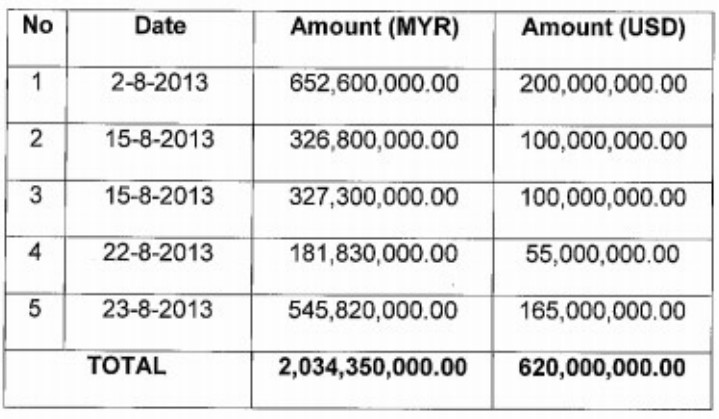
[973] In respect of charges 20 and 21 (amended), evidence was led to show that a total of RM161,411,646.34 was transferred by the accused from account 9694 to Account 1880 through 2 transactions.
[974] The evidence also revealed that there was a letter of instruction from the accused dated 26 August 2013 to close his account 9694 and his savings account of 211-002-009048-1 and had given instructions in respect of the balance amount in account 9694.
(ii) The Identified Amounts (Monies) Were Proceeds Of An Unlawful Activity
[975] The charges against the accused in respect of money laundering comprised the money deposited in the Accused's bank account 9694 amounting to RM2,081,476,926.00.
[976] Based on the definition of "property" in s 3 AMLATFA, the monies in the said bank account and the bank cheques therefore amount to "property".
Was The Said Property, Directly Or Indirectly, A Result Of An Unlawful Activity?
[977] The definition of unlawful activity means any activity which is related, directly or indirectly, to any serious offence or any foreign serious offence.
[978] The definition of a serious offence means inter alia, any of the offences specified in the Second Schedule to the AMLATFA.
[979] A charge under s 23 of MACC Act is listed as one of the offences in the Second Schedule to the AMLATFA.
[980] In light of my finding in respect of the 3rd Charge under s 23(1) MACC Act, the prosecution has thus sufficiently proven that the said property was as a result of an unlawful activity.
Money Trail
[981] The prosecution had also adduced evidence through Adam (PW47) who tendered a Money Trail Report (P1565) and Phase 3 Chart (P805) which showed in diagrammatical form, the flow of monies originating from 1MDB GIL until the transfer into the account of the accused, which ultimately also showed that the monies received in account 9694 belonging to the accused were as a result of the action he took on 25 February 2013 and 14 March 2013 with respect to charge no 3 under s 23(1) MACC Act.
[982] The time frame between the acts of the accused and the receipt of the funds was also proximate.
[983] It was proven that consequent upon the accused's approval on 25 February 2013 for 1MDB to enter into a Joint Venture Agreement with Aabar Investments, which was later signed on 12 March 2013 (P538) and further to the accused's approval of the Letter of Support dated 14 March 2013 (P526), the issuance of the bond amounting to USD3 billion resulted.
[984] Upon the issuance of the said bond, on 19 March 2013, some 3 days after the approval of the accused, 1MDB GIL, via its BSI SA bank account 9714.2001 received a total of USD2,721,000,000.00 (2.721 billion) in 2 transactions on 19 March 2013.
[985] It can thus be discerned that the said amount of USD2.721 billion was obtained directly pursuant to the actions taken by the accused, in relation to the 3rd Charge under s 23 MACC Act. This was thus property derived directly as a result of an unlawful activity as defined.
[986] According to exh. P818 and P746A, based upon the 1MDB GIL's BSI SA bank account which was registered on 8 March 2013, the last balance before the said amount was credited into the account was USD0.00.
[987] Subsequently, on 20 March 2013, 1MDB GIL instructed BSI SA to subscribe for the investment fund of Cistenique, EEMF and Devonshire. Following this instruction, the following transpired:
i. Cistenique received approximately USD530,303,034.00 via 5 transactions between 20 and 21 March 2013;
ii. EEMF received approximately USD414,141,416.00 via 3 transactions between 20 and 21 March 2013; and
iii. Devonshire received approximately USD646,464,649.00 via 5 transactions between 20 and 21 March 2013.
[988] The sum total amount as a result was USD1,590,909,099.00 originating partially from the sum of USD2.721 billion, being the proceeds of unlawful activity.
[989] Out of the funds transferred to Devonshire, on 21 March 2013 itself, there were subsequent transfers of funds to:
i. Tanore, amounting to USD210,000,000.00; and
ii. Granton, amounting to USD430,000,000.00. amounting to a total of USD640,000,000.00
[990] Based on the Tanore and Granton bank account statements, before they obtained the said amount, the last balance was as follows:
i. Tanore: USD-620,000,039.96
ii. Granton: USD-430,000,000.00
See exhibit IDP1613 and IDP1611.
[991] Out of the funds transferred to EEMF and Cistenique, between 22 to 25 March 2013 itself, the following transfers took place:
i. EEMF to Tanore, amounting to USD250,000,000.00; and
ii. Cistenique to Tanore, amounting to USD375,000,000.00,
amounting to a total of USD625,000,000.00
[992] It was proven that the funds received by Granton from Devonshire amounting to USD430,000,000.00 was wholly transferred to Tanore on 21 March 2013, which is the same day the funds were received from Devonshire.
[993] Based on the Tanore bank account statements, before the funds of the said amounts were credited, the last balance was USD620,000,000.00.
[994] The evidence with regard to Tanore receiving the funds was as follows:
i. 21 March 2013 from Devonshire, amount: USD210,000,000.00;
ii. 21 March 2013 from Granton, amount: USD430,000,000.00;
iii. 22 and 25 March 2013 from EEMF, amount: USD250,000,000.00; and
iv. 22 and 25 March 2013 from Cistenique, amount: USD375,000,000.00
amounting to a total of USD1,265,000,000.00.
[995] The monies received by Tanore, was then transferred into the accused's Account ending with 9694 on 22 March 2013 and 25 March 2013 amounting to USD681 million. A total of USD680,999,988.00 was then deposited into the accused's account 9694 account between 22 March 2013 and 10 April 2013, in 9 transactions.
[996] Before the receipts of the respective amounts by Tanore into its bank account, the last balance of its account was USD-620,000,000.00 and during the said span period of 2 days ie 21 and 22 March 2013, there were no other deposits into Tanore's account.
[997] Thereafter, a portion of the said amount, i.e. USD680,999,988.00, was subsequently transferred into the accused's account 9694. It showed therefore that the last stated amount was partly derived from the abovesaid USD1,590,909,099.00, partially obtained from the whole total amount of USD2.721 billion received by 1MDB GIL as a result of the unlawful activity by the accused.
[998] The prosecution helpfully encapsulated these transactions into a diagram shown as follows:
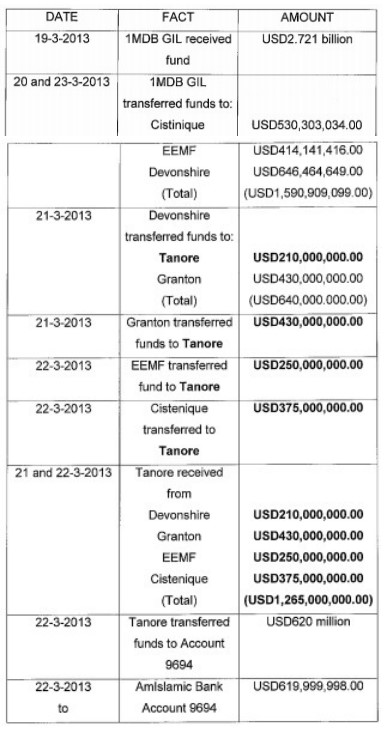
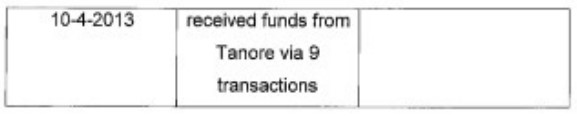
First In First Out (FIFO)
[999] This method of demonstrating that the funds deposited into the account of the accused 9694 totalling USD680,999,988.00 were from Tanore was explained by ACP Foo (PW48).
[1000] PW48 testified that monies resulting from illegal activities could be identified using financial analysis and tracking by using the FIFO method in respect of account 9694. This method served to analyse the cash flowing in and out of the account. The FIFO method used in this investigation involved identifying net money, which means funds not related to Tanore sources, and illegal money, which refers to funds related to the Tanore fund.
[1001] PW48 explained that this method was used in order to differentiate between clean monies and illegal monies when the funds were comingled with other monies in account 9694 originating from sources unrelated to Tanore. This led to the amendment of some of the charges.
[1002] PW48 explained utilising the FIFO method of analysis as in exh P1688, that the total Tanore funds received in Account 9694 amounted to RM2,081,476,926.00 (Charges 1 to 9). From this total, the accused had used RM22,649,000.00 (Charges 11 to 15) and transferred RM1,897,416,277.51 to Tanore (Charges 10 Amended, 16 to 19) and RM161,411,646.34 to his Account 1880 (Charges 20 and 21 Amended).
[1003] PW48 explained that every withdrawal from Account 9694 will reduce the existing balance until it reaches zero. By this method, any funds not originating from Tanore were classified as "clean money." The funds received from Tanore can only be said to be utilised after all other available sources of money have been completely exhausted. This means that the account holder has no remaining balance except for the funds from Tanore. Consequently, it can be inferred that the accused has used the Tanore funds, as there are no other funds left in the bank account.
[1004] PW48 explained that the benefit of doubt is given to the bank account holder using the FIFO method, as each transaction deemed illegal originated from the source of illegal funds deposited into the account under investigation. The available funds in the account will be completely used up before any illegal money is accessed. By using the FIFO method, PW48 was thus able to separate the transfers, received and usage of funds within Account 9694.
[1005] PW48 utilised FIFO for the whole of the Statement of Accounts for 9694 (P1675) as well as a summary (P1688) which focused on the Tanore monies. With reference to item 1 in P1688, the ending balance of the Account 9694 on 20 March 2013 was RM879,812,627.27. This amount was fully utilised by the Accused by item 120, which was on 2 August 2013.
[1006] Items 2, 3, 4, 10, 15, 16, 29, 38, and 40 of P1688 showed that Account 9694 had received a total of RM2,082,476,926.00 which corresponded with the evidence that Account no 9694 had received funds in 9 tranches.
[1007] Subsequently, on 30 July 2013 the accused instructed AmIslamic Bank to transfer the sum of USD620,000,000.00 from Account 9694 back to Tanore (P1200). The first transfer took effect on 2 August 2013. Item 121 of P1688 dated 2 August 2013 showed that the accused transferred out RM652,600,000.00. However, this transfer involved a portion of clean money and a portion of funds from Tanore, that is RM515,666,277.51, as the accused's clean money in the account had been entirely utilised. This led to the amendment of the 10th Charge from RM652,600,000.00 (transferred amount) to RM515,666,277.51 (the proceeds of unlawful activity).
[1008] Item 122 of P1688 dated 2 August 2013, revealed that the accused had used RM20,000,000.00 by issuing a cheque to UMNO, utilising funds received from the Tanore money on 22 March 2013.
[1009] Item 123 of P1688 dated 7 August 2013 showed that the accused had used funds from Tanore amounting to RM100,000.00 by issuing a cheque to UMNO Batu Kawan division.
[1010] Item 124 of P1688, also dated 7 August 2013, showed that the accused had used Tanore funds totaling RM246,000.00 by issuing a cheque to Lim Soon Peng.
[1011] Item 125 of P1688 dated 12 August 2013 showed that the accused had used Tanore funds amounting to RM2,000,000.00 by issuing a cheque to Orb Solutions Sdn Bhd.
[1012] Item 126 dated 14 August 2013, showed that the accused used Tanore funds totaling RM303,000.00 by issuing a cheque to Semarak Consortium Satu Sdn Bhd.
[1013] Subsequent to the first transfer back to Tanore on 2 August 2013, the rest of the transfer took place as shown in items 127, 128, 129 and 130. This resulted in the ending balance of Account 9694 on 23 August 2013 being shown as RM161,411,646.34 as per item 130 of P1688.
[1014] There were instructions from the accused to close Account 9694 vide letter dated 20 June 2013 (P1474), and to transfer RM150,000,000.00 and the balance to Account 9694 to his newly opened Account 1880 (P1311A). These instructions took place on 30 August 2013. As a result of this, the first instruction to transfer RM150,000,000.00 was reflected in the account statement as per item 133 of P1688 while the transferring of the balance from Account 9694 is reflected at item 137 of P1688.
[1015] Based on the FIFO method, it can be seen in item 136 that there was an inflow of clean money after the first transfer to Account 1880. Therefore, the ending balance transferred from Account 9694 to Account 1880, amounting to RM12,436,711.87, had mixed clean money with Tanore funds. However, the illegal funds (Tanore funds) could still be isolated by subtracting the amount of clean money from the illegal Tanore funds in item 133. Thus, the total amount of illegal money transferred to Account 1880 is indicated in item 133, which is RM11,411,646.34.
[1016] Based upon the available evidence therefore, the court finds that the said properties were as a result of the unlawful activity.
[1017] Under all the circumstances, I find that the prosecution had proven the actus reus in respect of all the 21 (twenty-one) charges under the AMLATFA.
(iii) The Presence Of Knowledge Of The Accused As To The Source Of The Proceeds (Mens Rea)
[1018] The act of money laundering can be inferred as stipulated in s 3 of AMLATFA from the following:
"Where:
(aa) as may be inferred from objective factual circumstance, the person knows or has reason to believe, that the property is proceeds from any unlawful activity; or
(bb) in respect of the conduct of a natural person, the person without reasonable excuse fails to take reasonable steps to ascertain whether or not the property is proceeds from any unlawful activity."
[1019] The prosecution has led evidence to show that these objective factual circumstances as stipulated in paragraph aa) and in bb) can be reasonably inferred from the following conduct by the accused:
i) The accused maintained 3 current accounts at the same bank which was opened on the same day ie on 31 July 2013 immediately after Account 9694 that received proceeds from Tanore was closed on the instructions of the accused.
ii) There were code names assigned for all the accused's personal accounts at the bank such as Account 9694 as AmPrivate Banking-MR and Account 1880 as AmPrivate Banking-1MY. However, Tan Sri Zeti (PW46) testified that all personal accounts opened by the account holder must be in the name of the account holder. Joanna Yu (PW41) testified that that Jho Low had requested that the accused's account was to be classified as in the "strictest confidence".
iii) Evidence was led that the accused was very much in control and in charge of the accounts at AmIslamic Bank, despite appointing a mandate holder such as Nik Faisal. According to the accused's statement, he had the knowledge as to the transactions that took place and the purposes for which it was intended.
iv) Tan Sri Zeti (PW46) said that the accused had asked her to declare that he had not committed any wrongdoing.
v) Joanna Yu (PW41) testified as to the role played by Jho Low with respect of the accused's Account 9694 in ensuring sufficiency of funds and said that this was with the knowledge of the accused although Nik Faisal was the mandate holder.
vi) Evidence was led that Akademi Kewartawanan dan Informasi Taima was engaged for the publication of a Chinese weekly, and AD Network was paid as the administrator of the Ah Jib Gor Facebook page. This was done according PW5, to counter negative perceptions from the Chinese community regarding the Government of the day. Payments for these services were made to Tan Sri Lim Soon Peng with the intention of facilitating back-to-back payments to both entities and to avoid linking the accused.
vii) PW8 testified that Orb Solutions Sdn Bhd was established to carry out branding promotion for 1 Malaysia and to manage the accused's social media which incidentally was the only client of the company.
viii) PW45 said that Semarak Konsortium Satu Sdn Bhd (Semarak) was appointed verbally to provide international media team services and English speechwriting for the accused from March 2011 to April 2014 and received a total of RM22,981,688.00 out of which RM303,000.00 were proceeds of unlawful activities.
ix) In light of the enormous sums of funds deposited namely, USD681,000,000.00 and the sums returned of USD620,000,000.00 into the accused's account, it was incumbent upon him to take reasonable steps to ascertain whether or not the property were proceeds from unlawful activity.
[1020] The above instances of conduct, as well as the respective acts of receiving, using and transferring the proceeds by the accused, were also relevant under s 8 of the Evidence Act 1950 and therefore admissible to reasonably and justifiably infer knowledge on the part of the accused with respect to all the 21 charges of money laundering under s 4(1)(a) of AMLATFA.
[1021] Under all the circumstances, I find that the accused was also "wilfully blind" with regard to his failure to inquire into the origin of these funds when the circumstances were such that he ought to have done so.
[1022] Under the circumstances and based upon the evidence, I find that the prosecution had also proven the mens rea in respect of all the AMLA charges.
[1023] The issue in relation to the Arab donations has been addressed earlier.
Decision (End Of Prosecution Case) 21 (Twenty-One) Charges Under The AMLATFA
[1024] In all the circumstances of the case and based upon the available evidence, and upon conducting a maximum evaluation of the prosecution's case, the court finds that the prosecution has successfully proven each ingredient of all the offences under s 4(1)(a) of AMLATFA, which, if unrebutted, would warrant a conviction.
[1025] This Court therefore finds that a prima facie case has been made out against the accused in respect of all the 21 charges under s 4(1)(a) of AMLATFA.
[1026] This court accordingly called upon the accused to make his defence in respect of all 21 charges under s 4(1)(a) of AMLATFA.
[1027] All the alternatives available in respect of all 21 charges individually were explained to the accused in order for him to make his election in respect of making his defence.
[1028] The accused elected to give sworn evidence in respect of all 21 charges.
E) The Defence
[1029] On 30 October 2024, the court ruled at the end of the prosecution case that the prosecution had successfully established a prima facie case against the accused on all the charges under s 23(1) of the Malaysian Anti-Corruption Commission Act 2009 (Act 694) ("MACC Act") and all the charges under s 4(1)(a) of the Anti-Money Laundering and Anti-Terrorism Financing Act 2001 (Act 613) ("AMLATFA") i.e., the Four (4) charges under the MACC Act and twenty-one (21) charges under s 4(1)(a) of the AMLATFA.
[1030] The accused was accordingly asked to make his defence on all these charges, and he elected to make his defence by giving sworn evidence and called 25 other witnesses in his defence.
[1031] The defence began by the accused himself giving evidence under oath and also called several other witnesses in support. The pertinent testimonies of the accused and key witnesses, in summary, are set out hereunder.
(DW1) Dato' Sri Mohd Najib Bin Tun Abd Razak
[1032] The accused opened his defence by lamenting that the consent to prosecute him was given by the Public Prosecutor one day earlier, ie even before the MACC finished recording his statement.
[1033] His dissatisfaction in the manner in which he was treated continued with his complaint that the charges against him were drafted on 28 August 2018, which was 22 days before MACC began to record his statement to hear his version of events.
[1034] He alleged procedural impropriety on the part of the prosecution when he said that some of the documents he signed, which were to form the basis of the accusations against him, were not even shown to him to be explained or controverted.
[1035] The accused testified that the inception of TIA was not even his idea and said that the alleged abuses of position levelled against him were gravely misconceived.
[1036] He said that (P242A), the Memorandum to obtain the Cabinet's approval to extend the RM5,000,000,000.00 Government guarantee to TIA was presented because he was directed to do so by the cabinet under the instruction of the cabinet led by the late Tun Abdullah Ahmad Badawi, as he (the accused) was not even the Prime Minister at the time.
[1037] He also refuted the allegation that he had further abused his position by federalising TIA from the State of Terengganu and had turned it into 1MDB and said that he was against the idea.
[1038] The accused said that the Federal Government had to take over TIA because His Majesty, the Yang di-Pertuan Agong, was inclined to have the Federal Government assume control of TIA.
[1039] The accused then testified that he never explicitly directed the Board of Directors to enter into the Joint Venture ("JV") with PetroSaudi and that if anything, the evidence for the prosecution shows that the Board of Directors, before their Board Meeting on 26 September 2009, had taken active steps towards realising the JV with PetroSaudi and that they had agreed to participate in the JV as early as 18 September 2009 and had even passed a resolution one day earlier to open a joint bank account with PetroSaudi.
[1040] He further refuted the allegation that he had abused his position by approving the additional RM1,000,000,000.00 investment in Murabaha Financing to PetroSaudi. According to the accused, there was never a 'top-down' approach as alleged. The accused testified that by way of reference to various contemporaneous documents, he had demonstrated that the approvals he gave came days, or even months or years later, after it was first mooted, discussed, and deliberated by the Board of Directors.
[1041] He said that according to the prosecution's own evidence, it was the Board of Directors that had earlier agreed to a USD1,500,000,000.00 Murabaha Financing Facility with PetroSaudi and that that decision was made unilaterally by the directors without seeking his approval.
[1042] As for the acquisitions of the two energy assets, Tanjong Energy and Mastika Lagenda, he said that in respect of the Board's decision to acquire Tanjong Energy, he had approved the Board's earlier resolution to acquire Tanjong Energy and he was merely exercising his statutory duties under the Companies Act 1965.
[1043] The accused testified that (PW9) Shahrol Azral, 1MDB's CEO and (PW50) Jasmine Loo, 1MDB's General Counsel, had gone behind the backs of the Board of Directors and entered into a bogus agreement with a fake entity, Aabar Investments PJS Limited and siphoned away US$576,943,490.00.
[1044] As for the acquisition of Mastika Lagenda, the decision had been deliberated on a month earlier when they approved the due diligence exercise for the acquisition of the energy company.
[1045] The accused testified that some two months earlier, the Board heard a presentation from Goldman Sachs and Shahrol Azral on the goal of acquiring additional power plants in addition to Tanjong Energy but lamented that neither Shahrol Azral nor Jasmine Loo nor Azmi were criticised for siphoning a further US$790 million through a bogus agreement.
[1046] DW1 also refuted the allegation that he had abused his office by approving the Joint Venture with Aabar Investments PJS and later signing the Letter of Support for the US$3 billion fundraising undertaken by 1MDB for that purpose. He said that he officially received the proposal for the joint venture from Khadem Al Qubaisi of the International Petroleum Investment Company (IPIC), the Abu Dhabi sovereign wealth fund. He also said that the proposal came after he met with Sheikh Mohammed bin Zayed Al-Nahyan, the then Crown Prince of Abu Dhabi, to discuss bilateral cooperation and foreign direct investment between the two states.
[1047] As for the approval of the US$3 billion Letter of Support, the accused said that he had approved the Letter of Support in favour of 1MDB as the request for the Letter of Support came from 1MDB itself, through its CEO, Shahrol Azral. He pointed out that Shahrol Azral even testified that the letter, in truth, was orchestrated by Jho Low and drafted by Jasmine Loo through the secret correspondence between themselves.
[1048] The accused testified that before tabling the matter to the cabinet, the discussions on the provision of the Letter of Support were all done above board, which involved comments and recommendations by the Treasury Department, Ministry of Finance, and the Attorney-General's Chambers.
[1049] Initially, the Cabinet had approved a Letter of Support for US$6 billion, but later, upon receiving an email from His Excellency Khaldoon Al-Mubarak raising concerns over 'double accounting', the accused said he returned to the Cabinet to request that the amount be halved to US$3 billion. He testified that his actions in fully disclosing the contingent liability to the cabinet and reducing the guaranteed amount were a testament to his lack of personal interest in the matter, and were in the public interest to minimize the financial exposure to the Malaysian Government.
[1050] The accused said that neither the JV with Aabar Investments PJS Limited nor the issuance of the Letter of Support had caused the losses at 1MDB. The losses instead were attributable to the actions of (PW12) Azmi Tahir and (PW10) Hazem Rahman, who had diverted US$1.6 billion of the funds raised by 1MDB for the JV to three unauthorised fiduciary funds and that these funds were diverted barely 24 hours after they were received through the then CFO, Azmi Tahir's blind act of signing of documents in bulk presented by BSI Bank's officers.
[1051] Regarding the accusation of abuse of position in approving the US$975 million Deutsche Bank loan, the accused testified that the loan had already been contemplated by the Board exactly one month before, during a Board discussion on 21 July 2014 (D882).
[1052] As for the US$300 million loan by Deutsche Bank, the accused said that he was forced to defend himself against the accusation of signing a document that even the prosecution itself could not produce.
[1053] The accused testified why he believed the funds he received originated from King Abdullah. He said that his belief that it was a legitimate donation was not out of nowhere and that he did, in fact, receive four donation letters from Prince Saud, which he had forwarded to AmBank for processing. He said that he did in fact, receive remittances from the Saudis and the transfers to his accounts were made from the accounts of the Saudi Princes and even directly from the Ministry of Finance Riyadh supported by the SWIFT documents exhibited in the court which the prosecution themselves furnished.
[1054] All of this, he said was supported by his transparent conduct in opening AmIslamic accounts under his name in his home country and open to scrutiny and his utilisation of the funds for political and social welfare purposes, which were transacted exclusively through the drawing of cheques for record-keeping.
[1055] He also testified that before he returned US$620 million in unutilised donations to the source, he even sought the Governor's (Bank Negara Malaysia) authorisation and said that no one would be so brazen as to alert the central bank and seek its authorisation to move such a large sum and what more to even return US$620 million to begin with.
(DW2) Catherine Nicholas
[1056] DW2 was the Deputy Registrar from the High Court, which had tried the Audit Tampering Trial, and was called to testify that the accused was acquitted and cleared of any wrongdoing in the 'Audit Tampering Trial' by a court of competent jurisdiction on 3 March 2023.
(DW3) Gunasekaran A/L Tholasy
[1057] DW3 from the Employees Provident Fund was a witness subpoenaed by the Defence to testify and produce records of contributions made by 1MDB to its former CEOs, Shahrol Azral (PW9), Hazem Abdul Rahman (PW10), former CFO, Azmi Tahir (PW12), and its former General Counsel, Jasmine Loo Ai Swan (PW50).
[1058] This witness was called to discredit some of the prosecution witnesses, especially Jasmine Loo. The EPF records showed that 1MDB contributed to Jasmine Loo's EPF account from June 2011 up until January 2015, although she testified that she resigned as 1MDB's General Counsel in October 2013.
(DW5) Datuk Professor Syed Omar Al-Saggaf
[1059] Datuk Syed Omar was the former Malaysian ambassador to Saudi Arabia during that material time and his testimony not only confirmed the accused's assertion that the late King Abdullah of Saudi Arabia had promised him a political donation, but he also went further to substantiate the very close relationship the accused had with the late monarch.
[1060] He testified that he was present during the particular audience between the Malaysian delegation and King Abdullah, and he recounted how King Abdullah was impressed with the accused's stewardship and how Malaysia's moderation, despite its multiculturalism, had resonated with King Abdullah.
[1061] He testified that apart from offering political donations to Dato' Sri Najib to be utilised for his political endeavours, King Abdullah also awarded the accused with the Kingdom's highest civilian award, the King Abdul Aziz Order of Merit (First Class), during that same visit. DW5 said that the other recipients of that same accolade were Vladimir Putin of Russia and Barack Obama of the United States of America.
[1062] DW5 also recounted a separate incident in which the Late King Abdullah personally placed a telephone call to the accused while the latter was performing the Hajj in the Kingdom.
[1063] When shown the prosecution's exhibits in the form of SWIFT remittance instructions to the accused AmBank accounts, DW5 confirmed that the funds were channeled through either the Saudi Arabian Government entities or relatives of King Abdullah, Prince Faisal Bin Turki Bin Bandar Al-Saud, Prince Saud Abdulaziz Al-Saud, Riyadh Bank, King Abdul Aziz Street, and even Governmental institutions including the Ministry of Finance, Riyadh and Saudi Monetary Agency, its central bank.
(DW6) Tengku Rahimah Binti Sultan Mahmud
[1064] Yang Mulia Tengku Rahimah, is a member of the Terengganu royal family, who also sat as one of the directors of Terengganu Investment Authority (TIA). YM Tengku Rahimah refuted the Prosecution's allegation that the inception of TIA, the Terengganu-initiated sovereign wealth fund, was the brainchild of the accused.
[1065] She confirmed that in truth, the idea for TIA's inception was that of her brother, Tuanku Mizan Zainal Abidin, the Sultan of Terengganu, who was also Malaysia's 13th Yang di-Pertuan Agong.
[1066] YM Tengku Rahimah's initial introduction to Jho Low was through another corporate figure, the CEO of Cahaya Mata Sarawak, Datuk Syed Ahmad Alwee Alsree, the son-in-law of the late Tun Pehin Sri Haji Abdul Taib bin Mahmud of Sarawak and said that they met at Jho Low's office in Kuala Lumpur, at the Petronas Twin Towers.
[1067] In that meeting, Jho Low adverted to his achievements, including his role in the acquisition of a substantial stake in RHB Bank Berhad by Mubadala, a well-known sovereign wealth fund from the Abu Dhabi emirate.
[1068] DW6 said that being impressed by Jho Low's credentials, connections, and visions, it was she who had introduced him to Tuanku Mizan. DW6 said that lending credence to his connections, Jho Low brought Mubadala's representatives for an audience with the King where Mubadala presented its business model and investment strategies to Tuanku Mizan.
[1069] The King later communicated his wishes to the Prime Minister at that time, the late Tun Abdullah Ahmad Badawi. After Tun Abdullah's special address to the Cabinet, the proposal for the setting up of a sovereign wealth fund for the State of Terengganu and a further RM5,000,000,000.00 in Government guarantee in TIA's favour was unanimously approved by the Cabinet. Her testimony confirmed that TIA was not at all the accused's idea.
(DW7) Mej. Jeneral Dato' Sri Jamil Khir Baharom
[1070] Mejar Jeneral Dato' Sri Jamil Khir Bin Baharom, who was then in charge of Islamic Affairs at the Prime Minister's Department, was part of the Malaysian delegation to Saudi Arabia for an official state visit in January 2010. He accompanied the accused in the audience with King Abdullah of Saudi Arabia at his palace in Riyadh before the commencement of Malaysia's official state visit to the kingdom. Also present in the meeting were Foreign Minister Dato' Seri Anifah Aman and Malaysia's ambassador to Saudi Arabia, Datuk Professor Syed Omar Al-Saggaf.
[1071] During this meeting, DW7 testified, Malaysia had requested, among others, King Abdullah's indulgence in granting an increase in the quota allocated for Malaysian hajj pilgrims to perform the Islamic rites in Saudi Arabia. King Abdullah, on the other hand, expressed his admiration for the accused's leadership of Malaysia, which struck him as a modern but moderate country.
[1072] DW7's testimony also confirmed that the donation pledged by the Late King Abdullah was made personally to the accused to ensure that he remained as Malaysia's leader in the upcoming General Election.
[1073] DW7 said that the late King Abdullah had personally uttered this to the accused when he was there.
(DW8) Fikri AB Rahim
[1074] Tuan Fikri headed the Commission's Anti-Money Laundering division when he was part of a five-member team that travelled to Saudi Arabia in November 2015 and said that the current MACC Chief Commissioner, Tan Sri Azam Baki, was also part of this team.
[1075] The team's mission to Saudi Arabia was to investigate and record statements from individuals from Saudi Arabia to ascertain the veracity of the donations and the accompanying donation letters from the members of the Saudi royal family and their mission was coordinated by the Attorney-General's Chambers, Malaysia.
[1076] Upon arrival in Riyadh, the team were greeted by representatives from Saudi Arabia. They were later asked to relocate to another hotel, arranged by the Kingdom, due to security concerns regarding their state guests. They were escorted, received security protection, and travelled in motorcades.
[1077] They were asked to perform the Umrah in the city of Makkah and travelled there via the Kingdom's jet. DW8 said that even the Ihram garbs were provided to them, and throughout their Umrah rituals, the Kingdom's security personnel escorted them.
[1078] Additionally, prayer spots, located in front of the Ka'bah, were reserved for them. They flew back to Riyadh on the Kingdom's jet and were later granted an audience with the Saudi princes at the Palace of King Abdullah bin Abdulaziz Al-Saud in Riyadh.
[1079] At the palace, said DW8, Prince Saud Abdulaziz Al Saud, a member of the Saudi royal family, presented his passport for verification but declined to have his statement recorded personally, citing his diplomatic immunity. DW8 said that Prince Saud Abdulaziz Al Saud was the author of the four donation letters sent to the accused. However, to assist in the investigation, Prince Saud gave his statement through his representative, Mohammad Abdullah Al-Koman.
[1080] According to the recorded statement, Prince Saud, through his representative, Mohammad Abdullah Al-Koman, reported that King Abdullah had instructed his son, HRH Prince Turki Bin Abdullah Bin Abdulaziz Al-Saud, to extend His Majesty King Abdullah's assistance and contributions to the accused personally. DW8 said that Prince Saud and Prince Faisal were nominated by Prince Turki to identify causes that would further the Kingdom's interests in the Muslim world.
[1081] DW8 testified that Mohammad Abdullah Al-Koman also confirmed on behalf of Prince Saud that HRH Prince Saud issued the four donation letters and that the donations were either remitted through their various assets, investment companies or funding arrangements via nominees and went on to state that he was aware that His Majesty King Abdullah even instructed the Minister of Finance of the Kingdom of Saudi Arabia, His Excellency Ibrahim Bin Abdulaziz Bin Al-Assaf and one of the Kingdom's Ministry of Finance representative, Mohammed Al-Mazyad to make donations via the Ministry of Finance, Kingdom of Saudi Arabia directly to the accused.
(DW9) Nazaruddin Bin Md Kasim
[1082] En Nazaruddin was the Senior Vice President of Compliance at AmBank Berhad and testified that AmBank operated under the rules and regulations established by Bank Negara Malaysia, which included the enforcement of Anti-Money Laundering safety requirements, as well as adherence to other laws and regulations set by Bank Negara and other financial regulators.
[1083] He said that one such precaution was the requirement to conduct a due diligence exercise over substantial financial transactions, which involved an inquiry into the purpose of such transactions by demanding supporting documents.
[1084] DW9 said that the threshold for substantiality was set at transactions exceeding RM50,000.00 or its equivalent in foreign currency coming through the banking system. Another layer of protection is through the reporting of suspected dubious transactions by filing a Suspicious Transactions Report with Bank Negara. These safeguards are applied even more stringently against any 'politically exposed person' (PEP), which, of course, includes the sitting Prime Minister.
(DW10) Mohd Nasharudin Bin Amir
[1085] DW10 was a member of the Joint MACC-AGC investigation team to Saudi Arabia and substantially corroborated DW8's testimony as to what had transpired in Saudi Arabia.
[1086] DW10 (a still-serving officer from MACC) initially referred to the palace as a 'big house'. He later recanted when it was revealed that the statements recorded by MACC's officer, Dato' Hafaz Bin Nazar, stated that the venue was the Palace of King Abdullah Bin Abdulaziz Al Saud in Riyadh.
(DW11) Sac Rajagopal A/L Ramadhass
[1087] Senior Assistant Commissioner Rajagopal a/l Ramadass was the Head of Corporate Crime Investigation Unit (CCID) of Bukit Aman before his retirement.
[1088] Concurrent with the MACC's investigations, PDRM also conducted its investigation into 1MDB and its investigation team was spearheaded by DW11. DW11 testified that he also investigated and interrogated the very same transactions investigated by the MACC.
[1089] DW11's testimony revealed that the same witnesses had provided a different version when PDRM was investigating them for instance, he said when Shahrol Azral gave his statement to the police on the purported meeting with Dato' Sri Najib at Langgak Duta immediately after Tuanku Mizan had decreed the suspension of the IMTN programme, Shahrol initially, in 2016, mentioned that Jho Low was also present at Dato' Sri Najib's residence then. However, two years later in 2018, Shahrol Azral clarified to the police that he had been mistaken and that Jho Low was not present.
[1090] DW11 said that during a Board Meeting on 22 January 2013, Shahrol Azral presented to the Board that the accused had agreed to the setting up of a special purpose vehicle for the Joint Venture with Aabar Investments PJS. DW11 revealed that upon being questioned by the police, Shahrol Azral informed investigators that he had never communicated with the accused on the matter.
[1091] According to DW11, all throughout his investigation, he had not come across any instance where the powers of the Prime Minister under art 117 of 1MDB's Memorandum and Articles of Association were ever invoked.
[1092] According to DW11, for the JV with PSI, Shahrol only briefed certain 'important points' to the Board of Directors instead of tabling the draft JV he had in his possession.
[1093] DW11 also produced the emails he received from Brian Chia (DW23), which were sent to Shahrol Azral by Jho Low, demonstrating that the final draft of the JV Agreement originated from Jho Low immediately before the Board Meeting on 26 September 2009.
That email reads:
"FYI, attached. I am charging you guys A LOT of meals for my sleepless nights! Kindly save and attach in a new e-mail to Brian to let him know it's the final version (ask him not to circulate to Saudi's yet) — I want it to be seen post Board approval."
[1094] In respect of the US$700 million transfer to Jho Low, DW11 confirmed that when Shahrol Azral was interrogated, he never alleged that the transfer was made upon the instruction of the accused.
[1095] DW11 also confirmed that none of the witnesses, despite their assertions in this Court, said that they had to comply with the accused's purported instructions out of fear or that their non-compliance would amount to "suicide", and that none of them mentioned that their actions were under 'duress' or anything of that sort when they gave their statements to PDRM.
[1096] DW11 proposed that the members of 1MDB's management be charged for the offences under the Penal Code for breach of trust, as they had dominion over 1MDB's funds and had diverted billions of dollars without authorisation.
(DW12) Tan Sri Dato' Che Lodin Wok Kamaruddin
[1097] DW12 was 1MDB's Chairman of the Board of Directors and in his testimony, referred to various documented discussions, deliberations, presentations, and decisions made by or to the Management and the Board, which happened days, months, and even years before those resolutions were escalated to the Ministry of Finance for the accused's approval. He also referred to various contemporaneous documents, which the prosecution had tendered, to show that the accused could not have compelled the Board to decide on matters they had deliberated on, long before his approval.
(DW14) Dato' Dr. Shamsul Anwar Bin Sulaiman
[1098] DW14 was serving 1MDB's Corporate Social Responsibility Division and later Ihsan Perdana Sdn Bhd, a non-profit oriented company under 1MDB, an arm committed to implementing the Company's Corporate Social Responsibility initiatives for 1MDB and was tasked with various 1MDB's CSR projects.
[1099] DW14 denied the account given by PW50 that he and the late Kee Kok Thiam were involved in an episode at the Business Centre of Mayfair Hotel, London, where an alleged forgery of one of the four donation letters by Prince Saud was created.
[1100] In particular, DW14 denied the testimony of PW50, who said that in early 2015, she witnessed DW14 raising concerns about the remittances into the accused's account originating from Ihsan Perdana Sdn Bhd and SRC International.
[1101] DW14 denied PW50's testimony that Jho Low instructed the late Kee Kok Thiam, in the presence of Dato' Dr Shamsul (himself), Dennis See and herself to prepare a letter from Prince Saud confirming that the funds were donations from the Kingdom of Saudi Arabia and that PW50 had then allegedly left briefly to discuss other business matters with Jho Low, and when she came back, she saw Kee Kok Thiam drafting the said letter allegedly from Prince Saud.
[1102] DW14 categorically denied ever being at Mayfair Hotel during that period or being in London at that time. He testified that he has never even met Kee Kok Thiam or even Jasmine Loo.
(DW15) Tan Sri Noh Bin Omar
[1103] DW15 was called to testify regarding the decision-making approach at the Cabinet level. DW15 was a former Minister of Agriculture and Agro-Based Industries under the accused's cabinet in 2009, and testified that cabinet decisions are reached by consensus and that the unanimous nature of Cabinet decisions was to the point that even if a Prime Minister had missed a Cabinet meeting, he was still bound by any decision made in his absence by other cabinet members.
[1104] He went on to clarify that a Cabinet decision is not a Prime Minister's decision to make and even during a Special Address by the Prime Minister to the Cabinet, the premier can still be questioned and interjected by the other ministers. He said that even if a particular Minister has presented a Memorandum, the matter presented has still to be deliberated until a consensus is reached among all cabinet members.
[1105] DW15 then confirmed that the Cabinet had agreed to guarantee TIA's RM5,000,000,000.00 bond unanimously during the Cabinet meetings during Tun Abdullah's premiership and that the idea of establishing TIA came from The Yang di-Pertuan Agong and that the options to have TIA federalised were communicated to the Cabinet according to the earlier recommendation made by the Secretary General of Treasury.
(DW16) Puan Nabila Binti Md Yusof
[1106] DW16 was from the Kuala Lumpur Subordinate Courts (Criminal) Registry and was called as a witness for the Defence to produce three (3) active warrants of arrest obtained by both PDRM and MACC against the once fugitive, Jasmine Loo Ai Swan.
[1107] It transpired from her evidence that upon her return from hiding, the arrest warrants issued by the Kuala Lumpur Court against Jasmine Loo (PW50) have not been executed or cancelled by either the PDRM or MACC to date.
[1108] These warrants were sought for possible offences under s 4(1)(a) of the Anti-Money Laundering and Anti-Terrorism Financing Act 2001 and charges under the Capital Markets and Services Act 2007.
(DW17) Puan Salmi Hazlinawati Nawawi
[1109] DW17 was also from the Kuala Lumpur Subordinate Courts (Criminal) Registry and testified that there are two criminal cases against Roger Ng Chong Hwa before the Kuala Lumpur Sessions Court; WA-62SC-11-12/2018 (charges under s 370(c) of the Capital Markets and Services Act 2007) and WA-62SC-10-12/2018 (charges under s 179(c) and s 370(c) of the Capital Markets and Services Act 2007). Those two cases were later requested by the prosecution to be transferred to the Kuala Lumpur High Court on 25 February 2020.
(DW18) Tuan Raywell Anduroh
[1110] DW18 is an investigating officer with MACC and was called to introduce a statement recorded from the late Kee Kok Thiam who was a close associate of Jho Low and had fled the country.
[1111] According to the statement recorded by MACC, Kee Kok Thiam had a prior working relationship with Jho Low. According to his statement, Kee Kok Thiam, has also worked at Utama Banking Group when Jho Low was a director there.
[1112] The MACC recorded confirmation from Kee Kok Thiam that prior to the 14th General election in 2018, Jho Low had asked him, Eric Tan, Casey Tang, Terence Geh, 'Botak' (Jasmine Loo's successor at 1MDB), and Nik Faisal to travel to Macau to monitor the election result.
[1113] When the Barisan National coalition lost the election, Jho Low had asked them not to return to the country. Kee Kok Thiam then went to Cambodia and later to Hong Kong before settling back in Macau.
[1114] His decision to return to Malaysia in 2023 was made after he agreed to forfeit his assets in Singapore and after his lawyer had approached and made a representation to the MACC. Kee Kok Thiam later passed away barely a month after giving his statement to MACC.
(DW19) Tan Sri Dato' Mohamad Fuzi Harun
[1115] DW19 was Malaysia's 11th Inspector General of Police and said that since September 2017, he was in charge of PDRM's task force in the investigation into 1 Malaysia Development Berhad by the police, wherein the police were tasked to probe into 1MDB's Board Minutes, the approvals granted, and resolutions passed relating to the company's payments and transactions made.
[1116] According to DW19, within a week after the 2018 General Election, he was instructed by the then Prime Minister, Tun Dr Mahathir to brief the premier on the progress of PDRM's investigation into 1MDB at the Yayasan Kepimpinan Perdana, Putrajaya. In that same briefing, he was asked by the Prime Minister about the progress of the investigation into the former Prime Minister, Dato' Sri Najib.
[1117] DW19 testified that in July of 2018, he was personally contacted by Tun Dr Mahathir to meet the then Prime Minister at the latter's residence in Sri Kembangan. Again, the Prime Minister was dissatisfied that no charges were made against the accused and other suspects by the PDRM. DW19 responded that PDRM has submitted the investigation to Tan Sri Tommy Thomas, and the decision to charge was his to make.
[1118] DW19 also testified that apart from Tun Dr Mahathir, several other political figures were also keen to know about the status of PDRM's investigation and he had briefed former Interior Minister, Tan Sri Muhyiddin Yassin as well as the late Tun Daim Zainuddin on the status of PDRM's investigation.
[1119] In all those briefings, the PDRM recommended that members of the Board of Directors and top officials of 1MDB be charged in Court for offences under the Malaysian Penal Code.
(DW20) Dato' Mohd Hafaz Bin Nazar
[1120] DW20 was MACC's Deputy Director of Financial Analysis Division in November 2015 when he received instructions to join the cross-border investigation team to travel to Riyadh, Saudi Arabia. The joint AGC-MACC investigation team was tasked with verifying the four Saudi donation letters received by Dato' Sri Najib.
[1121] At King Abdullah's palace in Riyadh, on 29 November 2015, DW20 recorded a statement from the Saudi Prince, His Royal Highness Prince Saud bin Abdulaziz Bin Majid Al-Saud, through his designated representative, one Mohammad Abdullah Al-Koman.
[1122] The recording of the statement was made after verification through the production of Prince Saud's passport. Citing diplomatic immunity, Prince Saud had authorized his representative to make the statement on his behalf instead.
[1123] Prince Saud confirmed that he is a member of the Saudi Royal Family, a descendant and relative of His Majesty, the Late King Abdullah. Prince Saud also confirmed that 'His Majesty had assured His Excellency Dato' Sri Najib that His Majesty will extend assistance and contributions to His Excellency personally for him to implement their shared vision.
[1124] The statement recorded by DW20 also confirmed the four donation letters and that the donations came from Prince Saud in accordance with the wishes of His Majesty King Abdullah. According to DW20, those confirmations were specific down to the dates of each respective letter.
[1125] Through the statement he recorded, Prince Saud also informed MACC of the following: "I am aware that HM had also instructed the Minister of Finance of the KSA ("MOF"), one HE Ibrahim bin Abdulaziz bin Al-Assaf, and the MOF Representative, one Mohammad Al-Mazyad, to make donations via MOF KSA directly to HE personally various sums".
[1126] After recording Prince Saud's statement, at the same palace, DW20 also went on to record the statement from one Tan Kim Loong (Eric).
[1127] DW20 said that Tan Kim Loong confirmed that he was appointed by Prince Turki bin Abdullah bin Abdulaziz Al-Saud to act as nominee for His Majesty King Abdullah and was 'required to deal with whatever assets designated by any of the aforesaid Principals in accordance with their instructions and general directions'.
[1128] DW20 also confirmed that prior to the recording of those statements, the investigation team was officially escorted by officials from the Kingdom of Saudi Arabia and was even escorted and guarded when he performed the rites of the Umrah in the city of Makkah. He testified that before their audience at the palace in Riyadh, they were asked to perform the Umrah in Makkah, which they were able to do by flying on an official private jet of the Kingdom of Saudi Arabia.
(DW21) Puan Nurul Ain Binti Hamzah
[1129] Puan Nurul Ain binti Hamzah is the Deputy Registrar of the Kuala Lumpur High Court and she confirmed that the Public Prosecutor had preferred four criminal charges against Ng Chong Hwa (Roger) under the Capital Markets and Services Act 2007 (CMSA).
[1130] DW14 said that for the case registered as WA-45-5-04/2020, the Public Prosecutor preferred two charges under the CMSA against Roger Ng, one for making misleading statements about the notes issued for the acquisition of Tanjong Energy under s 179(c) and one for conspiring with Goldman Sachs to make misleading statements under s 370(c) for the Notes issued by Goldman Sachs for 1MDB for the investment into ADMIC.
[1131] DW14 confirmed that for the case registered as WA-45-6-04/2020, Roger Ng was further charged under two more charges under the CMSA, one for making misleading statements about the notes issued for the acquisition of Mastika Lagenda under s 179(c) and one for conspiring with Goldman Sachs to make misleading statements under s 370(c) for the Notes issued by Goldman Sachs for 1MDB for the investment into ADMIC.
[1132] DW14 also confirmed that on 9 January 2023, the Public Prosecutor applied to the Kuala Lumpur High Court for all charges against Roger Ng to be discharged not amounting to an acquittal.
(DW22) Raymond Yeoh Cheng Seong
[1133] Raymond Yeoh was the CEO of Deutsche Bank Malaysia between 2006 and 2013 and his testimony gave an account of Deutsche Bank's involvement in the transfer of the US$700 million to the RBS Coutts bank account (now known to be Jho Low's Good Star Limited's account) and the US$300 million to the 1MDB-PSI's JV account at JP Morgan.
[1134] DW22 testified that pursuant to Bank Negara's directive requiring the central bank's written authorisation for remittances exceeding US$100 million abroad, Deutsche Bank had sought Bank Negara's authorisation for the US$700 million and US$300 million transfer instructed by 1MDB.
[1135] He testified that Deutsche Bank had contacted Bank Negara for the authorisation in question and said that in a recorded telephone conversation between Deutsche Bank and Wan Hanisa of Bank Negara's Foreign Exchange Administration Department, it was communicated that it was not for Bank Negara to decide on the business decision of 1MDB.
[1136] Deutsche Bank proceeded with Shahrol Azral's instruction to remit US$700 million into the specified RBS Coutts account ("Good Star account") and US$300 million to the JP Morgan account.
(DW23) Brian Chia Hock Gee
[1137] DW23 was a former partner of the law firm Messrs. Wong & Partners and headed the firm's Corporate and Commercial Securities Practice.
[1138] He testified that around September 2009, he was instructed by 1MDB's CEO, Shahrol Azral, to attend a meeting in London between 1MDB and the PetroSaudi Group of Companies to discuss the joint venture between 1MDB and PetroSaudi. While in London, he also met Jho Low. 1MDB's CEO introduced Jho Low as 1MDB's advisor. Shahrol Azral also instructed Brian Chia to work and liaise with Tang Keng Chee and Jho Low.
[1139] DW23 produced the email in his possession, which was left out in the documents furnished to the defence (D1871) which confirmed that Shahrol Azral not only checked but also responded to the email discussion.
[1140] DW23 testified that Shahrol Azral had personally made amendments to the draft JV agreement and in that said email, Shahrol responded with: "Have updated the docs. This is the version we are gunning to get approval from the BOD and will push on to the PSI. Brian, please note the minor amendments to the JVA."
[1141] DW23 further testified that Shahrol Azral knew about the US$700 million purported indebtedness by the JV Co to PSI's holding company, which was discussed in the draft JV Agreement, and the matter was raised in the first meeting in London attended by Shahrol personally.
[1142] Brian Chia also confirmed that he recorded Wong & Partners' concerns and reservations through two memoranda addressed to Shahrol Azral, recording concerns over the short period of time to conduct corporate searches on PSI's entities and on the due diligence and valuation of PSI's contributed assets into the JV.
[1143] DW23 further confirmed that he had never come across the entity known as PetroSaudi International Limited, not during the meeting in London and neither in any of the draft JV Agreements circulated. The JV had always been contemplated with PetroSaudi Holdings (Cayman) Limited even during the London meeting.
[1144] DW23 testified as to his professional experience as a corporate lawyer for 30 years and said that from his reading of 1MDB's Memorandum and Articles of Association, he was of the view that neither the Board of Advisors nor the Chairman of the Board of Advisors was accorded executive authority.
[1145] He also found art 117 to not be unusual within the context of Government linked companies. He also believed that, for art 117 be invoked, the invocation has to be mentioned explicitly in the documents to ensure there would be no confusion as to which approval capacity is being exercised.
[1146] DW23 also testified that initially, he was asked to appear as a prosecution witness, and he had even prepared his witness statement and furnished it to the prosecution between 2021 and 2022 but never heard from them until 2025, when the defence accepted the prosecution's offer for Brian Chia to testify on their behalf.
(DW24) Neethiya Nair A/P Vijaya Kumar
[1147] DW24 was the Senior Assistant Registrar attached to the Kuala Lumpur Criminal High Court (4) presided by Yang Arif Dato' Muhammad Jamil Bin Hussin.
[1148] DW24 was called to testify on the status of the criminal charges preferred by the Malaysian Public Prosecutor against former Goldman Sachs banker, Ng Chong Hwa ("Roger Ng"), registered as cases no WA-45-5-04/2020 & WA-45-6-04/2020 for offences committed under s 179(c) and s 370(c) of the Capital Markets and Services Act 2007 for his involvement in Goldman Sachs' fundraising exercises for 1MDB.
[1149] DW24 testified that, according to the transcript of the proceedings before the Kuala Lumpur High Court on 9 January 2023 (D1885), the prosecution requested that the charges against Roger Ng be discharged not amounting to an acquittal to give way to Roger Ng's sentencing in his criminal trial in the Eastern District of New York and to also give way to his appeal of the same which would take a while to be disposed of.
[1150] The Prosecution also intimated to the judge that the Public Prosecutor would like to proceed with the charges against Roger Ng once the judicial process in the United States had concluded.
(DW25) Ng Chong Hwa (ROGER)
[1151] DW25 was a former Goldman Sachs executive involved in Goldman Sachs' fundraising for 1MDB in the acquisitions of its energy assets, Tanjong Energy, and Mastika Lagenda. He appeared in several 1MDB Board Meetings on invitation, with, among others, Tim Leissner, to give Goldman Sachs' presentations and advice to 1MDB's Board of Directors.
[1152] DW25 testified that he had yet to be recharged in the Malaysian court for the offences he committed under the Capital Markets and Services Act, although repatriated for that purpose.
[1153] According to DW25, to date, he has not appeared as a witness, nor has he been notified that he was to appear as a witness in any prosecution in Malaysia. Despite his status as a protected witness, he also asserted in court that the U.S. DOJ had legally restrained him from providing statements that touched upon discovery material originating from the US trial.
Ruling In Respect Of DW25's Ability To Testify
[1154] Prior to the defence application to call DW25 to the witness stand, there was an application made by learned counsel for DW25 with regard to a Protective Order which was issued by the court of the Eastern District of New York which prohibited DW25, who had pending charges in the USA, from attending the interview (sought for by counsel for the accused) and from giving testimony in court concerning all material and information disclosed or produced to the defence in the course of his trial in the US.
[1155] Learned counsel representing DW25 said that DW25 could be exposed to criminal liability if he breaches that order, and it was also submitted that upon confirmation by US attorneys with the US Department of Justice, the Protective Order was still in effect.
[1156] Counsel for DW25 then requested for a short adjournment to instruct the US attorneys to apply for a variation of the Protective Order to allow him to testify here without necessarily breaching that order. Learned counsel for the accused objected to this request.
[1157] After hearing respective parties, the court refused the application made by counsel for DW25 on the basis, inter alia that it is not bound by any orders made by courts in the US and that this case has proceeded for far too long to accommodate any more requests for adjournment.
[1158] This court also left it to learned counsel for DW25 to make any application for the court to invoke the statutory immunity provision under s 132 of the Evidence Act 1950.
[1159] This court also ruled that should the witness Roger Ng refuse to be interviewed by learned counsel for the accused, he cannot be forced to do so but the court is only concerned with the fact that the witness has been subjected to a subpoena by the court and he is to accordingly testify as a witness for the defence.
(DW26) Tay Eu Kam
[1160] Ms Tay Eu Kam, DW26, is a forensic document examiner and examined several contested documents produced and relied upon in this trial.
[1161] She holds a Bachelor of Science (Mathematics major), Master of Business Administration, and Master of Forensic Science. She is a member of the Scientific Association of Forensic Examiners (SAFE), International Association of Document Examiners (IADE), Forensic Science Society Malaysia (FSSM), and Association of Certified Fraud Examiners (ACFE).
[1162] DW26 was requested to examine seven contested documents by the defence, ranging from a Minutes of Representative of Holding Company (P334), a purported Minutes of Meeting with the Chairman of the Board of Advisors (P331, P396, & P414), the supposed Kelulusan Pinjaman di bawah Akta Jaminan Pinjaman Pertubuhan Perbadanan 1965 (P469 & P495), and an alleged Letter of Support by the Minister of Finance (P565).
[1163] For the purpose of comparison, DW26 was furnished with 31 specimen documents bearing the accused's signatures and handwriting, comprising AmIslamic Bank cheques signed and issued by the accused, annotations made on official letters, two official memoranda from the Ministry of Finance, and a Letter of Support by the Ministry of Finance. Those specimen documents, dated between March 1, 2011, and March 14, 2013, were compiled from the exhibits relied on and tendered in the court.
[1164] In her findings, DW26 applied the seven Levels of Conclusion from the Scientific Association of Forensic Examiners (SAFE) Standards ranging from 'Identification'(strongest), 'Strong probability did write', 'Probably did write', 'Inconclusive', 'Probably did not write', 'Strong probability did not write', and 'Elimination' (strongest opinion of rejection).
[1165] In respect of the signatures appearing in the Minutes of Representative (P334), the Minutes of Meeting with the Chairman of the Board of Advisors (P331, P396, P414) and the Kelulusan Pinjaman di bawah Akta Jaminan Pinjaman Pertubuhan Perbadanan 1965 (P469), DW26 concluded that they were 'inconclusive' to be that of the writer ie, insufficient to decide on authenticity.
[1166] As for the signature appearing on a Letter of Support by the Minister of Finance (P565), she found significant dissimilarities and concluded that the specimen writer 'probably did not write' the signature. She also opined that there is a 'strong possibility' that the accused did not write the notation on P396.
[1167] In respect of the signature on P495, she noted a few significant similarities in the range of writing. Upon inspection of the 'original' copy in the Court's possession tendered by the prosecution, she found it to be a reproduction (copy), with no indentation marks, and was in an 'A3' size. She could not rule out the possibility that the signature had been lifted and pasted there.
[1168] DW4 and DW13 were called by the defence but however, did not testify as DW4's potential testimony was objected to and determined to amount to no more than a fishing expedition and that of DW13 was objected to as being subject to solicitor-client privilege.
F) Duty Of The Trial Court At The Conclusion Of The Whole Case
[1169] After having heard the evidence for the defence, it is apposite to set out the duty of the trial court at the conclusion of the whole case. This is stipulated in s 182A(1) of the Criminal Procedure Code ("CPC") as follows:
"At the conclusion of the trial, the Court shall consider all the evidence adduced before it and shall decide whether the prosecution has proved its case beyond reasonable doubt."
[1170] Several cases have elucidated what it means by the phrase "the Court shall consider all the evidence adduced before it".
[1171] In the case of Balachandran v. PP [2004] 2 MLRA 547, it was held as follows:
"As the accused can be convicted on the prima facie evidence it must have reached a standard which is capable of supporting a conviction beyond reasonable doubt. However, it must be observed that it cannot, at that stage, be properly described as a case that has been proved beyond reasonable doubt. Proof beyond reasonable doubt involves two aspects. While one is the legal burden on the Prosecution to prove its case beyond reasonable doubt the other is the evidential burden on the accused to raise a reasonable doubt..."
[Emphasis Added]
[1172] In the case of PP v. Ho Sek Kong [2005] 4 MLRH 59, it was held:
" This aspect of proving a case beyond a reasonable doubt has remained steadfast over the years. Over fifty years ago, in the Court of Appeal in Chan Chwen Kong v. PP [1962] 1 MLRA 32 enunciated the same principle in the following words of Thomson CJ:
In most criminal cases there is at some stage an onus of a sort upon the accused person. Once the prosecution produces evidence which if believed would support a conviction there is a tactical onus on the accused person either to produce evidence on his own or to point to something in the prosecution evidence that at the very lowest make the trier of fact less than sure of any conclusions he might otherwise be prepared to base upon the prosecution evidence. If he fails to discharge that tactical onus he will be convicted. That is very true."
[Emphasis Added]
[1173] In Prasit Punyang v. PP [2014] 1 MLRA 387, it was held:
"On the facts of the present case, we find there is merit in the contention of learned counsel for the appellant. In accordance with the provisions of s 182A(1) of the Criminal Procedure Code, it is the bounden duty of the learned JC, at the conclusion of the trial, to consider all the evidence adduced before him and shall decide whether the prosecution has proved its case beyond reasonable doubt. The legislature has advisedly used the term 'all the evidence'. The emphasis must be on the word 'all'.
......
[1174] There is no doubt that the general burden of proof lies throughout the trial on the prosecution to prove beyond reasonable doubt the guilt of the appellant for the offence with which he was charged. It never shifts.
Whether the prosecution has proved its case beyond reasonable doubt depends upon the existence or otherwise of reasonable doubt in the evidence adduced before the court. It is a question of fact that the court has to determine at the conclusion of the trial with great care after taking into consideration the entire evidence and the circumstances prevailing in the case. In Mohamad Radhi Yaakob v. PP [1991] 1 MLRA 158, the Supreme Court said as follows:
To earn an acquittal, the court may not be convinced of the truth of the defence story or version. Raising a reasonable doubt in the guilt of the accused will suffice. It is not; however; wrong for the court to be convinced that the defence version is true, in which case the court must order an acquittal. In appropriate cases it is also not wrong for the court to conclude that the defence story is false or not convincing, but in that instance, the court must not convict until it asks a further question, that even if the court does not accept or believe the defence explanation, does it nevertheless raise a reasonable doubt as to his guilt?"
[Emphasis Added]
[1175] In the case of Md Zainudin Raujan v. PP [2013] 3 MLRA 351, the Federal Court explained as follows:
'At the conclusion of the trial, s 182A of the Criminal Procedure Code imposes a duty on the trial court to consider all the evidence adduced before it and to decide whether the prosecution has proved its case beyond reasonable doubt. The defence of the accused must be considered in the totality of the evidence adduced by the prosecution, as well as in the light of the well-established principles enunciated in Mat v. PP [1963] 1 MLRH 400 with regard to the approach to be taken in evaluating the evidence of the defence. In Mohamed Yatin Abu Bakar v. PP [1949] 1 MLRH 439 Spenser Wilkinson J, at pp 441-442, opined:
"In an ordinary case, where no special burden of proof or explanation is by law cast upon the accused, his position is more favourable than it is in those cases where the law presumes something against him. The principle laid down in the recent English cases, particularly Mancini v. Director of Public Prosecutions appears to me to be that, where no special onus is cast by law upon the accused, then, if his story has the effect of raising a reasonable doubt as to the truth of the prosecution case, he is entitled to an acquittal; and this is the 'ordinary rule' which is referred to in the passage above quoted from Rex v. Garth. In this country, at the close of the case for the prosecution the Court will not call upon the accused for his defence unless the evidence of the prosecution witnesses is, in the first instance, believed. If, when called upon for his defence the accused gives evidence, then the question is, not which story is to be believed, but whether, even if the Court is not inclined to accept all that the accused has said, his evidence does not raise a reasonable doubt as to the truth of the prosecution evidence or as to the accused's guilt"".
[Emphasis Added]
[1176] The position is clear, therefore that a duty is imposed on the trial court to consider all the evidence adduced before it and to decide whether the prosecution has proved its case beyond reasonable doubt and the defence of the accused must be considered in the totality of the evidence adduced by the prosecution. In other words, all the evidence must be considered.
[1177] The phrase "a case beyond reasonable doubt" has itself been the subject of judicial consideration.
[1178] In Mohamad Radhi Yaakob v. PP [1991] 1 MLRA 158, the Federal Court held:
"To earn an acquittal, the court may not be convinced of the truth of the defence story or version. Raising a reasonable doubt in the guilt of the accused will suffice. It is not, however, wrong for the court to be convinced that the defence version is true, in which case the court must order an acquittal. In appropriate cases it is also not wrong for the court to conclude that the defence story is false or not convincing, but in that instance, the court must not convict until it asks a further question, that even if the court does not accept or believe the defence explanation, does it nevertheless raise a reasonable doubt as to his guilt? It is for this reason that in dealing with the defence story or explanation, the majority of judges rightly prefer to adopt straightaway the legally established 'reasonable doubt' test, rather than to delve in the 'believable and convincing' test before applying the 'reasonable doubt' test."
[Emphasis Added]
[1179] Perhaps the most comprehensible elucidation of what amounts to a "reasonable doubt" was that explained in PP v. Saimin & Ors [1971] 1 MLRH 91 as follows:
"The following definition of 'reasonable doubt' is often quoted:
"It is not mere possible doubt, because everything relating to human affairs and depending upon moral evidence is open to some possible or imaginary doubt. It is that state of the case which after the entire comparison and consideration of all the evidence leaves the minds of the jurors in that condition that they cannot say they feel an abiding conviction to a moral certainty of the truth of the charge."
[1180] The burden of proof upon the accused in respect of the 21 money laundering charges under s 4(1)(a) of AMLATFA is to raise a reasonable doubt in the prosecution's case.
[1181] However, where the accused is charged with the offence under s 23(1) of the MACC Act 2009, and there arises, as it has in this case, a presumption of law under s 23(2) of the MACC Act 2009, the burden of proof that is placed on the accused to rebut or explain is on the balance of probability.
[1182] See the cases of Public Prosecutor v. Yuvaraj [1968] 1 MLRA 606 as decided by the Privy Council, R v. Carr-Briant [1943] 1 KB 607 and Mohamad Radhi Yaakob v. PP (supra) by the Federal Court.
i) Preliminary Issues
[1183] Before, however embarking on an evaluation of all the evidence in this case in relation to the charges proper, there were some matters raised by the defence that necessitate consideration. Although this part of the analysis would involve some repetition of matters considered at the close of the prosecution case, as the defence had nonetheless again raised these matters in their submissions at the conclusion of the whole case, they require consideration.
ii) Defence Submission For This Court To Revisit Findings Made At The End Of Prosecution Case
[1184] The defence submitted at length that the court ought to revisit some of its findings at the end of the prosecution case.
[1185] Among the matters raised were:
a) Duplicity of charges
b) Hearsay
c) Credibility of prosecution witnesses
Revisiting Findings Made At Conclusion of The Whole Case
[1186] On the subject of revisiting my findings at the close of the prosecution case, the Federal Court case of Duis Akim & Ors v. PP [2014] 1 MLRA 92 held as follows:
"[38] We note that when assessing the defence the learned trial judge surprisingly revisited his earlier findings upon which he called for the defence. Such approach is quite contrary to the principle of maximum evaluation of the evidence adduced at the close of the prosecution's case. Indeed, in his judgment the learned trial judge made it very clear that he had conducted a maximum evaluation of the evidence adduced by the prosecution before calling for the defence.
....
[39] In Public Prosecutor v. Khong Soh [1966] 1 MLRH 130 Macintyre J said this at p 133:
Having held that a prima facie case had been made out against the respondent, the learned president should have given his reasons for holding why the respondent's evidence had created a reasonable doubt in his mind.
[40] Thus, in the present case the learned trial judge, having given the evidence before him the maximum evaluation before calling for the defence, should have therefore focused on whether the defence had cast a reasonable doubt in the prosecution's case and even if it did not, whether as a whole the prosecution had proved its case beyond reasonable doubt before finding the appellants innocent or guilty for the offence as charged."
[Emphasis Added]
[1187] In the case of Ariff Arhannan Che Udin v. PP & Another Appeal [2022] 4 MLRA 172, the Federal Court held as follows:
"[33] The appellant could only escape liability if he succeeded in raising a reasonable doubt in the prosecution case on any other essential element of the charge such as the nature of the drug, the weight of the drug or the identity of the drug. He could even raise a reasonable doubt on his identification. The trial court must however be mindful not to "revisit" its earlier findings at the close of the prosecution case: see Duis Akim & Ors v. PP [2014] 1 MLRA 92 where Richard Malanjum CJ (Sabah and Sarawak) (later CJ) delivering the judgment of a five member bench of the court said at para 38:
[38] We note that when assessing the defence the learned trial judge surprisingly revisited his earlier findings upon which he called for the defence. Such approach is quite contrary to the principle of maximum evaluation of the evidence adduced at the close of the prosecution's case. Indeed in his judgment the learned trial judge made it very clear that he had conducted a maximum evaluation of the evidence adduced by the prosecution before calling for the defence
[Emphasis Added]
[1188] The authorities are therefore clear that a trial judge, after having evaluated the prosecution case on a maximum evaluation basis, may not revisit his findings at the conclusion of the whole case.
[1189] The duty upon a trial judge at the conclusion of the whole trial is therefore to focus on whether the accused has raised a reasonable doubt in the prosecution case or where a statutory presumption has arisen, whether the accused has rebutted the presumption on a balance of probabilities.
[1190] In the process of doing so, the trial judge must, as of necessity, consider all the evidence adduced, meaning both that of the prosecution as well as the defence.
[1191] Nothing however, permits the trial judge to revisit its findings at the close of the prosecution case.
[1192] Since these matters have been raised, the court will consider the matters below albeit as part of the process of considering all the evidence, meaning the evidence of both the defence and the prosecution, in coming to a finding whether the defence has succeeded in raising a reasonable doubt in the prosecution case or in rebutting a presumption on a balance of probabilities as the case may be.
Duplicity Of Charges
[1193] In respect of the defence allegation that all of the four (4) charges under s 23(1) MACC Act are bad for being duplicitous, defective and ambiguous, I do not find any merit in the argument.
[1194] The short reason is that a perusal of each of the 4 charges will reveal that the time and place of commission of each offence is stated, the particular statutory provision contravened is stated and the capacity in which the accused acted either as Prime Minister, Minister of Finance, and Chairman of 1MDB's Board of Advisors respectively, is clearly stated.
[1195] The four charges also clearly state all the elements required for an offence under s 23(1) of the MACC Act, namely, that the accused, as an officer of a public body, is charged with using his position for gratification for himself.
[1196] Each of the charges then particularises the actions taken by the accused or the making of a decision in any matter in which he has an interest that is sufficient to attract the rebuttable presumption of gratification in s 23(2) of the MACC Act. These particulars explain the conduct relied upon to invoke the presumption and thus satisfy the requirements of a valid charge.
[1197] Those factual particularisations, such as the accused's approvals, directives, and decisions relating to 1MDB's joint ventures and fund transfers, were evidenced by documentary and oral evidence.
[1198] The duplicity argument was raised by the defence citing the fact that several actions were placed in the charges and this offended s 163 CPC.
[1199] In Haji Abdul Ghani Ishak & Anor v. PP [1981] 1 MLRA 649, the Federal Court speaking through Raja Azlan Shah (as H.R.H then was) held:
"that where a charge states a single offence but contains multiple particularisations of acts forming part of that offence, the charge is not duplicitous, provided the acts relate to a single transaction or scheme. His Lordship observed that duplicity arises only where a charge "contains more than one offence in the alternative" and that even where multiple particulars are used, it is permissible "if the matter relates to a single incident".
....
His Lordship further held (at p 681) that:
".. it is clear... that there is only one offence... and that the rest of the charge merely deals with particularisations... It cannot be said that he did not understand it. There is strong reason for thinking, and no reason for denying, that he was not in any way prejudiced.... The objection on the ground of duplicity must therefore fail".
[Emphasis Added]
[1200] Similarly, here there is only one offence in each predicate charge, ie abuse of position for gratification. The subparagraphs merely particularise the several official acts that constitute the conduct complained of and they do not create multiple offences.
Was the Defence/Accused Prejudiced?
[1201] Moreover, the defence here was by no means prejudiced. For one, this was evident from the manner in which the defence conducted itself during the trial.
[1202] Besides being represented by a highly experienced and competent legal team, the defence cross-examined all key witnesses at length on the particulars alleged in each charge, and in respect of the decisions the accused made, his approval of transactions, and the monetary flows into his personal accounts.
[1203] The manner of cross examination showed that the accused acknowledged the essential component of all the charges.
[1204] The accused accepted that the phrase "dengan cara mengambil tindakan seperti berikut" was plain and unambiguous, and that the words "yang mengenainya kamu mempunyai kepentingan secara langsung" were clearly reflected in each count.
[1205] Moreover, when the charges were first read out to the accused in the Sessions Court, the accused had claimed that he understood all the charges and duly pleaded "not guilty".
[1206] This process was duly repeated when the case was eventually transferred to the High Court. During cross examination by the learned Deputy, the exchange that took place between him and the accused was as follows:
(see p 11 to 23 of Subs In Reply Pros).
"Q: DS, setuju dengan saya that secara amnya, you understand that in this trial, DS dipertuduhkan dengan 4 pertuduhan bagi kesalahan di bawah s 23 MACC dan 21 pertuduhan di bawah s 4(1) AMLATFA. Secara generalnya, DS faham DS telah dipertuduhkan dengan 4 pertuduhan di bawah s 23 Akta SPRM dan 21 pertuduhan di bawah s 4(1) AMLATFA, DS setuju dengan saya?
A: Secara amnya ya, tapi..
Q: Secara amnya..
A: Tapi with the duplicity and multiplicity tu.
Q: 4 pertuduhan di bawah s 23 Akta SPRM dan 21 pertuduhan di bawah s 4(1) AMLATFA, betul ya?
A: First charge, 2nd Charge, yeah. 3rd charge, 4th Charge, yeah.
Q: Betul ya. Dan setuju DS jika saya cadangkan dari awal DS dipertuduhkan iaitu pada 20 September 2018 sehingga ke hari ini, DS diwakili oleh Peguam bela yang sama iaitu TS Dr Shafee Abdullah, setuju dengan saya?
A: Pasukan saya sama, ya.
Q: Dari awal pertuduhan sehingga kini ya?
A: Yes.
Q: Saya bawa DS kembali kepada 20 September 2018 di Mahkamah Sesyen KL. Pada hari tersebut, itulah kali pertama DS dipertuduhkan dalam kes ini atas 4 pertuduhan s 23 MACC dan 21 pertuduhan s 4(1) AMLATFA. Setuju dengan saya, pada ketika itu, pada kali pertama DS dipertuduhkan ini, setiap pertuduhan telah dibacakan satu per satu kepada DS dan DS diminta oleh mahkamah untuk membuat plea atau pengakuan betul tak?
A: Ya.
Q: Setiap pertuduhan dibacakan satu per satu kepada DS, betul?
A: Ya.
Q: Kesemua 25 pertuduhan dibacakan satu per satu kepada DS?
A: Betul.
Q: Setiap pertuduhan diterangkan kepada DS, ditanya oleh Mahkamah sama ada faham ke tak?
A: Saya faham hanya secara umum sahaja.
Q: DS, pertuduhan ada dibacakan, ada ditanyakan kepada DS adakah DS faham atau tidak?
A: Saya faham secara umum,
Q: Ada ke tidak benda ni berlaku?
A: Berlaku, faham secara umum.
Q: Itu soalan saya DS, kena faham soalan saya.
A: Ya.
Q: Saya tanya ada tak dibacakan satu per satu? Ada ke tak?
A: Ada.
Q: Ada tak ditanyakan kepada DS sama ada DS faham ke tidak?
A: Ada ditanya.
Q: Terima kasih DS. Dan setuju dengan saya bagi setiap satu pertuduhan yg dibacakan, DS jawab faham. Setuju tak?
A: Secara umumnya. Tapi saya tak dapat melihat secara dalam lagi masa itu.
YA I think what the learned DPP means that we're not asking your subjective mind but actually what happened and what you did as a matter of fact DW1 Yeah, that was my response YA.
Q: Dan DS, lanjutan daripada itu, setuju dengan saya bagi setiap pertuduhan yang telah dibacakan kepada DS, dan DS ditanya sama ada faham ke tidak, DS telah membuat satu plea? You made your plea, betultak?
A: Yes.
Q: Dan with that plea, Mahkamah explained lagi whether you understand the nature and consequences of your plea. Mahkamah memastikan sama ada DS faham sifat dan akibat pengakuan DS itu. Maksudnya. ada hukuman dibacakan, jika kamu mengaku tak bersalah kamu akan dibicarakan, kalau kamu mengaku salah dan kamu disabitkan, inilah hukuman dia. Ada kan ada di explainedkan kepada DS nature and consequences of the plea that you entered?
A: At that stage, macam saya katalah, secara umumnya.
Q: Ada ke tak ada dulu?
A: Dia bagitahu lah.
Q: Yes, alright. Itu di Mahkamah Sesyen KL, 20 September 2018. Setuju dengan saya, pada tarikh kemudiannya, kes ini telah dipindahkan ke Mahkamah Tinggi KL, betul?
A: Betul.
Q: Sekali lagi di Mahkamah Tinggi pula, kesemua 25 pertuduhan dibacakan kepada DS. Sama juga situation, dia jelaskan kepada DS, ditanya kepada DS sama ada faham atau tidak dan dijelaskan tentang nature and consequences of your plea, betul tak DS?
A: Sama, ya.
Q: Ada ya. Bagi kesemua pertuduhan di Mahkamah Sesyen, bila dibacakan juga di Mahkamah Tinggi untuk semua pertuduhan, DS telah memilih untuk tidak mengaku bersalah dan mohon perbicaraan, betul tak?
A: Betul.
Q: Ok. DS setuju dengan saya, di Mahkamah Sesyen dan juga di Mahkamah Tinggi, ketika pertuduhan dibacakan kepada DS, kesemua pertuduhan dibacakan dalam Bahasa Malaysia, dalam Bahasa Kebangsaan bukan dalam Bahasa Inggeris. Ingat tak?
A: Tak, saya tak beberapa ingat Tapi saya boleh semak baik 6 tahun.
Q: Tapi DS, seingat-ingat DS, dalam Mahkamah Sesyen dalam Bahasa Malaysia lah, Bahasa Kebangsaan. Tak mungkinlah Bahasa Inggeris, betul tak?
A: Saya tak beberapa ingat dah. Such a long time ago.
Q: Baik. Kalau saya cadangkan dia sebenarnya baca dalam Bahasa Kebangsaan, DS boleh setuju tak?
A: Kemungkinan besar tapi saya tak pasti 100%"
[1207] In respect of the understanding of the accused of the charges proffered and what they alleged, the cross examination of the accused showed as follows:
"Q: Next kita pergi kepada, setuju dengan saya bahawa pada 1 April, sepertimana yang dinyatakan dalam pertuduhan, DS sebenarnya telah terlibat dengan Mesyuarat Jemaah Menteri sepertimana yang dinyatakan dalam pertuduhan ini. Menghadiri Mesyuarat Jemaah Menteri pada tarikh yang dinyatakan dalam pertuduhan. Jadi boleh sahkan?
A: Sahkan sama ada saya hadir?
Q: Betul.
A: Ya, saya hadir.
Q: DS, setuju butiran pertama ini betul?
A: Saya tak setuju sebab saya telah menjalankan kewajipan saya, official duty.
Q: Ya, faham tetapi pada 1 April 2009..
A: Ya, saya ada.
Q: Memang DS berada dalam mesyuarat ini dan ada dibincangkan mengenai TIA dan sebagainya. Dia punya butiran dalam 1 ya?
A: Ya, setuju.
Q: Untuk para 2, pada 29 Julai 2011, di bilik mesyuarat Jemaah Menteri kita pun telah mengemukakan Nota Mesyuarat Jemaah Menteri. Jadi DS setuju DS hadir ke mesyuarat ini?
A: Ya.
Q: Pada 29 Julai dan semasa itu merupakan PM Malaysia?
A: Ya.
Q: Dan dalam waktu itu, mesyuarat telah memutuskan Kerajaan Persekutuan untuk mengambil alih TIA?
A: Ya, keputusan dalam ini mengambil alih tapi saya akan beri huraian nanti.
Q: Okay. Kita akan pergi satu-satu kita boleh tengok apa Dato' Sri dah setuju mudah untuk kami cross nanti. Okay?
Butiran (3) pada 26 September 2009, Dato' Sri telah mengarahkan Lembaga Pengarah 1MDB iaitu Tan Sri Bakke untuk meluluskan untuk menyertai satu usahasama. Dato' Sri setuju bahawa Dato' Sri telah mengarahkan ini berkaitan panggilan telefon kepada Tan Sri Bakke?
A: Saya tak setuju.
YA Tak setuju dengan butiran / roman (iii) ?
KBO Tak setuju dengan para (iii). So kami ambil maklum.
Q: Butiran (iv), bahawa pada 16 Mei 2011, kamu telah menyebabkan Lembaga Pengarah 1MDB untuk meluluskan Circular Resolution yang membenarkan satu pelaburan berjumlah.. mengenai butiran (iv). Adakah Dato' Sri setuju mengenai butiran (iv)?
A: Tak, saya tak setuju.
Q: Boleh ulang balik, Tuan Akram just memaklumkan dekat saya tadi, Dato' Sri tak setuju dengan (iii) tadi, saya katakan memang Dato' Sri mengambil tindakan yang berkaitan dengan perenggan (Hi)?
A: Ya, saya tak setuju.
Q: Sama juga dengan perenggan (iv) saya katakan setuju bahawa sepertimana yang nyatakan di perenggan (iv)?
A: Saya tak setuju.
Q: Itu pertuduhan pertama Dato’ Sri. Kita pergi ke pertuduhan kedua. Pertuduhan Kedua (Pindaan) ya Dato' Sri. Setuju pada antara 31 Oktober 2012 dan 20 November 2012 terdapat kemasukan duit RM90 juta lebih sepertimana yang dinyatakan dalam pertuduhan ke dalam akaun Dato' Sri? Akaun AMBank 9694?
A: Sebagai donation. Tapi sebenarnya, saya tak ingat.
Q: Tapi ada kemasukan duit ya? Takpa kita akan tunjukkan kemudian. Dan pada waktu tersebut Dato' Sri juga merupakan Perdana Menteri, Menteri Kewangan dan Pengerusi Lembaga Penasihat 1MDB, setuju?
A: Setuju.
Q: Sama juga dengan soalan sebelum ini, butiran (i) pada 9 Februari 2012, di Pejabat 1MDB, sebagai Menteri Kewangan, telah meluluskan 1MDB Energy Sdn Bhd yang merupakan anak syarikat milik penuh 1MDB untuk menawarkan bidaan bagi tujuan cadangan pengambilalihan Tanjong Energy Holdings dengan harga bidaan. Dato’ Sri setuju atau tidak dengan fakta yang dinyatakan dalam perenggan (i)? Tindakannya sebagai Menteri Kewangan telah meluluskan 1MDB Energy Sdn Bhd yang merupakan anak syarikat milik penuh 1MDB untuk menawarkan bidaan tersebut?
A: Tidak setuju.
Q: Butiran (ii), pada 10 Ogos 2012, di Pejabat 1MDB, kamu selaku Menteri Kewangan telah meluluskan pengambilalihan ekuiti Syarikat Mastika dengan harga pembelian agregat RM2.75 billion dan selanjutnya meluluskan 1MDB melalui anak syarikatnya 1MDB Energy (Langat) Sdn Bhd untuk melaksanakan penerbitan 10-Year structured Loan Note bernilai USD 1.75 billion. Adakah Dato' Sri setuju?
A: Tidak setuju.
Q: Dan saya katakan sebenarnya Dato' Sri mengambil tindakan-tindakan berikut, tersebut?
A: Tidak setuju.
Q: Saya miss satu, Dato' Sri, tindakan (i) dan (ii) ini sebenarnya Dato' Sri mempunyai kepentingan, adakah Dato' Sri setuju?
A: Tidak setuju.
Q: Dan kami katakan sebenarnya Dato' Sri mempunyai kepentingan dalam mengambil tindakan-tindakan tersebut, setuju?
A: Tidak setuju.
Q: Memandangkan tadi pertuduhan pertama saya tidak tanya soalan tersebut, adakah tindakan-tindakan yang diambil dalam pertuduhan pertama tadi, Dato' Sri juga mempunyai kepentingan? Saya katakan sebenarnya Dato' Sri mempunyai kepentingan dalam tindakan-tindakan tersebut?
A: Tidak setuju.
Q: Terima kasih. Sekarang ini kita pergi ke pertuduhan ketiga, Dato' Sri. Pertuduhan Ketiga (Pindaan). Dato' Sri ada pertuduhan tersebut?
A: Ya.
Q: Sama mcm sebelum ini, antara 22 Mac 2013 dan 10 April 2013, di AmIslamic Bank Berhad, Dato' Sri sebenarnya telah menerima RM2 Billion sepertimana yang dinyatakan dalam pertuduhan ke dalam akaun 9694, Dato' Sri, setuju?
A: Sebagai donation.
Q: Tapi ada terima duit dalam jumlah sebegini?
A: Ada, tapi jumlah kita kena confirm kemudian.
Q: Pada butiran (i) Pertuduhan Ketiga (Pindaan), pada 25 Februari 2013, di Pejabat 1MDB, sebagai Menteri Kewangan dan pada waktu tersebut Dato' Sri juga sebagai Perdana Menteri Malaysia, Menteri Kewangan Malaysia dan Pengerusi Lembaga Penasihat 1MDB. Setuju Dato' Sri memegang jawatan tersebut pada waktu ini?
A: Ya.
Q: Pada butiran (i) Pertuduhan Ketiga, 25 Februari 2013, di Pejabat 1MDB, selaku Menteri Kewangan, Dato' Sri telah meluluskan 1MDB untuk memasuki satu perjanjian usahasama dengan Aabar Investments. Adakah Dato' Sri setuju telah mengambil tindakan meluluskan 1MDB dalam memasuki perjanjian tersebut dengan Aabar Investments PJS?
A: Tidak.
Q: Dan jika Dato' Sri setuju bahawa Dato' Sri mempunyai kepentingan dalam tindakan tersebut, saya katakan pertama, Dato' Sri mengambil tindakan meluluskan 1MDB memasuki perjanjian tersebut. Adakah Dato' Sri setuju?
A: Tidak.
Q: Dan saya katakan juga Dato' Sri, dalam mengambil tindakan tersebut, Dato' Sri mempunyai kepentingan?
A: Tidak setuju.
Q: Butiran (ii), pada 14 Mac 2013, di Pejabat 1MDB, Dato' Sri sebagai Menteri Kewangan, Dato' Sri telah mengambil tindakan iaitu meluluskan satu Letter of Support kepada 1MDB Global Investment Limited bagi tujuan sokongan kepada terbitan bon berjumlah USD 3 Billion bagi pihak 1MDB. Adakah Dato' Sri setuju Dato' Sri mengambil tindakan meluluskan Letter of Support tersebut yang mana Dato' Sri mempunyai kepentingan mengenainya? Setuju dengan perkara tersebut? Setuju jika saya katakan bahawa Dato' Sri mengambil tindakan to meluluskan Letter of Support sepertimana yang dinyatakan dalam pertuduhan. Adakah Dato' Sri setuju?
A: Tidak.
Q: Dan saya katakan juga dalam mengambil tindakan tersebut, Dato' Sri mempunyai kepentingan, Dato' Sri setuju?
A: Tidak.
Q: Kemudian, kita merujuk Pertuduhan Keempat (Pindaan Kedua). Dato' Sri ada pertuduhan tersebut?
A: Pertuduhan Keempat?
Q: Pertuduhan Keempat (Pindaan Kedua).
A: Ok.
Q: Elemen pertama, Dato' Sri, di antara 23 Jun 2014 dan 19 Disember 2014, di AmIslamic Bank Berhad, Dato' Sri telah menerima suapan, atau Dato' Sri kata donation, suapan RM44 juta sepertimana yang dinyatakan dalam pertuduhan. Adakah Dato' Sri setuju? Telah terima di dalam akaun Dato' Sri ini saya rasa akaun 1880, Dato' Sri telah menerima wang sebanyak RM44 juta tersebut, setuju?
A: Terima sebagai donation tetapi jumlah saya tak berapa jelas.
Q: Dan pada tarikh tersebut, Dato' Sri merupakan Perdana Menteri, Menteri Kewangan dan Pengerusi Lembaga Penasihat, setuju?
A: Setuju.
Q: Okay itu tidak dipertikaikan. Kita tengok butiran (i). Pada 22 Mei 2014, di Pejabat 1MDB, Dato' Sri selaku Menteri Kewangan telah meluluskan 1MDB Energy Holdings Limited yang merupakan anak syarikat milik penuh 1MDB untuk membuat pinjaman melalui initial Bridge Financing Facility sehingga USD300 juta daripada Deutsche Bank AG bagi tujuan terbitan 1MDB Energy Group IPO. Adakah Dato' Sri setuju Dato' Sri telah mengambil tindakan tersebut?
A: Tidak.
Q: Yang mana tindakan tersebut Dato' Sri mempunyai kepentingan?
A: Tidak.
Q: Saya katakan Dato' Sri telah mengambil tindakan meluluskan pinjaman tersebut, adakah Dato' Sri setuju? Dan saya katakan juga Dato' Sri mempunyai kepentingan kepada tindakan Dato' Sri tersebut, setuju?
A: Tidak.
Q: Kita pegi ke butiran (ii). Pada 21 Ogos 2014, di Pejabat 1MDB, selaku Menteri Kewangan, telah meluluskan 1MDB Energy Holdings Limited yang merupakan anak syarikat milik penuh 1MDB untuk membuat pinjaman melalui Term Loan Facility sehingga USD 975 Million daripada Deutsche Bank AG bagi tujuan terbitan 1MDB Energy Group IPO. Adakah Dato' Sri mengambil tindakan tersebut iaitu meluluskan 1MDB Energy Holdings untuk membuat pinjaman tersebut?
A: Tidak.
Q: Dan adakah Dato' Sri setuju bahawa tindakan tersebut Dato' Sri mempunyai kepentingan?
A: Tidak.
Q: So saya katakan bahawa Dato' Sri telah mengambil tindakan seperti yang dinyatakan dalam pertuduhan ini iaitu meluluskan 1MDB Energy Holdings Limited untuk membuat pinjaman tersebut, adakah Dato' Sri setuju?
A: Tidak.
Q: Dan mengambil tindakan tersebut, Dato' Sri mempunyai kepentingan berkaitan dengannya. Dato' Sri setuju?
A: Tidak.
Q: Terima kasih Dato' Sri. Sekurang-kurangnya sekarang ni kita dah tahu Dato' Sri faham kes kami terhadap Dato' Sri. Okay Dato' Sri, minta maaf YA. So, Dato' Sri, berdasarkan kita pergi satu-satu tadi, campur dengan yang TPR Tuan Akram tanya tadi, sebenarnya berdasarkan jawapan, respond yang Dato' Sri berikan tadi pada semua soalan berkaitan dengan pertuduhan, Dato' Sri sebenarnya faham pertuduhan yang dikenakan terhadap Dato' Sri, sekurang-kurangnya s 23 iaitu salah guna kedudukan?
A: la amat mengelirukan.
Q: Soalan dia senang saja. Jawapan dia adalah setuju atau tidak?
A: Tidak.
Q: So saya katakan bahawa sebenarnya berdasarkan daripada cara jawapan Dato' Sri, Dato' Sri sebenarnya faham pertuduhan-pertuduhan tersebut. Setuju atau tidak?
A: Tidak"
[1208] The cross-examination conducted by the prosecution on the accused in relation to his understanding of the charges and his responses thereto shows that the accused understood that the clear allegation against him was that he had used his office to obtain gratification when funds were credited to his accounts. It is apparent from the exchange above that the accused demonstrated his understanding of the charges.
[1209] The accused, when questioned about the allegation that he had used his position to secure 1MDB's participation in joint ventures that ultimately resulted in funds flowing into his accounts, admitted that he understood the wordings of the charge, but he disagreed that it was for his benefit. This showed that the accused understood that the charge was for abuse of position for gratification but only denied his involvement.
[1210] In respect of the element of gratification and 'interest', the accused was asked whether he knew the Prosecution was alleging that the funds entering his accounts were the gratification referred to in the charge, to which he replied in the affirmative but said that the said funds were donations. This demonstrated that the accused understood the underlying basis of the charges, which is that he allegedly received gratification in the form of funds derived from 1MDB transactions.
[1211] When asked about his personal accounts receiving large sums from Tanore Finance and other intermediaries, the accused provided detailed explanations about the inflows, authorisations, and his belief in their legitimacy.
[1212] The accused also demonstrated the ability to distinguish between the different charges proffered and gave his explanation in respect of each transaction.
[1213] In light of the fact that the accused was able to mount the defence of the monies being Arab Donations, it clearly underscores his ability to perceive the nature of the charges against him.
[1214] The manner of cross-examination was detailed, sustained, persistent and unrelenting. This would undoubtedly have been in accordance with the instructions of the accused himself.
[1215] The accused had also previously undergone the SRC trial, where, as far as the MACC charges proffered there were concerned, was similar in nature to the MACC charges here. The contention of the accused, after all of this, that he misunderstood, was misled and prejudiced by the charges, can only legitimately be described as an afterthought and unmeritorious.
[1216] The accused was also a highly educated person holding the most exalted position in Government, and this in itself militated against the seemingly confused position that he now took.
[1217] In summary, the four charges under the MACC Act were in compliance with the provisions of ss 152 to 163 of the CPC, and the charges clearly identified the offence, the actions taken, the capacity in which they were taken and the gratification.
[1218] The findings made herein with respect to the charges under the MACC Act apply with equal force to all the charges under s 4(1)(a) AMLATFA for avoidance of doubt.
[1219] The charges did not therefore suffer from any infirmity, and the accused had not, for the reasons given above, suffered any form of prejudice.
The Allegation That The "Interest" Of The Accused Within The Meaning Of Section 23(2) MACC Act Was Not Specified
[1220] As was held at the conclusion of the case for the prosecution, the interest element is not an integral part of the offence under s 23(1), it being an offending provision. Moreover, the element of "interest" is not stated in s 23(1).
[1221] Section 23(2) of the MACC Act states that when an officer of a public body makes any decision, or takes any action, in relation to any matter in which he has an interest, whether directly or indirectly, he shall be presumed to have used his office or position for gratification, unless the contrary is proved.
[1222] It is clear that s 23(2) is an evidential provision and so if the prosecution intends to rely on the presumption in s 23(2), then it would be incumbent upon the prosecution to establish admissible evidence of the accused's interest in the decision or action that is the subject matter of the charge.
[1223] The requirement under s 23(2), being an evidential matter, requires the establishment of the basic facts which give rise to the statutory presumption.
[1224] There is thus no requirement in law for the nature of the accused's interest in the decision to be stated in the charge. The prosecution had however, adduced sufficient evidence during the course of the trial of the accused's direct interest in 1MDB sufficient to trigger the presumption.
[1225] Section 156 of the CPC states that no omission of particulars is material unless the accused was misled. Nonetheless, I find that the interest element was sufficiently particularised in roman-numerical subparagraphs and which raised the legal presumption under s 23(2).
[1226] I further find that from the nature of the extensive cross examination conducted by the defence and the accused's own answers in response to cross examination, that the accused was not misled and suffered no prejudice as a result.
Was There Conflation Of Sections 23(1) With Section 16 MACC Act?
[1227] The defence asserted that the prosecution had conflated s 23(1) with s 16 of the MACC Act.
[1228] This was because they said that in addition to the multiple dates, locations and wrongdoings specified in the charges, each of the abuse of power charges specified that the offence was committed at Am Islamic Bank but that no evidence was led that the accused was present at Am Islamic Bank.
[1229] The defence submitted that according to the prosecution's clarification, the charge event is the timeline that appears at the top of the charge, and this means that the charge event is at Am Islamic Bank and that therefore, the dates specified are the dates for the receipt of gratification.
[1230] The defence thus submitted that the charges as framed fell under the receipt of gratification under s 16 of the MACC Act.
[1231] Thus, the defence argued that the prosecution had conflated ss 23(1) and 16 of the MACC Act. The defence cited the case of Ravindran Ramasamy v. PP [2015] 3 MLRA 112 in support of their contention.
[1232] An examination of that case, however, will reveal that the express wordings of ss 3 and 3A of the Firearms (Increased Penalties) Act 1971 ("FIPA") were inserted together in the charge.
[1233] The charge had combined both the "principal offence" and the "accomplice offence", which raised ambiguity as to what the accused was being tried for.
[1234] It was for that reason that the court held that this had run afoul of the relevant provisions in the CPC and was therefore bad for duplicity.
[1235] An examination of the charges in the instant case before us shows that each of the four charges clearly states the commission of one offence only, namely, that the accused, as an officer of a public body, used his position for gratification.
[1236] The four charges also do not reveal the inclusion of any elements or ingredients of a s 16 charge.
[1237] I find thus that the defence assertion that there was conflation between ss 23(1) and 16, to be without merit.
Hearsay Evidence
[1238] The defence also urged the court to revisit its findings made in respect of hearsay at the conclusion of the prosecution case.
[1239] This was in the main with respect to certain statements, in oral and written form, that emanated from persons who were not present as witnesses during the trial.
[1240] As already stated above, nothing in the law enables the court to revisit the findings made at the close of the prosecution case. Nevertheless, as these matters were submitted by the defence at the conclusion of the whole case, I will therefore deal with them not as a matter of revisiting my findings previously made, but in the process of considering all of the evidence adduced at the end of the whole case and ultimately in determining whether the defence has succeeded in raising a reasonable doubt in the prosecution case or in rebutting a presumption on a balance of probabilities, as the case may be.
[1241] In any event, I am still of the firm view that the statements made in both oral and written form were admissible at trial through the application of s 32(1)(b) of the Evidence Act 1950 ("EA") and the common law exception as stated in the Privy Council case of Subramaniam v. Public Prosecutor (supra).
[1242] The statements which are embodied in both oral and written form are in the form of communications made to the officials in 1MDB and the Prime Minister's Office (PMO), and other witnesses by individuals not called by the prosecution.
[1243] The individuals who were not present in court as witnesses were the following:
a) Low Taek Jho (also known as Jho Low);
b) Datuk Azlin bin Alias;
c) Geh Choh Heng (Terence Geh); and
d) Nik Faisal Ariff Kamil.
[1244] Although reproduced earlier, for the sake of convenience, s 32(1)(b) EA is again set out as follows:
"Cases in which statement of relevant fact by person who is dead or cannot be found, etc., is relevant 32. (1) Statements, written or verbal, of relevant facts made by a person who is dead or who cannot be found, or who has become incapable of giving evidence, or whose attendance cannot be procured without an amount of delay or expense which under the circumstances of the case appears to the court unreasonable, are themselves relevant facts in the following cases:
...
b) when the statement was made by any such person in the ordinary course of business, and in particular when it consists of any entry or memorandum made by him in books kept in the ordinary course of business or in the discharge of professional duty; or of an acknowledgment written or signed by him of the receipt of money, goods, securities or property of any kind; or of a document used in commerce, written or signed by him, or of the date of a letter or other document usually dated, written or signed by him."
[1245] The conditions of admissibility under s 32(1)(b) of the Evidence Act 1950, as can be discerned from the section itself, are the following:
(i) Statements — either written or verbal;
(ii) It must be of relevant facts;
(iii) The statements were made by a person who cannot be found or dead; and
(iv) The statement was made by any such person in the ordinary course of business.
[1246] This constitutes an exception to the hearsay rule that statements by persons who are themselves not called as witnesses are inadmissible to prove the truth of the assertions made.
[1247] As it is an exception to the hearsay rule, while it must therefore be accorded a fairly strict interpretation, the exception stands to be applied in circumstances which by their very nature, as to their consistency and subsequent actions taken by certain related parties themselves, vouch for the accuracy and reliability of those statements. The acid test as to their admission in all circumstances nonetheless must be their strict relevancy to the facts in issue.
[1248] In addition, the admissibility of these statements must not be conflated with the weight to be accorded to the statements, as these are two entirely different matters so while the statements may be rendered admissible by virtue of the statutory or common law exceptions, the weight to be assigned to them is a different matter altogether.
[1249] The defence submitted that the prosecution's evidence, in particular, the statements or e-mails by Jho Low, Nik Faisal, Azlin Alias, and Terence Geh adduced through PW8 (Amhari), PW9 (Shahrol), PW10 (Hazem), PW12 (Azmi Tahir) PW50 (Jasmine Loo) and other witnesses amount to inadmissible hearsay under s 60 of the Evidence Act 1950 ("EA") and fails to satisfy the exception in s 32(1)(b).
[1250] The defence submitted that the reason is because the prosecution has failed to satisfy the requirement that:
i. The declarants are persons who cannot be found (within s 32(1)(b)); and
ii. The statements were made in the ordinary course of business.
Persons Who Are Either "Dead" Or "Who Cannot Be Found"
[1251] The attack launched by the defence in respect of the fact that the declarants are not persons who cannot be found is premised upon the fact that MACC had failed to show genuine efforts to trace Jho Low, Nik Faisal, or Terence Geh by reason of the following:
i. No police reports, letters, or witness testimony on search efforts.
ii. Reliance on "judicial notice" that Jho Low "cannot be found" is impermissible.
iii. Jasmine Loo's continuing communication with Jho Low shows he can be located.
iv. Improper reliance on extraneous considerations for e.g. filing of charges in absentia, tax litigation, or media reports cannot prove unavailability.
v. Statements were not made in the ordinary course of business as the communications were "directional," not routine and they were part of an alleged conspiracy, not normal company record-keeping.
vi. The defence argues that hearsay exceptions must be construed strictly.
[1252] As far as the fact that the declarants of these verbal and/or written statements are not persons who "cannot be found" is concerned, the prosecution had tendered sufficient evidence to satisfy this element.
[1253] As far as Jho Low is concerned, PW50 (Jasmine Loo Ai Swan) testified that she met Jho Low in China in 2017 and that he later instructed her to remain abroad after the 2018 General Election.
[1254] The testimony of Jasmine Loo thus indicates that Jho Low was not within the jurisdiction of Malaysia during and since that time. The fact that she was in communication to him made no difference if Jho Low was overseas, as he was still outside the jurisdiction.
[1255] The defence themselves produced documents which were marked as exhibits D949 (A-H) and D796 showing that Jho Low was charged in absentia in the courts in Malaysia.
[1256] Jho Low has been classified as a fugitive from justice and has had Interpol Red Notices issued against him as well as pending charges against him.
[1257] There are matters of which the courts may take judicial notice of according to s 57 of the EA. There are sufficient authorities that hold that the categories under s 57 are not closed.
[1258] In Chu Boon Yeh & Anor v. Kerajaan Malaysia [2015] 4 MLRH 612, the test for the admission of such matters were explained as follows:
"It is true that s 57(2) of the Evidence Act 1950 vests in the Court a wide power of judicially informing itself of matters of which it can take judicial notice (see Lim Kong v. PP [1962] 1 MLRH 536). But it is also trite law that matters of which the Court may take judicial notice must be the subject of common and general knowledge and accepted by the public without qualification or contention. The test is whether sufficient notoriety attaches to the fact involved as to make it proper to assume its existence without proof."
[Emphasis Added]
[1259] There is little doubt as to the well-known public fact, made available through the wider media both nationally and internationally, that Jho Low has yet to be brought before the relevant and appropriate courts in this country and abroad to face the demands of justice.
[1260] To ignore this fact, would be akin to a hermit living as a recluse in the farthermost corners of the globe and in an inner and dark cave unreached by the outside world.
[1261] I therefore see no reason to depart from my earlier findings that Jho Low is a person who "cannot be found" within the meaning of s 32(1)(b) EA.
[1262] In respect of Nik Faisal Ariff Kamil and Geh Choh Heng or Terence Geh, I also find that they are persons who "cannot be found" within the meaning of s 32(1)(b) EA by reason of the fact that they also have been charged and sued in absentia and are nationally and internationally recognised as being fugitives in hiding from justice and also by reason of Interpol Red Notices issued against them.
[1263] This fact is also so well known that they squarely fit into the category of matters of which the court can take judicial notice of.
[1264] The position was such that even if the authorities had done all in their power to locate these individuals, the plain fact is that in respect of Jho Low, Terence Geh and Nik Faisal, no subpoena could ever be served on them simply because they were unable to be located.
[1265] I find no reason thus to depart from my findings in this regard made at the end of the prosecution case.
[1266] In respect of Datuk Azlin Alias, his death in the Semenyih helicopter crash on 4 April 2015 is a matter of public record and was acknowledged in the grounds of judgment in the case of PP v. Dato' Sri Mohd Najib Hj Abd Razak [2020] 5 MLRH 232.
[1267] PW8 also testified regarding the demise of Datuk Azlin Alias and the impact that it had on 1MDB's internal operations. This fact too is admissible by way of judicial notice as being the subject of common and general knowledge and accepted by the public without qualification or contention and of sufficient public notoriety.
[1268] These facts also satisfied the statutory requirement that Datuk Azlin Alias is a person who is classified as being dead within the meaning of s 32(1)(b) EA.
Statements Made In The "Ordinary Course Of Business"
[1269] The other requirement to be satisfied in order to admit statements under s 32(1)(b) EA is that these statements must be made in the "ordinary course of business".
[1270] It is first necessary to examine the nature of the relationship between these persons who fall into the category of either "dead" or who "cannot be found" with the accused.
[1271] This is because whatever was alleged to have been said by the accused in relation to the affairs of 1MDB was made to these persons who are "dead" or "cannot be found", and came through the testimony of the witnesses who testified in court.
[1272] The prosecution adduced cogent evidence that Jho Low was the person who conducted the affairs of the accused in 1MDB and also managed the personal banking accounts of the accused at AmBank.
[1273] The following witnesses testified as to the nature of the relationship between the accused and Jho Low with regard to the affairs of 1MDB. Most of them had direct interactions with Jho Low regarding these matters.
(PW8) Datuk Amhari Effendi Nazaruddin
[1274] PW8 served as the accused's Special Officer between 2009 and 2016 and described Jho Low as "a key adviser to Dato' Sri Najib" who was already close to the accused and his family.
[1275] PW8 testified that he received messages and e-mails from Jho Low conveying specific instructions approved by the accused, including his own authorisation to attend the Terengganu Investment Authority meeting in 2008.
[1276] PW8 testified that Jho Low frequently supplied "talking points" and "action plans" prepared to defend the accused from public criticism over 1MDB and that he routinely passed such materials to the accused upon Jho Low's instructions. PW8 regarded Jho Low's communications as emanating directly from the accused.
(PW9) Datuk Shahrol Azral
[1277] PW9 was the first Chief Executive Officer of 1MDB. He stated that all major decisions requiring the shareholder's approval under art 117 of 1MDB's Memorandum and Articles ("M & A") were channelled through Jho Low, who repeatedly asserted that his directions carried the accused's "blessing."
[1278] PW9 received numerous "talking points" and "action plans" via private e-mail and Blackberry ("BBM") messages from Jho Low and asserted that every directive so conveyed was later confirmed or ratified by the accused. He described Jho Low as the "orchestrator" of 1MDB's projects, acting "on behalf of DS Najib."
(PW10) Hazem Abdul Rahman
[1279] PW10, who became the Chief Operating Officer and later Chief Executive Officer, testified that he was introduced to Jho Low by Datuk Azlin Alias, the accused's Principal Private Secretary.
[1280] He described Jho Low as the accused's unofficial adviser and voice in 1MDB. Hazem testified that Jho Low explained that 1MDB's true purpose was to serve the political and financial interests of the accused and that all decisions were subject to Jho Low's clearance.
[1281] Hazem's appointment letter was signed by the accused and he testified as to his understanding that Jho Low spoke with the Prime Minister's authority.
[1282] PW10 explained as to how Jho Low transmitted detailed "talking points" and "action plans" by way of e-mail and BBM, which the management executed in accordance with those directions.
[1283] PW12, who was the Chief Financial Officer, testified that he was introduced to Jho Low by Datuk Azlin, who confirmed that instructions from Jho Low and Datuk Azlin were to be treated as the accused's own.
[1284] PW12 was told in no uncertain terms that Jho Low was "the adviser to the Prime Minister" and that compliance with his directions was mandatory. PW12 said that following from this, he implemented financial instructions received through Jho Low and Datuk Azlin, which he believed carried the Prime Minister's mandate.
(PW13) Tan Sri Ismee Ismail
[1285] PW13 was a member of the 1MDB Board and testified that Jho Low acted as an adviser to the accused and routinely corresponded with members of the Board and management using the e-mail address dealrainman1@gmail.com.
[1286] He said that notwithstanding that Jho Low held no official post in 1MDB, the Board accorded weight to his proposals because of his well-known intimacy and proximity with the accused, whom Jho Low habitually referred to as "boss" or "PM."
[1287] PW13 further testified that he observed Jho Low accompanying the accused on official overseas visits.
(PW15) Tan Sri Mohd Bakke Salleh
[1288] PW15 testified as to the nature of the relationship that Jho Low had with the accused.
[1289] This is evident from the evidence of PW15 in court as follows:
Notes of Proceedings ("NOP") DATED 18 May 2022
"Q: Alright, but that's another occasion that you met Jho Low.
A: Hmm.
Q: Could you tell the court. Were there other occasion?
A: Well, I bumped into him at the Ministry of Defense.
Q: Okay.
A: Office.
Q: That was DS Najib?
A: Yes. And also at DS Najib's office at Putrajaya when he was Deputy Prime Minister.
Q: So you bumped into him?
A: Yes.
Q: Is there anything else?
A: No. He was at the office. And it was one occasion when I was waiting to enter the room of the Minister of Defense, Jho Low came out. He was there before me.
.....
Q: What do you think was the relationship between Jho Low and DS Najib?
A: Again based on what had happened, by way of the events preceding the signing of the agreement with Petro Saudi and the eventual remittance or payments to Saudi and also the joint, the bank account of the JV company, the two payments. Up to that point, I think we, my concern, especially was that, you know, more on the date to be to expedite this thing to work quickly, which I felt was out of line with a normal way of doing any kind of project evaluation or investment appraisal. So, the concern is why, why are we applying a lot of pressure and wanting to get this done by a certain date, when there's so many loose ends, so many things that need to be so there was no suspicion or...
Q: So Tan Sri, what do you think was the relationship between Jho Low and DS Najib at that time?
A: At that time? Someone who, who is like a conduit of an intermediary between the Board and him, right.
Q: There's nothing wrong with it?
A: Nothing wrong.
Q: Nothing wrong if it was true that Jho Low was an intermediary between the board and 1MDB. And... A And Prime Minister.
Q: Okay.
A: Yes."
....
Q: Yes. You're saying that you have suspicions the Prime Minister was dictating the management not to obey the Board correct?
A: What I said was...
Q: Tan Sri you said that.
A: Did I say that?
Q: Of course you said that. Come on, Tan Sri.
A: The Prime Minister...
Q: I'm a lot older than you. I can remember every word.
A: But what I said was, the management was taking instructions outside the Board. Above the Board.
Q: Yes. And you said, one of the members is Jho Low and the Prime Minister.
A: That's right
Q: I only suggested Jho Low, but you added the Prime Minister.
A: Yeah. That's right. Both of them. Yeah.
Q: So, you're saying that the Prime Minister and Jho Low was directing the management not to obey the Board. You said that.
A: That's the inference, yeah.
Q: Yes. Now, isn't that an offence committed by the management? Jho Low, the Prime Minister? Serious offence. Correct?
A: Hm.
Q: Tan Sri?
A: Yes."
[Emphasis Added]
[1290] In re-examination, PW15 testified as to the impact the phone call with the accused had on his mind and the members of the BOD in respect of the JV with Petro Saudi:
NOP Dated 19 May 2022
(Re-examination)
"Q: So, what meaning did the accused's words convey to your mind?
A: I think again the way I construed the words. Just say "Okay. Just lay off. Don't spend time looking at how the monies were raised. That was my... (Inaudible)".
Q: What money was raised where?
A: This Islamic Medium-Term Notes. RM5,000,000,000.00. The funding for TIA (Terengganu Investment Authority).
Q: So, what impact did it have on your mind?
A: Essentially; because the phone call comprises two parts. One, don't spend too much time looking at how the monies was raised earlier. Now I want you to focus on the PetroSaudi proposal. So, essentially the request by the Prime Minister to shift our focus or attention in evaluating the PetroSaudi proposal although we all know that Islamic Medium-Term Notes issuance was a very important matter that had to be attended or pursued by the Board."
[Emphasis Added]
[1291] It is clear from the evidence of PW15 that prior to a meeting in respect of the PetroSaudi joint venture, Jho Low handed him a phone and said "PM on the line."
[1292] During the phone call, the accused instructed PW15 to expedite the approval of the PetroSaudi proposal, describing it as an important Government-to-Government project.
[1293] PW15 later testified that it was evident to him that the management was taking directions "above the Board" from both Jho Low and the Prime Minister, and that Jho Low acted as a conduit between the Board and the accused.
[1294] The testimony of PW15 was clear that Jho Low acted under the instructions of the accused in matters regarding the running of 1MDB and this influence extended to the management and the board of directors level.
(PW16) Datuk Wan Shihab Ismail
[1295] PW16 was a Special Officer to the accused and testified to Jho Low's personal proximity to the accused and his family. He testified that Jho Low personally arranged and coordinated several of the accused's family vacations abroad on the luxury yachts RM Elegance (2009) and Topaz (2013).
[1296] He also testified that all arrangements proposed by Jho Low were confirmed by the accused without objection. Photographs were also tendered in evidence showing Jho Low accompanying the accused, Datin Sri Rosmah Mansor, their children, and foreign business associates, including officials linked to Aabar Investments.
[1297] PW16 further confirmed that Jho Low maintained regular communication with the Prime Minister's Office via e-mail and BBM.
PW41 (Joanna Yu Ging Ping)
[1298] PW41 was the banker or the relationship manager in charge of the accused's bank account and testified mainly in respect to the affairs of the accused bank accounts in AMBANK, particularly the '9694' account.
[1299] She said that she had communicated with Jho Low via BBM messenger (P1479). Her evidence clearly showed the extent of the accused's reliance on Jho Low in relation to the affairs in his own bank account.
[1300] PW41 also testified that she was in communication with Nik Faisal relating to the affairs of the accused's bank account.
PW44 (Kevin Swampillai)
[1301] PW44 was the BSI Banker in charge of various investments made by 1MDB and its subsidiaries. His evidence showed the role played by Jho Low in arranging for investment made by 1MDB and the layering transaction undertaken in order to camouflage the flow of monies which eventually ended up in the accused '9694' account.
PW50 (Jasmine Loo Ai Swan)
[1302] PW50 was the Legal Counsel of 1MDB and served between the period May 2011 until November 2013. She was a fugitive from justice until her eventual return to Malaysia. She was extensively cross-examined by learned defence counsel on the nature of her relationship with Jho Low and was subject to sustained and prolonged assault upon her credibility.
[1303] In spite of that, she steadfastly testified to and gave a comprehensive narrative regarding Jho Low's role in the affairs of 1MDB as well as Jho Low's close association with the accused.
[1304] All these pieces of evidence outlined above, when taken cumulatively, cannot be described in any other manner except that it revealed an unmistakable bond and connection between the accused and Jho Low.
[1305] Her evidence was so replete with details that she had to be regarded either as a witness of truth with regard to these matters or to consider that this witness had such a wild and fertile imagination that she could have conjured up such fabricated evidence on the spur of the moment amidst such attacks launched on her character and credibility.
[1306] This bond and connection between the accused and Jho Low, as testified to by PW50, showed that Jho Low operated as a go-between the accused and the running of the affairs of 1MDB in that his instructions clearly reflected the directions of the accused in respect of the operations of 1MDB.
[1307] It is also clear from the evidence that Jho Low had maintained constant communication with the witnesses above who were involved in the management of 1MDB and that he issued instructions to them on the authority of the accused.
[1308] The observance as to the close relationship and proximity of Jho Low with the accused was such that every single one of them, without exception, treated instructions regarding the running of the affairs of 1MDB emanating from Jho Low as coming directly from the accused.
[1309] Could all of the evidence regarding the proximity between Jho Low and the accused which in turn led to various instructions being issued through varying modes in relation to the running of the affairs of 1MDB be described as a mere unfortunate coincidence befalling upon the unsuspecting accused or did they in actual fact show clearly that there truly was a top down approach to the management of 1MDB and that Jho Low was unmistakably, the agent of the accused?
[1310] The testimonies of the prosecution's witnesses, namely PW8, PW9, PW10, and PW12, showed that Jho Low's "talking points," "action plans," and e-mails were integral parts of 1MDB's operational workflow.
[1311] All the verbal instructions and communications made by Jho Low were made in the ordinary course of 1MDB's business. These consisted of operational instructions, talking points, and approvals conveyed to company officers for implementation of corporate transactions, including the PetroSaudi joint venture, energy acquisitions, and fund-management activities.
[1312] These directions formed part of the day-to-day conduct of 1MDB's affairs and were treated by the recipients as official guidance emanating from the shareholder, MOF Inc., through the accused.
[1313] The manner of their content, frequency, and context of these statements demonstrate that they were not mere frivolous remarks but communications made in the discharge of professional duties by both the sender, who acted as the accused's intermediary and the recipients who were acting in the course of their employment.
[1314] These communications therefore fell squarely within the "ordinary course of business" limb of s 32(1)(b) as they were routinely transmitted between executives (PW9, PW10 and PW12) and were used to implement board resolutions, shareholder directives, and funding decisions that all fell within the purview of business matters and functions.
[1315] The evidence clearly points to the fact that this was no coincidence but was evident of a relationship in which Jho Low operated as a proxy or agent of the accused with regard to the running of the affairs of 1MDB.
[1316] The attempt by the accused to distance himself from Jho Low rang hollow in the light of the overwhelming evidence of these prosecution witnesses.
[1317] In the case of Tay Choo Foo v. Tengku Mohd Saad & ors (supra) the Court of Appeal held as follows:
"[85] We would agree with the learned judge that the words "in the ordinary course of business" appearing in s 32(1)(b) of the Act should be given "a broad and liberal connotation"".
[1318] The Indian case of Devi Singh v. Mt. Pulma (supra) held in relation to their equivalent of s 32 EA as follows:
"The passing of information about the important and chief events in the history of a family by the male members of the family to the women folk on by the elders to the youngers should be held to be in the ordinary course of business and those words should be given a broad and liberal connotation. To hold otherwise would result in the shutting out of proof of facts on which on account of lapse of time direct evidence is not available",
[Emphasis Added]
Datuk Azlin Alias and Terence Geh
PW8 (Datuk Amhari Effendi Nazaruddin)
[1319] Besides the communications made by Jho Low to him, PW8 testified that he was also in constant contact with Datuk Azlin Alias, who was his superior officer in the Economic Division of the Prime Minister's Office (PMO). PW8 had also worked with Terence Geh during the bail-out phase for 1MDB.
[1320] Therefore, it is clear that during the period while PW8 was serving as the accused's special officer, he was in fact carrying out his duty in the ordinary course of business of 1MDB, and the matters communicated to him by these persons were also communicated in the ordinary course of business.
PW9 (Datuk Shahrol Azral bin Ibrahim Halmi)
[1321] PW9 was the CEO of 1MDB right from its inception on 23 March 2009 until his departure in March 2013.
[1322] PW9 testified that he was also in communication with Datuk Azlin Alias as well as Geh Choh Heng (Terence Geh) in relation to matters pertaining to 1MDB. PW 9 had also communicated with Nik Faisal Ariff Kamil since both of them were on the Board of SRC International.
PW10 (Hazem Abdul Rahman)
[1323] PW10, testified as follows at para 143 of his witness statement:
"Jho Low telah meletakkan salah seorang proksi beliau iaitu Choh Heng Geh (Terence Geh) untuk menandatangani sebarang dokumen-dokumen kewangan 1MDB GIL bagi akaun BSI ini. Saya mengetahui perkara ini kerana sebelum menandatangani dokumen ini, saya telah pun diberikan update perancangan dan tindakan oleh Jho Lowmelalui emel sebelum itu lagi. ini termasuklah pelantikan-pelantikan penama terutamanya kuasa mengawal akaun tersebut."
[1324] Based upon this testimony, the communications made by Terence Geh were also clearly made "in the ordinary course of business" in relation to the business affairs of 1MDB.
[1325] PW12 was the CFO of 1MDB from 1 June 2012 until December 2017 and was responsible for the financial matters of 1MDB during that period and besides being in constant contact with Jho Low, he testified that he was also in communication with Datuk Azlin Alias as well as Geh Choh Heng (Terence Geh).
[1326] These witnesses all testified as to communications made to them by Datuk Azlin Alias as well as Terence Geh. These communications were all in relation to the affairs of the running and operation of 1MDB.
[1327] Given their respective roles and position they held within the organisation, it would not make sense other than to conclude that the communications, verbal or written made by these persons who are certified as dead in the case of Datuk Azlin and who cannot be found in the case of Terence Geh, Jho Low, and Nik Faisal were made in the ordinary course of business within the meaning of s 32(1)(b) of the EA.
[1328] The communications between them were not related to the weather conditions or regarding the best places to have lunch or dinner.
[1329] I therefore do not find any reason to review my findings made at the conclusion of the prosecution case that the combined testimonies of PW8, Datuk Amhari Effendi Nazaruddin, PW9, Datuk Shahrol Azral Ibrahim Halmi, PW10, Hazem Abdul Rahman, PW12, Azmi Tahir, PW13, Tan Sri Ismee Ismail, PW15, Tan Sri Mohd Bakke Salleh, PW16, Datuk Wan Shihab Ismail, PW41, Joanna Yu Ging Ping, PW44, Kevin Swampillai and PW50, Jasmine Loo, all respectively establish beyond dispute that Jho Low functioned as the personal representative and conduit of the accused in matters relating to 1 Malaysia Development Berhad ("1MDB") although not appointed in a formal capacity.
[1330] Consequently, all matters testified to by all these witnesses with regard to what was communicated to them by Jho Low, Nik Faisal, Azlin Alias, and Terence Geh are rendered admissible through s 32(1)(b) of the EA.
[1331] Section 32 EA was enacted based upon the twin principles of necessity and reliability, being that where a particular declarant is unavailable due to certain circumstances, statements which are contemporaneous, repetitive and supported by documentary evidence can nonetheless be admitted as its exclusion would operate to defeat the ultimate objective of achieving the truth.
[1332] The supporting documentary evidence in this case would be e-mails, board minutes and financial trails tendered in evidence.
[1333] The irresistible inference and conclusion therefore is that all the matters testified to by the witnesses with regard to receiving instructions from Jho Low and their well-founded belief that these instructions emanated from the accused himself were in regard to the ordinary course of business in the operations of 1MDB and of the affairs relating to the accused's personal bank accounts, thereby rendering all these communications being made admissible in evidence by reason of s 32(1)(b) EA.
Double Hearsay
[1334] Learned counsel for the defence also submitted that the exception to the hearsay rule in s 32(1)(b) EA does not bite because there was double hearsay here.
[1335] Learned counsel submitted that in this case, witnesses testified as to what Jho Low and several other persons, including the late Datuk Azlin had communicated to them regarding what the accused had communicated to them.
[1336] It was strongly contended therefore that the communications were twice removed from the accused's communication with these persons who then in turn related the same to the witnesses.
[1337] A plain reading however, of the provisions of s 32(1)(b) EA never placed any such restrictions upon the admissibility of such statements.
[1338] The legislature had seen fit in its wisdom to enact in the provision in the statute an exception to the hearsay rule subject to certain conditions being satisfied. No other conditions, such as the exclusion of double hearsay were imposed. If Parliament had seen fit to exclude double hearsay, it would have undoubtedly said so. The acid test when one reads the subsection is that it must be relevant to a fact in issue.
[1339] I therefore find no merit in the contention of learned counsel for the defence in this regard.
Who Were The Declarants Of The Communications?
[1340] Learned counsel for the defence also contended that the declarant under the provisions of s 32(1)(b) EA cannot be the accused, but it is instead the persons who communicated such statements, verbal or written, to the witnesses themselves.
[1341] This argument forms part of the double hearsay argument above. Once again, I find no such restriction stipulated within the provisions of s 32 EA.
[1342] The declarant here was undoubtedly the accused as the subject matter which he communicated to the persons who are dead or cannot be found related to matters which were directly relevant to facts in issue, namely, the affairs relating to the business operations of 1MDB and in relation to matters regarding the accused's personal bank accounts.
[1343] I therefore find no merit to this argument and dismiss it.
The Subramaniam Exception
[1344] Aside from the provisions of s 32 EA, the prosecution also contended that the common law exception as enunciated in the Privy Council case of Subramaniam v. PP (supra) applies to what the witnesses testified to as being communications made to them by persons who communicated directly with the accused.
[1345] It is best to extract the flavour of the judgment in that case by quoting verbatim the following:
"In ruling out peremptorily the evidence of conversation between the terrorists and the appellant the trial Judge was in error. Evidence of a statement made to a witness by a person who is not himself called as a witness may or may not be hearsay. It is hearsay and inadmissible when the object of the evidence is to establish the truth of what is contained in the statement. It is not hearsay and is admissible when it is proposed to establish by the evidence, not the truth of the statement, but the fact that it was made. The fact that the statement was made, quite apart from its truth, is frequently relevant in considering the mental state and conduct thereafter of the witness or of some other person in whose presence the statement was made. In the case before their Lordships statements could have been made to the appellant by the terrorists, which, whether true or not, if they had been believed by the appellant, might reasonably have induced in him an apprehension of instant death if he failed to conform to their wishes."
[Emphasis Added]
[1346] Thus, where the object of the evidence is not to establish the truth of the communication or statement but the fact that it was made, it does not necessarily amount to hearsay.
[1347] The statements or communications made by the declarants to the relevant prosecution witnesses are thus admissible to show or explain why the witnesses acted as they did upon hearing or receiving the said statements or communications from the declarants.
[1348] In other words, it went to show the witnesses' respective states of mind or mental state in acting the way they did in a particular manner, similar to the position that obtained in Subramaniam's case.
[1349] This would be relevant to show and to explain why some of these witnesses acted the way they did in carrying out certain instructions, as they believed (state of mind) that these instructions emanated from the accused himself.
[1350] The communications or statements made by the persons who heard directly from the declarant to the respective witnesses here were also admissible in evidence by virtue of the Subramaniam exception to the hearsay rule.
[1351] In light of the cumulative evidence adduced throughout the whole trial, I see no reason therefore to alter my findings made in respect of these matters at the conclusion of the prosecution case.
Credibility of Prosecution Witnesses
[1352] The defence also submitted that the court should reassess the credibility of certain prosecution witnesses.
[1353] This court found at the end of the prosecution case that the testimonies of these witnesses in relation to the role of the accused with regard to the charges proffered were consistent.
[1354] After hearing the evidence of the defence and after juxtaposing such evidence with the evidence of the prosecution witnesses, I do not find anything in the defence evidence that serves to displace my findings made at the conclusion of the prosecution case.
[1355] Despite a prolonged and sustained assault upon the credibility of the prosecution witnesses by way of extensive and persistent cross examination, the credibility of PW8, PW9, PW50 and PW43 remains intact and is capable of belief.
[1356] As was found at the conclusion of the prosecution case, a combined assessment and analysis of their evidence led the court to make the finding that all of their testimonies constituted a common theme especially with regard to the relationship between the accused and Jho Low and their interaction in the affairs and business of 1MDB, which was too consistent to be dismissed as mere coincidence.
[1357] As the court found earlier, and to place matters in their proper perspective, it must be appreciated that the accused by virtue of the provisions of arts 68, 93 and 117 of the company's M & A, and his combined positions as both the Prime Minister and the Minister of Finance stood at the very apex of the decision-making process with regard to matters in 1MDB.
[1358] To entertain the belief that officers subordinate to him in the hierarchy would willingly and knowingly conspire against the Prime Minister of the day, together with Jho Low who did not even hold an official position in 1MDB, would be to stretch the imagination into the realms of pure fantasy.
[1359] The only reasonable means by which they would entertain the instructions of Jho Low with regard to the affairs of 1MDB involving colossal sums of monies, would be if they held the genuine belief that Jho Low was acting upon the instructions of the accused or carried out whatever instructions given by Jho Low in the true belief that it was with the imprimatur of the accused.
[1360] The fact that both men knew each other was not something of a passing coincidence either. There was evidence of their connection through photographs during vacations and evidence adduced by several prosecution witnesses.
[1361] Once again, I repeat what was held at the end of the prosecution case that in the final analysis, these impugned witnesses were not the ones on trial and notwithstanding the allegations levelled against them, I find that their evidence in respect of the main facts in issue in the trial is capable of belief.
[1362] This court also had the audio-visual advantage of assessing the demeanour not only of these witnesses but of all the prosecution witnesses and arrived to the conclusion that the credibility of all the prosecution witnesses remains intact and accordingly, I see no reason why the appropriate weight ought not to be attached to their testimonies in order to assist the court in coming to the findings of fact and in making the inferences it did.
Constitutionality of Section 52 of the MACC Act
[1363] The defence had alleged that the position with respect to some of the witnesses is such that they can be considered as accomplices and so their evidence ought not to be believed or at the very least be treated with suspicion.
[1364] The defence further submitted that the provision enacted in s 52 of the MACC Act is unconstitutional and ought to be struck down.
[1365] The said section is reproduced in full as follows:
"52. Evidence of accomplice and agent provocateur (1) Notwithstanding any written law or rule of law to the contrary, in any proceedings against any person for an offence under this Act:
(a) no witness shall be regarded as an accomplice by reason only of such witness having:
(i) accepted, received, obtained, solicited, agreed to accept or receive, or attempted to obtain any gratification from any person;
(ii) given, promised, offered or agreed to give any gratification; or
(iii) been in any manner concerned in the commission of such offence or having knowledge of the commission of the offence;
(b) no agent provocateur, whether he is an officer of the commission or not, shall be presumed to be unworthy of credit by reason only of his having attempted to commit, or to abet, having abetted or having been engaged in a criminal conspiracy to commit, such offence if the main purpose of such attempt, abetment or engagement was to secure evidence against such person; and
(c) any statement, whether oral or written, made to an agent provocateur by such person shall be admissible as evidence at his trial.
(2) Notwithstanding any written law or rule of law to the contrary, a conviction for any offence under this Act solely on the uncorroborated evidence of any accomplice or agent provocateur shall not be illegal and no such conviction shall be set aside merely because the court which tried the case has failed to refer in the grounds of its judgment to the need to warn itself against the danger of convicting on such evidence."
[1366] I find no merit in this submission as the MACC Act and its provisions were enacted with the specific purpose of addressing the menace of corruption in this country.
[1367] As a specific Act, the legislature had obviously also had in mind that the provisions in the Act relating to the treatment of certain evidence would displace the more general evidential provisions in the Evidence Act 1950.
[1368] This finds expression in the Latin maxim "Generalia specialibus non derogant". Any dissatisfaction with the provision has to be resolved by recourse to Parliament.
[1369] The finding of the court therefore is that s 52 of MACC Act is not unconstitutional.
G) The Defence (Analysis And Findings)
[1370] The gist of the defence led by the accused centred around the fact that he genuinely believed that the monies which were remitted to his bank account were donations from Saudi Arabia.
[1371] The defence also raised the fact that the accused was misled or duped as to matters in 1MDB by his subordinates who collaborated with several persons, most notably, Jho Low, and who had siphoned large sums of money from 1MDB and diverted it elsewhere.
[1372] In considering these defences, the court will ultimately make a determination as to whether the defence raised has resulted in the accused successfully rebutting the statutory presumption under s 23(2) MACC Act on a balance of probabilities in respect of the four (4) charges under s 23(1) MACC Act and also whether the accused has successfully raised a reasonable doubt as to the twenty-one (21) charges under s 4(1)(a) of the AMLATFA.
Arab Donation
[1373] The main plank in the defence case is that the accused genuinely believed that the funds received in his account were as a result of donations from the Kingdom of Saudi Arabia.
[1374] The accused testified that during a private audience with the late Saudi Monarch, His Majesty King Abdullah, in 2010, he was informed through an interpreter that financial support from him would be forthcoming.
[1375] In his examination in chief in this regard the accused gave the following evidence:
Examination-in-Chief of DW-1; Dato' Sri Najib bin Tun Haji Abdul Razak by Tan Sri Muhammad Shafee Abdullah at pp 5-6.
[13.12.2024, Day 257]
"DW1: Yang Arif, when I received the funds I relied on several factors which gave me a genuine and honest belief that the funds were a Saudi donation. Firstly, I received the funds directly from two Saudi Princes, Prince Faisal and Prince Saud. Secondly, I received funds from the Ministry of Finance in Riyadh and each of these funds was accompanied by a donation letter D1439 which clearly outline the purpose and source of the funds. Additionally, I received funds from Blackstone Real Estate Partners Ltd. A company I believe was connected to King Abdullah or the Government of Saudi Arabia as stated in the donation letter D1447 accompanying those funds. Similarly, the funds I received from Tanore Finance Corporation and the subsequent donation in 2014 were also supported by corresponding donation letters D1448 and D1451. I utilise all these funds in my designated account held in my personal name in Malaysia, strictly in accordance with the purposes for which I believe the funds were given, namely for political purposes and corporate social responsibility.
Here I'd like to add a little bit. Yang Arif, if I knew at that material time that Blackstone and Tanore were not connected with King Abdullah or the royal family, I certainly would not have put it in my personal account and I knew I was politically exposed person so therefore I was being monitored and on top of that informing Bank Negara of it, it would have been insane of me to do such a thing and in fact I would be creating a huge problem for me... so my actions are consistent Yang Arif with my belief and knowledge at that time that the funds were connected with King Abdullah and the Saudi Royal Family."
[Emphasis Added]
[1376] The defence submitted that the explanation by the accused was corroborated by other evidence.
[1377] In the course of his examination in chief, the accused referred to several SWIFT confirmations (exhibits P1193, P1194, D1442, D1443, D1444, D1445, and D1446) to support his assertion that he genuinely believed that the funds remitted into his accounts were of Saudi origin.
[1378] The defence also tendered four confirmatory letters from Prince Saud Abdulaziz Majid Al-Saud marked as exhibits D1439, D1447, D1448, and D1451 respectively and tendered in Court.
Witnesses In Support Of The Arab Donation Defence
[1379] Witnesses were also called by the defence to confirm the accused's testimony that he was promised and had received funds from Saudi Arabia.
DW5
[1380] Datuk Professor Syed Omar Al-Saggaf (DW5) was Malaysia's ambassador to Saudi Arabia from 2008 to 2013.
[1381] DW5 testified that the accused visited Riyadh in January 2010. He said that an "informal" meeting was held on 11 January 2010, where King Abdullah praised Malaysia's moderate governance and granted an extra 10,000 Hajj quota.
[1382] Close to the end of the meeting, the witness testified that King Abdullah had offered financial assistance in view of Prime Minister Najib's political preparations for the next election.
[1383] DW5 later confirmed the authenticity of the Saudi royal letters and SWIFT transfers (2011-2014) that bore the Saudi coat of arms and involved members of the royal family and highlighted the close personal relationship between Najib and King Abdullah.
[1384] However, DW5 admitted he did not hear King Abdullah directly on the subject of the purported donation, but only the accused's brief remark about the financial assistance while leaving the meeting, in the presence of Datin Seri Rosmah, Jamil Khir, and Anifah Aman.
DW7
[1385] Major General (Rtd) Dato' Seri Jamil Khir Baharom (DW7), former Minister of Islamic Affairs (2009-2018) testified regarding his participation in the accused's official trip to Saudi Arabia in January 2010.
[1386] Jamil Khir confirmed that he attended a private meeting with King Abdullah on 11 January 2010, where matters such as additional hajj quotas and the Middle Eastern unrest were discussed.
[1387] He witnessed King Abdullah offering financial assistance to the accused, intended to support Malaysia's stability as a moderate Muslim country, counter Shia influence, and curb extremism. The King insisted the funds be sent to the accused's personal account for convenience and confidentiality.
[1388] In cross examination, DW7 confirmed that he joined an unofficial meeting at the palace where Prince Turki greeted the Malaysian delegation. He said the discussion without a fixed agenda focused on Malaysia's request for additional hajj quota and, at the Prime Minister's initiative, a request for financial assistance.
[1389] He said that he stood within roughly at an arm's length of the accused and King Abdullah and heard the King agree to provide a donation to Najib's personal account for political purposes.
[1390] He denied the suggestion that he had not been asked to join the group or that could not hear the exchange of conversation, and said that, while walking out, the accused mentioned the donation and hajj quota to Anifah Aman and Ambassador Syed Omar.
[1391] This witness however also admitted under cross examination that he had no knowledge of cabinet discussions regarding the donation and considered cabinet approval unnecessary for political funds. He also admitted that he did not know the details regarding the dates or the amounts received.
[1392] The defence also pointed to the testimony of Cheah Tek Kuang, PW39, the former Managing Director of AmBank, who confirmed that in January 2011, Dato' Sri Najib informed him that he was expecting a USD 100 million donation from Saudi Arabia.
[1393] Following that disclosure, Mr Cheah testified that because Dato' Sri Najib was a politically exposed person (PEP) as the Prime Minister of Malaysia at the material time, he informed the then Governor of Bank Negara Malaysia, Tan Sri Zeti Akhtar Aziz, that Dato' Sri Najib was opening a personal account with AmBank and that the account was expected to receive a donation of USD100 million from the Saudi royal family.
[1394] The defence said that to confirm this fact, Cheah Tek Kuang testified that approximately one week after such disclosure, he received a donation letter D1439.
[1395] The defence also submitted that the accused was consistent in his belief that he was receiving funds from the Kingdom of Saudi Arabia when he maintained this belief while giving his statement to the MACC investigating officer, Nur Aida, PW49, under s 53(3) of the MACC Act in 2015.
[1396] The defence submitted that the accused maintained his stance during the course of investigation by Polis Diraja Malaysia (PDRM) and explained to ACP Foo Wei Min, (PW 48) in his s 32 statement (D1691) that he believed the funds received in his AmBank '9694' account were a political donation from the Kingdom of Saudi of Arabia pledged to him by its late monarch.
[1397] The defence also pointed out that all the utilisation of the donations were made through cheques thus showing them to be transparent.
Factfinding Mission To Riyadh
[1398] The defence submitted that there was evidence and confirmation from MACC's officers through the testimonies of Tuan Fikri Ab Rahim (DW8), Tuan Mohd Nasharudin bin Amir (DW10) and Dato' Mohd Hafaz Nazar (DW20) respectively, which confirmed that in 2015, MACC conducted a fact-finding mission to Riyadh, Saudi Arabia.
[1399] The terms of reference of the delegation coordinated by the Attorney General's chambers were to verify the authenticity of the four donation letters and the sources of the remittances into the accused's accounts.
[1400] These witnesses testified that upon arrival in Riyadh, the delegation was received as official state guests of the Kingdom of Saudi Arabia, escorted under royal protocol, carried out the Umrah and was granted access to the palace of King Abdullah, where they met Saudi princes, including the author of the four donation letters, Prince Saud himself.
DW8
[1401] DW8, Fikri Ab Rahim, a former Senior Assistant Commissioner of the MACC, testified that he was a member of the delegation that travelled to Riyadh at the end of November 2015 to investigate the authenticity of the four purported donation letters.
[1402] DW8 said that upon arrival at what he described as a palace, the delegation found that Eric Tan was already present, together with three Malaysian lawyers, who were Datuk Selva Mookiah, Francis Ng Aik Guan, and another counsel. DW8 said that the delegation's objective was to record the statement of Prince Saud.
[1403] However, DW8 confirmed that the MACC investigating officer, through the recording officer, ultimately managed only to interview Prince Saud's attorney, Mohammad Abdullah Al Koman, who provided the statement on Prince Saud's behalf.
[1404] DW8 further testified that it was this attorney who signed the statement, because Prince Saud refused to do so on the grounds of his 'immunity'. He stated that Prince Saud was never in the room during the recording of the statement, and he could not confirm his actual whereabouts.
[1405] DW8 merely assumed that Prince Saud was in another room within the same premises. DW8 said that while he did see Prince Saud's passport, he did not see any of the other princes' passports.
[1406] DW8, testified during cross examination that when he arrived at King Abdullah's palace on 29 November 2015, he had never seen Prince Faisal before and that Prince Saud was only known to him through a letter and that Prince Turki was only recognisable from a photograph.
[1407] DW8 further confirmed that the purpose of the MACC delegation's visit to the Arab palace was to verify the authenticity of the Arab letters. But he said that no proper profiling had been conducted prior to the visit.
[1408] According to DW8, the delegation relied solely on a single photograph that had been shown to them during the visit.
[1409] DW8 also testified that the investigation team was satisfied with the explanation provided by Prince Saud's representative, Mohammad Abdullah Al-Koman, and confirmed that both MACC and the Attorney-General's Chambers were satisfied with the verification of the donation letters except that investigations were conducted on other aspects for completeness.
[1410] DW8's testimony in examination in chief is reproduced as follows:
Examination-in-Chief of DW-8; Fikri Ab Rahim by Tan Sri Muhammad Shafee Abdullah at pp 76-77.
[13 February 2025, Day 275]
"MSA: Okey. Secara secara am selepas semuanya habis dan seketika sebelum makan malam. Ya? Isu berkenaan dengan kepuasan hati MACC dan AGC berkenaan dengan rakaman percakapan Putera Saud menerusi Wakil Abdullah Koman. Daripada pandangan dan appreciation Encik Fikri adakah itu memuaskan?
DW8: Saya percaya ia memuaskan YA.
MSA: Sebab?
DW8: Saya kemudian memaklumkan selepas saya membaca keterangan tersebut yang Arif saya memaklumkan melalui panggilan telefon kepada Tan Sri Azam Baki berkaitan keterangan telah selesai dan Tan Sri hanya bertanya kepada saya adakah kamu berpuas berpuashati? Saya kata saya berpuas hati semua keterangan yang diperlukan ada jadi Tan Sri memalukan sekiranya kamu berpuas hati dia kata ok dan dia minta saya memaklum kepada Wakil Jabatan Peguam Negara.
MSA: Ok. Ya. Dari segi 4 surat donation tersebut adakah pihak MACC sebagai satu entiti dan juga pihak AGC iaitu Tan Sri Dzulkifli berpuas hati berkenaan dengan isu berkenaan dengan isu originality dan dia punya genuineness of the 4 documents?
DW8: Apa yang saya dapat rumuskan YA, kami berpuas hati dengan keterangan yang diberikan oleh Wakil Raja Arab, Putera Arab tersebut walaupun bagaimanapun siasatan diteruskan masih diteruskan saya mendapat arahan daripada Tan Sri Azam Baki untuk meneruskan lagi siasatan berkaitan perkara tersebut.
MSA: Perkara donation?
DW8: Ya. Sehingga kami betul-betul mendapat keterangan yang kukuh kerana setelah berbincang Tan Sri Azam Baki memaklumkan dengan hanya keterangan Putera Arab dan dokumen ini kita masih perlu mendapatkan keterangan-keterangan lain."
DW10
[1411] The evidence of DW10, Mohd Nasharudin bin Amir, a MACC officer, was that he and his team had travelled to Riyadh in November 2015 to verify the four "Arab letters" and upon arrival, they were treated hospitably, including being invited to perform the Umrah.
[1412] DW10 testified that prior to departure, the MACC had already received documentation from AmBank indicating that the incoming funds were classified as donations, and that he received the four donation letters, D1439, D1447, D1448 and D1451, during the course of the investigation.
[1413] DW10 admitted that while at the palace, only one individual, introduced as Prince Turki, spoke, while the other two individuals present remained silent and that no proper profiling of these individuals was conducted, and there were no photographs, no records, and no verification made, even for Prince Turki.
[1414] DW10 further testified that only one passport was briefly shown, which was said to belong to "Prince Saud," and even then, he said that it was only seen for a very short time by some senior officers and not by him personally.
[1415] DW10 said that no copies or records of the passport were kept. He admitted that he was not satisfied with the verification process and that he could not confirm the identity of the individuals represented to be Saudi princes.
[1416] He went on to confirm that the four letters were authored by His Royal Highness (H.R.H) Prince Saud Abdulaziz Al-Saud himself. Mohd Nasharudin further verified that the MACC took statements from both Abdullah Al-Koman and Tan Kim Loong at the Palace of King Abdullah bin Abdul Aziz Al Saud on 29 November 2015, and confirmed that two statements were recorded under s 30(8) of the MACC Act.
DW20
[1417] DW20, Dato' Mohd Hafaz Nazar, a MACC officer, testified that he personally recorded a statement from Mohammad Abdullah Al-Koman, the representative of H.R.H Prince Saud Abdulaziz Al-Saud, at the palace of King Abdullah on 29 November 2015.
[1418] In that statement, tendered as exhibit (D1860), Al-Koman confirmed that Prince Saud was the author of the four donation letters addressed to the accused, Dato' Sri Najib, and that the donations were made pursuant to instructions from King Abdullah, with remittances effected either through investment companies, royal assets, or funding arrangements via the Ministry of Finance of the Kingdom of Saudi Arabia.
[1419] In the statement recorded from Mohammad Abdullah Al-Koman, he went on to disclose the following to MACC:
"I wish to add that in addition to the various gifts/donations made by HM the late King Abdullah/KSA to HE Dato' Sri Najib by way of the aforesaid remittances, I am aware that HM had also instructed the Minister of Finance of the KSA ("MOF"), one HE Ibrahim bin Abdulaziz bin Al-Assaf, and the MOF Representative, one Mohammad Al-Mazyad to make donations via MOF KSA directly to HE personally various sums"
[1420] DW20 confirmed the identity of Prince Saud, upon production and inspection of the latter's passport, the details of which were taken down when the prince introduced himself to the investigation team.
[1421] DW20 also recorded a statement from Tan Kim Loong (D1861), a nominee of King Abdullah, who likewise confirmed that funds were remitted to Dato' Sri Najib under the directive of the Saudi royal household.
[1422] The defence also alluded to the confirmation from the members of the House of Saud themselves that the Kingdom's donation to Dato' Sri Najib came from the Executive branch of the Kingdom itself through the then Foreign Minister of the Kingdom of Saudi Arabia, His Excellency Adel Al-Jubeir.
[1423] The Defence further tendered Exhibits IDD1805 and IDD1807, an official news article and video recording respectively, where Al-Jubeir unequivocally stated that "the funds were a genuine donation originating from Saudi Arabia" and that "the matter is closed."
[1424] This confirmation, submitted the defence, was delivered publicly and in the presence of Malaysia's then Foreign Minister, Tan Sri Anifah Aman, and served as an authoritative affirmation of the donation's legitimacy.
Analysis And Evaluation Of The Arab Donation Defence
[1425] The question to be determined is whether the defence version above withstands the test of curial scrutiny?
[1426] The accused was questioned as to whether he had verified the authenticity of the four Arab letters and confirmed the identity of the sender of the monies that were transferred to him.
[1427] In response, the accused said that he had just assumed the funds originated from the Royal Family of King Abdullah. When questioned as to why he had made such an assumption, the accused explained that since the funds had been promised by King Abdullah, he entertained the belief that they must have been transmitted to the accused by members of the Royal Family.
[1428] In the accused's earlier version of events, he said that the funds came directly from King Abdullah himself. The accused later asserted that the funds were in fact sent by the Royal Family, thinking that it would not be expected for the King personally to transmit the monies.
[1429] Whatever the private belief of the accused was, the plain fact of the matter is that there was no verification done by the accused and neither did he cause any verification to be carried out to confirm that the funds were indeed from the said King Abdullah.
[1430] In an almost unnoticeable but nonetheless significant variation, the accused had now anchored his belief for the donation not as forthcoming from King Abdullah himself but now attributed it to the wider circle of the royal family.
[1431] The accused further claimed that although King Abdullah had promised to personally provide him with a total of USD 100 million, he ultimately received a lesser amount, and that too in several instalments.
[1432] Although it can be accepted that the commitment to remit USD100 million might reasonably be construed to be anything up to that limit, there is no evidence to suggest that the said amount was to be remitted in instalments. There was no indication within the four Arab letters that the funds were to be transmitted in such a manner.
[1433] The accused nevertheless maintained that it was not feasible for the entire USD 100 million to be transferred in a single lump sum, and that it would therefore be disbursed in instalments. This assertion, however, is entirely based on the accused's own assumption and is not supported by any corroborative evidence.
[1434] The accused when pressed as to his wavering with regard to the actual source of the funds, finally said that it does not matter from where the funds originated, so long as they were at the direction of King Abdullah. The accused testified that the manner in which they were transmitted was entirely up to King Abdullah, as he had no role in determining the method.
[1435] The fact that the accused's explanation vacillated between attributing the funds as coming directly from King Abdullah to later attributing them as emanating from the Royal Family in general, does not further the cause of the defence with regard to the legitimacy of the funds, especially with regard to the colossal amount of the sums transferred.
[1436] The result of the tracing done with regard to the origin and flow of the funds by prosecution witnesses further revealed that the channelling of the funds occurred through third-party accounts belonging to entities such Blackstone Asia Real Estate Partners, Black Rock Commodities Global Limited, Vista Equity and Tanore Finance Corporation.
[1437] The accused testified that he was informed that the funds would be transferred from Tanore Finance Corporation, an entity he said belonged to King Abdullah.
[1438] The prosecution however, adduced credible evidence establishing that all these entities were in fact owned or controlled by Tan Kim Loong, an associate of Jho Low who is also a fugitive from justice.
[1439] Further fissures appeared in the fabric of the defence narrative when the accused further testified that the four Arab letters in question were signed by Prince Saud Abdulaziz Al-Saud who was not a son of King Abdullah but a member of the wider Royal Family.
[1440] Another fact that is at variance with the normal behaviour of a reasonable person similarly circumstanced, what more a person in the position of the accused at the time, is that no written acknowledgement was expressed nor was any form of formal appreciation conveyed to the late King Abdullah nor was any letter of appreciation sent to the Al-Saud family.
[1441] The accused in response, stated that his gratitude was conveyed orally during a subsequent visit, on the basis that such contributions were not appropriate to be acknowledged in writing, given his position as Head of Government.
[1442] The accused testified that any official correspondence with a foreign royal family must go through the diplomatic channels of the Ministry of Foreign Affairs, and therefore he could not directly convey his appreciation in writing.
[1443] This, however would not be in keeping with what the accused himself said with regard to adhering to Malay custom and tradition in the context of him ushering Tan Sri Tong to the door in accordance with Malay custom as a gesture of bidding him farewell.
[1444] By way of contrast, the accused also said that since the contribution was a personal donation to him, it therefore should not be managed through official Government channels.
[1445] Once again and at the risk of repetition, the conduct of the accused was not in keeping with usual norms of human behaviour especially given the enormous sum received.
[1446] The failure of the accused to acknowledge the four Arab letters, whether on a formal or informal basis, places into question the credibility of his testimony especially when he said the matter was sensitive and so must proceed through proper channels like the Foreign Ministry.
[1447] Be that as it may, although the accused's position was that the matter was so sensitive and so gratitude had to be conveyed through diplomatic channels, there is no evidence that this was done.
[1448] The contents of the Arab Donation letters make no reference whatsoever to the meeting which took place. The evidence when taken cumulatively cannot but tend to the conclusion that the four (4) "Arab Letters" were in fact forgeries.
[1449] The defence also called several other witnesses in an attempt to corroborate the testimony of the accused that the four (4) "Arab Letters" were legitimate.
[1450] A summary of their evidence has already been set out earlier. There were however, several unsatisfactory features in their testimony that tend to the conclusion that what they said does not advance the defence case as to the legitimacy of the Arab Donation narrative nor establish the legitimacy of the four (4) "Arab Letters".
[1451] Despite DW5's testimony that he was present at the informal meeting with King Abdullah together with the accused on 11 January 2010 in Riyadh and said that he heard King Abdullah offering financial assistance for political purposes, he admitted that he did not hear King Abdullah directly in respect of the donation.
[1452] It is either that he heard it or he did not. DW5's testimony that he did not hear it directly from King Abdullah can only mean that he did not hear King Abdullah offer financial assistance to the accused but only the accused briefly mentioning the financial assistance in the earshot of Datin Seri Rosmah, Jamil Khir and Anifah Aman upon leaving the said meeting.
[1453] His reliability is thus inconclusive in respect of the matter of the King himself offering financial assistance and does nothing to advance the defence case regarding the donation.
[1454] The evidence of DW7 was that he was roughly at an arm's length of the accused and King Abdullah and that he witnessed King Abdullah offering financial assistance to the accused to his personal account for political purposes.
[1455] The accused himself however said and in his witness statement confirmed that no one else was around during the time of the private meeting between him and King Abdullah.
[1456] DW7 also admitted that he had no knowledge of cabinet discussions held in respect of the donations and maintained that cabinet approval was unnecessary for political funds.
[1457] DW7 said that he was unaware of the dates or the amounts received in respect of the donation.
[1458] DW5's testimony also contradicted that of DW7 that while the former said that King Abdullah had offered financial assistance to the accused, the latter said that the request for financial assistance emanated from the accused.
[1459] In respect of the delegation that travelled to Riyadh to investigate the authenticity of the donation letters, DW8 testified that profiling was only based on a photograph of Prince Turki that was made available to him when he visited the palace.
[1460] DW8 was only able to confirm his attendance at a meeting with three Arab men at a large residence in Riyadh, one of whom was purportedly Prince Saud Abdulaziz. However, the actual identity of this individual could not be verified as being that of Prince Saud.
[1461] DW8 testified that he was only shown a passport said to belong to Prince Saud, and from which he made his identification. However, DW8 admitted that he could not verify the authenticity of the passport and conceded that if the passport were in fact false, he would have no means of confirming the identity of that individual as Prince Saud.
[1462] The said individual also did not personally confirm either orally or in the written statement recorded by the MACC, that the four donation letters were issued by one Prince Saud.
[1463] DW8 further said that he did not personally know Prince Saud and that no supporting documents were obtained or produced by the Arab parties during the statement recording session to verify their responsibility for the remittances into the accused's personal accounts.
[1464] Based on DW8's testimony, it is clear that there is no conclusive evidence establishing that the three individuals they encountered at the palace were in fact Prince Faisal, Prince Saud, and Prince Turki.
[1465] DW8's relevant testimony is reproduced below as follows:
"288. Questionnya pada hari tuan sampai di istana Abdullah pada 29 haribulan 11, 2015, Prince Faisal langsung tak pernah dengar, Prince Saud hanya dengar melalui surat, Prince Turki pulak sebab tengok satu gambar. Itu ja
A: Prince Turki is the most famous prince, everybody knows in this world
289. Q: Tak apa jangan cerita general, tuan, tuan sendiri. Tuan sendiri cakap in chief yang saya boleh kenalpasti dia sebab buat profiling that is your statement tau, now bila saya tanya tuan kata profiling setakat tengok gambar ja
A: Saya kata part
290. Q: Part la, ada lain, gambar is part, ada benda lain, ada check benda lain
A: Saya tidak dimaklumkan dengan tindakan lain
291. Q: Maksudnya ada gambar sahaja la A Kemungkinan
292. Q: So, lagi sekali lagi saya tanya, maksudnya masa tuan hari pertama sampai dekat Istana Raja Abdullah pada 29 haribulan 11 2015, Prince Faisal langsung tak pernah dengar, Prince Saud dengar sebab nama dia ada dalam surat 4 itu, prince hanya tengok gambar ja, betul?
A: Benar"
[1466] The statement obtained by the MACC from Prince Saud through the intermediary suffers from numerous infirmities which undermine its credibility and reliability. The circumstances in which it was recorded raise serious doubts as to its authenticity, particularly as Prince Saud did not personally provide or sign the statement, but rather it was signed by his attorney on his behalf.
[1467] There was also no independent verification of his identity during the process, nor were any supporting documents produced to establish that he was indeed the author and issuer of the relevant letters or responsible for the remittances in question. These deficiencies, taken together, render the statement fundamentally flawed and, in law, insufficient to qualify as reliable evidence.
[1468] The evidence of DW10 was that he and his team had travelled to Riyadh in November 2015 with the purpose of verifying the four "Arab letters." DW10 said that upon arrival, they were treated hospitably, including being invited to perform the Umrah.
[1469] He said that while at the palace, only one individual, introduced as Prince Turki, spoke, while the other two individuals present remained silent. More importantly, no proper profiling of these individuals was conducted, with no photographs, no records, and no verifications were made, and not even for Prince Turki.
[1470] DW10 further testified that only one passport was briefly shown, said to belong to "Prince Saud," but even then, it was only seen for a very short time by some senior officers, but not by him personally.
[1471] He said that no copies or records of the passport were made or kept. DW10 admitted that he was not satisfied with the verification process and that he could not confirm the identity of the individuals said to be Saudi princes.
[1472] The upshot of this is that there was no conclusive evidence that these 3 individuals at the venue were indeed Prince Faisal, Prince Saud and Prince Turki as they were portrayed to be.
[1473] DW10 also confirmed that the statements supposedly recorded from Abdullah Al Koman and Tan Kim Loong were in fact pre-prepared documents and merely cut-and-pasted onto the statutory format required under the MACC Act.
[1474] He said that no genuine questioning or additional probing took place, and no supporting documents were produced by the interviewees.
[1475] DW10 admitted he was personally dissatisfied with the statements recorded and did not believe they proved the authenticity of the letters or that the monies entering the accused's accounts came from the persons interviewed.
[1476] He further agreed that the entire trip appeared to have been pre-arranged merely to "complete the story" with no meaningful verification being carried out.
[1477] DW20 testified under cross examination that when he went to Riyadh in November 2015 to record statements regarding the Arab letters, he did not personally verify whether the venue was indeed King Abdullah's palace. He said that this was merely what was told to him by those present.
[1478] DW20 said that three princes were introduced, but only one spoke predominantly. While he initially thought it was Prince Saud, he conceded that he could have been mistaken and that it might have been Prince Turki, as no profiling was carried out on any of the individuals.
[1479] DW20 further testified that no independent verification of identity was conducted and that although some personal details such as passport numbers and dates of birth appeared in the prepared documents, he could not confirm that any passport was ever shown directly to him. DW20 admitted that although he had asked for a copy of the passport, it was never provided.
[1480] With respect to the recording of the statements, DW20 said that there was no genuine question and answer session and instead there were pre-prepared statutory declarations that were handed over, and these were then converted into a statement format.
[1481] DW20 said that both Abdullah Al Koman and Tan Kim Loong had limited their statements strictly to what was already contained in the statutory declarations and did not provide further documents.
[1482] He agreed that the entire trip, including the venue, the introduction of persons, and the statements, had been pre-arranged and that he and his team had no control over the process, and the recording of statements was already organised before their arrival.
[1483] The testimony of defence witnesses DW8 (Fikri), DW10 (Nasharudin), and DW20 (Dato' Hafaz) revealed that no proper profiling of the Saudi princes was conducted, no genuine verification of their identities took place, and the "statements" obtained in Riyadh were pre-prepared documents, lacking any proper question-and-answer process or supporting documentation. The purported statement of Prince Saud was signed not by him, but by his attorney, raising serious doubts as to its credibility.
[1484] Even if the said Prince Saud was conferred and enjoyed diplomatic immunity from both criminal and civil jurisdiction, that restriction only meant protection from having to be subpoenaed and giving testimony in court.
[1485] This did not prevent him from giving a statement himself if the account regarding the Arab Donation was true as he would not be compelled to testify as a witness in any event, given his diplomatic immunity.
[1486] A summary of the accused's own narrative in relation to the Arab Donation reveals several features that render his defence implausible.
[1487] For starters, he was unable to produce a single direct communication with any Saudi donor and acknowledged that he never verified the authenticity of the documents or the donors' existence, and he finally admitted that he never met, called, or corresponded with the supposed donors.
[1488] The accused also continued using the funds even after being told by the bank that remittances originated from obscure offshore entities and that the donation narrative was not disclosed in any official declaration or Cabinet minute.
[1489] In relation to the delegation to Saudi Arabia, the person represented as being Prince Saud did not personally give or sign the statement, but went through an intermediary attorney who also signed the statement on his behalf.
[1490] There was no profiling done and so the identities of those involved were questionable at best.
[1491] Over and above all else, is the evidence that the accused had opened a private AmBank account which does not reveal his name which indicates that he was obviously expecting to receive funds in an account which was not readily discernible as being identified as belonging to him.
[1492] The evidence, when viewed as a whole, shows that there is no credible, contemporaneous, or reliable documentary evidence that directly connects the large sums deposited into the accused's personal accounts to King Abdullah or any member of the Saudi royal family.
[1493] Although the accused, given his position at the time, had all the necessary resources and machinery at his disposal to verify the authenticity and legitimacy of the source of the funds and for that matter, the said letters, he deliberately chose not to do so.
[1494] This deliberate omission translates into wilful blindness on the part of the accused in that because he deliberately refused to inquire into matters which aroused suspicion, he is taken to know and to possess a guilty mind or have the required mens rea with regard to the questionable origins of the funds.
[1495] The "letters" and "statements" relied upon were therefore unverified, pre-prepared, and obtained in circumstances which were at best, highly questionable thereby considerably reducing the evidential utility and reliability of both D1860 and D1861.
[1496] The cumulative evidence also threw in doubt the affirmation made in exhibits IDD1805 and IDD1807 by His Excellency Al-Jubeir who stated that "the funds were a genuine donation originating from Saudi Arabia" and that "the matter is closed".
[1497] The evidence adduced also makes the testimony of Cheah Tek Kuang, PW39, the former Managing Director of AmBank, who confirmed that in January 2011, the accused informed him that he was expecting a USD 100 million donation from Saudi Arabia and that he received an Arab Donation letter, devoid of all evidential utility in that respect since the source of his information was from the accused in the first place.
[1498] His evidence in any event only related to the fact that Bank Negara was informed as to the possible inflow of funds into the account of the accused and to the mechanism of the payments.
[1499] In light of the less-than-convincing evidence to establish the authenticity of the Arab Donation letters, it matters not one jot as to whether the letters were said to have been received from Jho Low or from the late Datuk Azlin.
[1500] The ultimate finding of the court therefore and the irresistible conclusion is that the Arab Donation narrative is not meritorious, the Arab Donation letters were forgeries and that the evidence pointed unmistakably to the fact that the monies were in fact derived from 1MDB funds.
The Fourth (4) Arab Donation Letter
[1501] The fourth Arab Donation letter (D1451) is deserving of separate treatment.
[1502] This is because the defence submission was that my findings made at the conclusion of the prosecution case demonstrated a lack of judicial appreciation in the face of the other remaining evidence equally placed before the court.
[1503] These findings of the court at the conclusion of the prosecution case were premised upon the testimony of PW50 as follows:
"[174]...Saya sahkan saya pernah melihat deraf surat ini di skrin computer di Business Centre di Hotel Mayfair London pada awal tahun 2015. Seperti yang diterangkan sebelum ini, Kee Kok Thiam sedang menyediakan dokumen ini kerana telah diarahkan berbuat demikian oleh Jho Low setelah satu perbincangan di antara Jho Low, Dato' Shamsul, Dennis See dan Kee Kok Thiam sendiri di Business Centre tersebut...Nilai derma pada ketika itu saya tidak pasti. Saya lihat pada ketika itu deraf tersebut tidak mempunyai tandatangan lagi dan tidak pasti bila surat tersebut dihantar kepada DS Najib Razak. Oleh itu, saya percaya tarikh yang tertera pada surat ini adalah backdated."
[1504] The specific assailed findings of the court were that the evidence of Jasmine Loo (PW50) had injected grave doubts as to the authenticity of not only the relevant 4th Arab Donation letter in question, but also had thrown in doubt the authenticity of the other letters as well and were expressed as follows:
"The Arab Donation
160. PW50 testified that sometime in 2015 when she was in London, she met Jho Low and also saw Kee Kok Thiam, Dato' Shamsul and Dennis See.
161. According to PW50, she heard Jho Low instruct Kee Kok Thiam to prepare a letter from Prince Saud to confirm that the monies deposited was a donation from Saudi Arabia.
162. This was in response, according to PW50, to the inquiry by Dato'. Shamsul to Jho Low as to certain allegations that the monies had been deposited into the accounts of the accused were monies from 1MDB.
163. PW50, said that she then left the room and when she returned, she saw Kee Kok Thiam preparing the said letter namely, (D1451) (P1478) dated 1 June 2014.
164. This piece of evidence supports the case for the prosecution that the funds received by the accused were not in fact donations from the Arabs but as a result of the actions and vested interest of the accused as stated in the charges proffered.
165. This further raises the reasonable inference that the other letters in respect of the Arab donations were of questionable origin."
[1505] The defence submitted that in coming to these findings, the court had failed to consider the contrary evidence of (PW41), Joanna Yu Ging Ping, AmBank's Relationship Manager in relation to funds received in the 9694 Account in 2014 when she confirmed the following:
"[88] This is a letter from HRH Prince Saud Abdulaziz Majid Al-Saud to Dato' Sri Najib Bin Tun Haji Abdul Razak. This letter was provided to the bank to confirm the purpose of the INCOMING funds into DS Najib's Account. According to this letter an additional sum of up to GBP50,000,000.00 WILL BE REMITTED to Dato' Sri Najib... This letter was submitted to Bank Negara."
[1506] Joanna Yu, submitted the defence, testified while under cross examination that she had placed reliance upon D1451 when she effected the remittance into the account of the accused in 2014.
[1507] The relevant cross examination of PW41, Joanna Yu Ging Ping by Tan Sri Muhammad Shafee Abdullah is reproduced as follows:
"MSA: Now, this (D1451) is dated 1st 4 June 2014?
PW41: Yes.
MSA: Same format from the same Prince Al-Saud, Miss Joanna. This letter is addressed to Dato' Sri Najib and this time it is for 50 million Great Britain Pounds?
PW41: Yes.
...
MSA: You received it in fact? It is not the bank? You received it?
PW41: Yes.
MSA: When you requested the support letter for the money that came in?
PW41: I am not sure whether this was just sent because at times they would just send. So, there were four letters. I remembered asking for the first one and the second one to prompt because they had exceeded the amount.
...
MSA: So, in any case, you received it?
PW41: Yes.
...
MSA: Okay. Now so thus far of all the remittance slips that I have shown you that is the SWIFT and the four support letters, it did not raise any suspicion or concern with you or to your bank? PW41: No. At that time, no.
MSA: And, it did not raise, as far as you are concerned, because otherwise you would know any inquiries or query from the Bank Negara?
PW41: No.
MSA: Nothing? Yes? All right. Now, and you are also aware that these four letters were also sent to Bank Negara?
PW41: I passed it to Mr Cheah. I know Ashok and compliance all had copies."
[1508] The defence submitted that it was apparent from Joanna Yu's (PW41) testimony that AmBank confirmed receipt of the donation letter D1451 as early as June of 2014 and that her confirmation of receipt of the same in 2014 remained unchallenged by the prosecution.
[1509] It was further submitted that even the other three earlier donation letters were confirmed to have been received by AmBank as supporting documents and the regulatory basis for crediting the remittances into Dato' Sri Najib's account.
[1510] The defence further submitted that in a similar vein, PW38, Yap Wai Keat, AmBank's Director of Foreign Exchange, also confirmed that he would have received or been informed of the donation letters to record the purpose code before effecting the incoming overseas transfer into Dato’ Sri Najib's accounts.
[1511] The defence submitted that in the face of the evidence from various AmBank officers, it remains a great deal of mystery as to why, suddenly, when Jasmine Loo came to testify, all other testimonies and exhibits seem to have been wiped clean from the records and discarded, resulting in the court relying solely on Jasmine Loo's bare assertion that the donation letter, D1451, was forged in the Mayfair Hotel, London in 2015, and in disbelieving the origin of D1451 and they submitted, worse still, all other donation letters which Jasmine Loo did not testify to.
[1512] Before embarking on an analysis in respect of the authenticity of this particular fourth (4) Arab Donation letter, it must be borne in mind that apart from the oral testimony of witnesses, the defence has failed to produce cogent evidence establishing the authenticity of the letter. The original (4) four Arab letters have also not been produced before the court.
[1513] With regard to the testimony of Joanna Yu (PW41), her evidence must be placed in its proper perspective in order to truly appreciate her testimony.
[1514] In PW41's evidence, given in examination in chief, she refers to (6) six transactions that occurred in 2014, giving their details, including their amounts, conversion rates, and amounts inter alia.
[1515] Her testimony, shorn of the details regarding the 6 transactions, was as follows:
"Prior to the receipt of funds, I would be prompted by Nik Faisal that funds are incoming to DS Najib's Account. I would then prompt treasury to update me once the funds are received and they will provide me the current exchange rate of that particular day. I will then inform Nik Faisal or Jho Low (in the event I am unable to reach Nik Faisal) of the exchange rate and get the confirmation to proceed. Once I receive the confirmation (via BBM/phone call) from Nik Faisal or Jho Low (in the event I am unable to reach Nik Faisal), I will inform the Remittance Unit to proceed with the transaction. I would also ask Nik Faisal or Jho Low (in the event I am unable to reach Nik Faisal) the purpose of the incoming funds. I was informed that the purpose of money credited into this account is for the purpose of Donation/ Personal Gift".
[1516] When she was referred to a letter from Saud Abdulaziz Majid Al-Saud to the accused dated 1 June 2014, she testified as follows:
" This is a letter from HRH Prince Saud Abdulaziz Majid Al-Saud to Dato' Sri Mohd Najib bin Tun Haji Abdul Razak. This letter was provided to the bank to confirm the purpose of the incoming funds into DS Najib's Account. According to this letter an additional sum of up to GBP50,000,000.00 will be remitted to Dato' Sri Najib. The purpose of the incoming funds is a gift to DS Najib. This is the letter that was referred to by Nik Faisal or Jho Low (in the event I am unable to reach Nik Faisal) when they confirm that the purpose of the incoming funds to DS Najib's account is a gift. This letter was submitted to Bank Negara."
[1517] It is apparent from PW41's testimony that before any funds were credited into the accused's account, she would be alerted by Jho Low or Nik Faisal about the incoming transfer, and upon inquiry, she was informed that the purpose of the incoming funds was a donation or personal gift.
[1518] It is significant however, that when referring to the fourth Arab letter, while she confirmed that it was the letter relating to the 2014 remittance into the accused's account, nowhere in her testimony did she specify the date on which she actually received the 4th Arab Donation letter.
[1519] The relevant cross examination conducted by the defence upon PW41 was as follows:
"Q: When you requested the support letter for the money that came in?
A: I am not sure whether this was just sent because at times they would just send. So, there were four letters. I remembered asking for the first one and the second one to prompt because they had exceeded the amount.
Q: All right.
A: Whether this letter was just sent because they... (Inaudible).
Q: This is the fourth letter?
A: Yes.
Q: So, you only have no memory about the fourth letter whether you requested for it or they sent it?
A: Yes.
Q: So, it could be either?
A: Yes.
Q: So, in any case, you received it?
A: Yes."
[1520] The defence referred to a Blackberry Messenger (BBM) Chat or conversation in P1479 where they partially quoted the cross examination of this witness.
The full exchange that followed however is as follows:
225. "Q: So if you look at the date of June 2014, Ms Joanna...if you look at the page I referred to you just now, P1479 Tab 5 page 6, you notice the date is 19th of June? You remember the one I referred to you?
A: Yes.
226. Q: Okay. Now, 19th of June 2014, sorry, the letter closest to this date is D1451, correct?
A: Yes.
227. Q: Which is dated 1 June 2014.
A: Yes.
228. Q: And this is the last of the four letters?
A: Yes.
229. Q: Okay. Now, this is what Jho Low was talking to you on the 19th of June,
"..... It needs to tie in with the letter from the sender that Mr Chia is passing to the Governor. "
When he says this, he was talking about this letter?
A: No, this message sent; is from me. Because this letter is a letter from Nik to tell us that there's fund coming in.
230. Q: Okay...
A: So: I said Nik has to tell us where and how much is coming in.
231. Q: I see. This is not, anything to do with this letter from the Saudi?
A: No. But it says, I need the purpose to tie in with the Saudi letters...
232. Q: So the only way you can explain the purpose is to bring in the Saudi letter?
A: I don't have the Saudi letter at that time. He had.
233. Q: But if you look at one page before, p 5, you'll see right at the end, and it says,
"I will get one from HH2. "
Remember?
A: Yes.
234.Q: That is on 18th June?
A: Yes.
235. Q: So it has got to be this letter, isn't it?
A: Yes.
236. Q: So he's referring to what finally became D1451. Correct?
A: Yes.
237. Q: So to tie up with the 19th June entry, where you sent to Jho,
"..... It needs to tie in with the letter from the sender that Mr Chia is passing to the Governor."
So because you need to inform the purpose, this letter is also part of the lettering to the Governor. Because of the purpose. The purpose of the money has got to be stated, isn't it?
A: No, the letter, this 19th June, if you read just above that, the account was over drawn and Nik was writing in to tell us that he's sending funds, the funds will be coming in. So he asked to get a letter from Nik drafted so that Nik can send to the bank.
238. Q: Okay. But it says Mr Chia is passing to the Governor?
A: Mr Chia will be passing this letter that Jho passed to him.
239. Q: Which letter? 1451 ?
A: Yes.
240. Q: Ah, that's what I'm saying. So when you mentioned to Jho that Mr Chia is passing to the Governor, you're referring to this letter?
A: Yes.
241. Q: Which is exh 01451?
A: Yes, because he said he will get it from HH to pass to Mr Chia to pass to the Governor.
242. Q: Yes, that was what I was telling you from the previous page to the current page.
A: Yes.
243. Q: All right. Good. And HH, what he meant is His Royal Highness Prince Saud Abdul Aziz Al-Saud. As you can see from 1451.
A: Yes."
[1521] For proper context, submitted the prosecution, the cross examination referred to must be read together with the BBM conversation between Joanna Yu and Jho Low.
[1522] In that conversation, Joanna's message on 19 June 2014 referred to the letter that Nik Faisal needed to sign and send to AmBank to inform them that funds would be incoming into the accused's account, including the source and amount (ie sender, purpose, quantum).
[1523] It will be observed that at no point during the course of the cross examination or in the BBM conversation did Joanna Yu say that she received the fourth (4) Arab Donation letter on 19 June 2014.
[1524] In her BBM messages and during cross examination, Joanna informed Jho Low that the letter to be signed by Nik Faisal must align with the letter from the sender that Mr Cheah was forwarding to the Governor.
[1525] Lest it be seized upon by the defence to ascribe a sinister motive on the part of PW41, the clear context is that the sender's purpose and amount needed to correspond with the letter Mr Cheah was sending to the Governor, which was the Arab letter because her attention was only directed to that portion of the particular message "it needs to tie in with the letter from the sender that Mr Cheah is passing to the Governor." without referring to the full message.
[1526] Here again, it is to be noted that she never said that the Arab letter was sent to her or to the bank on 19 June 2014.
[1527] Further, the fourth Arab Donation letter, although it bears the AmBank compliance rubber stamp, does not have a date as to when the bank received it.
[1528] With regard to the BBM messages, this clearly refers to a letter that Nik Faisal needed to sign and send to AmBank to inform the bank about incoming funds, their source, and the quantum and not to the fourth Arab donation letter.
[1529] Joanna also said that the letter that Nik Faisal was to send "needs to tie in with the letter from the sender that Mr Cheah is passing to the Governor."
[1530] During cross examination, Joanna Yu admitted that she could not recollect when she received D1451, or whether it was even sent at all.
[1531] This would clearly contradict the defence's assertion that AmBank received the said letter as early as June 2014.
[1532] In re-examination, the prosecution merely confirmed that AmBank had received four donation letters in total, namely D1439, D1447, D1448 and D1451 and sought to clarify how such letters would have been delivered to the bank.
[1533] PW41, Joanna Yu's response is that the letters would have come to the bank via despatch, or handed to me by either Nik or Jho. There was, however, no question posed regarding when any of these letters, including D1451, were received, and no reference whatsoever to any date or month.
[1534] The prosecution's line of questioning was confined to confirming the mode of delivery and the fact that four letters existed, but did not seek to establish any timeline of receipt.
[1535] Accordingly, the defence's assertion that the prosecution "confirmed that AmBank received all four donation letters as early as June 2014" is factually incorrect.
[1536] The above is all the more significant when it is considered that PW50 said that when she saw the draft letter in London, it was undated, resulting in her expressing her belief that the letter was backdated.
[1537] The defence's contention that (PW38) Yap Wai Keat or other AmBank officers "confirmed" the Arab donation letters is also incorrect. In PW38's testimony, he was only questioned in general about the purpose of incoming and outgoing transactions when the funds were received and later returned, without ever being shown or referring to any Arab donation letter.
[1538] He specifically stated that he relied on information from Joanna Yu regarding the purpose codes and not on any such letter. In cross-examination, when referred to the donation letter D1439 dated 1 February 2011, it was merely suggested to him that certain transactions were covered in that letter, to which he replied that he would not know, as he did not deal directly with the client.
[1539] PW38 was never referred to the fourth donation letter (D1451) and his testimony concerned only the remittance and return of funds in 2013, relating to the 3rd Charge.
[1540] All of the other witnesses from AmBank including PW23 Salmah Damanhuri, PW29 Wedani Senin, PW24 Khairil Anwar bin Khalid, PW25 Rosliza binti Ishak, PW37 Yeoh Eng Leong, PW40 Kok Tuck Cheong, PW Uma Devi Raghavan, or PW39 Cheah Tek Kuang respectively, had never testified in relation to the fourth Arab donation letter, their evidence being limited to transactional, operational, and procedural matters and not to the receipt or the authenticity of any donation letters.
[1541] The contention by the defence in asserting that Joanna Yu (PW41) or any other AmBank witness for that matter, had confirmed receipt of the fourth Arab donation letter (D1451) in June 2014 is thus without merit.
[1542] It is clear that the cumulative evidence as pointed out does not have the effect of demolishing the testimony of Jasmine Loo relating to the fact that the fourth (4) Arab Donation letter was crafted as she described in London at Mayfair, on the particular date.
[1543] It is also apposite here to evaluate the testimony of (DW14) Dato' Shamsul Anwar Sulaiman in relation to what the defence refers to as the "Mayfair forgery".
[1544] The defence submitted that, notwithstanding Jasmine Loo's assertion of the 2015 'Mayfair forgery', the sworn testimony of DW14, Dato' Dr Shamsul Anwar Sulaiman, refutes Jasmine Loo's version of events.
[1545] The defence, through DW14 Dato' Shamsul, testified on behalf of the accused that he had never been to the Mayfair Hotel, contrary to PW50's claim that the 4th Arab Letter was a fabrication involving Jho Low, the late Kee Kok Thiam, and himself. DW14 also during his testimony in court confirmed that he never met Jasmine Loo and Kee Kok Thiam.
[1546] DW14's evidence during examination-in-chief is as follows:
"I categorically deny the claims made in Jasmine Loo's testimony. I was not in London in early 2015, and I have never been to the Business Centre of the Mayfair Hotel during that period or at all. Furthermore, I have never had any meeting with Jasmine Loo, Jho Low, Kee Kok Thiam or Dennis See at the Mayfair Hotel in the Business centre, let alone participated in any discussion regarding the alleged funds in Dato' Sri Najib Razak's account or the preparation of a donation confirmation letter or donation letter from Prince Saud.
I was never involved in any such conversation in relation to drafting or procuring letters concerning donations from Saudi Arabia. Jasmine Loo's assertion that I was present and engaged in such discussions is entirely false and a fabrication of testimony, perhaps to meet a mischievous agenda
....
Yes, I have been to the Mayfair Hotel before. However; that was in the middle of July 2015; I accompanied my close friend the late Tan Sri Wan Ahmad Zaki, on a trip to Antwerp, Belgium, where we joined the then Tengku Mahkota of Pahang, who is now the Sultan of Pahang. The purpose of the trip was to attend the World Hockey Competition, in which Malaysia was participating. Around 1 to 2 July 2015; while I was in Antwerp, Belgium.
I received a call from my secretary informing me that my office had been raided by officers from the Malaysian Anti-Corruption Commission (MACC). Shortly thereafter) I began receiving multiple calls from various media outlets) including TV3, requesting my comments on the raid. It was also during this time that I came across the Wall Street Journal article) which I then read and discovered that the entire RM42,000,000.00 (subject matter of SRC charges against DSN) had come from SRC International Sdn Bhd via Gandingan Mentari Sdn Bhd) a subsidiary of SRC.
I was quite surprised by what I had read and I needed time to process the information. I was initially scheduled to return to Malaysia after the hockey tournament; but Tan Sri Wan Ahmad Zaki; seeing that I had a lot on my mind, sincerely suggested that I take a short break to clear my thoughts. He invited me to extend my stay and spend a few days with him at his apartment in London before heading back. Recognizing the need to step back and digest what I had just read in The Wall Street Journal and the serious allegations made) I accepted his invitation) and we travelled together to London. While I was in London, I received a phone call from Dennis See; who informed me that he was also in London. He mentioned that Jho Low requested to meet with me at the Mayfair Hotel. Surprised by that; I asked Dennis how he knew that I was in London) to which he responded that he had read about it in the news.
Initially, I was set to return to Malaysia as planned, but Dennis See urged me to stay and meet with Jho Low. After some consideration) I agreed to do so. Dennis See even suggested that they would replace my airline ticket home."
[1547] The defence submitted that Dato' Dr Shamsul categorically denied ever being at the Mayfair Business Centre at that time or participating in any discussion involving Jasmine, Jho Low, or Kee Kok Thiam regarding Arab donation letters.
[1548] DW14 described Jasmine's version as "entirely false and a fabrication of testimony.... perhaps to meet a mischievous agenda." He further testified that he did not even know Kee Kok Thiam and was not contacted by MACC for any verification despite being easily reachable.
[1549] The defence submitted that the testimony of DW14, supported by the timeline of his travel abroad during that period, significantly undermines the credibility of PW50's assertion regarding the origin of D1451.
[1550] To place matters in perspective, however, when Jasmine Loo (PW50) testified to this effect, it is to be noted that the defence did not mount a direct challenge to her evidence in the sense of putting DW14’s version of events to her.
[1551] The only suggestion put to PW50 was that she had deliberately implicated DW14 in order to tarnish his reputation and undermine his credibility in the event that the defence were to call him as a witness.
[1552] An excerpt of the relevant cross examination of PW50 is as follows:
"Q: And IDP1478 these are the 2 letters and it says 'Ini adalah Surat daripada HRH Prince Saud Abdulaziz Ah Saud Bertarikh 1 Jun 2014 Kepada Dato' Sri Najib Razak. Saya sahkan pernah melihat deraf surat ini di skrin komputer di Business Centre di Hotel Mayfair; London pada awal tahun 2015. Seperti yang diterangkan sebelum ini Kee Kok Thiam sedang menyediakan dokumen ini kerana diarahkan berbuat demikian oleh Jho Low setelah satu perbincangan di antara Jho Low, Dato' Shamsul, Dennis See dan Kee Kok Thiam sendiri di Business Centre tersebut. Surat yang disediakan oleh Kee Kok Thiam pada ketika itu adalah berkaitan dengan derma daripada Prince Saud Abdulaziz Al-Saud kepada DS Najib Razak. Nilai derma pada ketika itu saya tidak pasti. Saya lihat pada ketika itu deraf tersebut tidak mempunyai tandatangan lagi dan tidak pasti bila surat tersebut dihantar kepada DS Najib Razak. Oleh itu, saya percaya tarikh yang tertera pada surat ini adalah backdated.'
You see you have dug the hole even deeper for yourself. You knew this is what you saw the criminal ways of Jho Low and when my colleague suggested to you you knew Jho Low is famous for forging and you say no this is forging.
A: No I don't know maybe I don't know whether Kee Kok Thiam what he was doing with the documents he was in the midst of looking at the document he was could have been typing it I don't know what he was doing with it that's all am saying it was on the screen
Q: Your info in these 2 para I don't want to be too long because manifestly obvious ya? Alright your info in this 2 para 1 is contemporaneous as the event is happening on Mayfair hotel the other in 174 is event with the benefit of a hindsight u were shown 1441 and 1478 then u said yea this is the document I saw but at that time not signed u see so with the benefit of the hindsight u knew this is the criminal conduct of Jho Low at the very minimum which I don't agree because u knew this contemporaneously.
A: I disagree
Q: You disagree. Now I'm putting it to you even in this aspect u lied terribly and I must say unimpressively ill tell u why now this document we have got testimony from 2 bankers from Arab nation AmIslamic sorry.
A: Yes
Q: I witness is called Joanna Yu
A: Yes
Q: Joanna Yu I would say had got credibility issues like u maybe lesser but like u but there's another officer who got no credibility issues shes got no reason to lie uma devi. Uma devi is just u know a pencil pusher with greatest respect to her she got no interest in the bank she testified the court before same judge that this doc came in so that the bank could received the money otherwise they have serious problem to answer to bank negara.
A: Yes
Q: Ya know your client where his money arecoming from these 4 letters came earlier before the money came in for or contemporaneously.
A: Ok
Q: You aware of that?
A: No I'm not aware
Q: You're not aware of that now I made u aware of that because I'm telling u that this convenient description that you did in para 173 174 is a testimony u know is false but u offered this testimony because u made a deal with MACC that u will implicate DSN so that u will win your freedom.
A: No that's not true I disagree.
Q: Alright now u know for reason best known to u apart from criminals there that u mentioned which I agreed a bunch of criminals there except for Shamsul u also implicated Shamsul so that Shamsul can never be regarded as credible witness for the defence u implicated him for nothing.
A: that's not true.
Q: And u mentioned about SRC in these statement and I said u did that in order to ensure that Shamsul is destroyed in his credibility.
A: that's not true.
Q: When you got to know this subsequently? Did you lodge a report to say that I am a witness to these fraudulent letters?
A: No
Q: Why not? it doesn't matter how late but you are a lawyer.
A: I have informed I mean this is during the course of investigations I mean I inform the investigators.
Q: It's a bit too late isn't it you should have volunteered this right at the very beginning to say say that you witness this and maybe a couple of hundreds crimes you witness it cannot be just this u did not right?
A: Nope"
[1553] The defence further did not challenge the prosecution witness as to the fact that DW14 Dato' Shamsul was absent when the letter was drafted, nor was it put to him that he was not part of the group involved in preparing the forged 4th Arab Letter.
[1554] What the defence did instead was to call DW14 Dato' Shamsul to testify and deny his involvement in the making of the 4th Arab Letter.
[1555] It is trite that the failure to cross-examine a witness on material aspects, particularly where such issues form the crux of the defence case, amounts to acceptance of that witness's testimony.
[1556] Refer to Wong Swee Chin v. PP [1980] 1 MLRA 125, where it was held:
"... On this point we need only say there is a general rule that failure to cross-examine a witness on a crucial part of the case will amount to an acceptance of the witness's testimony."
[1557] This court thus cannot but consider the defence evidence in the form of the testimony of DW14 in this aspect to be reasonably characterised as an afterthought.
[1558] What is glaring also is that DW14 never lodged a police report, notwithstanding that a prosecution witness had made a most serious allegation that the 4th Arab Letter was fabricated by Jho Low, a fugitive from justice, together with DW14, thus implicating him directly.
[1559] It is also significant to note that in the final analysis, DW14 never denied being at the Mayfair Hotel but only said that he was not there on that particular date and even admitted that he had met Jho Low at the Mayfair Hotel sometime in July 2015.
[1560] It is also significant to note the discrepancies in the evidence of DW14 between the present 1MDB proceedings and the SRC trial. In his witness statement in the 1MDB case, at para 1098, DW14 stated: "Yes, around July 2015, after Antwerp I travelled to Brussels, where I received a call from DS Najib. He asked me if it was true that I had transferred the three remittances" which later became the subject matter of the SRC charges.
[1561] However, in the SRC trial, at paras 81 and 89 of his witness statement (which was shown to the witness and subsequently marked as P1864 pursuant to s 159 of the Evidence Act), DW14 said that he did not receive any calls from the accused.
[1562] When confronted with this, his explanation was that the timeline in the SRC trial and the 1MDB trial were different as one was in 2014 and the other was in 2015.
[1563] Nonetheless, both statements refer to the transmission of funds, where the accused was said to have called DW14 to seek clarification. Yet, this crucial piece of evidence that he allegedly received a call from the accused was never mentioned in the SRC trial, despite it being directly relevant to the charges in that case. This inconsistency undermines the very credibility of DW14 as a witness.
[1564] Taking ail the evidence cumulatively, it cannot therefore be said that Jasmine Loo's (PW50) testimony in respect of the fourth (4) Arab Donation letter can be dismissed as a fabrication of evidence.
[1565] The upshot to all of this is that there is compelling evidence that all the Arab Donation letters, as earlier determined (including the fourth (4) letter), were not genuine and were a fabrication.
Section 115 of the Evidence Act 1950 (Estoppel)
[1566] Quite apart from the independent analysis and evaluation conducted in respect of the Arab Donation defence, and the findings made above, the court will also consider in addition, the submission of the prosecution that the doctrine or principle of estoppel applies to bar or to estop the defence from raising and relying upon this defence.
[1567] This principle is founded upon s 115 of the Evidence Act 1950 ("EA") which reads as follows:
"115. Estoppel
When one person has by his declaration, act or omission intentionally caused or permitted another person to believe a thing to be true and to act upon such belief, otherwise than but for that belief he would have acted, neither he nor his representative in interest shall be allowed in any suit or proceeding between himself and that person or his representative in interest to deny the truth of that thing"
[1568] In order to have a clear elucidation of the application of that section and the concept of estoppel, it is pertinent to refer to the seminal case decided by the then Supreme Court in Asia Commercial Finance (M) Berhad v. Kawal Teliti Sdn Bhd [1995] 1 MLRA 611, where Justice Peh Swee Chin (SCJ) said as follows:
"On the other hand, the issue estoppel literally means simply an issue which a party is estopped from raising in a subsequent proceeding. However; the issue estoppel, in a nutshell', from a consideration of case law, means in law a lot more, ie that neither of the same parties or their privies in a subsequent proceeding is entitled to challenge the correctness of the decision of a previous final judgment in which they, or their privies, were parties. This sounds like explaining a truism, but it is the corollary from that statement that is all important and that could have given birth to the controversies alluded to above; the corollary being that neither of such parties will be allowed to adduce evidence or advance any argument to contradict such decision. In this respect; we respectfully agree with Peter Gibson J in Lawlor v. Gray [1984] 3 All ER 345 at p 350; who said:
'Issue estoppel... prevents contradiction of a previous determination, whereas cause of action estoppel prevents reassertion of the cause of action."
[Emphasis Added]
[1569] The immediate response of the defence was to retort that the application of the principle would only apply to civil cases and not to criminal cases.
[1570] However, in Harun Abdullah v. PP [1998] 1 MLRA 251, the court when applying the principle in a criminal case stated as follows:
'[14] What is estoppel in the context of the above section in relation to a criminal case then? Suffice if I merely refer to Black's Law Dictionary which sufficiently defines it as follows:
'Estoppel' means that party is prevented by his own acts from claiming a right to detriment of other party who was entitled to rely on such conduct and has acted accordingly.
...A principle that provides that an individual is barred from denying or alleging a certain fact or state facts because of that individual's previous conduct, allegation, or denial. A doctrine which holds that an inconsistent position, attitude or course of conduct may not be adopted to loss or injury of another.
... Estoppel is a bar or impediment which precludes allegation or denial of a certain fact or state of facts, in consequence or previous allegation or denial or conduct or admission, or in consequence of a final adjudication of the matter in a court of law. It operates to put party entitled to its benefits in same position as if thing represented were true.
[15] As the above definition illustrates, in the context of s 115 of the Evidence Act 1950, and by due construction of it, estoppel there means that a person, in relation to a criminal case the public prosecutor, is barred from denying or alleging a certain fact or state facts pursuant to a previous declaration, act or omission. It is a doctrine which holds that an inconsistent position, attitude or course of conduct that is not permitted to be adopted as it may cause loss or injury of another, and with that doctrine operating to put a party entitled to its benefits in the same position as if things represented were true. And this doctrine which is a general principle of law applies equally to all classes of cases (Field's Commentary on the Law of Evidence (12 Ed 2002) Vol 5 p 4384).
[16] With case laws being unavailable, by necessity, we have to advert and construe the very provision in order to arrive at a proper construction of the above s 115. The latter provision is from an Act that defines the law of evidence. Section 2 of this Act promulgates that the Act 'applies to all judicial proceedings in or before any court, but not to affidavits presented to any court or officer nor to proceedings before an arbitrator
[17] Black's Law Dictionary defines 'judicial proceedings' as follows:
Judicial Proceeding
- Any proceeding wherein judicial action is invoked and taken.
- Any proceeding to obtain such remedy as the law allows. Any step taken in a court of justice in the prosecution or defense of an action. A general term for proceedings relating to, practiced in, or proceeding from, a court of justice; or the course prescribed to be taken in various cases for the determination of a controversy or for legal redress or relief. A proceeding in a legally constituted court. A proceeding wherein there are parties, who have opportunity to be heard, and wherein the tribunal proceeds either to determination of facts upon evidence or of law upon proved or conceded facts.
[18] It is quite obvious that a criminal trial, which invariably is conducted in open court, certainly falls within the ambit of judicial proceedings, let alone it is not a trial conducted by affidavits or presided by an arbitrator. On that premise, with it falling squarely within the folds of the terms judicial proceedings', it must follow that s 115 of the Evidence Act 1950 is equally applicable to criminal trials. That criminal trial likewise will fit equally comfortably under the terminology of 'proceeding' as legislated in s 115 itself. If not for the restrictions of s 2, which are irrelevant to criminal proceedings as clarified above, there are no identifiable provisions in the Evidence Act that state that the principle of estoppel in the context of s 115 of the Evidence shall be inapplicable to criminal proceedings.'
[Emphasis Added]
[1571] In the Indian case of Dal Chand v. State of Uttar Pradesh [2000] Cri LJ 4579, GP Mathur J emphasised that:
"The principle of 'issue estoppel' does not prevent the trial of any offence but only precludes evidence being led to prove a fact in issue as regards which evidence has already been led and a specific finding has been recorded at an earlier criminal trial before a Court of competent jurisdiction."
[1572] In Sukma Darmawan Sasmitaat Madja v. PP [2006] 2 MLRA 752, the court held as follows:
"[24] It follows that the observations made by the Federal Court as between the instant accused and the Public Prosecutor bind them both prospectively and retrospectively. As between them, the finding by the Federal Court that the circumstances surrounding the recording of the confession warranted the rejection of the confession is both relevant and binding, But if we accept the argument of the learned deputy before us it would mean that the same confession that was rejected in the other case may now be used to support the accused's conviction in the instant case. The proposition needs only to be stated to reveal its absurdity.
[25] There is also this further point. The findings by the Federal Court in favour of the instant accused on the admissibility of his confession constitute an issue estoppel against the Public Prosecutor. In our judgment, the narrower pleas of autrefois acquit and convict that are housed in s 302 of the CPC and art, 7(2) of the Federal Constitution do not exclude the application of the wider doctrine of issue estoppel to criminal cases. In Lalta v. State of Uttar Pradesh AIR [1970] SC 1381, Ramaswami J when delivering the judgment of the Indian Supreme Court said this when considering s 403 of the Criminal Procedure Code of India, the equipollent of s 302 of our CPC:
It is manifest in the present case that the appellants cannot plead the bar enacted in s 403(1) of the Criminal Procedure Code. It is equally manifest that the prosecution of the appellants would be permitted under subsection (2) of s 403, Criminal Procedure Code. The question presented for determination in this appeal is, however, different. The question is whether there an issue of fact has been tried by a competent court on a former occasion and a finding has been reached in favour of an accused, such a finding would constitute an estoppel or res judicata against the prosecution, not as a bar to the trial and conviction of the accused for a different offence but as precluding the reception of evidence to disturb that finding of fact when the accused is tried subsequently even for a different offence which might be permitted by the terms of s 403(2), Criminal Procedure Code. The distinction between the principle of autrefois acquit and the rule as to issue-estoppel, in other words, the objection to the reception of evidence to prove an identical fact which has been the subject-matter of an earlier finding between the same parties is clearly brought out in the following passage from the judgment of Wright, J in The Queen v. Ollis [1900] 2 QB 758 atpp 768-769
The real question is whether this relevant evidence of the false pretence on July 5, or 6 ought to have been excluded on the ground that it was part of the evidence given for the prosecution at the former trial, at which the prisoner was charged with having obtained money from Ramsey on that false pretence, and was acquitted of that charge.
Speaking of this type of estoppel, Dixon, J state in The King v. Wilkes 77 CLR 511 at p 518:
Whilst there is not a great deal of authority upon the subject, it appears to me that there is nothing wrong in the view that there is an issue-estoppel, if it appears by record of itself or as explained by proper evidence, that the same point was determined in favour of a prisoner in a previous criminal trial which is brought in issue on a second criminal trial of the same prisoner.That seems to be implied in the language used by Wright, J in R v. Ollis [1900] 2 QB 758 which in effect I have adopted in the foregoing statements...
There must be a prior proceeding determined against the Crown necessarily involving an issue which again arises in a subsequent proceeding by the Crown against the same prisoner. The allegation of the Crown in the subsequent proceeding must itself be inconsistent with the acquittal of the prisoner in the previous proceeding. But if such a condition of affairs arises, I see no reason why the ordinary rules of issue-estoppel should not apply. Such rules are not to be confused with those of res judicata which in criminal proceedings are expressed in the pleas of autrefois acquit and autrefois convict. They are pleas which are concerned with the judicial determination of an alleged criminal liability and in the case of conviction with the substitution of a new liability. Issue estoppel is concerned with the judicial establishment of a proposition of law or fact between parties. It depends upon well-known doctrines which control the relitigation of issues which are settled by prior litigation.
The same question was the subject-matter of consideration by the High Court of Australia in a later case Mraz v. The Queen 96 CLR 62 at pp 68-69. The question at issue was the validity of a conviction for rape after the accused had been acquitted on the charge of murdering the woman during the commission of the act. In a unanimous judgment by which the appeal of the accused was allowed, the High Court stated as follows:
It is a negation in the alternative upon which, so long as the verdict stood in its entirety, the applicant was entitled to rely as creating an issue-estoppel against the Crown. He was entitled to rely upon it because when he pleaded not guilty to the indictment of murder the issues which were thereby joined between him and the Crown necessarily raised for determination the existence of the three elements we have mentioned and the verdict upon those issues must, for the reasons we have given, be taken to have affirmed the existence of the third and to have denied the existence of one or other of the other two elements. It is nothing to point that the verdict may have been the result of a misdirection of the judge and that owing to the misdirection the jury may have found the verdict without understanding or intending what as a matter of law is its necessary meaning or its legal consequences. The law which gives effect to issue estoppels is not concerned with the correctness or incorrectness of the finding which amounts to an estoppel, still less with the processes of reasoning by which the finding was reached in fact; it does not matter that the finding may be thought to be due to the jury having been put upon the wrong track by some direction of the presiding judge or to the jury having got on the wrong track unaided.
It is enough that an issue or issues have been distinctly raised and found. Once that is done, then, so long as the finding stands, if there be any subsequent litigation between the same parties, no allegations legally inconsistent with the finding may be made by one of them against the other."
[Emphasis Added]
[1573] The opening statement in the above-mentioned case leaves no doubt that not only does the principle apply to criminal cases as well as to civil, but it is clear also that the principle binds both the accused and also the prosecution. In any case, the case law referred to above did not express the view that the principle would only apply against the prosecution.
[1574] Having said all of that, it is pertinent to now refer to the decision of the Court of Appeal in the SRC trial confirming the finding of the learned trial Judge in that case on the 'Arab Donation' defence put forth by the same accused. The relevant part of the judgment is reproduced as follows.
"The Arab donation defence
[247] Despite the overwhelming evidence, the appellant denied knowledge of the movement of the SRC funds into his accounts. The appellant claimed that he had assumed that the funds that came into his accounts were donations from the Saudi Royal family. In support of this, reference was made to some Arab letters (D601-D604) which were purportedly written by one Prince Saud Abdulaziz Al-Saud on behalf of the King of Saudi Arabia. However, neither the maker was called nor the authenticity of these letters established at trial. The contents of the letters were inadmissible hearsay. The letters were marked as exhibits merely for the purposes of establishing the fact that these letters were given to AmIslamic Bank when queried as to the source of the funds entering the appellants accounts. These letters were marked by agreement of the prosecution and defence to prove merely the production of the letters to AmIslamic Bank and nothing more.
[248] The learned trial judge considered this defence in some detail before rejecting it. He found that the appellant's belief that the funds in his accounts were Arab donations was unbelievable when weighed against the totality of the evidence. The knowledge of the appellant as to the source of the funds is clear from the evidence, where the appellant knew of the transactions and the status of his bank accounts. The evidence shows that Nik Faisal, Dato Azlin Alias and for that matter Jho Low were in active communication with the appellant in order to manage the funds in the appellant's bank accounts. These individuals who were charged with the responsibility to ensure sufficient funds in his bank accounts needed to communicate and inform the appellant of the account balances and the source of funds.
[249] The learned judge's evaluation and analysis of the 'Arab donation' defence and its rejection is found in paras 943-945 of the grounds of judgment:
Whether The Arab Royalty Donation Version Tenable
[943] At the same time, the one other key contention of the defence related to his denial of knowledge of the SRC's RM42m is that the funds that he had spent on came from Arab royalty donations.
[944] In my view however, the contention that the accused had believed that the source of the funds in his accounts was the alleged donation from the Arab royalty is difficult to sustain because in addition to the evidence of knowledge of the transactions and of status of his accounts which I have set out, evidence of money trail in bank documents further shows that the said bulk of the donations was either returned (in 2013) and the remainder had been fully utilised several months before the deposit of the RM42m from SRC in the accounts of the accused beginning late December 2014.
[945] Even though the defence pointed to another tranche of a series of an alleged Arab donation in 2014, its total amount was only RM49m whilst the utilisation by the accused was more than triple that amount during the pertinent period of the later part of 2014 and early 2015. The accused must have known he did not have that much funds in his accounts, such that his continued spending must have meant and raised the inference that he knew there were other sources of funds which included SRC (other than cash deposits) that had been pumped into his Accounts 880 and 906. It is irresistible that an inference of dishonest intention to cause wrongful gain to himself and wrongful loss to SRC end of December is to be drawn from this knowledge of the accused, and from the evidence as set out earlier.
[250] We too found this 'Arab donation' defence untenable for the same reasons as that found by the learned trial judge. Firstly, the evidence clearly shows that funds originated from SRC and ended in the personal accounts of the appellant Now, if they were personal donations from the Saudi monarch to the appellant, then there is no reason for it to be deposited into SRC's account SRC is a Government linked company owned by MOF Inc. Secondly, the alleged bulk of the Arab donation entered and left the appellant's account sometime 2013, well before the RM42m came from SRC to the appellant's bank accounts. Thirdly, the alleged second tranche of a series of an alleged Arab donation in 2014 amounted in total to about RM49m only (including a RM5m which had nothing to do with the alleged Arab donation), which had been used up except for about RM6m, before the arrival of the RM42m into the appellant's bank account from SRC. Evidence had shown that from the later period of 2014 until early 2015, some RM136m was utilised by the appellant despite his belief that only RM49m came pursuant to the alleged fourth Arab letter (D604). Hence, we agree with the learned deputy's contention that the circumstances surrounding the fourth Arab letter clearly shows that it is a fabrication and that the appellant could not honestly belief that the RM49m is from the Saudi monarch. In fact the utilisation of funds by the appellant in his account during the pertinent period of the later part of 2014 and early 2015 was more than triple that amount Hence, the defence contention that the appellant honestly believed the funds were part of the Saudi monarch's donation is not borne out by the hard evidence before the court. In short, the evidence does not support the appellant's contention or belief that the source of the RM42m was the 'Arab donation'. Therefore, the defence contention that the appellant had an honest belief that he was entitled to deal with the funds in question is unsustainable. In the overall, we find that there is ample evidence that the appellant was entrusted with dominion over the RM42m in his capacity as agent with a specific purpose relating to strategic investments but instead the funds were used by the appellant for his own purpose."
[1575] In the same judgment, the Court of Appeal further held:
"The Arab donation
[276] The Arab donation story once again reared its head in regards the mens rea of the appellant for the AMLA offence. This was once again dealt very clinically by the learned trial judge. This tale that surpassed even those from the Arabian Nights, not only lacked credibility, but was contradicted and dispelled by the documentary evidence. The learned trial judge as part of his judicial duty considered the defence in minute detail before dispatching it in the following terms:
The Arab donation story
[1064] In addition to the factual objective circumstances referred to above which give rise to the finding that the accused had also failed without reasonable excuse to take reasonable steps to ascertain whether or not the RM42m was the proceeds of an unlawful activity under s 4(2)(b), the other aspect of the objective factual circumstances concern more specifically to the alleged Arab donations or the personal donations from King Abdullah. The defence of the accused is that he had honestly believed that the SRC funds of RM42m which flowed into his personal accounts were part of the Arab donation monies.
[1065] As has been discussed earlier in the section on CBT, evidence shows the accused returned a massive USD620m in 2013 to the outfit which made the transfer to his accounts but the accused accepted a further RM49m from alleged Arab sources barely a year later. Furthermore, the bank statements have been shown to record that by October 2014 the alleged donations from the remittances in 2011 to 2013 had very substantially been used up. The RM49m that arrived later in 2014 could not have been the reason why the accused thought that the SRC's RM42m was part of the Arab donation monies of RM49m since during that period in late December 2014 and February 2015 the accused had spent almost RM136m. Thus, even on this aspect, the mental element of the accused has been proved under both of s 4(2)(a) and s 4(2)(b) of the AMLATFPUAA.
[1066] The accused was then the serving Prime Minister. There was much public controversy on the matter. Yet he chose not to lodge any report with the bank or the authorities, when that would have been the very first and obvious thing reasonably expected by all and sundry to have been undertaken by any incumbent of not just an important public office, but the highest executive and elected position in the nation, as the Prime Minister and the Minister of Finance, who is publicly accused including in the international media, of committing financial crimes. The doctrine of wilful blindness, as explained in Azmi bin Osman v. Public Prosecutor and another appeal, readily applies in the instant case, imputing knowledge on the accused who so manifestly had his suspicion aroused to the point that despite the glaring need to inquire further, he deliberately chose not to make those inquiries.
[1067] And it is also part of the doctrine of wilful blindness that the accused decided against obtaining the final confirmation because he wished in the event to be able to deny knowledge. It does therefore appear to me compelling an inference that the accused had deliberately chosen not to do anything regarding the matter as he knew that this would expose his involvement in a criminal activity. This more than amply proves the mental element of the accused in the three money laundering charges.
[1068] Accordingly, in respect of the element of knowledge, given the evidence stated earlier I find that the accused knew that the RM42m was proceeds of an unlawful activity under s 4(2)(a) or in the best case for the defence, the accused was wilfully blind in that he had failed without reasonable excuse to take reasonable steps to ascertain whether or not the RM42m was the proceeds of an unlawful activity under s 4(2)(b).
[277] We agree with the learned trial judge that the Arab donation story is nothing but a concoction that is completely bereft of any credibility. There is no evidence at all that the RM42m came from, or could have come from the Saudi monarch, nor is there any reasonable basis for the appellant to have formed that belief. The funds came from SRC, and that is well established."
[Emphasis Added]
[1576] To conclude, there was an affirmative finding made by the High Court and agreed to by the Court of Appeal as quoted above, which was later affirmed by the Federal Court that the Arab Donation defence is incapable of belief.
[1577] These findings constitutes an issue-estoppel against the accused in respect of the Arab Donation defence and based upon the authorities cited, the accused is estopped from bringing it up again or to relitigate the same defence which has been found in a previous trial between him and the Public Prosecutor, at the High Court and subsequent levels of the superior court hierarchy in the SRC trial, to be "unbelievable", "difficult to sustain", "untenable", "fabrication", "not borne out by the hard evidence before the court", "unsustainable", "tale that surpassed even those from the Arabian Nights", "lacked credibility", "contradicted and dispelled by the documentary evidence"; and a "concoction that is completely bereft of any credibility".
[1578] The submission of the prosecution that the doctrine or principle of estoppel applies to bar or to estop the defence from raising and relying upon this defence has the force of sound authority and finds favour with the court.
[1579] In order to dispel any doubt and as expressed earlier, this finding is over and above the independent findings made by the court based upon the evidence in this trial as to the reasons why the court has found the Arab Donation defence to be incapable of belief, has not succeeded in rebutting the presumption of gratification under s 23(2) of the MACC Act in respect of all four (4) of the abuse of power charges under s 23(1) MACC Act and in further failing to raise a reasonable doubt in the prosecution case in respect of all twenty-one (21) charges under s 4(1) of the AMLATFA as reasoned later on in this judgment.
The Political Donation Defence
[1580] In addition to the defences already raised by the accused, he also testified that the sums of monies remitted to his account were political donations given to him.
[1581] The accused said that at the meeting with King Abdullah he was told specifically that he would be assisted in the then upcoming General Election to ensure that he would be returned as the Prime Minister to the Government of the day which he understood to be financial assistance.
[1582] The accused said that pursuant to this, he in fact received remittances from the Ministry of Finance, Riyadh made through the Saudi Monetary Agency, the Saudi Arabian central bank as well as letters confirming the Saudi Arabian donations which were extended to AmBank and Bank Negara.
[1583] He said that he was also given to understand at this meeting that he would have to open private personal accounts. The accused said that he was also later informed by Jho Low that H.M King Abdullah would be donating about USD1,000,000,000.00.
[1584] The accused further said that he was informed by the late Datuk Azlin that the CEO of AmBank, Mr Cheah Tek Kuang would be managing the process and procedures in relation to the opening of the AmBank account for the purposes of receiving the donations from Saudi Arabia and the disclosures to be made to Bank Negara which he said he did in fact make as he wanted to ensure full transparency.
[1585] The fallacy of the Arab Donation has already been dealt with. Nonetheless in order to specifically address this defence and at the risk of repetition, this matter will be dealt with.
[1586] In summary, the contention by the accused that the funds were meant as a political donation cannot hold true.
[1587] For one, these funds were transferred directly into the personal account of the accused and no receipt or receipts were issued by the Government or by any political party acknowledging the receipt of these monies into their accounts.
[1588] In addition, there was no evidence of any formal acknowledgement by the Government or any political party to the purported donor, and for that matter by the accused himself and the alleged donation letter was addressed to the accused's private residence rather than to any official or party address.
[1589] There was further no minute or official record by the accused in relation to the alleged donation letter up to now, there is no original copy of the alleged donation letter tendered before court.
[1590] There is also no evidence of confirmation or verification from the purported Royal Family donor that any political donation was made to the accused.
[1591] It defies reasonable belief that given the colossal amount remitted into the account of the accused in the form of political donations that there was no evidence of proper and transparent accounting taking into account that the political party which was headed by the accused at the time was not some fly by night rookie political entity but a party (UMNO) that was at the time Malaysia's largest political party having its roots established as far back as 1946.
[1592] It is inconceivable that a person in the position of Prime Minister of the ruling political party at the time, would not have any accounting records kept by the organisation who was supposed to be the beneficiary of these sums of monies not of an insignificant amount.
[1593] Finally, even if these funds were meant for political donation, which in any event is found to be without merit, this does not in any way serve to legitimise the use of the funds if they originated from illegal sources as the purpose for which the funds were utilised for would not be relevant.
[1594] In light of this, the accused's contention that the monies received were meant for political donations is untenable.
Handwriting Expert (DW26)
[1595] The accused in his defence called DW26, a handwriting expert to prove that certain signatures or handwriting on some of the documents produced and tendered at trial were not his as reported in exh D1890.
[1596] The list of documents subject to challenge listed in D1890 were as follows:
1.1 Q1-P334
1.2 Q2-P331
1.3 Q3-P396
1.4 Q4-P414
1.5 Q5-P469
1.6 Q6-P495
1.7 Q7-P565
[1597] Out of these, the prosecution submitted that only two signatures can validly be said to be subject to dispute. This is because apart from 2 signatures and handwriting which appear in exhs P396 and P396A (Q3) and P565 (Q7), the other 5 signatures on exhs P334, P331, P414, P469 and P495 were inconclusive to be determined by DW26 as stated in her report. The only thing capable of being in dispute was therefore P396 (handwriting and signature) and P565 (signature).
[1598] The prosecution pointed out several overall deficiencies that characterised the findings of DW26.
[1599] The first deficiency is that the documents for comparison provided by the defence consisted merely of cheques marked as S1 to S17 and S19 to S26 (25 samples) whereas the handwriting specimens of the accused were limited to S18 and S27 to S31 (6 samples) as stated in D1890.
[1600] It was elicited from DW26 that the signatures on the cheques were not conclusive, as they were executed in circumstances where the signatory is generally more careful and consistent compared to when signing other types of documents.
[1601] This was evident from her testimony as follows:
"Q: Okay. So can also subconscious mean when I sign on certain particular document, the subconscious might come in? For example, for this particular report; most of the signature sample are cheques
A: You're talking about the specimens? Yes, they are cheques
Q: The specimens. So subconsciously, the person who sign cheque must be careful because if there is a mistake, there is a possibility the cheque will be rejected.
A: That's commonly known. It's a general statement."
[1602] This, as a matter of common sense, significantly reduces the evidential and probative value of these documents.
[1603] The second deficiency was when DW26 agreed that the best specimen for signatures would be the signatures made closer or within the same year in comparison with the questioned signatures.
[1604] By comparison, the specimen cheques were made in the year between 2011 and 2012 whereas the impugned signatures were done in the year 2010 (Q3b-sig) and 2014 (Q7-sig) respectively.
[1605] The deficiency thus was with respect to the fact that there were no specimens from the same year as the signatures in dispute.
[1606] The relevant portion of DW26's testimony in this regard is as follows:
Q: Okay Then the next page, p 3. Page 3, in particular, para 4.2, specimen signatures, 4.22, specimen signatures item as one, were contemporaneous with the question signatures item.
So, I want to, for you to explain about what do you mean by contemporaneous.
A: Okay. A lot. YA. The contemporaneous means that the years of the signature of the samples given are between two and three years compared to the year of the question documents.
Q: Two to three years. And agree with me, the nearer the date will be bette
A: Indeed, it will be.
Q: Okay. On that issue, you agree with me that actually in terms of the specimen, it started from 2011 to 2013?
A: Yes.
Q: As stated at para 4.2.2?
A: Yes.
Q: But you did not state the range of date about the question signatures.
A: Okay. The year of the question signatures are actually in the appendix A, which is 2009 to 2014.
Q: But you did not state it in the report directly?
A: Not in that particular sentence.
Q: So we agree that actually in terms of the question signature is from 29 to 2014?
A: Yes.
Q: But for sample signature, specimen signature, 2011 to 2013?
A: Yes.
Q: Because you say two to three years, 2009, 2011, two years, still between the contemporaneous period?
A: Yes. Yes.
Q: Okay. In terms of documents, because Tm afraid if I forget to ask this question, given by the counsel, when you prepare the report or you did your analysis, can you request for additional documents?
A: Yes, I can.
Q: Did you ask any additional documents?
A: I did ask.
Q: But that's all yet you have?
A: Yes. That's all that was given to me for my analysis.
Q: Dengan izin YA I would like to refer to document P563, YA have 563? May YA also have 565?
Ms Tay pis also have P565 and P563
A: Ok
Q: Now you look at 563 you agree with me it is dated 21 Aug 2014 the 1st p 1st para the last line 563
A: Ok
Q: And 565 dated 29 Aug 2014
A: Also 2014 yes
Q: So same month
A: Yes
Q: About 8 days difference
A: Yes
Q: Then you look at the, now we go to the signature. Signature will be second page. Can you compare the particular signature? In particular, the protruding part?
A: Okay. As best as can describe, my lord, is that the G-like feature in this 21 August 2014 B563, it doesn't appear like a W.
Q: Agreed. Okay.
A: Where the S-like, there is the, instead of like the true light feature that's quite pronounced, was not as pronounced in the August 2014. And the strokes are retraced in the apex. So, looking at this too, there is still certain level of differences, but if you could provide more of the same time, then we can do further analysis on this.
Q: That's the only document that we have.
A: Okay.
Q: But this particular one was not referred to you in the specimen. Okay. Agree?
A: I didn't examine this document.
Q: But one thing about the protruding is similar.
A: Not as pronounced.
Q: Pronounced, but.
A: Less pronounced. That means it's like, you hardly see the two figures in the 21 August 2014 signature.
Q: Because in terms of the p 12 the 2013, it go to the right
A: It's actually very, it has a very round, I would say, a very curvier, curvier curve. And this one is a little bit straight, yeah.
Q: To the right. But here, it's actually to the middle, and then to the left. It's quite similar with 563. 563 also to the middle and to the left.
A: No, actually comparing this to 565 to 563, you're gonna make that, yeah.
Q: And also, the gap between the so-called C and W is nearer
A: The gap is nearer. But the formation of the W is still different there
Q: Different there, yeah. But the gap, because in your analysis, you also compare the gap.
A: Yes, as well.
Q: But here, the gap is quite nearer.
A: This one is nearer.
Q: So that's one of the element. Okay?
A: Mm-mm.
Q: One thing, what you think was important, that this particular document, 563, was not referred to you during your examination. Okay.
A: I didn't examine this document, YA.
Exh P396
[1607] With respect to the examination of the accused's handwriting in P396 (Q3-HW), DW26's analysis was limited to a comparison to only two specimens, namely S18 (P350) and S28 (P525), which considerably reduced the value of her analysis.
[1608] There were also two errors elicited during cross examination in the analysis of DW26 in respect of the alphabets appearing in exh P396 (Q3-HW) namely the letters "L" and "K" in Chart 4 (p 16).
[1609] DW26 agreed that in sample S18, the second alphabet identified as H is actually L and in sample S28, the second alphabet identified as H is actually K. These errors would undoubtedly affect the quality of DW26's analysis and conclusions in respect of P396.
[1610] These can be discerned from her testimony as follows:
"Q: You put here H. These similarities were observed in the formation of the alphabet H, red circle. Yes, and then chart four, Q3, you identify three H. First add the, the first The, and then the second The, and then the third the, all from T, H, E.
A: Yes.
Q: Really, okay. Then based on the sample, S18, you identify two so-called H, agree, the first line?
A: Yes.
Q: And S28, you refer; you're able to identify two.
A: I circle two, yes.
Q: Yes, okay. Do you agree with me that actually, okay, we look at the S18 first Okay. S18, H, W. You know that actually the second H is actually L?
A: It's actually?
Q: L.
A: L, huh?
Q: YBhg. Tan Sri Lodin
A: Oh, okay, all right, okay, all right.
Q: Then S28, H, W. AH right Actually, the second H is K,K.
A: Oh, that's supposed to be Dato, huh? Okay, Dato, K. AH right, my apology, yeah.
Q: So, in terms of alphabet, so comparison in terms of the word H, you only have?
A: Two alphabets, yeah, make the correction, yes, H.
Q: So, is it sufficient?
A: Yes, because the characteristics of the writer of the H was, it's due, it's due that particular retraced."
[1611] The prosecution submitted that in respect of P396, the evidence of DW26 must be considered in the light of the oral testimonies of the witnesses. In respect of P396, PW9 had testified that the signature and writings on the said document were in fact made by the accused.
[1612] PW9 stated thus at para 271 of his witness statement the following:
"271 RUJUK KEPADA MINIT MEETING DENGAN CHAIRMAN OF BOARD OF ADVISORS (BOA) BERTARIKH 21 JULY 2010
Ini adalah Minit Mesyuarat dengan CBOA bertarikh 21 Julai 2010. Mesyuarat ini hanya antara saya sebagai CEO 1MDB dengan DS Najib sebagai CBOA. Perjumpaan ini dibuat bagi membincangkan berkaitan cadangan pelaburan GDF Suez. DS Najib kemudiannya bersetuju dengan cadangan dan pihak pengurusan perlu membuat analisa risiko dan due diligence. Terdapat catitan tulisan tangan milik DS Najib pada halaman 4 minit ini yang menyatakan "the management needs to do the full risk analysis plus the usual legal and financial due diligence"".
[1613] It is also noteworthy that the challenges in respect of the signatures and handwriting only surfaced after a considerable period of trial spanning some six years.
Exh P565
[1614] The defence contended that the letter P565 is not genuine and, in support of this assertion, relies on the handwriting examination conducted by DW26, Tay Eu Kam, which is as follows:
"Observation Summary:
Significant dissimilarities were observed between the questioned signature 'Q7-sig' and the specimen signatures 'S27-sig' to 'S31-sig'.
Examination 5:
In the comparative analysis of the questioned signature 'Q7-sig' (Design 5) and the specimen signatures 'S27-sig' to 'S31-sig' (Style II), it was concluded that there is a probability that the writer of the specimen signatures did not write the signature marked as !Q7-sig'."
[1615] However, during cross examination by the prosecution, DW26 admitted that the signature appearing on P565 could represent a natural variation when compared with the signatures on P563 and P564, both of which were signed by the accused in 2014.
[1616] DW26 also conceded that P563 and P564 had not been referred to her during her examination and analysis. In her testimony, DW26 stated that when shown exhs P563, P564, and P565, she observed that all three documents were dated in August 2014, P563 and P564 on 21 August 2014, and P565 on 29 August 2014 indicating only an eight-day difference between them.
[1617] DW26 further agreed that variations could occur even within signatures executed on the same day, describing these as natural "variations of the writer." She also acknowledged that the 2014 signatures in P563 and P564 reflected an evolution in style (Style III) not covered in her report since those documents were never referred to her.
[1618] In respect of P565, DW26 said that the spacing was slightly closer than in P563, though both were within a similar range. She acknowledged that the 2014 signatures showed signs of natural variation and that it was possible for the same person to produce stylistic differences even on the same day, describing these as "variations of the writer".
[1619] Her evidence is reproduced as follows:
"Q: Can the two of the same person, there will be a different style?
A: This, okay. I have stated that the specimen has evolved.
Can I trouble YA, can we see which is the court's copy? Can we have a look at the same document, but court's copy? All three documents, sorry. Thank you YA
Q: Can you continue? I believe in terms of, can the same person have different style?
A: The signatures be evolved.
Q: When you agree that this particular two signature, actually on the same day? On the same day?
A: On the same day.
Q: Yes, 21 August 2014.
A: This one is what we call the variation. The variation of the writer.
Q: Okay, so variation.
A: This, when you sign on the same day. In fact, that features all, like what I've described is like the variation of this two document's signature.
Q: So it varies.
A: Variation.
Q: Then, we look, please refer to page three of your report. Because we talk about evolvement, evolve.
A: Yes.
Q: Yes? So formation style. Right. Can you agree, based on this particular two document, that is this particular 563, 564, actually style three?
A: Yes.
Q: And it is in 2014?
A: It is in 2014, yes correct my lord.
Q: And I got instruction from my colleague actually the new design, actually it's not in your report, because it was not referred to you.
A: I didn't receive these two documents."
[1620] DW26 testified that the 2014 signatures in P565, P563 and P564 represented an evolution of the writer's style (Style III) not previously analysed in her report, and she did not rule out that all three signatures could belong to the same person, noting that her original findings were limited by the absence of contemporaneous 2014 samples.
[1621] To conclude, it cannot be said that the evidence of DW26 in respect of the handwriting and signatures she analysed was conclusive in determining that they were not the signatures of the accused.
Was The Accused Misled And Duped?
[1622] The defence also led evidence in support of one of the main defences which is that the accused is innocent of all the charges proffered because he was misled by the management of 1MDB and principally by Jho Low.
[1623] The defence assertion was that some members of the management, most notably, PW9 Shahrol Azral, PW10 Hazem Abd Rahman, PW12 Azmi Tahir and PW50 Jasmine Loo were working hand in glove with Jho Low in order to cause the siphoning of funds from 1MDB and that the accused had no knowledge of these happenings.
[1624] The theory of the prosecution case, on the other hand, is that Jho Low instead of him working hand in glove with members of management, was in fact operating upon the direct instructions of the accused.
[1625] In order to arrive at the truth or probabilities of the matter, the court may either rely upon direct evidence or place reliance upon indirect evidence which is usually expressed in legal language as inferences drawn from circumstances.
[1626] Another manner of expressing this is that the court may rely upon circumstantial evidence. In relying upon circumstantial evidence, the evidence must point irresistibly to the guilt of the accused in order to secure a conviction.
[1627] In order for the prosecution to succeed in their endeavour to prove their theory that Jho Low was in fact operating upon the instructions of the accused, it is necessary to evaluate the evidence that demonstrated a connection or relationship between the accused and Jho Low and their interaction.
[1628] A convenient and obvious place to start this analysis is to consider the evidence that shows that on 11 of 2009, Jho Low was on board of a yacht with the accused and his family members on holiday. This was evidenced in photograph P487. According to (PW16) Wan Shihab, Jho Low was the one who arranged the holiday in which Tarek Obaid and Prince Turki were also present.
[1629] The timing of this holiday is highly significant as just days before the yacht trip, in August 2009, art 117 of the TIA Memorandum & Articles of Association was passed, thereby placing the accused at the apex of the company's structure.
[1630] The following day, 12 August 2009, the accused signed a resolution in his capacity as Minister of Finance appointing himself as corporate representative of TIA (later renamed 1MDB).
[1631] By the time he embarked on the yacht trip, the accused was already vested with ultimate control over the entity that would soon become 1MDB. His claim that TIA remained under the control of the then Yang di-Pertuan Agong is without basis as the resolutions and documentation clearly show that the accused had already assumed a plenipotentiary role. It is no coincidence that Jho Low was present on board the yacht.
[1632] At the risk of repetition, there is evidence that on 26 September 2009, Jho Low was present again in a 1MDB meeting as an advisor to the accused. According to (PW15) Tan Sri Bakke, Jho Low handed his phone to him (TS Bakke) and at the other end of the line was the accused.
[1633] According to PW15, the accused told him and the BOD to stop looking back and to quickly consider the proposal (for the PetroSaudi Project) and to firm up a decision on it, inter alia which PW15 took to mean that he and the BOD should affirmatively decide on the proposal on an urgent basis.
[1634] In order to drive the point home, the result of this was that by the end of September, USD 700 million went into the account of Good Star Ltd instead of to the proper JV Company.
[1635] It is noteworthy that Tan Sri Bakke raised questions regarding this transfer in a meeting on 3rd October, but no action was taken. Tan Sri Bakke then resigned in October. Tan Sri Bakke sent a text message to the accused in respect of his resignation, but received no reply.
[1636] In spite of all this, Shahrol, who was said to be the person instrumental in this, evaded any form of action being taken against him by the accused.
[1637] Then, in the very next month of November of 2009, Jho Low and Shahrol accompanied the accused to New York for a meeting with Goldman Sachs officials Lloyd Blankfein and Tim Leissner. This meeting took place in the accused's own suite in the Four Seasons Hotel in New York. There is evidence that the matter for discussion was relating to 1MDB's future investments.
[1638] Evidence, which was admitted by the accused, was that Jho Low was present at the said venue except that the accused said that he was far away thereby giving the impression that he took no part in the discussion.
[1639] However, this is contradicted by the accused's own witness statement where he acknowledged that Jho Low, together with Tim Leissner, later met him in his office and informed him that they had secured IPIC's co-guarantee for the Goldman Sachs bond issuance to finance the Tanjong Energy acquisition.
[1640] In the accused's statement, he said that Tim Leissner himself praised Jho Low as being "instrumental in persuading IPIC" to provide the guarantee.
[1641] The assertion of the accused therefore that Jho Low was "merely present" or "had nothing to do with it" cannot hold true. All the evidence clearly showed that Jho Low played a pivotal role in securing one of the most critical components of the financing exercise that is the IPIC's guarantee.
[1642] The accused's attempt to distance himself from Jho Low in light of the evidence that pointed to the reliance of the accused upon Jho Low with respect to key matters involving the affairs of 1MDB cannot therefore succeed.
[1643] Barely two months after the New York meeting, in January 2010, the accused admitted that Jho Low was the one who played a pivotal role behind the scenes in him being conferred the highest title by the King of Saudi Arabia.
[1644] On 11 January 2010, the accused was present at the office of 1MDB together with members of the Board of Directors and management of 1MDB and in fact officiated that office the same day despite the fact that he earlier said that he never set foot in the 1MDB office.
[1645] Then in July and August of 2010, Datuk Wan Shihab told the court that Jho Low had arranged yet another yacht holiday for the accused and his family in Greece and in Italy.
[1646] PW16, Datuk Wan Shihab testified that Jho Low first contacted him through BBM and informed him that the accused and his family were invited aboard a Saudi prince's yacht, and told Datuk Wan Shihab that he had been selected by the accused to serve as the officer on duty.
[1647] PW16 Datuk Wan Shihab said that he then verified this with the accused, who confirmed the arrangement and directed him to proceed. His testimony was corroborated with documentary evidence, including emails exchanged with Captain Mike Hitch of the Golden Odyssey, the vessel used for this holiday.
[1648] PW16 Datuk Wan Shihab further gave particulars such as the Government aircraft (ACJ 319) used to fly the entourage of 17 people from Kuala Lumpur to Athens, and the presence of Tan Sri Bustari and other acquaintances of the accused on board.
[1649] The amount of detail revealed by PW16 lend credence that what he said was true. Once again, the central role of Jho Low in all of this is evident and not insignificant.
[1650] In 2011 Jho Low was with the accused again in London for a meeting with PSI on the Murabaha Notes during which time Jasmine Loo (PW50) saw the accused together with Jho Low, Tarek Obaid, Patrick Mahony and Shahrol (PW9) go into a room at the Dorchester Hotel, while she waited at the hotel door near the Hilton Park Lane Hotel. The meeting in the hotel room lasted for about an hour.
[1651] The end result of the meeting at the Dorchester in London on 16 May 2011, was that the accused duly signed the resolutions authorising the additional RM1 billion Murabaha financing which underscored the accused's direct and active role in 1MDB's dealings with PetroSaudi, facilitated by Jho Low and in concert with PS I representatives.
[1652] The submission by the defence that attempted to pass this off as a mere social encounter cannot therefore hold true.
[1653] Jho Low arranged for yet another yacht holiday for the accused and his family in Southern France in July 2013 in which Mohamed Badawy Al Huseinny, the Director of Aabar was also present together with Jho Low himself and Joey McFarland, the latter being the Producer of the Wolf of the Wall Street. The accused's stepson Riza Aziz was also on board. See exh. P 484, 485 and 486.
[1654] (PW16) Datuk Wan Shihab's testimony demonstrates that the accused was acquainted with the key persons behind PetroSaudi and Aabar, and he and his family accepted their hospitality on luxury yachts on multiple occasions.
[1655] All the circumstances point to the fact that these trips coincided with discussions on joint ventures between 1MDB and these Arab-linked entities and reveal the accused's direct personal ties to the individuals who were instrumental in the fraudulent siphoning of 1MDB funds.
[1656] The emails (P1006, P1007) show Eric Tan Kim Loong, Robert Shepperd, and Wan Shihab jointly coordinating the accused's travel and yacht arrangements, while Eric Tan handled details such as family movements, airport tarmac access, and security (e.g., instructions that the yacht should remain anchored at sea for "P&C reasons").
[1657] There were photographs (P484-486) confirming the presence of Mohamed Al Badawy, Jho Low, Riza Aziz, Joey McFarland, Datin Seri Rosmah Mansor, and the accused's children on board.
[1658] The accused admitted meeting Mohamed Al Badawy on the yacht on 5 July 2013 and acknowledged that Riza Aziz, Jho Low, and Joey McFarland were present that evening.
[1659] It is therefore no mere coincidence that the financial records (P444-P448, P1520A-B, P1850-1851) establish that in 2011-2012, vast sums were channelled from 1MDB via Good Star Limited and Aabar Investments PJS Ltd into entities controlled by Riza Aziz (Red Granite) and Eric Tan (Blackstone Asia).
[1660] It is also no coincidence that the very individuals who received these illicit payments such as Riza Aziz, Jho Low, Eric Tan, and Mohamed Badawy, were the same individuals holidaying with the accused aboard the yacht.
[1661] The attempt by the accused to portray the holidays on the yachts as mere social encounters flies in the face of the evidence adduced. It is also no coincidence that Jho Low was at the very heart of these encounters.
[1662] Moving on from there, in March 2015, Tan Sri Tong Kooi Ong (PW43) met the accused at his residence and raised some red flags among them being the questionable involvement of Jho Low in matters involving 1MDB, most notably the siphoning of USD 700 million, as a result of which he was shown the door by the accused.
[1663] In 2016, and in spite of the warnings issued by PW43, Jho Low was involved in the rationalisation plan for 1MDB together with Amhari in China with the knowledge of the accused. When questioned as to on why Jho Low was present instead of the MOFA officials and after the warning by Tan Sri Tong, the accused replied "Sebab kita ada sesuatu kita nak capai utk kepentingan negara".
[1664] PW8 Amhari further said that sending emails in respect of instructions were part of Jho Low's modus operandi and these documents and action plans would pass through him before reaching the accused.
[1665] One such email is P214 which uses the phrase "Please brief boss" and all indicators in the evidence point to that person being the accused, further underscored that Jho Low functioned as the conduit of instructions between the accused and management with regard to the affairs of 1MDB.
[1666] The chronology and facts set out above reveals some part of the involvement of Jho Low in the affairs of 1MDB despite not having an official role or designation. The question that naturally arises is whether his involvement in the affairs of 1MDB and his interaction with the accused amounted to sheer coincidence or does it reveal another narrative?
[1667] As far as the holidays on board the yacht was concerned, it is implausible that on three separate occasions (in 2009, 2010, and 2013), the accused and his family would coincidentally find themselves holidaying with Jho Low, Prince Turki, Tarek Obaid, Mohamed Badawy and Sheikh Mansour, all of whom were central to 1MDB's "business" dealings without there being any form of discussion regarding the affairs of 1MDB.
[1668] The evidence also showed that Tarek Obaid later corresponded directly with the accused in letters (P353 and P411), showing a line of communication no doubt established during these yacht holidays.
[1669] The uncontroverted evidence shows that the 2013 holiday on the Topaz aligns with 1MDB's dealings with Aabar and IPIC with the presence of Mohamed Badawy who was the signatory of multiple agreements underpinning the fraudulent fund transfers.
[1670] The defence has submitted at length that all the unlawful actions of management and especially that involving Shahrol unveils a concerted plot with the involvement of Jho Low to pull wool over the eyes of the BOD and the accused in an effort to divert and siphon monies from 1MDB for their own personal gain and benefit.
[1671] Yet, as far as Shahrol is concerned, despite the numerous and infamous milestones during the chronology of events described above which was said to amount to wrongdoing, there was no form of action taken against Shahrol, whether it be by way of internal disciplinary proceedings or by the act of lodging a police report against him for acting against the interests of 1MDB even when the fact that monies were diverted became known.
[1672] There was also no such report lodged against Jho Low in respect of these wrongdoings. Such an omission can only reasonably be construed to amount to an act of condonation on the part of the accused who at the material time, wielded considerable powers as both Finance Minister, Chairman of the Board of Advisors and Prime Minister.
[1673] The accused was no country bumpkin but was possessed of not only an impeccable family and political pedigree but of superior intelligence given his academic background and his previous experience in politics and in the administration, not only regionally but also on national level.
[1674] Any attempt to paint the accused as an ignoramus who was hopelessly unaware of the misdeeds going on around him must therefore fail miserably.
[1675] The attempt by the defence to portray the accused as a person too immersed and engaged in the affairs of the running of the country to keep an eye on matters involving the management of a sovereign fund and that as a result placed blind trust in the management and the BOD, cannot hold true in the light of his powers as stated in the M & A and given his stronghold in the running of the affairs in the nation as the Prime Minister, in the financial affairs of the country as Minister of Finance and as Chairman of the Board of Advisors of 1MDB.
[1676] Any other construction would have to result in the court believing that the accused is the only one of his kind among world leaders who stood out with distinction as capable of being fooled by his subordinates and that too led by a someone who had no apparent position in 1MDB thereby making the accused the singular laughing stock amongst world leaders, which he undoubtedly was not.
[1677] The cold hard facts and the evidence that stare directly in the face of the court is that, given the presence and involvement of Jho Low at critical phases of transactions and dealings involving 1MDB, and his obvious proximity and relationship with the accused, including the fact that no action was taken against Jho Low even after the wrongdoings surfaced, leads to the only reasonable inference which is that Jho Low operated and functioned as the proxy, the conduit, the intermediary and the facilitator of the accused in the affairs of 1MDB.
[1678] The vain attempt by the accused to distance himself from Jho Low by attributing his presence at critical junctures to other parties such as the Arab Royals, the Terengganu Royalty and the officials from China, must therefore fail.
[1679] Therefore, the defence version advanced that the accused was misled and duped by management and by Jho Low is unmeritorious.
Other Evidence Showing That The Accused Had Taken Action In Relation To Matters In Which He Had An Interest
[1680] These matters have been dealt with at the close of the prosecution case and therefore will only be referred to here briefly so as to emphasise the role played by Jho Low and his connection with the accused and the in depth involvement of the accused in matters involving 1MDB which serves to negate the fact that Jho Low had no involvement and that the accused was somehow distant from key decisions and actions relating to 1MDB and so had no such interest in making those decisions.
The Mission To Abu Dhabi
[1681] PW8 testified that the accused personally instructed him to meet with Khaldoon Khalifa Al-Mubarak, CEO of Mubadala Investment, in Abu Dhabi. The purpose was to privately settle the 1MDB-IPIC dispute outside the formalities of the International Court of Arbitration in Paris.
[1682] This instruction was given directly after a meeting at the accused's Langgak Duta residence. Immediately thereafter, PW8 received a BlackBerry message from Jho Low providing Khaldoon's contact and confirming that Abu Dhabi was expecting a Malaysian emissary.
[1683] PW8 testified that the accused was deeply concerned about the political fallout in the run-up to the 14th General Election and that he wanted the issue contained before it damaged Malaysia's bilateral relations and threatened his own political position.
[1684] PW8 testified that Jho Low played a pivotal part and orchestrated the communications between the relevant parties. PW8 said that Jho Low was at the very centre of the communications between parties. Within two weeks, PW8 met Khaldoon in Abu Dhabi, where they agreed to act as facilitators or "back channels" to avoid arbitration, provided Malaysia honoured further payments.
[1685] The evidence given by PW8 in this respect showed that this was not a Government-to-Government initiative channelled through MOF or the auspices of the Attorney General's Chambers, but a private and secret mission directed by the accused and coordinated by Jho Low.
[1686] The accused acknowledged that Amhari had no role in 1MDB, but said he sent him because the Crown Prince wanted resolution "at political PM level". The accused said that he chose Amhari because he wanted someone he trusted personally, as opposed to officers from 1MDB.
[1687] The accused was cross-examined after audio recording P1534A, which is a conversation between himself and PW8, was played and was visibly evasive regarding the true purpose as to why he instructed PW8 to meet Khaldoon in Abu Dhabi.
[1688] The cross examination in respect of P1534A after it was played was as follows:
"Q: Berdasarkan perbualan-perbualan yang telah didengar dan transkripsi di depan DS, DS tengok sama tak? Soalan saya, I put it to you that the dokumen di hadapan DS adalah transkripsi bagi perbualan yang kita baru dengar?
A: Jawapan sama lah, I cannot verify the authenticity.
Q: Baik. I put it to you, the transcript that is in front of you is the transcript for the audio that we played just now, P1534A?
A: The transcript ini? But I cannot verify the authenticity of the tape, apa yang kita dengar saja lah.
Q: Itu lah soalan saya, DS setuju ya? Transcript ini adalah apa yang kita dengar?
A: Apa yang kita dengar, Ya.
Q: Terima kasih DS. Setuju dengan saya, dalam perbualan tadi, suara 1 adalah suara DS dan suara 2 adalah Dato' Amhari PW8 sebab dalam para 2 Amhari ada cakap "Hello sir, Amhari sir"'. Ok, so that shows suara 2 suara Amhari and he was talking to you. Do you agree or disagree?
A: Kemungkinan besar.
Q: Ok, looking at the whole conversation, I put it to you this is the conversation between you and Amhari your special officer where he reported to you about his meeting with Khaldoon or his conversation with Khaldoon with regards to the request that you had put up. The first request is to resolve the impasse between 1MDB and IPIC, no 2 is to protect Riza. DS faham?
A: Apa soalannya? Is it a put question?
Q: Panjang sangat ni soalan saya. I put it to you, this is a conversation between Amhari, your special officer, about his conversation with Khaldoon on 2 matters upon your request.
No, 1, to settle the Impasse between 1MDB and IPIC, and no 2 is to absolve Riza your son. Do you agree this he reported to you?
A: It appears so.
Q: Ok, now, from the text that is in front of you, when Amhari said that "Khaldoon was not comfortable receiving a call from you", dalam para 6 tu, audio 7 tadi, "and he also gives excuses that he only receives call when he's back in Abu Dhabi". Your reply was "Aii, susah la macam ini, dia tak nak jumpa lah pulak di Jakarta". That will be in para 1. My put question is, this shows that you have a personal interest and you want to see it resolved as soon as possible?
A: I disagree.
Q: Di para 8, Amhari's further explanation to you, Dato' Amhari cakap "Khaldoon nak jumpa pun payah, takut bocor". Ada banyak lah kat situ.. lepas itu.. that shows..
I put it to you DS, when he reports para 8 to you, that shows what you are doing is talking about something illegal?
A: Illegal?
Q: Sebab itu Amhari cakap "nak jumpa bahaya", "communication back channel", "bring the beef to that we have" apa nama "very danger" kat hujung hujung tu "very danger, very danger*', cakap macam ini, "takut bocor semua", that shows a concern if leaked, something bad will happen.
So, I put it to you that this shows that what you are talking to Dato' Amhari was regarding something illegal, ataupun saya spesifik lah, with regards to money being swindled from 1MDB as per DOJ report?
A: I disagree.
Q: Ok, para 11. Ok, lepas dengar Amhari kata "tu yang Khaldoon tak mahu iayan sangat", suara 1 is DS, "but on the second thing he will see it to happen". On the second part, selepas you dengar Amhari cakap Khaldoon tak mau dengar sangat, takut Khaldoon tak mau Iayan sangat, DS telah bertanya kepada Amhari, "apa pandangan Khaldoon tentang second part?"
Saya put kepada DS yang 'second part' ini, apa yang DS maksudkan ialah mengenai request DS kepada Crown Prince dalam perbualan 5 dan 6, P1531A dan P1532 yang semalam itu. You are referring to your request to have Riza to be absolved. I put it to you when you say "that second thing", it is referring to problem relating Riza. You agree or not?
A: No comment.
Q; No comment? Ok, that's why DS, Amhari punya reply dia kata, the second part he said that "the 2 players will meet up and then this guy will come back and report to him. What is the deal on the table and see whether he can work on that".
I put it to you, the explanation to you was for Riza's matter, for the request you made for Riza to be absolved. 'The 2 players' means Khaldoon and Riza will meet up and then they will work up from that. That is his explanation to you. Do you agree?
A: I have no comment.
Q: That is why, we look at para 13, para 13 ni very clear. DS punya ayat sendiri, "The second part is simple, for Sheikh Mansour to sign a letter to say that the amount was". Amhari cakap "was a loan". DS jawab balik "was a loan". That is it. You know. Ok, so that will, I put it to you, it clearly shows what you talk about in para 11, and explanation given to you in para 12, second part ini referring to your request to Crown Prince in Perbualan 5 dan 6, audio 5 dan 6, untuk dapatkan Sheikh Mansour untuk menandatangani satu perjanjian untuk menunjukkan "it was a legitimate loan so that Riza will pay it back"?
A: What is the question?
Q: Again para 13, 14 and 15, I put it to you, it shows clearly when you talked about second part in para 11 and 12,11 lepas tu explanation by Amhari in 12, you were speaking about the request that you made to the Crown Prince to have Riza's matter absolved by having Riza and Sheikh Mansour sign a bogus loan agreement?
A: Bogus loan agreement? I disagree. Don't say that. Q: "To sign loan agreement to appear as legitimate"? A: No, I disagree to your connotation there.
Q: Not agree to the connotation. But do you agree the second part refers to that matter, to Riza's issue lah? With Riza's issue with Crown Prince?
A: I have no comment here.
Q: Baik, thank you DS. Ok, and then para 18. Amhari explained to you "I am sure his lawyer will then advise him, you know, the recapitulation", and so on and so on sampai habis. Dan ini adalah further explanation bahawa mengenai, ini lebih menjelaskan bahawa perbualan di sini antara DS dan Amhari adalah mengenai menyelamatkan Riza Aziz?
A: I have no comment.
Q: Ok. That's why saya cadangkan, that you, again in this matter, has a personal interest?
A: I disagree.
Q: And from the whole conversation, that the fact that Amhari reported this to you, no 1 about keadaan Khaldoon tak nak melayan you tapi DS tanya jugak pasal Riza's matter. The second thing, I put it to you that from here, this is the evidence that shows that DS memang percaya Amhari untuk menjalankan tugas-tugas yang berkaitan kepentingan peribadi DS?
A: Ini bukan kepentingan peribadi. I disagree with that."
[1689] The accused replied that he had "no comment" when it was put to him that it was because he had personal interests in the matter, in particular, to sort matters out regarding the involvement of his stepson Riza Aziz.
The Termination Of KPMG As Auditors
[1690] The evidence revealed that the accused had convened meetings at his private residence and allowed Jho Low to orchestrate the strategy of these meetings, and the accused personally instructed KPMG to sign off the 2013 accounts without documentation.
[1691] The accused denied Jho Low's involvement at the meetings, although documentary evidence (emails P835 and P838) shows Jho Low's talking points were circulated. The accused denied having seen these emails. Upon being confronted with the minutes recording that "PM would like the account to be signed by 31 December 2013" (P897A), the accused admitted to the words but said that the phrase "would like" was not in the form of an instruction.
[1692] When the auditors refused to cooperate, the accused terminated them and replaced them with Deloitte. The accused also personally contacted the bankers in Singapore in relation to the Brazen Sky funds.
[1693] The accused admitted calling Lobo Lee, BSI's fund manager for Brazen Sky, to confirm the funds. Although the line was poor, he insisted, "the guy said the money I was there".
The Side Lining Of Finance Minister II
[1694] PW20, Dato' Seri Ahmad Husni Hanadzlah, who was then the Second Minister of Finance, testified that he was excluded from all matters relating to 1MDB affairs.
[1695] Husni went to the accused's office from the very inception of 1MDB in 2009 to voice his concerns and to advise that proper feasibility studies needed to be conducted in order to assess the risks. The accused however, dismissed him with the words "Saya akan teruskan".
[1696] Later, when Husni raised questions about the PetroSaudi joint venture, the accused replied "Husni, today onwards, you don't get involved. I don't want you to interfere in 1MDB".
[1697] PW20 further testified that on 23 August 2010, he submitted a detailed letter (exh P1037) to the accused, outlining serious risks associated with 1MDB, among them, operational, financial, management, business, and integrity risks. The letter was handed over to the accused's late Principal Private Secretary, Dato' Azlin, but was never replied to.
[1698] PW20 testified that from then on, he was never consulted on 1MDB's major transactions and only learned of its developments on a second-hand basis.
Government Guarantee For 1MDB's USD3 Billion Bond
[1699] The testimony of PW26, Datuk Siti Zauyah, and PW42, supported by contemporaneous documents, shows that in 2013, the Malaysian Government's guarantee of 1MDB's USD 3 billion bond was rushed through on the direct instruction of the accused.
[1700] PW26 testified that the entire process was unprecedented in pace and highly irregular. PW42 said that the order to expedite came directly from the accused as early as January 2013.
[1701] PW26 said that the Cabinet was effectively compelled to approve the paper without the usual safeguards, no proper cash flow projections, and no comprehensive assessment of risk, PW42 described the speed of the process as "very unusual," with documentation reduced to a minimum.
[1702] The evidence shows that the accused signed the memos, attended the JV ceremony, and executed the Letter of Support that bound the Government.
Tan Sri Tong Kooi Ong Shown The Door
[1703] On 6 March 2015, at the time the affairs of 1MDB were circulating publicly, PW43, the Chairman of The Edge Media Group, went personally to the accused's residence at Langgak Duta to raise urgent concerns.
[1704] During the meeting, Tan Sri Tong highlighted the unsustainable levels of borrowing at 1MDB and said that the CEO Dato' Shahrol was merely acting as Jho Low's proxy, and warned the accused that Jho Low had committed serious wrongdoing.
[1705] In particular, he pointed out that USD 700 million had been diverted into Good Star Ltd, and that Jho Low should be held accountable and prosecuted.
[1706] At that juncture, PW43 said that the accused stood up, walked to the door, opened it, and ended the meeting by showing him out.
[1707] Although the accused endeavoured to portray this as adhering to culture or "adat", the testimony and the demeanour of Tan Sri Tong as to this encounter indicated otherwise.
No Reports Were Lodged With Authorities And Banks
[1708] PW8, who was the accused's Special Officer, testified that he never received instructions from the accused to lodge reports to PDRM or the MACC regarding the embezzlement of 1MDB’s funds.
[1709] PW23, PW37 and PW41, who were bankers from AmIslamic Bank, confirmed that despite billions of ringgit being deposited and spent from the accused's personal accounts, he never raised any protest or complaint.
[1710] PW49 said that in her investigations, the accused did not lodge any complaint about 1MDB with MACC or PDRM, and never took any action against Jho Low.
[1711] The accused conceded he never lodged any police report to say that his signature had been forged on documents P331, P334, P414, P396, P469, P495, P565 and P842.
Other Forms Of Action
[1712] In addition to the above, the evidence also showed that the accused took the following action:
i. The disbanding of the Special Task Force in July 2015, which had been investigating 1MDB and deposits into the accused's personal accounts;
ii. The abrupt removal of the then Attorney General, Tan Sri Abdul Gani Patail, who had been leading the Task Force;
iii. The removal of MACC Chief Commissioner Tan Sri Abu Kassim, and the reshuffling of his deputies, just as MACC was intensifying investigations; and
iv. Attempts to persuade the then Bank Negara Governor, Tan Sri Zeti, to issue a public statement declaring that the billions credited into the accused's accounts did not involve wrongdoing.
[1713] All of the above clearly shows that the accused had more than a passing interest in the affairs of 1MDB and also serves to highlight the extent of the steps or action that he took in order to protect and to consolidate that interest.
[1714] It also showed that Jho Low was very much involved in the affairs of 1MDB with the undoubted blessings of the accused.
[1715] All of this evidence when viewed cumulatively forms a continuous and consistent pattern that leads to the irresistible conclusion that the accused had taken various forms and action, sometimes drastic, in relation to matters involving 1MDB in which he undoubtedly had an interest.
[1716] The evidence also pointed unmistakeably to the role of Jho Low as the intermediary of the accused in the affairs of 1MDB.
The Chairman Of The Board Of Advisors Meetings (CBOA) (Fact Or Fiction?)
[1717] The defence challenged the fact that the accused had ever resorted to his role as Chairman of the Board of Advisors claiming that the need for such a meeting had to be activated by the Board of Directors and this was never done.
[1718] This was however, contradicted by exhs P331, P396 and P414 tendered through PW9, being the Minutes of meetings with the Chairman of the Board of Advisers ("CBOA") of 1MDB.
[1719] These minutes provide evidence of the accused's active role in the company. Article 93 of 1MDB's M & A expressly created the position of CBOA, vesting it in the accused.
[1720] These exhibits further show that the accused sat as Chairman, and the minutes recorded his engagement with management.
[1721] The minutes further demonstrate that the accused received updates from management through PW9, considered matters raised, and endorsed decisions: while his signatures on the minutes confirm his direct participation.
[1722] The minutes show that far from being a non-functional position, the office of CBOA was fully functional and shows further that the accused was very much involved and intimately aware of the affairs of 1MDB.
[1723] The accused however, sought to distance himself from this when he challenged and disputed the meeting with Shahrol on 16 October 2009 and discussed matters raised in P331 and denied having seen the minute P331 before and further said that it was not his signature and that his signature had been forged.
[1724] The accused also denied having seen the minutes P414 and also disputed his signature there claiming it had been forged. The accused gave similar evidence in regard to the minutes reflected in P396 while also disputing his signature there.
[1725] The evaluation of the testimony of DW26, the handwriting expert has already been dealt with. Suffice to say that in respect of P396, DW26's analysis was limited to a comparison of only two specimens which of course significantly reduces the value and utility of her analysis.
[1726] In respect of exhibits P331 and P414, these were said to be too inconclusive to be determined by DW26.
[1727] The other matters to note with regard to the challenge to the signatures is that the accused admitted that he had never lodged any police reports in respect of the signatures that he claimed were forged and neither was the fact of the forgery of his signatures suggested to the prosecution witnesses.
[1728] This omission justifiably tends to the conclusion that this amounted to an afterthought on the part of the accused.
[1729] PW9 testified that in respect of the third meeting as reflected in (P414), it was Jho Low who prepared the minutes and he signed it after he saw the accused's signature there.
[1730] The testimony of PW8 and the minutes show that the CBOA did in fact convene and further show that the accused was intimately involved with and acquainted with the affairs of 1MDB.
[1731] The fact of the CBOA meetings being held also shows the accused's personal knowledge, his control and his undoubted vested interests in the affairs of 1MDB.
Testimonies Of (DW11) Senior Assistant Commissioner Of Police Rajagopal a/l Ramadhass And (DW12) Tan Sri Lodin Wok Kamaruddin, Former Director And Chairman Of 1MDB
[1732] DW12 came across as an interested witness whose career path was owed in no small measure to the accused. DW12's denials that the accused never influenced the BOD and his denial of the involvement of Jho Low in the affairs of 1MDB flew in the face of contradictory evidence.
[1733] In respect of DW11, from the evidence, it was apparent that the focus of his investigation was in respect of purported wrongdoings by management with specific reference to an offence under s 409 of the Penal Code and not in respect of the accused with respect to an offence under s 23 of the MACC Act.
[1734] This assessment considerably reduces the utility of their evidence in support of the defence.
The Charges Against The Accused Were Politically Motivated
[1735] The defence argued that the charges proffered against the accused were driven and motivated by the forces of politics.
[1736] That contention however cannot hold true in light of the glaring evidence adduced that large sums of monies were siphoned and diverted from what was supposed to be a sovereign fund into the account of companies associated with Jho Low and ultimately, into the account of the accused.
[1737] The fallout and effects of the 1MDB saga was also played out in courts in the United States and elsewhere.
[1738] There is no basis therefore to the defence contention that the charges against the accused were politically motivated.
The MACC Act Charges
[1739] After having considered and evaluated the main and key defences, it falls upon the court to now determine whether the accused has succeeded in rebutting the presumption under s 23(2) on a balance of probabilities in respect of the charges under s 23(1) MACC Act.
1st Charge
[1740] The action the accused took is that firstly, he attended the Cabinet Meeting on 1 April 2009 and did present a Memorandum of the Ministry of Finance No 216/2639/2009 (exh. P242A) and obtained the consent of the Cabinet for the provision of a guarantee by the Government of Malaysia to Terengganu Investment Authority Berhad (TIA) to enable TIA to obtain domestic and foreign market loans of up to RM5,000,000,000.00 by way of Islamic Medium-Term Notes (IMTN) Programme.
[1741] The 2nd Action taken is that the accused did on 29 July 2009 at the Cabinet Meeting Room, approve the acquisition of TIA by the Government of Malaysia and further caused TIA's name to be changed to 1 Malaysia Development Berhad (1MDB).
[1742] The 3rd Action taken is that the accused directed the Board of Directors ("BOD") of 1MDB during a Special Meeting at The Royale Bintang Damansara to pass a resolution authorising 1MDB to participate in a joint venture with PetroSaudi International Limited.
[1743] The 4th Action taken is that the accused caused the Board of Directors of 1MDB to pass a Circular Resolution (exh. P417) authorising an investment of an additional RM1,000,000,000.00 (or equivalent in USD) under the Murabaha Financing Agreement dated 31 March 2010 with 1MDB PetroSaudi Limited.
[1744] As a result of these actions taken, the accused was charged with the receipt of a gratification for himself in the sum of RM60,629,839.43.
[1745] While there were certain common characteristics with regard to the defence advanced by the accused in respect of each of all the four (4) charges under s 23(1)(b) MACC Act, there are some notable differences in relation to the approach taken by the accused in giving evidence with respect to each charge.
[1746] The defence raised with regard to the fact that it was not the accused who was responsible for the takeover of TIA has already been dealt with at the close of the prosecution case and will not be repeated here except to state that it has found no merit.
[1747] Suffice to quote the evidence of PW8 Amhari that sometime towards the end of 2008 he received a BBM message from Jho Low that said that the latter had obtained approval or blessing from the accused for him (Amhari), to join in the meeting with regards to TIA, thus evidencing the obvious interest of the accused in regard to that organisation.
[1748] In relation to the 1st Charge, the accused testified that he was a mere public servant who was misled by his subordinates.
[1749] He also claimed that the charges against him were politically motivated. The accused claimed that he had no personal interest in the ventures of 1MDB.
[1750] Central to the defence of the accused is that he believed the funds credited into his accounts were lawful "Arab donations" and that all his acts were official policy decisions made in Malaysia's national interest.
[1751] The accused denied abusing his position or that he derived any personal benefit from the 1MDB-PetroSaudi joint venture. He said that the transaction was a legitimate investment which was approved collectively by 1MDB's Board of Directors and supervised by professionals.
[1752] The accused said that any wrongdoing which occurred was beyond his knowledge. He also claimed that the "Arab donations" he received were used for political or charitable purposes.
[1753] The accused argued that the decision to enter the joint venture with PetroSaudi was made by 1MDB's Board of Directors based on professional advice, and that he merely endorsed what the Board had already approved.
[1754] He stressed that as Chairman of the Advisory Board, he had no executive authority and bore no personal responsibility for the Board's resolutions.
[1755] The evidence however reveals that in August 2009, the accused received two letters addressed to him personally from Turki bin Abdullah and Petro Saudi Int. Ltd respectively, (exh. P352 and P353).
[1756] Both letters were dated 28 August 2009. The clear purpose of P353 was to materialise an earlier discussion between the accused and King Abdullah of Saudi Arabia for a joint venture (JV) between Malaysia and the Kingdom of Saudi Arabia.
[1757] The accused of course denied receiving these letters but in light of the events that transpired earlier, namely, the meeting on the yacht, the strong inference is that the accused did in fact receive these letters pursuant to a discussion in relation to the JV with Petro Saudi.
[1758] On 18 September 2009, a Board of Directors (BOD) meeting chaired by PW15 was held which discussed the investment proposal in 1MDB-Petrosaudi Limited Joint Venture (JVCo).
[1759] However, the BOD expressed dissatisfaction with the presentation and directed the management team to conduct certain further action and required them to update the BOD at the next meeting on 26 of September 2009. The minutes of the BOD meeting on 18 September 2009 is marked as exh. (P355).
[1760] During the BOD meeting on 26 September 2009, Jho Low was present as can be seen in exh. (P361). Before the commencement of this meeting, Jho Low passed his mobile phone to PW15 who confirmed that it was the accused who was on the other line.
[1761] PW15 (Tan Sri Mohd Bakke Salleh) testified that Jho Low handed him his handphone and said "boss on the line", the accused's personal phone call before a pivotal Board meeting on 26 September 2009.
[1762] PW15 said that the gist of the conversation was that the accused told him not to focus too much on things in the past and that the JV ought to be firmed up with some measure of urgency.
[1763] Tan Sri Bakke testified that after that phone call, he and other directors felt compelled to proceed with the joint venture (JV) despite reservations regarding the uncertain structure of the JV and the absence of due diligence regarding the same. In light of this evidence, the "Collective Decision" argument therefore does not hold water.
[1764] The accused approved the JV with Petro Saudi even before it was presented to the Cabinet.
[1765] The next course of events that occurred is also not without significance. Within a matter of days thereafter the joint venture was executed and USD 1 billion was transferred from 1MDB to the purported joint venture company, of which USD 700 million was immediately diverted to Good Star Limited, a company later discovered to be under the control of Jho Low.
[1766] There was also documentary evidence in the form of emails and minutes contemporaneous with these events which show that Jho Low and PetroSaudi representatives were already working together with the accused's office before the Board even convened.
[1767] Evidence was led that the accused subsequently endorsed Cabinet papers to legitimise what he had already sanctioned. It was also concealed from the Cabinet the immediate diversion of USD 700 million to Jho Low's Good Star Limited.
[1768] The stark reality is that there was no genuine investment and that the accused later benefited personally from the diversion of funds.
[1769] The accused in cross examination conceded that he had ultimate authority over 1MDB as Prime Minister, as Minister of Finance (the sole shareholder through MOF Inc.), and as Chairman of its Board of Advisors.
[1770] The accused in cross examination also said that he had final approval over the 1MDB-PetroSaudi joint venture and was briefed by both 1MDB officers and Jho Low before and after the transaction.
[1771] He admitted that he personally spoke to Tan Sri Mohd Bakke Salleh who was then 1MDB Chairman in the month of September 2009 which was at the stage of the JV formation.
[1772] The accused further approved and endorsed Cabinet papers legitimising the JV after it had already been executed.
[1773] The actions alluded to above show that the accused had personally directed, influenced, and validated decisions that allowed the misappropriation of USD1 billion from 1MDB.
[1774] The accused's narrative that his acts were just "policy decisions", "collective decision" or were "official acts" and were made in good faith ran quite contrary to the reality and his claim that he had no executive role when in fact as Minister of Finance, he controlled MOF Inc., and was the sole shareholder of 1MDB, thus making him the de facto decision-maker. The explanation of the accused therefore, could not withstand curial scrutiny.
[1775] The so-called "collective decision" argument advanced by the accused is thus without merit.
[1776] The accused also disputed that the amount as stated in the 1st Charge was traceable to 1MDB. However, the testimony of PW47 confirmed the exact quantum and dates of inflows corresponding precisely with the sum in the charge.
[1777] The banking trail set out shows the movement of funds from 1MDB to the PetroSaudi joint venture, and then to Good Star Limited, and finally through intermediary entities into the accused's personal AmPrivate account. The evidence of the bank-tracing forms cogent evidence that the RM60,629,839.43 was traceable to 1MDB.
[1778] During the course of cross examination, the accused did not dispute that these amounts were credited into his account but said that the monies were instead Arab donations. The accused was however aware of large sums entering his personal AmBank accounts within months of the PetroSaudi JV.
[1779] The accused admitted that he did not query or investigate the source of the funds despite the fact that the sums were huge, and that he continued spending from those accounts.
[1780] Such actions were also indicative of someone who had hesitated or refrained from inquiring as to the actual source of the funds notwithstanding that the circumstances, when viewed objectively, aroused suspicion and thus was guilty of wilful blindness that the law treats as equivalent to knowledge.
[1781] He admitted using those accounts for personal and political expenses, including cheque payments that he personally signed.
[1782] The cross examination also showed that the accused received regular bank balance updates from Nik Faisal, personally signed cheques for both political and private purposes but never once questioned the origins of the enormous amounts credited to his accounts.
[1783] The Arab Donation defence has already been dealt with earlier and I do not propose to repeat the same but suffice to state that the accused did not adduce any evidence of any direct communication with any Arab donor and admitted that the donation letters did not come directly from the Arabs.
[1784] The accused also never made any attempts to verify the authenticity of these letters or for that matter, the very existence of these donors. There was no evidence that the accused had ever met, communicated with or had any form of correspondence with these supposed donors.
[1785] The accused also continued to utilise the funds even after being made aware of their questionable origins. Finally, the accused admitted that the matter of the Arab donations was not disclosed in any official manner or form or to the Cabinet.
[1786] The overall circumstances show that the irresistible inference is that these monies were derived from the purported JV between 1MDB and PetroSaudi.
[1787] The defence contended that there was no causal link between the accused's actions and the gratification he received, and said that the funds came from independent commercial transactions following the joint venture.
[1788] But evidence showed that the accused in fact approved the JV, had intervened in the process of approving the JV through his phone call with Tan Sri Bakke and later endorsed Cabinet papers which were essential preconditions for the release of the USD 1 billion from 1MDB.
[1789] It is evident that had it not been for his authority as Prime Minister and Minister of Finance, the transfers of these funds would not have taken place.
[1790] So contrary to what the defence had contended, the actions of the accused were the proximate cause of the misappropriation of funds and there was a causal connection that enabled these funds to be misappropriated and channelled into his personal accounts.
[1791] The attempt by the defence to deflect the blame for the PetroSaudi JV fiasco onto Shahrol ignored several key factors.
[1792] For one, Shahrol admitted that he had communicated with Jho Low directly instead of to the Board of Directors (BOD) regarding the execution of the JVA.
[1793] The question posed by the defence as to why Shahrol would be looking to Jho Low for guidance when he owed the duty to the Company and to the BOD, would not seem so incredulous if, as the prosecution's theory of the case had advanced, he looked to and acted upon the instructions of Jho Low, reasonably believing that they came from his alter ego, the accused himself.
[1794] The top-down approach would then make sense, if one were to accept that all the instructions with regard to the running of 1MDB came from Jho Low to management straight from the lips of the accused.
[1795] Why otherwise would there be a sustained and concerted effort led by Jho Low as adduced in the evidence to protect the "Boss" from allegations? Why was there a need to protect the "Boss" and what did the Boss require protection from?
[1796] The defence contended that it was Shahrol who diverted the USD 700 million to Good Star and not the accused and it was submitted that the accused had nothing to do with the USD 700 million transfer to Good Star Limited.
[1797] Despite the denials by the accused and the deflection of the blame to those in management and in particular to Shahrol, the fact of the matter is that the money trail by PW47 shows considerable funds flowing into the account of the accused and not that of Shahrol.
[1798] So even if it was Shahrol who instructed the transfer of the funds into the account of Good Star Limited, the strong inference is that it was upon the direction of Jho Low who was acting on the instructions of the accused.
[1799] That would legitimately also explain why Shahrol neglected to do any corporate searches on the entities connected with the JV despite being asked to do so by Brian Chia.
[1800] The accused denied having signed P331, which is the Minutes of Meeting with Chairman of the Board of Advisors (CBOA) on 16 October 2009 at 10.00pm.
[1801] However, as pointed out by the prosecution, the allegation as to whether the said document was a forgery or genuine was never put to the relevant witnesses, namely Shahrol (PW9), Hazem (PW10, Azmi (PW12), Ismee (PW13), GGK (PW17), Lim Poh Seng (PW18), IO (PW49) and Jasmine (PW50).
[1802] The expert witness, DW26 however, said that the disputed signature on P331 was inconclusive in that she could not determine whether or not it was the signature of the accused.
[1803] As alluded to previously, the absence of a police report lodged by or on behalf of the accused would militate against his contention that it was not his signature on P331.
[1804] The contention by the accused that the charges against him was a witch-hunt and was politically motivated, was debunked by the cold hard and incontrovertible evidence adduced that pointed towards the accused as having abused his all-powerful position in 1MDB coupled with the extensive powers conferred upon him.
[1805] In any event, the assertion that the charges were politically motivated has already been dealt with earlier.
[1806] The accused claimed that he acted based on the advice of legal and financial advisers, such as BNP Paribas and AmBank. The evidence however shows that these advisers relied on representations made by 1MDB management and the Ministry of Finance, which were both under the accused's control.
[1807] The evidence showed however, that the professional advice was far from independent. The whole mechanism and operation were in fact carried out and driven by officials acting under the direction of the accused or under the influence of Jho Low with the ultimate blessing of the accused.
[1808] As far as the accused authorising the investment of an additional RM1 billion under the Murabaha Financing Agreement dated 31 March 2010 with 1MDB PetroSaudi Limited, I do not propose to repeat my findings at the j end of the prosecution case, but based upon the evidence adduced, without the accused signing the SRRP and Minutes by Representatives (MR) (exh. P418 & P419), it would not have been possible for 1MDB to release the further loan.
[1809] The defence had not produced anything cogent to displace these findings. The defence argued that there is insufficient evidence to invoke the statutory presumption under s 23(2). The presumption arises once it is proven that a public officer used his position in a matter in which he had an interest.
[1810] The evidence showed the accused's role in approving the 1MDB-PetroSaudi joint venture and his subsequent receipt of 1MDB-derived funds. This was sufficient to raise the presumption. The burden then shifted to the accused to rebut the presumption on a balance of probabilities.
[1811] The defence further submitted that the basis of the prosecution case is not based on direct evidence but based solely on inferences and circumstantial evidence.
[1812] The evidence leads to the accused's control over 1MDB, his interventions, his approval of the joint venture, his personal communications with Jho Low, and the fund entering his personal accounts constitute direct and cogent evidence through irresistible inferences and strong circumstantial evidence that comprise an unbroken chain sufficient to prove the case convincingly against the accused.
[1813] The ultimate consequence of all of this was also proven by cogent evidence to have resulted in the receipt of gratification by the accused as specified in the charge.
Decision
[1814] On a totality of the evidence, I find that the accused has not rebutted the presumption of gratification under s 23(2) of the MACC Act on a balance of probabilities and neither has the defence raised a reasonable doubt in the prosecution case.
[1815] The prosecution has thus proven its case against the accused beyond a reasonable doubt in respect of the 1st Charge under s 23(1) MACC Act.
[1816] I therefore convict the accused of the 1st Charge under s 23(1) of the MACC Act.
2nd Charge (Amended)
[1817] The 1st Action taken by the accused was by issuing the approvals in exhibits P456 and P457 (MR and SRRP) for the fund-raising exercise for 1MDB to acquire Tanjong Energy IPP as well as exh P469 which was approval by the accused to allow 1MDB to incur further indebtedness pursuant to s 6 of the Loan Guarantee Act (Bodies Corporate) 1965.
[1818] In respect of the 2nd Action for the acquisition of Mastika Lagenda's IPP, the accused had issued exhibits P497 and P498 (MR and SRRP) to approve the fund-raising exercise for the said acquisition as well as exh P495 which was approval by the accused to allow 1MDB to incur further indebtedness pursuant to s 6 of the Loan Guarantee Act (Bodies Corporate) 1965.
[1819] The gratification received as a result was a sum of RM90,899,927.28.
[1820] The accused testified that his signatures on P456 and P457 were mere formalities required by the Companies Act in particular ss 132C(1) and 147(1) and mere endorsements of the BOD resolution made after deliberation.
[1821] This however, has to be weighed against the overall realities of the case which is that as Prime Minister and sole shareholder of MOF Inc., the accused had ultimate authority and control over 1MDB.
[1822] Evidence was led to prove that he directly enabled 1MDB Energy Sdn Bhd's RM10,600,000,000.00 bid, which later facilitated the diversion of hundreds of millions of dollars into accounts traceable to him.
[1823] The defence was that the idea to acquire the 2 IPPs did not come from him but was mooted by Goldman Sachs, Jho Low and Shahrol (PW9).
[1824] The evidence led by the prosecution however, in the form of PW9, Shahrol painted a very different picture. PW9 had narrated the event leading up to the fund-raising exercise for the two IPPs as follows:
"350. Pada hujung bulan November 2009, PM DS Najib telah mengadakan satu pertemuan dengan pelabur-pelabur asing di New York, USA. Pada masa itu, saya telah menerima permintaan daripada Jho Low untuk terbang ke New York untuk bersama-sama PM berjumpa dengan pelabur yang berminat untuk berurusan dengan 1MDB. Saya terbang ke USA dengan Tan Sri Che Lodin Wok Kamarudin pada 21 November 2009 untuk berjumpa dengan delegasi PM dan juga pelabur asing tersebut Seingat saya keesokan harinya iaitu 22 November 2009, telah diadakan perjumpaan antara Perdana Menteri DS Najib dengan CEO Goldman Sachs (Global) iaitu Lloyd Craig Blankfein. Jho Low dan Tim Leissner (CEO Goldman Sachs Asia) telah menjadi matchmaker untuk pertemuan tersebut. Jho Low sebagai fasilitator kepada DS Najib manakala Tim Leissner ialah fasilitator kepada Lloyd Craig Blankfein. Saya nampak pada masa itu Jho Low dan Tim Leissner sangat rapat berdasarkan "body language" dan perbualan mereka.
351. Perjumpaan tersebut dibuat di suite DS Najib iaitu di Hotel 4 Seasons, New York. Saya difahamkan oleh Jho Low bahawa pertemuan tersebut di antara lain adalah untuk membincangkan tentang kerjasama antara 1MDB dengan Goldman Sachs bagi pelaburan di luar negara. Seingat saya pada masa itulah, DS Najib memaklumkan kepada Lloyd (CEO GS Global) meminta Goldman Sachs untuk support dan consult pelaburan-pelaburan 1MDB kerana kepakaran Goldman Sachs dalam bidang kewangan dan pelaburan. Seingat saya, ada sedikit perbincangan mengenai sektor-sektor pelaburan 1MDB seperti sektor tenaga, hartanah, pelancongan dan pertanian. Saya beranggapan bahawa pada masa itu, Perdana Menteri meminta Goldman Sachs untuk komited terhadap 1MDB. Selepas pertemuan tersebut keyakinan saya terhadap sebarang urusan perundingan kewangan melalui Goldman Sachs adalah semakin tinggi.
352. Bermula daripada pertemuan tersebutlah, apabila ada cadangan Jho Low untuk membawa masuk Goldman Sachs (Financial Advisor) ke dalam perundingan kewangan dan pelaburan 1MDB, saya beranggapan ia dibuat dengan pengetahuan Perdana Menteri. Saya menerima cadangan oleh Jho Low untuk menggunakan Goldman Sachs dengan good faith kerana pertemuan peringkat tertinggi telah dibuat antara Perdana Menteri dan CEO Goldman Sachs Global bagi kerjasama ini.
353. Salah satu sektor pelaburan dalam strategi business 1MDB adalah sektor tenaga. Idea awal untuk melabur dalam sektor Independent Power Producer ("IPP") adalah bermula lebih kurang pada awal Mei 2010, yang mana pasukan dalaman (pasukan pelaburan & strategi) telah membentangkan strategi 1MDB yang mana mereka mendapat hasil kajian terdapat keperluan untuk meningkatkan tahap janaan kuasa elektrik di Semenanjung Malaysia sebelum tahun 2016.
354. Pada tahun 2010, saya telah menghantar surat kepada Perdana Menteri & Menteri Kewangan iaitu DS Najib untuk memaklumkan cadangan strategi dan pelaburan dalam IPP oleh 1MDB. DS Najib telah meminta Menteri di Jabatan Perdana Menteri (portfolio Unit Perancang Ekonomi) pada masa itu iaitu Tan Sri Nor Mohamed Yakcop untuk mengkaji cadangan ini."
[1825] Shahrol's evidence referred to a meeting at the Four Seasons hotel in New York (NYC) on 22 November 2009, the purpose of which was to discuss fundraising exercises in respect of a number of sectors of interest by 1MDB, including the "energy" sector.
[1826] The meeting was held in the accused's suite in the hotel. The meeting was attended by the accused with the CEO of Goldman Sachs, Lloyd Craig Blankfein, Jho Low and Tim Leissner (Goldman Sachs Asia).
[1827] The particular subject of discussion was the collaboration between 1MDB and Goldman Sachs with regard to overseas investments. During the meeting, the accused requested the support of Goldman Sachs in the light of their expertise in the financial and investment sectors. Discussion was also held in respect of investments in the energy sectors, real estate, tourism and agriculture.
[1828] It was evident thus that the seeds of entering the energy sector by 1MDB with the help of a fundraising exercise by Goldman Sachs were already sown as early as 22 November 2009 with the full knowledge of the accused.
[1829] As was held at the close of the prosecution case, the proposal, therefore by Shahrol on 11 May 2010 (P453) was a mere formality to materialise what was planned earlier in NYC.
[1830] The accused attempted to distance himself from all responsibility by asserting that all decisions were made by the "board and management". The evidence however, showed that the accused personally attended and hosted the Goldman Sachs meeting in November 2009 in his own hotel suite, was personally briefed by Tim Leissner and Jho Low about the financing arrangements for Tanjong Energy as well as signed the relevant approvals (P456, P457 and P469) that enabled 1MDB's funding exercise to proceed.
[1831] These three (3) pivotal documents namely, exhibits P456 and P457 (the Minutes of Representatives and Shareholder's Resolution in Writing by the Holder of Special Rights), together with exh P469 (his written approval permitting 1MDB to incur further indebtedness pursuant to s 6 of the Loan Guarantee Act (Bodies Corporate) 1965) were the sine qua non and indispensable to both the acquisition and the funding exercise.
[1832] Without these approvals personally executed by the accused in his capacity as Minister of Finance and holder of the Special Share, the transaction could not have lawfully proceeded. These documents therefore, constitute direct evidence of his participation and authority.
[1833] The presence at the meeting of Jho Low was attempted to be played down as insignificant by the defence. The accused's own testimony painted a picture to suggest that apart from Jho Low's mere presence, he had nothing to do with the discussions that took place and that he "sat very far away".
[1834] This account by the accused however, is flatly contradicted by the accused's own witness statement (para 2.20, Bundle B), where he acknowledged that Jho Low, together with Tim Leissner, later met him in his office and informed him that they had secured IPIC's co-guarantee for the Goldman Sachs bond issuance to finance the Tanjong Energy acquisition. The accused also noted that Tim Leissner himself praised Jho Low as "instrumental in persuading IPIC" to provide the guarantee.
[1835] The incontrovertible evidence therefore is that Jho Low played a pivotal role in securing one of the most critical components of the financing exercise that is the IPIC's guarantee. The accused's awareness of and reliance upon Jho Low's facilitation is therefore beyond dispute.
[1836] The accused pointed to the evidence of DW12, Tan Sri Lodin, in an attempt to prove that the accused was not the proximate cause of the engagement of Goldman Sachs in relation to the acquisition of the two independent power producers or IPPs.
[1837] The testimony of DW12 however tends to corroborate the continued presence and proximity of Jho Low during the meeting between the accused and Lloyd Blankfein, the Chief Executive Officer of Goldman Sachs. During his testimony, DW12 conceded as follows:
"Q: Was Jho Low in the suite?
A: Yes, Jho Low was in the suite, but he did not participate in the discussion and was in the other room during the discussion between Dato' Sri Najib and Lloyd Blankfein."
[1838] DW12's testimony therefore contradicts the version by the accused himself, who claimed that Jho Low was present in the same room but seated some distance away.
[1839] This further undermines the credibility of the defence's attempt to distance Jho Low from the Goldman Sachs engagement and from the accused's dealings in 1MDB's financial arrangements.
[1840] The plain facts therefore show that the accused and DW12 had acknowledged Jho Low's presence at the meeting with the Goldman Sachs' chief executive although with somewhat differing accounts of his exact position at that meeting.
[1841] This clearly and unmistakably shows that Jho Low was an important member of the accused's inner circle and was accorded access to the highest levels of official and financial discussions concerning 1MDB as well as being very involved with its operations.
[1842] This aspect of the evidence further reinforced the prosecution's case that Jho Low's participation was both known to and sanctioned by the accused, and that his role as intermediary and advisor operated with the accused's full knowledge and authority.
[1843] With regard to the acquisition of Mastika Lagenda Sdn Bhd (Genting Sanyen IPP), the evidence of Shahrol on 10 August 2012 was that the accused, in his capacity as the Minister of Finance, had approved the acquisition of Mastika Lagenda Sdn Bhd (Genting Sanyen IPP) by way of the Minutes of Representatives (MR) pursuant to s 147(6) of the Companies Act 1965.
[1844] On the same date, the accused also issued the Shareholder's Resolution in Writing by the Holder of Special Rights (SRRP) in his capacity as the holder of the Special Share in 1MDB, thereby granting approval for the said acquisition at an aggregate purchase price of RM2,750,000,000.00 (exhibits P497 and P498).
[1845] PW9 testified that the acquisition of Mastika Lagenda could not have taken place without the accused's approvals in P497 and P498. The issuance of these two documents by the accused constitutes the second act of approval as specified in the Amended 2nd Charge, which evidenced his direct exercise of authority in relation to the transaction.
[1846] The timing of this acquisition also occurred shortly after the acquisition of Tanjong Energy was successfully concluded.
[1847] Evidence will also show that the accused had facilitated the financing mechanism for this acquisition by personally signing a letter dated 3 August 2012 in his capacity as Minister of Finance.
[1848] By way of this letter, P495, the accused granted approval for 1MDB to incur additional indebtedness pursuant to s 6 of the Loan (Guarantee) Act (Bodies Corporate) 1965.
[1849] In so doing, the accused effectively authorised 1MDB to undertake substantial borrowing for the purpose of the Mastika Lagenda acquisition, and thereby committing the Government to additional financial exposure.
[1850] The manner in which these transactions were carried out further reinforced the involvement of the accused's role when it was revealed that the financial implications of this approval were never disclosed to the officers of the Ministry of Finance.
[1851] PW26, Datuk Siti Zauyah Md Desa, who was the Deputy Secretary General (Policy) of the Treasury at the material time, testified that she had never seen nor been made aware of the letter signed by the accused (Exhibit P495).
[1852] This aspect of the case underscores what the prosecution described as the non-transparent manner in which this whole exercise was conducted by the accused especially with regard to the usual machinery of operations within the Ministry of Finance.
[1853] The then Chief Executive Officer of 1MDB, Hazem Abdul Rahman testified as to instructions received from Jho Low in relation to the proposed extension of Genting Sanyen's IPP concession and the associated acquisition process.
[1854] PW10 testified that Jho Low, using his email address of dealrainman1@gmail.com, sent him an email on 17 September 2012 containing a letter that had been minuted and approved by the accused. This letter was addressed to Tan Sri Nor Mohamed Yakcop, the Minister in the Prime Minister's Department and who was overseeing the Economic Planning Unit, seeking his assistance for 1MDB's proposals regarding the Genting Sanyen IPP and the Tanjong Energy bid for the Prai Power Project.
[1855] PW10 also stated that this letter, which bore the accused's handwritten notation state as "YB Tan Sri Nor Mohamed, Saya bersetuju dengan cadangan ini", followed by his signature dated 2 August 2012, was transmitted to him by Jho Low (exhibit P808B).
[1856] PW10 testified that such correspondence would typically be prepared by Jasmine Loo, handed to Jho Low for presentation to the accused, and then circulated to relevant officers after being minuted by the accused. PW10 understood this process as confirmation that Jho Low acted as a conduit of the accused's instructions, and that all directives emanating from Jho Low were effectively those emanating from the accused himself.
[1857] It is significant that the date of the accused's handwritten notation made on 2 August 2012 is before the formal approval by 1MDB's Board of Directors via the Directors' Circular Resolution (DCR) dated 10 August 2012 (Exhibit P496).
[1858] This is evidence that the accused had pre-approved the said acquisition and its financing structure even before the Board had the opportunity to deliberate or endorse the transaction.
[1859] This was followed by the issuing of the Minutes of Representatives (P497) and the SRRP (P498) on the same date, 10 August 2012, thereby completing the approval process at both the shareholder and ministerial levels. These documents bore the accused's signature and constitute formal instruments of consent without which the transaction could not have lawfully proceeded.
[1860] It was evident that the accused had played an active part in the acquisition of Mastika Lagenda/Genting Sanyen and this evidence cannot but support the case of the prosecution that Jho Low had acted as the alter ego of the accused and a vital intermediary for the accused in the execution of the plans initiated by the accused.
[1861] The written approvals of the accused in exhs P495, P497 and P498 were pivotal and instrumental in the issuance of the USD 1.75 billion bond by 1MDB.
[1862] The accused testified that he did not place his signature on exhibits P469 and P495. The defence sought to place reliance upon the expert's evidence of DW26, and the Report prepared exh D1890 in order to bolster this contention.
[1863] With regard to this, it can be said that prior to this, the defence had never attempted to dispute the authenticity of P496 or P495. It was only at this belated stage of the defence case that the authenticity of these exhibits was called into question, tending toward the conclusion that this was an afterthought.
[1864] DW26's analysis in relation to P469 in D1890 is as follows:
"5.4 (a) The comparative examination of the Questioned signature 'Q5-sig' (Design 4) and the Specimen signatures 'S1-sig' to 'S26-sig' is inconclusive. Poor image quality and missing sections hindered a complete evaluation. Further analysis of the original document is required for a conclusive opinion."
[1865] It is quite obvious that if the conclusion of the analysis is inconclusive and one of the reasons cited as being due to poor image quality and missing sections, this does not support the case of the accused in any probative manner.
[1866] Furthermore, his belated attempt to challenge their authenticity at this late stage smacked of an afterthought.
[1867] The accused also disputed that he signed P495 and the analysis of DW26 of this was as follows:
"(b) In the comparative examination of the Questioned signature 'Q6-sig' (Design 4), it is concluded that there is a probability that the writer of the Specimen signatures 'S1-sig' to 'S26-sig' (Style I) wrote the signature item 'Q6-sig'."
[1868] This, of course, hinging on mere probabilities, does nothing to substantiate the contention of the accused that he did not sign this document. The belated challenge to this is similarly infected by the afterthought argument.
[1869] The irresistible inference therefore, is that the accused wilfully used and abused the power and trust vested in him by using his official position to approve the acquisition of the two IPPs and to sanction the raising of funds through the issuance of USD 1.75 billion notes in 2012.
[1870] The ultimate result was the receipt of the gratification as specified in the charge by the accused.
Decision
[1871] On a totality of the evidence adduced, I find that the accused has not rebutted the presumption of gratification under s 23(2) of the MACC Act on a balance of probabilities and neither has the defence raised a reasonable doubt in the prosecution case.
[1872] The prosecution has thus proven its case against the accused beyond a reasonable doubt in respect of the 2nd Charge under s 23(1) MACC Act.
[1873] I therefore convict the accused of the 2nd Charge under s 23(1) of the MACC Act.
3rd Charge (Amended)
[1874] The essence of the charge here by the prosecution is that the accused did abuse his position by taking action in matters in which he had an interest by firstly, approving 1MDB to enter into a Joint Venture Agreement (JVA) with Aabar Investments PJS and secondly, by approving a Letter of Support to 1MDB Global Investment Limited ("1MDB GIL") for the purpose of supporting bond issues amounting to USD3,000,000,000.00 (USD 3 Billion) on behalf of 1MDB. A gratification of RM2,081,476,926.00 as specified in the charge resulted from this.
[1875] It is the case for the prosecution that the approvals for the Aabar JV were carried out by the accused exercising his authority in the following manner:
i. On 25 February 2013, the accused signed Exh. P530 (Minutes by Representatives) and Exh. P531 (Special Shareholder's Resolution), expressly approving the JV with Aabar in ADMIC.
ii. On 12 March 2013, the accused signed Exh. P534 and another Special Shareholder's Resolution, approving 1MDB GJL's USD3 billion fundraising, backed by a Government Letter of Support.
iii. On 11 March 2013, the accused acknowledged the venture in Parliament, and on 12 March 2013 he personally attended the USD6 billion JV signing ceremony at the Prime Minister's Office (Exh. P538).
[1876] The defence disputed this assertion by submitting that Shahrol was acting in concert with Jho Low way before the MR and the SSR were signed by the accused.
[1877] The prosecution submitted in response that no civil servant or company officer would dare override or ignore a Prime Minister's instruction, particularly in transactions involving multibillion-dollar bonds backed by the Government of Malaysia.
[1878] The prosecution submitted that the decisions were inevitably visible to the accused and could not have occurred without his knowledge and direction and that even Jho Low, the accused's close associate, repeatedly sought the accused's blessing before taking major steps.
[1879] It was contended therefore that if Jho Low himself needed the accused's approval, it is inconceivable that Shahrol or other officers acted independently and further said that this underscores that the accused, and the accused alone, was the final authority driving 1MDB's decisions.
[1880] The submissions advanced by the prosecution have merit as, taking all the circumstances as a whole, the probabilities that officers subordinate to the accused, who as the P.M, MOF and Chairman of the BOA which wielded enormous powers in themselves and coupled and reinforced by the relevant articles in the M & A including art 117 and thereby placing him at the very apex of the decision making process, would for no good reason commit misappropriation of an enormous scale.
[1881] Now, what pray tell could such a reason possibly be unless it was to personally benefit on a financial basis? Yet for all the wrongdoings attributed to Shahrol, there is not an iota of evidence to show that he benefitted in any financial form.
[1882] The same can be said of Tan Sri Ismee, Hazem and Azmi. As far as Jasmine Loo is concerned, she admitted to benefiting from Jho Low. While she was undoubtedly a fugitive from justice and had charges hanging over her head, that of itself does not mean that her testimony is devoid of all credibility especially in the light of certain patterns that emerged during the whole episode which led to the charges against the accused being proffered.
[1883] The patterns referred to are that these transactions were carried out based upon instructions by Jho Low given to management. Strong inferences have arisen from a totality of the evidence that he acted upon the instructions of the accused.
[1884] So, the defence contention that Shahrol was in lock step with Jho Low may have a ring of truth to it after all, albeit with one significant twist to the tale and that is it was all done for the benefit of none other than the accused.
[1885] So, the defence contention that these decisions were collective decisions, as testified to by Tan Sri Lodin (DW12) cannot be true.
[1886] With regard to the approval of the Letter of Support (LOS) (P526), this again was characterised by the defence as a routine Cabinet-backed process. The reality in the face of cold hard evidence however, paints a very different picture.
[1887] In exh P525 which is a letter dated 15 January 2013 from Shahrol to the accused in relation to a strategic acquisition fund between 1MDB and Aabar Investments PJS, there was a notation by the accused directed to PW42, Tan Sri Irwan Serigar, marked as P525A as follows:
"Sila uruskan perkara dengan segera."
[1888] PW42 (Tan Sri Irwan Serigar) testified that this was understood as a directive for immediate action, compelling MOF officers to act without discretion.
[1889] PW26 (Dato’ Siti Zauyah) testified that in her long tenure of service, she had never witnessed such a rushed exercise. She said that within barely a week, MOF officers were compelled to prepare incomplete Cabinet papers and push them through as a Memorandum Jemaah Menteri, and thus bypassing the usual processes of due diligence, financial vetting, and consultation with Bank Negara.
[1890] PW26 and PW42 testified that the reason for this haste was not borne out of financial necessity but by the impending visit of Sheikh Mohamed Zayed and Arab dignitaries.
[1891] With regard to the notations by the accused, PW9 (Shahrol) testified that after the accused had notated support, he would later inquire about its progress thus indicating that he followed up in the expectation of compliance.
[1892] PW13 (Ismee) testified that Board papers with the accused's signature or notation left no discretion to the Board and in his words, "we would not ask questions and would just sign."
[1893] The prosecution argued, and for good cause, that the pattern of notations, especially from the period 2009 through 2013, indicates a pattern which is that the notations by the accused were to be treated as binding directives.
[1894] All of this showed that the ultimate authority responsible for making decisions was the accused.
[1895] The other compelling factor that proves that it was the accused acting through his agent Jho Low that accomplished these transactions, and it is this distinguishing factor that diverts blame from management, is that the evidence of the money trail shows that substantial sums originating from the USD 3 billion fundraising were ultimately traced to the personal account of the accused.
[1896] This also flatly contradicted the version of the accused that he had no personal interest in these transactions.
[1897] The evidence of PW47 demonstrated how USD2.721 billion from the 19 March 2013 disbursement was channelled into fiduciary funds (Devonshire, EEMF, Cistenique), and then layered through Granton and Tanore, both controlled by Eric Tan.
[1898] This occurred within a very short time frame after the said sums were credited into 1MDB GIL's account.
[1899] By 25 March 2013, Tanore had received USD890 million, and between 21st March and 10 April 2013, USD681 million (RM2.08 billion) was transferred in nine tranches into the accused's AmPrivate Banking-MR account.
[1900] PW47's evidence was that not a single cent of the USD3 billion bond proceeds was invested in TRX or a genuine JV and instead it was diverted into the accused's personal account.
[1901] This cannot but prove that the accused had a direct, overwhelming interest in the approvals and that his contention of having "no personal interest" cannot hold true.
[1902] The defence also advanced the theory that if the funds credited to the account of the accused were illegitimate, why would he bother to return the sum of USD620 million in 2013.
[1903] The authenticity and reliability of the Arab Donation defence is dealt with elsewhere in these broad grounds.
[1904] However, the reliability of the version by the accused can be thrown in doubt and at the risk of repetition, the accused himself admitted that he never verified the authenticity of the four Arab letters and relied only on assumptions.
[1905] The explanation or version of the accused shifted over time when he first said that it was King Abdullah personally who gave the funds, and then stated that it was the wider Royal Family, and finally, Prince Saud.
[1906] Furthermore, despite claiming to have returned the funds, the accused later received fresh inflows through Tanore, allegedly supported by further Arab correspondence.
[1907] It stands to reason that if the returned sum were truly a bona fide donation, there would be no need for subsequent "donations" through entities controlled by Jho Low's associate, Eric Tan.
[1908] Far from cloaking this act of returning the funds with the stamp of legitimacy, to the contrary, the irresistible inference is that the return of the funds was clearly staged to disguise the illicit origins of the funds, while ensuring the accused continued to benefit from them.
[1909] All of this evidence, when taken cumulatively, proves that the accused had a direct interest in the approvals. Section 23(2) MACC Act presumes corrupt intent where a public officer decides in a matter in which he has any interest.
[1910] The result of ail of this was the receipt of gratification by the accused as specified in the charge.
Decision
[1911] On a totality of the evidence adduced, I find that the accused has not rebutted the presumption of gratification under s 23(2) of the MACC Act on a balance of probabilities, and neither has the defence raised a reasonable doubt in the prosecution case.
[1912] The prosecution has thus proven its case against the accused beyond a reasonable doubt in respect of the 3rd Charge under s 23(1) MACC Act.
[1913] I therefore convict the accused of the 3rd Charge under s 23(1) of the MACC Act.
4th Charge (Amended)
[1914] The amended 4th Charge specifies two actions of abuse of position by the accused, which are as follows:
(a) Approval of the initial USD300 million bridging loan from Deutsche Bank AG on 22 May 2014 for the purpose of the 1MDB Energy Group IPO; and
(b) Approval of the subsequent USD975 million term loan on 21 August 2014 from Deutsche Bank for the purpose of 1MDB Energy Group IPO.
[1915] The charge also states that as a result of the abuse of power, the sum of RM44,570,920.70 was traced from the Deutsche Bank loan proceeds to the accused's personal accounts.
[1916] The prosecution adduced evidence from PW9 (Shahrol Azral), PW10 (Hazem Rahman), PW12 (Azmi Tahir), and PW13 (Tan Sri Ismee Ismail), in order to bring home the elements of the charge as regards to the 1st Action taken.
[1917] PW9 (Shahrol) testified that at the time he received the particular Director's Circular Resolution (DCR) (P559), the Shareholder's Resolution (SSR) and the Minutes by Representatives (MR) was already signed by the accused, in which approval had been obtained for the loan of not more than USD 300 million for the purpose of terminating the Aabar option.
[1918] PW9 said that both these documents, ie SSR and the MR constituted the reason as to why he decided to sign the DCR. PW9 said that at the time he received these documents, they were all unsigned. PW9's testimony in this regard was as follows:
"608. Semasa saya menerima DCR ini, Shareholder's Resolution dan Minutes by Representatives yang telah ditandatangani oleh DS Najib yang memberikan kelulusan cadangan pinjaman Deutsche Bank Singapore tidak melebihi USD300 million bagi tujuan penamatan perjanjian opsyen dengan Aabar telah pun diperolehi. Kedua-dua dokumen ini menjadi dasar untuk saya membuat keputusan untuk menurunkan tandatangan pada DCR ini. Pada ketika itu kesemua dokumen ini tidak bertarikh. Tambahan juga pihak BOD tidak akan menandatangani atau mengambil keputusan untuk membuat sebarang pinjaman tanpa kelulusan daripada DS Najib. Ini kerana setiap urusan 1MDB yang melibatkan kepentingan kewangan perlu mendapatkan kelulusan daripada beliau dahulu selaras dengan Artikel 117, M & A 1MDB."
[1919] Tan Sri Ismee (PW13) testified in the same vein that the DCR was brought to him by one of the members of senior management, together with the SSR and the MR, which were already signed by the accused and approving the proposal to obtain a loan from Deutsche Bank Singapore not exceeding USD300 million for the purpose of terminating the option with Aabar.
228. RUJUK KEPADA 1MDB DIRECTOR'S CIRCULAR RESOLUTION IN WRITING DCR 18/2014 BERTARIKH 22 MEI 2014
"Ini adalah Pekeliling Pengarah 1MDB Director's Circular (DCR 18/2014) yang menyatakan tentang kelulusan cadangan atas terma pinjaman Deutsche Bank Singapore bagi tujuan penamatan perjanjian opsyen dengan Aabar. Saya sahkan tandatangan di ruangan nama saya iaitu Datuk Ismee Bin Haji Ismail di ms 4 dokumen ini adalah tandatangan milik saya yang ditandatangani oleh saya sendiri. DCR ini di bawa ke pejabat saya oleh salah seorang ahli pengurusan kanan dimana ia disekalikan dengan Shareholder's Resolution dan Minutes of Representative yang telah ditandatangani oleh DS Najib memberikan kelulusan cadangan atas terma pinjaman Deutsche Bank Singapore tidak melebihi USD300 million bagi tujuan penamatan perjanjian opsyen dengan Aabar. Kedua-dua dokumen ini menjadi asas utama kepada saya membuat keputusan dan menurunkan tandatangan pada DCR ini. Pada masa tersebut kesemua dokumen ini tidak bertarikh."
[1920] All the above witnesses said that such approvals were the prerequisite condition for the Board's signature and were given effect pursuant to art 117 of 1MDB's M & A, which requires the shareholder's (i.e, the accused's) consent for all financial transactions.
[1921] The defence launched a vehement attack in respect of the SSR and the MR, as they were not physically produced and tendered in court. The prosecution had relied upon the oral testimony of its witnesses to establish this fact.
[1922] The prosecution also contended that the defence had misconstrued their position by taking the position that these two documents never existed.
[1923] The prosecution submitted that it was evident during the course of their cross examination of the accused that what they meant was that the MR and the SSR were not in their physical possession, resulting in them not being in a position to produce them and tender them in court.
[1924] The following excerpt from the cross examination of the accused illustrates the point:
"Q: Dengan izin YA, we refer to another document, only 1 set of document. P559. Ok DS, P559 DCR18/2014 dan ia bertarikh 22 Mei 2014 ms 4.
A: 22 Mei ya.
Q: DS tahu tak mengenai dengan perkara ini. Undertake of initial public offering of the division involve floating distinct vehicle including of energy division.
A: Mana SSR, M&R dia?
Q: Tak ada. TS Ismee cakap tak ada, tapi benda itu timbul dalam keterangan TS Ismee, tapi saya kena tanya juga.
A: Saya tak tahu, sebab dia tak ada MR dengan SSR.
Q: Saya tahu tapi saya kena tanya juga. DS tahu mengenai perkara ini iaitu actually khususnya perkara ms 3, eh 2 proposed acquisition of Aabar Option and/or other minority interest. Proposed of financing of initial facility of up to USD 300 Million arranged by Deutsche Bank AG dan pada ms 3 ada 2 lagi, proposed appointment of initial bridge lenders as international global run coordinator up to USD 1 billion for purposes of refinancing. Pertama, DS tahu tak perkara ini secara umum atau secara prinsip?
A: Saya tak tahu sebab tiada MR.
Q: Sebelum itu, DS kata ada orang brief ka?
A: Tak ada, tak ada.
Q: Menurut TS Ismee menyatakan bahawa berdasarkan DSR ini DS telah menandatangani DSR dan MR.
A: Tak setuju sebab mana dia.
Q: Memang tak ada, tapi saya kena tanya juga pasal ini TS Ismee punya keterangan.
A: Memang tiada.
Q: OK DS tak setujulah bahawa DS tandatangan SSR dan MR sebab tak ada dikemukakan.
A: Tak ada, saya tak sign "
[1925] In any event, the prosecution rightly submitted that in instances where an important document is unable to be located, oral testimony regarding its existence was accepted, relying on the English case of Sugden v. Lord St. Leonards (1875) (supra).
[1926] The accused was also cross-examined regarding the SRRP and the MR in relation to this charge as follows:
"Q: Very short topic DS can the witness be shown to P559. This is regard to the loan obtained by 1MDB in 2014 amounting to 250 million in Deutsche Bank. Yesterday when the document was shown to DS, you said that you did not approve this loan, or find any shareholder resolution or minutes of representative for the loan amounting to 250 million, remember?
A: I ask for copy, I ask for the document.
Q: Ok, now I would like the witness to also refer to P562, P563 and P564. Ok P562 will be DCR for the loan obtained by 1MDB in August amounting to 975 million, whereas P563 and P564 will be SRRP MR for the loan or the 975 million obtained from Deutsche Bank Singapore, Ok, DS in your evidence, you confirmed that you signed P563 and P564, Correct?
A: Yes, after the DSR.
Q: Ok, now I would like you to refer to Appendix A in P563 and P564. Look at Appendix A to P563 A first.
A: Appendix A this one.
Q: Look at the purpose of the loan is to refinance the borrower existing US 250 Million bridge facilities.
A: Sorry what is the question?
Q: So the question is when you sign P563, you have a knowledge of 250 million loan?
A: I only sign it after DCR.
Q: My question is I put to you that you have knowledge of 250 million based on the document that you confirmed that you have signed it?
A: Only after the DCR, I only signed it after the DCR.
Q: So the question is DS, so I put to you based on the purpose of this 975 million loan, you had knowledge that this loan is also to refinance the existing 250 million loan?
A: I only did what the board wanted.
Q: I only did what board wanted. DS are you saying that you are subordinate to the board?
A: No, I am not subordinate to the board, but main organ of the company is the board.
Q: Ok, but you were the shareholder of the company?
A: Yes. But the running of the company is the board and management.
Q: And you have power in 117 to approve the loan DS?
A: No, I do not exercise that, I am only based on what the board want.
Q: Ok, move on, I refer to P, that was 563 DS, now I refer to DS P564, please look into Appendix A — the purpose was to refinance the borrower's existing US 250 million loan which was obtained on 26 May 2014.
A: Yes.
Q: So my question therefore I put to you DS based on the purpose that is stated in P563 and P564, DS you had the knowledge of 250 million loan which was obtained by 1MDB in May 2014?
A: I only did what the Board wanted.
Q: Secondly, I put to you that you approve the amount the loan taken by 1MDB in May 2014 amounting to 250 million?
A: That was the request of the board.
Q: I put to you that without your approval this loan would not have been taken by 1MDB?
A: No, I don't agree with that
Q: Now can the witness be shown to P565, P565 is the letter of Approval and Support for 1 Malaysia. Based on your evidence and also question by Tuan Akram yesterday. You confirm that you did not sign this document; but we are putting our case to you DS, Ok, look at P565 the first para — 'We note that the Board of Directors of 1MDB (BOD) approved the entry by 1MEHL into a US 250 million term loan credit facility dated 26 May 2014."
A: This is what it says here.
Q: Based on this document DS, I also put to DS, that you had knowledge of 250 million loan which was obtained by 1MDB in May 2014?
A: No, I disagree.
Q: And also my last question, I put to you based on this letter of support you had approved the loan amounting to 250 million in May 2014?
A: No, disagree."
[1927] It is evident from the above exchange that the accused had knowledge of and approved the USD250 million loan obtained by 1MDB from Deutsche Bank in May 2014, as well as the subsequent refinancing loans in the same year.
[1928] The accused agreed during cross examination that he had signed documents P563 and P564, both of which, as stated in Appendix A, were for the purpose of refinancing the existing USD250 million facility.
[1929] Therefore, by admitting to having signed P563 and P564, the accused's knowledge of the earlier USD250 million loan was evident. The accused also signed the Letter of Approval and Support (exh P565), which also evidenced that the accused was aware of the existing USD 250 million obtained by 1MEHL.
[1930] The attempt of the accused, therefore, to pass this off as him only acting based upon what the BOD wanted, cannot hold true. I find that the accused had seized on the opportunity created by the prosecution not being in physical possession of these documents to tailor his evidence accordingly and contend that he never signed such documents.
[1931] The evidence as alluded to above however, had demolished the accused's seeming lack of knowledge as to the existence of these documents.
[1932] The submission thus of the defence that the absence of a police report being lodged in respect of the missing SSRP and the MR is of no consequence to the narrative of the prosecution case.
[1933] The accused also contended that P559 showed no reference to MOF Inc. However, a closer examination of the documents will show that P561A (Final Decisions Memorandum dated 13 August 2014) and P563&P564 (Shareholder's Resolution and MR for the USD975 million loan) explicitly confirm that the accused had granted approvals for both the initial and follow-up Deutsche Bank facilities.
[1934] Appendix A to P563 & P564 further explicitly states that the purpose of the USD975 million facility was to "refinance the existing USD250 million bridge facilities advanced pursuant to the Facility Agreement dated 26 May 2014".
[1935] These pieces of evidence form a chain that establishes a continuity between the first and 2nd Actions taken by the accused that negates his apparent lack of knowledge.
[1936] In light of the evidence above, the claim of the accused that he signed MR (P563) and the SSSR (P564) because he was carrying out his official functions is without merit.
[1937] The defence submitted that the blame for this fiasco must be attributed to the management of 1MDB and not the accused. This position, however, is contradicted by the evidence that, according to PW10, he received an email from Jho Low on 14 August 2014 informing him of the intention of obtaining a further USD 975 million loan from Deutsche Bank AG to facilitate the termination of Aabar Option.
[1938] PW10 also confirmed attending the 1MDB BOD meeting dated 18 August 2014. The Minutes of the meeting contained an Appendix B titled "Final Decisions on 1MDB Energy Group IPO" were emailed to him by Jho Low on 14 August 2014 (P561A) which also contained the handwritten notation "YBhg Tan Sri Ismee, Noted the contents with no objection" by the ! 1 accused with the date stated, also in handwritten form, as "13.8", where there was also approval for 1MDB Energy Holdings Limited to obtain a loan of USD 975 million from Deutsche Bank AG for the purpose of disposing of the Aabar Option.
[1939] PW10 confirmed that the 1MDB BOD and the accused as Minister of Finance (Incorporated), approved 1MDB Energy Holdings Limited to take a loan of USD 975 million from Deutsche Bank.
[1940] PW10 further testified that both documents, signed by the accused, were received on 14 August 2014 via email from Jho Low, obtained without any discussion and without the knowledge of the BOD.
[1941] PW10 confirmed that the BOD signed the DCR (P562) for the USD 975 million loan. When this DCR was received by the directors, the Shareholders Resolution and Minutes by Representative exhs P563 and P564 were already signed by the accused.
[1942] The accused also signed the Letter of Approval and Support (exh P565), which also evidenced that the accused was aware of the existing USD 250 million obtained by 1MEHL.
[1943] The fingerprints of Jho Low, metaphorically speaking, at critical junctures of these approvals cannot but also point to the accused's involvement. Management would not have the gall to comply with the directions of Jho Low without the imprimatur of the accused being behind it especially so as none of them benefited personally from the flow of funds resulting from the carrying out of these transactions.
[1944] The accused himself admitted that Jho Low was very much involved in the option held by IPIC/Aabar when he met up with Jho Low without Tan Sri Ismee, as the latter could not make it for the meeting.
[1945] Representations at that meeting made by Jho Low were believed to be true by the accused because by his own account vacillated between believing that Jho Low would eventually return the proposals made back to Tan Sri Ismee and believing Jho Low because he had demonstrated his influence with the Middle Eastern leaders.
[1946] So, did the accused harbour no doubt as to the representations made by Jho Low because by the accused's own account he (Jho Low) was asked by Aabar/IPIC to negotiate on their behalf, or was he (Jho Low) supposed to only act based upon Tan Sri Ismee's and management's directions?
[1947] The accused testified that he was not aware, nor was it brought to his attention that Jho Low had been giving directions to senior management of 1MDB, supposedly pursuant to his directions.
[1948] The evidence adduced by the prosecution of Jho Low's active involvement with the affairs of 1MDB proves that he was very much in the thick of things in relation to key decisions and instructions.
[1949] This can only be the work of a madman choosing to walk a thin line and risk being caught and tried for criminal offences, or that of someone who was so emboldened to interact with management regarding the affairs of 1MDB because he had the sanction and backing of the most powerful man in the country at the time. All the probabilities point to the latter.
[1950] The absence of any police reports being lodged against Jho Low for the issuing of instructions that never came from the accused speaks loud and clear that Jho Low was not operating independently or in cahoots with the management to defraud and hoodwink the man, who at the time, was the most powerful man in the country.
[1951] In the light of the overwhelming evidence alluded to above, the refutation by Tan Sri Lodin (DW12) of the "top-down" approach to management in 1MDB cannot hold true.
[1952] There is also evidence from (PW50) Jasmine Loo that P565 was indispensable for the purpose of securing both loans obtained in 2014.
[1953] The relevant portion of (PW50) Jasmine Loo's evidence is as follows:
"170. Lebih kurang antara Julai dan Ogos 2014, say a, Terence Geh, Mark Lim dan Ivan Chen telah menghadiri satu perjumpaan di pejabat Deutsche Bank bagi membincangkan isu LOS tersebut. Semasa pertemuan tersebut, pihak Deutsche Bank diwakili oleh Tan Boon Kee. Di dalam pertemuan tersebut, saya memberitahu mereka bahawa LOS seperti Project Catalyze tidak boleh dikeluarkan kerana pihak 1MDB telah menerima LOS dan GG daripada Kerajaan Malaysia bagi projek-projek sebelum ini dalam jumlah yang besar. Ini menyebabkan LOS bagi pinjaman Deutsche Bank ini tidak mungkin akan diperolehi lagi oleh 1MDB tanpa satu justifikasi yang kukuh. Tan Boon Kee tetap meminta saya supaya LOS tersebut diperolehi dan meminta supaya saya bercakap dengan Jho Low untuk membawa perkara ini kepada DS Najib Razak untuk kelulusan. Walaubagaimanapun, saya telah meminta Tan Boon Kee untuk berhubung sendiri dengan Jho Low bagi mendapatkan LOS tersebut.
171. Tidak berapa lama kemudian, saya mendapat makluman daripada Jho Low bahawa DS Najib Razak telah setuju untuk mengeluarkan satu surat bagi menyokong pinjaman daripada Deutsche Bank. Kemudiannya, Jho Low telah menghantar kepada saya satu deraf Letter of Approval and Support bagi pinjaman Deutsche Bank tersebut untuk di semakoleh saya. Saya percaya kandungan surat ini disediakan oleh pihak Deutsche Bank. Jho Low telah mengarahkan saya untuk membuat perbandingan surat ini dengan surat jaminan projek Catalyze. Setelah saya membuat semakan, saya telah maklumkan kepada Jho Low bahawa surat sokongan Deutsche Bank tidak sekukuh surat jaminan yang telah diberikan kepada projek Catalyze tetapi nampaknya adalah sebagai suatu surat sokongan Kementerian Kewangan Diperbadankan yang diwakili oleh DS Najib Razak sebagai pemegang saham kepada 1MDB.
172. RUJUK KEPADA LETTER OF APPROVAL AND SUPPORT FOR 1 MALAYSIA DEVELOPMENT BERHAD (1MDB) AND 1MDB ENERGY HOLDINGS LIMITED (1MEHL) IN RELATION TO TERM LOAN FACILITIES ARRANGED BY DEUTSCHE BANK AG, SINGAPORE BRANCH (DB) BERTARIKH 29 OGOS 2014
[EKSIBIT P565]
Saya sahkan tidak pernah melihat dokumen original ini namun saya boleh sahkan kandungan dokumen dalam surat ini adalah lebih kurang sama dengan deraf yang telah ditunjukkan oleh Jho Low kepada saya. Walaubagaimanapun, saya tidak mempunyai sebarang pengetahuan tentang dokumen ini dan bagaimana kelulusan dan tandatangan DS Najib Razak diperolehi. Selepas beberapa lama, saya telah diberitahu oleh Terence Geh bahawa LOS tersebut telah ditandatangani dan pinjaman kedua dari Deutsche Bank telah berjaya."
[1954] From the evidence led, the loan amounting to USD 975 million would not have materialized without the accused's approval.
[1955] The submission by the defence in relation to the evidence by Gunasekaran a/l Tholasy (DW3) from EPF who testified that Jasmine Loo (PW50) was maintained in 1MDB's payroll until January 2015, is of no relevance and does not assist the defence in their pursuit of rebutting the statutory presumption.
[1956] Her credibility has been assessed and re-assessed and can be accepted in respect of material particulars as being consistent and corroborative with the testimony of the other witnesses.
[1957] The accused also disputed that the signatures on the undated MR and SSR in P842 were not his. The accused further testified that the Letter of Approval and Support (P565) dated 29 August 2014 purportedly issued to Deutsche Bank AG in favour of 1MEHL was not his and were forged.
[1958] The expert document examiner DW26, Tay Eu Kam, testified that significant dissimilarities were observed between the disputed signature and the specimens provided.
[1959] During cross examination, DW26 said that the signature on P565 could represent a natural variation when compared to the signatures on P563 and P564, both signed by the accused in 2014. DW26 also said that P563 and P564 were not referred to her during her examination.
[1960] However, her conclusion was that there was a probability that the writer of the specimen signature did not write the signature. This does not in any manner determine with certainty that the author of the signature was not the accused.
[1961] The other infirmities with regard to the findings of DW26 has been addressed earlier and I do not propose to repeat them here.
[1962] The accused said that there is no evidence that the sum of RM44,570,920.70 originated from either the Deutsche Bank loan of USD 250,000,000.00 or the USD975,000,000.00.
[1963] This was also coupled with the Arab Donation defence.
[1964] The testimony of Adam (PW47) has put paid to these assertions as the money trail unmistakably showed the origin and eventual recipient of the funds.
[1965] The claims of the Arab Donation have been likewise dealt with elsewhere and need not be repeated here. Suffice to say that it has not found favour with the court for the reasons expressed.
[1966] The evidence taken cumulatively showed that the accused had used his position as Prime Minister and Finance Minister to approve two loan facilities in 2014 and that both approvals were prerequisites under art 117 and that the resulting funds were traced to his personal accounts and hence the receipt of gratification as specified in the charge.
Decision
[1967] On a totality of the evidence adduced, I find that the accused has not rebutted the presumption of gratification under s 23(2) of the MACC Act on a balance of probabilities and neither has the defence raised a reasonable doubt in the prosecution case.
[1968] The prosecution has thus proven its case against the accused beyond a reasonable doubt in respect of the 4th Charge under s 23(1) MACC Act.
[1969] I therefore convict the accused of the 4th Charge as amended under s 23(1) of the MACC Act.
The AMLATFA Charges
[1970] Similar to the exercise conducted in respect of the charges under the MACC Act, after having considered and evaluated the main and key defences, it falls upon the court to now determine whether the accused has succeeded in raising a reasonable doubt in respect of all the charges under s 4(1)(a) Anti-Money Laundering and Anti-Terrorism Financing Act 2001 (AMLATFA).
[1971] The accused is charged with twenty-one (21) charges under s 4(1)(a) of the Anti-Money Laundering and Anti-Terrorism Financing Act 2001 (AMLATFA).
[1972] The charges relate to the receipt, utilisation, and subsequent transfer of funds originating from Tanore Finance Corporation ("Tanore"), which in turn had received monies from the misappropriation of 1MDB bond proceeds.
[1973] They involved proceeds of an unlawful activity of a total sum of RM2,081,476,926.00, which were committed between 22 March 2013 and 30 August 2013.
[1974] The relevant section under consideration is set out again as follows.
Anti-Money Laundering, Anti-Terrorism Financing And Proceeds Of Unlawful Activities Act 2001 [Act 613)
[1975] Section 4(1) of AMLATFA states as follows:
Section 4(1) Any person who:
(a) engages in, or attempts to engage in; or
(b) abets the commission of,
money laundering, commits an offence and shall on conviction be liable to a fine not exceeding five million ringgit or to imprisonment for a term not exceeding five years or to both.
[1976] In order to evaluate the evidence with respect to the twenty-one (21) charges of money laundering against the accused, it is pertinent to first set out in summary form the evidence that led the court to make the findings in respect of the Third (3) charge under s 23(1) of the MACC Act which constitutes the predicate charge upon which all the twenty-one (21) money laundering charges under s 4(1)(a) of the AMLATFA are based.
The Said Sums Were "Proceeds Of An Unlawful Activity"
[1977] The prosecution had adduced cogent evidence through the Money Trail Report (P1565) and 3rd Charge Chart (P805), tendered by PW47 (Adam), which trace the origin, movement, and utilisation of the funds involved in the 21 charges.
[1978] The funds, which originated from Tanore Finance Corporation via Falcon Private Bank, were shown to have been deposited into the Accused's AmIslamic Bank Account 9694, and subsequently used or transferred by the Accused through a series of specific financial transactions.
[1979] In respect of the co-mingling of funds within the account, the prosecution relied on the First In, First Out (FIFO) forensic accounting method, explained by PW48 (ACP Foo), to isolate and identify the illegal funds used in each transaction.
[1980] This methodology enabled the prosecution to establish that the funds disbursed by the accused, including the payments to political entities and third-party contractors, were directly traceable to the proceeds of unlawful activity.
[1981] The combined effect of both the Money Trail Report (P1565) and the 3rd Charge Chart (P805) and the First In, First Out (FIFO) methodology, coupled with the evidence of PW47 and PW48 and other prosecution witnesses, shows a traceable link between the predicate offence (3rd Charge under s 23(1) of the MACC Act 2009) and the funds that form the subject matter of all the twenty-one (21) money laundering charges.
[1982] There was no merit therefore to the defence submission that the prosecution failed to lead any evidence on how the accused had abused his position(s) at AmBank Jalan Raja Chulan between 22 March 2013 and 10 April 2013 for a gratification for himself totalling RM2,081,476,926.00 according to the Third Amended Charge under s 23(1) of the MACC Act 2009.
[1983] There was equally no merit to the contention by the defence that there was no actual direct credible evidence to show the nexus and causal connection between the accused's approvals of the Joint Venture with Aabar and/or the Letter of Support to 1 GIL to the 'gratification' received in his Am Islamic Bank account.
[1984] This court therefore made the finding based upon the evidence adduced in respect of the Third (3) charge under s 23(1) of the MACC Act, that the misappropriated funds originating from the 1MDB bond issuances (1MDB Global Investment Limited (1MDB GIL)) were channelled through Tanore's Falcon Bank Account no 8550299001 ("Tanore's Account 9001") into the Accused's AmBank Islamic bank account No 2112022009694 (hereinafter referred to as "Account 9694").
[1985] That constituted the proof of the predicate offence under s 23(1) of the MACC Act.
Actus Reus
[1986] In respect of the actus reus that the accused had engaged in the specified acts of money laundering, these can be placed into three (3) categories according to the charges proffered as follows:
(i) receiving proceeds of unlawful activity (9 charges);
(ii) using proceeds of unlawful activity (5 charges); and
(iii) transferring proceeds of unlawful activity (7 charges).
(i) Nine Charges — Receiving Proceeds Of Unlawful Activity
[1987] The evidence showed that the accused opened an Account No 2112022009694 (hereinafter "Account 9694") with AmIslamic Bank Berhad on 13 January 2011, under the name AmPrivate Banking-MR, as confirmed by Prosecution witnesses PW37 (Uma Devi), PW41 (Joanna Yu), and PW39 (Cheah Tek Kuang).
[1988] In order to evidence this, Bank documents showing the opening of Account 9694 and a payment slip for RM500.00 for setting up of the account were tendered.
[1989] The evidence showed that a total of USD681,000,000.00 (approx. RM2,081,476,926.00) originating from Tanore's Account No 9001 at Falcon Private Bank, Singapore, was deposited into Account 9694 which sum forms the subject matter of the 9 charges for receiving proceeds of unlawful activity.
(ii) Five Charges — Using Proceeds Of Unlawful Activity
[1990] Evidence was led by the prosecution that the accused had issued cheques from Account 9694 to several individuals and entities, and had thereby utilised the illegal funds as follows:
(i) 2 August 2013: RM20,000,000.00 to UMNO (Cheque No 571854);
(ii) 7 August 2013: RM100,000.00 to UMNO Bahagian Batu Kawan (Cheque No 571857);
(iii) 7 August 2013: RM246,000.00 to Lim Soon Peng (Cheque No 571858);
(iv) 12 August 2013: RM2,000,000.00 to ORB Solutions Sdn Bhd (Cheque No 571859); and
(v) 14 August 2013: RM303,000.00 to Semarak Konsortium Satu Sdn Bhd (Cheque No 571856).
[1991] Evidence was also led that through witnesses from the relevant entities who confirmed the receipt of funds which were also supported by documentary evidence.
[1992] Documentary evidence was also adduced to show the clearing, and the purpose for which the issuance of the cheques was for. These various acts clearly fall within the definition of "using" the proceeds of unlawful activity.
(iii) Seven Charges — Transferring Proceeds Of Unlawful Activity
[1993] In respect of these charges, the prosecution led evidence showing that the accused had transferred illegal funds from Account 9694 to the Tanore Account: RM2,034,350,000.00 in five tranches between 2 August and 23 August 2013 and the new AmIslamic Account No 2112022011880 (Account 1880): RM161,411,646.34 in two tranches.
[1994] Evidence led by the prosecution showed that the accused had also issued a written instruction dated 26 August 2013 to AmIslamic Bank with an instruction to close his Account 9694 (P1474) and to subsequently transfer the available balance to his new Account 1880 and his savings account.
[1995] All of the above constitutes cogent and uncontroverted evidence in respect of the actus reus of the twenty-one (21) money laundering charges.
Mens Rea
[1996] In the case of Azmi Osman v. PP & Another Appeal [2015] MLRAU 459, the Court of Appeal held that where an accused fails to take reasonable steps to ascertain whether the monies received constitute proceeds of unlawful activity, and he either knows or is deemed to know the source of those funds, the requisite mens rea under s 4(1) of AMLATFA 2001 may properly be imputed to him.
[1997] The Court of Appeal in paras 35 and 36 of that case elaborated as follows:
"[35] As was alluded to earlier, it is immaterial that he, or for that matter anyone, is not convicted for the predicate serious offence. It is money laundering, for example, if he engages in any manner involving proceeds of an unlawful activity if he, without reasonable excuse, fails to take steps to ascertain whether or not the property is the proceeds of an unlawful activity. The law recognises the difficulty that the investigation may face in absolutely establishing the direct nexus between the accused and the illegal proceeds from the unlawful activity. That was the reason as to why the definition of money laundering has been couched in the manner that appears under s 3 of the AMLATFA in which para (aa) imputes knowledge of the proceeds being from an unlawful activity viewed from an objective factual circumstance, and under para (bb) in respect of a natural person, his conduct, where he had without reasonable excuse failed to take steps to ascertain that the monies are not proceeds of an unlawful activity, namely a duty is cast on him to take steps to ascertain the nature of the proceeds, in terms of their lawfulness or legitimacy. With respect, we agree with the learned deputy on this issue on the true effect of paras (aa) and (bb) being the mens rea element in the definition of money laundering under s 3 of the AMLATFA.
[36] Those paras (aa) and (bb) define the mens rea necessary to turn the preceding actus reus (conduct) into a money laundering offence. It does not excuse wilful blindness on the part of the accused person. There is no room for safe harbours, where proceeds of an unlawful activity may find itself quietly nestling in so-called bank accounts of "innocent" account holders. A bank account holder must be vigilant and must take steps to ensure that monies that are received in his account are not proceeds of any unlawful activity and that he knows that the source of those monies is lawful, lest he runs afoul of AMLATFA and runs the risk of being charged for an offence of money laundering. The doctrine of wilful blindness imputes knowledge to an accused person who has his suspicion aroused to the point where he sees the need to inquire further, but he deliberately chooses not to make those inquiries.
Professor Glanville Williams has succinctly described such a situation as follows:
"He suspected the fact; he realised its probability but he refrained from obtaining the final confirmation because he wanted in the event to be able to deny knowledge. This, and this alone is wilful blindness." (Glanville Williams, Criminal Law 157, 2 edn 1961).
Indeed, in the context of anti-money laundering regime, feigning blindness, deliberate ignorance or wilful ignorance is no longer bliss. It is no longer a viable option. It manifests criminal intent."
[Emphasis Added]
[1998] In money laundering offences therefore, objective factual circumstances allow the court to infer knowledge or belief (ie mens rea) even if the accused denies knowing the money was illicit. See definition of money laundering in s 3 of the AMLATFA.
[1999] The defence launched an attack upon the reliability of both the Money Trail Report and the FIFO method of analysis. This court will therefore address this next.
The Money Trail Report (P1565)
[2000] The defence launched an attack on the reliability of the forensic money trail analysis (Exhibits P1565 and P805), claiming inconsistencies and selective presentation.
[2001] The Money Trail Report (P1565) and 3rd Charge Chart (P805) tendered by PW47, trace the origin, movement, and use of the Tanore funds.
[2002] These documents show that these funds, originate from Tanore Finance Corporation via Falcon Private Bank and were deposited into the accused's AmIslamic Bank Account 9694 and subsequently utilised through specific financial transactions.
[2003] An examination of the Money Trail Report will reveal that PW47 in preparing the report and in arriving at his findings, placed reliance upon banking records and documents.
[2004] PW47 also consulted the I.O in respect of accumulating necessary information and seeking clarification in respect of certain information.
[2005] PW47 stated in the report the clear purpose of the report which inter alia was to identify the receipt of proceeds raised by 1MDB in the four phases, to identify the receipt of funds of the accused's personal accounts maintained in AmPrivate Banking-MR and AmPrivate Banking 1MY, identify and match relevant documents related to the transactions in question, namely, SWIFT MT103, bank statements, correspondence records and more importantly, identify the link between the subject matter and the funds received in the accused's accounts.
[2006] PW47 set out the analysis methodology and identified and conducted analysis upon 24 bank accounts, including that of Good Star Limited, Tarek Obaid, 1MDB Petro Saudi, AmPrivate Banking-MR account no 211-202-200969-4, Aabar-BVI, Devonshire, Granton, 1 GIL account no 12939714.2001, and Tanore's account no 8550299001 held with Falcon Bank in Singapore, just to name a few.
[2007] The Report then launched into an analysis of each four (4) Phases with supporting documents and in-depth accounts of the dates and amounts flowing in and out of the various bank accounts.
[2008] The very same method of in-depth analysis was conducted in respect of each Phase including the Third or the "Tanore" Phase. The conclusion of the Report clearly identifies the funds received by the accused into his two personal accounts at AmIslamic Bank as being traceable to the proceeds raised by 1MDB and its related companies.
[2009] The evidence showed that PW47 (Adam) is a qualified forensic analyst who produced detailed transactional charts based on certified banking records. His analysis was corroborated by documents from AmIslamic Bank, Falcon Bank (Singapore), and the relevant SWIFT confirmations.
[2010] The defence sought to highlight that he began his internship with Bank Negara Malaysia in 2017 and was absorbed later that same year as a junior associate analyst and that by June 2018 which was barely a year into his career was seconded to the 1MDB Task Force.
[2011] This court finds that the fact that PW47 was relatively junior makes no difference when one refers to the comprehensive and detailed manner in which PW47 prepared his report and his use of supporting documents to substantiate the same as well as his testimony in court which was subject to prolonged and rigorous cross examination but withstood the test of reliability and credibility.
[2012] The Money Trail Report has therefore shown itself to be reliable, consistent and corroborated by various independent sources.
[2013] The assault upon the Money Trail Report by the defence is therefore without basis and unmeritorious and neither does the court see the need to depart from its findings in this respect at the end of the prosecution case.
The FIFO Analysis
[2014] In a similar fashion, the defence had sought to assail the findings and reliability of the FIFO analysis by (PW48) ACP Foo. The defence asserts that the use of the First-In-First-Out (FIFO) method by ACP Foo (PW48) is unreliable and unsupported by precedent.
[2015] The prosecution submitted that the FIFO methodology was not merely a forensic convenience but a necessary analytical tool to identify the chronological source and utilisation of funds within the accused's accounts, thereby establishing a clear causal nexus between the predicate offence and the property forming the subject matter of these charges.
[2016] PW48 explained that FIFO is applied to establish an audit trail where funds enter and exit accounts in overlapping transactions. He demonstrated that the funds credited to Account 9694 were drawn from the earliest unlawful deposits received via Tanore Finance Corporation and its related entities.
[2017] The prosecution relied on the FIFO forensic method explained by PW48 (ACP Foo) to address the co-mingling of funds in accounts and to trace the illegal funds used in each transaction. This method of analysis established that payments made by the accused were directly linked to unlawful proceeds.
[2018] Through PW48's analysis, supported by both documentary and banking evidence, the prosecution has convincingly demonstrated that the funds credited into Account 9694 can be traced to unlawful transfers from Tanore Finance Corporation which was an entity that received and channelled monies derived from 1MDB.
[2019] The evidence adduced through ACP Foo (PW48) clearly established a link between the predicate offence (3rd Charge under s 23(1) of the MACC Act 2009) and the funds that formed the subject matter of the charges. The proximity in timing, the accused's control over the accounts, and the structured movement of funds all point irresistibly toward knowledge and involvement in money laundering activity, as required under s 4(1)(a) of AMLATFA 2001.
[2020] Here again, the defence had not seen fit to adduce any rebuttal evidence of its own to displace the methodology and analysis of the FIFO method as explained by PW48.
[2021] In the absence of any contrary evidence of their own, the findings of PW48 stand unrebutted and the court can place reliance upon it as evidence to show the link between the impugned transactions and their link to the accounts of the accused.
[2022] The FIFO methodology here was utilised as a forensic mechanism to identify and isolate the unlawful proceeds within mixed account transactions. The application of this methodology served to fulfil the statutory requirement of establishing the element of "property derived or obtained, directly or indirectly, as a result of unlawful activity" as stipulated under s 3 of the AMLATFA.
[2023] In the final analysis, the FIFO method enabled the court to make a factual determination on whether the funds received by the Accused constituted proceeds of unlawful activity based on the totality of the evidence.
[2024] The submission of the defence that the FIFO method of analysis was unreliable is without merit.
Overdraft Facility Argument
[2025] The defence submitted that the prosecution had to prove that the funds credited into the 9694 Account were in fact proceeds of an unlawful activity and were derived from or traceable to the predicate offence.
[2026] More particularly, the defence submitted that it is incumbent upon the prosecution to prove that the sum of USD681 million, which was subsequently converted into MYR in the 9694 Account, constitutes proceeds traceable to 1GIL and derived from the alleged abuse of power forming the basis of the third s 23(1) MACC charge.
[2027] The defence submitted, however, that far from the prosecution having achieved that purpose, they point to contemporaneous banking records, including Tanore's own statements, which reveal that the bulk of the funds, namely the USD620 million, remitted on 21 March 2013 to the 9694 Account originated from an overdraft facility extended by Falcon Bank to Tanore and not from 1MDB GIL. As for the balance of USD61 million, it was submitted, there is likewise no evidential basis to connect it to 1MDB GIL.
[2028] The defence further submitted that when these facts are viewed cumulatively, the banking records expose a fundamental defect in the prosecution's tracing theory.
[2029] The evidence, it was asserted, does not support the conclusion that the USD681 million (equivalent to MYR2,081,476,926.00) originated from 1MDB GIL, or that it represents proceeds of any unlawful activity.
[2030] The defence submitted still further, that as a result of these fundamental defects, it becomes necessary for the court to revisit the evidential foundation upon which the prosecution's tracing theory was accepted at the prima facie stage and in particular, the findings of the court that rested primarily on the Money Trail Report (P1565) and its accompanying chart (P805), both prepared by and introduced through Adam Ariff bin Mohd Roslan (PW47) ("Adam").
[2031] The prosecution, on the other hand, contended that their case is founded upon an extensive and comprehensive money trail linking the funds deposited into the accused's Account 9694 with monies originating from 1 Malaysia Development Berhad (1MDB).
[2032] The prosecution submitted that the evidential chain was established principally through the evidence of PW47, through the testimony of bank officers, investigating officers, and other witnesses (PW37, PW39, PW41, and PW48), and supported by contemporaneous documents (Exhibits P1565, P805, and related SWIFT transfers).
[2033] They further contended that the defence narrative in respect of the overdraft facility is misconceived and point to the evidence from PW47, PW49 and others which show that the overdraft facility was underpinned by and finally repaid from, the bond proceeds raised by 1MDB Global Investments Limited, thus making the funds indirect proceeds of unlawful activity under s 3 of the AMLATFA.
[2034] This court finds that the argument advanced by the prosecution is well-founded.
[2035] The Prosecution has established cogent evidence through the testimony of PW47, Adam Ariff, and PW49, Nur Aida, inter alia, that the overdraft facility was ultimately repaid from the bond proceeds raised by 1MDB Global Investments Limited.
[2036] The evidence establishes that, whether directly or indirectly by way of the overdraft mechanism, the funds were derived from the unlawful 1MDB bond proceeds and constituted "proceeds of unlawful activity" within the meaning of the AMLATFA.
[2037] This would satisfy s 3 of the AMLATFA, which expressly defines unlawful proceeds to include property derived "directly or indirectly" from any serious offence.
[2038] It is pertinent here to reproduce the testimony of PW47 during the course of cross examination in this regard as follows:
NOP dated 30 August 2023
24. "Q: Ok. Now, that's number one. Now, number two, En Adam, I want to find out from you. When an amount is expressed in the balance column, it can be expressed in a negative... that means there is a negative sign or without the negative sign.
A: Yup.
25. Q: What does it commonly mean?
A: That the account initially had no balance remaining and the entity had spent more than the balance it has in the account at that point in time.
26. Q: Ok. That means if it is a minus, there is a debit.
A: There is a debit than the existing balance, more than the existing balance of the account.
27. Q: Correct. That means the account holder; in a general way, owes that money to the bank.
A: It depends. Because if the bank knew that some funds are already expected to come in, sometimes the bank would effect the debit transaction earlier than the credit came in because the bank is already expecting some funds coming in.
28. Q: Ok. But still, if the funds come in even several hours or a couple of days later, banks don't normally do that, especially if it involves a serious amount of money like a few hundred Million US. Correct? Banks do not expend their money first.
A: Unless the bank knew that some monies are expected to come in.
29. Q: Even if the bank knew, the bank will not take that risk. I have not heard of any bank that will take that kind of risk. It will not take risk with me even for 50,000. That's bank.
A: Yeah. I can agree to that to a certain extent because for me, I think the bank would do that if they can get some fees out of it
30. Q: That means they extend a kind of overdraft.
A: Yup"
[2039] In the final analysis, the fact that there was an overdraft makes no difference to the outcome here as the money trail traces the funds from 1MDB GIL through a circuitous route with funds ultimately ending up in the account of the accused.
[2040] The fact that funds were remitted to the accused's account is undisputed by the defence except that he maintains that its source is the Arab Donation.
[2041] In respect of the testimony of PW47, the defence had not seen the need to call for rebuttal evidence of someone similar to the position of PW47 or by calling an officer well-versed with these matters from a banking institution.
[2042] In the face of this omission, the position is that the prosecution's evidence in respect of the money trail and consequently, the matter of the overdraft, stands unrebutted.
[2043] The ultimate finding of the court thus is that there is no merit to the contention by the defence that the overdraft facility narrative serves to breach or to sever the money trail linking the funds from 1MDB GIL into the accused's account.
The Arab Donation Defence
[2044] The principal defence of the accused that he believed that the funds remitted into his Account 9694 were donations from Saudi Arabia following the promise made by the late King Abdullah to him, has already been dealt with earlier in the judgment.
[2045] However, for the sake of completeness and for convenience, some of the findings made and the main reasons for doing so will be restated in brief.
[2046] The defence led by the accused was based primarily upon a document D1448, which purports to evidence a personal donation from King Abdullah by way of a letter.
[2047] However, this and the other alleged donation letters were never authenticated by any official of the Kingdom of Saudi Arabia. No Saudi witness testified as to their genuineness, and no custodian of records was produced to verify them.
[2048] Given the status of the accused at the time, he would not have difficulty in employing the whole weight and machinery of resources at his disposal in order to secure cogent verification of the authenticity of both the letters of donation as well as the genuineness of the donations. However, no such measures were resorted to in order to achieve this purpose.
[2049] The delegation sent to Riyadh to verify the Arab donations as has been described earlier, fell woefully short of constituting cogent evidence in order to establish the authenticity of the letters.
[2050] Focusing on exhibit D1448 itself, although the donation was said to be from King Abdullah in relation to the private audience in 2010, Exhibit D1448 states it was from "Saud Abdul Aziz Al-Saud Private Office" and not from King Abdullah himself or His Majesty's office.
[2051] The use of the accused's personal residential address as opposed to the official residence of the Prime Minister as the recipient address for the remittances ought reasonably to have aroused suspicion on the part of the accused but for some reason it did not.
[2052] The contents of the letter made no reference whatsoever to the alleged 2010 meeting, and neither do they link the purported donation to that said meeting.
[2053] Although the promise of donation was made by King Abdullah, the Accused never sought clarification as to who the said Saud Abdul Aziz Al-Saud was, and neither did he confirm whether the funds were in fact provided by him on behalf of the late King Abdullah.
[2054] In fact, the accused admitted that he never contacted either the late King Abdullah or Saud Abdul Aziz Al-Saud at any time, although by way of a stark contrast, he was able to obtain the specific remittance details required to transfer funds from his account 9694 back to Tanore, through which he returned USD620,000,000.00. (P1199).
[2055] The testimony of the accused in this regard is reproduced as follows:
NOP dated 10 January 2025
"126. Q: Surat ini dialamatkan kepada rumah Dato' Sri, tetapi diterima oleh Dato' Azlin, ada Dato' Seri tanya Dato' Azlin daripada mana dia terima?
A: Saya tak tanya
127. Q: So saya tanya sekarang, memandangkan ia menggunakan alamat rumah peribadi Dato' Sri, bagaimanakah proses penghantaran surat peribadi sebegini?
A: Mungkin dia serah kepada Dato' Azlin sebab Dato'Azlin Setiausaha Sulit saya.
128. Q: Siapa?
A: Itu saya tak bertanya
129. Q: Dan Dato' Sri pun tidak bertanya kepada Dato' Azlin daripada mana Dato' dapat ini?
A: Tak, saya tak tanya
130.Q: Dan Dato' Azlin sebenarnya, dah arwah dah, adakah Dato' Azlin ada bagitahu dia dapat daripada siapa?
A: Saya tak ingat
NOP dated 13 January 2025
40. Q: (referring to exh P1845-SRC's l/l/S page 9058) Beberapa pucuk surat berkenaan derma ini juga diterima oleh AmBank dan saya sendiri daripada Jho Low pada ketika itu selaras dengan derma-derma tersebut. So dalam WS ini Dato' Sri kata terima daripada Jho Low setuju?
A: Dalam witness statement (WS)7
41. Q: Ya dalam WS ini Dato' Sri kata terima daripada Jho Low betut?
A: Dalam WS ini ya."
[2056] The accused himself testified that he never verified how Tanore had obtained the details of account 9694, which ultimately resulted in the sum of USD681,000,000.00 being remitted into that account. The accused also said that he made no inquiry into the matter, stating that what was important to him and all that mattered was that he did in fact receive the monies.
[2057] All of this must also be appreciated in the context of the considerable sums received into his account. This was not chicken feed. The sums remitted were staggering in its enormity.
[2058] The reaction of the accused in this respect does not at all conform to the behaviour of a reasonable man similarly circumstanced, even allowing for his position as the Prime Minister.
[2059] At the risk of repetition, the money trail, as shown by bank records, demonstrates that the funds came directly from 1MDB bond proceeds, via entities such as Enterprise Emerging Markets and Cistenique which constituted the layering process, before reaching Tanore and eventually into the account of the accused.
[2060] The money trail, as evidenced by bank statements (P1310 and related exhibits) and corroborated by witnesses Adam Ariff (PW47) and ACP Foo (PW48), shows that the funds originated from the 1MDB USD3 billion bond issuance (March 2013).
[2061] In light of the evidence adduced, the Arab Donation explanation cannot hold true and is contradicted by financial records and testimony of credible witnesses.
Return Of Funds
[2062] The accused testified that he returned the sum of USD620 million to Tanore Corporation. He said that as the 13th General Elections at that time was over, he decided that he did not need a huge amount of funds in his accounts as it might have raised all kinds of speculation.
[2063] The accused however said that he did not inform Tanore Corporation formally of his intention to return the said sum and neither did he communicate formally, ie by way of letter, to inform Saud Abdul Aziz Al-Saud of his intention to return the said sum.
[2064] The accused also said that at the time, he did not also inform King Abdullah of his intention to return the said sum although the accused said that the promise to remit the donations had emanated from the King himself.
[2065] The accused testified that he did not inform these personalities or Tanore as he believed that the fact that he returned the sums would be apparent and evident through the banking system itself.
[2066] The accused also said that he believed that Tanore had a connection with King Abdullah and so he returned it to that institution.
[2067] The relevant testimony of the accused is reproduced as follows:
"135Q: Ok Soalan selanjutnya setuju wang terima daripada tanore yg rujuk tadi kali ketiga daripada surat D1448 ok, itu kan datang daripada tanore kan setuju?
A: Ya
136Q: Dato' Sri setuju bahawa Dato' Sri telah pulangkan jumlah yg banyak kepada Tanore?
A: Berjumlah 620 juta USD
137Q: Mengapa Dato' Sri pulangkan?
A: Sebab pilihan raya sudah selesai satu jadi saya tidak perlu jumlah yang besar dalam akaun sebab saya boleh timbul macam macam tafsiran jadi saya pulang balik kepada pihak penyumbang saya
138Q: Ok. Dato' Sri arahkan siapa utk uruskan pemulangan ini?
A: Saya ada tulis surat kepada bank pulang balik
140Q: Ok bila Dato' Sri pulangkan USD620 juta itu ada Dato' Sri memaklumkan kepada Tanore Corporation secara rasmi?
A: Secara rasmi tidak tapi melalui banking document
141Q: Tu melalui banking dokumen, secara rasmi adakah Dato' Sri membuat surat? Tak ada ya?
A: Tiada
144Q: Adakah Dato' Sri menghantar surat kepada Saud Abdul Aziz Al-Saud saya nak pulangkan 620 juta USD ni ada dimaklumkan?
A: Tidak
146Q: Jadi maksudnya duit derma ini daripada Raja Abdullah secara tidak langsung itu Dato' Sri katakan so adakah Dato' Sri maklumkan kepada Raja Abdullah sebab Dato' Sri nak pulangkan derma Baginda ni?
A: Tidak sebab melalui sistem saya percaya mereka akan tahu
148Q: Ok memang kalau melalui sistem setuju dengan saya dia masuk ke dalam Tanore?
A: Yang saya percaya ada kaitan dengan Raja Abdullah.
149Q: Sebab tu saya tanya dalam sistem kepada Tanore?
A: Iye la
150Q: Tetapi kepada Saud Abdul Aziz Al-Saud tiada dalam sistem, Dato' Sri ada hantar surat kepada Saud Abdul Aziz Al-Saud? Tak ada kan?
A: Sebab saya beranggapan Tanore datang daripada family mereka lah
151Q: Saya katakan Dato' Sri tidak membuat pemakluman kerana Dato' Sri tahu atau mempunyai alasan yg munasabah utk mempercayai bahawa duit ini duit yg Dato' Sri pulangkan USD620 juta tidak datang daripada Saud Abdul Aziz Al-Saud setuju?
A: Tidak setuju
152Q: Soalan kedua saya katakan Dato' Sri tidak membuat surat pemakluman kepada RA sebab Dato' Sri tahu atau mempunyai alasan yg munasabah mempercayai duit ini tidak datang daripada RA setuju?
A: Tak setuju"
[2068] The evidence thus reveals that not only did the accused not see fit to express his thanks to either King Abdullah or Saud Abdul Aziz Al-Saud for the enormous sums remitted to his account but had also not seen fit to inform either of these personalities or Tanore, the institution to which the sums were returned, of the fact that he intended to return the sums he said was in excess of his needs.
[2069] The testimony of the accused in this regard is as follows:
"97.Q: So, now kita dah ada No Akaun ya, so bagaimana, siapa yang maklumkan No Akaun ini kepada Arab Saudi?
A: Saya tak tahu macam mana
98.Q: Tadi setuju no akaun tadi, kita panggil akaun no 9694. Akaun ini lah yang menerima duit tersebut, Macam mana boleh Putera Saud Abdul Aziz Majid Al Saud, macam mana dia boleh tahu No Akaun Dato' Sri ini?
A: itu saya tak pasti.
99. Q: Dato' Sri, tak pernah bertanya, tak kuiri kepada sesiapa macam mana dia ni boleh tahu No Akaun saya?
A: Tak. Saya tak tanya
100. Q: Bukankah ini No Akaun peribadi?
A: Ada kemungkinan ada orang lain bagitahu dia.
101. Q: Dan Dato' Sri tak tanya langsung?
A: Asalkan duit itu masuk
102. Q: Sebab itulah sekarang ini contohnya akaun mule ini sebab kita tak tahu No Akaun kita orang lain tahu?
A: Saya tak tahu macam mana, siapa yang bagitahu dia
103. Q: Dan Dato' Sri tak tanya langsung ataupun inquire?
A: Saya tak inquire masa tu.
103. Q: Memang sampai sekarang la kan ?
A: Saya tak tahu siapa yang bagitahu dia saya tak pasti
105.Q: Bila tak inquire, bila Dato' Sri tak inquire macam mana orang ini boleh ada No akaun Dato' Sri?
A: Mungkin saya tak tahu, mungkin Jho Low bagitahu dia."
[2070] Based upon the evidence, the return of the funds by the accused to Tanore in the circumstances referred to above, far from displaying transparency as the accused would have us believe, reveals instead, a method of distancing himself from the said sum, which is an indication of one of the mechanisms by which the process of money laundering is achieved.
The Reliance Of The Accused On Banking Institutions And Regulatory Authorities As Alerts Of Irregularity
[2071] The accused asserted that he was unaware of the true source of the funds, as he relied on Nik Faisal and Jho Low in managing the accounts, and further depended on AmIslamic Bank and Bank Negara to alert him to any irregularities. The accused therefore, said that he had no reason to suspect the funds were tainted.
[2072] What the defence is in fact contending is that because no alarm was raised by Bank Negara Malaysia or AmIslamic Bank, the funds must have been perceived as legitimate.
[2073] The evidence however, pointed to the contrary in that it showed that the accused had full knowledge of and control over the very accounts involved in this case.
[2074] Although the accused had given a mandate to Nik Faisal to manage his account, this only extended to issuing cheques below a certain amount.
[2075] The accused was also aware that two accounts were opened on 13 January 2011, namely the current account ending 9694 and a separate savings account.
[2076] The accused was the sole signatory of account 9694 and all the cheques disbursed including to ORB Solution, Semarak Konsortium, and certain political recipients, bore his personal signature.
[2077] The accused testified that he had given instructions for the transfer of USD620,000,000.00 to Tanore, and provided Tanore's Falcon Private Bank, Singapore banking details to AmIslamic Bank for the purpose of effecting the remittance. All the foreign exchange conversions were authorised by the accused and he also gave specific instructions to the bank (P1200).
[2078] The accused further admitted that he had given instructions to close Account 9694 (P1474) and to transfer the remaining balance from Account 9694 into Account 1880, which had just been opened at the same bank (P1311A, P1688).
[2079] The evidence therefore showed that the accused was well in control of his bank accounts and further was very aware of the bank transactions conducted in relation thereto.
[2080] Notwithstanding this, the accused failed to make any verification himself regarding the funds received from Tanore amounting to USD681,000,000.00. At the risk of repetition, the evidence showed that the enormous sum was divided into nine tranches.
[2081] The subsequent transfer of USD620,000,000.00 on 30 July 2013 back to Tanore also involved an equally substantial amount, executed in five (5) tranches (P1200, P1199).
[2082] The uncontroverted evidence thus shows that the accused placed reliance in the first instance upon letters allegedly from the Saudi royals and also from Jho Low who told him that he would be receiving the funds.
[2083] Over and above that, it is the evidence of the accused that neither AmIslamic Bank nor Bank Negara had "red-flagged" the remittances as suspicious.
[2084] The accused said that had the funds been unlawful, the banking system would no doubt have picked it up and alerted him accordingly.
[2085] In re-examination, the accused said that he did not verify Jho Low's representation on the 'donation' in 2011 either as he relied on the SWIFT documents (D1442, D1443), which indicated that the monies came from the Ministry of Finance, Riyadh.
[2086] The evidence however reveals that when the funds comprising the subject matter of the 21 AMLATFA charges were received in 2013, the SWIFT documents (P804D) and (P804M) did not identify the Ministry of Finance in Riyadh as the remitter but instead clearly stated Tanore as the source of the funds.
[2087] Notwithstanding, the accused took no steps to verify the origin of the monies or to ascertain the identity of Tanore at the time but now explains somewhat belatedly that Tanore was a proxy of the late King Abdullah.
[2088] In light of all the circumstances, the explanation of the accused rings hollow and his failure to take steps to verify the source of funds can reasonably be ascribed to the fact that he was possessed of knowledge as to the actual source of the funds and the irresistible inference is that he knew that it was funds from 1MDB GIL bond issues.
[2089] At the very least, and given the circumstances, namely, the enormous scale of the transactions and the less than credible evidence to substantiate the Arab donation defence, the accused had every reason to believe the inflow of such large funds warranted inquiry.
[2090] Given the suspicious nature of the transactions, the failure of the accused to make inquiries amounts to wilful blindness, which the law treats as equivalent to knowledge. See Azmi Osman v. PP & Another Appeal (supra).
[2091] By deliberately shutting his eyes to the obvious, the accused had every "reason to believe" that the property was proceeds from an unlawful activity.
[2092] The accused's reliance on the relevant institutions for red flags or alerts is at variance with the obligation imposed by s 4(1)(a) AMLATFA, which criminalises knowing possession or use of proceeds of unlawful activity regardless of third-party oversight or alerts.
[2093] The attempt of the accused, therefore to distance himself from responsibility from making the necessary inquiries as to the source of the funds by foisting the responsibility upon the banking institutions and Bank Negara, as well as other regulatory bodies and individuals, is without merit.
Actus Reus And Mens Rea Proven
[2094] The proximity in timing in respect of the movement of funds, the accused's complete control over the accounts, and the structured manner in which the funds were channelled and distributed all point irresistibly toward knowledge and involvement in money laundering activity, as required under s 3(aa) and s 4(1)(a) of AMLATFA 2001 on the part of the accused.
[2095] The evidence as analysed and evaluated above, both proves the actus reus as well as the mens rea elements of the offences under s 4(1)(a) AMLATFA.
[2096] The defence version in light of the cogent evidence both direct and indirect adduced and the reasonable inferences made therefrom, is incapable of belief and neither does it raise a reasonable doubt in the prosecution case.
[2097] After having considered and evaluated the evidence adduced by both the prosecution and the defence, there is overwhelming cogent evidence both direct and indirect, coupled with strong circumstantial evidence and corroborated by documentary evidence that lead to the inevitable conclusion that the defence is incapable of belief and has also failed to raise a reasonable doubt in respect of all the money laundering charges.
Decision In Respect Of The Twenty-One (21) Charges Under Section 4(1)(a) Of AMLATFA 2001
Nine Charges (Receiving)
[2098] This is with respect to charges no 1, 2,3, 4,5,6,7,8 and 9.
[2099] In conclusion, in respect of the Nine Charges relating to receiving proceeds of unlawful activity, the defence advanced by the accused that although he admitted that such funds did enter his account, he said that it was an "overdraft" facility or by way of "donations", cannot hold true in light of the evidence adduced by the prosecution and neither does it raise a reasonable doubt in the prosecution case. See Mat v. PP [1963] 1 MLRH 400.
[2100] This court therefore finds the accused guilty of all nine (9) charges, namely charges no. 1, 2, 3, 4, 5, 6, 7, 8, and 9, under s 4(1)(a) of AMLATFA and convicts the accused accordingly on all nine charges.
Five Charges (Using)
[2101] This is with respect to charges no 11, 12, 13, 14 and 15.
[2102] In respect of the Five Charges relating to using the proceeds of unlawful activity, the version of the accused that the funds were not tainted has already been dealt with and is without merit.
[2103] Witnesses from the receiving entities confirmed the receipt of funds and the manner or purpose of such use is immaterial. Documentary evidence also corroborated the issuance, clearing, and the purpose of the cheques. These acts clearly fall under "using" the proceeds of unlawful activity.
[2104] The accused did not dispute issuing the cheques in question and the fact that these funds were utilised for certain seemingly legitimate purposes does not absolve the accused from the charges and cannot operate as a defence as the ultimate source of funds was proven to be unlawful.
[2105] In any event, the various entities that received the cheques, namely, to Tan Sri Lim Soon Peng for the countering of negative perceptions of the Chinese community against Barisan Nasional, to Orb Solutions Sdn Bhd in order to manage the accused's social media inter alia, to Semarak Konsortium Satu Sdn Bhd to provide international media team services and English speechwriting for the accused and the payments to UMNO and to UMNO Bahagian Batu Kawan were, given the accused's position as Prime Minister and leader of UMNO at the material time, ultimately for the benefit of the accused if not in a direct, then most certainly in an indirect manner.
[2106] The contention of the defence, therefore, that these cheques and payments were issued not for the benefit of the accused, is unfounded.
[2107] The defence advanced by the accused is therefore unmeritorious and incapable of belief, and neither does it raise a reasonable doubt in the prosecution case. See Mat v. PP (supra).
[2108] This court therefore finds the accused guilty of all five (5) charges, namely charges no 11, 12, 13, 14 and 15 under s 4(1)(a) of AMLATFA and convicts the accused accordingly on all five charges.
Seven Charges (Transferring)
[2109] This is with respect to charges no 10 (amended), 16,17,18,19,20 and 21 (amended).
[2110] In respect of the Seven Charges of transferring proceeds of unlawful activity, similarly, the version of the accused that the funds were not tainted has already been dealt with and is without merit.
[2111] The fact that there was movement of monies from Tanore into the accused's personal account, then back to Tanore, and also from Account No 9694 into the newly opened Account No 1880 illustrates the process of layering, which is a common modus operandi employed in money laundering schemes and designed to obscure the illicit origin of funds.
[2112] The defence advanced by the accused is unmeritorious and incapable of belief and neither does it raise a reasonable doubt in the prosecution case. See Mat v. PP (supra).
[2113] This court therefore finds the accused guilty of all seven (7) charges, namely charges no 10 (amended), 16,17,18,19,20 and 21 (amended) under s 4(1)(a) of AMLATFA and convicts the accused accordingly on all seven charges.
[2114] For avoidance of doubt, the court finds the accused guilty of all twenty-one (21) charges under s 4(1)(a) of AMLATFA and convicts the accused accordingly on all the (21) twenty-one charges.
(H) Submissions In Respect Of Sentence
[2115] I thereafter called upon parties to address the court in respect of sentence on the four (4) charges under s 23(1) MACC Act and the twenty-one (21) charges under s 4(1)(a) AMLATFA for which the accused has been found guilty.
Defence Submission In Mitigation
[2116] Learned defence counsel's submission by way of mitigation referred to the antecedents and educational background of the accused. The accused was born on 23 July 1953 in Kuala Lipis, Pahang and received his early education at St. John's Institution, Kuala Lumpur, and later obtained a Bachelor's Degree in Industrial Economics from the University of Nottingham, United Kingdom. It was submitted that the accused is presently continuing his academic pursuits by undertaking a PhD programme with Universiti Kebangsaan Malaysia under an initiative facilitated by the Prison Department.
[2117] The accused holds the title Orang Kaya Indera Shahbandar, which is one of the four noblemen of the Pahang Royal Court, a lineage that carries a deep and enduring tradition of public service to this nation.
[2118] The accused's service to Malaysia began almost half a century ago. At only 23 years old, following the untimely passing of his father, he was elected Member of Parliament for Pekan and since then, he has devoted his life to public office serving successively as Deputy Minister, Minister of Education, Minister of Defence, Minister of Finance, Deputy Prime Minister, and ultimately as the sixth Prime Minister of Malaysia. The accused has had 47 years of dedication to public service. Under his leadership, Malaysia witnessed major economic reforms and infrastructural expansion.
[2119] The defence submitted that the court ought to consider the present realities of the accused's circumstances to date, which is that the accused has been charged in a total of five (5) criminal cases, the status of which was set out as follows:
a) In WA-45-2-7/2018, WA-45-3-7/2018, and WA-45- 4-8/2018 (Public Prosecutor v. Mohd Najib Bin Hj Abd Razak) ("SRC International Case"), the accused was convicted after the close of the defence's case by the court on 28 July 2020 which conviction was subsequently affirmed by the Court of Appeal on 8 December 2021, and by the Federal Court on 23 August 2022.
[2120] In that case, the accused was originally sentenced to twelve (12) years' imprisonment and a fine of RM210,000,000.00. Following the exercise of the royal prerogative of mercy pursuant to art 42 of the Federal Constitution, the sentence was substantially reduced to:
a. six (6) years' imprisonment
b. a fine of RM50,000,000.00; and
c. in default of fine, one (1) year's imprisonment.
[2121] The accused has been serving his custodial sentence since 23 August 2022 and continues to do so.
[2122] It was also pointed out that the accused had faced other prosecution but had concluded without any finding of guilt against him as follows:
a. WA-45-12-04/2019 — Public Prosecutor v. Mohd Najib Bin Hj Abd Razak ("1MDB Audit Tampering Case"): The accused was acquitted at the close of the prosecution's case on 3 March 2023.
b. WA-45-10-12/2018 — Public Prosecutor v. Mohd Najib Bin Hj Abd Razak & Mohd Irwan Serigar bin Abdullah ("MOF/IPIC Case"): The accused was discharged not amounting to an acquittal (DNAA) on 27 November 2024.
c. WA-45-6-02/2019 — Public Prosecutor v. Mohd Najib Bin Hj Abd Razak ("Three AMLA Charges Case"): The accused was discharged not amounting to an acquittal (DNAA) on 20 June 2025.
[2123] It was submitted that the accused has been subjected to civil proceedings as well, but that in many of these civil actions, although proceedings were initially commenced against the accused together with other parties, these were discontinued against the other parties, leaving the suits pending against the accused alone and thus underscoring the selective and disproportionate burden placed upon him. The accused has also been subjected to an unprecedented RM1,690,000,000.00 tax demand.
[2124] It was submitted that the exercise of royal clemency that reduced the accused's SRC sentence was not an absolution, but a recognition of his cooperation, his public service, and the principle of proportionality in sentencing.
[2125] Some of the mitigating factors advanced on behalf of the accused included the following:
a. the nature of the offence and the degree of culpability attributable to the accused;
b. considerations of selective accountability and fundamental human fairness;
c. the absence of any personal gain on the part of the accused coupled with his respect for due process;
d. the health condition of the accused; and
e. the accused's full cooperation with the relevant authorities throughout the course of investigations and proceedings.
[2126] It was further submitted that the accused had never been a corporate professional and his reliance upon the professional boards and officers of 1MDB was genuine and consistent with established Governmental practice.
[2127] It was contended that the evidence demonstrates that the principal wrongdoing was committed by insiders who exercised direct control over transactions and funds, concealed material facts, and acted without authorisation. By way of contrast, the accused neither designed nor implemented the schemes, nor did he benefit from them and the sentencing must accordingly reflect this clear disparity in culpability, and the accused should not bear disproportionate punishment for the criminality of others.
[2128] Those with direct operational control such as Jho Low, Shahrol Azral Ibrahim Halmi, Hazem Abdul Rahman, Azmi Tahir, Jasmine Loo Ai Swan and Amhari Effendi Nazaruddin, have yet to face equivalent accountability.
[2129] It was submitted that the intent of the accused, at all times, was directed toward national and public interest considerations, including strategic investment, economic development, and Government-to-Government cooperation and not personal enrichment.
[2130] It was submitted that the most significant mitigating factor is the complete absence of personal gain and that there is no evidence that the accused received, solicited, or expected any personal benefit from the impugned decisions and that all the approvals were made in the perceived interest of the Government and Ministry of Finance, and any funds later misappropriated were diverted without the accused's knowledge or participation. This case therefore lacks the core corrupt feature that ordinarily justifies severe punishment.
[2131] A large portion of the relevant funds was used for political, social, and welfare activities under the Barisan Nasional framework while the limited personal expenditure was functional in nature and related to official obligations as a sitting Prime Minister.
[2132] It was submitted that his voluntary return of USD620 million of nearly the entire sum of the received donation (USD681 million) showed the absence of a profit motive and supported his bona fide belief in the legitimacy of the transaction.
[2133] The accused has experienced multiple serious health-related issues during the course of these proceedings. On several occasions, it was pointed out, proceedings had to be adjourned due to acute medical conditions, including episodes of severe hypertension requiring hospitalisation and the accused has also been treated for acute inflammation of the knee and required medical leave following eye surgery.
[2134] It was submitted thus that the cumulative effect of these health challenges renders incarceration significantly more onerous for him compared to an offender in good health.
[2135] The defence cited the Singapore case of Public Prosecutor v. Chot Saik Kam [1990] 4 MLRH 647 and Tang Ka Wak v. PP [2017] MLRHU 1482, where the court gave due allowance to the health condition of the accused when imposing sentence.
[2136] The accused has, at all material times, fully and voluntarily cooperated with the Malaysian Anti-Corruption Commission and the Royal Malaysian Police, beginning as early as 2015, when he was still serving as the Prime Minister and Minister of Finance.
[2137] It was during the accused's administration that the Public Accounts Committee (PAC) was empowered to investigate matters relating to 1MDB and its subsidiaries. Notwithstanding the political sensitivity and public scrutiny surrounding these investigations, there was never any allegation or evidence of witness tampering, interference with investigations, or obstruction of justice attributable to the accused.
[2138] The accused's consistent cooperation with investigative authorities is a recognised and well-established mitigating factor in sentencing. The cases of PP v. Morah Chekwube Chukwudi [2017] MLRAU 276 and PP v. Mahanthiran Durasamy [2007] 5 MLRH 1 were cited as authorities where due allowance was made for the accused's cooperation with the authorities.
[2139] The accused has deep and genuine remorse for the events that transpired and demonstrated this when on 24 October 2024, while the accused was incarcerated at Kajang Prison, a written letter authored by the accused was publicly read by his son, Dato' Mohd Nizar Mohd Najib, at a press conference. In that letter, the accused expressly acknowledged that "it pains me every day to know that the 1MDB debacle happened under my watch as Minister of Finance and Prime Minister" and further stated, "for that, I would like to apologise unreservedly to the Malaysian people." This apology was made voluntarily, without qualification, and reflects sincere contrition and moral accountability.
[2140] Learned defence counsel also submitted that although the SRC trial was conducted and tried in court first, the offence was, in point of time, committed later. Learned counsel submitted therefore that in that sense this 1MDB case is the accused's first offence in point of time.
[2141] It was argued that the court can also take official notice of the decision of the Pardons Board in respect of the SRC case and the reasons advanced. It was stated that His Majesty the then Yang Di Pertuan Agong ("YDPA") only took one factor into account which was that the accused had not received a fair trial right up to the Federal Court level. Counsel submitted that the accused has been serving sentence from August 2022 but as a result of the Pardon mechanism, this has now been reduced.
[2142] Learned counsel for the defence submitted that there had been an application made to the appropriate institution in regard to the non-observing of the Geneva Convention in respect of the accused not having received a fair trial, but they are still awaiting a response.
[2143] Learned counsel submitted further that because he was held accountable for the wrongdoings of others in management (as pointed out above), including the fact that Jho Low's Red Notice by Interpol had also been removed, at the end of the day, the accused will walk away from the court feeling that he has not had his day in court.
[2144] The accused, it was contended, had not benefited himself but the monies were for political purposes and Corporate Social Responsibility (CSR) purposes. There was no evidence from the prosecution that the monies returned by the accused were tainted in any manner.
[2145] Counsel made mention of the unfairness of the whole situation in alluding to the fact that the accused had his statement taken in the morning and then charged in the afternoon.
[2146] Counsel submitted that although the accused was charged and convicted of 4 charges under the MACC Act and 21 Charges under the AMLATFA, all sentences ought to run concurrently in this case.
[2147] It was further submitted that offences arising from the same factual matrix warrant concurrent sentences and moderated punishment. The offences are interrelated, and form part of a continuous transaction, and the punishment should therefore reflect that unity. To impose consecutive terms would be to punish events that arose from the same factual matrix multiple times.
[2148] It was submitted further that the sentences here although running concurrently, can also be allowed to run together with the sentence in the SRC case as long as it is taken to commence with effect from today.
[2149] Learned counsel cited s 282 of the CPC and in particular, paragraph (d) thereof, which states that every sentence of imprisonment shall take effect from the date on which it was passed unless the Court passing the sentence otherwise directs.
[2150] Counsel also cited s 292(1) of the CPC to the effect that the sentence imposed here can either commence immediately or at the expiration of the previous term of sentence. It was accordingly urged upon the court that the sentences passed here ought to run immediately.
[2151] Counsel further submitted that any form of sentencing must consider the totality principle and ask the question as to whether the term of imprisonment imposed was too excessive as well as the crushing sentence principle.
[2152] Counsel thus urged the court to dispense mercy and fairness and that any custodial term imposed run concurrently.
[2153] Learned counsel submitted that the accused had not asked for a stay of sentence here in the expectation that he would be able to reap the full benefits of the Pardon sentence.
Prosecution Submission On Aggravating Factors
[2154] In summary, the Prosecution submitted that deterence and public interest must be the paramount considerations in sentencing, particularly given:
(a) the position occupied by the accused as Prime Minister of Malaysia;
(b) the gravity and complexity of the offences; and
(c) the devastating impact upon national interest and public interest.
[2155] The Prosecution submitted that it is trite law that sentencing must reflect the classical principles of:
(a) retribution,
(b) deterence,
(c) prevention, and
(d) rehabilitation
[2156] It was submitted that in the circumstances of this case, which involved a sustained course of corrupt conduct committed by an individual holding a high and powerful public office, particularly involving substantial sums of money over a prolonged period, punishment and deterence must be the paramount considerations in sentencing.
[2157] The next important factor in sentencing, it was submitted, was that of the public interest, citing the case of Lim Yoon Fah v. PP [1970] 1 MLRH 544 as authority.
[2158] The Prosecution submitted that the courts have consistently affirmed that the weight to be accorded to public interest depends on the facts and circumstances of each case, citing New Tuck Shen v. PP [1981] 1 MLRH 227.
[2159] Several other cases which prioritised the public interest as paramount considerations in sentencing were also mentioned.
[2160] In the present case, submitted the Prosecution, the public interest was of paramount consideration to consider in determining the sentence for the accused as the offences involved the misappropriation of public funds, resulting in severe and lasting reputational damage to Malaysia on the international stage and the financial burden that continues to be borne by the Government.
[2161] It was submitted that the 1MDB scandal was the most serious of financial crimes ever perpetrated in Malaysia and has been described internationally as "kleptocracy at its worst" and involved sophisticated cross-border transactions, resulting in enormous financial losses, and has produced severe and enduring consequences for the nation, both economically and reputationally.
[2162] It was pointed out that at all material times, the accused held the positions of Prime Minister, Minister of Finance and Chairman of the Board of Advisers of 1MDB and used that position to do certain acts and to exert influence over the board of 1MDB to carry out certain abnormal transactions with undue haste.
[2163] It was submitted accordingly, that these factors fully justified the imposition of the maximum sentence permitted by law.
[2164] The Prosecution also submitted that the accused was classified as a previous offender by reason of the SRC case and that they have sufficiently proven the prior conviction by way of s 400 of the CPC through production of the official and certified records from the Malaysian and Singapore Criminal Registration Centre (D2), Criminal Investigation Department (JSJ), Bukit Aman.
[2165] It was pointed out next by the Prosecution that the accused is presently undergoing a sentence of imprisonment following the conviction in the SRC case as follows:
(a) Section 23 MACC Act (single charge) — Imprisonment for 12 years and fine of RM210,000,000.00 (I/D 5 years' jail)
(b) Section 409 Penal Code (3 charges) — Imprisonment for 10 years
(c) Section 4 Anti-Money Laundering, Anti-Terrorism Financing and Proceeds of Unlawful Activities Act 2001 (AMLATFPUAA) (3 charges) — Imprisonment for 10 years.
[2166] All these sentences of imprisonment were ordered to run concurrently and so cumulatively, the accused was sentenced to 12 years of imprisonment commencing from the date from which the sentences were passed.
[2167] The Prosecution submitted that the relevant provisions that apply here were therefore those of s 282(d) and s 292(1) of the CPC.
[2168] The Prosecution submitted that from the relevant provisions and relevant case law, the position guiding the courts was summarised to be as follows:
(a) Where two or more offences are committed in the course of a single transaction all sentences in respect of these offences should be concurrent rather than consecutive;
(b) For there to be one transaction, four elements must be present: proximity of time, proximity of place, continuity of action and continuity of purpose or design;
(c) The one transaction is, however not absolute, as there are situations where consecutive sentences are necessary to discourage the type of criminal conduct being punished;
(d) A cumulative sentence may offend the totality principle if the aggregate sentence is substantially above the normal level of sentences for the most serious of the individual offences involved, or if its effect is to impose on the offender 'a crushing sentence' not in keeping with his records and prospects;
(e) Sentences must have regard to the total length of the sentence passed, particularly where consecutive sentences have been imposed, to ensure that the sentence properly reflects the overall seriousness of the behavior;
(f) There will be cases properly described as crushing the hope in the offender of reformation and a return to a desirable life but in which the offender has, by his criminal acts, forfeited any right to have his sentence reduced on that account;
(g) A richly deserved sentence, not manifestly excessive, should not be disturbed just because the person upon whom the sentence is imposed may feel crushed by it.
[2169] It was asserted that in this case there are distinct offences which are wholly separate from the offences for which the accused is currently serving sentence for.
[2170] They also do not derive from or form one single transaction. Therefore, it was urged upon the court that the appropriate sentence of imprisonment shall run consecutively upon the expiration of the imprisonment to which the accused has been previously sentenced so as to reflect the seriousness and gravity of the offences which the accused had committed.
[2171] It was thus submitted that the imprisonment for each of the 4 charges under s 23 of the MACC Act be ordered to run concurrently with each other while the sentences for all the 21 charges under s 4(1) of the AMLATFA should also run concurrently with each other.
[2172] However, it was submitted that the sentence for the offences under s 23 of the MACC Act and that under s 4(1) of the AMLATFA should run consecutively, given the distinct and separate nature of these offences.
[2173] The fines to be imposed in respect of the offences under s 23 of the MACC Act were calculated in tabulated form to be as follows:
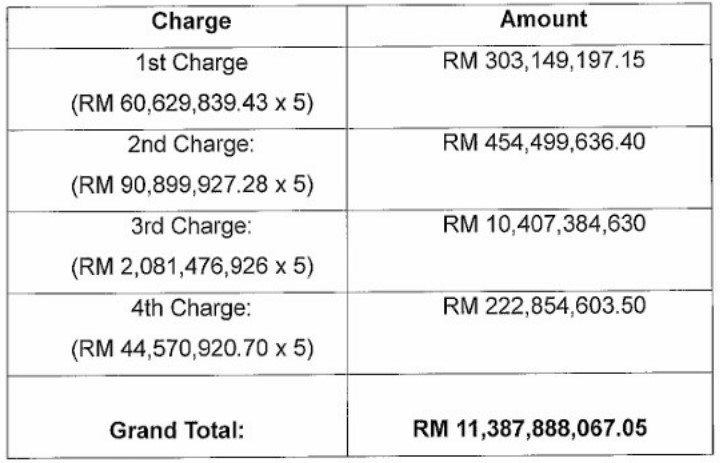
[2174] In respect of imprisonment, it was urged upon the court to impose the maximum twenty years imprisonment for each and every count, and fine the accused accordingly.
[2175] The Prosecution submitted also that any sentences imposed run consecutively to the accused's existing term of imprisonment.
[2176] Finally, the Prosecution submitted that in respect of the charges under the AMLATFA, the court is empowered and mandated to order the forfeiture of property derived from or connected with unlawful activity, or, where such property has been disposed of, or cannot be traced, to impose a penalty of a sum which is equivalent to the value of the property pursuant to s 55(2) AMLATFA.
(I) Sentence
The Law
Public Interest
[2177] It is trite that the first and foremost consideration in the passing of sentence is the element of public interest.
[2178] The starting point and locus classicus to be considered in every case where sentence is to be passed is the case of R v. Kenneth John Ball (1951) 35 Cr App R 164, (R v. Ball) and the time-honoured passage of Hilbery J, which sounded as follows:
"In deciding the appropriate sentence a court should always be guided by certain considerations. The first and foremost is the public interest. The criminal law is publicly enforced not only with the object of punishing crime, but also in the hope of preventing it. A proper sentence, passed in public, serves the public interest in two ways. It may deter others who might be tempted to try crime as seeming to offer easy money on the supposition, that if the offender is caught and brought to justice, the punishment will be negligible. Such a sentence may also deter the particular criminal from committing a crime again, or induce him to turn from a criminal to an honest life. The public interest is indeed served, and best served, if the offender is induced to turn from criminal ways to honest living. Our law does not, therefore, fix the sentence for a particular crime, but fixes a maximum sentence and leaves it to the court to decide what is within that maximum, the appropriate sentence for each criminal in the particular circumstances of each case. Not only in regard to each crime, but in regard to each criminal, the court has the right and the duty to decide whether to be lenient or severe."
[Emphasis Added]
It is to be noticed that Hilbery J opined that the public interest element is served when firstly, it operates to act as a deterrent to would be offenders and secondly, may also deter the particular criminal from committing a crime again, or induce him to turn from a criminal to an honest life. Whether or not the particular individual transforms into a better individual after the passage of time by reflecting upon his misdeeds and rehabilitating is something that only time will tell.
Deterence
[2179] This is the other aspect of Hilbery J's reason of the manner in which the public interest is served and that is that the sentence passed is done so with the confident expectation that it would deter would-be offenders.
[2180] This is basically, the sending of a message out from the court that if you are prepared to do the crime, then be also prepared to pay the price for it by spending time in prison.
[2181] It is also made clear in R v. Ball that the court retains the discretion and duty, within the statutory maximum, to determine a sentence that is proportionate to the offence and appropriate to the individual offender, having regard to all the circumstances of the case, whether such sentence be lenient or severe.
[2182] In that sense, too lenient a punishment passed would not have the desired effect, while on the other hand, the punishment passed must also be commensurate with the nature and gravity of the crime committed.
[2183] Having said all of that, it is also trite that the weight to be accorded to public interest depends on the facts and circumstances of each case. See New Tuck Shen v. PP [1981] 1 MLRH 227.
[2184] The case of PP v. Loo Choon Fatt [1976] 1 MLRH 23 echoed the sentencing principles stated in R v. Ball.
[2185] Nearer in point of time to the present, the Federal Court case of PP v. Dato' Waad Mansor [2005] 1 MLRA 1 reaffirmed the classical principles of sentencing, namely retribution, deterence, prevention and rehabilitation, as articulated in R v. Sargeant [1974] 60 Cr App R 74 and reproduced what was held in the latter case as follows:
'Those classical principles are summed up in four words: retribution, deterence, prevention and rehabilitation. Any judge who comes to sentence ought always to have those four classical principles in mind and to apply them to the facts of the case to see which of them has the greatest importance in the case with which he is dealing. I will start with retribution. The Old Testament concept of an eye for an eye and tooth for tooth no longer plays any part in our criminal law. There is, however, another aspect of retribution which is frequently overlooked: it is that society, through the courts, must show its abhorrence of particular types of crime, and the only way in which the courts can show this is by the sentence they pass. The courts do not have to reflect public opinion. On the other hand, courts must not disregard it. Perhaps the main duty of the court is to lead public opinion".
[Emphasis Added]
[2186] So, it is with the principles of retribution, deterence, prevention and rehabilitation in mind that the court approaches the sentencing process. It will be noted that deterence is an important component of the public interest.
[2187] One of the principles that also emerges out of a consideration of these authorities is that the courts are vested with a discretion in order to determine the sentence that is proportionate to the offence and also appropriate to the individual offender, having regard to all the circumstances of the case and to decide within that band of discretion, whether to be lenient or severe.
[2188] These are all settled sentencing principles which are applied in general across every type of criminal case.
[2189] In the case of PP v. Teh Ah Cheng [1976] 1 MLRH 76, the High Court held that public interest must necessarily assume foremost importance in sentencing, particularly where the offence has serious societal implications.
[2190] In Francis Phillip Nunis v. Public Prosecutor [1982] 1 MLRA 281, the Federal Court, when considering a sentence in the precursor to s 23(1) MACC Act held as follows:
"Perhaps, it would also be appropriate to say that if there is a hope for the country to have a clean and efficient administration it is essential that members of the administration should not be corrupt. Offences for corrupt practice committed by a public officer, Members of Parliament and Assemblymen must therefore be dealt with severely. Public interest demands it".
[Emphasis Added]
[2191] In the case of Azmi Osman v. PP & Another Appeal [2015] MLRAU 459, where the accused was occupying a position of trust at the material time, it was held:
"[68] Though the interest of the accused person must be taken into account when passing sentence, the interest of the public is however paramount, especially bearing in mind the fact that the accused was occupying a position of trust when he committed those offences. He was a Deputy Superintendent of Police in charge of combating vice activities, such as illegal gambling and prostitution. Instead he abused his position and obtained illegal gains.
[69] In passing sentence, the court has a duty to reflect public abhorrence against the acts committed by the accused person. A sentence of a deterrent nature needs to be meted out, to drive home the point that crime does not pay."
[Emphasis Added]
[2192] It can be discerned from the last 3 cases cited that public interest considerations demand more accountability when the crime results in societal implications, when the crime involves members of the administration, and when the crime is committed by a person who is occupying a position of trust.
[2193] In such cases, it is said that a duty is imposed upon the court to express or reflect public abhorrence of the crime committed in imposing the sentence.
The Facts
[2194] The legal principles in respect of sentencing having been laid out, their application to the facts here now follow.
[2195] One of the relevant factors in considering sentence, as alluded to above, is where the crime has resulted in serious societal implications. See Public Prosecutor v. Teh Ah Cheng (supra).
[2196] 1MDB was founded in 2009 as a strategic investment company by the Malaysian Government to promote the country's economic growth. It was meant to be a state-owned sovereign wealth fund to drive economic development through global partnerships. However, it became instead the centre of one of the largest financial corruption and money laundering scandals in modern history.
[2197] The scale and magnitude of the fallout to the country and its people can best be discerned from an extract of the Parliamentary Hansard (DR-02122025 dated 2 December 2025) — produced by the prosecution — and where the then Prime Minister of Malaysia addressed the house as follows:
"Begitu juga, pinjaman luar pesisir. Sekarang ini, RM22.4 bilion iaitu bawah daripada paras 35 yang ditetapkan. Bil perbendaharaan Malaysia juga tidak melebihi kerana sekarang ini RM4 bilion, paras kita RM10 bilion. Jadi, hutang yang terbesar masih 1MDB yang diwarisi sejak 2018, itu RM34 bilion. Keseluruhannya RM34 bilion termasuk komitmen faedah RM17 bilion. Jadi, jumlah hutang 1MDB mencecah hampir RM50 bilion. Yang sudah dibayar oleh kerajaan hingga kini ialah RM42 bilion. Ini termasuk prinsipal dan faedah.
Tapi, Alhamdulillah kerana kita juga dapat pulangan balik RM29 bilion yang telah dapat dibiayai kerana usaha semua jabatan, Jabatan Peguam Negara, Kementerian Kewangan dan SPRM mendapat pulangan sebanyak RM29 bilion yang disebut tadi. Tetapi tanggungjawab kita, tekanan hutang 1MDB masih sekitar RM13 bilion dan masih terdapat baki yang harus kita sempurnakan."
[2198] It was stated that the total liabilities arising from 1MDB amount to nearly a staggering RM50 billion, of which approximately RM42 billion has already been paid by the Government, inclusive of principal and interest and that despite recovery efforts yielding RM29 billion, a substantial debt of approximately RM13 billion remains outstanding.
[2199] The repercussions and consequences arising from the fallout of the scandal are still ongoing, and there are current financial obligations that still need to be fulfilled. This will impact future generations of Malaysians as well.
[2200] Another relevant factor to take into consideration is the damage this scandal has caused to the reputation of this country. It is no secret that the reverberations of this financial scandal have echoed throughout the globe.
[2201] The web of financial transactions was deliberately made complex by multiple layerings in order to obscure the origin of the funds. The crimes involved sophisticated cross-border transactions, which resulted in financial losses of a colossal nature, and resulted in severe and enduring financial consequences for the nation. It was described internationally as being "kleptocracy at its worst", an unwanted blemish on the record of our beloved country's otherwise sterling reputation on the world stage.
[2202] At the heart of this scandal stood not a humble employee of an organisation who saw an opportunity to exploit a flaw in the system, but a man exalted and who held the highest reins of power.
[2203] This was someone who held simultaneously the offices of the positions of Prime Minister, Minister of Finance and Chairman of the Board of Advisers of 1MDB and who used and exploited that position in order to carry out certain acts and to exert influence over the board of 1MDB to carry out certain abnormal transactions with unholy haste.
[2204] The abuse and betrayal of that trust while in those exalted positions must be taken into account as a major consideration in the sentencing process.
[2205] Another relevant factor to take into consideration is the previous conviction of the accused, proven by the Prosecution through s 400 of the CPC by way of official and certified records and where confirmation has been obtained from the Malaysian and Singapore Criminal Registration Centre (D2), Criminal Investigation Department (JSJ), Bukit Aman, following a verification of the accused's particulars and fingerprint records. This verification confirms that the accused is listed in the criminal registry, as reflected in the attached RJ2B report.
Section 400 of the CPC (in so far as is relevant) is reproduced for convenience as follows:
"400. How previous conviction or acquittal may be proved
(1) In any inquiry, trial or other proceeding under this Code a previous conviction or acquittal or an order directing any person to be under the supervision of the police may be proved in addition to any other mode provided by any law for the time being in force:
(a) by an extract certified under the hand of the officer having the custody of the records of the Court whether of Malaysia or the Republic of Singapore in which that conviction or acquittal was had to be a copy of the sentence or order."
[2206] Based upon the record, the accused thus stands in the position of having a previous record of conviction, which is the SRC case. It is also highly relevant that the offence committed is of a similar nature to the one presently before the court.
[2207] I have considered all the mitigating factors submitted by learned counsel for the accused and also the aggravating factors submitted by the prosecution. I have also taken into consideration the cases cited by both sides and the principles of law applicable.
[2208] I have also considered and taken into account the antecedents of the accused, including the fact and the length of his public service, and the other mitigating factors advanced.
[2209] It is undisputed that the accused is a person who has had almost 47 years of public service and had served as Prime Minister of the nation. This is of course a relevant factor to be weighed in the consideration of sentencing.
[2210] The question is whether this record of public service and contribution to the nation outweighs the breach of trust reposed in the accused taking into account the high and exalted positions held by him.
[2211] After taking into account all these factors including the magnitude of the crime both in terms of the colossal sums involved and magnitude and scale of the repercussions from the scandal, including the ongoing financial obligations of the nation for the present and future generations, the court is of the view that a deterrent sentence is called for and this therefore outweighs the public service record and contribution to the service of the nation by the accused.
[2212] This court is also of the view that public abhorrence ought to be reflected in the sentence to be passed in light of the scale of the offences and the negative reputation to the country undoubtedly caused by it.
[2213] This court has also to rightfully consider that the accused has not exhibited or displayed any remorse for the offences committed, having chosen instead to attach the blame for this scandal to others, including the management of 1MDB. This lack of remorse is a highly relevant factor to consider in sentencing.
[2214] The evidence adduced and determined to be admissible and relevant by the court clearly demonstrated that the accused had orchestrated the financial siphoning of funds through the wiles and deception of his proxy, Jho Low.
[2215] Together, the accused, through Jho Low working hand in hand, carefully and meticulously fashioned a complex web of deceit by transactions which resulted in siphoning of funds from 1MDB and which by way of multiple layering, eventually found their way into the private bank account of the accused.
[2216] Another factor to be taken into account is that when the scale of the financial scandal had started to surface in the public eye, the accused had taken several measures to conceal and to cover up the offences, including disbanding the task force assembled to inquire into the scandal as well as attempting to persuade the then Governor of the Central Bank to issue a statement clearing him of all wrongdoing.
[2217] Having carefully considered and weighed both the mitigation by the defence and the aggravating factors submitted by the prosecution, as well as other relevant considerations, the court will now proceed to impose the sentences for the offences committed.
Charges Under The MACC Act
[2218] In respect of the sentencing provision in s 24(1) MACC Act, I find that the phrase "shall on conviction be liable" is to be construed as imposing both a term of imprisonment and also the imposition of a fine.
[2219] The sentence of the court therefore, is as follows:
Charge no 1 under s 23(1) MACC Act
The accused is sentenced to a term of imprisonment of 15 years and a fine of not less than 5 times the sum or value of the gratification which amounts to RM303,149,197.15. In default of payment of the fine, 10 years' imprisonment.
Charge no 2 under s 23(1) MACC Act
The accused is sentenced to a term of imprisonment of 15 years and a fine of not less than 5 times the sum or value of the gratification which amounts to RM454,499,636.40. in default of payment of the fine, 10 years imprisonment.
Charge no 3 under s 23(1) MACC Act
The accused is sentenced to a term of imprisonment of 15 years and a fine of not less than 5 times the sum or value of the gratification which amounts to RM10,407,384,630.00. in default of payment of the fine, 10 years imprisonment.
Charge no 4 under s 23(1) MACC Act
The accused is sentenced to a term of imprisonment of 15 years and a fine of not less than 5 times the sum or value of the gratification which amounts to RM222,854,603.50. in default of payment of the fine, 10 years imprisonment.
Sentences to run concurrently or consecutively
In respect of when the sentence of imprisonment is to commence and in the case of a prior sentence being served, whether they are to run together or separately, two provisions are relevant, namely, ss 282 and 292 of the CPC.
[2220] Section 282 CPC reads as follows:
"Section 282 of the CPC:
(a) where the accused is sentenced to imprisonment the Court passing the sentence shall immediately forward a warrant to the prison in which he is to be confined and, unless the accused is already confined in that prison, shall forward him in the custody of the police to that prison with the warrant;
(b) every warrant for the execution of a sentence of imprisonment shall be directed to the officer in charge of the prison or other place in which the prisoner is or is to be confined;
(c) when the prisoner is to be confined in a prison the warrant shall be lodged with the officer in charge of the prison;
(d) every sentence of imprisonment shall take effect from the date on which it was passed unless the Court passing the sentence otherwise directs."
[Emphasis Added]
[2221] Section 292 of the CPC reads:
"Section 292 of the CPC:
(1) When a person who is an escaped convict or is undergoing a sentence of imprisonment is sentenced to imprisonment, such imprisonment shall commence either immediately or at the expiration of the imprisonment to which he has been previously sentenced, as the Court awarding the sentence may direct.
(2) A sentence of death shall be executed notwithstanding the pendency of any sentence of imprisonment.
(3) Nothing in subsection (1) shall be held to excuse any person from any part of the punishment to which he is liable upon his former or subsequent conviction."
[Emphasis Added]
[2222] Section 292 of the CPC gives a discretion to the court, depending on the facts and circumstances of each case, whether to order the commencement of the sentence on such convicted persons, either immediately or at the expiration of the imprisonment to which he has been previously sentenced. See also PP v. Ooi Wang San [1998] 1 MLRA 273.
The One-Transaction Rule And The Totality Principle
[2223] Also, of relevance is the one-transaction rule and the totality principle.
[2224] The case of Bachik Abdul Rahman v. PP [2004] 1 MLRA 323 cited by the prosecution, sets out the relevant sentencing considerations and discusses the provisions of s 282(d) and s 292 of the CPC as well as the proper application of the one-transaction rule and the totality principle as follows:
"[5] Section 282(d) prescribes the general rule that a sentence of imprisonment shall take effect from the date on which it was passed unless the court passing the sentence otherwise directs. Section 292 is a specific provision dealing with the date of commencement of a sentence of imprisonment of a person who is already undergoing imprisonment Under this section, the court may order the imprisonment to commence either immediately or at the expiration of the imprisonment to which he has been previously sentenced. An order that the subsequent prison term is to start immediately does not negate s 292(2) as adverted to in Shafruddin Selengka v. Public Prosecutor & Other Appeals [1994] 2 MLRH 887. It is expressly authorized by s 292(1) and what is prohibited is only that the term of imprisonment cannot commence at any point of time prior to the date of conviction. To that extent it cannot be concurrent to a prison term being served but will be part-concurrent.
[6] Section 292(2) resolves the problem identified in the above passage. Pursuant to the subsection where a person is, say, on bail in respect of a prison term and is sentenced to imprisonment with immediate effect to another prison term for a subsequent conviction he will not thereby be excused from any part of the punishment to which he is liable upon his former conviction.
[7] The combined effect of s 282 and s 292 is that unless the court imposing a sentence says anything to the contrary, the sentence runs from the date on which it was passed (see Ooi Sim Yim v. Public Prosecutor [1989] 1 MLRA 284). The exercise of the discretion to determine the date of commencement of the sentence of imprisonment is dependent on the facts and circumstances of each case. In deciding whether the terms of imprisonment should be consecutive or commence at another date, the court will be guided by the one transaction rule and the totality principle. Pursuant to the one transaction rule where two or more offences are committed in the course of a single transaction, all sentences in respect of these offences should be concurrent rather than consecutive (see R v. Saleem [1964] Crim LR 482; R v. Walsh [1965] Crim LR 248). For there to be one transaction four elements must be present, that is to say, proximity of time, proximity of place, continuity of action and continuity of purpose or design (see Jayaraman & Ors v. PP [1979] 1 MLRH 215; Amrita Lai Hazra v. Emperor 42 Cal 957; Chin Choy v. PP [1955] 1 MLRA 674). The rule, however, is not absolute. As Yong Pung How CJ said in Kanagasuntharam v. Public Prosecutor [1992] 1 SLR 81 at p 83:
The English courts have recognized that there are situations where consecutive sentences are necessary to discourage the type of criminal conduct being punished: see R v. Faulkner [1972] 56 Cr App R 594, R v. Wheatley [1983] 5 Cr App R (S) 417 and R v. Skinner [1986] 8 Cr App R (S) 166. The applicability of the exception is said to depend on the facts of the case and the circumstances of the offence. It is stated in broad and general terms and although it may be criticized as vague, it is necessarily in such terms in order that the sentencer may impose an appropriate sentence in each particular case upon each particular offender at the particular time the case is heard.
[8] In explaining the totality principle, His Lordship referred (at p 85) to the view of DA Thomas in Principles of Sentencing (2nd edn) at pp 57-58: The many decisions of the court in which the totality principle has been applied to explain the reduction of a cumulative sentence made up of correctly calculated individual parts suggest that the principle has two limbs. A cumulative sentence may offend the totality principle if the aggregate sentence is substantially above the normal level of sentences for the most serious of the individual offences involved, or if its effect is to impose on the offender 'a crushing sentence' not in keeping with his records and prospects.
[9] In this regard, reference is also made to Emmins on Sentencing (2nd edn) p 151:
It is well established that sentences must have regard to the total length of sentence passed, particularly where consecutive sentences have been imposed, to ensure that the sentence properly reflects the overall seriousness of the behaviour.
[10] There will be cases properly described as crushing the hope in the offender of reformation and a return to a desirable life but in which the offender has, by his criminal acts, forfeited any right to have his sentence reduced on that account (see Crowley and Garner v. R [1991] 55 A Crim R 201). As O'Bryan J said in R v. Vaitos [1981] 4 A Crim R 238 at p 301:
I have some difficulty appreciating the concept that a richly deserved sentence, not manifestly excessive, should be disturbed because the person upon whom the sentence is imposed may feel crushed by it. It is quite true that the applicant has to face a very long term of imprisonment before he will be released and because he is a comparatively young man, many of the best years of his life will be spent in custody. However, from the community point of view, his detention for a very substantial period is necessary to protect females from his criminal behaviour.
[11] Young CJ said in that case that the question of whether the sentence imposed is crushing cannot be answered mathematically by reference to the offender's age and the length of sentence to be served but by the circumstances of the case."
[Emphasis Added]
[2225] The principles espoused in the above case were also echoed in PP v. Abdul Wahab Abd Jabar & Anor [2002] 2 MLRH 79 and the case of Mansor Meyon v. PP [2006] 4 MLRH 148.
[2226] In applying these principles to the facts of the case here, while the offences under the MACC Act charges satisfy the one transaction rule and each therefore can run concurrently with the others, they are nevertheless distinct offences and wholly separate from the offences for which the accused is presently serving sentence for (SRC case) and do not derive from or form part of the same single transaction.
[2227] All the sentences of imprisonment in all four charges in respect of the MACC Act in this case are to run concurrently with each other but in accordance with s 292 of the CPC, shall only commence at the expiration of the imprisonment to which he has been previously sentenced, meaning after the expiration of the sentence in the SRC case.
Charges Under The AMLATFA
[2228] In respect of all the twenty-one charges under the AMLATFA, a prison sentence of the maximum number of 5 years is imposed.
[2229] In order to avoid doubt, the charges are charge 1,2,3,4,5,6,7,8,9,10,11,12,13,14,15,16,17,18,19,20 and 21 respectively under the AMLATFA. There is no imposition of a fine in addition, as it is not mandatory.
[2230] The offences here are distinct and wholly separate from the offences for which the accused is presently serving sentence for (SRC case) and do not derive from or form part of the same single transaction (the one transaction rule).
[2231] All the sentences of 5 years for each of the twenty-one charges therefore are to run concurrently with each other and also concurrently with the terms of imprisonment imposed in the four charges under the MACC Act but in accordance with s 292 of the CPC, shall only commence at the expiration of the imprisonment to which he has been previously sentenced, meaning after the expiration of the sentence in the SRC case.
Penalty Pursuant To Section 55(2) AMLATFA
Section 55(2) AMLATFA provides as follows:
"Forfeiture of property upon prosecution for an offence
(2) Where the offence is proved against the accused but the property referred to in subsection (1) has been disposed of, diminished in value, or cannot be traced, the court shall order the accused to pay as a penalty a sum which is equivalent to, in the opinion of the court, the value of the property, and any such penalty shall be recoverable as a fine."
[2232] The Prosecution submitted that upon proof of the offences under the AMLATFA, the court is empowered and mandated by s 55(2) AMLATFA to order the forfeiture of property derived from or connected with unlawful activity, or, where such property has been disposed of, or cannot be traced, to impose a penalty of a sum which is equivalent to the value of the property.
[2233] It was submitted also that in the context of this case, the evidence demonstrates that substantial sums constituting proceeds of unlawful activity were transferred through multiple accounts, expended, layered, or otherwise placed beyond direct recovery. To permit the accused to avoid forfeiture on the basis that the property is no longer traceable would directly undermine the purpose and effectiveness of the enforcement of anti-money laundering laws.
[2234] It was further submitted that, given the scale of the misappropriation in the 1MDB case, the enduring financial burden borne by the Government and the difficulty in tracing all proceeds due to the manner in which the funds were moved and dissipated, an order under s 55(2) AMLATFA is not only appropriate but necessary in the interests of justice and public interest.
[2235] As alluded to above, the scale and magnitude of this financial scandal reverberated with force around the globe and placed this nation in the invidious position of having to continue to bear the financial burden caused by it.
[2236] Public abhorrence at the manner in which the offences were committed in that it involved a breach of trust by the person who held the highest public office, is a highly relevant consideration.
[2237] In light of these considerations and also the enormous sums of money siphoned off and to date remain unrecoverable, the court agrees with the submission of the Prosecution that the provisions of s 55(2) AMLATFA ought to be given effect to.
[2238] Therefore, pursuant to s 55(2) AMLATFA, the court imposes a fine of RM2,081,476,926.00, which in the opinion of the court, is equivalent to the value of the property, in default 2 years and 6 months for each of the 9 charges which are charges 1,2,3,4,5,6,7,8 and 9, in which case the default term(s) of imprisonment are to run concurrently with each other.
[2239] Learned counsel for the defence requested for the return of the bail sum in this case and this was not objected to by the prosecution because there is no application of a stay of execution of sentence.
[2240] In the circumstances, the court orders the return of the bail sum.
[2241] Learned counsel also states that the non-objection as to application for a stay of execution of sentence is with liberty to apply for stay.