Court of Appeal, Putrajaya
Mohamed Zaini Mazlan, Ong Chee Kwan, Muniandy Kannyappan JJCA
[Civil Appeal No: B-02(W)-659-04-2024]
25 May 2026
Tort: Defamation — Appeal against award of damages and dismissal of counterclaim — Impugned publications occurring within compressed timeframe, relating to same underlying allegations and forming part of coherent narrative directed against respondent — Whether court entitled to view publications as constituting continuous course of defamation and to assess injury to reputation globally — Whether defences of justification, qualified privilege and fair comment not applicable — Whether court had power to order publication of apology
The respondent was a former general agent for the 3rd appellant (Company), of which the 1st and 2nd appellants were the founders and directors. The respondent purportedly breached the Company's policies by inter alia getting involved in another online business and dealing with the Company's former agent, who at the material time was under close scrutiny for various wrongdoings. The respondent admitted her wrongdoings at a meeting with the 1st and 2nd appellants, but subsequently, by way of a text message to the 1st and 2nd appellants, retracted her admission and claimed she was unsure of which rules she had breached. The respondent was subsequently terminated, following which the appellants published 7 statements on 4 separate dates (impugned statements) relating, inter alia, to the respondent's breach of the Company's operational policies and directives, involvement in another online business and painting the respondent as a 'compulsive liar' and 'manipulative leader'. The respondent accordingly commenced the instant defamation suit against the appellants arising from the impugned statements that were published by the appellants. The High Court Judge (HCJ) found in favour of the respondent, rejected the appellants' pleaded defences of justification, qualified privilege and fair comment, and awarded general damages together with aggravated damages totalling RM600,000.00 against the appellants in respect of their respective publications. The HCJ also ordered the appellants to publish an apology to the respondent and dismissed the Company's counterclaim for the refund of performance bonuses paid to the respondent, and for the delivery up of WeChat and Instagram accounts used by the respondent in the course of her engagement with the Company. Hence the instant appeal. As regards liability, the appeal was confined to the availability and application, if at all, of the pleaded defences of justification, qualified privilege and fair comment. The appellants also submitted that if liability was affirmed, a global approach should be adopted and a single award of damages made on a joint and several basis.
Held (allowing the appeal in part; order accordingly):
Per Ong Chee Kwan JCA delivering the judgment of the court
(1) The evidential weight of the respondent's admission became questionable when the admission was subsequently retracted or denied, and there was no independent corroborative evidence. The defence of justification ought to meet the precise imputation complained of. In this regard, the appellants had failed to prove their allegations against the respondent. Accordingly, the defence of justification failed. (paras 37-39)
(2) While the Company's management might have a duty to communicate relevant company matters, the privilege was lost if the communication exceeded the scope of interest or duty necessary for the occasion. On the facts, the impugned statements had become increasingly excessive, disproportionate and inflammatory, went outside the permitted privileged occasions altogether and were evidence of malice and improper motive amounting to character assassination, thereby defeating the defence of qualified privilege. (paras 42-47)
(3) To rely on fair comment, the statement ought to be recognisable as a comment and based on true facts. The assertions in the impugned statements were structured more as facts, conveying definite factual guilt rather than honest opinions and were internal communications made to selected members of the company on commercially related and business matters rather than matters of public interest. Accordingly, the defence of fair comment failed. (para 51)
(4) There was no recognised relief under the common law empowering the court to compel a defendant to publish an apology, nor was there any provision under the Defamation Act 1957 (Act) which empowered the High Court to grant such an order. To compel a party to apologise would be to require the court to dictate the content of speech and supervise its adequacy and sincerity, which were matters beyond the proper province of judicial determination. The remedies expressly contemplated under the Act were confined to damages. (paras 55, 56, 57, 58, 59, 60, 61, 62, 63, 64 & 66)
(5) The court's jurisdiction to grant relief ought to be grounded in recognised heads of remedies, whether statutory, common law or equitable, and did not extend to creating novel remedies in the absence of legal foundation. Accordingly, the court had no jurisdiction to order the publication of an apology. (paras 67-68)
(6) Although it was trite that each publication of a defamatory statement constituted a separate cause of action, the court in assessing damages was not bound to proceed on a purely arithmetical or compartmentalised basis. Where, as in the instant case, the publications occurred within a compressed timeframe, related to the same underlying allegations and formed part of a coherent narrative directed against the same person, the court was entitled to view them as constituting a continuous course of defamation and to assess the injury to reputation globally. Such an approach would better reflect the reality that the harm suffered was cumulative and indivisible, and avoid the risk of double-counting or disproportionate awards. (paras 72-81)
(7) Given that the impugned statements had not caused any proven or substantial harm to the respondent's reputation, and it was not proven that the respondent had suffered any financial losses, the damages awarded by the HCJ were exorbitant. Following Chin Choon v. Chua Jui Meng, wherein it was held that separate awards should not be made in defamation, the HCJ's order for general and aggravated damages ought to be reduced to a global award. On the facts and in the circumstances, the amount of damages ought to be reduced from the cumulative sums of RM600,000.00 to a global sum of RM100,000.00. (paras 84, 85, 86, 87, 91 & 94)
(8) There was no contractual basis for the Company to demand the reimbursement of the performance bonus that was paid to the respondent, nor was there any evidence that the bonus paid was not based on the respondent's actual performance. Clause 4 of the independent contractor agreement, which was relied on by the Company, dealt expressly with 'inventions, discoveries, developments and innovations conceived' by the respondent during her engagement with the Company. The WeChat and Instagram accounts claimed by the Company did not fall within the said clause. (para 93)
Per Muniandy Kannyappan JCA (supporting judgment)
(9) It was not entirely accurate to state that the court had no jurisdiction whatsoever to order or facilitate an apology as a remedy for defamation. The jurisdictional boundaries of a superior court were not so rigidly constrained. Where the ends of justice absolutely demanded a non-monetary rectification of the record, an apology or a formal retraction might be ordered pursuant to the inherent jurisdiction of the court to ensure the remedy matched the true nature of the harm. The court would not force a party to say they were 'sorry', but could legally compel the party to declare what was true. (paras 99, 102, 103 & 104)
(10) In the circumstances, the scripted order by the HCJ might be substituted with a mandatory order for rectification and factual withdrawal under the court's inherent jurisdiction. Such an order would not violate the appellants' freedom of speech nor force them into a hypocritical display of an unfelt remorse. (para 105)
Case(s) referred to:
Abdul Rahman Talib v. Seenivasagam & Anor [1964] 1 MLRH 296 (refd)
Chin Bay Ching v. Merchant Ventures Pte Ltd [2005] 3 SLR(R) 142; [2005] SGCA 29 (folld)
Chin Choon v. Chua Jui Meng [2004] 2 MLRA 636 (folld)
Chow Kon Yeow v. Tan Sri Dato' Tan Kok Ping [2025] 2 MLRH 506 (refd)
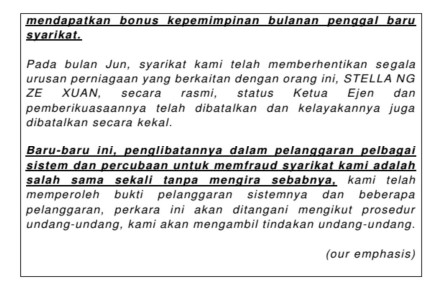
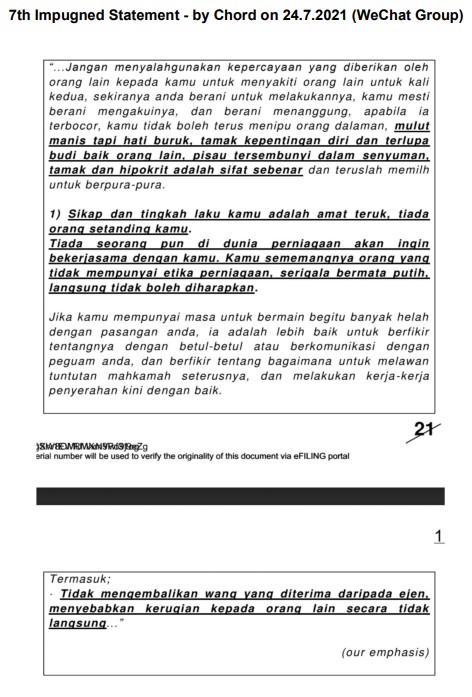
Credit Guarantee Corporation Malaysia Berhad v. SSN Medical Products Sdn Bhd [2017] 1 MLRA 541 (folld)
Dato Sri Dr Mohamad Salleh Ismail & Anor v. Nurul Izzah Anwar & Anor [2021] 2 MLRA 626 (folld)
Excel Golf Pte Ltd v. Allied Domecq Spirits & Wine (Singapore) Ltd [2003] 4 SLR 771 (folld)
Horrocks v. Lowe [1975] AC 135 (refd)
Joshua Benjamin Jeyaretnam v. Goh Chok Tong [1989] 1 MLRA 500 (folld)
Lim Guan Eng v. Datuk Tan Teik Cheng & Anor [2024] 1 MLRH 217 (folld)
Raub Australian Gold Mining Sdn Bhd v. Hue Shieh Lee [2019] 2 MLRA 345 (refd)
Reynolds v. Times Newspapers Ltd & Ors [2001] 2 AC 127 (folld)
Tan Sri Dr Muhammad Shafee Abdullah v. Tommy Thomas & Ors [2019] 1 MLRA 306 (refd)
Wilkinson v. Barking Corporation [1948] 1 KB 721 (refd)
Yeoh Tseow Suan v. Musa Hassan [2026] 2 MLRA 709 (refd)
Legislation referred to:
Defamation Act 1957, ss 8, 9
Counsel:
For the appellants: Ranjit Singh (Prisilla Chong Mun Mun & Tioh Xin Min with him); M/s Ranjit Singh & Yeoh
For the respondent: Bryan Ho Jiann Yau (Kimberly Ng Wenn Mei with him); M/s Ho Partnership & Neoh
[For the High Court judgment, please refer to Ng Ze Xuan v. Tan Sing How & Ors [2025] 3 MLRH 433]
JUDGMENT
Ong Chee Kwan JCA:
Introduction
[1] This is an appeal against the decision of the High Court Judge who allowed the Respondent's claim in a defamation suit arising from seven impugned statements published by the three Appellants over a compressed period of eight days. The learned High Court Judge found that each of the impugned statements bore defamatory meanings of and concerning the Respondent, rejected the Appellants' pleaded defences of justification, qualified privilege and fair comment, and proceeded to award general damages together with aggravated damages against each of the Appellants in respect of each of their respective publications. The Appellants were further ordered to publish an apology to the Respondent.
[2] The Appellants appealed against that decision. Significantly, while the finding that the impugned statements are defamatory was not seriously pursued before us, the Appellants contended that the learned High Court Judge erred in rejecting the defences advanced and in the approach taken to the assessment of damages. In particular, it was submitted that the seven statements, having been made within a short span of time and concerning the same subject matter, ought properly to have been treated as constituting a single continuous course of defamation, rather than as discrete and independent publications attracting separate awards.
[3] Arising from that submission is the further question whether, assuming liability is established, it would be more appropriate to substitute the multiple awards made below with a single global sum of damages, and whether such damages ought to be imposed jointly and severally against all three Appellants, rather than severally against each Appellant for each statement.
[4] This appeal also raises an important issue of principle as to whether the Court possesses the jurisdiction to compel the publication of an apology, a matter on which the learned High Court Judge below ruled in the affirmative.
[5] In addition, there is before us a cross-claim brought by Kalysta against the Respondent, seeking, inter alia, the return of performance bonus allegedly paid, and the delivery up of certain social media accounts, namely WeChat and Instagram accounts, said to have been used by the Respondent in the course of her engagement with Kalysta.
[6] Accordingly, the principal issues for determination in this appeal may be summarised as follows:
a) Whether the defences of justification, qualified privilege and fair comment were rightly rejected by the High Court Judge;
b) Whether the seven impugned statements ought to be treated as a continuous course of defamation;
c) Whether the assessment of damages should be global rather than segmented, and if so, whether liability ought to be joint and several;
d) Whether the Court has the power to order the publication of an apology; and
e) Whether there are merits to the Appellants' cross-claim.
Background Facts
[7] The 1st Appellant, Tan Sing How ("Chord") and the 2nd Appellant, Lai Phui Khae ("Kay") are the founders and directors of the 3rd Appellant, Kalysta Sdn Bhd ("Kalysta").
[8] Kalysta is a company that markets and sells health supplements with a focus on weight loss. Their products are known as "XLIMIX" and "ORI.LEMON". They have about 1500 agents across Malaysia. Significantly, Kalysta's business operates exclusively online, with its customers primarily drawn from the public who use Instagram.
[9] The Respondent, Ng Ze Xuan ("Stella"), was the former General Agent of Kalysta, a position just below the founders of Kalysta, who led the "KALYSTA SOULUV" group with more than 400 sales representatives.
[10] As a General Agent, Stella was required to comply with all the terms set out in the Independent Contractor Agreement as well as the policies and guidelines issued by Kalysta from time to time. Her income was mainly from commissions on sales generated by her downline and from performance-based bonuses.
[11] Kalysta spent significant effort and financial resources in building and promoting its brand and products. It also invested in recruiting, training, and supporting its General Agents so that they could effectively market and sell Kalysta's products to customers through various social media platforms. One of Kalysta's key rules is that General Agents are not allowed to engage in other online businesses. This is to ensure that they are fully committed to promoting the brand and to prevent any potential conflicts of interest that may arise from selling other products online.
[12] In or around April 2021, Chord and Kay received complaints from other General Agents that Stella was engaged in another online business known as "Everyday".
[13] Following these complaints, Chord and Kay conducted investigations on this issue to maintain the integrity of Kalysta's policies and to ensure compliance with the company's strict rule that General Agents are not permitted to engage in other online businesses.
[14] Based on their investigations, Everyday was found to be an online business that sells sanitisers. The company was recruiting agents to market and sell products based on a similar incentive and bonus structure as Kalysta. More importantly, Stella and her boyfriend, Lim Kian Wee ("Wilson"), were involved in Everyday ("the Investigations").
[15] Around the same time, Kalysta was also dealing with a separate issue involving one of its former agents and social media influencer, one Yong Hoong Ling, more commonly known as "YBB". At the material time, YBB was under close public scrutiny for various wrongdoings, including fraud, which had been widely reported in the news. Companies that had engaged her for promotional activities also faced public backlash and were boycotted.
[16] On 25 April 2021, Kalysta officially issued a notice to all its agents to notify them that YBB had violated various of the company's rules and had even borrowed money from others using Kalysta's name. In light of these actions, Kalysta decided to cancel all matters related to YBB and to revoke her agency with the company. The company also prohibited its agents from remitting any money to her.
[17] Notwithstanding the aforesaid, Stella had contacted YBB and asked her to promote Kalysta's products online in or around May 2021. Instructions from Kalysta to Stella to request YBB to remove the post were not acted upon. Chord had no option but to contact YBB directly to request that the post be removed. Until YBB complied, the post had remained online for more than 30 minutes, during which time it gained traction and reached the public ("the YBB Incident").
[18] On 3 June 2021, Stella requested a face-to-face meeting with Chord and Kay to explain herself regarding the events that transpired. The meeting lasted approximately 11 hours, from 9.00p.m. to 8.00a.m. the following day ("the Meeting").
[19] During the Meeting, Stella admitted all her wrongdoings, including but not limited to the YBB Incident, but also the fact that she was operating Everyday with Wilson.
[20] Following the Meeting, Stella informed Chord that she would accept any punishment or fine that the company would impose on her. She further indicated that she would understand the company's decision even if the company were to terminate her agency. In this connection, whilst Chord and Kay were deliberating on the appropriate next course of action, they informed Stella that, pending an official decision from Kalysta, she was not permitted to accept any money from the sales representatives under her for stock ordering.
[21] However, on 26 June 2021, Stella sent a text message to Chord and Kay in which she adopted a completely different stance and queried the next steps that would be taken by Kalysta and stated that she was unsure which rules she had allegedly breached. This was despite her earlier admissions.
[22] In light of Stella's unremorseful behaviour, Kalysta decided to terminate her position as a General Agent ("the Termination"). This was communicated to her on the same day.
[23] Following the Termination, Kalysta's representatives liaised with Stella on the handover of matters that she had been working on in Kalysta. However, Stella was not fully cooperative as she had, amongst others, refused to leave the group chats that were created for work purposes and also provoked other agents to leave the company. The relationship between the parties thereafter deteriorated significantly.
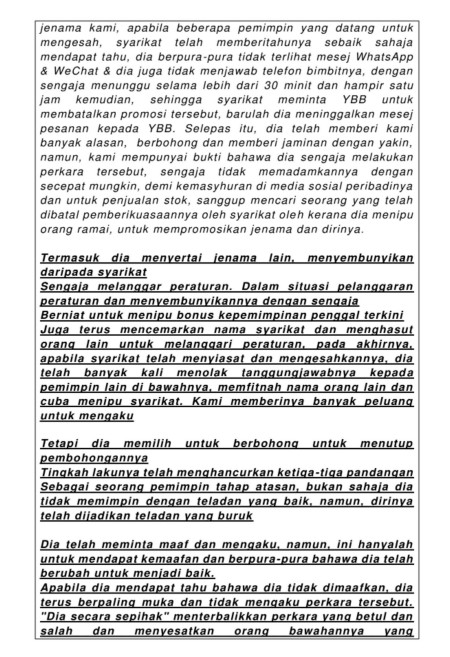
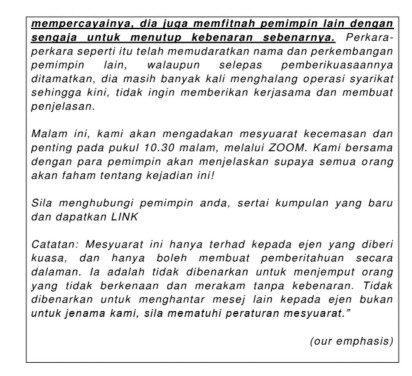
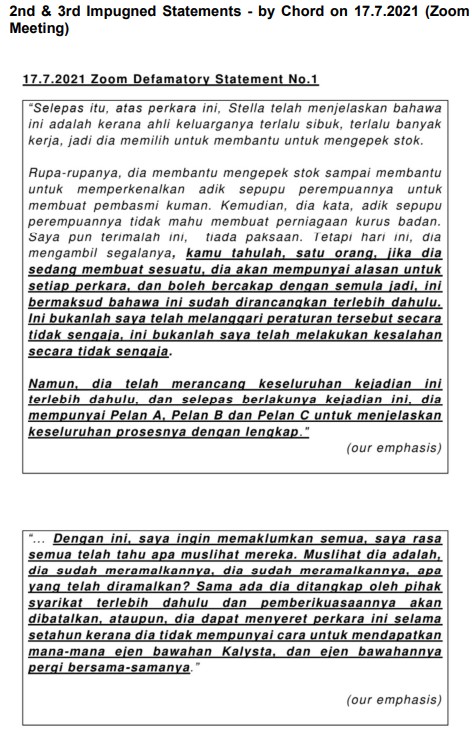
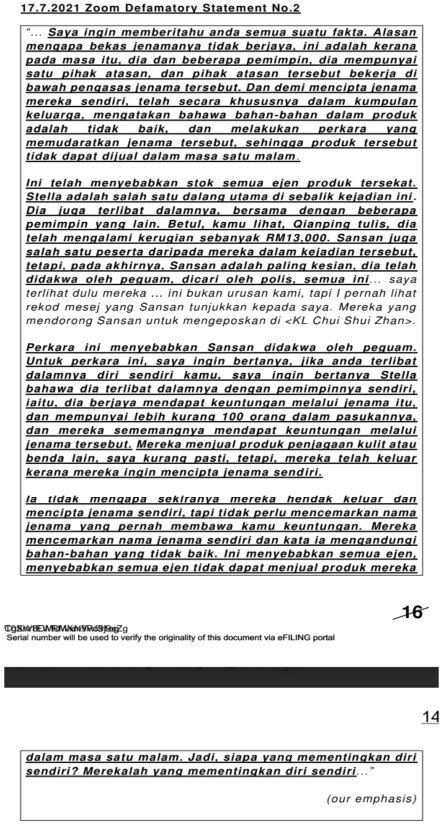
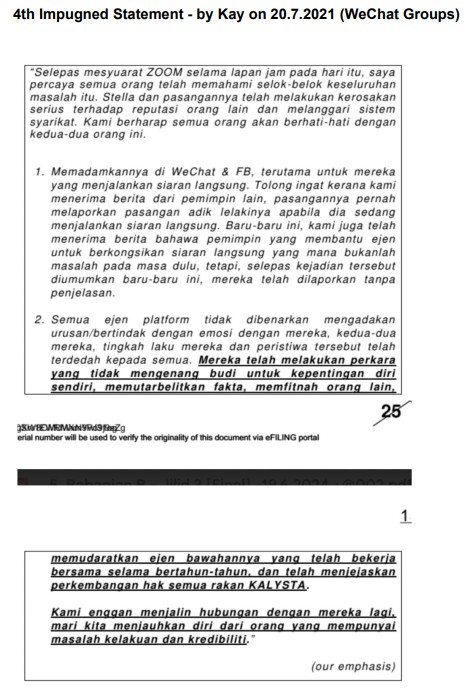
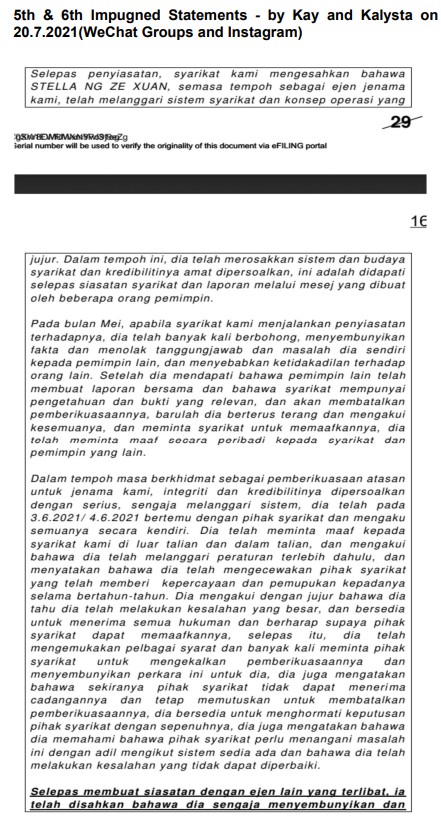
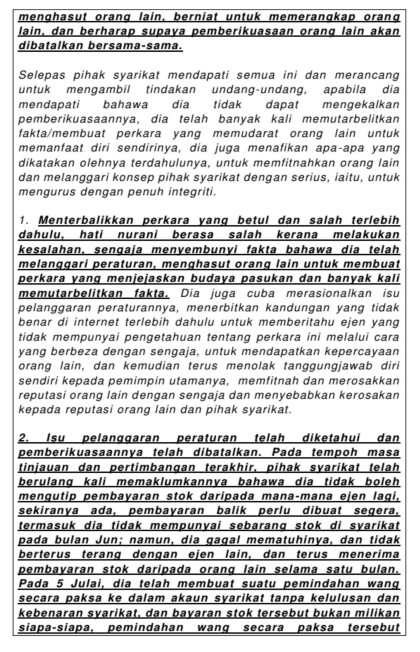
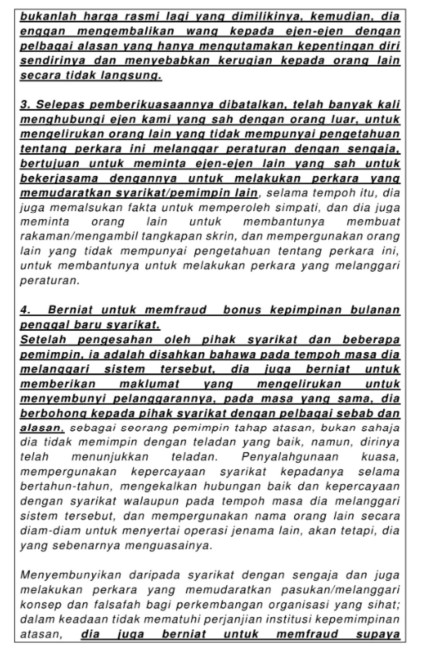
[24] Following from the Termination and Stella's departure, during the period between 16 July 2021 and 24 July 2021, Chord, Kay, and Kalysta published 7 statements on 4 separate dates ("the Impugned Statements"), which Stella contended were defamatory of her reputation. More specifically:
On 16 July 2021
(i) at 10.25pm
Chord published the 1st Impugned Statement in two WeChat Groups
On 17 July 2021
(i) at 2.37am
Chord published the 2nd and 3rd Impugned Statements in a Zoom Meeting
On 20 July 2021
(i) at 9.03pm
Kay published the 4th Impugned Statement to three WeChat Groups
(ii) at 9.09pm
Kay published the 5th Impugned Statement to three other WeChat Groups
(iii) at 9.55pm
Kalysta published the 6th Impugned Statement on its Instagram account
Chord republished Kalysta's 6th Impugned Statement on his Instagram account
Kay also republished Kalysta's 6th Impugned Statement on her Instagram account
On 24 July 2021
(i) at 12.29am
Chord published the 7th Impugned Statement in the SOULUV WeChat group.
[25] The Impugned Statements are reproduced in Appendix A to this judgment.
[26] The subject matter of the Impugned Statements relates to the claims that Stella had breached Kalysta's operational policy and directives, that she had acted in a manner that had prejudiced the company's system and culture, and was involved in Everyday, an online company run by her boyfriend. More specifically, the Impugned Statements portray Stella as someone who cheated Kalysta out of her leadership bonus, who wrongly accused other leaders of misconduct, instigated members to leave the company, and intentionally spoke ill of Kalysta's product, resulting in monetary losses to other members. The attack on Stella's character became progressively more scathing with the last publication, where Stella was described as a dishonest person who had plotted to jeopardise the rights and interests of Kalysta and its agents. Stella was painted as a "compulsive liar" and "manipulative leader" and one whom no one would want to do business with.
[27] After the trial and listening to counsel's submissions, the learned High Court Judge found the Impugned Statements to be defamatory and ordered Chord, Kay, and Kalysta to pay the following sums as damages to Stella totalling RM600,000.00:
Chord
a) Four (4) Defamatory Statements x RM50,000.00 each;
b) Aggravated damages = RM70,000.00;
Kay
a) Three (3) Defamatory Statements x RM50,000.00 each;
b) Aggravated damages = RM80,000.00; and
Kalysta
a) One (1) Defamatory Statement x RM100,000.00.
[28] The learned High Court Judge also dismissed Kalysta's Counterclaim for the refund of the performance bonuses paid to Stella and for an order requiring Stella to transfer the operation of her WeChat or Instagram accounts to the company.
[29] Dissatisfied, Chord, Kay, and Kalysta appealed against the learned High Court's judgment to this Court.
Issues Raised At The Appeal
[30] The law in respect of what amounts to defamation is well settled. In the Federal Court case of Dato Sri Dr Mohamad Salleh Ismail & Anor v. Nurul Izzah Anwar & Anor [2021] 2 MLRA 626 the Federal Court at para [19] reiterates that an imputation would be defamatory if its effect is to expose the plaintiff, in the eyes of the community, to hatred, ridicule or contempt or to lower him or her in their estimation or to cause him or her to be shunned and avoided.
[31] The standard for determining whether a statement is defamatory is that of the ordinary and reasonable member of society. As summarised by the Federal Court in Dato' Sri Dr Mohamad Salleh Ismail at paragraph [20], such a person is one with fair average intelligence, who is not avid for scandal, may engage in some degree of loose thinking, and may read between the lines but is not unduly suspicious.
[32] Before this Court, it is not in dispute that the Impugned Statements bear meanings that are defamatory of Stella. Quite rightly, Chord, Kay, and Kalysta have not sought to disturb the findings of the learned High Court Judge on that issue. The learned High Court Judge's conclusion that the Impugned Statements are actionable therefore stands.
[33] The appeal, in so far as liability is concerned, is confined to the availability and application, if at all, of the pleaded defences of justification, qualified privilege, and fair comment.
[34] Each of these defences will now be considered in turn.
Justification
[35] In Abdul Rahman Talib v. Seenivasagam & Anor [1964] 1 MLRH 296, Hepworth J at p 324 explained that to make out a plea of justification, a defendant must prove that the defamatory imputation is true or substantially true. This is in line with the legislative intent in s 8 of the Defamation Act 1957.
[36] In the instant case, Chord, Kay, and Kalysta relied on the defence of justification, asserting that the Impugned Statements were substantially true. Central to this defence is the contention that Stella had "admitted" to operating a separate business known as "Everyday" with her boyfriend, Wilson, and that she had acknowledged her engagement with YBB in breach of the company's express directives.
[37] However, it is not in dispute that Stella had subsequently retracted her "admission". In fact, the evidence shows Stella had treated her "apology" as one that was made out of economic necessity to protect her source of income. The contemporaneous documents show that Stella had clarified that she "lowered her ego" to stay in the company, "even though [she] never violates anything". The evidential weight of an "admission" becomes questionable when the "admission" is subsequently retracted or denied, and there is no independent corroborative evidence.
[38] Furthermore, Chord, Kay, and Kalysta failed to prove the more serious "stings" of their allegations, such as that Stella intended to defraud the company of leadership bonuses or masterminded the downfall of her previous brand. The defence of justification must meet the precise imputation complained of, which Chord, Kay, and Kalysta have failed to do.
[39] Moreover, the later publications where the attacks were escalated claiming that Stella had the intention to defraud Kalysta's monthly leadership bonus for the new term, describing Stella as "someone with a sweet mouth but evil heart, extremely self-centred, forgetful of others' good deeds, knife behind a smile, greedy and a hypocrite, someone with an extremely bad attitude without compare, someone whom nobody would want to deal with in the business world, no business ethics and wholly untrustworthy as a person", simply cannot be justified at all.
Qualified Privilege
[40] In Tan Sri Dr Muhammad Shafee Abdullah v. Tommy Thomas & Ors [2019] 1 MLRA 306, David Wong CJ at para [77] held that qualified privilege protects communications made where the maker has a legal, moral, or social duty to communicate the statement and the recipient has a corresponding interest in receiving it. The truth of such a statement is irrelevant, provided the communication is not made with malice.
[41] To invoke the defence of qualified privilege, these statements must satisfy the 3 tests in Reynolds v Times Newspapers Ltd & Ors [2001] 2 AC 127, which have been adopted in Malaysia. The 3 tests can be summarised as follows:
a) Duty Test - Was the publisher under a legal, moral, or social duty to those to whom the material was published?
b) Interest Test - Did those to whom the material was published have an interest in receiving the material?
c) Circumstantial Test - Were the nature, status, and source of the material, and the circumstances of the publication, such that the publication should, in the public interest, be protected in the absence of express malice?
[42] Chord, Kay, and Kalysta contended they had a duty to inform their agents of the outcome of the company's internal investigations. This is because Kalysta operates an online multi-level marketing business that relies heavily on its network of agents to market and promote its products. The Impugned Statements were made as a form of disclosure by the management to its members about the dismissal of a key leader. Stella was a General Agent and held a high level of responsibility, and she was a representative of Kalysta's brand. Kalysta imposed an express prohibition against its General Agents being involved in the other brands, as they act as the company's representative and are expected to promote and uphold the integrity of the brand. If the agents intend to operate other brands, they can opt to terminate their agreement with the company by giving a 5-month written notice. In the instant case, Stella was summarily dismissed.
[43] By reason of the aforesaid circumstances, the management has a duty to maintain transparency, discipline, and ethical standards. The members have a corresponding interest in understanding events affecting trust, cohesion, and their own commercial position. The relationship was one of reciprocal duty and interest.
[44] The aforesaid justified the arising of qualified privilege occasions in the circumstances of this case, as the statements were made by Chord, Kay, and Kalysta to explain to their members that a top leader had been dismissed, giving the reasons necessary for maintaining confidence, and addressing issues affecting members' interests, doubts, and queries in connection with Stella's dismissal.
[45] Whilst we agree that the facts in the present case did give rise to qualified privilege occasions, nevertheless, these qualified privilege occasions were strictly confined by the limits of the occasions. By the aforesaid, we mean that while the management may have a duty to communicate relevant company matters, the privilege is lost if the communication exceeds the scope of interest or duty necessary for the occasion.
[46] More specifically, the defence of qualified privilege will be defeated if there is malice. Where the dominant motive for making the statements is improper (i.e., to exact a personal vendetta) or is made with knowledge of the falsity or with reckless indifference to the truth, and using the occasion for a collateral attack, the reliance on qualified privilege will be rejected [See: Horrocks v. Lowe [1975] AC 135]. In Raub Australian Gold Mining Sdn Bhd v. Hue Shieh Lee [2019] 2 MLRA 345, the Federal Court interpreted malice as being reckless or acting intentionally without just cause or excuse.
[47] In the present context, malice may be inferred where the statements made were exaggerated and went beyond what was necessary, including irrelevant personal attacks targeting the individual to undermine her reputation beyond matters of the network. In the Impugned Statements, the criticisms against Stella became increasingly more excessive, exceedingly scathing, hyperbolic, and went beyond the subject matter of the investigation into Stella's conduct, especially in the 7th Impugned Statement. These attacks were disproportionate, inflammatory, and had gone outside the permitted privileged occasions altogether. To our mind, they are evidence of malice and improper motive, amounting to character assassination and thereby defeating the defence of qualified privilege.
Fair Comment
[48] The defence of fair comment is codified under s 9 of the Defamation Act 1957. In Tan Sri Dr Muhammad Shafee Abdullah, the Court of Appeal at para [87] held that the defence of fair comment provides the freedom to publish statements of public interest, as long as it is not made with ill intent to harm the plaintiff.
[49] The defence of fair comment applies where the defendant publishes an opinion rather than a statement of fact on a matter of public interest. The comment must be fair, meaning that it must be honestly held and based on true facts, which are either indicated or known to the readers. The defence is also defeated if the defendant was actuated by malice.
[50] The principles governing the defence of fair comment are laid down in the case of Joshua Benjamin Jeyaretnam v. Goh Chok Tong [1989] 1 MLRA 500. The words complained of must be comments, although they may include facts or inferences drawn from facts:
a) the comment must be made on a matter of public interest;
b) the comment must be based on true facts; and
c) the comment must be one which a fair-minded person could honestly make on the facts proved.
[51] We find that the defence of fair comment fails in this case because the Impugned Statements were presented as facts rather than expressions of opinion. To rely on fair comment, the statement must be recognisable as a comment and based on true facts. In the Impugned Statements, the assertions were structured more as facts, conveying definite factual guilt rather than honest opinions. Furthermore, the statements were internal communications made to selected members of the company and dealt with commercially related and business matters. They are not a matter of public interest at all. In any case, the finding of malice above also undermines the defence.
[52] Accordingly, we would reject the defences of justification, qualified privilege, and fair comment relied upon by Chord, Kay, and Kalysta.
[53] However, we agree that the learned High Court Judge erred when she proceeded to make the order directing Chord, Kay, and Kalysta to issue an apology to Stella.
Apology As A Remedy For Defamation
[54] The learned High Court Judge, having found the Impugned Statements to be defamatory and the defences of justification, qualified privilege, and fair comment to be inapplicable, proceeded to order Chord, Kay, and Kalysta to render an apology to Stella based on the language and contents proposed by her.
[55] It is well established that the remedies available in an action for defamation are damages (including general and, where appropriate, aggravated or exemplary damages), and in appropriate cases, injunctive relief to restrain further publication. There is, however, no recognised relief under the common law empowering the court to compel a defendant to publish an apology.
[56] An apology, by its nature, is an expression of contrition and a matter of volition. To compel a party to apologise would be to require the court to dictate the content of speech, and supervise its adequacy and sincerity, which in our view are matters that lie beyond the proper province of judicial determination.
[57] In fact, there are inherent difficulties in granting such relief. Typically, the plaintiff seeks an apology "on terms acceptable to the plaintiff ". This immediately gives rise to several problems. What constitutes a "sufficient" apology varies from plaintiff to plaintiff. The court would be drawn into settling the precise wording, tone, and prominence of the apology. The aforesaid would inevitably lead to disputes as to whether the apology tendered complies with the order. These considerations underscore why the law has not recognised a coercive power to extract an apology.
[58] In the Court of Appeal case of Credit Guarantee Corporation Malaysia Berhad v. SSN Medical Products Sdn Bhd [2017] 1 MLRA 541, Harminder Singh JCA (as he then was) at para [70] and [71], referred to the Singapore Court of Appeal case of Chin Bay Ching v Merchant Ventures Pte Ltd [2005] SGCA 29 and held that an apology by its very nature should be voluntary and cannot be compelled:
"[70] In this regard, we think it is important to distinguish between an order forcing a defendant to apologise from an order compelling a withdrawal or correction of an offending statement. On this question, we find ourselves in agreement with the views expressed by the Singapore Court of Appeal in Chin Bay Ching v Merchant Ventures Pte Ltd [2005] SGCA 29 where it was held (at para 25):
We recognise the force of the argument that a defendant should not be compelled to apologise against his will as the very spirit of an apology is that it must come from the heart, something which the defendant wishes to do on account of the wrong he has done to the plaintiff. On the other hand, an order compelling a defendant to merely withdraw, or correct, an offending statement after a trial, seems to be of a different character or genre from that of an apology. In the same way that the court compels a defendant to pay damages for the defamation, there is no reason or principle why it cannot compel the issue of a correction. Of course, the cases where the court should think that justice requires the grant of a mandatory injunction, to issue either a letter of withdrawal or correction, must be quite exceptional."
[71] In the instant appeal, we note that the apology was ordered by the court despite the defendant's unwillingness to do so. Such an apology is really useless. An order for apology ought to have been considered only in the case where the offending party was willing. In such a case, the award of damages can then be reduced as an incentive for agreeing to either retraction of the offending material, which is not relevant to the present appeal, or an apology for publishing the said material. For the reasons we have stated, we take the view that the order for an apology ought not to have been granted by the learned JC."
[59] The rationale in Credit Corp Malaysia Bhd was later also followed by the case of Lim Guan Eng v. Datuk Tan Teik Cheng & Anor [2024] 1 MLRH 217, wherein the High Court similarly held that an order for apology should not be granted if the defendants had not indicated their willingness to do so.
[60] Again, the same sentiments were shared in the recent High Court case of Chow Kon Yeow v. Tan Sri Dato' Tan Kok Ping [2025] 2 MLRH 506, whereby Quay Chew Soon J at para [129] had declined to order an apology since there was no indication from the defendant of any willingness to apologise to the plaintiff.
[61] In Excel Golf Pte Ltd v. Allied Domecq Spirits & Wine (Singapore) Ltd [2003] 4 SLR 771, S Rajendran J at para [6] and [7] referred to Gatley on Libel and Slander (9th Ed, 1998) and emphasised that there is no general power for the court to order a defendant to publish an apology as it is not a recognised remedy under the law. The courts do not have the power to grant remedies that are not legally available.
[62] However, the Court may, in appropriate cases, grant an injunction to restrain the defendant from repeating the defamatory statements or to make corrective statements or to issue a letter to withdraw the defamatory statements. These, however, are not orders to issue an apology at all.
[63] We would respectfully adopt the following passages by the Singapore Court of Appeal in Chin Bay Ching v. Merchant Ventures Pte Ltd [2005] 3 SLR(R) 142:
Chin submitted that the court's power in a defamation action (the present action is such an action, although MVP had also claimed in malicious falsehood) was limited to ordering damages, costs and an injunction to restrain the defendant from repeating the defamatory statements. In this regard, Chin relied upon a passage in Gatley on Libel and Slander (Sweet & Maxwell, 9th Ed, 1998) at para 9.1:
An award of damages is the primary remedy for defamation ... There is no general power for the Court to order the defendant to publish a correction or apology ...
and another passage in David Price, Defamation Law, Procedure & Practice (Sweet & Maxwell, 2nd Ed, 2001) at p 169:
Most claimants want an apology and retraction first and foremost. However, a court cannot make an order requiring a defendant to publish an apology against his will. Since the majority of claims settle, the claimant may nevertheless be able to negotiate the publication of an apology as a term of settlement.
[20] Chin also referred to the local High Court decision of Excel Golf Pte Ltd v Allied Domecq Spirits & Wine (Singapore) Ltd [2003] 4 SLR(R) 771 and the New South Wales Supreme Court decision in Summertime Holdings Pty Ltd v Environmental Defender's Office Ltd (1998) 45 NSWLR 291 where Young J stated (at 298) that:
"the common law does not compel apologies but merely takes the matter of whether an apology is offered or not into account when assessing damages".
[25] We recognise the force of the argument that a defendant should not be compelled to apologise against his will as the very spirit of an apology is that it must come from the heart, something which the defendant wishes to do on account of the wrong he has done to the plaintiff. On the other hand, an order compelling a defendant to merely withdraw, or correct, an offending statement after a trial, seems to be of a different character or genre from that of an apology. In the same way that the court compels a defendant to pay damages for the defamation, there is no reason or principle why it cannot compel the issue of a correction. Of course, the cases where the court should think that justice requires the grant of a mandatory injunction, to issue either a letter of withdrawal or correction, must be quite exceptional.
[26] In this connection, we note the following observation made by Gault J in TV3 Network at 447:
The action for defamation developed in the common law as attracting remedy only in damages. That did not prevent the use of injunctions to restrain threatened repeated publication of defamatory statements after the passing of the Judicature Acts. In principle therefore there is no jurisdictional bar to an injunction cast in mandatory form. Indeed that is what occurred in Hermann Loog v Bean [(1884) 26 Ch D 306].
[Emphasis Added]
[64] There is also no provision under the Defamation Act 1957 that empowers the High Court to grant such an order or compel a defendant to render an apology. Under the Defamation Act 1957, the remedies expressly contemplated are confined to damages and are notably silent on any power to compel a defendant to issue an apology. Where Parliament has legislated comprehensively in respect of defamation remedies and omitted apology as a form of relief, the Court should not supplement the legislative schemes of remedies.
[65] Indeed, the UK Court of Appeal in Wilkinson v. Barking Corporation [1948] 1 K.B. 721 states:
"It is undoubtedly good law that where a statute creates a right and, in plain language, gives a specific remedy or appoints a specific tribunal for its enforcement, a party seeking to enforce the right must resort to that remedy or that tribunal, and not to others. As the House of Lords ruled in Pasmore v. Oswaldtwistle U.D.C. (1) (per Lord Halsbury):
"The principle that where a specific remedy is given by a statute, it thereby deprives the person who insists upon a remedy of any other form of remedy than that given by the statute, is one which is very familiar and which runs through the law."
[Emphasis Added]
[66] A plaintiff may argue that an apology, not damages, will better serve to redress his hurt feelings and reputation. Whilst this may be true in some exceptional cases, we find that to the extent that the plaintiff seeks vindication of reputation, and redress for hurt feelings, those objectives are in fact adequately served by the law of defamation itself. In particular, an award of damages operates as a public vindication of the plaintiff's reputation and the grounds of judgment, in which the Court finds the allegations to be false and defamatory, constitutes a formal and authoritative repudiation of the libel. Indeed, the judgment of the Court is itself the most effective form of vindication, as it carries the weight of judicial authority rather than the potentially reluctant words of the defendant.
[67] A Court's jurisdiction to grant relief must be grounded in recognised heads of remedies, whether statutory, common law, or equitable. It does not extend to creating novel remedies in the absence of legal foundation.
[68] Accordingly, we hold that the Court has no jurisdiction to order the publication of an apology.
Assessing Damages — Approach In Cases Of Successive Publications Within A Compressed Period
[69] It is trite that damages in defamation are several, not joint, unless there is evidence of a concerted action. As such, the court will assess damages separately against Chord, Kay and Kalysta. It will not lump all the Impugned Statements by them into a single award.
[70] Indeed, the learned High Court Judge had treated each of the seven Impugned Statements as giving rise to separate liability, and accordingly she had assessed damages severally against Chord, Kay and Kalysta by reference to their respective individual publications made on different occasions.
[71] Before this Court, however, learned counsel for Chord, Kay and Kalysta submitted that, should liability be affirmed, it would be more appropriate to adopt a global approach, awarding a single sum of damages against all three of them on a joint and several basis. This submission was advanced on two principal grounds:
a) both Chord and Kay are the only directors and shareholders of Kalysta, and the publications complained of were, in substance, part of a coordinated course of conduct emanating from the same controlling minds; and
b) the seven Impugned Statements were made within a relatively short period, concerned the same subject matter, and were directed at Stella in a manner that constituted a single, continuing attack on her reputation, rather than discrete and unrelated publications.
[72] There is no dispute that at common law, each publication of the Impugned Statements is an actionable wrong and gives rise to a separate and distinct cause of action. More specifically, where each of the Impugned Statements are made on different platforms, to different audiences, and at different times, the Court is entitled, strictly speaking, to treat each as a separate defamatory publication, with each capable of founding liability and attracting damages.
[73] This is because each fresh publication, even when it may be a repetition of the earlier ones, can cause renewed injury to reputation, and may expand the circle of damage. Thus, assessing them individually allows the Court to calibrate damages based on reach, medium, and gravity, and recognise that later publications may aggravate harm.
[74] However, in our judgment, there is considerable force in the submission that in the circumstances of this case, the Impugned Statements ought not to be treated in a fragmented manner. While it is trite that each publication of a defamatory statement constitutes a separate cause of action, the Court, in assessing damages, is not bound to proceed on a purely arithmetical or compartmentalised basis.
[75] We find that where, as here, the publications occur within a compressed timeframe, relate to the same underlying allegations, and form part of a coherent narrative directed against the same person, the Court is entitled, and indeed, it is preferable, to view them as constituting a continuous course of defamation, and to assess the injury to reputation globally.
[76] Such an approach better reflects the reality that the harm suffered is cumulative and indivisible, and avoids the risk of double-counting or disproportionate awards arising from an artificial dissection of what is, in substance, a single defamatory episode.
[77] The relationship between Chord, Kay and Kalysta further reinforces this approach. Chord and Kay, being the sole directors and shareholders of Kalysta, were plainly the directing minds and will of the corporate entity, Kalysta. The publications complained of cannot sensibly be viewed as independent or unconnected acts. Rather, they were manifestations of a common course of conduct undertaken through different channels.
[78] As such, it would be unduly technical to insist on separate quantification of damages against each of them, particularly where the same controlling individuals were responsible for the publications, whether in their personal capacities or through the corporate vehicle.
[79] Where multiple defendants are responsible for the same or substantially the same defamatory injury, the Court may impose joint and several liability, leaving issues of contribution, if any, to be resolved between them. Given the overlapping authorship, the unity of purpose, and the indivisible nature of the reputational harm, we are satisfied that this is an appropriate case to make a single global award of damages against all three, namely, Chord, Kay and Kalysta, jointly and severally.
[80] In fact, in the present case, if each of the Impugned Statements is compensated separately without restraint, this will result in artificial fragmentation of harm with the risk that Stella would be overcompensated for essentially the same sting, especially where the allegations are substantively repetitive, with their true character being in truth a single episode. This is because the Impugned Statements referred to the same target, namely, Stella and made similar allegations against her in her role as the General Agent of Kalysta, albeit in escalating rhetoric. The statements were made almost continuously in some cases, and the entire publication was made within a very short time period. The statements are not materially different in their imputation, the audiences were not significantly different, and the incidents were not clearly separable, causing distinct reputational harm. The reality, therefore, reflects a sustained campaign and can be characterised as a single course of conduct or campaign of defamation.
[81] To our mind, taking this approach would better capture the cumulative impact on Stella's reputation and the overall narrative created in the audience's mind. Further, by treating the publications as a single episode and adopting a global assessment of damage to reflect the total harm to Stella, the Court will avoid mechanical multiplication of awards in circumstances where the publications are closely connected in time and subject matter. This approach will also permit the Court to treat the later and more caustic statements as aggravating factors, to increase the overall award rather than creating separate heads of damages. The Courts must lean against duplicative damages for the same reputational injury, exaggerating the distinction between separate statements.
[82] Based on the aforesaid approach, we shall now evaluate the quantum of damages.
Quantum Of Damages
[83] Defamation is actionable per se, in other words, the plaintiff need not prove actual loss or damage. The injury to reputation is presumed upon proof of defamatory publication. However, the absence of evidence of actual harm will reduce the quantum, though not defeat the claim. The assessment of damages is, at large, and not susceptible to precise calculation. Thus, whilst the trial judge is accorded considerable latitude, he or she must ensure that the award is fair, reasonable, and proportionate, and consistent with comparable cases. Appellate intervention is limited to cases where the award is manifestly excessive or inadequate, or based on wrong principles.
[84] Although there is generally no fixed scale in calculating the quantum of damages in defamation cases, we agree that the damages awarded by the learned High Court Judge were exorbitant in view of the fact that the Impugned Statements had not caused any proven or substantial harm to Stella's reputation, and it was also not shown that Stella had suffered any financial losses.
[85] During the trial, it was also established that despite the publication of the Impugned Statements, Stella's followers on Instagram not only did not decrease but increased over time. Hence, it is clear that the publication did not have any significant negative impact on Stella's reputation or standing in society.
[86] Further, in the Court of Appeal case of Chin Choon v. Chua Jui Meng [2004] 2 MLRA 636, which involved the then Deputy Minister for International Trade and Industry, Gopal Sri Ram JCA (as he then was) held that separate awards for damages should not be made in defamation cases. The Court of Appeal opined that the courts should maintain the age-old practice of making a global award in such cases to limit the size of awards. Otherwise, there will be runaway damages.
[87] Following this rationale, the learned High Court Judge's order in this case for general and aggravated damages ought to be reduced to a global award.
[88] In the recent case of Chow Kon Yeow v. Tan Sri Dato' Tan Kok Ping [2025] 2 MLRH 506, the defamatory remarks were made against the Chief Minister of Penang during a press conference and subsequently a publication in six Chinese newspapers and one in an English newspaper. The allegations suggested that the plaintiff was incompetent, ignorant and shameless in relation to his public duties. Despite the plaintiff's high public standing and the widespread republication of the defamatory statements, the High Court declined to grant separate awards for each of the said publications. Instead, a global sum of RM350,000.00 in damages was awarded to avoid any double-counting.
[89] More recently, in Yeoh Tseow Suan v. Musa Hassan [2026] 2 MLRA 709, the Court of Appeal awarded a sum of RM250,000.00 in damages. The plaintiff in that case is a veteran politician who had been actively involved in politics since 2008 and was formerly a State Assemblywoman for Subang Jaya, serving from 2008 until 2018. The plaintiff is currently a Member of Parliament representing the Segambut constituency, and at the material time, she held a ministerial post in which she served as the Minister of Youth and Sports. Upon the recent reshuffling of the cabinet, the plaintiff was appointed as the Minister in the Prime Minister's Department (Federal Territories) on 17 December 2025.
[90] The plaintiff claimed against the former Inspector-General of Police of Malaysia, claiming that he had made statements that had severely tarnished and disparaged her reputation. The plaintiff succinctly contended that the unjust publication of the impugned statements had insidiously perpetrated a false and baseless narrative and belief (especially within the Malay Muslim majority of Malaysia) that she intends to destroy Islam in Malaysia, that she has ties with the Jews to destroy Malaysia and that the plaintiff had written her book to convert Malaysia into a Christian nation and that the plaintiff intends to conquer Malaysia.
[91] Given that in the present case, Stella is not a public figure, the publications of the Impugned Statements were not spread nationally and in fact substantially confined to the company's internal online groups and there is no evidence that the publications had caused any actual harm, let alone substantial harm to Stella's reputation, and it was also not shown that Stella had suffered any financial losses, the amount of damages ought to be reduced from RM600,000.00 to a global sum of RM100,000.00. To our mind, the award of RM100,000.00 would be fair, reasonable, and proportionate, and consistent with comparable cases.
The Cross Appeal On The Counterclaim
[92] At the High Court, Kalysta counterclaimed for the return of RM217,936.68, which was paid to Stella during her tenure as Kalysta's General Agent. Kalysta also sought an order that Stella return the control of the WeChat account known as "KALYSTA SOULUV" and the Instagram account "KALYSTA INTERNATIONAL".
[93] The learned High Court Judge had dismissed the Counterclaim. We see no reason to depart from her judgment in this regard. There is no contractual basis at all for Kalysta to demand the reimbursement of the April 2021 bonus amounting to RM217,936.68 paid to Stella based on her performance. There is no evidence that the bonus paid was not based on the company's records of Stella's actual performance. As regards the WeChat and Instagram accounts, cl 4 of the Independent Contractor Agreement, which was relied upon by Kalysta to support its claims, deals expressly only with "inventions, discoveries, developments and innovations conceived" by Stella during her engagement with the company. The WeChat and Instagram accounts do not come within the clause at all.
Conclusions
[94] In the premises, we affirmed the learned High Court Judge's decision that the Impugned Statements are defamatory of the Respondent. We reject the defences of justification, qualified privilege, and fair comment. However, we allow the appeal on the quantum of damages, reducing the cumulative sums of RM600,000.00 to a single global sum of RM100,000.00 to be paid jointly and severally by the Appellants. We also set aside the order for an apology to be issued. The Appellants' Cross Appeal is dismissed.
[95] We order the Respondent to pay the Appellants the costs of the appeal, fixed at RM50,000.00, subject to allocator.
[96] My learned brother, Justice Datuk Mohamed Zaini bin Mazlan, has indicated that he concurs with this judgment.
APPENDIX A

Muniandy Kannyappan JCA:
The Remedy Of Apology And Scope Of Inherent Jurisdiction
[97] I have had the privilege of reading in advance the main grounds of judgment of my learned brother Ong Chee Kwan JCA. I am in absolute concurrence with the comprehensive analysis, findings and conclusions, save for the part of the judgment on apology as a remedy for the defamation; specifically stating that the court has no jurisdiction to order the publication of an apology.
[98] Ensuing from that, I now turn to the crucial question of remedies, specifically the order made by the learned High Court Judge directing the Appellants to issue a scripted apology to the Respondent. The appellants have strenuously argued that the court faces an absolute jurisdictional bar under both common law and the Defamation Act 1957 when it comes to compelling a party to publish an apology against their will. They rely heavily on Credit Guarantee Corporation Malaysia Berhad v. SSN Medical Products Sdn Bhd [2017] 1 MLRA 541 and the Singapore Court of Appeal decision in Chin Bay Ching v. Merchant Ventures Pte Ltd [2005] SGCA 29 to contend that because an apology is intrinsically a volitional act of contrition, it lies beyond the coercive power of judicial determination.
[99] I accept that as a general proposition, a court-mandated apology extracted under the threat of legal contempt is often hollow and practically ineffective. However, it has to be clarified that it is not entirely accurate to state that the court has no jurisdiction whatsoever to order or facilitate an apology as a remedy for defamation. The jurisdictional boundaries of a superior court are not so rigidly constrained.
[100] First, a clear distinction must be drawn between an adversarial context where a remedy is forced upon an unwilling litigant after a full trial, and a consensus-driven context where the parties pursue a settlement, be it by way of mediation, etc. There can be, and frequently are, instances where a defaming party willingly tenders an apology to the acceptance of the defamed party as a central condition of resolving their dispute.
[101] When such a settlement is reached, the court routinely exercises its power to record a consent judgment or consent order incorporating the agreed apology. In those specific circumstances, the court does not run afoul of the sincerity dilemma. The spirit of volition remains intact because the defaming party has voluntarily chosen to tender the apology as a pragmatic legal and commercial trade-off to conclude litigation. The court is merely giving the formal force of law to the consensus reached by the parties.
[102] Secondly, when a full trial has concluded and liability is firmly established, the court is not entirely paralysed by the silence of the Defamation Act 1957. While the statutory framework outlines standard common law reliefs, it does not expressly prohibit or extinguish the court's ultimate power to regulate remedies. As a superior court of unlimited jurisdiction, it possesses an inherent jurisdiction to prevent injustice and to craft remedies that achieve complete equal justice between the parties. Further, where damages are difficult to calibrate or intentionally scaled down to avoid runaway figures, as we have done here by substituting a global sum of RM100,000.00, equitable remedies must step in to bridge the gap.
[103] In cases like the present, where a defamatory campaign has been carried out entirely within closed online networks, such as the WeChat and Instagram groups utilised by the Appellants, a simple award of damages may prove wholly inadequate to erase the specific stain on a plaintiff's reputation. A formal written judgment, confined to legal journals, will rarely reach the original target audience. Where the ends of justice absolutely demand a non- monetary rectification of the record, an apology or a formal retraction may be ordered pursuant to the inherent jurisdiction of the court to ensure the remedy matches the true nature of the harm. A respondent whose reputation was systematically dismantled in an online forum is to ignore the reality of how the information flows in the digital age. An Internet-based defamation requires an Internet-based remedy.
[104] To resolve the practical difficulties of supervising emotional speech, any order made pursuant to the inherent jurisdiction of the court must be structured not as a command to express a subjective feeling of regret, but as a mandatory command to state an objective fact. The court will not force a party to say they are "sorry", but they can be legally compelled to declare what is true.
[105] Consequently, to give effect to this inherent power while avoiding the quagmire of regulating forced remorse, the scripted order by the High Court may be substituted with a Mandatory Order for Rectification and Factual Withdrawal under the court's inherent jurisdiction. Such an order does not violate the Appellants' freedom of speech, nor does it force them into a hypocritical display of an unfelt remorse. It is a mechanical enforcement of the truth, entirely analogous to forcing a judgment debtor to part with funds to pay a civil debt. Compliance with this order requires no verification of the heart; it requires only verification of the text.