Court of Appeal, Putrajaya
Azizah Nawawi CJSS, Faizah Jamaludin, Lim Hock Leng JJCA
[Civil Appeal Nos: K-01(A)-430-07-2024, K-01(A)-431-07-2024, K-01(A)-432-07-2024, K-01(A)-433-07-2024, K-01(A)-435-07-2024 & K-01(A)-436-07-2024]
20 May 2026
Constitutional Law: Federal and State law — Federal-State division of legislative and executive powers — Item 4(1), Federal List and Item 4(a), State List in Ninth Schedule to Federal Constitution — Judicial review — Appeal from High Court — Kedah State Government through EXCO Decision ceased renewal of business premises licences for pool betting businesses operating under valid federal licences issued by Minister of Finance under Pool Betting Act 1967 — Federally licensed pool betting businesses rendered practically inoperative throughout state — Whether impugned decision founded on moral and social policy considerations was a non-justiciable policy decision not amenable to judicial review — Whether State's blanket State-wide refusal to renew business premises licences under s 107, Local Government Act 1976 read with Item 4(a), State List constituted in pith and substance an impermissible prohibition of a federally licensed activity within federal field of betting and lotteries under Item 4(1), Federal List — Whether State's exercise of premises licensing power was required to be exercised consistently with federal law and without impeding federal executive authority under arts 80 and 81(b) Federal Constitution — Whether operative invalidity of State's unconstitutional executive action lay in arts 80 and 81(b) rather than art 75 Federal Constitution — Whether order that damages be assessed against State was wrong in principle
The respondents were pool betting operators, agents, and premises operators conducting business in Kedah pursuant to pool betting licences issued by the Minister of Finance under s 5 of the Pool Betting Act 1967 ("PBA") and business premises licences issued by the relevant local authorities. In November 2021, following the tabling of the Kedah State Budget, the Menteri Besar announced that the Kedah State Government would no longer renew business premises licences for gaming outlets in Kedah, and the Majlis Mesyuarat Kerajaan Negeri Kedah ("EXCO") subsequently made a decision to that effect. In 2022, the respondents received letters from the relevant local authorities stating that the issuance and renewal of gaming premises licences throughout the State would cease with effect from 1 January 2023. The letters further conveyed that the Minister of Finance would no longer consider the renewal of gambling licences in Kedah for 2023 and threatened enforcement action against any licence holder continuing to operate after 31 December 2022. It was common ground that the Minister of Finance had, in fact, renewed the relevant PBA licences for 2023, rendering the premise on which the letters proceeded factually wrong. The respondents' applications to renew their local business premises licences were not approved, with the practical effect that federally licensed pool betting businesses could no longer operate anywhere in Kedah. The respondents commenced judicial review proceedings in the High Court, which allowed the applications and granted declarations that the 1st appellant had acted illegally and irrationally in deciding to cease the renewal of business premises licences for pool betting businesses, that the decision was ultra vires the Federal Constitution ("FC") and unconstitutional, and that its implementation by the relevant local authorities was unlawful. The High Court further ordered damages to be assessed. There was no cross-appeal against the High Court's dismissal of the respondents' art 8 of the FC discrimination argument. The 1st and 2nd appellants appealed against those orders, and all six appeals were heard together by the Court of Appeal. The issues before the Court were: (i) whether the impugned decision, being founded on moral and social considerations, was a policy decision and therefore non-justiciable and not amenable to judicial review; (ii) whether, having regard to the allocation of legislative competence under the Federal List and State List in the Ninth Schedule and to arts 74, 75, 80 and 81(b) of the FC, the High Court erred in its constitutional analysis, including in its application of the principle of harmonious construction, in holding that the State's exercise of local authority premises licensing power under s 107 of the Local Government Act 1976 ("LGA") constituted an impermissible State-wide prohibition on a federally licensed activity within the federal field of betting and lotteries under Item 4(1) of List I of the Ninth Schedule; and (iii) whether the order that damages be assessed was wrong in principle.
Held (Dismissing the appellants' appeals):
Faizah Jamaludin JCA (Majority):
(1) The respondents did not ask this Court to decide whether the State of Kedah should approve of gambling. They asked whether Kedah could, consistently with the Federal Constitution and federal law, implement a blanket refusal of premises licences so as to prevent the operation of federally licensed pool betting businesses throughout the State. The controlling point was that the dispute was resolvable by legal criteria of the constitutional allocation of subject matter, the limits of State executive power, the effect of a federal licensing statute, and orthodox public law grounds of review. The impugned decision was justiciable and amenable to judicial review. The court below was not reviewing the merits or desirability of the gambling policy. It was determining legality, constitutionality, and the limits of State executive power. That was plainly within its remit. (paras 27, 31 & 32)
(2) The impugned decision exceeded the constitutional limits of State power. It was not an exercise of premises regulation within the local government field. It was an impermissible State-wide prohibition of a subject matter reserved to the Federation. The decision was therefore ultra vires the Federal Constitution. It was also unlawful in public law because it deployed local licensing power for an impermissible constitutional purpose, and irrational because it proceeded, at least in part, on the erroneous premise that the Ministry of Finance would not renew the relevant federal licences and failed to grapple with the legal consequences of licences in fact renewed under the PBA. Article 75, whilst not directly rendering an executive decision void, confirmed the paramountcy of valid federal law within its field, with the operative invalidity lying in unconstitutional executive action under arts 80 and 81(b), and moral or social considerations could inform policy choices within a permissible field of competence but could not enlarge that field. (paras 48, 49, 52 & 55)
(3) There was no error of principle in the High Court's order that damages be assessed. In public law proceedings, damages did not follow automatically from declaratory relief, but where an unlawful public act had been established and loss was said to have flowed from it, an order that damages be assessed was not without more objectionable; the order did not award a quantified sum or predetermine entitlement, and the respondents remained required to establish causation, remoteness, quantum, and any other applicable requirement at the assessment stage, whilst the appellants retained liberty to contest each of those matters. On the facts, where the respondents were directly affected operators and licensees whose premises-based operations had ceased by reason of the impugned decision, the order disclosed no error in principle. (paras 57-59)
Lim Hock Leng JCA (Supporting):
(4) The award of damages to be assessed against the 1st appellant by the Deputy/Senior Assistant Registrar could not be faulted as it was in line with O 53 r 5 of the Rules of Court 2012, the respondents having included a claim for damages in their statements in support of their applications for leave, and there having been abrupt closures of businesses which had been running for years with attendant outlay of capital expenditure. (para 104)
Azizah Nawawi CJSS (Dissenting):
(5) The trial Judge was wrong in finding that the EXCO Decision was ultra vires arts 73, 74 and 75 of the FC, as art 73 was merely an empowering provision enabling Parliament and State Legislatures to make laws within their respective jurisdictions. Article 74 only demarcated the subject matters upon which each legislative body could legislate, and art 75 governed inconsistency between state and federal laws, but did not operate to render an executive decision ultra vires the FC. (para 153)
(6) The appellant's jurisdiction over business premises licences under s 107 of the LGA read with Item 4(a) of the State List was entirely distinct from the Federal Government's authority over the issuance of gambling licences under Item 4(1) of the Federal List, as the PBA regulated licences for operating or organising pool betting but did not cover premises, whereas s 107 of the LGA regulated premises licences issued by local authorities, such that gambling licences and premises licences operated under separate jurisdictions with no conflict between them. (paras 161-163)
(7) The principle of harmonious construction was unnecessarily and incorrectly applied by the trial Judge, as a careful reading of Item 4(a) of the State List revealed that its wording did not cover betting and lotteries in any ordinary meaning of those words, and accordingly there was no real conflict or overlap between Item 4(a) of the State List and Item 4(1) of the Federal List that required reconciliation through harmonious construction. (para 173)
(8) Since the termination and/or non-renewal of business premises licences fell within the jurisdiction of the State Government pursuant to Item 4(a) of the State List read with s 107 of the LGA, the EXCO Decision was not unconstitutional, and this case was distinguishable from Nik Elin Zurina Nik Abdul Rashid & Anor v. Kerajaan Negeri Kelantan and Iki Putra Mubarrak v. Kerajaan Negeri Selangor & Anor as Kedah had not enacted any law banning gambling but had merely adopted a policy that had the practical effect of banning physical gambling within the state, such that no conflict between federal and state laws arose. (paras 177-178)
(9) The reasons or intentions underlying the EXCO Decision were irrelevant to the determination of legislative competency, and since the termination or non-renewal of business premises licences fell squarely within the State's legislative competency, the EXCO Decision could not be said to be ultra vires Item 4(1) of the Federal List regardless of the policy objectives behind it. (para 180)
(10) Where an administrative decision was made within and pursuant to a valid law, such decision could not be said to be ultra vires the Federal Constitution, and since the EXCO Decision was made pursuant to s 107 of the LGA and Item 4 of the State List, matters which the respondents themselves had conceded fell within the purview of the State, the EXCO Decision could not be said to be ultra vires the FC, and in particular, Item 4(1) of the Federal List. (paras 184-185)
(11) In view of the finding that the EXCO Decision was a decision made within the ambit of State power and competency pursuant to valid law, it consequently followed that the same was neither illegal nor irrational. (para 187)
(12) The EXCO Decision not to renew the licences of gambling premises constituted a policy determination that lay beyond the purview of the Court, as it involved the appellant's discretion and reflected a deliberate prioritisation of the collective welfare of the people of Kedah, particularly considerations of public morality, family integrity and societal harm, over the personal interests of the respondents, and accordingly the EXCO Decision was not amenable to judicial review, (paras 192, 193 & 202)
(13) The trial Judge's finding that the EXCO Decision was unreasonable or irrational was absolutely erroneous, having regard to the Federal Court's pronouncement in Dato' Ting Ching Lee v. Ting Siu Hua that gambling was against public policy in Malaysia, a position further reinforced by the various statutory provisions and judicial authorities affirming the Government's consistent stance in curbing gambling activities. (paras 203-205)
Case(s) referred to:
Dato' Ting Ching Lee v. Ting Siu Hua [2025] 3 MLRA 207 (distd)
Dominic Lau Hoe Chai v. Maszlee Malik & Ors [2019] MLRHU 1449 (distd)
Dr Michael Jeyakumar Devaraj v. Peguam Negara Malaysia [2013] 2 MLRA 179 (folld)
Gin Poh Holdings Sdn Bhd v. The Government Of The State Of Penang & Ors [2018] 2 MLRA 547 (refd)
Government Of Malaysia v. Lim Kit Siang & Another Case [1988] 1 MLRA 178 (distd)
Iki Putra Mubarrak v. Kerajaan Negeri Selangor & Anor [2021] 3 MLRA 384 (folld) Latifah Mat Zin v. Rosmawati Sharibun & Anor [2007] 1 MLRA 847 (refd)
Letitia Bosman v. PP & Other Appeals [2020] 5 MLRA 636 (refd)
Marcel Jude Joseph v. The Minister Of Education, Malaysia [2011] 13 MLRH 281 (distd)
Merdeka University Bhd v. Government Of Malaysia [1981] 1 MLRH 75 (refd) Minister Of Labour & The Government Of Malaysia v. Lie Seng Fatt [1990] 1 MELR 10; [1990] 1 MLRA 246 (refd)
Mohamad Raimi Ab Rahim & Ors v. Dato' Seri Mohd Najib Tun Haji Abdul Razak & Ors [2016] MLRHU 412 (refd)
Mohd Najib Hj Abd Razak v. Government Of Malaysia & Another Appeal [2024] 1 MLRA 69 (refd)
Ng Yee Hong v. Disciplinary Committee Malaysian Institute Of Accountants & Anor [2022] MLRHU 1902 (refd)
Nik Elin Zurina Nik Abdul Rashid & Anor v. Kerajaan Negeri Kelantan [2024] 3 MLRA 1 (folld)
Peguam Negara Malaysia v. Chin Chee Kow & Another Appeal [2019] 3 MLRA 183 (folld)
Petaling Tin Bhd v. Lee Kian Chan & 2 Ors [1994] 1 MLRA 109 (folld)
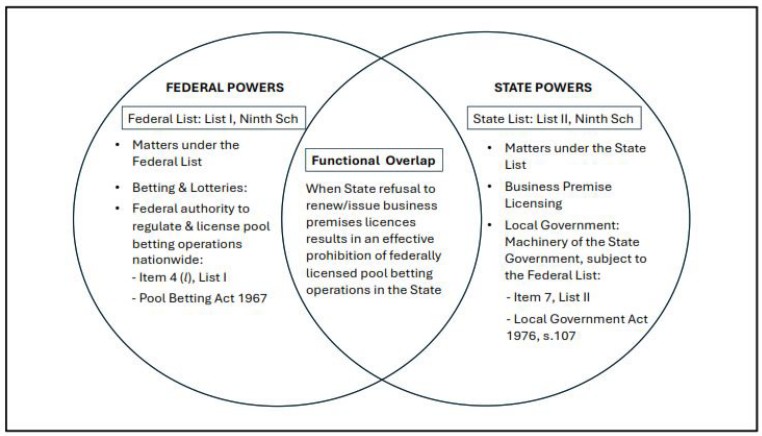
Pihak Berkuasa Tatatertib Majlis Perbandaran Seberang Perai & Anor v. Muziadi Mukhtar [2019] 6 MLRA 307 (refd)
R Rama Chandran v. Industrial Court Of Malaysia & Anor [1996] 1 MELR 71; [1996] 1 MLRA 725 (folld)
Legislation referred to:
Civil Law Act 1956, s 26
Contracts Act 1950, ss 24, 31
Federal Constitution, arts 4(1), 8, 73, 74, 75, 80(1), (2), 81(b), Eighth Schedule, Ninth Schedule, List I, Item 4(1), List II, Item 4(a)
Kelantan Syariah Criminal Code (I) Enactment 2019, s 37 Local Government Act 1976, s 107(3)
Pool Betting Act 1967, s 5(1), (3)(d)
Rules of Court 2012, O 53 r 5
Counsel:
For the appellants: Saifulrijal Azhari (Norhayati Ibrahim & Nurul Liyana Mohammad Nasir with him); State Legal Advisor's Office
For the respondents: Brian Foong Mun Loong (Eolanda Yeo Jin Huay, Muhammad Hiqmar Danial Hidzir & Nur Ellyana Farina Muhammad Ello with him); M/s Cheang & Ariff
[For the High Court judgment, please refer to Lee Bak Chui & Ors v. Kerajaan Negeri Kedah Darul Aman & Ors And Other Cases [2024] 6 MLRH 235]
JUDGMENT
Faizah Jamaludin JCA (Majority):
Introduction
[1] These six appeals arise from the High Court's decision at Alor Setar, delivered on 20 June 2024, allowing the respondents' applications for judicial review. The respondents challenged the Kedah State Government's decision, and its consequential implementation by the relevant local authorities, not to renew or issue business premises licences for pool betting businesses in Kedah with effect from 1 January 2023.
[2] The 1st appellant is the Government of the State of Kedah. The 2nd appellant is the Menteri Besar of Kedah, who presides over the Majlis Mesyuarat Kerajaan Negeri Kedah ("EXCO"). The respondents are pool betting operators, agents, premises operators, and persons directly affected by the cessation of renewals of business premises licences for federally licensed pool betting operations in Kedah.
[3] STM Lottery Sdn Bhd and ENE (Penang) Sdn Bhd held pool betting licences issued by the Minister of Finance under s 5 of the Pool Betting Act 1967 ("PBA 1967"). The individual agents and premises operators conducted business within that federal licensing framework and pursuant to the necessary premises licences issued by the relevant local authorities.
[4] These appeals do not concern unlicensed gambling. Nor do they require this Court to pronounce upon the social or moral desirability of gambling. The question is one of constitutional and public law: whether a State executive decision, implemented through local authority premises licensing, may, in substance, be used to impose a State-wide prohibition on federally licensed pool betting operations.
[5] For the reasons that follow, I would answer that question in the negative. These appeals should be dismissed, and the orders of the High Court affirmed.
The Material Facts
[6] The PBA 1967 is a federal statute. Section 5 empowers the Minister of Finance to grant licences for pool betting, subject to such conditions and restrictions as the Minister may impose during the currency of the licence. The power to licence pool betting is therefore vested in the Federal Executive acting under federal law.
[7] Those licences are not unconditional. Section 5(3)(d) provides that licences issued under s 5(1) are subject to such conditions or restrictions as the Minister may impose during the currency of the licence. The licences in evidence contained conditions, including the requirement that the words "JUDI ADALAH HARAM DI SISI AGAMA ISLAM" be printed on tickets sold to the public. The federal regime therefore proceeds on the footing that pool betting, though lawful, is controlled.
[8] In November 2021, after tabling the Kedah State Budget, the Menteri Besar announced that the Kedah State Government would no longer renew business premises licences for gaming outlets in Kedah. EXCO subsequently made a decision to that effect.
[9] In 2022, the respondents received letters from the relevant local authorities headed "Memberhentikan Pengeluaran Lesen Premis Perjudian Seluruh Negeri Kedah Mulai 1 Januari 2023". The letters referred to the EXCO decision and, in substance, conveyed two matters: first, that the Minister of Finance would no longer consider renewal of gambling licences in Kedah for 2023 because such licences were within the Minister's jurisdiction; and second, that if licence holders continued to operate after 31 December 2022, the relevant local authorities together with the Royal Malaysia Police would take firm enforcement action.
[10] It is common ground that the Minister of Finance did in fact renew the relevant PBA 1967 licences for 2023. The premise on which the local authority letters proceeded that the Minister of Finance would no longer renew the federal licences was therefore wrong.
[11] The respondents' applications to renew their local business premises licences were not approved. Some respondents had operated from their respective premises for many years, in some instances since 1988. The practical effect of the impugned decision was that federally licensed pool betting businesses could no longer operate in Kedah.
[12] The respondents then commenced judicial review proceedings. The High Court granted declarations that the 1st appellant had acted illegally and irrationally in deciding to cease the renewal of business premises licences for pool betting businesses; that the decision was ultra vires the Federal Constitution and unconstitutional; and that its implementation by the local authorities was unlawful. The High Court also ordered damages to be assessed.
The High Court's Decision
[13] The learned High Court Judge held that the impugned decision was amenable to judicial review. Her Ladyship rejected the contention that the decision was insulated from scrutiny merely because it was described as a matter of policy.
[14] The High Court found that the decision could not properly be characterised as no more than an exercise of local authority premises licensing. In substance and effect, it prevented the respondents from carrying on pool betting activities licensed by the Minister of Finance under the PBA 1967.
[15] The High Court further held that the relevant constitutional powers had to be read harmoniously. The State may regulate matters of local Government and premises licensing. It may not, however, use that power to nullify, impede, or defeat the federal licensing framework governing betting and lotteries.
[16] In substance, the High Court concluded that the impugned decision crossed the constitutional line between State regulation of premises and State prohibition of a federally licensed activity.
The Issues In The Appeals
[17] The appellants' grounds of appeal may be distilled into three principal questions:
(1) whether the impugned decision was a policy decision founded on moral and social considerations and therefore non-justiciable;
(2) whether the High Court erred in its constitutional analysis of the Federal List, the State List, and arts 74, 75, 80 and 81(b) of the Federal Constitution, including the application of harmonious construction; and
(3) whether the order that damages be assessed was wrong in principle.
[18] These issues are, in substance, questions of law and constitutional principle. The material facts are largely undisputed. The task on appeal is therefore to decide whether the High Court erred in law, principle, or constitutional characterisation.
Appellate Approach
[19] An appellate court does not interfere merely because it might have expressed the reasons differently. Intervention is justified where the court below misdirected itself on the law, applied a wrong principle, took into account irrelevant matters, failed to consider relevant matters, or reached a conclusion inconsistent with the governing constitutional framework.
[20] Here, the appeal turns on constitutional characterisation and the allocation of constitutional competence. In that setting, one must look to substance rather than labels. Descriptions such as "policy", "business premises licensing", or "local Government" do not conclude the inquiry. The Court must identify the true source of the power invoked, the constitutional field to which the measure belongs in pith and substance, and its practical legal effect. That is a question of law.
Issue 1: Justiciability And Policy
[21] The appellants submit that the impugned decision was one of policy, adopted in the public interest and on moral and social grounds, and was therefore not amenable to judicial review. In support, they rely, among other authorities, on Petaling Tin Bhd v. Lee Kian Chan & 2 Ors [1994] 1 MLRA 109; R Rama Chandran v. Industrial Court Of Malaysia & Anor. [1996] 1 MELR 71; [1996] 1 MLRA 725; Government Of Malaysia v. Lim Kit Siang & Another Case [1988] 1 MLRA 178; Dr Michael Jeyakumar Devaraj v. Peguam Negara Malaysia [2013] 2 MLRA 179; Dominic Lau Hoe Chai v. Maszlee Malik & Ors [2019] MLRHU 1449; and Marcel Jude Joseph v. The Minister Of Education, Malaysia [2011] 13 MLRH 281.
[22] I accept, of course, that courts do not sit in judgment on the wisdom, merits or political attractiveness of executive policy. Whether a policy is preferable is not a question for the courts.
[23] But a decision does not become immune from review merely because it is described as policy. The distinction is clear. The court does not review policy on its merits; it reviews legality. Where a policy decision is said to exceed constitutional limits, to contradict federal law, or to amount to an abuse of power, the court is not entering the policy arena. It is performing its constitutional duty.
[24] That is the effect of Dr Michael Jeyakumar Devaraj. The Federal Court recognised that courts must be slow to trespass into areas dominated by non-legal considerations. But it also made clear that where policy or action is unconstitutional, unlawful, arbitrary, irrational, tainted by mala fides, or constitutes an abuse of power, judicial intervention is required.
[25] The same approach is consistent with R Rama Chandran. Judicial review in Malaysia is not confined to formal error where the complaint is that a public authority has exceeded constitutional or statutory limits. A challenge to the legality of the decision itself, where grounded in public law error, is plainly justiciable.
[26] It is likewise consistent with Peguam Negara Malaysia v. Chin Chee Kow & Another Appeal [2019] 3 MLRA 183, where the Federal Court explained that justiciability concerns whether an issue is capable of determination by legal standards. A challenge that an executive decision exceeds constitutional power is paradigmatically such a case.
[27] The present case is therefore remote from those in which the court is invited to choose between competing policy preferences, allocate scarce public resources, conduct foreign relations, manage national security, or determine educational content. The respondents do not ask this Court to decide whether the State of Kedah should approve of gambling. They ask whether Kedah may, consistently with the Federal Constitution and federal law, implement a blanket refusal of premises licences so as to prevent the operation of federally licensed pool betting businesses throughout the State.
[28] Government Of Malaysia v. Lim Kit Siang & Another Case [1988] 1 MLRA 178 does not assist the appellants. That decision concerned, among other matters, standing and the propriety of using private litigation to vindicate a public right where no sufficient legal interest was shown. Here, the respondents are directly affected. Their licences, premises, and businesses were the immediate objects of the impugned decision.
[29] Petaling Tin Bhd v. Lee Kian Chan & 2 Ors [1994] 1 MLRA 109, properly understood, is also no authority for broad executive immunity. It recognises that some questions may not be appropriate for judicial determination. It equally recognises that where there is a real controversy as to legal right and legal power, the courts are competent to decide it. That is this case.
[30] Dominic Lau Hoe Chai v. Maszlee Malik & Ors [2019] MLRHU 1449 and Marcel Jude Joseph v. The Minister Of Education Malaysia [2011] 13 MLRH 281 were education policy cases. They did not involve a direct conflict between a State executive decision and a federal licensing statute operating within an expressly enumerated federal field. They do not answer the constitutional issue now before this Court.
[31] The controlling point is that the present dispute is resolvable by legal criteria: the constitutional allocation of subject matter, the limits of State executive power, the effect of a federal licensing statute, and orthodox public law grounds of review. That makes the case justiciable.
[32] The impugned decision was justiciable and amenable to judicial review. The court below was not reviewing the merits or desirability of the gambling policy. It was determining legality, constitutionality, and the limits of State executive power. That was plainly within its remit.
Issue 2: Constitutional Demarcation
[33] The central question is where the constitutional line falls between federal power over betting and lotteries, and State power over local Government and premises licensing.
[34] Article 4(1) declares the Federal Constitution to be the supreme law of the Federation. Articles 73 and 74 allocate legislative competence by subject matter. Item 4(1) of List I in the Ninth Schedule places "betting and lotteries" within the Federal List. The PBA 1967 is an exercise of that federal legislative competence, and the Minister of Finance's licensing power under s 5 is an exercise of federal executive authority within that field.
[35] By contrast, Item 4(a) of List II concerns local Government, including local administration and local authorities. The Local Government Act 1976, including s 107, supplies the statutory machinery for licensing trades, businesses, and premises by local authorities. Those powers are substantial and legitimate. They permit regulation of the use of premises, public order, sanitation, safety, nuisance, suitability of location, and other genuinely local considerations.
[36] The difficulty arises when an ostensible exercise of local licensing power is used, not to regulate premises as premises, but to suppress the licensed activity throughout the State. In such a case, constitutional analysis cannot stop at form. The Court must identify the true character, object and effect of the impugned measure.
[37] On the facts here, the refusal was blanket, State-wide, directed at the subject of betting and lotteries, and driven by opposition to the activity itself rather than by any defect in the premises. In pith and substance, this was not the regulation of premises. It was prohibition of a federally licensed activity. That is the constitutional vice in this case.
[38] That conclusion does not diminish the reality of local licensing powers. It marks their constitutional limit. A State or local authority may regulate premises for proper local Government purposes. It may not use that power as a device to enter a federal field or to render nugatory licences lawfully granted under a federal statute.
[39] Article 80 reinforces the same conclusion. Executive authority follows legislative competence. Article 80(2) further requires State executive authority to be exercised so as to secure compliance with federal law applying to the State. Article 81(b) adds that State executive authority must not impede or prejudice the exercise of federal executive authority. Where the Minister of Finance has renewed licences under the PBA 1967, a State-wide decision that renders those licences inoperative in practice, not for premises-specific reasons but because the State seeks to stop pool betting altogether, impedes federal executive authority in a federal field.
[40] Accordingly, the State and local authorities retain their premises licensing powers, but those powers must be exercised for legitimate local Government purposes and consistently with the Federal Constitution and federal law. They cannot be used as a constitutional substitute for federal control over betting and lotteries.
[41] Article 75 is also relevant, though its role must be stated precisely. In terms of it, it addresses the inconsistency between State law and federal law. The impugned measure here is executive and administrative rather than legislative. Even so, art 75 forms part of the constitutional architecture affirming the priority of valid federal law where State action, whether by legislation or by executive implementation under State law, collides with a federal scheme operating in a federal field.
[42] The authorities support that approach. In Letitia Bosman v. PP & Other Appeals [2020] 5 MLRA 636, the Federal Court emphasised that the Legislative Lists demarcate constitutional fields of competence and are not to be read as invitations to encroachment. In Gin Poh Holdings Sdn Bhd v. The Government Of The State Of Penang & Ors [2018] 2 MLRA 547, the Federal Court reiterated that List entries are to be given a wide meaning, but always within a constitutional context and with due regard to reconciliation where fields overlap.
[43] Nik Elin Zurina Nik Abdul Rashid & Anor v. Kerajaan Negeri Kelantan [2024] 3 MLRA 1 is instructive because it reaffirms that constitutional demarcation is structural, not semantic. A State cannot do indirectly what the Constitution denies it power to do directly. Iki Putra Mubarrak v. Kerajaan Negeri Selangor & Anor [2021] 3 MLRA 384 illustrates the same method: identify the true subject matter, determine the governing constitutional entry, and prevent an apparent State power from being deployed so as to occupy a federal field.
[44] The appellants' reliance on moral and social considerations does not alter the constitutional position. Such considerations may inform policy choices within a permissible field of competence. They cannot enlarge that field. Constitutional power derives from the Federal Constitution, not from the strength or sincerity of the policy preference asserted.
[45] Nor is it an answer to say that the respondents' federal licences remained formally in existence. Constitutional impairment is not confined to formal revocation. A federal licence may remain on paper yet be rendered practically worthless if the State, through a blanket premises-licensing policy, prevents any operation under it throughout the State. The Constitution looks to substance and effect.
[46] This holding should not be overstated. It does not mean that every refusal of a premises licence to a pool betting operator is unconstitutional. A local authority may refuse a licence on legitimate premises-based grounds, such as planning, zoning, safety, public health, nuisance, traffic, building non-compliance, or other matters genuinely falling within local Government competence. What it may not do is adopt a blanket policy whose object and effect are to prohibit throughout the State the operation of an activity licensed under a federal statute in a federal field.
[47] That is what occurred here. The letters were not directed to defects in any particular premises. They identified no safety, sanitation, planning, or nuisance grounds. They referred instead to a State-wide decision to stop the issuance or renewal of gambling premises licences from 1 January 2023. The Menteri Besar's affidavit evidence points the same way: the decision was directed not to premises suitability, but to the cessation of pool betting operations in Kedah as a matter of State policy.
[48] For those reasons, the impugned decision exceeded the constitutional limits of State power. Properly characterised, it was not an exercise of premises regulation within the local Government field. It was an impermissible State-wide prohibition of a subject matter reserved to the Federation.
[49] The decision was therefore ultra vires the Federal Constitution. It was also unlawful in public law because it deployed local licensing power for an impermissible constitutional purpose, and irrational because it proceeded, at least in part, on the erroneous premise that the Ministry of Finance would not renew the relevant federal licences and failed to grapple with the legal consequences of licences in fact renewed under the PBA 1967.
Article 75: The Proper Scope Of The Finding
[50] The juridical basis of invalidity must be identified with some care. Article 75 applies in terms of where a State law is inconsistent with a federal law. The impugned measure before us is not a State enactment. It is an executive decision implemented administratively through local authority licensing.
[51] Accordingly, this is not a case in which art 75 directly renders a State enactment void. Rather, art 75 confirms the broader constitutional principle that valid federal law is paramount within its field. The operative invalidity here lies in unconstitutional executive action: the State executive and the local authorities acted beyond the limits of their constitutional authority when, in substance and effect, they entered the federal field of betting and lotteries and impeded the operation of licences granted under the PBA 1967.
[52] This clarification matters because it keeps distinct constitutional doctrines in their proper spheres. Article 74 allocates legislative fields; art 75 resolves inconsistency between State and federal laws; art 80 links executive authority to legislative competence and compliance with federal law; and art 81(b) prohibits State executive action from impeding federal executive authority. Read together, those provisions support the conclusion reached by the High Court and affirmed in this judgment.
Irrationality, Illegality And Relief
[53] The appellants further contend that the decision was rational because it reflected the policy of the Kedah State Government. That submission again mistakes policy for legality. It does not answer the legal challenge.
[54] A decision may be motivated by policy and yet be unlawful if the decision-maker acts outside the limits of its powers. It may be sincerely held and yet irrational if it proceeds on a material mistake, ignores the governing constitutional and statutory framework, or treats an irrelevant premise as determinative.
[55] Here, the decision was unlawful because it deployed local business premises licensing for an impermissible purpose. It was unconstitutional because, in substance and effect, it intruded into the federal field of betting and lotteries. It was irrational because it proceeded, at least in part, on the erroneous basis that the Ministry of Finance would not renew the relevant federal licences and because it failed to confront the legal significance of licences that were in fact renewed under the PBA 1967.
[56] I find that the High Court's declarations were not wrong. They do not require the State Government to endorse gambling as a matter of policy. They simply mark the constitutional limits of State power and declare the unlawfulness of the impugned decision.
Issue 3: Damages
[57] The High Court ordered damages to be assessed. I see no error of principle in that order.
[58] The order does not award a quantified sum and does not predetermine entitlement. It merely preserves the respondents' ability, if they can, to prove at the assessment stage loss causally attributable to the unlawful decision. The respondents must still establish causation, remoteness, quantum, and any other applicable requirement. The appellants remain at liberty to contest each of those matters.
[59] In public law proceedings, damages do not follow automatically from declaratory relief. But where an unlawful public act is established and loss is said to have flowed from it, an order that damages be assessed is not, without more, objectionable. On the facts here, where the respondents were directly affected operators and licensees whose premise-based operations ceased because of the impugned decision, I find that it was not wrong for the High Court to have made the order, and it discloses no error in principle.
Conclusion
[60] These appeals turn on constitutional characterisation. The impugned measure was not a premises-specific licensing decision made on local regulatory grounds. It was a State-wide decision, implemented through the relevant local authorities, to stop the renewal or issuance of premises licences for pool betting businesses because the activity itself was disapproved.
[61] The State may regulate business premises. It may not, through that power, prohibit throughout the State the operation of businesses licensed under a federal statute within the federal field of betting and lotteries. Once the matter is viewed in substance rather than form, the constitutional answer is clear.
[62] Nothing in this judgment detracts from the ordinary competence of local authorities to refuse premises licences on genuine local grounds. The ratio is narrower: a blanket State-wide licensing stance, adopted to suppress the activity itself and not grounded in premises-specific considerations, cannot be used to defeat the practical operation of a federal licensing regime in a federal field.
[63] The High Court was right to hold that the impugned decision was amenable to judicial review and was ultra vires the Federal Constitution, unconstitutional, unlawful and irrational. The appellants did not show any proper basis for appellate intervention. The appeals must therefore fail.
Decision
[64] For these reasons, all six appeals are dismissed, and the decision and orders of the High Court dated 20 June 2024 are affirmed.
[65] Given the public law and constitutional issues raised, I make no order as to costs.
Lim Hock Leng JCA (Supporting):
Salient Facts
[66] There were 6 related appeals before us which were heard together. These appeals were brought by the State Government of Kedah ("the 1st Appellant") and the Right Honourable Chief Minister of the State of Kedah ("the 2nd Appellant"), against the decision of the learned High Court Judge ("the learned HCJ") granting judicial review on 20 June 2024 - to the Respondents who are pool betting agents, pool betting companies or principal officers of pool betting companies registered under the Pool Betting Act 1967.
[67] The salient facts are undisputed.
[68] The 1st Appellant, comprising the 2nd Appellant and the Kedah State Executive Council ("the EXCO"), had decided to stop renewing and issuing business premises licences for pool betting business activities.
[69] The decision was announced at a press conference on 14 November 2021, following the tabling of the State of Kedah's budget for 2022.
[70] It was said to be made for the welfare of the people, taking into consideration the religion of Islam and the social ills of gambling.
[71] From 16 November 2022 to 3 January 2023, the Municipal Councils of Alor Setar and Sungai Petani as well as the District Council of Baling issued a series of letters to the Respondents in which reference was made to an EXCO meeting on 8 December 2021 where there was consensus that (i) the Malaysia Ministry of Finance ("MOF") should no longer consider renewing gambling licences in the State of Kedah for 2023, and (ii) the local authorities and police would take strict enforcement action if any licence holder were to continue operating after 31 December 2022.
[72] In spite of the letters by these local authorities which were prompted by the decision made at the said EXCO meeting on 8 December 2021, the MOF renewed the pool betting licences for 2023, for such of the Respondents as were pool betting companies which, in turn, allowed them to appoint principal officers or agents who are then individually licensed to carry out the pool betting business. Both types of licences require the display of a sign stating, inter alia, "JUDI ADALAH HARAM DI SISI AGAMA ISLAM".
[73] The said local authorities, however, refused to renew the business premises licences which they had previously done so on a yearly basis.
[74] While some of these licences had a validity period till 31 December 2022, there were others that would only expire at various dates in the course of 2023.
[75] To recapitulate, the local authorities in Alor Setar, Baling and Sungai Petani had made it clear by their respective letters that strict enforcement action would be taken if any licence holder were to continue operating after 31 December 2022.
[76] As a result, starting from January 2023, the Respondents could not operate their pool betting business at the business premises designated in the pool betting licences.
Judicial Review
[77] It was thus that the Applicants/Respondents took out applications for judicial review for, inter alia, declarations that the local authorities and their heads had acted illegally, irrationally and in an unconstitutional manner or ultra vires the Federal Constitution in issuing those letters from 16 November 2022 to 3 January 2023; further and/or in the alternative, declarations that the 1st and 2nd Appellants had acted illegally, irrationally and in an unconstitutional manner or ultra vires the Federal Constitution in directing the local authorities and their heads to follow the decision of the Kedah Exco on 8 December 2021; and certain orders of certiorari and mandamus. The Respondents also prayed for damages.
Whether Decision Amenable To Judicial Review
[78] The Appellants contended that their collective decision was a policy matter which rendered it non-justiciable. With the tenet of separation of powers in mind, it was also contended that the judiciary ought not to interfere with the executive's role in policy-making.
[79] In so contending, the Appellants referred to a number of authorities including R Rama Chandran v. Industrial Court Of Malaysia & Anor [1996] 1 MELR 71; [1996] 1 MLRA 725, where Edgar Joseph Jr FCJ, in delivering his majority decision, observed that "where policy considerations are involved in administrative decisions and Courts do not possess knowledge of the policy considerations which underlie such decisions, Courts ought not to review the reasoning of the administrative body, with a view to substituting their own opinion on the basis of what they consider to be fair and reasonable on the merits, for to do so would amount to a usurpation of power on the part of the Courts."
[80] Reference was also made to Dr Michael Jeyakumar Devaraj v. Peguam Negara Malaysia [2013] 2 MLRA 179, where the Appellant, the Member of Parliament for the Sungai Siput constituency, had requested the Director of the Perak State Development Office for funds for his constituency from the Special Constituency Allocation. The Appellant did not get the response he wanted, and applied for judicial review to quash the decision. Leave had been granted by the High Court but was set aside by the Court of Appeal, whose decision was affirmed by the Federal Court.
[81] In that case, Raus Sharif PCA (as His Lordship then was), in delivering the judgment of the Federal Court, held: "Courts must be wary of unduly extending its judicial arms to policy matters which are exclusively within the domain of the executive. Unwarranted usurpation and transgression by the judiciary into the realm of the executive and vice versa will bring about disrepute to our system of Government which upholds the separation of powers between the three main components vis-à-vis the executive, the legislature and the judiciary."
[82] In response to the Appellants' arguments, the Respondents pointed out that the issue of non-justiciability was raised at the leave stage but the High Court nonetheless granted leave. There was no appeal against the decision granting leave. As such, the Respondents argued, relying on Ng Yee Hong v. Disciplinary Committee Malaysian Institute Of Accountants & Anor [2022] MLRHU 1902, that the dispute is justiciable and may be heard on the merits.
[83] In any event, the principle that policy decisions are not amenable to judicial review is subject to exceptions, and dependent on the facts of each case.
[84] Significantly, the material facts in the authorities cited by the learned SFC did not concern a transgression of the Federal Government's exclusive jurisdiction over "betting and lotteries", as prescribed by item 4(1) of the Federal List (List I)/Ninth Schedule of the Federal Constitution.
[85] The material facts in fact fall within the exceptions envisaged in Dr Michael Jeyakumar Devaraj (supra), as may be garnered from the following passage:
"[21] Of course, in appropriate cases the courts as the custodian of law and justice must not remain idle. Where the policy or action of the executive is inconsistent with the Constitution and the law or in any manner arbitrary, irrational or there are elements of mala fides and abuse of power, the court is duty bound to interfere. Whether or not the court should interfere clearly depends on the facts and circumstances of each case."
[86] If at all further authority is required, the Supreme Court, in Minister Of Labour & The Government Of Malaysia v. Lie Seng Fatt [1990] 1 MELR 10; [1990] 1 MLRA 246, made it clear that the Courts can subject an executive act to judicial review where the act is in contravention of the law.
Whether Decision Unconstitutional/ Ultra Vires/ Irrational
[87] While the issuance of trading or business premises licences is an incidental part of local Government which falls within item 4 of the State List (List II)/Ninth Schedule of the Federal Constitution, it is the Pool Betting Act 1967 applicable throughout Malaysia which confers on the Minister of Finance the authority to issue licences to regulate the pool betting business under the oversight of the Federal Government.
[88] Article 74 of the Federal Constitution stipulates that it is Parliament that makes laws on subjects within the Federal List (and the Concurrent List, which is not in issue or of relevance in the appeals before us), while art 80 demarcates the executive authority of the Federation and a State, according to matters with respect to which Parliament and the State Legislature may make laws.
[89] Any attempt by a State to prohibit pool betting activities and business, which is within the exclusive jurisdiction of the Federal Government through the non-renewal of business premises licences would be unconstitutional or ultra vires the Federal Constitution.
"[200] As submitted by the petitioners, betting and lotteries is a subject-matter under the Federal List which is clearly spelt out by item 4(1) of the Federal List which states: 4. Civil and criminal law and procedure and the administration of justice, including - ... (I) betting and lotteries.
[201] We take the view that 'betting and lotteries' can clearly and reasonably be taken to include gambling. The organisation of gaming houses and the regulation of betting and lotteries, as well as the creation of offences and their punishments are within the jurisdiction of Parliament. We find that s 37(1)(b) purports to deal with a matter that is included in item 4(1) of the Federal List which should be read together with the general header of item 4 on 'criminal law'. The subject matter of s 37(1)(b) is thus caught by the preclusion clause.
[202] We accordingly hold that s 37(1)(b) is unconstitutional on the ground that the respondent did not have the power to make it."
[90] I am mindful that, in the instant case, it is not the enactment of a State law which directly clashes with a law enacted by Parliament.
[91] Rather, it is the purported exercise of a State law or executive act of the State authorities which encroaches on a Federal law, and clashes with it.
[92] In respect of the recent decision of the Federal Court in Dato' Ting Ching Lee v. Ting Siu Hua [2025] 3 MLRA 207 that gambling activities are against public policy, that case concerned the recovery of monies related to gambling debts and the application of s 26 of the Civil Law Act 1956 and ss 24 and 31 of the Contracts Act 1950.
[93] The salient facts and applicable laws in that case are markedly different.
[94] By contrast, the issues here turn on the exercise of a State law in relation to the Pool Betting Act 1967, and the exercise of the Federal Minister's duties and responsibilities under that Federal law; and how all that is to be viewed, subject to the supreme law in Malaysia, the Federal Constitution.
[95] The Appellants' contention that the EXCO decision and the ensuing letters by the local authorities were neither illegal nor irrational - because they only dealt with the termination or non-renewal of the business premises licences, and were matters within the purview of the State Government of Kedah - ought to be given short shrift.
[96] Section 107(3) of the Local Government Act 1976 which provides that a local authority may at its discretion refuse to grant or renew any licence without assigning any reason must be read in the light of the EXCO decision and the ensuing impugned letters which were aimed at, as concisely summarised by the learned HCJ, "the banning of pool betting in the State of Kedah altogether."
[97] Indeed, in his affidavit-in-opposition, the 2nd Appellant expressly averred that the object of the whole exercise or decision was to ban gambling activities ("melarang aktiviti perjudian").
[98] The learned HCJ held that, undertaking the exercise of harmonious construction, the local authorities could exercise rights over the issuance of business premises licences, "but not to the extent of banning betting and lotteries. Otherwise, it would be including matter to override or render meaningless the entry in item 4(1) of the Federal List."
[99] While the learned High Court Judge did not specifically mention art 81 of the Federal Constitution, it is abundantly clear that the impugned decision violates art 81, which provides that every State shall exercise its executive authority so as to ensure compliance with all applicable federal laws, and so as not to impede or prejudice the exercise of the executive authority of the Federation.
[100] In substance, the termination and non-renewal of the business premises licences were clearly the means to an end, which had the effect of usurping the constitutional right and duty of the Minister of Finance to regulate the business of pool betting throughout Malaysia.
[101] It was an exercise of State executive authority to implement a blanket ban on gambling, including the pool betting business, which falls within the regulatory ambit of the Federal Government.
Conclusion
[102] For the reasons given, the 1st Appellant's decision to terminate or cease the renewal of business premises licences for pool betting businesses is irrational, inconsistent with and ultra vires the Federal Constitution.
[103] The learned HCJ could not be faulted for granting declaratory reliefs as against the 1st Appellant, and an Order for certiorari to quash the decision of the 1st Appellant.
[104] The learned HCJ also granted the prayer for damages to be assessed against the 1st Appellant by the Deputy/Senior Assistant Registrar. The award of damages cannot be faulted as it is in line with O 53 r 5 of the Rules of Court 2012. The Respondents had included a claim for damages in their statement in support of their applications for leave, and they were in a position for damages to be awarded at that point in time. There were abrupt closures of businesses which had been running for years. There would have been outlay of capital expenditure, and so on.
[105] The learned HCJ did not grant any prayers against the 2nd Appellant, whose appeal is thus of no utility and in vain. No orders were granted against the local authorities and their respective heads who were named as Respondents in the Judicial Review proceedings, and there were accordingly no appeals by these Respondents.
[106] On a related note, there was no cross-appeal by the Respondents in regard to the dismissal of their contention that "there is unfair discrimination against the non-Muslims in the State of Kedah who have been deprived of collecting, promoting, operating or participating in pool betting, while it is allowed in other States in Malaysia." The Respondents argued that the Exco decision and the letters by the local authorities fell foul of art 8 of the Federal Constitution which provided protection against unfair treatment. The argument did not find favour with the learned HCJ, who was of the view that the 1st Appellant's decision was applicable across-the-board to all persons in the same class. Since there is no cross-appeal on that finding, nothing more needs to be said of it.
[107] On the date fixed for the decision on the appeals, my learned sister Justice Azizah Nawawi (now CJSS) dissented. My learned sister Justice Faizah Jamaludin and I were of the view that the appeals are to be dismissed, and the decision of the learned HC is to be affirmed. We have each set out our reasons in our respective judgments.
[108] My learned sisters and I are unanimously of the view that there shall be no order as to costs, as the appeals are a matter of public interest.
Azizah Nawawi CJSS (Dissenting):
Introduction
[109] There are six (6) appeals before this Court, emanating from the decision of the learned High Court Judge dated 20 June 2024.
[110] These appeals do not concern the rights to engage in gambling. The sole issue before this Court is whether the decision of the State Government to stop the issuance of gambling premise business licences for pool betting within the State is ultra vires the Federal Constitution. The determination of this issue turns on the proper interpretation of the respective legislative powers conferred on the Federal and State Governments under the Federal Constitution. Accordingly, the role of this Court is confined to determining this constitutional issue, and does not extend to adjudicating any purported rights relating to gambling.
The Salient Facts
[111] As narrated by the learned Judge, the Respondents (Applicants in the High Court) are pool betting agents, pool betting companies, or principal officers of pool betting companies operating in the northern state of Kedah.
[112] The 1st appellant is the Government of the State of Kedah, represented by the Menteri Besar Kedah (the 2nd appellant), whilst the 3rd appellant is the local authority, represented by the Yang Dipertua Majlis Daerah Baling, Sungai Petani and Alor Setar respectively.
[113] On 14th November, 2021, the Menteri Besar announced that the State Government had decided not to renew business premises licences for gambling activities in Kedah.
[114] On 8th December 2021, the Kedah State Executive Council ("EXCO") decided to cease the renewal of gambling premises licences for number forecast operators and association clubs in Kedah, effective from 1st January 2023 ("EXCO Decision").
[115] The Respondents had received letters from the local councils informing them that their gambling premises licences would not be renewed after 31st December 2022.
[116] Aggrieved by the said decision, the Respondents filed their respective judicial review applications seeking the following orders:
(a) a declaration that the 1st appellant had acted illegally and/or irrationally in:
(i) deciding pursuant to the EXCO's decision on 8 December 2021 to cease the renewal of premises licences for pool betting in the State of Kedah effective from 1 January 2023; and/or
(ii) causing the Municipal Councils to issue the notice and/or letters ('Municipal letters') to inform the Respondents that their respective premises licences for pool betting will cease to be renewed effective from 1 January 2023.
(b) a declaration that the 1st appellant's decision is ultra vires the Federal Constitution and/or unconstitutional as it is inconsistent with and in breach of, inter alia, arts 8, 73, 74, 75, Eighth Schedule and item 4(1) of List I of the Ninth Schedule and are therefore null and void;
(c) an order for a certiorari to move this Court to quash the 1st appellant's decision;
(d) an order for a mandamus directing the 1st appellant to forthwith direct all of the local authorities in the state of Kedah to renew all applications for gambling premises licences for the year 2023 and onwards;
(e) an order for damages for losses suffered by the Respondents to be assessed by the Deputy Registrar/Senior Assistant Registrar and thereafter to be paid by the 1st appellant to the Respondents/ Applicants; and/or
(f) any other orders or reliefs as deemed necessary and/or just and/ or appropriate to be given by this court.
[117] The grounds for the judicial review are as follows:
(i) irrationality and unreasonableness that the 1st appellant had acted unreasonably and failed to take into account relevant considerations in reaching the 1st appellant's decision by:
(a) failing to understand that pool betting and lotteries are matters within item 4(1) of List I in the Ninth Schedule to the Federal Constitution and not under List II in the Ninth Schedule to the Federal Constitution. Implementation of the 1st appellant's decision is ultra vires the Federal Constitution and/or unconstitutional for being inconsistent with, inter alia, arts 74 and 75 of the Federal Constitution;
(b) arriving at the 1st appellant's decision and issuing the municipal letters and the action of not renewing and revoking the premises licences of the respondents were intended to ban the business of pool betting in the State of Kedah. It was done mala fide as the Appellants were aware that the jurisdiction regarding the business of pool betting and lotteries are matters within the Federal List and not the State List;
(c) failing to take into account that the 1st appellant's decision causes loss in livelihood, income and/or business of the respondents;
(d) failing to take into account that the 1st appellant's decision brings direct impact to the Respondents who are unable to collect, carry out or operate pool betting through their agents, and/or other agents in the State of Kedah. Therefore, this will have a paralysing effect on the staff and/or employees of the Respondents, especially those who reside in the State of Kedah;
(e) failing to take into account that the State of Kedah is a State of multiracial community, and the implementation of banning pool betting, which was participated by non-Muslims, is an unreasonable infringement of the rights of non-Muslims in the State of Kedah for the collection, operation or promotion of pool betting or taking part therein. Therefore, this is inconsistent with art 8 of the Federal Constitution;
(f) The 1st appellant's decision to ban pool betting in the State of Kedah by cancelling the renewal of the premise licence for the activities of pool betting is unreasonable, inconsistent with common sense, and unfair discrimination against the non-Muslims in the State of Kedah, who have been deprived of collecting, promoting, operating or participating in pool betting, while it is allowed in other States in Malaysia. This is a violation of art 8 of the Federal Constitution; and
(g) the implementation by the 1st appellant and/or the 2nd appellant in enforcing the 1st appellant's decision is unreasonable and irrational;
(ii) illegality - The 1st appellant had acted illegally and/or ultra vires of its authority when it arrived and implemented the 1st appellant's decision and failed to understand, inter alia, that:
(a) pool betting and lotteries are matters under item 4(1) of the Federal List and not under List II of the State List. Implementation of the 1st appellant's decision is ultra vires the Federal Constitution and/or unconstitutional for being inconsistent with, inter alia, arts 74 and 75 of the Federal Constitution;
(b) implementation of the 1st appellant's decision is an unreasonable infringement of the rights of non-Muslims in the State of Kedah for the collection, operation or promotion of pool betting or taking part therein. Therefore, this is inconsistent with art 8 of the Federal Constitution;
(c) the 1st and 2nd appellants had erred in law in arriving at the 1st appellant's decision disregarding arts 74 and 75 of the Federal Constitution that pool betting and lotteries are matters under the Federal List and not the State List;
(d) the 1st and 2nd appellants had improperly delegated themselves with the powers to implement the 1st appellant's decision when the powers to make laws and/or regulations relating to pool betting and lotteries are given to Parliament and not the 2nd appellant and/or the 1st appellant and/or the Kedah State Legislative Assembly; and
(e) there is no reasonable and/or legal basis for the 1st and 2nd appellants to implement the 1st appellant's decision;
(iii) procedural impropriety (legitimate expectation) - The act of the Appellants in making the 1st appellant's decision, issuing the municipal letters and the refusal to renew the premise licence for the Respondents is in breach of the legitimate expectation of the Respondents on the following grounds:
(a) the Respondents had operated the business of pool betting mostly for more than ten years, and one of them had been in the business since 1987;
(b) the 3rd and 4th respondents had never revoked the premise licences and always renewed the premise licence without failure for the business of pool betting every year;
(c) the Respondents had the relevant and valid licence from the Ministry of Finance under s 5 of Act 809 for the collection, operation or promotion of pool betting at their premise of business;
(d) every year, the Respondents had paid for the required fee to the Ministry of Finance including the fee for licences in 2023 for the collection, operation or promotion of pool betting;
(e) since the Respondents had an interest in the pool betting business in the State of Kedah, the Appellants should have heard from the Respondents before making the 1st appellant's decision, issuing the municipal letters, and refusing to renew and revoke the premise licence for the premises of the business; and
(f) the premise licence for the business of pool betting is still listed in the business that is allowed under the guidelines for business premises licence.
Decision Of The High Court Judge
[118] The learned Judge has allowed the Respondents' applications for judicial review and had quashed the decisions of the Appellants, premised on the grounds of justiciability, illegality and irrationality.
Non Justiciability
[119] On the issue of non-justiciability of the policy decisions made by the 1st Appellant, the learned Judge held that as a general principle, executive actions are non-justiciable where they concern matters of high policy or specialised expertise, such as national security, foreign affairs, or defence. These areas are recognised as falling within the exclusive discretion of the Executive and are ordinarily beyond judicial interference.
[120] However, the learned Judge held that the Court retains its jurisdiction to intervene where the impugned executive action is tainted by illegality, irrationality, or procedural impropriety. The learned Judge then held that judicial review is therefore available in this case where the Appellants' executive acts are outside its legal authority, have made a decision that is unreasonable or devoid of logic, or have failed to comply with fair procedures or have denied the legitimate expectations of the respondents.
Illegality
[121] In respect of illegality, the learned Judge held that the EXCO Decision to stop renewing licences for gambling premises is inconsistent with the Federal Constitution. Learned Judge held that under arts 80(1) and 74 of the Federal Constitution, a State's executive authority is confined to matters listed in the State List. Betting and lotteries, however, are expressly provided in Item 4(1) of the Federal List, and are therefore solely within the Federal Government jurisdiction. The State Government had therefore exceeded its constitutional authority, and its decision is illegal as it is ultra vires the Federal Constitution. The learned Judge held as follows:
"[46] Thus, the 1st respondent's decision to cease the renewal of the premise licence for gambling is inconsistent with art 80 reading together with art 74 and item 4(1) of the Federal List of the Federal Constitution, upon the following reasoning:
(i) each general word of the entries in the Legislative Lists in the Ninth Schedule to the Federal Constitution should be held to extend to all ancillary or subsidiary matters which can fairly and reasonably be said to be comprehended in it, and therefore there is no difficulty for item 4 of the State List to be interpreted to include matter of local authority in relation to the premise licence for gambling;
(ii) however, the matter in issue is far beyond that, which had been extended to the matter of local authority banning betting and lotteries under the subject matter of premise licence for gambling. This would then cause apparent conflict or overlap between the entry of item 4 of the State List and the entry of item 4(1) of the Federal List, where the court should attempt to reconcile them by adopting a harmonious construction. It must be borne in mind that the rule of widest construction does not permit an entry to be interpreted so as to include matters with no rational connection to it or to override or render meaningless another entry;
(iii) undertaking the exercise of harmonious construction, it may only allow the matter of local authority in relation to the premise licence for gambling, but not to the extent of banning betting and lotteries. Otherwise, it would be including matter to override or render meaningless the entry in item 4(1) of the Federal List; and
(iv) as a result, the matter of local authority to ban betting and lotteries under the subject matter of premise licence for gambling has no rational connection to item 4 of the State List, instead, it has the effect of overriding and rendering meaningless the entry of betting and lotteries in item 4(1) of the Federal List.
[47] Having reached the decision above, the court is, therefore, duty-bound to interfere as the decision of the 1st respondent is inconsistent with the Federal Constitution, where the 1st respondent had acted illegally and/or ultra vires of its authority when it arrived and implemented the 1st respondent's decision and failed to understand, inter alia, that:
(i) pool betting and lotteries are matters in item 4(1) of the Federal List and not under the State List. Implementation of the 1st respondent's decision is ultra vires the Federal Constitution and/or unconstitutional for being inconsistent with art 80 read together with art 74 and item 4(1) of the Federal List of the Federal Constitution; and
(ii) the 1st respondent had erred in law in arriving at the 1st respondent's decision in disregard of art 80 reading together with art 74 and item 4(1) of the Federal List of the Federal Constitution that pool betting and lotteries are matters under the Federal List and not State List."
[122] The learned Judge also held that the EXCO Decision to stop renewing licences for gambling premises was inconsistent with arts 80 and 74 of the Federal Constitution and Item 4(1) of the Federal List. Although Item 4(a) of the State List can be read broadly to cover local-authority matters relating to premise licensing, that power does not extend to banning betting and lotteries. Doing so creates a direct conflict with Item 4(1) of the Federal List, which specifically confers betting and lotteries under federal jurisdiction.
[123] By applying the canon of harmonious construction, the learned Judge held that the State may regulate premises but cannot use that power to override or nullify the Federal List. Since the State's decision effectively banned betting and lotteries, it had no rational connection to Item 4(a) of the State List and instead encroached on federal authority. The learned Judge therefore held that the 1st appellant had acted illegally and that such decision is ultra vires the Federal Constitution.
Irrationality
[124] The learned Judge further held that the EXCO Decision was irrational because the State Government had failed to take into account that betting and lotteries are matters assigned to the Federal Government under the Federal List, not the State List. By ignoring this fundamental jurisdictional limitation, the learned Judge held that the State Government had acted on a premise where it had no legal authority to enforce.
[125] The EXCO Decision was also irrational because it failed to consider the Respondents' legitimate expectations that their licences, which are governed under federal laws, would be continued to be processed lawfully. The learned Judge held as follows:
"[53] At this juncture, the pertinent issue to be determined is whether the 1st respondent had directed himself properly in law, taking into consideration the matters which he is bound to consider and excluding from his consideration matters which are irrelevant, which falls under the first category of unreasonableness.
...
[55] Following the finding above that the 1st respondent's decision to cease the renewal of premise licence for gambling is inconsistent with art 80 reading together with art 74 and item 4 of the State List of the Federal Constitution, the failure of the 1st respondent to understand that pool betting and lotteries are matters within item 4(1) of the Federal List and not under the State List is, therefore, a relevant consideration that the 1st respondent is bound to consider.
...
[61] To sum up, the 1st respondent had not directed himself properly in law taking into consideration the matters which he is bound to consider, whereby it had acted unreasonably and failed to take into account relevant consideration in reaching the 1st respondent's decision by failing to understand that betting and lotteries are matters within item 4(1) of the Federal List and not under the State List. Thus, the application for judicial review ought also to be granted upon the grounds of irrationality."
Article 8
[126] In respect of the Respondents' claim premised on unfair discrimination against non-Muslims under art 8 of the Federal Constitution, the same was dismissed by the learned Judge. The learned Judge held that art 8(1) protects equality only among persons within the same class, and the State Government's decision affected all licensed gambling operators in Kedah equally, irrespective of religion or race. Accordingly, no unfair discrimination was established. There is no cross appeal by the Respondents against this decision based on art 8 of the Federal Constitution.
Submissions Of The Appellants
[127] It is the submission of the Appellants that the learned Judge has erred in law by making an erroneous conclusion that there was an overlap or significant conflict between the Federal executive's power to issue gambling licences and the State executive's power to issue premises licences for gambling activities.
[128] Under art 80 of the Federal Constitution, read with Item 4(a) of the State List in the Ninth Schedule, the local authorities are empowered to enforce s 107 of the Local Government Act ("LGA"), which includes granting, refusing, or renewing premises licences, including licences for gambling premises.
[129] Accordingly, it is the submission of the Appellants that the decision of the 1st appellant, acting through the local authority, to refuse the renewal of the gambling premises licence, constituted a proper exercise of the discretion conferred by subsection 3 of s 107 of the LGA, read with art 80 and Item 4(a) of the State List.
[130] The Appellants further submit that they do recognise that the authority to issue gambling licences does not fall within their powers or discretion. That authority lies exclusively within the Federal Government, as stipulated in arts 73 and 74 and Item 4(1) of the Federal List in the Ninth Schedule.
[131] Accordingly, the Appellants had never challenged the gambling licences obtained by the Respondents, as the granting of the same falls within the jurisdiction of the Federal Government.
[132] However, the Appellants maintain their positions that the powers exercised through the local authority remain squarely within the scope of State jurisdiction and do not encroach upon Federal authority. The appellants had issued a policy decision, which the local authorities were then directed to implement within their respective local areas.
[133] It is also the submission of the Appellants that the decisions to issue the directives to the local authorities directing them to stop issuing or renewing gambling premises licences do not interfere with the issuance of gambling licences, which fall under the purview of the Ministry of Finance.
[134] Added to that, the EXCO Decision is a policy decision by the State Government.
Submissions Of The Respondents
[135] It is the submission of the respondents that the EXCO Decision appears to relate to the termination or non-renewal of Business Premises Licences, a matter which falls within the jurisdiction of the State of Kedah pursuant to s 107 of the Local Government Act 1976 and Item 4(a) of the State List.
[136] However, upon a proper examination of the Affidavits of the Appellants, in particular, the averments of the Menteri Besar at paragraph 14(a)(iii), reveal that the true objective of the EXCO Decision was to prohibit gambling within the state, using the renewal process for Business Premises Licences merely as the mechanism for implementation.
[137] As such, it is the submission of the Respondents that the EXCO Decision had exceeded the legitimate scope of administrative regulation and had effectively imposed a prohibition on gambling, a matter that lies exclusively within the Federal Government's legislative and executive competency. The State of Kedah does not possess the constitutional authority to legislate on or regulate matters relating to gambling, which fall exclusively within the Federal Government's legislative and executive competence under the Federal List.
[138] It is also the submission of the respondents that the learned Judge had correctly applied the principles articulated by the Federal Court in Letitia Bosman v. PP & Other Appeals [2020] 5 MLRA 636, that the EXCO Decision to cease renewing business premises licences for pool betting businesses would, in effect, render Item 4(1) of the Federal List (relating to betting and lotteries) nugatory.
[139] This is because in pith and substance, the EXCO Decision is to prohibit betting and lotteries, a subject which the State of Kedah has no constitutional authority. In other words, the purported cessation of licence renewals operates merely as a facade, masking what is in substance an unconstitutional attempt to regulate a matter reserved exclusively for the Federal Government.
[140] It is also the submission of the Respondents that the EXCO Decision, which concerns the banning of gaming and lotteries, is a matter over which the State of Kedah has no constitutional authority, and is therefore ultra vires the Federal Constitution, being inconsistent with art 80 read with art 74 and item 4(1) of the Federal List.
Decision
[141] The main prayer that the Respondents are seeking is a declaration that the EXCO Decision is ultra vires the Federal Constitution and/or unconstitutional as it is inconsistent with and in breach of, inter alia, arts 8, 73, 74, 75, Eighth Schedule and item 4(1) of List I of the Ninth Schedule, and are therefore null and void.
[142] As such, the main issue in this appeal is whether the EXCO Decision is made within the competency of the State Legislature and whether the same has transgressed into the Parliament's legislative jurisdiction and is therefore illegal, irrational and ultra vires the Federal Constitution.
[143] The constitutional provisions relied on by the Respondents are arts 8, 73, 74, 75, Eighth Schedule and item 4(1) and List I of the Ninth Schedule. The Respondents took the position that the EXCO Decision is ultra vires the Federal Constitution and/or unconstitutional as it is inconsistent with and in breach of, inter alia, arts 8, 73, 74, 75, Eighth Schedule and item 4(1) and List I of the Ninth Schedule and are therefore null and void.
[144] Article 8 is on 'Equality', art 73 is on 'Extent of federal and State laws', art 74 is on 'Subject matter of federal and State laws', art 75 is on 'Inconsistencies between federal and State laws', Eighth Schedule is on 'Provisions to be inserted in State Constitutions', Ninth Schedule is the 'Legislative Lists', whereas item 4(1) is on 'betting and lotteries' of the Federal List I. Whether the EXCO Decision is ultra vires arts 8, 73, 74, 75, Eighth Schedule and item 4(1) and List I of the Ninth Schedule. the Federal Constitution
[145] As affirmed by the Federal Court in Nik Elin Zurina Nik Abdul Rashid & Anor v. Kerajaan Negeri Kelantan [2024] 3 MLRA 1, the Reid Commission had contemplated that the State Legislature would possess exclusive authority to enact laws within the State List, while the State Government would bear sole responsibility for formulating policy and overseeing administrative matters. The apex court held as follows:
"[75] In commenting on the creation of a strong Federal Government with a defined set of matters that it can legislate coupled with a list for autonomous State Governments, the Reid Commission observed as follows in the RCR:
82. We have already explained the way in which powers are now divided between the Federation and the States and we have noted some of the difficulties which have arisen from this division (Chap. II). We think that it would be impracticable to continue the present system in so far as, with regard to many matters, it confers legislative power on the Federation and executive power on the States. If Malaya is to be a democratic country the Government of each State must be controlled by its elected Legislative Assembly, and we must envisage the possibility that from time to time the party in power in one or more of the States may differ in outlook and policy from the party in power in the Federation ... But, before proceeding to deal with specific subjects, we wish to emphasise that with regard to any which are in the Federal List not only should the Federal Parliament have the sole power to legislate but the Federal Government should also have the ultimate responsibility for determining policy and controlling administration. And similarly, with regard to any subject in the State List, in general the State Legislature should have the exclusive power to legislate and the State Government should have the exclusive responsibility for determining policy and controlling administration. We say that 'in general' the State Legislative Assembly and the State Government should have these powers and responsibilities because we think it necessary to recommend that in certain particular circumstances which we shall explain later the Federation should have overriding powers.
[76] Again, the above historical document clarifies that there is a clear demarcation of powers between the Federation and the States. There is no overlap and the primary powers of legislation were given to the Federation including the powers to legislate generally on civil and criminal law, and procedure.".
[Emphasis Added]
[146] The Federal Court in Latifah Mat Zin v. Rosmawati Sharibun & Anor [2007] 1 MLRA 847 has held that the matters enumerated in the State List (List II) in the Ninth Schedule of the Federal Constitution fall exclusively within State jurisdiction and lie beyond Parliament's legislative competence:
"[15] It must be emphasized that the Ninth Schedule is a schedule to the Constitution. Under the heading "Ninth Schedule", we find the following words:
[Article 74, 77]
Legislative Lists
List I - Federal List
[16] This is then followed by "List II - State List".
[17] The Ninth Schedule, as it says what it is, is a "Legislative List."
[18] The words "legislative lists" are clear enough. They mean what they say: the matters contained in the two lists are matters that Parliament and the legislature of a State may make law with respect thereto, respectively. Anyway, let me reproduce the two articles:
...
[19] For our present purpose it is sufficient for me to make the following points. First, art 74(1) gives the Federal Parliament power to make laws with respect to any of the matters enumerated in the federal list or the concurrent list, ie, the first or the third list of the ninth schedule.
...
[20] Secondly, art 74(2) gives power to the legislature of a State to make laws in respect of any of the matters enumerated in the State List."
[147] In Letitia Bosman v. PP & Other Appeals [2020] 5 MLRA 636, Azahar Mohamed CJ (Malaya) explained as follows, with regard to the interpretation of entries in the Legislative Lists of the Ninth Schedule to the Federal Constitution in the following passages:
"[49] Evidently, Parliament derives its legislative power from the FC. The power to legislate is a plenary power vested in Parliament. The issue of legislative competency is to be decided by reference to matters falling within Parliament's power to legislate. What is important in the setting of the present appeals is that the constitutional scheme of the FC empowers Parliament, the Legislative branch of the Government to make laws with respect to any of the matters enumerated in cl (1) art 74 of the FC and the Federal List as set out in the Ninth Schedule. The constitutional provisions highlight the fundamental principle relating to the power of Parliament to make law in respect of a particular matter pursuant to the FC. In this regard, item 4 of the Federal List provides for 'civil and criminal law', including in para (h) 'creation of offences in respect of any of the matters included in the Federal List or dealt with by federal law'......
......
"[51] Another equally important point to note is that the function of the entries in the Legislative Lists in the Ninth Schedule is not to confer powers of legislation, but merely to demarcate the fields in which legislative bodies operate..."
[Emphasis Added]
[148] Therefore, the Federal Court has held in numerous cases that the entries in the Legislative Lists in the Ninth Schedule do not grant legislative powers; they merely define the areas in which legislative bodies may act.
[149] Article 73 reads:
"Extent of federal and State laws
73. In exercising the legislative powers conferred on it by this Constitution
(a) Parliament may make laws for the whole or any part of the Federation and laws having effect outside as well as within the Federation.
(b) the Legislature of a State may make laws for the whole or any part of that State."
[150] Under art 73, Parliament can make laws for all or any part of the country, and those laws can even apply outside Malaysia, whereas a State Legislature can only make laws for all or any part of its own state. As such, art 73 is an empowering provision for Parliament to make laws for the Federation, whilst the State Legislature is empowered to make laws for the respective states.
[151] Article 74 of the Federal Constitution provides the subject matter in which the Federal and State Governments can make laws. This provision reads as follows:
"Subject matter of Federal and State laws
74. (1) Without prejudice to any power to make laws conferred on it by any other Article, Parliament may make laws with respect to any of the matters enumerated in the Federal List or the Concurrent List (that is to say, the First or Third List set out in the Ninth Schedule).
(2) Without prejudice to any power to make laws conferred on it by any other Article, the Legislature of a State may make laws with respect to any of the matters enumerated in the State List (that is to say, the Second List set out in the Ninth Schedule) or the Concurrent List.
(3) The power to make laws conferred by this Article is exercisable subject to any conditions or restrictions imposed with respect to any particular matter by this Constitution.
(4) Where general as well as specific expressions are used in describing any of the matters enumerated in the Lists set out in the Ninth Schedule the generality of the former shall not be taken to be limited by the latter.".
[152] Whilst Article 73 is an empowering provision for Parliament to make laws for the Federation, and State Legislatures for their respective states, art 74 then sets out the subjects or matters on which each of them can make laws. Any conflict between the state law and the federal law is governed by art 75, which provides that:
"Inconsistencies between federal and State laws
75. If any State law is inconsistent with a federal law, the federal law shall prevail and the state law shall, to the extent of the inconsistency, be void."
[153] Therefore, the learned trial Judge is clearly wrong when she made a finding that the EXCO Decision is ultra vires arts 73, 74 and 75. This is simply because art 73 is an empowering provision to make laws whilst art 74 merely sets out the demarcation of the subject matter on which Parliament or State Legislature can make the laws. Added to that, under art 75, state laws may be declared invalid if the same is ultra vires the Federal Constitution, however it does not provide for an executive decision (EXCO Decision) to be ultra vires the Federal Constitution.
Betting And Lotteries
[154] Item 4(1) of the Federal List in the Ninth Schedule to the Federal Constitution specifically provides betting and lotteries as the subject matter that is within the jurisdiction of the Federal Government to legislate:
"4. Civil and criminal law and procedure and the administration of justice, including
...
(1) betting and lotteries.".
[155] Pursuant to these legislative powers, Parliament has enacted the Pool Betting Act 1967, which provides as follows:
"Licence
5. (1) Unless there is established a Board under s 6, the Minister may issue a licence to a person for the collection, operation or promotion of pool betting."
Licences And Permits By Local Authorities
[156] On the other hand, Item 4(a) of the State List in the Ninth Schedule to the Federal Constitution provides the State with the authority to govern the Local Government outside the Federal Territories of Kuala Lumpur, Labuan and Putrajaya:
"4. Local Government outside the Federal Territories of Kuala Lumpur, Labuan and Putrajaya, including-
(a) local administration; municipal corporations; local, town and rural board and other local authorities; local Government services, local rates, local Government elections;".
[157] Therefore, the licensing of a business premises are matters that fall within the purview of the State of Kedah pursuant to Item 4(a) of the State List, read with s 107 of the LGA. Section 107 reads:
"(1) A local authority in the granting of any licence or permit may prescribe the fees for such licence or permit and the charges for the inspection or supervision of any trade, occupation or premises in respect of which the licence is granted.
(1A) Any licence or permit granted under this Act may be issued jointly with any other licence or permit.
(2) Every licence or permit granted shall be subject to such conditions and restrictions as the local authority may think fit and shall be revocable by the local authority at any time without assigning any reason therefor.
(2A) The revocation of any particular licence or permit issued jointly with any other licence or permit under subsection (1A) shall not affect the validity of any other licence or permit with which it had been jointly issued.
(3) The local authority may at its discretion refuse to grant or renew any licence without assigning any reason therefor.
(4) A licence shall be valid for a period not exceeding three years.
(5) Every person to whom a licence has been granted shall exhibit his licence at all times in some prominent place on the licensed premises and shall produce such licence if required to do so by any officer of the local authority authorised to demand the same.
(6) Any person who fails to exhibit or to produce such licence under subsection (5) shall be guilty of an offence and shall on conviction be liable to a fine not exceeding five hundred ringgit or to imprisonment for a term not exceeding six months or to both such fine and imprisonment.
(7) For the purpose of subsection (5) or (6) any reference to the word "licence" shall include its certificate true copy.
(8) The certificate of any licence as a true copy shall be made by the President, Secretary or any officer authorised by the President in writing."
[158] From the above provisions, there is clearly a demarcation of legislative competence between the Federation and the States. Under art 74, betting and lotteries fall under Item 4(1) of the Federal List, which is under the jurisdiction of the Federal Government, not the State Government.
[159] It is also not in dispute that the termination and/or non-renewal of business premise licences is a matter that falls within the jurisdiction of the State Government pursuant to item 4(a) of the State List. This legal position has been conceded by the Respondents as can be seen from paragraph (80) of their written submissions and it reads:
"80. On its face, the EXCO Decision does appear to concern the termination and/or non-renewal of Business Premises Licences, a matter that does fall within the purview of the State of Kedah pursuant to s 107 of the Local Government Act 1976 and Item 4 of the State List."
[160] Therefore, since the termination and/or renewal of Business Premises Licences is a matter that falls within the purview of the State Legislature, then the State Government would bear the sole responsibility for formulating policy and overseeing administrative matters pertaining to Business Premises licences. This is clearly provided under art 80 of the Federal Constitution:
"Distribution of executive powers
80. (1) Subject to the following provisions of this Article, the executive authority of the Federation extends to all matters with respect to which Parliament may make laws, and the executive authority of the State to all matters with respect to which the Legislature of a State to all matters with respect to which the Legislature of that State may make laws."
[161] Accordingly, I am of the considered opinion that the Appellant's jurisdiction, pertaining to business premises licences, is entirely different from that of the Federal Government authority over the issuance of gambling licences.
[162] The EXCO Decision was made within the ambit of s 107 of the LGA 1976. This is clearly within the province of the State Legislature pursuant to item 4(a) of the State List. There is clearly no conflict or overlap with federal law in the exercise of powers by the Appellant or the local authorities (PBT). The EXCO Decision concerns only the regulation of premises licences, including those for gambling activities, and does not deal with the Pool Betting Act and the licences that were issued under it.
[163] In other words, the Pool Betting Act regulates licences for operating or organising pool betting, but it does not cover the premises. Section 107 of the LGA regulates premises licences issued by local authorities (PBT). Therefore, gambling licences and premises licences are under separate jurisdictions and there is clearly no conflict between them.
[164] Therefore, I am of the considered opinion that the EXCO Decision was made within jurisdiction and is not ultra vires arts 73 or 74 of the Federal Constitution.
Harmonious Construction
[165] However, the learned Judge then held that the EXCO Decision to stop renewing gambling premises licences, pursuant to the State's executive authority under art 74 and Item 4 of the State List, had effectively banned betting and lotteries through the premises licensing. This, according to the learned Judge, gives rise to an apparent conflict or overlap between Item 4 of the State List and Item 4(1) of the Federal List. The learned Judge sought to reconcile this conflict by applying a harmonious construction. The learned Judge held as follows:
"[41] Following the majority judgment of Letitia Bosman, the relevant principles with regards to the interpretation of entries in the Legislative Lists of the Ninth Schedule to the Federal Constitution can thus be gleaned that the cardinal rule of interpretation is that the entries in the Legislative Lists in the Ninth Schedule to the Federal Constitution are not to be read in a narrow or restricted sense and that each general word should be held to extend to all ancillary or subsidiary matters which can fairly and reasonably be said to be comprehended in it.
[42] Moreover, in the event of apparent conflict or overlap between entries, the court should attempt to reconcile the entries by adopting a harmonious construction. The rule of widest construction does not permit an entry to be interpreted so as to include matters with no rational connection to it or to override or render meaningless another entry. What then follows is that the court, in interpreting a particular entry, should confine its decision to the concrete question arising from the case, without pronouncing a more exhaustive definition than is necessary
.....
"[46] Thus, the 1st respondent's decision to cease the renewal of the premise licence for gambling is inconsistent with art 80 reading together with art 74 and item 4(1) of the Federal List of the Federal Constitution, upon the following reasoning:
(a) each general word of the entries in the Legislative Lists in the Ninth Schedule to the Federal Constitution should be held to extend to all ancillary or subsidiary matters which can fairly and reasonably be said to be comprehended in it, and therefore there is no difficulty for item 4 of the State List to be interpreted to include matter of local authority in relation to the premise licence for gambling;
(b) however, the matter in issue is far beyond that, which had been extended to the matter of local authority banning betting and lotteries under the subject matter of premise licence for gambling. This would then cause apparent conflict or overlap between the entry of item 4 of the State List and the entry of item 4(1) of the Federal List, where the Court should attempt to reconcile them by adopting a harmonious construction. It must be borne in mind that the rule of widest construction does not permit an entry to be interpreted so as to include matters with no rational connection to it or to override or render meaningless another entry;
(c) undertaking the exercise of harmonious construction, it may only allow the matter of local authority in relation to the premise licence for gambling, but not to the extent of banning betting and lotteries. Otherwise, it would be including matter to override or render meaningless the entry in item 4(1) of the Federal List; and
(d) as a result, the matter of local authority to ban betting and lotteries under the subject matter of premise licence for gambling has no rational connection to item 4 of the State List, instead, it has the effect of overriding and rendering meaningless the entry of betting and lotteries in item 4(1) of the Federal List.".
[Emphasis Added]
[166] I take note that the learned Judge had also made a finding that the EXCO Decision to cease the renewal of the premise licence for gambling is inconsistent with art 80 of the Federal Constitution. But art 80 is not the pleaded case for the Respondents, as they have only relied on arts 8, 73, 74 and 75 of the Federal Constitution.
[167] In any event, after applying the harmonious construction of constitutional interpretation, the learned Judge then held that while the State can regulate premises, it cannot use that power to override matters under the Federal List. This is because the State's decision had effectively banned betting and lotteries. This decision was not connected to Item 4(a) of the State List and instead intruded into federal powers. The learned Judge therefore found that the 1st appellant had acted unlawfully and that the EXCO Decision was ultra vires the Federal Constitution.
[168] The doctrine of harmonious construction was explained by the Federal Court in Pihak Berkuasa Tatatertib Majlis Perbandaran Seberang Perai & Anor v. Muziadi Mukhtar [2019] 6 MLRA 307 as follows:
"[78] In this regard, it would be convenient for us to discuss the doctrine of harmonious construction. To put it simply, the doctrine of harmonious construction means a statute should be read as a whole and one provision of the Act should be construed with reference to other provisions in the same Act so as to make a consistent enactment of the whole statute. Such an interpretation is beneficial in avoiding any inconsistency or repugnancy either within a section or between a section and other parts of the statute. The five main principles of this doctrine/rule are as follows:
(i) the court must avoid a head on clash of seemingly contradictory provisions and they must construe the contradictory provisions so to harmonise them (see Commissioner of Income Tax v. Hindustan Bulk Carriers [2002] 3 sec 57, p 74);
(ii) the provision of one section cannot be used to defeat the provision contained in another unless the court, despite all its efforts, is unable to find a way to reconcile their differences;
(iii) when it is impossible to completely reconcile the differences in contradictory provisions, the courts must interpret them in such a way that effect is given to both provisions as much as possible (see Sultana Begum v Prem Chand Jain, AIR 1997 SC 1006, pp 1009, 1010);
(iv) Courts must also keep in mind that interpretation that reduces one provision to useless or dead lumber is not harmonious construction (see Commissioner of Income Tax v. Hindustan Bulk Carriers [2002] 3 sec 57, p 74); and
(v) to harmonise is not to destroy any statutory provision or to render it fruitless.
[79] In a nutshell, the doctrine requires that the legislation be construed in a way which would achieve a harmonious result. and that construction should favour coherence in the law."
[169] On the application of harmonious construction, the Federal Court in Gin Poh Holdings Sdn Bhd v. The Government Of The State Of Penang & Ors [2018] 2 MLRA 547, held that harmonious construction should only be applied when there is an "apparent conflict or overlap between entries, the court should attempt to reconcile the entries by adopting the harmonious construction."
[170] I am of the considered opinion that a careful reading of Item 4(a) of the State List in the Ninth Schedule to the Federal Constitution shows that its wording does not cover betting and lotteries. As such, there is no real conflict or overlap between the relevant entries, and there is absolutely no necessity for the learned Judge to apply the principle of harmonious construction to reconcile them.
[171] While it is a fundamental rule of interpretation that the entries in the Legislative List in the Ninth Schedule to the Federal Constitution must not be read narrowly or restrictively, this does not permit the entries to be interpreted freely so as to distort or pervert the language of the constitutional provisions. In Merdeka University Bhd v. Government Of Malaysia [1981] 1 MLRH 75, where Abdoolcader J (as His Lordship then was) held that:
"I said in PP v. Datuk Harun Haji Idris & Ors [1976] 1 MLRH 611 that the Constitution is not to be construed in any narrow or pedantic sense (James v. Commonwealth of Australia) [1936] AC 578 (at p 614) but this does not mean that a court is at liberty to stretch or pervert the language of the Constitution in the interests of any legal or constitutional theory, or even, I would add, for the purpose of supplying omissions or of correcting supposed errors.".
[172] It is equally important to recall that in Letitia Bosman (supra) the Federal Court held that whilst the widest possible construction must be given in interpreting the meaning of the words in an entry, the said construction must be given in accordance to their ordinary meaning of the words in the entry. The Federal Court held as follows:
"[50] An important point to note is that the words 'with respect to' in art 74 must be interpreted with extensive amplitude. The cardinal rule of interpretation is that the entries in the legislative lists are not to be read in a narrow or restricted sense and that each general word should be held to extend to all ancillary or subsidiary matters which can fairly and reasonably be said to be comprehended in it. The widest possible construction, according to the ordinary meaning of the words in the entry, must be put upon them. In construing the words in a constitutional document conferring legislative power the most liberal construction should be put upon the words so that the same may have effect in widest amplitude ...".
[173] Consequently, I find that from a careful reading of Item 4(a) of the State List in the Ninth Schedule to the Federal Constitution, there is nothing to indicate that the words therein encompass the ordinary meaning of betting and lotteries. Accordingly, there is no apparent conflict or overlap between Item 4(a) of the State List and Item 4(1) of the Federal List. Consequently, there is absolutely no necessity for the learned Judge to reconcile them through a harmonious construction.
EXCO Decision Prohibits Betting And Lotteries
[174] However, learned Counsel for the Respondents further submitted that in the pith and substance, the EXCO Decision is to prohibit betting and lotteries, a matter beyond the State of Kedah's constitutional authority. In other words, the purported cessation of licence renewals serves only as a facade, concealing what is, in substance, an unconstitutional attempt to regulate a matter reserved exclusively for the Federal Government. This can be seen from the following submissions of the Respondents:
"81. However, a closer examination of the Affidavits in Opposition, particularly the averments by the Menteri Besar at paragraph 14(a)(iii), reveals that the true objective of the EXCO Decision was to prohibit gambling within the state by using the renewal process as a tool of implementation.
82. In substance, the EXCO decision goes beyond the administrative regulation of Business Premises Licences and squarely amounts to a prohibition on gambling, a subject matter that lies exclusively within federal legislative and executive competence.
83. The State of Kedah does not possess the constitutional authority to legislate or regulate in respect of gambling, which falls exclusively within the legislative and executive competence of the Federal Government under the Federal List."
[175] In the present case, as conceded by learned Counsel for the Respondents, the termination and/or non-renewal of business premise licences is a matter that falls within the jurisdiction of the State Government pursuant to item 4(a) of the State List read with s 107 of the LGA 1976.
[176] This case differs significantly from the Federal Court's decision in Nik Elin Zurina (supra). In that case, one of the challenged provisions was s 37 of the Kelantan Syariah Criminal Code (I) Enactment 2019, which deals with gambling offences. The Court held, by a majority, that creating offences such as gambling falls within Parliament's jurisdiction.
"[201] We take the view that 'betting and lotteries' can clearly and reasonably be taken to include gambling. The organisation of gaming houses and the regulation of betting and lotteries, as well as the creation of offences and their punishments are within the jurisdiction of Parliament. We find that s 37(1)(b) purports to deal with a matter that is included in item 4(1) of the Federal List which should be read together with the general header of item 4 on 'criminal law'. The subject matter of s 37(1)(b) is thus caught by the preclusion clause.
[202] We accordingly hold that s 37(1)(b) is unconstitutional on the ground that the respondent did not have the power to make it.".
[177] Therefore, since the termination and/or non-renewal of business premise licences is a matter that falls within the jurisdiction of the State Government pursuant to item 4(a) of the State List, the same is not unconstitutional.
[178] This case is not a conflict between federal and state laws, because Kedah has not passed any law banning gambling, unlike the case of Nik Elin Zurina (supra) and Iki Putra Mubarrak v. Kerajaan Negeri Selangor & Anor [2021] 3 MLRA 384, where the states concerned have enacted laws that fall within the jurisdiction of Parliament. Instead, Kedah only has a policy that has the effect of banning physical gambling in the state.
[179] However, if the Federal Government wants to introduce online gambling, then the EXCO Decision will not be applicable, as the EXCO Decision only covers business licensing of business premises within the locality of the state.
[180] Regarding the policy considerations underlying the EXCO Decision, I am of the considered opinion that the reasons or intentions behind it are irrelevant when determining legislative competency. Since the termination or non-renewal of business premises licences falls within the State's legislative competency, it cannot be said to be ultra vires Item 4(1) of the Federal List.
[181] Indeed, the learned Judge has failed to consider the test of ultra vires as set out by the Federal Court in Mohd Najib Hj Abd Razak v. Government Of Malaysia & Another Appeal [2024] 1 MLRA 69, where it is stated clearly that:
"[31] The determination of the validity of a written law that is challenged as being ultra vires the Federal Constitution is an exercise of construction which is to be undertaken in accordance with established constitutional principles. This is equally true for tax or fiscal statutes as it is for any other statute.
[32] The determination involves a two-fold process of interpretation vis-à-vis the Constitution and the impugned statute. The substance and effect of the impugned legislation is to be benchmarked against the breadth and scope of the constitutional provision it allegedly impinges upon. In other words, the process to be undertaken may be summarised as follows:
(a) what is the true scope and implication of the relevant provision of the Federal Constitution which is alleged to be transgressed?
(b) what is the substance and effect of the impugned statute or statutory provision on its true construction?
(c) the court then has to consider whether the impugned statute or statutory provision is capable of a construction which is consistent with the constitutional provision;
(d) if the impugned statute or provision can be so construed, no contravention arises. Alternatively, if it appears to confer untrammelled powers when construed, it should be read down first, in order to uphold the provision. It is only where the construction of the impugned statute or provision lends itself to only one meaning that the power to strike down under art 4(1) of the FC should be utilised;
(e) to that extent constitutional review of a statute by the Judiciary under art 4(1) of the FC is an iterative process;
(f) in determining in (a) and (b), the meaning of a statutory provision and the intention of the Legislature in enacting the same can only be properly construed by considering the whole of the statute and every part of it. (See B.N.C.B. v. Babubhai (1987) 1 SCC 606 (para. 4) where it was held, inter alia, that "... It is an elementary rule that construction of a section is to be made of all parts together. It is not permissible to omit any part of it. For, the principle that the statute must be read as a whole is equally applicable to different parts of the same section";
(g) the position in this jurisdiction is provided for by statute in s 17A of the Interpretation Acts 1948 and 1967. The section requires any construction to take into account the words of the statute in the context and purpose of the statute. This means that the intention of the Legislature behind a particular provision can only be properly understood by a consideration of the whole instrument and every part of it. The meaning is to be drawn from the context of the Act using the words in the impugned section, other sections in the Act or the scheme of the Act in general;
(h) where however the invalidity or encroachment or unconstitutionality is clear, the court is bound to carry out its duty under the Federal Constitution to strike down or sever the impugned statutory provision or statute. The function of the court in this context is to ensure that the other organs of the Government do not overstep or overreach their functions so as to contravene the fundamental liberties in Part II of the FC. The Federal Constitution strikes at any arbitrariness or capriciousness of the State's action, so as to ensure fairness. The action of the Legislature should ensure that it is based on valid and relevant principles applicable alike to all similarly situated, and not guided by extraneous and irrelevant considerations;
(i) in economic and fiscal matters such as tax measures the court should proceed warily or with restraint as the Judiciary is not expert in these matters. The State should therefore generally be left with wide latitude in designing and implementing modes of imposing fiscal regulatory measures and the court should not, unless compelled by the Federal Constitution, encroach into this field. However, where such measures are shockingly arbitrary, clearly illegal or unconstitutional, the court should act under art 4(1) of the FC. (see M/S Bajaj Hindustan Ltd v. Sir Shadi Lal Enterprises Ltd (2011) 1 SCC 640 at 655 and 656); and
(j) the principle of judicial restraint applied to taxing statutes emphasises the significance of taxation, which extends beyond its role as a means of generating revenue for Government expenditures. Taxation also serves as a mechanism to address economic and societal disparities, aiming to mitigate inequalities within society."
[182] Therefore, in determining the issue of constitutionality, the court must first ascertain the true meaning and scope of the relevant constitutional provision, and then consider the substance and effect of the impugned law. The court must, as far as possible, interpret the law in a manner consistent with the Constitution, favouring an interpretation that preserves its validity, including by reading it down where necessary. A law will only be struck down where it cannot reasonably be construed in a constitutional manner. This is a careful and iterative process, requiring the statute to be read as a whole in light of its purpose and scheme. However, where a clear constitutional breach is established, the court is duty-bound to invalidate the law to prevent any abuse of power.
[183] In the context of the present appeal, the constitutional challenge must be between the statute concerned, that is s 107 of the LGA 1976 vis-à-vis the Federal Constitution. This is because the EXCO Decision was made within jurisdiction pursuant to s 107 of the LGA 1976.
[184] Added to that, there is no challenge on the constitutionality of s 107 of the LGA 1976 by the Respondents in the case. What is being challenged is the unconstitutionality of the EXCO Decision. I am of the considered opinion that where an administrative decision is made within and pursuant to a valid law, the said decision cannot be said to be ultra vires the Federal Constitution.
[185] The EXCO Decision was made pursuant to s 107 of the LGA 1976 and item 4 of the State List. As conceded by learned Counsel for the Respondent, the EXCO Decision, which concerns the termination and/or non-renewal of Business Premises Licences, is a matter that does fall within the purview of the State of Kedah pursuant to s 107 of the LGA 1976 and Item 4 of the State List. Therefore, the EXCO Decision, made pursuant to s 107 of the LGA 1976 cannot be said to be ultra vires the Federal Constitution, and in particular, item 4(1) of the Federal List.
Whether The EXCO Decision Is Illegal And/or Irrational
[186] On the issue of illegality and irrationality, the learned Judge made a finding that the EXCO Decision is illegal and irrational because the said decision is inconsistent with the Federal Constitution:
"[96] In conclusion, based upon the authorities and discussion above, the application for judicial review ought to be granted on the grounds of illegality and irrationality, for the following reasons:
(i) on the facts and circumstances of the present case, the court may interfere on the grounds of illegality and irrationality if the 1st respondent's decision is inconsistent with the Federal Constitution and in any manner irrational."
[187] In view of my finding that the EXCO Decision is a decision made within the ambit of State power and competency, then the same is consequently not illegal nor irrational.
Whether EXCO Decision Is Justiciable
[188] Justiciability refers to whether a particular issue or decision is suitable for review and adjudication by a court. It defines the limits of legal matters over which a court can exercise its judicial authority. If a matter is deemed non-justiciable, the court lacks the competence or jurisdiction to decide it due to the nature or subject matter of the issue.
[189] Justiciability determines whether executive actions are subject to review and adjudication by the courts. While courts generally refrain from interfering in policy decisions or matters within the exclusive domain of the Executive, they may intervene when such actions contravene constitutional provisions, statutory laws, or principles of administrative law.
[190] Since the EXCO Decision is made within the ambit of the State List and is therefore not illegal or ultra vires the Federal Constitution, the next issue is whether the EXCO Decision is non-justiciable.
[191] The Appellants have submitted that the EXCO Decision constitutes a policy decision made in its capacity as the State Government. The decision is an exercise of administrative policy by the Government of Kedah and falls within the Appellant's full discretion. Accordingly, based on established authorities, the Appellant's decision is non-justiciable, and the Court is obliged not to intervene in the Appellant's policy decision not to renew the licences of all gambling premises in the State of Kedah.
[192] It is also the submission of the Appellants that the policy in question was duly considered by the State Government. In making the decision, the Appellant took into account the welfare of the people of Kedah, particularly those of the Islamic faith, as gambling is prohibited by Islam. The State also took into consideration that the adverse effects of gambling outweigh any benefits to the society as a whole, irrespective of the religious convictions. Such effects include the breakdown of family institutions, serious indebtedness, and broader harm to societal values. The decision reflects a deliberate prioritization of the collective interests of the people of Kedah over the interests of any individual or specific entity.
[193] I am therefore of the considered opinion that the EXCO Decision constitutes a policy matter that should not be interfered with by the Court, as it involves the Appellant's discretion and reflects consideration of the welfare of the people of Kedah above the personal interests of the Respondents.
[194] The concept of justiciability of administrative decisions was discussed by the Supreme Court in Petaling Tin Bhd v. Lee Kian Chan & 2 Ors [1994] 1 MLRA 109, where Edgar Joseph Jr SCJ held as follows at p 119:
"Having said that, we should like to touch on the term Justiciability' that according to Black's Law Dictionary (5th Ed, 1983) at p 1004:
The term refers to real and substantial controversy which is appropriate for judicial determination, as distinguished from dispute or difference of contingent, hypothetical or abstract character. Guimarin & Doan, Inc v Georgetown Textile & Mfg Co 249 SC 561, 155 SE 2d 618, 621.
To take the point further, the concept of justiciability requires consideration of the subject matter of the question at issue, the manner of its presentation and the appropriateness of judicial adjudication in the light of these factors. Appropriateness in this context may be determined according to both institutional and constitutional standards which in turn require consideration of both the adequacy of judicial machinery for the task as well as the legitimacy of using it. To illustrate, we would refer to the following cases:
In Council of Civil Service Unions v. Minister for the Civil Service 15 at p 4110-F, Lord Diplock made some reference as to whether an issue is a justiciable issue or not in these terms:
The reasons for the decision-maker taking one course rather than another do not normally involve questions to which, if disputed, the judicial process is adapted to provide the right answer, by which I mean that the kind of evidence that is admissible under judicial procedures and the way in which it has to be adduced tend to exclude from the attention of the court competing policy considerations which, if the executive discretion is to be wisely exercised, need to be weighed against one another - a balancing exercise which judges by their upbringing and experience are ill-qualified to perform."
[195] In R Rama Chandran v. Industrial Court Of Malaysia & Anor. [1996] 1 MELR 71; [1996] 1 MLRA 725, the apex court held at pp 750-751:
"Needless to say, if, as appears to be the case, that this wider power is enjoyed by the courts, the decision whether to exercise it and if so, in what manner, are matters which calls for the utmost care and circumspection, strict regard being had to the subject matter, the nature of the impugned decision and other relevant discretionary factors. A flexible test whose content will be governed by all the circumstances of the particular case will have to be applied.
For example, where policy considerations are involved in the administrative decisions and the courts do not possess the knowledge of the policy considerations which underlie such decisions, courts ought not to review the reasoning of the administrative body, with a view to substituting their own opinion on the basis of what they consider to be fair and reasonable on the merits, for to do so would amount to a usurpation of power on the part of the courts."
[196] In Government Of Malaysia v. Lim Kit Siang & Another Case [1988] 1 MLRA 178, Tun Salleh Abbas LP said this:
"Finally if the objection of the respondent to the NSH contract is based on the ground of its excessive costs and unfairness to UEM's rivals, the jurisprudence of the Court is that it is not for the Court to interfere in the matter because the wisdom and policy decision of the Government belongs to the Government. We cannot tell the public authority how to exercise its power (per Lord Justice Lawton in Blackburn's case [1980] TLR 13 at p 15). Consequently, all those figures and reports showing economic feasibilities for and against the project are absolutely irrelevant and serve no purpose."
[197] In the case of Dr Michael Jeyakumar Devaraj v. Peguam Negara Malaysia [2013] 2 MLRA 179, the Federal Court held as follows on non-justiciability of policy decisions:
"[18] We are in complete agreement with the above view. We would like to add that the disbursement of the Special Constituency Allocation is a policy matter which is not within the purview of the courts. It is our view that the courts is in no position to evaluate the qualifications in the application for the Special Constituency Allocation and to determine or decide on the policy made by the executive. We have to take cognisance of the fact that Government policies emanate after consideration of a number of technical factors which are often non legal; and judges do not possess the necessary information and expertise to evaluate these non-legal factors and to pass judgment on the appropriateness or adequacy of a particular policy.
.....
[20] In the present case, the 2nd respondent had clearly explained, why he decided the way he did with regard to the distribution of the Special Constituency Allocation for the Sungai Siput constituency. Clearly, what was decided by the 2nd respondent hinged on matters relating to policy and thus we would dissuade ourselves from entering into the realm which belongs to the executive. Courts must be wary of unduly extending its judicial arms to policy matters which are exclusively within the domain of the executive. Unwarranted usurpation and transgression by the judiciary into the realm of the executive and vice versa will bring about disrepute to our system of Government which upholds the separation of powers between the three main components vis-à-vis the executive, the legislature and the judiciary."
[198] In Dominic Lau Hoe Chai v. Maszlee Malik & Ors [2019] MLRHU 1449, Amarjeet Singh JC (as he then was) held that the policy to implement Jawi writing in schools is not amenable to judicial review. The decision was a matter of executive discretion, considering non-legal factors such as national heritage, identity, and educational policy. The Court emphasized that evaluating the merits or reasoning behind such a policy would encroach upon the executive's domain. As with other Government policies, judicial intervention is limited, and public dissatisfaction must be addressed through public opinion rather than the courts.
[199] In Marcel Jude Joseph v. The Minister Of Education Malaysia [2011] 13 MLRH 281, the Court held that the Minister's decision to abolish the PPSMI in Sabah was a non-justiciable policy decision. It was beyond the Court's competence, as interfering would exceed its constitutional role.
[200] In Mohamad Raimi Ab Rahim & Ors v. Dato' Seri Mohd Najib Tun Haji Abdul Razak & Ors [2016] MLRHU 412, the Court applied the principles from Dr. Michael Jeyakumar Devaraj v. Peguam Negara Malaysia and Government Of Malaysia v. Lim Kit Siang & Another Case. The Court held that the request to disclose all documents related to the Trans Pacific Partnership Agreement involved Government policy considerations, which are non-justiciable. Judicial review cannot question the merits or technical aspects of such executive decisions, as they fall within the exclusive domain of the Government, and judges lack the expertise to evaluate non-legal factors. The Court reaffirmed that Government wisdom and policy decisions belong solely to the executive.
[201] The FC in Letitia Bosman (supra), inter alia, made the following observation with regards to policy decisions:
(i) that controversial matter of policy involving differing views on the moral and social issues involved is one circumstance where other branches of Government are better placed than the courts. The needs of society and to make difficult choices between competing considerations, taking into account the right of individuals as well the interests of society. A balance must be struck in mind the condition and needs of the society it serves, including its culture and traditions and the need to maintain public confidence ..." [see paragraph 92];
(ii) policy determination often requires surveys, investigation and reports conducted where the findings are on a macro scale. The other branches of Government as better placed than the courts because they have the facilities and resources to employ such useful tools in making the difficult choices between competing considerations in determining policy [see paragraph 108];
(iii) it is not the role of the courts to formulate policy neither can the courts substitute its view as this would tantamount to challenging the policies and usurp the policy making role of the other branches of Government [see paragraph 112].
[202] Therefore, the Courts have consistently decided that where Government decisions involved policy considerations, the court will regard these policy decisions as non-justiciable. Consequently, I am of the considered opinion that the EXCO Decisions not to renew the licences of gambling premises is a policy determination that lies beyond the purview of this Court. As such, it falls outside the Court's jurisdiction and is not amenable to judicial review.
[203] Furthermore, the recent decision of the Federal Court affirms the Federal Government's policy stance in combating gambling. In Dato' Ting Ching Lee v. Ting Siu Hua [2025] 3 MLRA 207, the Federal Court reiterated the view that gambling is against public policy in Malaysia. The Court held as follows:
"The issue of public policy
[84] The issue of public policy in the present case is equally important to be addressed by this Court. s 24(d) of the Contracts Act 1950 has provided that considerations or agreements against the public policy are unlawful. Sections 31(1) of the same Act and s 26 of the Civil Law Act 1956 as discussed earlier, were enacted to curb gambling activities. Now, the issue here is whether gambling is against public policy in Malaysia.
.....
[87] Besides the statutory provisions alluded to earlier that directly discourage gambling activities, the courts in Malaysia have taken the stand that gambling is actually against public policy. In Jupiters Ltd's case (supra), the court expressed the following view:
'[48] There is no doubt that gaming or gambling is injurious to the public welfare of our local society. It is recognised that gambling or gaming should be avoided and therefore it cannot be good social behaviour to indulge in it. In multi-racial and multi-religious Malaysia, Muslims are expressly prohibited from patronizing casinos and other gambling outlets. Gambling is similarly prohibited by the Bible. The Malaysians of Chinese descent also face the problem of gambling whose associate of is the loan shark (Ah Longs). The Hindus as well the Buddhist also have a disdain for gambling."
.....
[90] Our neighbour country, Singapore, takes the same position as ours. They also took a clear stand that gambling is against public policy. In Star Cruise Services Ltd v. Overseas Union Bank Ltd [1999] 2 SLR 412, the Court expressed this: [28] Public policy, therefore, was the purpose of the Gaming Acts. The policy was to suppress gambling on credit and protect property from capture by gamblers. It was also to declare that the courts of justice are out of bounds to gamblers and that the courts will not settle or collect gambling debts. The courts exist for more important business and will not assist those who make gambling their business."
[204] The Federal Court further reiterated while it is true that gambling premises operate in Malaysia with proper licences and are subject to existing laws, this does not mean that gambling does not violate public policy. The Federal Court stated as follows:
"[93] I do not deny that gambling premises are operating in this country but those premises are licensed and regulated under the relevant laws. That does not mean that gambling is not against public policy. As discussed earlier, the negative effect of gambling activities resulted in the Government policy to curb gambling activities and enact laws that nullify any gaming contracts and make any claim for recovery of gambling debts unenforceable.
[94] I also wish to dispel any thoughts that the present law is only favourable to gamblers who lose in their gambling activities. The law applies to all parties involved in the gaming transactions. It also applies to the winner of any wagers as they also cannot enforce their claim under Malaysian law. The debt arising from gambling activities is a debt of honour and not a legal debt. A debt of honour as defined in the Concise Oxford English Dictionary is a 'debt that is not legally recoverable, especially a sum lost in gambling".
[205] Therefore, based on the Federal Court decision in Dato' Ting Ching Lee v. Ting Siu Hua, where it is clearly stated that gambling is against public policy in Malaysia, the decision of the learned Judge in finding that the EXCO Decision to be unreasonable or irrational is absolutely erroneous.
Conclusion
[206] For the reasons enumerated above, I am of the considered opinion that the decision of the learned Judge is erroneous and must be set aside. I would therefore allow the appeal and set aside the decision of the learned Judge.