Federal Court, Putrajaya
Abu Bakar Jais PCA, Rhodzariah Bujang, Lee Swee Seng FCJJ
[Civil Appeal No: 01(i)-28-09-2024(B)]
1 April 2026
Administrative Law: Judicial review — Leave — Application by appellants who acted as legal officers for environmental organisations to challenge gazette notification de-gazetting forest reserve — Decision to de-gazette made in 2000 while organisations established in 2010 and 2016 — Notification published in 2022 specifying retrospective effective date of 2000 — Whether appellants possessed requisite locus standi to challenge decision made prior to their legal incorporation-Whether application filed out of time under O 53 r 3(6), Rules of Court 2012 — Whether material date for limitation period was date of original executive decision or date of gazette publication — Whether s 13, National Forestry Act 1984 and s 20, Interpretation Acts 1948 and 1967 permitted retrospective operation of de-gazettement notification — Whether requirement to hold public inquiry under s 11, National Forestry Act (Adoption) Enactment 1985 applied to decision finalised in 2000 prior to 2011 amendment
On 20 November 2000, the 1st respondent decided to de-gazette 406.22 hectares of the Bukit Cherakah Forest Reserve for development. Between 2001 and 2016, portions of the land were alienated to various entities, including the 6th and 7th respondents, and subsequently developed into residential estates, commercial buildings, and educational institutions. In 2011, the National Forestry Act (Adoption) (Amendment) Enactment 2011 introduced a requirement under s 11 for a public inquiry prior to any de-gazettement. On 5 May 2022, the 1st respondent published a gazette notification formally notifying the de-gazettement of the land, specifying the effective date of cessation as 20 November 2000. The appellants, who were the legal officers of environmental organisations established in 2010 and 2016 respectively, applied to the High Court for leave to commence judicial review. They sought a declaration that a public inquiry was a mandatory prerequisite for the de-gazettement and challenged the validity of the May 2022 notification. The High Court dismissed the application for leave, a decision subsequently affirmed by the Court of Appeal. The appellants appealed to the Federal Court where the issues to be decided were (i) whether the appellants possessed the requisite locus standi to challenge a de-gazettement decision made prior to their legal incorporation; (ii) whether the application for judicial review was filed out of time under O 53 r 3(6) of the Rules of Court 2012 ("ROC"), having regard to whether the "decision" took effect on 20 November 2000 or the date of the gazette publication in May 2022; (iii) whether s 13 of the National Forestry Act 1984 and s 20 of the Interpretation Acts 1948 and 1967 permitted the retrospective operation of the de-gazettement notification; and (iv) whether the requirement to hold a public inquiry under s 11 of the National Forestry Act (Adoption) Enactment 1985 (as amended in 2011) applied to a de-gazettement decision finalised in 2000.
Held (dismissing the appellants' appeal):
Abu Bakar Jais PCA (majority):
(1) The appellants lacked the legal standing (locus standi) to challenge the de-gazettement because they were not in existence when the decision was made in 2000 and therefore had no rights or interests that could have been altered or deprived. A small group of "nature conservationists" could not claim locus standi to displace the established rights and interests of thousands of residents and students who moved to the area after the land was developed. (paras 15, 17, 21 & 22)
(2) The application for judicial review was filed out of time under O 53 r 3(6) of the ROC, as the three-month limitation period commenced from the date of the actual decision on 20 November 2000, not the date of the gazette notification in 2022. The massive and visible development on the land between 2001 and 2016 meant that any interested party should have been aware of the change in the land's status long before the 2022 notification. (paras 25, 33, 34 & 35)
(3) Section 13 of the National Forestry Act 1984 allowed the State Authority to fix a cessation date in the gazette that was earlier than the date of the notification itself. Furthermore, s 20 of the Interpretation Acts 1948 and 1967 expressly permitted subsidiary legislation (which included gazette notifications) to operate retrospectively to any date not earlier than the commencement of the parent Act, provided no penalties were imposed for prior acts. (paras 29, 30 & 32)
(4) There was no legal requirement to hold a public inquiry for the 2000 de-gazettement decision because the statutory requirement for such an inquiry under s 11 of the Enactment 1985 only came into effect on 19 May 2011. The 2022 gazette notification was merely a formal administrative act to comply with statutory requirements for a decision that had already been lawfully finalised in 2000. (paras 36-38)
Lee Swee Seng FCJ (dissenting):
(5) In relation to the limitation period under O 53 r 3(6) of the ROC, where the decision of the Selangor State Executive Council dated 20 November 2000 had been made privately and without public disclosure, time did not begin to run from the date the decision was made. The limitation period commenced only upon the official communication of the decision to the public, namely through the Gazette notification dated 5 May 2022. Accordingly, for the purposes of O 53 r 3(6), where a decision of a public body had not initially been communicated to the public, the prescribed time ran from the date on which the decision was officially communicated. In the present case, the relevant date was 5 May 2022, being the date of publication in the Gazette. (para 169)
(6) The decision of the Selangor State Executive Council retrospectively legitimising the excision of the Bukit Cherakah Forest Reserve on 5 May 2022 was not immune from judicial review merely on the ground that it involved policy considerations. Policy reasons did not preclude or immunise a public law decision from challenge by way of judicial review. In the circumstances, the appeal was allowed, and the matter was remitted to the High Court for the judicial review application to be heard on its merits. (paras 169-170)
Case(s) referred to:
Association Of Bank Officers Peninsular Malaysia v. Malayan Commercial Banks Association [1990] 1 MLRA 324 (refd)
CAS v. MPPL & Anor [2019] 1 MLRA 439 (refd)
Datuk Bandar Kuala Lumpur v. Perbadanan Pengurusan Trellises & Ors And Other Appeals [2023] 4 MLRA 114 (refd)
Datuk Haji Idris Haji Bujang & Anor v. Ketua Pentadbiran Parlimen Malaysia & Ors [2024] 2 MLRA 710 (refd)
Dr Michael Jeyakumar Devaraj v. Peguam Negara Malaysia [2013] 2 MLRA 179 (refd)
Kerajaan Malaysia v. Wong Pot Heng & Anor [1996] 2 MLRA 433 (refd)
Ketua Pentadbir Parlimen Malaysia & Ors v. Datuk Haji Idris Haji Bujang & Anor [2026] 1 MLRA 106 (refd)
Kijal Resort Sdn Bhd v. Pentadbir Tanah Kemaman & Anor [2015] 1 MLRA 255 (refd)
Krishnasamy Kuppusamy & Anor v. Pengarah Hospital Sultanah Aminah & Ors And Other Appeals [2024] 1 MLRA 344 (refd)
Lee Kean Choon v. Khoo San & Ors [2026] 2 MLRA 284 (refd)
Malaysian Trade Union Congress & Ors v. Menteri Tenaga Air & Komunikasi & Anor [2014] 2 MLRA 1 (refd)
P Maradeveran Periasamy & Ors v. Suruhanjaya Pilihan Raya & Anor [2019] 3 MLRA 567 (refd)
Perbadanan Pengurusan Sunrise Garden Kondominium v. Sunway City (Penang) Sdn Bhd & Ors And Another Appeal [2023] 3 MLRA 44 (refd)
Pow Hing & Anor v. Registrar of Titles, Malacca [1980] 1 MLRA 57 (refd)
Public Textiles Berhad v. Lembaga Letrik Negara [1976] 1 MLRA 70 (refd)
Ratna Sari Arif & Ors v. The Mayor Of The City Of Kota Kinabalu [2016] 6 MLRA 570 (refd)
State Public Service Commission Sarawak v. Sarjit Singh Khaira [2000] 1 MLRA 589 (refd)
Sivarasa Rasiah v. Badan Peguam Malaysia & Anor [2012] 6 MLRA 375 (refd)
Surrey County Council v. The King (On The Application Of BC) [2025] EWCA Civ 719 (refd)
Syed Ibrahim Syed Mohd & Ors v. Esso Production Malaysia Incorporated [2003] 2 MLRA 432 (refd)
UEM Group Bhd v. Genisys Integrated Engineers Pte Ltd & Anor [2010] 2 MLRA 668 (folld)
WRP Asia Pacific Sdn Bhd v. Tenaga Nasional Bhd [2012] 4 MLRA 257 (refd)
YAM Tunku Dato' Seri Nadzaruddin Ibni Tuanku Ja'afar v. Datuk Bandar Kuala Lumpur & Anor [2002] 3 MLRH 313 (refd)
Legislation referred to:
Civil Procedure Rules 1998 [UK], r 54.5
Courts of Judicature Act 1964, Paragraph 1 of the Schedule Federal Constitution, art 5(1), Part II
Interpretation Acts 1948 and 1967, ss 3, 18(3), 20, 54(2)
National Forestry Act (Adoption) (Amendment) Enactment 2011, s 2
National Forestry Act (Adoption) Enactment 1985, ss 7, 11, 12, 13
National Forestry Act 1984, s 13(1)(a), (b)
National Land Code, ss 43(4), 130(1) Rules of Court 2012, O 53 rr 1(1), 3(6), (7)
Rules of the High Court 1980, O 53 rr 1, 1A, 3(6)
Counsel:
For the appellants: Gurdial Singh Nijar (Rajesh Nagarajan, Sachpreetraj Singh, Abraham Au, Ambbi Balakrishnan & Amanda Sonia Mathew with him); M/s Raj & Sach
For the 1st-4th respondents: Hani Aziza Ismail @ Aziz (Mary Phoon Keat Mee with her); State Legal Adviser's Office
For the 5th respondent: Ng Ka Choon (Low Jiah Yee with him); M/s Tengku Maria Lim & Ong
For the 6th respondent: R Ganapathi (Al-Sabri Ahmad Kabri & Marlia Mohd Azrin with him); M/s Al-Sabri & Co
For the 7th respondent: John Wong Yok Hon (Sarah Low Wan Qi with him); M/s Shui Tai
Amicus Curiae for the Malaysian Bar: New Sin Yew (Abhilaash Subramaniam with him); M/s Abhilaash Subramaniam & Co
Amicus Curiae for the World Wide: Malik Imtiaz Sarwar; M/s Kelviin Manuel Pillay Fund for Nature Malaysia
[For the Court of Appeal judgment, please refer to Damien Thaman Divean & Anor v. Majlis Eksekutif Negeri Selangor Darul Ehsan (EXCO) & Ors [2025] 4 MLRA 693]
JUDGMENT
Abu Bakar Jais PCA (Majority):
Introduction
[1] This case concerns the application for leave for Judicial Review ("JR") at the High Court ("HC"). The application was dismissed at the same court. Subsequently, that decision of the HC was appealed to the Court of Appeal ("COA"), and the latter dismissed the appeal and affirmed the decision of the former. All parties then came before us for the appeal against that decision of the COA.
[2] Both the HC and the COA came to the same conclusion that the application for leave for JR by the appellants should not be allowed. The application for this leave is essentially to challenge the gazette notification that had degazetted 406.22 hectares of the Bukit Cherakah Forest Reserve ("land"). It is also to challenge the decision to allow for the development of the land. The leave application for JR also sought a declaration that the requirement for a public inquiry as stipulated in the National Forestry Act (Adoption) (Amendment) Enactment 2011 ("Enactment 2011") must be complied with by the respondents as a prerequisite before the de-gazettement of any land can be allowed in the state of Selangor.
[3] The appellants also applied before us for all actions, proceedings, executory proceedings or any other cause of action that may arise because of the decision to degazette to be stayed, until the application for the JR has been decided and resolved in its entirety and with finality or until it is ordered otherwise by this court.
Parties
[4] The 1st appellant is the legal officer of Pertubuhan Pelindung Khazanah Alam Malaysia ("PEKA"). PEKA was established in 2010 with the vision to save the rainforest and its biodiversity from extinction and to ensure the conservation and protection of the environment. The 2nd appellant is the legal officer of Persatuan Rimba Komuniti Shah Alam ("SACF"), an association that was officially formed in March 2016 to essentially protect forest areas.
[5] The 1st respondent is the State Executive Council or Majlis Kerajaan Negeri. The 2nd respondent is the State Director of the Forestry Department. The 3rd respondent is the Director of the Petaling Land and Mineral Department. The 4th respondent is the State Government of Selangor. The 5th respondent is a private company. The 6th respondent is Perbadanan Kemajuan Negeri Selangor (PKNS), the legal and beneficial owner of about 141 hectares of the said land. That land was alienated to PKNS in December 2016 for development purposes. The 7th respondent is Restu Mantap Sdn Bhd, another private company that was given part of the land and had entered into a joint-venture agreement with the 5th respondent for the development of the area of the land given to the 7th respondent.
Background Facts
[6] The land started to be a permanent forest reserve on a smaller scale in 1909 when the same was gazetted for that purpose. Thereafter, the land was degazetted since 1976 for the purposes of development.
[7] On 20 November 2000, the 1st respondent decided to degazette the land as a forest reserve. Certain areas were also cleared for the construction of residential buildings on top of the land. The decision to degazette part of the land as a permanent reserved forest and to be alienated to entities or companies, including:
(a) Perbadanan Kemajuan Negeri Selangor (350 acres);
(b) SAS Estate Sdn Bhd (50 acres);
(c) Excel Nobel Const Sdn Bhd (50 acres);
(d) Permaddun Sdn Bhd (50 acres); and
(e) the 7th respondent, Restu Mantap Sdn Bhd (50 acres).
[8] In 2007, part of the land for development was given for the construction of a residential area.
[9] Thereafter, a residential enclave known as Alam Budiman was erected at the said location.
[10] On 29 April 2011, Enactment 2011 introduced the requirement to hold a public inquiry into the de-gazettement process.
[11] On 5 May 2022, the secretary of the 1st respondent had caused to be published a gazette (Selangor State Government Gazette No 1645 dated 14 April 2022 [PHN Sel. 100 1/9/1 Jld.2 (11): P.U. Sel. (ADV) PS.05/4/5]). This gazette notifies that the land had been degazetted. Prior to the de-gazettement, no public inquiry was held with regard to the de-gazettement of the land.
The questions of law
[12] The present appeal before us is premised on the following questions of law:
a) Whether the National Forestry Act 1984 ("NFA 1984") allows for retrospective legislation?
b) Whether the National Forestry Act (Adoption) Enactment 1985 ("Enactment 1985") allows for retrospective legislation despite there being no specific provision for retrospective legislation under Enactment 1985 and/or NFA 1984?
c) Pursuant to s 13 of Enactment 1985, does the decision to excise the Bukit Cherakah forest reserve take effect from the date of the Selangor Executive Council's meeting on 20 November 2000 or when the de-gazettement took place on 5 May 2022?
d) Whether the "decision" of a state executive council to excise forest reserves takes effect on the day of the state executive council's meeting in private or on the day the notification of the de-gazettement of the said forest reserve is made?
e) Taking into account the fact that the 'decision' of the Selangor Executive Council on 20 November 2000 was made in private without public disclosure, whether limitation under O 53 r 3(6) Rules of Court 2012 ("ROC 2012") starts to run from the 20 November 2000 or when the said decision was officially communicated via the de-gazettement on 5 May 2022?
f) Whether O 53 r 3(6) of ROC 2012 applies to decisions of a public body that were not communicated to the public?
g) Whether the decision of the Selangor State Executive Council in retrospectively legitimizing the excision of the Bukit Cherakah forest reserve on 5 May 2022 is a decision that cannot be reviewed on the general ground of 'policy reasons'?
h) Whether the requirement to hold a public inquiry prior to de-gazettement of the Bukit Cherakah forest reserve under s 11 of Enactment 1985 can be dispensed with via the State Executive Council's retrospective de-gazettement of the same?
i) Whether any executive body can de-gazette a forest reserve without complying with the pre-requisite of holding a public inquiry pursuant to s 11 of Enactment 1985?
Attempt for settlement
[13] This court allowed parties time to come to an agreement to settle this case, but we were then informed that this was unsuccessful.
Decision
Locus Standi
[14] In the first place, I am of the view that it is of crucial importance to determine whether the appellants have the locus standi to challenge the action to degazette the land. If both the appellants do not have the legal standing to question that decision made to degazette the land as a forest reserve, then it should only be appropriate and just that their application for JR on the same issue must not be allowed. One decisive factor to consider in determining the locus standi of the appellants is to look at the material times when the de-gazettement was made and when both appellants or, more importantly, the real substantive appellants were established or came to function.
[15] The decision to degazette was in 2000. The 1st appellant was formed in 2010. The 2nd appellant came into existence in 2016. Thus, the appellants did not acquire or have any rights when the decision was made to degazette the land. Appellants had no interest to protect when the decision to degazette was made.
[16] The 1st and 2nd appellants are, of course, individuals, but both acted as legal advisers for the substantive appellants, the two environmental organisations or associations, PEKA and SACF. The real appellants, PEKA and SACF, were not in existence when it was decided to degazette the land. Hence, how could that action to degazette the land in any manner affect the rights of both the appellants? Their rights, if any, came into existence only many years after the decision to degazette.
[17] I agree with the decision of the HC that the appellants have failed to demonstrate how their rights or obligations were altered or how they were deprived of a benefit they were permitted to enjoy. The appellants did not have the rights and obligations that could be altered, and they could not be deprived of a benefit simply because they came into existence at least a decade or more after the land was degazetted.
[18] Further, on this issue of locus standi, with respect, I disagree with the COA. I am of the view that the COA came into error in concluding that this is a case involving public interest litigation and the appellants act in the interests of the public as "nature conservationists". The COA therefore concluded the appellants have a real and genuine interest in protecting the land as a forest reserve. As such, the appellants have the necessary locus according to the COA.
[19] What should have been done is to ask when the appellants came in as "nature conservationists". They came in after the land was developed. In this regard, it is wise to remember that a huge portion of the land had been developed after the land was degazetted, among others, as a housing area known as Alam Budiman. This area also comprises, inter alia, commercial and higher education buildings, including the Universiti Teknologi MARA, UiTM (Puncak Perdana Campus), Puncak Perdana Mosque and Puncak Perdana Primary School.
[20] The appellants could not have had any interests in the land then, as opposed to at least thousands of people now residing in that area. As stated earlier, the leave for JR also challenged the decision to allow for the development of the land. This could not be granted as development had already taken place in a huge parcel of the land before the filing of the application for leave of the JR.
[21] A group of people, so-called "nature conservationists" (the term used by the COA), could not simply claim locus standi in the face of a much larger group of people running to the thousands. They came in and now genuinely have an interest, as among others, residents in the housing area. There are also schools and other public amenities in that area. It is most difficult to fathom how this larger group of people, at least as residents, could be displaced in terms of priority in interest by a smaller group who were not even in existence when the decision was made to degazette the land. Surely the stark displacement is a huge possibility if the leave for JR is allowed. One may want to argue that this should not be a consideration, at least at the leave stage. But the reality is that when the decision to degazette was made in 2000, both substantive appellants were not even in existence. That is precisely why the leave for JR should not be allowed, as correctly decided by the HC. The appellants could not gain an interest many years after the decision to degazette simply as "nature conservationists".
[22] In my judgment, the practicability of a redress sought from a court of law must always be observed. It should not be granted if such redress affects the greater good or interest of too large a group of people. This is especially so when the redress was sought many years after the larger group of people acquired some rights and interests. Granting that redress as requested by the present appellants affecting thousands of people who are residents, business people, students, and other interested groups in Alam Budiman simply could not be practical in the name of saving the land to its original position, bearing in mind that a large part of the land is already developed. I call this approach not only practical but realistic.
[23] Of course, neither do I say the authorities or those having the power and duties to act accordingly could simply trample on the rights of smaller groups of people, such as the appellants, if there is evidence to that effect. However, to my mind, the reality in this case is that the appellants came in many years after a substantial part of the land had been completely developed. And more importantly, based on the facts available, in my opinion, the respondents too could not be legally obligated in this case to the appellants, as shown by the reasons above and what is stated in the rest of this written judgment.
[24] This issue alone is sufficient to decide this appeal against the appellants. However, I will address other issues that arose in this case. These issues will also be shown in due course to be not cogent for the appellants to sustain the present appeal.
Out of Time
[25] The next issue is the time for the appellants to bring this matter to court. With respect to the appellants, I could not see why the HC was wrong in finding the appellants were out of time in filing the application for leave for JR. The appellants, like anyone else, must abide by the rules and laws governing such filing. A JR application must be made to challenge a decision within 3 months as required by O 53 r 3(6) of the ROC 2012. The decision to degazette the land was, as earlier said, made in 2000. Hence, the application for JR was clearly out of time as the 1st and 2nd appellants came into existence only in 2010 and 2016, respectively. I also note the observation of the COA that the application for JR was filed more than 20 years from the decision to degazette the land in 2000. The appellants also failed to request an extension of time beyond the required 3 months. There is also no reason to say that the appellants should be exempted from complying with the timeline of 3 months without making such an application, in which the reasons for the delay would be canvassed.
[26] The appellants submitted that they had initiated the application for leave of the JR in time, as the gazette notification on the de-gazettement of the land was only issued on 14 April 2022 and published on 5 May 2022. They contended that they only became aware of the decision to degazette the land on these dates. This, with respect, is incorrect because the decision to degazette the land was made on 20 November 2000 by the 1st respondent and not on 14 April 2022 or 5 May 2022 as indicated above. And the law allows for that date, 20 November 2000 and not 14 April 2022 and 5 May 2022 to be maintained as the material and relevant date, as will be explained in a short while.
Communication
[27] The decision to degazette must be communicated according to the appellants through the gazette because of s 13 NFA 1984, which provides that the State Authority must notify in the Gazette any excision of land from a permanent reserved forest. This provision states as follows:
(1) Whenever any land is excised from a permanent reserved forest, the State Authority shall cause to be published in the Gazette a notification-
(a) specifying the situation and extent of such land; and
(b) declaring that such land shall cease to be a permanent reserved forest from a date fixed by the notification.
(2) From the date so fixed, such land shall cease to be a permanent reserved forest.
[28] Further, there is no dispute that the above gazette notification states as follows:
ENAKMEN (PEMAKAIAN) AKTA PERHUTANAN NEGARA 1985
NATIONAL FORESTRY ACT (ADOPTION) ENACTMENT 1985
PENGELUARAN KAWASAN TANAH DARIPADA HUTAN SIMPANAN KEKAL
EXCISION OF LAND FROM PERMANENT RESERVED FOREST
Menurut seksyen 13 Akta Perhutanan Negara 1984 [Akta 313], seperti yang diterima pakai oleh Enakmen (Pemakaian) Akta Perhutanan Negara 1985 [En 5/1985], Pihak Berkuasa Negeri Selangor mengisytiharkan bahawa kawasan tanah yang diperihalkan dalam Jadual, dan yang merupakan sebahagian daripada hutan simpanan kekal yang dikenali sebagai Hutan Simpan Bukit Cherakah dan diisytiharkan sedemikian melalui Pemberitahuan Warta No 2578 tahun 1927, tidak lagi menjadi hutan simpanan kekal berkuat kuasa mulai dari tarikh kelulusan Majlis Mesyuarat Kerajaan Negeri Selangor pada 20 November 2000.
[29] By the provision of s 13 and the gazette notification above, as seen, there is a date stated for the cessation of the land as a forest reserve ie 20 November 2000. Section 13 above forms the basis of the gazette notification, which allows for that date to be stated. From a clear reading of the above provision of s 13, there is no bar to that date being stated. Nowhere does it state that the effective date of that cessation can only happen on the date of the gazette ie 14 April 2022, or when it was published on 5 May 2022. Neither could both these dates be imputed to mean they are the only dates for the cessation of the land as a forest reserve. The provision of s 13 does not mean that a date much earlier could not be stated as the date of a particular land to cease as a forest reserve. That written law also does not mean that the cessation as a forest reserve can only be effective on the date of the gazette, in this case 14 April 2022 or the publication of the same, in this case on 5 May 2022.
[30] It is also permissible for the gazette in 2022 to be used to validate the decision made in 2000 in the cessation of the land as a forest reserve. This is because the HC correctly found that s 20 of the Interpretation Acts 1948 and 1967 ("IA"), allows for subsidiary legislation to operate retrospectively, provided it does not impose penalties. This provision states as follows:
Notwithstanding the absence of any express provision in any Act or other written law, where such Act or other written law empowers any person to make subsidiary legislation, such subsidiary legislation may be made to operate retrospectively to any date which is not earlier than the commencement of the Act or other written law under which it is made or, where different provisions of that law come into operation on different dates, the commencement of that law under which it is made: Provided that no person shall be made or shall become liable to any penalty in respect of any act done before the date on which the subsidiary legislation was published.
[Emphasis Added]
[31] What is the meaning of "subsidiary legislation" stated above? Section 3 of IA gives the meaning, and it states as follows:
Subsidiary legislation means any proclamation, rule, regulation, order, notification, by-law or other instrument made under any Act, Enactment, Ordinance or other lawful authority and having legislative effect.
[Emphasis Added]
[32] Following this provision, the words "notification" and "other instrument" above should include the gazette, and the same has legislative effect. Therefore, it is correct for the HC to determine that s 20 of IA allows for subsidiary legislation to operate retrospectively, provided it does not impose penalties.
[33] Hence, it is incorrect for the appellants to submit that they were in time to challenge the decision to degazette the land as a forest reserve by way of an application for leave of the JR. The application for leave of the JR, as stated earlier, can only be taken within 3 months of the decision, i.e., 20 November 2000, and there is no dispute that the appellants were well beyond the 3 months in filing the application from that date.
The Appellants must have known
[34] On the decision to degazette the land in 2000, in my opinion, the COA also correctly found as follows:
Even if the appellants have no knowledge of the impugned decision made in year 2000 (as they were only established in 2010 and 2016 respectively), the grounds of the application would have arisen when parts of the said lands were alienated to the other parties, including the 7th respondent and the 6th respondent between 2001 to 2016 respectively. Thereafter, the said parties have developed the said land into housing estates, including Alam Budiman and the Universiti Teknologi MARA, UiTM (Kampus Puncak Perdana). Therefore, from the date of the decision in 2000, to the alienation of the state land in 2001 to 2016, we are of the considered opinion that the application to review the 2000 decision is clearly out of time and this goes to the issue of jurisdiction.
[35] Thus, with respect, it is incorrect to arrive at the conclusion that any parties in a similar position as the appellants had no opportunity at all to know about the decision to degazette the land in 2000. The developments on the land are too massive for anyone not to notice what was happening at that time. The appellants were simply too late in challenging the de-gazettement.
Public Inquiry
[36] There is also no need for a public inquiry when the decision was made to degazette the land in 2000. That requirement for a public inquiry under s 11 of the Enactment 1985 only came into effect in 2011, of course, more than a decade after 2000. It is wrong to say that the decision to degazette the land then must be preceded by a public inquiry. It was instead permissible to go on to degazette the land without a public inquiry as there was no requirement for one in the year 2000. In this regard, the COA too correctly interpreted the amending legislation regarding the amended s 11 of Enactment 1985 on the requirement of a public inquiry takes effect only on the date of the gazette, ie 19 May 2011. This obviously could not apply to degazette the land as part of the forest reserve in 2000.
[37] It is also incorrect for the appellants to submit that by backdating the de-gazettement to the year 2000, the 1st respondent had sought to circumvent the express requirement of holding a public inquiry under s 11 of the Enactment 1985. This is because there is actually no real backdating as s 13 allows for the decision to degazette the land to be made on the date of the decision, but may be announced much later, as demonstrated in this present case.
[38] In my view, there is also no reason for this court to depart from the interpretation of s 13 of the NFA 1984 by the COA. The COA correctly noted that the gazette notification is not a decision to excise or, for want of a better word, carve out the land from a permanent reserved forest. The decision to excise the land as a permanent forest reserve or degazette the land was already made in the year 2000. The gazette notification in this regard was merely to comply with the statutory requirement of the provision of the said s 13.
No Plain Error
[39] Further, the HC was not plainly wrong in the decision to deny the leave for JR. This court, on the same point in the case of UEM Group Bhd v. Genisys Integrated Engineers Pte Ltd & Anor [2010] 2 MLRA 668 held as follows:
[26]... It is well settled law that an appellate court will not generally speaking, intervene with the decision of a trial court unless the trial court is shown to be plainly wrong in arriving at its decision. A plainly wrong decision happens when the trial court is guilty of no or insufficient judicial appreciation of evidence.
[40] The reasons as highlighted above given by the HC to refuse that leave are indeed cogent and simply could not be unwarranted and unfounded. It is also incorrect for the appellants to say there was insufficient judicial appreciation of evidence by the lower courts. I am of the opinion that the reasons given to deny the leave application for JR, as explained above by the lower courts, were not without sufficient basis or without judicial appreciation of evidence. The converse is that the reasons highlighted above are indeed easily understood and not something that could not be fairly appreciated.
Threshold Not Met
[41] On another point, I note the case decided by the Supreme Court in Association Of Bank Officers, Peninsular Malaysia v. Malayan Commercial Banks Association [1990] 1 MLRA 324, to the effect that the threshold at the leave stage of a Judicial Review application is low. What is required according to this case is only to show prima facie evidence that the application is not frivolous or vexatious and that there is some substance in the grounds supporting the application. However, with respect, I am of the opinion that in the present case before us, even this threshold has not been met by the appellants. This is because when the decision to degazette the land was made, the appellants were not even in existence. They were formed only a decade or more after that decision to degazette the land. Therefore, even when the threshold is low, unfortunately, the appellants did not achieve this threshold, as it is glaring and obvious that they had not attained any rights or interests when the decision to degazette the land was made. It should never be the case that because the threshold is low, any party can walk in and be given leave. That is precisely why it is called the leave stage as opposed to the substantive stage. The leave stage is when the court sieves through the case to determine, among others, whether, in the first place, any parties are justifiably and correctly before the court to further proceed to the substantive stage.
Conclusion
[42] Based on all that have been explained, answers to the questions of law posed are as follows:
a) Whether the NFA 1984 allows for retrospective legislation? Answer: Affirmative.
b) Whether Enactment 1985 allows for retrospective legislation despite there being no specific provision for retrospective legislation under the Enactment 1985 and/or NFA 1984? Answer: Affirmative.
c) Pursuant to s 13 of Enactment 1985, does the decision to excise the Bukit Cherakah forest reserve take effect from the date of the Selangor Executive Council's meeting on 20 November 2000 or when the de-gazettement took place on 5 May 2022? Answer: 20 November 2000.
d) Whether the "decision" of a state executive council to excise forest reserves takes effect on the day of the state executive council's meeting in private or on the day notification of the de-gazettement of the said forest reserve is made? Answer: In this case, the excise is effective on the day of the Selangor Executive Council's meeting as the law does not prohibit that as explained in this written judgment.
e) Taking into account the fact that the 'decision' of the Selangor Executive Council on 20 November 2000 was made in private without public disclosure, whether limitation under O 53 r 3(6) ROC 2012 starts to run from the 20 November 2000 or when the said decision was officially communicated via the de-gazettement on 5 May 2022? Answer: On 20 November 2000 as the gazette notification pursuant to s 13 NFA 1984 allows for this date.
f) Whether O 53 r 3(6) of the ROC 2012 applies to decisions of a public body that were not communicated to the public? Answer: Applies depending on the facts and law governing the issue such as in this case.
g) Whether the decision of the Selangor State Executive Council in retrospectively legitimizing the excision of the Bukit Cherakah forest reserve on 5 May 2022 is a decision that cannot be reviewed on the general ground of 'policy reasons'? Answer: There is no necessity to answer this question as the whole decision reflected in the present grounds of judgment does not need to turn on this issue.
h) Whether the requirement to hold a public inquiry prior to de-gazettement of the Bukit Cherakah forest reserve under s 11 of Enactment 1985 can be dispensed with via the State Executive Council's retrospective de-gazettement of the same? Answer: There is no retrospective de-gazettement as s 13 NFA 1984 allows for the gazette to state the date upon which the excise was done ie 20 November 2000.
i) Whether any executive body can de-gazette a forest reserve without complying with the pre-requisite of holding a public inquiry pursuant to s 11 of Enactment 1985? Answer: There is no need for a public inquiry as at the relevant time there is no need for one.
[43] Therefore, with respect, I would dismiss the present appeal. However, I am not inclined to make any order as to costs.
[44] My learned sister Rhodzariah binti Bujang FCJ has read the draft of these written grounds and has agreed to the same.
Lee Swee Seng FCJ (Dissenting):
[45] This appeal to the apex Court raises the important question as to whether time would begin to run against an applicant in a Judicial Review application the moment he ought to have known of the decision of the public authority, even though the said decision was not communicated to the applicant or parties who would be aggrieved by the decision.
[46] The context of the issue before us is the test to be applied at the leave stage in a case where the relevant statute prescribes gazetting of the decision of the public authority before any reserved forest may be degazetted as one of the conditions to be fulfilled for the revocation of a reserved forest.
[47] There was a 20-year lapse between the decision of the State Executive Council of Selangor and the gazetting of the revocation of the reserved forest in what is commonly referred to as Bukit Cherakah Forest Reserve.
At the High Court
[48] The High Court took a locus standi approach and held that as the first applicant representing Pertubuhan Pelindung Khazanah Alam Malaysia ("PEKA") and the second applicant representing Persatuan Rimba Komuniti Shah Alam ("SACF") were only established in 2010 and 2016, respectively, they could not have been adversely affected by a decision made in 2000, prior to their coming into existence.
[49] The decision on the excise of part of the reserved forest was made by the 1st respondent, the Selangor State Executive Council ("State Exco"). The 2nd to the 4th respondents are the State Director of Forestry, the Director of the Petaling Land and Mineral Department and the State Government of Selangor, respectively.
[50] The 6th respondent is the Perbadanan Kemajuan Negeri Selangor ("PKNS"), with 350 acres of the excised land alienated to it in 2016. The 7th respondent is Restu Mantap Sdn Bhd, with 50 acres of the excised land, with the 5th respondent, YCH Development Sdn Bhd, being the developer of the land.
[51] The High Court also held that pursuant to O 53 r 3(6) of the Rules of Court 2012 ("ROC 2012"), the Judicial Review application shall be filed within 3 months from the date when the grounds of application first arose, and since the decision was made in 2000, the application was out of time. Whilst the Court may grant an extension of time for cogent reasons, here there was no application made.
[52] The High Court, in dismissing the leave for Judicial Review, further took the view that the requirement for a public inquiry under s 11 of the National Forestry Act (Adoption) Enactment 1985 ("the NFA (Adoption) Enactment 1985") came into effect only in 2011. Therefore, the High Court concluded that there was no need for a public inquiry as the decision to degazette was made long ago in 2000, before the statutory requirement for a public inquiry came into force.
[53] The High Court further held that the retrospective gazetting was valid and consistent with the 2000 decision, as under s 20 of the Interpretation Acts 1948 and 1967, subsidiary legislation may operate retrospectively provided it does not impose penalties. The High Court dismissed the application and so the applicants appealed to the Court of Appeal.
At the Court of Appeal
[54] On the point of locus standi, the Court of Appeal, through its main and supporting judgment, placed a premium on the fact that the appeal before it was a matter of public interest and as the appellants are nature conservationists, they have a real and genuine interest in advancing the cause of protecting Bukit Cherakah Forest Reserve. Reference was also made to the Federal Court case in Malaysian Trade Union Congress & Ors v. Menteri Tenaga Air & Komunikasi & Anor [2014] 2 MLRA 1, where it was held that for an applicant to pass the 'adversely affected' test, the applicant has to at least show he has a real and genuine interest in the subject matter. As none of the respondents had appealed against the finding in favour of locus standi and hence no questions were framed for leave on locus standi, the judgment shall not be revisiting this issue.
[55] The Court of Appeal also referred to the more expansive view of locus standi as expounded in the Federal Court case of Datuk Bandar Kuala Lumpur v. Perbadanan Pengurusan Trellises & Ors And Other Appeals [2023] 4 MLRA 114 at para [471], where on matters involving public participation as in the Kuala Lumpur Structural Plan and any deviation from it, the standing to sue extends to members of the public who can show a genuine interest in the matter, again in the public interest and with the expertise or knowledge to raise objections in relation to proper planning. The Federal Court cautioned against precluding and prejudging when it hastened to add that whether or not the challenge succeeds on the substantive merits is a different issue.
[56] However, where compliance with O 53 r 3(6) ROC 2012 was concerned, the Court of Appeal held that the leave application shall be filed promptly and within 3 months from the date when the grounds of application first arose or when the decision was first communicated to the appellants. The Court of Appeal concluded that the delay of more than 20 years in filing the application in 2022, when the impugned decision was made in 2000, was not in compliance with the need to file promptly within the time frame provided for in O 53 r 3(6) ROC.
[57] The Court of Appeal further held that the gazette notification under s 13 of the National Forestry Act (Adoption) Enactment 1985 was not a decision to excise land from a permanent reserved forest, as that decision was made in 2000, and so time cannot begin to run only from the date of the Gazette notification.
[58] Moreover, the Court of Appeal also held that the amended s 11 of the National Forestry Act (Adoption) Enactment 1985 on the need for a public inquiry came into effect when it was gazetted on 19 May 2011 and so it does not apply to the State Exco's decision to excise the reserved forest in 2000.
[59] The Court of Appeal therefore dismissed the appellants' appeal.
Before the Federal Court
[60] Before the Federal Court, leave to appeal was allowed for the following questions:
(1) Whether the NFA 1984 allows for retrospective legislation;
(2) Whether the National Forestry Act (Adoption) Enactment 1985 allows for retrospective legislation even though there is no specific provision addressing retrospective legislation in the National Forestry Act (Adoption) Enactment 1985 and/or the NFA 1984;
(3) Whether under s 13 National Forestry Act (Adoption) Enactment 1985, the decision to excise part of land in Bukit Cherakah Forest Reserve takes effect from the date the State Exco made the decision on 20 November 2000 or on 5 May 2022 which is the date of the actual gazette;
(4) Whether the "decision" of the State Exco to excise part of the land held under the Bukit Cherakah Forest Reserve became effective on the date of the State Exco meeting or the date the notification in the gazette;
(5) Taking into account the fact that the "decision" of the Selangor Exco on 20 November 2000 was made in private without public disclosure, whether the limitation under O 53 r 3(6), Rules of Court 2012 starts to run from the 20 November 2000 or when the said decision was officially communicated via the gazette notification on 5 May 2022?
(6) Whether O 53 r 3(6), Rules of Court 2012 applies to decisions of a public body that were not communicated to the public?
(7) Whether the decision of the Selangor State Executive Council in retrospectively legitimizing the excision of the Bukit Cherakah Forest Reserve on 5 May 2022 is a decision that cannot be reviewed on the general ground of 'policy reasons'?
(8) Whether the requirement to hold a public inquiry prior to de-gazettement of the Bukit Cherakah Forest reserve under s 11 of the National Forestry Act (Adoption) Enactment 1985 can be dispensed with via the State Exco's retrospective de-gazettement of the same?
(9) Whether any executive body can de-gazette a forest reserve without complying with the pre-requisite of holding a public inquiry pursuant to s 11 of the National Forestry Act (Adoption) Enactment 1985?
Whether the date to file the Judicial Review application should be within 3 months from the date when the grounds of application first arose, when the decision to excise the Scheduled Land from the Bukit Cherakah Forest Reserve was made on 20 November 2000 or when the decision was communicated via a Gazette Notification published on 5 May 2022.
[61] There are 2 time periods within which a leave application for a Judicial Review shall be filed. Order 53 r 3(6) ROC 2012 provides as follows:
"An application for Judicial Review shall be made promptly and in any event within three months from the date when the grounds of application first arose or when the decision is first communicated to the applicant."
[62] Clearly, the first time period of 3 months from the date when the grounds of the application first arose cannot apply to the circumstances of this case, when there is a statutory requirement to gazette the decision of the State Exco to excise part of the Forest Reserve. It stands to reason why the State Legislature has specifically provided for the need to gazette, as it would be unenviable to communicate such a decision to everyone who may be affected by such a decision that may have repercussions on the flora and fauna life of the Forest Reserve and the delicate balance of biodiversity and a host of environmental issues. It is not just residents and people staying and working near Bukit Cherakah who would be concerned, but also the wider populace of Selangor itself.
[63] The Federal legislation, as adopted by the Selangor State, provides under s 13 NFA 1984 that it is mandatory for the State to publish a Gazette notification on the excise of any land from a permanent reserved forest. It is obligatory and not optional as the word used is "shall" and not "may". It reads as follows:
"13. State Authority to notify in the Gazette any excision of land from permanent reserved forest
(1) Whenever any land is excised from a permanent reserved forest, the State Authority shall cause to be published in the Gazette a notification-
(a) specifying the situation and extent of such land; and
(b) declaring that such land shall cease to be a permanent reserved forest from a date fixed by the notification.
(2) From the date so fixed, such land shall cease to be a permanent reserved forest."
[Emphasis Added]
[64] Hence, the wisdom in gazetting for that is not just a statutory requirement but also a most sensible way to communicate such a decision to all and sundry who may have an interest and be aggrieved by the decision. Whether or not a person actually reads the gazette is not important because the proclamation via the State Gazette is deemed effective communication to all.
[65] Little wonder that s 18(3) of the Interpretation Acts 1948 and 1967 provides as follows:
"Where any matter is of local application only and is issued under the authority of a State officer or any person in the State having authority to do so under federal law it shall constitute sufficient notice thereof if the matter is published in the official Gazette of the State concerned."
[Emphasis Added]
[66] In a matter where there is a prescribed mode of communication of a decision via a Gazette notification, one cannot read other alternatives into the statutory requirement or excuse it on the grounds of expediency. Where legislation provides for the need to gazette the decision, one cannot lament and look for relief in the reality that development has taken place, and it is too late to turn back the hands of the clock.
[67] Learned counsel for the appellants had gone on record that they are not asking for any relief affecting current or completed developments, but only limiting their remedy to the remainder areas not affected by any development yet in the excised part of the Forest Reserve.
[68] I agree with the appellants' submission that the decision of the State Exco is shrouded from scrutiny under the Official Secrets Act 1972 and, as such, sealed in secrecy. The public who are affected cannot be made to guess what could be the decision on the extent of the excise for the duty and the burden rests with the State to disclose and proclaim in the Gazette.
[69] It cannot be a case where the State can say whilst it could have been negligent in not gazetting, the parties affected should have been more diligent in investigating further. Neither can it be a case where, when the State should be careful to comply with the statutory requirement, the people affected should not have been so careless in pursuing their rights. The State's indolence does not translate into the need for the people and civic societies to be more vigilant.
[70] When a statute like the NFA (Adoption) Enactment 1985 provides for a mandatory requirement of a Gazette, the first limb of O 53 r 3(6) ROC 2012, when the grounds of application first arose does not apply, and instead the second limb of when the decision is first communicated to the applicant, would kick in. To hold otherwise would be to dilute and even denude the need for a Gazette notification, which is the legally prescribed way of informing all and sundry in the State who may have an interest in the decision made.
[71] In a recent Federal Court decision in Lee Kean Choon v. Khoo San & Ors [2026] 2 MLRA 284 it was held that where the Land Office through its officers had made a decision to partition a piece of land, that decision must comply with the statutory requirement of notification in writing to the other affected co-proprietor and the Land Office cannot rely on some informal and incomplete means of an oral communication in a surveyor informing the affected party when he was on the land to do some survey work. The 1st respondent applied for the partitioning of a piece of land in which he was a co-proprietor with the appellant, and the 2nd respondent was the Selangor Director of Lands and Mines that allowed the partitioning and the 3rd respondent was the Klang District Land Administrator that issued the fresh titles.
[72] The relevant provision on the statutory need to inform the other co-proprietor in s 43(4) National Land Code ("NLC") reads as follows:
"Powers of Land Administrator or State Director in relation to applications
(4) On approving, or being informed by the State Director that he has approved, the partition of any land, the Land Administrator shall notify each of the co-proprietors of the approval, and of any modifications subject to which it is given, and shall in each such notification specify, and call upon the co-proprietors as a whole to pay to him within a specified time..."
[Emphasis Added]
[73] The Federal Court did not mince its words when it observed as follows:
"[48] It must be noted that the decision of the 2nd respondent to approve the application for partition was made as early as 7 August 2020 and yet the second and 3rd defendants did not see it fit to perform their statutory duty to timeously serve that decision on the appellant, who as an affected party had the statutory right to be served with that notice of decision. And it is disheartening that the second and 3rd respondents are now "clinging onto straws to argue that their statutory duty to notify had been fulfilled by the surveyor who was on the land not to serve any notice, but to survey the land and give effect to the 2nd respondent's decision, in fact, the evidence shows that the second and 3rd respondents had no knowledge of the surveyor's presence on the land in March 2021."
[Emphasis Added]
[74] It is clear that when there is a statutory need for a public authority to communicate the decision, no reliance can be placed on the party affected by saying that in any event, he ought to have known of the decision by making due inquiry or even observing what is happening on the affected land.
[75] The consequence of not complying with a mandatory gazette requirement is a matter for argument at the substantive hearing of the Judicial Review. There is a formidable argument in the proposition that until such a decision complies with the statutory requirement of a written notification to the affected parties or as in the present case, the Gazette notification, there is no effective and enforceable decision. The Federal Court in Lee Kean Choon (supra) observed as follows:
"[39] An administrative decision is not operative until proper notice is given to the person affected. Public authorities must act reasonably and fairly, which includes communicating their decisions effectively so that the persons affected can exercise their legal rights. Where the statute required notice to be served, failure to communicate in accordance with the statutory procedure rendered the decision ineffective and unenforceable. Effective communication is essential to give the affected party notice and an opportunity to comply with, challenge, or act upon the decision."
[Emphasis Added]
[76] In the case of the requirement for giving notice of its decision via a Gazette notification, that duty of the public authority is even more imperative and in the case of a land acquisition, actual notice as opposed to a constructive notice via Gazette is required as was held by the Federal Court in Kijal Resort Sdn Bhd v. Pentadbir Tanah Kemaman & Anor [2015] 1 MLRA 255 at p 274, where it observed:
"[109] By the acquisitions of the land, the appellant was deprived of its right to own the property, as such it would only be just and fair that the decision to acquire the lands be brought to the appellant's actual knowledge by way of communicating the same to the appellant. The rights of a citizen to property under art 13 of the Federal Constitution could only be deprived in accordance with law and that an actual or express notice (as opposed to a constructive notice by way of a gazette) of such deprivation ought to have been given to the citizen. The appellant cannot be expected to apply for leave to commence Judicial Review to challenge the deprivation of its rights to the property unless it has knowledge or is made aware of such deprivation and this could only happen when the appellant is served with the actual or express notice that its right has been infringed."
[Emphasis Added]
[77] A similar approach was taken by the Court of Appeal in Ratna Sari Arif & Ors v. The Mayor Of The City Of Kota Kinabalu & Ors [2016] 6 MLRA 570 where it had the opportunity to determine whether the three-month limitation period commenced from the date a decision was made to rezone an area of land and grant development approvals or only from the date a press statement was issued confirming those decisions. It held at para [55] that:
"[55] In our considered view, if the evidence had been properly and sufficiently evaluated, it would be clear that the period of three months in O 53 r 3 para (6) could only begin to run from that point in time when the applicants knew for certain that such approval and rezoning decision had been made."
[Emphasis Added]
[78] In fact, as pointed out by learned counsel for the appellant, the Court of Appeal in the above case further rejected the suggestion that knowledge of work done on a land can be equated to knowledge of any decision of the public authorities as follows:
"[49] Contrary to the interpretation given by the learned High Court Judge to the contents of the letters, while the applicants knew of the hoarding and the earthworks activities which indicated that some development was being undertaken on the subject land, that knowledge could not be equated to knowledge that approval had in fact been given by the authorities. That lack of knowledge was precisely the reason for their requests for information through those letters."
[Emphasis Added]
[79] It follows, as day follows night, and as submitted by the appellants, that where a notification is required by the statute from which the public authority derives its power, the computation of time for the purposes of Judicial Review cannot begin to run until that requisite notification is duly and lawfully made.
[80] It is not for the Court to fast-forward, as it were, at the leave stage, and ask itself, what is the likely outcome even if the applicants should succeed. It is not for the Court to second-guess that the respondents' argument would be that it is too late in the day to reverse what had been put into motion in the excise of the Scheduled Land of about 406.22 hectares (1,003.76 acres) as part of land that ceased to be part of a permanent reserved forest.
[81] It is for the respondents to sweat it out in the substantive hearing to explain why a clear requirement of a gazette notification was not complied with, and whether to make amends, the State can then look into an alternative and comparable forest area to be gazetted as a forest reserve. The reliefs and remedies need not be confined to setting aside the decision which we were told had been acted upon, as private developers and state-owned bodies have proceeded with massive development on part of the excised land.
[82] It is for the State to file in their affidavits to disclose what areas of the excised land are still left, which may still be salvaged by a re-gazetting of it or if that is practically impossible, then other remedies and reliefs can be explored.
Whether the date of communication of the decision to excise the Scheduled Land from the Bukit Cherakah Forest Reserve should be the date of the publication of the gazette notification on 5 May 2022, and not the date of the State Exco's decision on 20 November 2000, nor its decision to issue the gazette notification on 14 April 2022
[83] The Federal legislation, as adopted by the Selangor State, provides under s 13 NFA 1984 that it is mandatory for the State to publish a Gazette notification on the excise of any land from a permanent reserved forest. It is obligatory and not optional as the word used is "shall" and not "may". It reads as follows:
"13. State Authority to notify in the Gazette any excision of land from permanent reserved forest
(1) Whenever any land is excised from a permanent reserved forest, the State Authority shall cause to be published in the Gazette a notification-
(a) specifying the situation and extent of such land; and
(b) declaring that such land shall cease to be a permanent reserved forest from a date fixed by the notification.
(2) From the date so fixed, such land shall cease to be a permanent reserved forest."
[Emphasis Added]
[84] A Gazette notification is the most practical and hence, most prescribed mode of informing the public of a decision which would affect them and where feedback and objections to such a decision may be made. After all, the people interested in such a decision may be scattered far from the Forest Reserve but may still have a shared concern with like-minded segments of society on what is being excised from the Forest Reserve.
[85] The people concerned may not be in the immediate vicinity of the Bukit Cherakah Forest Reserve but are no less entitled to have their objections heard. Normally, objections of this nature would be via an NGO established to advance and promote the cause of environmental conservation.
[86] Little wonder that s 13(1)(a) of the NFA 1984 requires the relevant information of the situation and extent of such land to be found in the Gazette notification. Those interested do not have to make a second guess as to the area being excised and the extent of it. It is also required to be stated when the excised land shall cease to be a permanently reserved forest.
[87] The information required to be communicated with respect to the decision of the State Exco is specific enough, and there is no good reason why the people should not be kept posted as to a decision that may affect the environment. The people need not be left to speculate or guess the actual location and area affected by the excision exercise.
[88] The State cannot convert what is obligatory in the need to inform the public via a gazette and turn it on its head into the applicants' obligation to use the opportunity to inquire about the decision. When there is a statutory obligation on the State to inform via a Gazette notification, there is no obligation on the part of the applicants to inquire into a possible decision of the State Exco with respect to the location and land area excised and the date the excised land ceases to be a reserved forest.
[89] To suggest and what more to submit that the State can ignore with impunity the need to gazette the decision on excision of land from the Forest Reserve would be to thumb its nose at the Legislature when the State Legislature does not act in vain.
[90] The public has no way of knowing the decision made to excise land from the Forest Reserve unless that decision is communicated to the public at large via the instrument of a Gazette notification as prescribed under s 13 of the NFA 1984. Someone in the State Exco must have been awakened from his stupor and slumber with a sudden flash of insight for the State Exco decided on 14 April 2022 to make the details of the excision published in the Gazette, which was done on 5 May 2022, the effective date of notification to the public and hence communication to the public.
[91] The Gazette notification dated 14 April 2022 and published only on 5 May 2022 reads as follows:
"No. 1645.
ENAKMEN (PEMAKAIAN) AKTA PERHUTANAN NEGARA 1985
NATIONAL FORESTRY ACT (ADOPTION) ENACTMENT 1985
PENGELUARAN KAWASAN TANAH DARIPADA HUTAN SIMPANAN KEKAL
EXCISION OF LAND FROM PERMANENT RESERVED FOREST
Pursuant to s 13 of the National Forestry Act 1984 [Act 313], as adopted by the National Forestry Act (Adoption) Enactment 1985 [En 5/1985], the State Authority of Selangor declares that the area which is described in the Schedule, and which is part of a permanent reserved forest known as Bukit Cherakah Forest Reserve and declared as such vide Gazette Notification No 2578 of 1927, shall be [sic] cease to be permanent reserved forest with effect from the date of State Executive Council Selangor on 20 November 2000.
SCHEDULE
District-Petaling. Mukim-Bukit Raja. Plan No-Gazette Plan No 1443 (kept in the office of the Director of Survey, Selangor). Area excised-Area with thick line boundary. Size-Approximately 406.22 hectares (1,003.76 acres).
Dated 14 April 2022
[PHNSel. 100-1/9/1 Jld. 2 (11); P.U. Sel. (ADV) PS.05/4/5]"
[Emphasis Added]
[92] The applicants made their application on 3 August 2022, which was well within the stipulated 3 months provided under O 53 r 3(6) ROC 2012 to bring a Judicial Review ("JR") action, as the date of effective statutory notification and hence communication of the decision to the public was on 5 May 2022 when the Gazette was published.
Whether the JR application had nevertheless to be made "promptly" as the decision was made some 20 years ago, though the Gazette notification by the State Executive Council was only made on 5 May 2022.
[93] Where there are two possible cut-off dates to file one's application, the Court will determine which of the two events would be more relevant on the facts and circumstances of the case, vis--vis the rights of the applicant in the party adversely affected by the decision. In a case where the Gazette notification is unclear, then the Court would take the date of the communication of the decision to the applicant.
[94] Where there is no requirement of communication to any specific person but there is a statutory requirement for a Gazette notification to the public at large, then the Court would take the date of the publication of the Gazette notification, assuming that the Gazette notification is clear as in this case with respect to the size and location of the Scheduled Land to be excised from the reserved forest.
[95] Where two timelines are possible, with the former being implicit and the latter explicit, surely the latter of the two events is to be taken as one's right cannot be said to have been extinguished until the later time frame has expired. In P Maradeveran Periasamy & Ors v. Suruhanjaya Pilihan Raya & Anor [2019] 3 MLRA 567, it was stated with succinct clarity as follows:
"[14] Order 53 r 3(6) of the Rules which prescribes the limitation period for the filing of an application for Judicial Review is couched in the following language:
An application for Judicial Review shall be made promptly and in any event within three months from the date when the grounds of application first arose or when the decision is first communicated to the applicant.
[15] So the rule requires the application to be made promptly but at the same time it provides for two cut off dates for the applicant to do so, and they are in the following alternatives:
(a) within three months from the date when the grounds of application first arose; or
(b) within three months from the date the decision is first communicated to the applicant.
...
[21] The significance of the difference in the two cut off dates is that it provides for two different timelines for the filing of a Judicial Review application. On the premise that the two cut off dates were intended by the rules committee to operate in the alternative by the use of the disjunctive 'or' in O 53 r 3(6), it is safe to say that the two dates apply independently of each other and the first is not intended to supersede the second and vice versa. What the court needs to do to determine the commencement date of the limitation period is to determine which of the two dates applies on the facts and circumstances of the case.
...
[31] The distinction between the two cut off dates is important in the context of the present appeal because the issue was not when the 'grounds of application first arose'. The issue was when was the decision 'first communicated' to the appellants. The election commission may have made a decision on any matter under the Elections Act, but unless and until that decision is communicated to the person affected by the decision, the cause of action will not have arisen. It will only arise after the decision is communicated to him."
[Emphasis Added]
[96] The word "promptly" in O 53 r 3(6) ROC 2012 was, in all likelihood, inspired by and copied from the equivalent provision of the Civil Procedure Rules ("CPR") in the United Kingdom ("UK") in CPR 54.5, which reads as follows in respect of Judicial Review:
"(1) The claim form must be filed-
(a) promptly; and
(b) in any event not later than 3 months after the grounds to make the claim first arose.
(2) The time limits in this rule may not be extended by agreement between the parties."
[97] A bit of history of the position of the current O 53 r 3(6) ROC 2012 would be helpful in appreciating the difference between our time frame to bring an action for JR as compared to the UK CPR. We need only to go back to the position before the amendments made in 2000 to the then Rules of the High Court 1980 ("RHC 1980"). The then O 53 r 1A RHC 1980 provided as follows:
"Order 53 r 1A. Leave shall not be granted to apply for an order of certiorari to remove any judgment, order, conviction or other proceedings for the purpose of its being quashed, unless the application for leave is made within 6 weeks after the date of the proceedings or such other period (if any) as may be prescribed by any enactment or, except where a period is so prescribed, the delay is accounted for to the satisfaction of the Court or Judge to whom the application for leave is made and where the proceeding is subject to appeal and a time is limited by law for the bringing of the appeal, the Court or judge may adjourn the application for leave until the appeal is determined or the time for appealing has expired."
[98] The above O 53 r 1A of the RHC 1980 was clearly convoluted and was replaced by O 53 r 3(6) of the RHC 1980 in the year 2000, which brought some clarity as follows:
"3(6) An application for Judicial Review shall be made promptly and in any event within 40 days from the date when the grounds for the application first arose or when the decision is first communicated to the applicant provided that the Court may, upon application and if it considers that there is a good reason for doing so, extend the period of 40 days."
[99] The present O 53 r 3(6)-(7) ROC 2012, which came into effect on 1 August 2012, extended the time frame of 40 days to 3 months, with the same discretion being given to the Court to extend time where there is good reason for doing so, as follows:
"(6) An application for Judicial Review shall be made promptly and in any event within (3) three months from the date when the grounds of application first arose or when the decision is first communicated to the applicant.
(7) The court may, upon an application, extend the time specified in r 3(6) if it considers that there is good reason for doing so."
[Emphasis Added]
[100] Whilst we have included a second scenario of "within three months from the date the decision is first communicated to the applicant", the UK provision has only one scenario of "in any event not later than 3 months after the grounds to make the claim first arose." One can appreciate that there may not be a fixed date when "the grounds to make the claim first arose", as when a public authority does not reply to an applicant's query or application or a clarification or confirmation, then the need to file the claim "promptly" makes a lot of sense.
[101] The UK Court of Appeal in Surrey County Council v. The King (On The Application Of BC) [2025] EWCA Civ 719 observed as follows:
"16. The court has the general power to extend time for compliance with r 54.5 pursuant to r 3.1(2)(a). However, in a Judicial Review context, the central importance of acting promptly at all times has been "repeatedly restated: see for example R v. Institute Of Chartered Accountants In England And Wales Ex Parte Andreou [1996] 8 Admin LR 557. More recently, the judgment of Carr LJ (as she then was) in R (Good Law Project Limited) v. Secretary Of State For Health And Social Care [2022] EWCA Civ 355; [2022] 1 WLR 2339 ("Good Law") stressed at [39] the need for promptness: "Good public administration requires finality. Public authorities need to have certainty as to the validity of their decisions and actions"
[Emphasis Added]
[102] One can appreciate why there is a need for the adverb "promptly" to qualify the filing of a claim for Judicial Review in a case where only one scenario is provided for in relation to "after the grounds to make the claim first arose". Where the 3 months run from an objective date when "the decision is first communicated to the applicant", the need to file "promptly" merges into the time frame of 3 months. It would be a contradiction in terms for an application made within 3 months when the decision was first communicated to the applicant to nevertheless be out of time for failure to file "promptly."
[103] Thus, in a case where there was no communication of a public authority's decision either because there was no statutory need to or because of an inadvertence in gazetting the decision, then reliance would have to be on the date when the applicant becomes aware of the decision as was observed by the UK Court of Appeal in Surrey County Council (supra) as follows:
"17. If the applicant is unaware of the decision that he or she subsequently wishes to challenge, that may amount to a good reason for delay, but that is on the proviso that the applicant acts expeditiously once they become aware of the decision: see R v. Secretary Of State For The Home Department Ex Parte Ruddock [1987] 1 WLR 1482 ("Ruddock'). But errors by the applicant's lawyers will not generally amount to a good reason for delay: R v. Secretary of State for Health Ex Parte Furneaux [1994] 2 All E.r 652."
[Emphasis Added]
[104] The Court of Appeal in its main judgment appears to excuse the State for its lack of promptitude in a 20 year delay in making the Gazette notification but to exact promptitude from the applicants who filed the JR leave application within 3 months from the date the decision is communicated formally and for the first time to the public via the Gazette notification published on 5 May 2022. The State's obligation to gazette the decision has been shifted to the obligation of the applicants to have made the necessary inquiry.
[105] If a 20-year delay on the part of the State is excusable, then surely an application filed within the statutory time frame of 3 months from the date of the publication of the decision in the Gazette cannot be inexcusable. It is incumbent on the State, armed with all the necessary information on the excision of the Scheduled Land from the permanent reserved forest, to disclose full information on the degazettement.
[106] Surely the applicants cannot be blamed for the dilatory delay in the State Exco's decision to make on 14 April 2022, the Gazette notification published on 5 May 2022. The applicants do not have the X-ray vision to look past the walls of secrecy into the minutes of the State Exco's Meeting of 20 November 2000. When the State is under no disability to do a simple act of gazetting a decision as statutorily required, the applicants should not be put to greater difficulties in deciphering what, when and to what extent an excision of the land may have been made with respect to Bukit Cherakah Forest Reserve. The size of the Scheduled Land excised, said to be 406.22 hectares (1,003.76 acres), cannot be surmised, speculated or surveyed by the applicants short of a State Gazette notification of the particulars of the land so excised and its demarcation.
[107] The approach of the presiding Judge in her main judgment in the Court of Appeal seemed to put the blame on the delay squarely on the shoulders of the applicants and in the process excused and approved the State of its dilatory delay in the gazetting which requirement the Court of Appeal appeared to have accepted as no longer relevant and necessary in the light of the development already on the excised land. It was observed as follows:
"The impugned decision was made in year 2000 and this application was filed more than twenty (20) years later. Such an application failed to comply O 53 r 3(6) ROC 2012 which provides that an application for leave shall be filed promptly, and within three (3) months from the date when the grounds of application first arose or when the decision was first communicated to the appellant.
Even if the appellants have no knowledge of the impugned decision made in year 2000 (as they were only established in 2010 and 2016 respectively), the grounds of the application would have arisen when parts of the said lands were alienated to the other parties, including the 7th respondent and the 6th respondent between 2001 to 2016 respectively. Thereafter, the said parties have developed the said land into housing estates, including Alam Budiman and the Universiti Teknologi MARA, UiTM (Kampus Puncak Perdana).
Therefore, from the date of the decision in 2000, to the alienation of the state land in 2001 to 2016, we are of the considered opinion that the application to review the 2000 decision is clearly out of time and this goes to the issue of jurisdiction."
[Emphasis Added]
[108] The statutory need to inform cannot be whittled down and much less waived merely because no one has inquired about what could be a decision to excise part of the Forest Reserve. The State Legislature would have acted in vain if an obligation can ossify into an option, and what is mandatory can be managed by making retrospective the effective date when the excised land ceased to be a reserved forest to the date when the decision of the State Exco was made in secrecy. At the very least, such serious issues are matters for substantive argument once leave is granted lest one be accused of putting the cart before the horse.
[109] With respect, the Judge in the Court of Appeal in his supporting judgment took the view that the 3 months run from when the grounds for JR first arose. I am of the view that since there was official communication via the gazetting, it would be more appropriate that the date of communication of the decision to the public via the Gazette notification would be the relevant date from which time runs. The way O 53 r 3(6) ROC 2012 is worded is that the first limb of the time frame appears more relevant in cases where there was no need for an official communication via a Gazette notification or where there is no reply from the public authority after due inquiry has been made by the applicant.
[110] The learned Judge in the supporting judgment unfortunately got the date of the publication of the Gazette as 14 April 2022 (date of decision to Gazette) instead of 5 May 2022 (date of publication of the Gazette). The supporting judgment reads as follows:
"(2) the SA's Decision (20 November 2000) was not communicated to the Appellants. Hence, the 2nd Limb [O 53 r 3(6) ROC] could not apply in this case;
(3) the 1st Limb [O 53 r 3(6) ROC] applied in this case because the grounds of the Judicial Review application first arose when the Gazette Notification (14 April 2022) was published. According to s 18(3) IA, the Gazette Notification (14 April 2022) constituted sufficient notice of the SA's Decision (20 November 2000). I reproduce below s 18(3) IA-
"Where any matter is of local application only and is issued under the authority of a State officer or any person in the State having authority to do so under federal law it shall constitute sufficient notice thereof if the matter is published in the official Gazette of the State concerned."
[Emphasis Added]; and
(4) by virtue of the 1st Limb [O 53 r 3(6) ROC], the 3 Months' Period commenced on 14 April 2022 and expired on 14 July 2022. However, the Leave Application was only filed on 3 August 2022. Hence, the Leave Application was out of time when it was filed on 3 August 2022. The Appellants should have applied to the High Court pursuant to O 53 r 3(7) ROC for an extension of time to file a Judicial Review application with regard to the SA's Decision (20 November 2000). This was however not done in this case. This is the only reason why I am constrained to dismiss this Appeal."
[Emphasis Added]
[111] When the need for official communication of the decision is statutorily provided by way of Gazette notification as the objective mode of communication, one does not have to resort to a subjective assessment of what is happening with the speculative element of the scope of the excision of the land from being a reserved forest and its effective date. As learned counsel for the appellants put it rhetorically as follows:
"When the belated and faulty compliance of s 13 of NFA 1984 by the State Executive Council Selangor took place on 5 May 2022, how could the Appellants reasonably have the knowledge on the State Executive Council Selangor decision to excise the said land as at 20 November 2000?"
[112] The strange steps taken to try to lend legitimacy to the decision to excise the land from the Forest Reserve after an inaction of some 20 years is perhaps a case of an extreme situation justifying extreme action. Whether such an extreme action can stand the scrutiny of the law at this leave stage is surely a matter for a more mature and meaningful discussion on the applicable laws and not a matter so simple and straightforward as in not worthy of further deliberation.
[113] To snuff out the leave for the JR application by dismissing and stopping it in its tracks would send the wrong message out to State agencies similarly circumstanced that certain actions may be too big to fail for the Court would intervene to refuse leave when the State's actions have become irreversible and the ramifications too severe for rectification.
[114] Fortuitously for the State, the applicants are not asking for any orders that may affect the current and completed development of the excised land. That being the case, the law would have the space for arguments and the Court would be able to explore with the parties and shape the reliefs, taking into account the realities on the ground.
[115] Inasmuch as a smouldering wick may still be fanned into flame, this application cannot be said to be frivolous or doomed to fail. It is made at much risk and with no personal benefit to the applicants other than championing a worthy cause in preserving and protecting the ecological balance in a forest reserve that may bring about a more harmonious co-existence of man and nature. The process of promoting accountability and transparency is as important as the final decision, whatever it may be, having regard to what cannot be reversed and can only remain.
Whether the decision to excise the land from the Bukit Cherakah Forest Reserve being a decision which was not communicated to the public at the material time, would now be subject to the need for a public inquiry under s 11 National Forestry Act (Adoption) Enactment 1985
[116] By the time the decision was made by the State Exco to gazette the decision of 20 November 2000, an amendment had been introduced to s 11 of the National Forestry Act (Adoption) Enactment 1985 via s 2 of the NFA (Adoption) (Amendment) Enactment 2011 ("Enactment 2011"), which provided as follows in its original language:
"(1) The State Authority, if satisfied that any land in a permanent reserved forest
(a) is no longer required for the purpose for which it was classified under s 10; and
(b) is required for economic use higher than that for which it is being utilized,
may excise such land from the permanent reserved forest;
Provided that such land may only be excised after the holding of a public inquiry in the manner as prescribed by the State Authority."
[Emphasis Added]
[117] Section 11 of the NFA (Adoption) Enactment after the Enactment 2011 reads as follows, where the new proviso is concerned:
"Provided that such land may only be excised after the holding of a public inquiry in the manner as prescribed by the State Authority."
[118] There is now a need for a mandatory public inquiry by the State Exco before the issuance of the gazette for the excise. It is part and parcel of promoting transparency and accountability in important decision-making, where the feedback and suggestions from the public would be taken into consideration before a final decision is made.
[119] As no gazette had been done within a reasonable time, to gazette after the 2011 Amendment would risk the criticism of the public, as some developments had commenced circa 2008 and others had already concluded. Not to gazette at all may risk a public-spirited applicant applying to the Court to declare the excise exercise illegal. It was a case of being caught between the devil and the deep blue sea. The comedy of errors could not be ignored without grave consequences.
[120] Someone had to bite the bullet, and so a decision was made on 14 April 2022 to have the 20 November 2000 decision gazetted! The device of backdating was used to have the Gazette of 5 May 2022 take retrospective effect, purportedly on 20 November 2000. By doing so, it was thought that the argument could be advanced that there was no need for a public inquiry, which came into effect only in 2011.
[121] However, another problem arose, for back-dating always brings in its wake fresh problems. It would require reading s 13 of the NFA (Adoption) Enactment 1985 on the need for gazetting in total disregard of the grammar. Section 13 reads as follows:
"13.State Authority to notify in the Gazette any excision of land from permanent reserved forest
(1) Whenever any land is excised from a permanent reserved forest, the State Authority shall cause to be published in the Gazette a notification-
(a) specifying the situation and extent of such land; and
(b) declaring that such land shall cease to be a permanent reserved forest from a date fixed by the notification.
(2) From the date so fixed, such land shall cease to be a permanent reserved forest."
[Emphasis Added]
[122] Like all gazetting, it is to inform the public of a decision already made, which decision would come into effect only on a future date to be fixed as represented in "shall cease to be". It is, after all, not a case where the State Authority declares that such land "had ceased to be". It is a formidable argument that to backdate the coming into effect of a Gazette notification by some 20 years would be beyond all proportion of reasonableness. It risks setting a dangerous precedent. The purported decision to excise the permanent reserved forest was back-dated to 20 November 2000, such that when one gets to read it, it is already a fait accompli.
[123] Learned counsel for the Malaysian Bar in his amicus brief made reference to Malaysia's commitments to the United Nations Framework Convention on Climate Change ("UNFCCC"), having signed the UNFCCC on 9 June 1993 and ratified it on 17 July 1994. The UNFCCC requires public participation in matters that will result in climate change.
"UNFCCC art 4 Commitments
(i) Promote and cooperate in education, training and public awareness related to climate change and encourage the widest participation in this process, including that of non-Governmental organizations; and
UNFCCC art 6
In carrying out their commitments under art 4, para 1 (i), the Parties shall:
(iii) Public participation in addressing climate change and its effects and developing adequate responses;"
[124] Learned counsel further referred to the proposition that where the law is ambiguous, the Courts may have regard to principles and requirements of international law and obligations as may be found in Conventions for example as reiterated in the Court of Appeal case of CAS v. MPPL & Anor [2019] 1 MLRA 439.
[125] In any event, the question as to whether a public inquiry can be dispensed with on account of a decision said to have been made on 20 November 2000 but only gazetted on 5 May 2022 is a matter to be argued fully at the substantive hearing of the JR application. For the purpose of the test for leave requirement, the appellants have shown more than an arguable case.
Whether the decision to excise the land from the Bukit Cherakah Forest Reserve may be backdated to the date of the State Exco's decision on 20 November 2000 and to make it effective as of that date
[126] The parent Act to the Enactment 2011 is the NFA 1984. It cannot be disputed that the NFA 1984 does not provide the State Authority with the power to retrospectively degazette any forest reserves at any material time. It goes without saying that the powers of a State organ are circumscribed by its parent Act governing it.
[127] Learned counsel for the appellants referred to the case of Syed Ibrahim Syed Mohd & Ors v. Esso Production Malaysia Incorporated [2003] 2 MLRA 432, where it was held as follows:
"[3] A body is empowered to make subsidiary legislation only when the parent Act provides it with such power. For that subsidiary legislation to have retrospective effect the parent Act must also provide that body with power to make the subsidiary legislation with retrospective effect. This power could not be provided by s 20 of the Interpretation Acts as submitted by the respondent for the simple reason that the Interpretation Acts have no power to provide a person to make a subsidiary legislation with retrospective effect. Though the said s 20 has been amended, that did not change the character of the Interpretation Acts. It follows that in the present case, in order to give the Exemption Order retrospective effect, the Act must make provisions for it. There is no such provisions in the Act."
[128] Syed Ibrahim Bin Syed Mohd (supra) had relied on the Federal Court case of Kerajaan Malaysia v. Wong Pot Heng & Anor [1996] 2 MLRA 433, which also found favour with the Court of Appeal in Datuk Haji Idris Haji Bujang & Anor v. Ketua Pentadbiran Parlimen Malaysia & Ors [2024] 2 MLRA 710. The Federal Court, in a carefully reasoned judgment in Wong Pot Heng (supra), observed as follows at p 442:
"We are also of the opinion that our view is more consistent with the concept that power from any subsidiary legislation can never rise above that in its parent Act...
We venture to give our reasons. An Interpretation Act is a statute, concerned, prima facie, with meanings of words used in statutes so that the same words can have uniform meanings as far as possible, particularly those words which occur frequently in the statutes, so that the same meanings need not be repeated in various statutes with much tedium.
Section 20 of our Interpretation Acts refers to such retrospective subsidiary legislation which 'may be made'. These three words give rise to some ambiguity. They may mean that if it is made to operate retrospectively, it is by itself and nothing else, in order perfectly. They may also mean that it may be made on a certain underlying premise but unexpressed, i e only when it is enabled by its parent Act to do so. We lean towards the latter meaning. In a nutshell, s 20 with the limitation therein contained, merely permits the making of retrospective subsidiary legislation, but the source of such power for making it must come from a valid, competent source, eg statute of the legislature. If no such power is given, the delegated authority is not entitled to legislate retrospectively.
That complete reliance on s 20 by itself may not be safe is illustrated in another way. Thus, e g ex facie, s 25 seems broadly to reinforce the said former meaning of the said three words. Section 25 is set out below:
Subsidiary legislation shall be deemed to be made under all powers thereunto enabling, whether or not it purports to be made in exercise of any particular power or powers.
But s 23(1) of the same Interpretation Acts on the other hand, seems to lend weight to the latter meaning of the said three words, and s 23(1) is set out below:
Any subsidiary legislation that is inconsistent with an Act (including the Act under which the subsidiary legislation was made) shall be void to the extent of the inconsistency."
[129] I am not unaware of the amendment to s 20 of the Interpretation Acts 1948 and 1967, which was amended in 1997 by the Interpretation (Amendment) Act 1997 that introduced the following amendments to s 20, reproduced below for ease of comparison with the pre-amended version on the left column as follows:
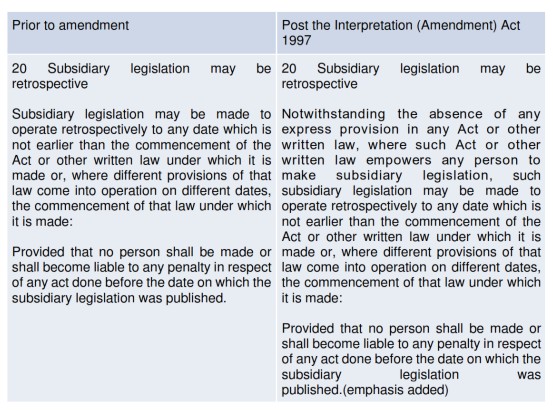
[130] The appellants also referred to the case of Datuk Haji Idris Haji Bujang & Anor v. Ketua Pentadbiran Parlimen Malaysia & Ors [2024] 2 MLRA 710, where the Court of Appeal held that a retrospective application of any legislation is only when it is purely procedural or when expressly provided for or by necessary implication as follows:
"[42] The applicable principles may thus be summed up in the following manner. Parliament possesses plenary powers of legislation, and is competent to legislate with retrospective effect, subject to any restriction in the Federal Constitution (see Loh Kooi Choon v. Government Of Malaysia [1975] 1 MLRA 646).
A piece of subsidiary legislation can always have a retrospective effect if it only affects matters of procedure. Where however the subsidiary legislation affects vested or accrued rights or privileges, then the subsidiary legislation can only have a retrospective effect if the principal Act expressly or by necessary implication provides that the subsidiary legislation may take effect retrospectively. If the subsidiary legislation affecting rights or privileges purports to have a retrospective effect but is not empowered by the enabling legislation to have a retrospective effect, then the subsidiary legislation is ineffective to defeat a pre-existing or accrued right or privilege, due to s 30(1) (b) of the Interpretation Acts 1948 and 1967. In such a case, the subsidiary legislation would only take effect from the date of its Gazette."
[Emphasis Added]
[131] However, the Federal Court had overruled the Court of Appeal in the Federal Court's case of Ketua Pentadbir Parlimen Malaysia & Ors v. Datuk Haji Idris Haji Bujang & Anor [2026] 1 MLRA 106. The Federal Court held as follows:
"[43] Because of the Wong Pot Heng's decision, the Interpretation (Amendment) Act 1997 (Act A996) was introduced. Amongst the amendments made were to:
(a) the long title;
(b) Section 20 of the Act; and
(c) insertion of new s 17A
[44] The long title of an Act plays an important role in a statute/Act as it sets out the subject, scope and purpose of the statute Act. The long title can be used in court as an aid to interpret the statute Act. The declared purpose of the Interpretation Acts 1948 and 1967 (Act 388) as manifested in the long title to the Act was for the application, construction, interpretation and operation of written laws.
[45] The amendment made to the long title of Act 388 makes it clear that the scope of Act 388 is not limited merely to the meanings of words used in written laws. With the amendment to the long title, the character of Act 388 has changed, as the Act is no longer confined to merely interpreting words and phrases of the statutes, but shall have the legislative power to provide a delegated authority [power] to make a subsidiary legislation with retrospective effect as reflected from new s 20 of the Act.
[46] Further, the insertion of s 17A by Act A996 is to emphasise that in construing a provision of an Act, due regard must be had to the purpose or object of the Act. In the light of ss 15 and 17A of the Interpretation Acts 1948 and 1967 (Act 388), the purpose and object of Act 388 should be read into s 20 of Act 388 after its amendment in order to give it the meaning as intended by Parliament when it enacted Act A996.
[47] It cannot be gainsaid that the decision in Wong Pot Heng was premised on the old provisions of the long title and s 20 of the Interpretation Acts 1948 and 1967 (Act 388) prior to their amendment, that is to say, before the amendments to the long title, ss 15 and 20 of the Interpretation Acts 1948 and 1967 (Act 388) and the insertion of new s 17A vide Act A996. Therefore, Wong Pot Heng's case is no longer binding and cannot stand after the amendment to Act 388 via Act A996. The amendments to Act 388 via Act A996 have changed the position of the law and character of Act 388."
[132] Be that as it may, the argument may still be had that even though the impugned decision is on the face of it procedurally valid and not null and void, yet where effective date is concerned the parent Act in s 13(1)(b) of the NFA had committed itself to "declaring that such land shall cease to be a permanent reserved forest from a date fixed by the notification," (Emphasis Added). The natural meaning of that is one of a future event anticipated and not a past event antedated.
[133] In fact, the supporting judgment of the Court of Appeal was not persuaded that the effective date of the excision could be backdated to the date of the State Exco's decision of 20 November 2000 as neither that decision nor the Gazette notification has any legislative effect and thus does not come within the meaning of "subsidiary legislation" which under s 20 of the Interpretation Acts 1948 and 1967, may be made to operate retrospectively.
[134] Section 3 of the Interpretation Acts 1948 and 1967 reads with respect to "subsidiary legislation" as follows:
"subsidiary legislation" means any proclamation, rule, regulation, order, notification, by-law or other instrument made under any Act, Enactment, Ordinance or other lawful authority and having legislative effect;"
[135] The supporting judgment reads as follows:
"20. With respect, the learned High Court Judge in this case had committed an error of law in relying on ss 19(1) and 20 IA to decide: that the SA could lawfully gazette the SA's Decision (20 November 2000) in the Gazette Notification (14 April 2022) [after a period of more than 21 years and 4 months from the date of the SA's Decision (20 November 2000)]. This is because ss 19(1) and 20 IA only apply to "subsidiary legislation" as defined in s 3 IA. "Neither the SA's Decision (20 November 2000) nor the Gazette Notification (14 April 2022) have any "legislative effect" as understood in the definition of "subsidiary legislation" in s 3 IA. It is therefore clear that there is no room to apply ss 19(1) and 20 IA in this case to the SA's Decision (20 November 2000) and the Gazette Notification (14 April 2022)."
[Emphasis Added]
[136] The question may be asked if the effective date of the excise of the land as a reserved forest is backdated then how would any meaningful objections be raised or feedback given in the light of the 2011 Amendment which calls for a public inquiry to be convened. Where a subsidiary legislation in the Gazette notification is in conflict with its parent Act, it is open to argument at the substantive hearing that the parent Act would prevail.
[137] One may appreciate that whilst there is no strict timeframe within which the State Exco shall make a Gazette notification of a decision made under s 13 of the NFA (Adoption) Enactment 1985, both the requirements under the law and that of reasonableness would constrain the compliance with the Gazette notification with all convenient speed. Indeed, s 54(2) of the Interpretation Acts 1948 and 1967 addressed this need to act with all due diligence as follows:
"54. Computation of time
(1) In computing time for the purposes of any written law-
(2) Where no time is prescribed within which anything shall be done, that thing shall be done with all convenient speed and as often as the prescribed occasion arises."
[Emphasis Added]
[138] In Pow Hing & Anor v. Registrar of Titles, Malacca [1980] 1 MLRA 57, the Federal Court considered the meaning of "as soon as may be" prescribed under s 130(1), NLC and found that a 7-month delay in gazetting a forfeiture notice under the NLC could hardly be said to be "as soon as may be", without stretching that requirement well beyond any conceivable latitude that can be properly given in the circumstances.
[139] Whether the gazetting of the excise of part of the land in Bukit Cherakah Forest Reserve may be backdated to some 20 years ago as its effective date when the purported decision to degazette the reserve forest was made is a matter for argument at the substantive hearing of the JR application once leave is granted.
[140] Learned counsel holding a watching brief for the World Wide Fund ("WWF") referred to the case of the State Public Service Commission Sarawak v. Sarjit Singh Khaira [2000] 1 MLRA 589, where the Federal Court found that attempts to give retrospective effect to validate an executive decision, which is otherwise unlawful, cannot be allowed. In determining whether there was a valid delegation of power under the Sarawak State Constitution by an order issued in 1988, but backdated to 1967, Abdul Malek Ahmad FCJ criticised the practice of backdating and said at p 599 as follows:
"To backdate it almost 22 years earlier is beyond our comprehension."
[141] It is not a frivolous argument with a foregone conclusion, for in this case, the appellants would not know for certain and would be guessing until the gazette communicating the decision was made on 5 May 2022. The public-spirited and concerned citizenry should not be put to inferential speculation. Whether the decision of the State Exco is complete until a Gazette Notification is a matter for argument at the substantive hearing stage.
[142] Even if the decision is procedurally valid with respect to retrospective effect stretching backwards to some 20 years, surely that cannot immunise the decision from being challenged on the traditional grounds of irrationality, illegality, procedural impropriety or even proportionality and mala fides.
Whether the decision to excise the Scheduled Land from the reserved forest is a "policy decision" of the State, and which the Court should not interfere
[143] The main judgment of the Court of Appeal was persuaded that the decision to excise the Scheduled Land from being a permanent reserved forest is a matter falling under that which is categorised as a "policy decision" of the State Authority. I do not view "policy decision" as a category that appears to have the status of "non-justiciability", which must necessarily be confined to, for example, matters of international relations, accession to Treaties and Conventions and in a limited sense to powers of pardon under the Federal Constitution. In an increasingly open, transparent and accountable policy that successive Governments have prided themselves in promoting, the so-called "policy decision" must pass the test of scrutiny in the traditional tests of irrationality, illegality, procedural impropriety, proportionality and mala fides.
[144] Even in Dr Michael Jeyakumar Devaraj v. Peguam Negara Malaysia [2013] 2 MLRA 179, when the Federal Court refused to intervene in the distribution of the Special Constituency Allocation for the Sungei Siput Constituency on the ground that the matter related to executive policy, it hastened to add as follows:
"21 Of course, in appropriate cases the courts as the custodian of law and justice must not remain idle. Where the policy or action of the executive is inconsistent with the Constitution and the law or in any manner arbitrary, irrational or there are elements of mala fides and abuse of power, the court is duty bound to interfere. Whether or not the court should interfere clearly depends on the facts and circumstances of each case. On the facts and circumstance of this case we are inclined to agree with the Court of Appeal that the decision of the 1st respondent and/or 2nd respondent is not amenable to Judicial Review."
[Emphasis Added]
[145] The supporting judgment of the Court of Appeal was not persuaded on that "policy decision" ground at all. It reiterated what O 53 r 1(1) ROC 2012 states which is as follows:
"Application for Judicial Review (O 53 r 1)
1.(1) This Order shall govern all applications seeking the relief specified in paragraph 1 of the Schedule to the Courts of Judicature Act 1964 and for the purposes therein specified."
[Emphasis Added]
[146] Paragraph 1 of the Schedule to the Courts of Judicature Act 1964 states as follows:
"SCHEDULE [Subsection 25(2)]
ADDITIONAL POWERS OF High Court
Prerogative writs
1. Power to issue to any person or authority directions, orders or writs, including writs of the nature of habeas corpus, mandamus, prohibition, quo warranto and certiorari, or any others, for the enforcement of the rights conferred by Part II of the Constitution, or any of them, or for any purpose."
[Emphasis Added]
[147] Part II of the Constitution enshrines what is referred to as "Fundamental Liberties" enjoyed by all who come under the Malaysian sun. The supporting judgment was emphatic in underlining that the right to file for Judicial Review is part of an applicant's fundamental access to justice guaranteed under art 5(1) of the Federal Constitution. See the Federal Court's decision in Sivarasa Rasiah v. Badan Peguam Malaysia & Anor [2012] 6 MLRA 375, at [4].
[148] Much has been preached on the need for good and robust governance, and the supporting judgment referred to the Court of Appeal's decision in Krishnasamy Kuppusamy & Anor v. Pengarah Hospital Sultanah Aminah & Ors And Other Appeals [2024] 1 MLRA 344, at [33(ii)].
[149] If it were otherwise, then every decision of the State and its agencies would be impervious and impenetrable to challenge, for invariably such a decision would be a "policy decision" and thus immunised from Judicial Review. Our Courts have shown great dexterity in matters where State and Federal agencies have raised "policy decisions" in attempts to resist the quashing of planning permissions and development orders that have adversely impacted the environment and ecological balance in nature vis--vis the State and Federal authorities' assertion that they know best where orderly and proper development of the constituencies, communities and the country are concerned.
[150] The Federal Court in Datuk Bandar Kuala Lumpur v. Perbadanan Pengurusan Trellises & Ors And Other Appeals [2023] 4 MLRA 114 observed as follows with respect to deviation from the Kuala Lumpur Structure Plan, which was said to be mere policies as follows:
"[161] The KL Structure Plan (2004) contains the primary policy of the Datuk Bandar, then the City Hall Kuala Lumpur, and sketches out in visual terms how the Federal Territory was to be developed in the following twenty or so years. The 'how is answered by a set of policies.
[162] But, it does not follow that by saying that the KL Structure Plan represents mere policies, this then diminishes the KL Structure Plan's legal character of bearing statutory force. To give development plans their own force of law is to ensure that planning in the Federal Territory is achieved pursuant to cohesive planning principles over space and time. Parliament, by embedding into the FT Act a mandatory process of public participation, ensures the inclusion of the public's views on the proposed plan. Once gazetted, there is no room for extraneous matters to be inserted at will, nor for development planning on an inconsistent and piecemeal basis.
[163] The fact that these development plans are set out in the statute in express terms requiring compliance means that they cannot be equated to policies which require no such strict compliance. It is not possible to utilise the term 'policy or series of policies to circumvent or obviate the need to comply with statute. The statute prescribes that development has to be undertaken in accordance with the Structure Plan and Local Plan. It is no answer to that statutory requirement to contend that compliance is not required because it is mere policy."
[Emphasis Added]
[151] The need to statutorily comply with Gazette notification for the land excised from the reserved forest after a public inquiry under ss 13 and 11 respectively of the NFA (Adoption) Enactment 1985 cannot be excused on the mere ground that being a "policy decision" the end result would be the same as the Courts are supposed to keep their hands off lest they be accused of encroaching into the executive's province.
[152] Learned counsel for the Malaysian Bar in his amicus brief highlighted the fact that public participation was required under the relevant legislation for development orders, which meant that decisions surrounding such plans were susceptible to Judicial Review and could not be said to be matters of "policy":
"[469] This element of public inclusion naturally broadens the categories of persons who may challenge a development order, particularly where the development does not conform to the structure plan. If the public participated in the implementation of the statutory development plan as the legislature has seen fit to provide, then indubitably a member of the public can challenge a development which fails to conform to the statutory development plan, if he has a genuine interest..."
[Emphasis Added]
[153] The mantra of "policy decision" cannot drown the chorus of statutory compliance, for surely the State Legislature saw the wisdom in promoting transparency and accountability where such a major decision of excision is concerned. See also the approach taken by the Federal Court in Perbadanan Pengurusan Sunrise Garden Kondominium v. Sunway City (Penang) Sdn Bhd & Ors And Another Appeal [2023] 3 MLRA 44.
[154] As far back as the Federal Court's case of Public Textiles Berhad v. Lembaga Letrik Negara [1976] 1 MLRA 70 at 79, Raja Azlan Shah FJ (as His Majesty then was) observed with prescient and prophetic insight as follows:
"The term public policy is vague and unsatisfactory. From time to time judges of the highest reputation have uttered warning notes as to the danger of permitting judicial tribunals to roam unchecked in this field. The "unruly horse" of Hobart C.J. is common place: see Fender v. Mildmay [1938] AC 10. In my opinion, the public policy yardstick is too wide and elusive."
[Emphasis Added]
[155] Surely the applicants should be allowed to run the argument at the substantive hearing that the State Exco has a statutory obligation to satisfy the public represented by the applicants that all the factors referred to under s 12 of the NFA (Adoption) Enactment 1985 have been considered rather than taking the convenient way out by latching on to "policy decision" as a shorthand to justify overriding statutory requirements set out below:
"State Authority to replace land excised from permanent reserved forest
12. Where any land is excised under s 11 the State Authority shall, wherever possible and if it is satisfied that it is in the national interest so to do having regard to
(a) the need for soil and water conservation, biodiversity and other environmental consideration;
(b) the need to sustain timber production in the State in order to meet the requirements of the forest industry;
(c) the economic development of the State; and
(d) the availability of suitable land,
constitute in accordance with s 7 an approximately equal area of land a permanent reserved forest"
[Emphasis Added]
[156] I see no good reason to refuse leave, as there are ostensibly some serious non-compliance with the National Forestry Act (Adoption) Enactment 1985, where the respondents should explain their actions and inactions and argue that no meaningful reliefs may be granted at this late stage and that the back-dating of the effective date of the excision of the reserved forest was valid in law.Whether in all the circumstances of the case, the appellants have satisfied the test for leave to be granted for a Judicial Review application to be filed
[157] Once the hurdles of the time period within which the Judicial Review application was to be filed are cleared, together with the question of locus, which the Court of Appeal had no issue with, then the test for leave to commence a Judicial Review is a very low threshold test designed to weed out the frivolous and the fanciful. In the case of Association Of Bank Officers Peninsular Malaysia v. Malayan Commercial Banks Association [1990] 1 MLRA 324, the Supreme Court stated that when considering leave to apply for Judicial Review, the court should not go further than the leave stage and embark on substantial issues of merit. It was further held that the guiding principle ought to be that the applicants must show prima facie that the application is not frivolous or vexatious and that there is some substance in the grounds supporting the application. See para 228 of the judgment.
[158] The cases speak with one consistent voice, and in the case of YAM Tunku Dato' Seri Nadzaruddin Ibni Tuanku Ja'afar v. Datuk Bandar Kuala Lumpur & Anor [2002] 3 MLRH 313, the High Court used the "arguable case test" as follows:
"At this stage of the proceedings, the court need not go into the matter in great depth. The whole purpose of requiring that leave should first be obtained to make the application for Judicial Review would be defeated if the court were to go into the matter in any depth at that stage. If on a guided perusal of the material then available, the court thinks that it discloses what might on further consideration turn out to be an arguable case in favour of granting to the applicant the relief claimed, it ought, in the exercise of a judicial discretion, to give him leave to apply for that relief."
[Emphasis Added]
[159] The Federal Court in WRP Asia Pacific Sdn Bhd v. Tenaga Nasional Bhd [2012] 4 MLRA 257 stated the settled state of the law on the test for leave to commence a JR action as follows:
"Without the need to go into depth of the abundant authorities, suffice if we state that leave may be granted if the leave application is not thought of as frivolous, and if leave is granted, an arguable case in favour of granting the relief sought at the substantive hearing may be the resultant outcome."
[Emphasis Added]
[160] The low threshold test designed to weed out the frivolous and fanciful has been met. What was designed to sieve out the scurrilous should not be allowed to become a stumbling block against a public-spirited body's attempt to call the State to account for its action and inaction in excising the Scheduled Land from the reserved forest in Bukit Cherakah in a matter of public interest affecting the environment.
Whether the Court may mould the necessary reliefs without affecting the present housing development on the excised land and having regard to the factors referred to in section 12 of the National Forestry Act (Adoption) Enactment 1985
[161] It is only to be expected that any hearing of a Judicial Review application would consider the hardship that may be caused to third parties arising from granting the reliefs sought to set aside the decision of degazettement of part of the land in Bukit Cherakah Forest Reserve. Damages may also not be a suitable remedy with respect to how to assess it and who to pay to.
[162] Learned counsel for the State informed the Court that he does not have information on the area of the land not yet developed from the Scheduled Land excised from the reserved forest. There has been no denial that such land not developed yet exists. Learned counsel for the appellants raised what is generally true in that it is at the substantive hearing stage then that the necessary discovery application may be made.
[163] However, the Court in hearing the application is not bound by the reliefs sought and may explore other reliefs and remedies as may be necessary based on what the NFA (Adoption) Enactment 1985 provides as if there had been proper compliance with the law and that the decision is not tainted by illegality, unreasonableness, the lack of proportionality or procedural non-compliance.
[164] Section 12 of the NFA (Adoption) Enactment 1985 which had already been there when the purported decision of 20 November 2000 was made by the State Exco provides for the concomitant duty of the State Authority in the event of an excise of a reserve forest. It shall, wherever possible and if it is satisfied that it is in the national interest so to do, having regard to:
"(a) the need for soil and water conservation, biodiversity and other environmental consideration;
(b) the need to sustain timber production in the State In order to meet the requirements of the forest industry;
(c) the economic development of the State; and
(d) the availability of suitable land, constitute in accordance with s 7 an approximately equal area of land a permanent reserved forest."
[Emphasis Added]
[165] The respondents would be required to justify their decision at the substantive Judicial Review hearing to show how they had taken into consideration the factors such as soil and water conservation, biodiversity and other environmental considerations. What is more to be expected is that the 4th Respondent is required to replace the excised portion of the Bukit Cherakah Forest Reserve with an approximately equal area of land to be designated as a permanent reserved forest in accordance with s 7 of the National Forestry Act (Adoption) Enactment 1985.
[166] It is for the respondents to inform the Court how this statutory requirement has been adhered to by the 4th Respondent to date. In the event that it is found at the end of the day after the substantive hearing that the requirements of s 12 NFA (Adoption) Enactment 1985 have not been met, the Court may direct the respondents to comply with such directions and orders that the Court may make including the need for the 4th Respondent to identify an equivalent piece of land to be gazetted as a permanent reserved forest.
[167] This is to ensure that whilst economic development may be inevitable, yet there is a need to conserve and not to disrupt the delicate and dynamic ecological balance between man and nature and the conservation of soil and water vital in preventing flash floods and other deleterious effects like climate change and the preservation of biodiversity and carbon footprints consistent with the Government's emphasis on the new paradigm of ESG in Environmental, Social and Governance framework.
[168] Learned counsel for WWF in his amicus brief made an impassioned plea that this Court should take into account the broader national and environmental implications that this appeal portends in this:
"Decisions that facilitate deforestation without scrutiny, credible environmental assessments, or public engagement risk triggering a cascade of ecological harm, economic costs, and social injustice. Forest loss is not merely a conservation issue; it is an incendiary threat to national resilience and public welfare."
Decision
[169] After having considered the various issues raised above, I find that at the end of the day, at this threshold stage of leave application, there is no real necessity to answer all the leave questions for the purpose of disposing of this appeal. It would suffice if the following questions are answered as follows:
'Question (5): Taking into account the fact that the "decision" of the Selangor Exco on 20 November 2000 was made in private without public disclosure, whether the limitation under O 53 r 3(6), Rules of Court 2012 starts to run from the 20 November 2000 or when the said decision was officially communicated via the gazette notification on 5 May 2022?
Answer:
The limitation under O 53 r 3(6) ROC 2012 starts to run when the said decision was officially communicated via the Gazette notification on 5 May 2022.
Question (6): Whether O 53, r 3(6), Rules of Court 2012 applies to decisions of a public body that were not communicated to the public?
Answer:
In this case the decision was communicated to the public via the Gazette notification of 5 May 2022 and time under O 53 r 3(6) ROC 2012 runs from the date of such communication.
Question (7): Whether the decision of the Selangor State Executive Council in retrospectively legitimizing the excision of the Bukit Cherakah Forest Reserve on 5 May 2022 is a decision that cannot be reviewed on the general ground of 'policy reasons'?
Answer:
No as 'policy reasons' for any such decision cannot be immunised from a challenge by way of Judicial Review.
[170] I would therefore allow the appeal and remit the matter back to the High Court for hearing of the Judicial Review application on its merits. I make no order as to costs, as the subject matter of the dispute is of considerable public interest and importance.