Federal Court, Putrajaya
Nordin Hassan, Vazeer Alam Mydin Meera, Ahmad Terrirudin Mohd Salleh FCJJ
[Civil Appeal No: 01(F)-26-08-2024(B)]
29 October 2026
Constitutional Law: Equality before law — Right of appeal — Appeal to Federal Court on leave questions against dismissal of judicial review of Police Inspector's dismissal after disciplinary proceedings under Public Officers (Conduct and Discipline) Regulations 1993 — Absence of right of appeal to Disciplinary Appeal Board available to certain other public officers under Public Services Disciplinary Board Regulations 1993 — Whether regs 37 to 37D of Public Officers (Conduct and Discipline) Regulations 1993 infringed Art 8(1) Federal Constitution ("FC") due to police officers having no right of appeal to Disciplinary Appeal Board, having regard to reasonable classification and proportionality tests and to availability of judicial review — Whether those provisions were inconsistent with Arts 132 and 135(2) of the FC and void to extent of inconsistency under Art 4(1) of the FC
The appellant, a Police Inspector, was served by a letter dated 4 February 2020 with three disciplinary charges under the Public Officers (Conduct and Discipline) Regulations 1993 ("POCDR"), concerning the management and custody of investigation papers, contrary to Inspector General of Police Standing Order D 150A, which alleged failures to circulate 165 investigation papers, to take action on 121 investigation papers and to hand over 286 investigation papers before his transfer, under regs 4(2)(i), 4(2)(e) and 4(2)(g) of the POCDR. He made a written representation dated 9 June 2020 under reg 37(2)(b) of the POCDR, and, by a letter dated 16 February 2021, the disciplinary authority informed him that it had found him guilty on all three charges and dismissed him with effect from 5 February 2021. On 21 May 2021, the appellant commenced judicial review proceedings in the High Court against the 1st respondent, the Chairman of the Royal Malaysia Police Disciplinary Board, the 2nd respondent, the Royal Malaysia Police Disciplinary Board, and the 3rd respondent, the Government of Malaysia, to quash the dismissal, and for declarations on the legal force of the Inspector General's Standing Orders and the constitutionality of regs 37 to 37D of the POCDR. The appellant contended, inter alia, that the absence of a disciplinary appeal for police officers, in contrast with the appeal mechanism available to other public officers, was discriminatory. The High Court dismissed the application on 5 January 2023, holding that Police Inspectors were a distinct class of public officers for whom different disciplinary arrangements were constitutionally permissible, and the Court of Appeal dismissed the appeal on 30 January 2024, holding that the disciplinary provisions satisfied the requirements of reasonable classification and proportionality under Art 8(1) of the Federal Constitution ("FC") and that the opportunity to make written representations was consistent with Art 135(2). The Federal Court granted leave to appeal on 20 August 2024 on two questions concerning the compatibility of the disciplinary arrangements with Arts 8, 132 and 135(2), read with Art 4(1) of the FC. The issues before the court were (i) whether regs 37, 37A, 37B, 37C and 37D of the POCDR infringed Art 8(1) of the FC, due to police officers not having the right of appeal to a Disciplinary Appeal Board available to certain other public officers under regs 12 to 14 of the Public Services Disciplinary Board Regulations 1993 ("PSDBR"), having regard to the reasonable classification and proportionality tests and to the availability of judicial review and (ii) whether those provisions were inconsistent with Arts 132 and 135(2) of the FC and were accordingly void to the extent of the inconsistency under Art 4(1) of the FC.
Held (dismissing the appellant's appeal):
(1) Regulations 37 to 37D of the POCDR did not infringe Art 8(1) of the FC by reason of the absence of a right of appeal to a Disciplinary Appeal Board for police officers. Article 8(1) did not require identical treatment of persons whose circumstances were materially different. Legislative classification was permissible where it rested on a constitutionally sufficient justification rather than an arbitrary distinction. A permissible classification had to be founded upon an intelligible differentia distinguishing those included in the class from those excluded, which bore a rational nexus to the object of the law. The measure could not be disproportionate to the legitimate objective pursued. The Federal Court agreed with the Court of Appeal that police officers undertook a particular oath, discharged onerous public duties and were deemed to be always on duty. That provided an intelligible basis for treating the police force as a distinct category for disciplinary purposes. The differentiation was rationally related to the objects of securing fair and expeditious discipline within the police service. The absence of a further administrative appeal served the objective of finality and expedition in disciplinary matters involving a service entrusted with distinctive responsibilities relating to matters of national security and maintenance of law and order. (paras 15, 16, 18, 21, 22 & 28)
(2) Judicial review and a statutory appeal were not interchangeable. A statutory appeal permitted the appellate body to reconsider the merits, review the sanction and, where empowered, substitute its own decision. The Court of Appeal's reference to judicial review was to be understood as identifying an available safeguard, and not as asserting that it replicated the full scope of a disciplinary appeal. Its constitutional analysis did not depend on treating the remedies as identical. The absence of a statutory appeal, taken by itself, did not establish unconstitutional discrimination where the relevant classification was justified and the disciplinary process remained subject to legal safeguards. (paras 23, 24, 27 & 28)
(3) The impugned provisions were not inconsistent with Arts 132 or 135(2) of the FC, and the constitutional challenge failed. Article 132 identified the constituent branches of the public services. That common constitutional description did not, without more, require identical disciplinary machinery for every branch, the appellant not having demonstrated that Art 132 itself created a right to an administrative appeal from a disciplinary decision. Article 135(2) protected a member of the relevant public service against dismissal or reduction in rank without a reasonable opportunity of being heard. Regulation 37(2)(b) of the POCDR provided for written representations in response to disciplinary charges. The appellant was afforded that opportunity and made representations, so that the absence of a further statutory appeal did not, of itself, establish a breach of Art 135(2). (paras 29-33)
Case(s) referred to:
Alma Nudo Atenza v. PP & Another Appeal [2019] 3 MLRA 1 (refd)
Danaharta Urus Sdn Bhd v. Kekatong Sdn Bhd [2004] 1 MLRA 20 (refd)
Harris Solid State (M) Sdn Bhd & Ors v. Bruno Gentil Pereira & Ors [1996] 1 MLRA 665 (refd)
Kerajaan Malaysia & Ors v. Mior Rusli Mior Md Jaafar & Ors [2026] 1 MLRA 675 (refd)
Ketheeswaran Kanagaratnam & Anor v. PP [2024] 2 MLRA 288 (refd)
Lai Hen Beng v. PP [2024] 2 MLRA 21 (refd)
Lindsley v. Natural Carbonic Gas Co [1911] 220 US 61 (refd)
Malaysian Bar & Anor v. Government of Malaysia [1986] 1 MLRA 272 (refd)
PP v. Datuk Haji Harun Bin Haji Idris (No 2) [1976] 1 MLRH 562 (refd)
PP v. Harmenderpall Singh Jagara Singh [2007] 1 MLRA 171 (refd)
PP v. Khong Teng Khen & Anor [1976] 1 MLRA 16 (refd)
R Rama Chandran v. Industrial Court of Malaysia & Anor [1996] 1 MLRA 725 (refd)
R Rethana v. The Government of Malaysia & Anor [1987] 2 MLRH 834 (refd)
State of West Bengal v. Anwar Ali Sarkar [1952] SCR 284 (refd)
Legislation referred to:
Federal Constitution, arts 4(1), 8(1), (2), 132(1)(c), (d), (f), 135(2)
Police Act 1967, ss 3(3), 13, 19, 20(3), 97
Public Officers (Conduct and Discipline) Regulations 1993, regs 4(2)(e), (g), (i), 37(2)(b), 37A, 37B, 37C, 37D
Public Services Disciplinary Board Regulations 1993, regs 12, 13, 14
Counsel:
For the appellant: GK Ganesan (G Subramaniam Nair, KN Geetha, JN Lheela, TP Vaani, Dhanesh Subramaniam & Lydia Jaynthi with him); M/s Maniam Nair & Co
For the respondents: Ahmad Hanir Hambaly @ Arwi (Imtiyaz Wizni Aufa Othman with him); AG's Chambers
[For the Court of Appeal judgment, please refer to Mohd Azizul Abd Wahab v. Tan Sri Dato' Seri Abdul Hamid Bador & Ors [2025] 7 MLRA 456]
JUDGMENT
Vazeer Alam Mydin Meera FCJ:
Introduction
[1] This appeal concerns the constitutionality of the disciplinary framework applicable to members of the Royal Malaysia Police (PDRM). In particular, it raises the question whether the absence of a statutory right of appeal against a disciplinary decision, when such a right is available to certain other public officers, infringes the guarantee of equality before the law and equal protection of the law under art 8(1) of the Federal Constitution (FC).
[2] The Appellant, a Police Inspector, was dismissed from service following disciplinary proceedings conducted pursuant to the Public Officers (Conduct and Discipline) Regulations 1993 [P.U.(A) 395/1993] (POCDR). He was found guilty of three charges concerning the management and custody of investigation papers, contrary to the Inspector General of Police Standing Orders (PTKPN D 150A). The misconduct alleged was serious. The present appeal, however, is principally concerned with the constitutional validity of the applicable disciplinary provisions rather than a fresh determination of those charges.
[3] The Appellant challenged his dismissal by way of judicial review. The High Court dismissed his application, and the Court of Appeal affirmed that decision. Leave to appeal was granted by this Court on 20 August 2024 on two questions concerning the compatibility of the disciplinary arrangements with arts 8, 132 and 135(2) of the FC, read with art 4(1).
Material Background
[4] The Appellant joined the PDRM as a trainee Inspector on 16 July 2008. After completing his training, he was posted to the Langkawi District Police Headquarters on 27 July 2009 as a criminal investigation officer. He subsequently served as Chief of the Kuah Police Station and as a local forensic investigator, before his transfer to the D7A Branch of the North Klang District Police Headquarters on 1 March 2017.
[5] In mid-2018, the Appellant was called upon by the Integrity and Standard Compliance Department (JIPS), Kedah, to explain failures relating to investigation papers. He maintained that he had handed the papers to Corporal Syamsuri bin Aripin, the officer responsible for their custody, before his transfer. Corporal Syamsuri denied receiving them.
[6] Three disciplinary charges were subsequently brought against the Appellant: first, failure to circulate 165 investigation papers to his supervising officer within seven days; secondly, failure to take appropriate action on 121 investigation papers, leaving investigations unresolved; and thirdly, failure to hand over 286 investigation papers before his transfer. The charges invoked reg 4(2)(i), 4(2)(e) and 4(2)(g) of the POCDR respectively, relating to insubordination, lack of diligence and irresponsibility.
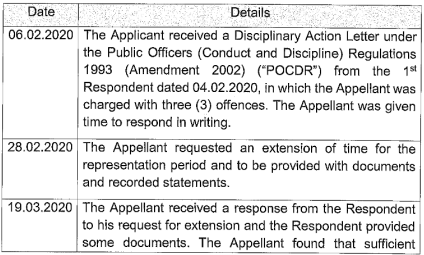
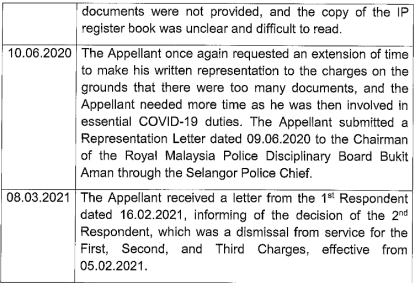
[7] By a letter dated 4 February 2020, received on 6 February 2020, the Appellant was informed of the charges and afforded an opportunity to make written representations. He sought extensions of time and requested supporting documents on 28 February and 10 June 2020. A written representation dated 9 June 2020 was submitted through the Selangor Police Chief. By a letter dated 16 February 2021, received on 8 March 2021, he was informed that the disciplinary authority had found him guilty on all three charges and dismissed him with effect from 5 February 2021.
Chronology Of Events
Proceedings In The Courts Below
[8] On 21 May 2021, the Appellant commenced judicial review proceedings in the High Court at Shah Alam. He sought to quash the dismissal, obtain reinstatement with consequential benefits, and secure declarations concerning the legal force of the Inspector General's Standing Orders and the constitutionality of regs 37 to 37D of the POCDR.
[9] His challenges included alleged defects in the charges, denial of relevant documents and procedural fairness, uncertainty in the notification of punishment, improper constitution of the Disciplinary Board, and delay said to amount to condonation. He also argued that the absence of a disciplinary appeal for police officers, in contrast with the appeal mechanism available to other public officers, was discriminatory.
[10] The High Court rejected those contentions. It held that the charges sufficiently identified the alleged misconduct, that the Standing Orders constituted binding administrative directions issued under s 97 of the Police Act 1967, and that no breach of natural justice had been established. The High Court also rejected the challenges to the constitution of the Disciplinary Board and the validity of the dismissal letter. On art 8(1), it considered Police Inspectors to be a distinct class of public officers for whom different disciplinary arrangements were constitutionally permissible.
[11] The Court of Appeal dismissed the ensuing appeal. It agreed that the charges contained sufficient particulars to enable the Appellant to answer them, notwithstanding the absence of certain dates and the overlap in investigation papers referred to in the charges. The Court also rejected the complaint concerning the non-production of documents, noting the explanation that the papers had not been handed over and that the Appellant had nevertheless submitted a detailed written defence.
[12] As to condonation, the Court of Appeal was doubtful whether the doctrine applied under the relevant regulations. In any event, it found no factual basis for concluding that the authorities had excused the alleged misconduct. The constitutional challenge was likewise rejected: the Court held that the disciplinary provisions satisfied the requirements of reasonable classification and proportionality under art 8(1), and that the opportunity to make written representations was consistent with art 135(2).
Questions For Determination
[13] The two leave questions, read together, raise the following issues:
(a) whether regs 37, 37A, 37B, 37C and 37D of the POCDR infringe art 8(1) because police officers do not enjoy the right of appeal to a Disciplinary Appeal Board provided to certain other public officers under regs 12 to 14 of the Public Services Disciplinary Board Regulations 1993 [P.U.(A) 396/1993] (PSDBR); and (b) whether those provisions are inconsistent with arts 132 and 135(2), and are accordingly void to the extent of any inconsistency under art 4(1) of the FC.
[14] The essential comparison is between members of the police force, a public service expressly identified in art 132(1)(d), and officers within the general and joint public services referred to in arts 132(1)(c) and 132(1)(f). The latter may appeal to a Disciplinary Appeal Board under the PSDBR, whereas the impugned POCDR provisions confer no corresponding statutory right on police officers disciplined under those provisions.
The Constitutional Guarantee Of Equality
[15] Article 8(1) guarantees equality before the law and equal protection of the law. It does not, however, require identical treatment of persons whose circumstances are materially different. Legislative classification is permissible where it rests on a constitutionally sufficient justification rather than an arbitrary distinction.
[16] The established Malaysian authorities include PP v. Khong Teng Khen & Anor [1976] 1 MLRA 16 and PP v. Datuk Haji Harun Bin Haji Idris (No 2) [1976] 1 MLRH 562. They recognise that a permissible classification must be founded upon an intelligible differentia distinguishing those included in the class from those excluded, and that the differentia must bear a rational nexus to the object of the law.
[17] These principles have been considered in Malaysian Bar & Anor v. Government Of Malaysia [1986] 1 MLRA 272, R Rethana v. The Government Of Malaysia & Anor [1987] 2 MLRH 834, Danaharta Urus Sdn Bhd v. Kekatong Sdn Bhd [2004] 1 MLRA 20 and PP v. Harmenderpall Singh Jagara Singh [2007] 1 MLRA 171. The comparative roots of the test may be traced, among other authorities, to State of West Bengal v. Anwar Ali Sarkar [1952] SCR 284 and Lindsley v. Natural Carbonic Gas Co [1911] 220 US 61.
[18] More recent decisions, including Alma Nudo Atenza v. PP & Another Appeal [2019] 3 MLRA 1, Ketheeswaran Kanagaratnam & Anor v. PP [2024] 2 MLRA 288 and Kerajaan Malaysia & Ors v. Mior Rusli Mior Md Jaafar & Ors [2025] MLRAU 166, emphasise the additional inquiry into proportionality. The measure must not be disproportionate to the legitimate objective pursued. The analysis therefore requires attention to the classification, its purpose and the practical effect of the differentiation.
[19] The distinction between arts 8(1) and 8(2) must also be maintained. As explained in Lai Hen Beng v. PP [2024] 2 MLRA 21, art 8(2) addresses discrimination on specified prohibited grounds and cannot simply be displaced by the general reasonable-classification analysis under art 8(1). The present challenge is advanced under art 8(1), not by reference to a prohibited ground enumerated in art 8(2).
Application To The Disciplinary Framework
[20] The Appellant submits that, because the police force forms part of the public services under art 132, police officers should enjoy the same statutory disciplinary appeal as officers governed by the PSDBR. In his submission, the denial of that appeal deprives him of an important opportunity to challenge both the finding of misconduct and the severity of dismissal.
[21] The Respondents contend that the distinction is justified by the particular duties and obligations imposed upon members of the police force. The Court of Appeal accepted that position, relying on the statutory responsibilities prescribed by the Police Act 1967, including ss 3(3), 13, 19 and 20(3). Police officers undertake a particular oath, discharge onerous public duties and are deemed to be always on duty. These features provide an intelligible basis for treating the police force as a distinct category for disciplinary purposes.
[22] The Court of Appeal further held that the differentiation was rationally related to the objects of securing fair and expeditious discipline within the police service. The impugned provisions apply alike to officers within the relevant class. The absence of a further administrative appeal serves the objective of finality and expedition in disciplinary matters involving a service entrusted with distinctive responsibilities relating to matters of national security and maintenance of law and order.
[23] In assessing proportionality, the Court of Appeal also attached weight to the availability of judicial review. An officer dissatisfied with a disciplinary decision is not wholly deprived of judicial supervision. The Appellant disputes the sufficiency of that safeguard, arguing that judicial review cannot be equated with a statutory appeal.
Statutory Appeal And Judicial Review
[24] There is force in the Appellant's submission that the two remedies are not interchangeable. A statutory appeal may permit the appellate body to reconsider the merits, review the sanction and, where empowered, substitute its own decision. Judicial review ordinarily examines the lawfulness of the exercise of public power, including illegality, procedural impropriety, irrationality and, where applicable, proportionality. It does not confer a general appellate jurisdiction to substitute the court's preferred disciplinary outcome.
[25] It would nevertheless be inaccurate to suggest that judicial review is invariably confined to procedure or that the substance of an administrative decision is entirely beyond scrutiny. In Harris Solid State (M) Sdn Bhd & Ors v. Bruno Gentil Pereira & Ors [1996] 1 MELR 42; [1996] 1 MLRA 665, the Court of Appeal recognised that, where a decision is challenged on grounds of irrationality or unreasonableness in the Wednesbury sense, the reviewing court may examine its merits without thereby exercising an appellate jurisdiction. The approach is also reflected in R Rama Chandran v. Industrial Court Of Malaysia & Anor [1996] 1 MELR 71; [1996] 1 MLRA 725.
[26] The important distinction is between examining the substance of a decision for a recognised ground of judicial review and conducting an unrestricted rehearing on the merits. Judicial review may, in an appropriate case, engage with the substantive basis of a disciplinary decision. It does not, for that reason alone, become the equivalent of a statutory appeal.
[27] The Court of Appeal's reference to judicial review should therefore be understood as identifying an available safeguard, not as asserting that it replicates the full scope of a disciplinary appeal. Its constitutional analysis did not depend upon treating the remedies as identical. It also rested on the existence of a distinct class, the particular statutory duties of police officers and the rational connection between the differentiated procedure and the objective of prompt and effective discipline.
[28] We see no sufficient reason, on the arguments advanced, to depart from the Court of Appeal's conclusion that the impugned differentiation is constitutionally permissible under art 8(1). The absence of a statutory appeal, taken by itself, does not establish unconstitutional discrimination where the relevant classification is justified and the disciplinary process remains subject to legal safeguards.
Articles 132 And 135(2)
[29] Article 132 identifies the constituent branches of the public services. That common constitutional description does not, without more, require identical disciplinary machinery for every branch. The Appellant has not demonstrated that art 132 itself creates a right to an administrative appeal from a disciplinary decision.
[30] Article 135(2) of the FC protects a member of the relevant public service against dismissal or reduction in rank without a reasonable opportunity of being heard, subject to its constitutional qualifications. Regulation 37(2)(b) provides for written representations in response to disciplinary charges. The Appellant was afforded that opportunity and made representations. The absence of a further statutory appeal does not, of itself, establish a breach of art 135(2) of the FC.
Answer To The Leave Questions
[31] For these reasons, we agree with the Court of Appeal that the absence of a statutory right of appeal to the Disciplinary Appeal Board for police officers does not, in the circumstances considered, render regs 37 to 37D of the POCDR inconsistent with art 8(1) of the FC. Nor has inconsistency with art 132 or art 135(2) been established.
The constitutional challenge therefore fails.
[32] The first leave question is:
Whether the absence of avenue, i.e. a right to appeal to the 'Disciplinary Appeal Board' under the Public Officers (Conduct and Discipline) (Amendment) Regulations 2002, is discriminatory and unconstitutional in the administration of law relating to profession or employment: which contravenes arts 132, 135(2) and 8 of the Federal Constitution and therefore inconsistent with the Constitution and void to the extent of the inconsistency under art 4 of the Federal Constitution.
The answer to the first leave question is, thus, in the negative.
[33] The second leave question is:
Whether regs 12, 13 and 14 of Public Services Disciplinary Board Regulations 1993 are discriminatory in employment practices with regard to the Public Officers (Conduct and Discipline) (Amendment) Regulations 2002, which contravenes arts 132, 135(2) and 8 of the Federal Constitution and therefore inconsistent with the Constitution and void to the extent of the inconsistency under art 4 of the Federal Constitution.
The answer to the second leave question is also in the negative.
Conclusion
[34] Wherefore, the appeal is dismissed and the order of the Court of Appeal is affirmed. No order as to costs.