Court of Appeal, Putrajaya
Wong Kian Kheong, Ahmad Kamal Md Shahid, Ahmad Fairuz Zainol Abidin JJCA
[Civil Appeal No: A-02(NCC)(A)-1391-07-2025]
28 September 2026
Civil Procedure: Appeal — Further evidence — Dispute over transmission of shares of deceased shareholder to beneficiaries — Medical report of executor available to respondents, not adduced at hearing of originating summons in High Court but tendered from Bar table for first time at hearing of appeal — Whether medical report constituted "existent evidence" and not "subsequent evidence" — Whether respondents fulfilled conditions for tendering medical report
Civil Procedure: Judicial precedent — Stare decisis — Whether Court of Appeal decision reversed by Federal Court without written judgment binding on High Court
Company Law: Shares — Transmission of shares — Deceased's shares in 1st respondent transmitted to and registered in executor's name — Executor's written notices to transmit and register shares in names of appellants as beneficiaries rejected by 1st respondent's board of directors — Whether company and directors could insist that executor "transfer" instead of "transmit" shares and pay stamp duty — Whether s 105 Companies Act 2016 or 1st respondent's articles of association on transfer of shares barred transmission — Whether 1st respondent required in law to register transmission under s 109(1) and (5) Companies Act 2016 — Whether executor's prior transfer of shares to another beneficiary barred transmission — Whether beneficiaries' alleged debts to estate or pending dispute over executor's estate valid grounds to refuse registration
The testatrix, Madam Wong Kim, owned 986,606 shares in the 1st respondent company, of which the 2nd to 7th respondents were directors. By her will dated 15 December 2010 ("the will"), the testatrix appointed her eldest son, Loh Koh Fah, as sole executor ("the executor") and directed that her assets, including those shares, be distributed in specified proportions to the executor, the 1st to 3rd appellants and the 2nd respondent. The testatrix died on 19 February 2015. The executor obtained probate of the will, and all the testatrix's shares were transmitted to him and registered in his name in the 1st respondent's register of members. In 2023, the executor transferred 612,413 shares in the 1st respondent to the 2nd respondent, a beneficiary named in the will, and stamp duty was paid on that transfer. On 22 January 2024, the executor sent three written notices to the 1st respondent, enclosing copies of the will and probate, informing the 1st respondent that he "hereby transmit[ted]" 164,434 shares in the 1st respondent to each of the appellants in accordance with the will, and authorising the 1st respondent's company secretary to register the three transmissions. By letter dated 29 January 2024, the 1st respondent's board of directors rejected the notices on the ground that further transmissions of the shares did not arise. The executor died on 12 April 2024, and a case on the administration of his estate was pending in the High Court. The appellants filed an originating summons ("the OS") against the respondents seeking, inter alia, declarations that 164,434 shares in the 1st respondent had been transmitted to each of them by operation of law pursuant to the will and probate, an order that the 1st respondent register those shares in their names within 14 days, and an order that the company secretary make the necessary changes to the register of members. The High Court dismissed the OS with no order as to costs, holding, inter alia, that the initial vesting of the testatrix's shares in the executor constituted a "transmission" of the said shares by operation of law pursuant to s 109 of the Companies Act 2016 ("the CA") and the 1st respondent's articles of association ("the AA"), that the subsequent registration of those shares by the executor in the appellants' names constituted a "transfer" that had to comply strictly with s 105 of the CA and arts 16 to 19 of the AA, and that the executor could not bypass the AA by "transmitting" the shares in the 1st respondent a second time to the appellants. The High Court also held that it was bound by the Court of Appeal's judgment in Ng Chong Wee v. Ng Chong Geng & Sons Sdn Bhd ("Ng Chong Wee"), and that it would not allow the OS until the dispute over the executor's estate and the appellants' alleged debts to the testatrix's estate were resolved. The appellants appealed. When the appeal was heard on 2 July 2026, counsel for the respondents tendered from the Bar table, for the first time, a medical report on the executor that had not been adduced in the High Court, which was objected to by the appellants. The central question before the court was whether a company and its directors could insist that an executor of an estate of a deceased shareholder of the company "transfer" instead of "transmit" the shares of the deceased to the beneficiaries named in the deceased's will. In addition to the said question, the following issues arose for determination: (i) whether the respondents could rely on the executor's medical report without having obtained prior leave of the Court of Appeal under s 69(3) of the Courts of Judicature Act 1964 ("the CJA") and r 7(3A)(a) and (b) of the Rules of the Court of Appeal 1994 ("the RCA"); (ii) whether, under the doctrine of stare decisis, the Court of Appeal's judgment in Ng Chong Wee was a binding precedent, given that the Federal Court had reversed that decision without a written judgment; (iii) what the meaning and effect of a "transmission" of a deceased person's shares in a company was; (iv) whether s 105 of the CA, arts 16 to 19 of the AA, the earlier transmission of the shares to the executor and/or the executor's transfer to the 2nd respondent barred the transmission of the shares to the appellants; and (v) whether the High Court could refuse the OS on the ground of the appellants' alleged debts to the testatrix's estate and/or the pending dispute over the executor's estate.
Held (allowing the appellants' appeal):
(1) The executor's medical report was available to the respondents when the OS was heard in the High Court, but was not adduced by the respondents as evidence therein. For the purpose of the appeal, the respondents could not rely on the said report as the report was not "subsequent evidence" (evidence which came into being after the High Court's decision). Consequently, the respondents could not invoke the second limb of s 69(2) of the CJA or the second limb of r 7(2) of the RCA so as to rely on the said report. The report constituted "existent evidence" and the respondents had not fulfilled the conditions for tendering the same under r 7(3A)(a) and (b) of the RCA as well as those laid down in Ladd v. Marshall. (para 20)
(2) Once a superior court's decision (Court A) in a case was reversed by a higher court (Court B), the ratio decidendi of Court A's written judgment in that case could not be a binding precedent unless it was subsequently restored by a higher court. Court A's ratio decidendi could not be a binding precedent even though Court B had given no written judgment. Given that the Federal Court had reversed the Court of Appeal's decision in Ng Chong Wee, even though it gave no written judgment, the High Court had therefore erred in law in deciding that, as a matter of stare decisis, it was bound by the Court of Appeal's judgment in Ng Chong Wee. (paras 23-24)
(3) The CA did not define the terms "transfer" and "transmission" of shares in a company. Based on Gan Tuck Meng & Ors v. Ngan Yin Groundnut Factory Sdn Bhd & Anor, a deceased person's shares in a company could be "transmitted" (not "transferred") to a beneficiary by operation of law, namely by operation of the deceased person's will and probate of the will. Following Re Kenzler and Seah Teong Kang (co-executor of the will of Lee Koon, deceased) & Anor v. Seah Yong Chwan (executor of the estate of Seah Eng Teow) ("Seah Teong Kang"): (a) an application to a company to register a deceased person's shares in the name of a beneficiary of the deceased person's will and probate of that will constituted a "transmission" and not a "transfer" of those shares; and (b) an executor of the deceased person's estate might "assent" to a transmission of the deceased person's assets to a beneficiary on the ground that the beneficiary did not owe any debt to the estate. Premised on the cogent reasons explained in Re Kenzler and Seah Teong Kang, the Court of Appeal in this instance was not able to follow its own earlier judgment in Ng Chong Wee. Adopting the Court of Appeal's judgment in Ng Chong Wee would have meant that a personal representative could not "transmit" the deceased's shares to the beneficiaries by operation of law, and instead, was required to "transfer" the said shares and pay stamp duty on that "transfer". The effect of the Court of Appeal's judgment in Ng Chong Wee was to render nugatory the concept of "transmission" which had been recognised and enforced by case law. (paras 25, 26 & 31)
(4) The result of the transmission of the testatrix's shares to the executor was that those shares were registered in the executor's name in the 1st respondent's register of members. It was undisputed that, by virtue of the will and probate, the appellants (not the executor) were entitled in law and equity to their respective shares. Nothing in s 105 of the CA required the executor to "transfer" and not "transmit" the shares to the appellants. On the contrary, s 105(4) of the CA expressly provided that s 105(1) of the CA "shall not affect any power of a company to register a person as a shareholder .... to whom the right to shares .... has been transmitted by operation of law". The High Court had therefore erred in construing s 105(1) and (4) of the CA as requiring the executor to "transfer" the shares to the appellants. (paras 33-34)
(5) As decided in Seah Teong Kang, the High Court erred in law by not deciding, firstly, that the executor's three written notices to the 1st respondent clearly evidenced the executor's "assent" to the "transmission" of the shares to the appellants; and secondly, that the 1st respondent was required in law to register that transmission in its register of members under s 109(1) and (5) of the CA. The 1st respondent's contravention of s 109(1) and (5) of the CA constituted an offence under s 109(8) of the CA. (para 35)
(6) Articles 16 to 19 of the AA concerned a "transfer" of the 1st respondent's shares and did not apply to the transmission of the shares from the executor to the appellants. (para 37)
(7) The executor's transfer of shares to the 2nd respondent did not involve the appellants. That transfer could not prevent the application of the case law on transmission of shares, which allowed the transmission of the shares from the executor to the appellants. (para 38)
(8) The High Court committed an error of law in dismissing the OS based on the appellants' alleged debts to the testatrix's estate. The executor's three written notices to the 1st respondent clearly proved on a balance of probabilities that the executor had accepted the fact that the appellants did not owe any debt to the estate, and the executor had not retracted those notices before his death. Even if it was assumed that the appellants owed debts to the estate, the case law on transmission of shares did not recognise such debts to be a lawful ground for the 1st respondent to refuse the transmission, and the estate could file civil suits to recover such debts from the appellants (subject to the defence of limitation). (para 39)
(9) Given the case law on transmission of shares, it could not be seen how the dispute over the executor's estate could bar the transmission, and in this regard, the High Court had committed an error of law. The High Court Judge had also erroneously relied on Tan Ruy Mun & Anor v. Desaminium Jaya Sdn Bhd, the material facts of which were easily distinguished from the instant case. (paras 40-41)
Case(s) referred to:
Gan Tuck Meng & Ors v. Ngan Yin Groundnut Factory Sdn Bhd & Anor [1989] 3 MLRH 522 (refd)
Ladd v. Marshall [1954] 3 All ER 745 (folld)
Lee Eng Eow v. Low Ah Lian & Anor [1991] 1 MLRH 704 (refd)
Ng Chong Wee v. Ng Chong Geng & Sons Sdn Bhd [2018] 6 MLRA 473 (not folld)
Re Kenzler [1983] 7 ACLR 767 (folld)
Seah Teong Kang (Co-Executor Of The Will Of Lee Koon, Deceased) & Anor v. Seah Yong Chwan (Executor Of The Estate Of Seah Eng Teow) [2015] 5 SLR 792 (folld)
SQA Builders Sdn Bhd v. Luxor Holdings Sdn Bhd & Anor And Other Cases [2023] 4 MLRH 378 (refd)
Tan Nyok Chin v. Pemungut Duti Setem [2026] 3 MLRA 886 (refd)
Tan Ruy Mun & Anor v. Desaminium Jaya Sdn Bhd [2019] MLRHU 2085 (distd)
Legislation referred to:
Companies Act 2016, ss 2(1), 33, 105(1), (4), 109(1), (5), (8)
Courts of Judicature Act 1964, s 69(2), (3)
Rules of the Court of Appeal 1994, r 7(2), (3A)(a), (b)
Other(s) referred to:
Black's Law Dictionary, 9th edn, p 1638
Counsel:
For the appellants: Elizabeth Lau (Hazel Siau Ju Shuen with her); M/s Elizabeth Lau
For the respondents: Rabinder Singh Juggeet Singh (Roshan Singh Dhaliwal with him); M/s Rabin & Associates
[For the High Court judgment, please refer to Loh Siew Choong & Ors v. Toong Yuen (Ipoh) Sdn Bhd & Ors [2026] MLRHU 2050]
JUDGMENT
Wong Kian Kheong JCA:
A. Introduction
[1] This judgment discusses the main question of whether a company and its directors can insist that an executor of an estate of a deceased shareholder of the company (Deceased) "transfer", instead of "transmit", the shares of the Deceased to the beneficiaries named in the Deceased's will (Beneficiaries). A "transfer" of the Deceased's shares to the Beneficiaries attracts stamp duty under the Stamp Act 1949, while stamp duty is not imposed on a "transmission" of the Deceased's shares to the Beneficiaries.
B. Background
[2] Madam Wong Kim (Testatrix) owned 986,606 shares (Testatrix's Shares) in the 1st respondent company (1st Respondent).
[3] The 2nd to 7th respondents ("2nd Respondent" to "7th Respondent") are the directors of the 1st Respondent. This judgment shall refer to the 1st to 7th Respondents collectively as the "Respondents".
[4] The Testatrix executed a will dated 15 December 2010 (Will).
[5] On 19 February 2015, the Testatrix died.
[6] The Will stated as follows, among others:
(1) Mr. Loh Koh Fah (Executor), the eldest son of the Testatrix, was named as the sole executor of the estate of the Testatrix (Estate); and
(2) the Executor shall, among others, divide and distribute all the assets of the Testatrix, including the Testatrix's Shares, to the following persons in the following proportions:
This judgment shall refer to the 1st to 3rd Appellants collectively as the "Appellants".
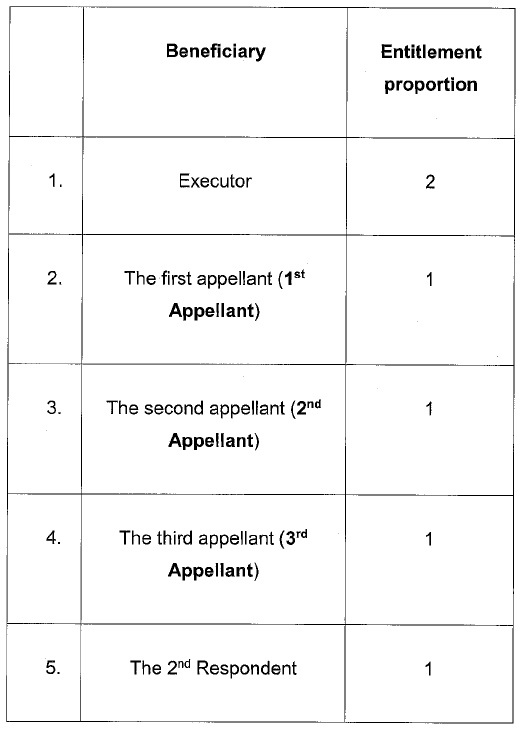
[7] The Executor had obtained a probate of the Will from the High Court (Probate).
[8] All the Testatrix's Shares were transmitted to the Executor [Transmission (Testatrix-Executor)] and registered on the 1st Respondent's register of members (1st Respondent's Register).
[9] On 22 January 2024, the Executor sent three written notices to the 1st Respondent [Executor's 3 Written Notices (1st Respondent)]. According to the Executor's 3 Written Notices (1st Respondent):
(1) the Executor informed the 1st Respondent that he "hereby transmit":
(a) 164,434 shares in the 1st Respondent to the 1st Appellant in accordance with the Will;
(b) 164,434 shares in the 1st Respondent are transmitted to the 2nd Appellant in accordance with the Will; and
(c) 164,434 shares in the 1st Respondent are transmitted to the 3rd Appellant in accordance with the Will; and
(2) the Executor authorised the company secretary of the 1st Respondent (1st Respondent's Co. Secretary) to register the above three transmissions in favour of the Appellants.
Enclosed in the Executor's 3 Written Notices (1st Respondent) were copies of the Will and Probate.
[10] By way of a letter dated 29 January 2024 to the Executor, the 1st Respondent's Board of Directors (BOD) rejected the Executor's 3 Written Notices (1st Respondent) [1st Respondent's Letter (29 January 2024)]. The 1st Respondent's Letter (29 January 2024) stated as follows, among others:
"Please be informed that your current holding of 1,837,237 shares in [the 1st Respondent] in your capacity as the executor of the [Estate] is the residue of a total of 3,674,479 already transmitted to you. As such, further transmissions of any part of these shares do not arise.
In the circumstances, the [BOD] cannot accede to your abovementioned request whatsoever.
Your [Executor's 3 Written Notices (1st Respondent)] are hereby rejected and returned accordingly:- ..."
[Emphasis Added]
[11] In 2023, the Executor transferred 612,413 shares in the 1st Respondent to the 2nd Respondent, one of the beneficiaries named in the Will [Executor's Transfer (2nd Respondent)]. Stamp duty was paid in respect of the Executor's Transfer (2nd Respondent).
[12] The Executor passed away on 12 April 2024. There is a pending case in the High Court regarding the administration of the Executor's estate [Dispute (Executor's Estate)].
C. Proceedings In The High Court
[13] The Appellants filed an Originating Summons (OS) against the Respondents in the High Court for the following relief, among others:
(1) a declaration that:
(a) 164,434 shares in the 1st Respondent are transmitted to the 1st Appellant by operation of law pursuant to the Will and Probate;
(b) 164,434 shares in the 1st Respondent are transmitted to the 2nd Appellant by operation of law pursuant to the Will and Probate; and
(c) 164,434 shares in the 1st Respondent are transmitted to the 3rd Appellant by operation of law pursuant to the Will and Probate;
(2) an order that the 1st Respondent shall register -
(a) 164,434 shares in the 1st Respondent in the name of the 1st Appellant within 14 days from the date of the court's order;
(b) 164,434 shares in the 1st Respondent in the name of the 2nd Appellant within 14 days from the date of the court's order; and
(c) 164,434 shares in the 1st Respondent in the name of the 3rd Appellant within 14 days from the date of the court's order; and
(3) an order that the 1st Respondent's Co. Secretary shall make the necessary changes in the 1st Respondent's Register to reflect the above shareholdings of the Appellants in the 1st Respondent.
[14] The High Court dismissed the OS with no order as to costs (High Court's Decision).
[15] According to the learned High Court Judge's written judgment, the High Court's Decision was based on the following reasons:
(1) the initial vesting of the Testatrix's Shares in the Executor constituted a "transmission" of the Testatrix's Shares to the Executor by operation of law pursuant to s 109 of the Companies Act 2016 (CA) and Articles of Association of the 1st Respondent (AA). Thereafter, a subsequent registration of those shares by the Executor in the names of the Appellants, constituted a "transfer" of shares which "must strictly comply" with:
(a) section 105 CA; and
(b) AA;
(2) by reason of s 33 CA, the AA bind all the members of the 1st Respondent, including the Executor. Articles 16 to 19 AA provide for a transfer of shares in the 1st Respondent while arts 20 to 23 AA deal with a transmission of shares. The Executor could not bypass AA regarding a transfer of the 1st Respondent's shares by "transmitting" the shares in the 1st Respondent a second time to the Appellants;
(3) according to the learned High Court Judge:
(a) the Court of Appeal's judgment in Ng Chong Wee v. Ng Chong Geng & Sons Sdn Bhd [2018] 6 MLRA 473 was "binding" on the High Court by virtue of the doctrine of stare decisis; and
(b) the judgments of:
(i) the Supreme Court of Queensland in Australia in Re Kenzler [1983] 7 ACLR 767; and
(ii) the Court of Appeal of Singapore in Seah Teong Kang (Co-Executor Of The Will Of Lee Koon, Deceased) & Anor v. Seah Yong Chwan (Executor Of The Estate Of Seah Eng Teow) [2015] 5 SLR 792
- were "merely persuasive"; and
(4) the High Court would not allow the OS until -
(a) the Dispute (Executor's Estate); and
(b) the debts of the Appellants due to the Estate [Appellants' Alleged Debts (Estate)]
- were resolved. Reliance was placed on the High Court's judgment in Tan Ruy Mun & Anor v. Desaminium Jaya Sdn Bhd [2019] MLRHU 2085.
D. Proceedings In The Court of Appeal
[16] The Appellants appealed to the Court of Appeal against the High Court's Decision (This Appeal).
[17] When This Appeal was heard on 2 July 2026, for the very first time, the Respondents' learned counsel tendered from the Bar table a copy of a medical report regarding the Executor (Executor's Medical Report). The Executor's Medical Report was not adduced as evidence when the OS was heard in the High Court. Unsurprisingly, the Appellants' learned counsel objected to the Respondents' reliance on the Executor's Medical Report for the purpose of This Appeal.
E. Issues
[18] In addition to the main question as stated in the above para 1, the following issues arise in This Appeal:
(1) whether the Respondents could rely on the Executor's Medical Report in This Appeal when the Respondents had not obtained prior leave of the Court of Appeal to adduce the Executor's Medical Report in a supplemental record of appeal under:
(a) section 69(3) of the Courts of Judicature Act 1964 (CJA); and
(b) rule 7(3A)(a) and (b) of the Rules of the Court of Appeal 1994 (RCA);
(2) from the viewpoint of the stare decisis doctrine, is the Court of Appeal's judgment in Ng Chong Wee a binding precedent when the Federal Court had reversed the Court of Appeal's decision in Ng Chong Wee without a written judgment from the Federal Court?;
(3) what is the meaning and effect of a "transmission" of a deceased person's shares in a company?;
(4) whether:
(a) section 105 CA;
(b) arts 16 to 19 AA;
(c) the Transmission (Testatrix-Executor); and/or
(d) Executor's Transfer (2nd Respondent)
- bar a transmission of the shares in the 1st Respondent in the name of the Executor to the Appellants; and
(5) could the High Court rely on-
(a) the Appellants' Alleged Debts (Estate); and/or
(b) the Dispute (Executor's Estate)
- as ground(s) to refuse the OS in this case?
Our Decision
F. Could The Respondents Rely On The Executor's Medical Report In This Appeal?
[19] The relevant parts of s 69 CJA and r 7 RCA are reproduced below:
"CJA
section 69. Hearing of appeals
(1) Appeals to the Court of Appeal shall be by way of re-hearing, and in relation to such appeals the Court of Appeal shall have all the powers and duties, as to amendment or otherwise, of the High Court, together with full discretionary power to receive further evidence by oral examination in court or through a remote communication technology, by affidavit, or by deposition taken before an examiner or commissioner.
(2) The further evidence may be given without leave on interlocutory applications, or in any case as to matters which have occurred after the date of the decision from which the appeal is brought.
(3) Upon appeals from a judgment, after trial or hearing of any cause or matter upon the merits, the further evidence, save as to matters subsequent as aforesaid, shall be admitted on special grounds only, and not without leave of the Court of Appeal.
RCA
rule 7. Power of Court to amend, admit further evidence, or draw inferences of fact
(1) The Court shall have all the powers and duties, as to amendment or otherwise, of the appropriate High Court, together with full discretionary power to receive further evidence by oral examination in Court, by affidavit, or by deposition taken before an examiner or Commissioner.
(2) Such further evidence may be given without leave on interlocutory applications, or in any case as to matters which have occurred after the date of the decision from which the appeal is brought.
(3) Upon appeals from a judgment, after trial or hearing of any cause or matter upon the merits, such further evidence, save as to matters subsequent as aforesaid, shall be admitted on special grounds only, and not without leave of the Court.
(3A) At the hearing of the appeal further evidence shall not be admitted unless the Court is satisfied that:
(a) at the hearing before the High Court or the subordinate court, as the case may be, the new evidence was not available to the party seeking to use it, or that reasonable diligence would not have made it so available; and
(b) the new evidence, if true, would have had or would have been likely to have had a determining influence upon the decision of the High Court or the subordinate court, as the case may be."
[Emphasis Added]
[20] The Executor's Medical Report was available to the Respondents at the time of the hearing of the OS in the High Court. However, the Executor's Medical Report was not adduced as evidence in the High Court by the Respondents. We are firmly of the view that for the purpose of This Appeal, the Respondents cannot rely on the Executor's Medical Report. Our reasons are as follows:
(1) the Executor's Medical Report was not "subsequent evidence" (evidence which came into being after the High Court's Decision). Consequently, the Respondents could not invoke the second limb of s 69(2) CJA (in any case as to matters which have occurred after the date of the decision from which the appeal is brought) and the second limb of r 7(2) RCA (in any case as to matters which have occurred after the date of the decision from which the appeal is brought) so as to rely on the Executor's Medical Report in This Appeal; and
(2) the Executor's Medical Report constituted "existent evidence" (evidence which was available to the Respondents at the time of the hearing of this OS in the High Court). The Respondents did not fulfil the following conditions for tendering the Executor's Medical Report as evidence for the hearing of This Appeal-
(a) the Executor's Medical Report could have been obtained by the Respondents with reasonable diligence for use at the High Court. Hence, the Respondents did not fulfil the second limb of r 7(3A)(a) RCA (reasonable diligence would not have made it so available). Nor did the Respondents satisfy the first condition laid down by Denning LJ (as he then was) in the Court of Appeal of the United Kingdom in Ladd v. Marshall [1954] 3 All ER 745, at 748;
(b) the Respondents had failed to show that the Executor's Medical Report "would probably have an important influence" on the High Court's Decision, the second condition as explained in Ladd; and
(c) the Respondents were not able to show that the Executor's Medical Report "would have had or would have been likely to have had a determining influence" on the High Court's Decision within the meaning of r 7(3A)(b) RCA.
G. Was The Court of Appeal's Judgment In Ng Chong Wee Binding On The High Court?
[21] The Court of Appeal decided as follows in Ng Chong Wee, at [1], [3], [5] to [7], [16], [23] and [24]:
"[1] The appellant, who is one of the beneficiaries of the estate of his father Hwang Eng Pei @ Ng Eng Puah (deceased), appeals against the decision of the learned Judicial Commissioner. The court had refused his application for the shares he has acquired through the deceased to be transferred onto his name. The application was not to transmit all shares of the deceased in his name as personal representative of the deceased's estate. The distinction of the phrases 'his share', 'all shares', 'transmission and transfer' is important to appreciate this judgment and to derive a correct conclusion in law. ...
...
[3] The brief facts of the case are well articulated by the learned Judicial Commissioner. We will summarise it as follows:
...
(d) Only the appellant's transfer is in dispute here as the directors of the respondent, acting in the best interest of the company and in order to avoid share dilution, decided "not to approve the proposed transfer or transmission". The respondent however would approve a transfer "to a corporation which is wholly owned by the descendants of the deceased". The other two beneficiaries accepted the condition imposed by the directors. The appellant refused and sought an order of the court to get his share as beneficiary of the deceased's estate registered under his name.
...
[5] This case essentially involves the rights of beneficiaries of deceased shareholder in a private limited company as opposed to public company to be registered as a shareholder as of right. We are of the view that this issue must be dealt with under CA 1965 and not CA 2016 because the rights and obligations of the parties concerned arose under the old CA 1965. Section 620(4) of CA 2016 preserves and saves such rights and objections to be dealt with under CA 1965. On this point alone, the Originating Summons which was moved under CA 2016 ought to have been dismissed in limine.
[6] To appreciate the second issue which is the real problem in issue and to arrest any form of convoluted jurisprudence, it must be noted that a private limited company cannot have more than 50 members. [See s 15 of CA 1965]. To say a deceased with 60 children can all be registered as shareholders is not logical and the law may not entertain such construction. Unlike public companies, Articles of Association of private companies may provide the discretion to accept a transfer of share from its existing member to a third party. However, when it comes to a deceased member, the law recognises that the personal representative (Administrator or Executor) can represent the deceased shareholder with limited rights. This process in law is called rights acquired by transmission. What is important to note is that the law does not give a right to beneficiaries of the deceased estate to have their portion of entitlement to the deceased estate to be registered by way of transfer as of right. This is evident from the terms of s 103(2) which reads as follows:
...
[7] To put it simply, personal representative who is recognised by the company to have stepped into the shoes of the deceased is said to have been vested with the shares by transmission. Personal representative having agreed to distribute the shares to the relevant beneficiaries according to law is a separate exercise and does not fall under the concept of transmission as envisaged usually by the Articles of Association as well as legislation. As we said earlier, if such construction is allowed it may breach the 50 member rule.
...
[16] In essence, transmission is related to the transmission of the shares to the personal representative. Transmission is not related to the beneficiaries of the estate. For that, the concept of transfer is involved — see s 103(2).
...
[23] We have read the appeal records and able submissions of the learned counsel. After giving much consideration to the submissions of the learned counsel for the appellant in detail, we take the view that the appeal has no merit. Our reasons inter alia are as follows:
(a) The learned trial judge has set out the facts and dealt with issues and law related to transfer. Learned counsel for the appellant, notwithstanding the Originating Summons is related to transfer of shares has mixed up the jurisprudence related to transmission, thereby to some extent bordering into confusion as well as convoluted jurisprudence.
(b) In the instant case, any reasonable tribunal appraised with the facts of this case as well as the reasons for refusal of transfer, will not come to the conclusion that it was done mala fide. In fact, two other beneficiaries have agreed to accept the condition for transfer imposed by the Board. In our considered view, this is not a fit and proper case to interfere with the discretion of the Board of Directors. [See Xiamen International Bank v. Sing Eng (Pte) Ltd [1993] 3 SLR 228].
(c) We are in agreement with the submission of the respondent that the governing Act is CA, 1965 and not Act 2016. ...
[24] For reasons stated above, we take the view that this is not a fit and proper case for appellate intervention. In consequence, the appeal is dismissed with costs. ..."
[Emphasis Added]
[22] The Court of Appeal's decision in Ng Chong Wee had been reversed by the Federal Court. The Federal Court ordered the shares of the deceased testator in that case to be registered in the name of the appellant pursuant to the testator's will and probate of the will. There was however no written judgment of the Federal Court in Ng Chong Wee.
[23] Once a superior court's decision (Court A) in a case, is reversed by a higher court (Court B), the ratio decidendi of Court A's written judgment in that case (Court A's Ratio Decidendi), cannot be a binding precedent unless Court A's Ratio Decidendi is subsequently restored by a higher court. Court A's Ratio Decidendi cannot constitute a binding precedent even though Court B did not provide a written judgment for the reasons why Court A's Ratio Decidendi was reversed by Court B.
In this regard, the High Court had decided as follows in SQA Builders Sdn Bhd v. Luxor Holdings Sdn Bhd & Anor And Other Cases [2023] 4 MLRH 378, at [22(1) to (3)]:
"[22] Firstly, I am of the following view regarding the stare decisis doctrine:
(1) it is the ratio decidendi in the written judgment of a superior court [Ratio Decidendi (Superior Court)] and not the decision of the superior court itself which binds all lower courts. I use the term "superior court" to refer to the Federal Court, Court of Appeal and High Court. ...;
(2) when a written judgment of a lower court has been reversed or overruled by a higher court, the ratio decidendi of the lower court [Ratio Decidendi (Lower Court)] cannot be cited as an authority unless the Ratio Decidendi (Lower Court) has been subsequently restored or accepted by the Ratio Decidendi (Superior Court);
(3) if a lower court's decision is reversed by a higher court, the Ratio Decidendi (Lower Court) cannot have binding effect even though there is no written judgment of the higher court. The Ratio Decidendi (Lower Court) can only be cited as an authority if the Ratio Decidendi (Superior Court) subsequently restores or accepts the Ratio Decidendi (Lower Court); ..."
[Emphasis Added]
The above judgment in SQA Builders had been approved by the Court of Appeal in Tan Nyok Chin v. Pemungut Duti Setem [2026] 3 MLRA 886, at [28(2) (b)].
[24] In view of the Federal Court's reversal of the Court of Appeal's decision in Ng Chong Wee, notwithstanding the fact that there was no written judgment by the Federal Court in Ng Chong Wee, the learned High Court Judge had erred in law by deciding that as a matter of stare decisis, Court of Appeal's judgment in Ng Chong Wee was binding on the High Court (1st Legal Error).
H. The Meaning And Effect Of A "Transmission" Of A Deceased Person's Shares In A Company
[25] The CA does not provide for a definition of the terms "transfer" and "transmission" of shares in a company.
[26] In the High Court case of Gan Tuck Meng & Ors v. Ngan Yin Groundnut Factory Sdn Bhd & Anor [1989] 3 MLRH 522, Peh Swee Chin J (as he then was) decided that a "transmission of shares" in that case was "by operation of law and was not a transfer at all" because the shares in that case were transmitted by way of the deceased testator's will and probate of the will. It is clear that a deceased person's shares in a company, can be "transmitted" (not "transferred") to a beneficiary by operation of law, namely by operation of the deceased person's will and probate of the will.
[27] According to Abdul Hamid JC (as he then was) in the High Court in Lee Eng Eow v. Low Ah Lian & Anor [1991] 1 MLRH 704 -
"The facts are not in dispute. The only question for determination is whether the provisions of art 16 of the articles of association of the company overrides the provision of the will.
Put simply the argument of counsel for the plaintiff was that as the deceased in his lifetime could not have transferred the shares to the 1st defendant because of art 16, he could not do the same after his death by a provision in his will. On the other hand, counsel for the defendants pointed out that there was a difference between 'transfer' and 'transmission'.
What art 16 prohibits is the transfer of shares to persons other than his male descendants. 'Transfer' means transfer of legal title to shares by registering the transferee as the owner of the shares. It does not prevent transmission.
Volume 7 of Halsbury's Laws of England (4th Ed) at para 417 makes a clear distinction between 'transmission' and 'transfer'. 'Transmission' means 'transmission by operation of law, including devolution by death...'. On the other hand a 'transfer' is a 'transfer by the act of a member'.
In Executors, Administrations and Probate by William, S Mortimer and Sinnucks (16th Ed) at p 947, it is said: 'The articles of a company cannot, however, by-pass the personal representatives. If they purport themselves to operate a transfer they are invalid to this extent.' Re Greene, deceased was cited as authority for that proposition."
[Emphasis Added]
[28] According to "Black's Law Dictionary", 9th edn, at p 1638, "transmission" means the "passing of an inheritance to an heir".
[29] We refer to the following judgment of McPherson J (as he then was) in the Supreme Court of Queensland Australia (court of first instance) in Re Kenzler, at p 772 to 773:
"The application here is, however, not simply for registration of the executors of the deceased but of the applicant in her character as residuary legatee under the will of the deceased. The question is whether this amounts to transmission or transfer, and on this there is little direct authority. ...
...
... As a matter of general principle, it seems to me that the process by which the applicant became entitled to her shares is properly described as one of "transmission" in which no "transfer" is involved. The principle is that a legatee takes title to the subject-matter of the bequest by virtue of the will of the deceased, and not by virtue of any act of the executor, and this is so whether the legacy is specific or merely residuary: see Williams & Mortimer: Executors Administrators & Probate, at pp 848-850. It is true that, until the executor assents, the legatee has merely an inchoate right to the subject of the bequest, but it is not the assent that operates to vest title in the beneficiary. As was said by Viscount Haldane in George Attenborough & Son v. Solomon [1913] AC 76 at 83: "The transfer is not made by the mere force of the assent of the executor but by virtue of the dispositions of the will which have become operative because of this assent."
...
It follows that an application to the company for registration of the applicant as shareholder in place of the deceased cannot be regarded as a "transfer" from the executors to the applicant as legatee. Indeed, the better view appears to be that the deceased remains the "member" or "shareholder" until, if at all, the personal representative is registered: A L Campbell & Co Pty Ltd v. Federal Commissioner of Taxation (1951) 82 CLR 452. The document headed "transmission" forwarded by the applicant's solicitors is therefore not to be regarded as an application for transfer of the shares from the executors, but simply as a request implying their assent to the transmission from the deceased of legal title to the shares which by virtue of the will devolved on the applicant by operation of law."
[Emphasis Added]
It is to be noted that McPherson J who decided Re Kenzler, was the founding author of the much sought after legal practitioners' reference book, "The Law of Company Liquidation".
[30] The above judgment of Re Kenzler was followed by Andrew Phang Boon Leong JA in the Court of Appeal of Singapore (its apex court) in Seah Teong Kang, at [22], [25] to [27] and [41] to [44]:
"[22] We therefore prefer the view that the whole interest in the Shares in this case does in fact pass, upon the death of the Testator, to the executor. In this regard, we should add that we agree with the Judge (see the Judgment at [34]) that the proper characterisation of the manner by which the Shares devolved upon the executor was via the process of transmission (which takes place by operation of law) and not by a transfer (which occurs as a result of an act of the parties) (see Williams, Mortimer and Sunnucks on Executors, Administrators and Probate (John Ross Martyn and Nicholas Caddick gen eds) (Sweet & Maxwell, 20th Ed, 2013) ("WMS 2013") at para 45-65; and Palmer's Company Law vol 1 (Geoffrey Morse gen ed) (Sweet & Maxwell, Looseleaf Ed, 2015) at para 6.475). The result is that s 259, which governs only the transfer of shares after a company is ordered to be wound up, is not attracted at this stage.
...
[25] An assent is an acknowledgment by a personal representative that an asset of the deceased is no longer required for the payment of the debts of the estate, funeral expenses or general pecuniary legacies (see WMS 2013 at para 81-01). Where the facts disclose that there has been an assent, then its effect, in the context of a specific bequest under a will, is to turn the executor into a trustee of the bequeathed asset because equitable ownership moves to the specific legatees upon the assent who, for their part, are turned into beneficiaries (see Hanbury & Martin at para 2-020). From that point onwards, the executor is precluded from dealing with the bequeathed asset as executor (see WMS 2013 at para 81-20 and Nitikman at 675). The effect of an assent upon the role of an executor was explained by Viscount Haldane LC in the leading House of Lords decision of George Attenborough & Son v. Solomon [1913] AC 76 ("George Attenborough") in these words (at 85):
The executors had long ago lost their vested right of property as executors and become, so far as the title to it was concerned trustees under the will. Executors they remained, but they were executors who had become divested, by their assent to the dispositions of the will, of the property which was theirs virtute officii; and their right in rem, their title of property, had been transformed into a right in personam, — a right to get the property back by proper proceedings against those in whom the property should be vested if it turned out that they required it for payment of debts for which they had made no provision. My Lords, that right always remains to the executors and they can always exercise it, but it is a right to bring an action, not a right of property ...
[26] To be clear, we should stress that the passing of equitable ownership in the bequeathed asset is "not by the mere force of the assent of the executor, but by virtue of the dispositions of the will which have become operative because of [the] assent" (see George Attenborough at 83). In other words, the significance of the assent is that it is necessary to "cause" the property to vest in the legatee, but it should not be mistaken as "the instrument of the vesting", which is in fact the will (see Bryen ([21] supra) at 399). This is neatly summed up in the following passage in Nitikman (at 673):
Once the executor assents, it is the Will, rather than the assent, that determines to whom the property goes, and it is the Will, rather than the assent, that is the legal instrument that effects the passage of beneficial interest. The assent is not a conveyance of the property. The assent makes the Will operative, that is, it perfects the beneficiary's beneficial ownership to the assets gifted under the Will.
[27] A final point which we make in relation to the doctrine of assent (which is of some importance in the context of the present case) is that, in determining whether such assent exists, the inquiry is necessarily a fact sensitive one. What is sought is an indication by the executor that the bequeathed asset is no longer required for the purposes of administration and that it may pass under the testator's will — and this he or she may do informally and it may be inferred from his or her conduct (see George Attenborough at 83). In other words, it is not necessary in order to prove an assent to show affirmatively that the executor had, either verbally or in writing, made a formal declaration to that effect (see, for example, the English High Court decision of Wise v. Whitburn [1924] 1 Ch 460 at 467).
...
[41] In our view, the logic applied by McPherson J in Re Kenzler is sound and in harmony with the basic principles of succession law — because when a specific legatee of shares ultimately acquires an interest in those shares under the provisions of the will, it is by operation of law that he takes such interest and that is properly a "transmission". This is notwithstanding the fact that the executor's assent is required to give effect to the provisions of the will. The executor's assent, properly understood, merely "activates the gift of the property by the testator's will" [emphasis added] (see Parry & Kerridge at para 24-39). If there is any disagreement that we have with McPherson J's analysis, it is only in respect of the quite separate point where he says (in underlined italics in the quoted passage) that it is the "legal" title in the shares that passes to the beneficiary by transmission pursuant to an assent. As we have sought to explain at [28]-[33] above, the effect of an assent in respect of a testamentary gift of shares is effective only to pass the beneficial interest therein to the specific legatee. It does not serve also to pass the legal title in the shares — that is contingent on the registration of a share transfer that has taken place in accordance with the company's articles.
[42] Given that Re Kenzler generally rests on sound principles, it is unsurprising to find that the proposition which it lays down has not been the subject of any adverse comment in the relevant authorities which have discussed this case (see, for example, H A J Ford, R P Austin & I M Ramsay, Ford's Principles of Corporations Law vol 2 (LexisNexis Butterworths, Looseleaf Ed, 2000, October 2012 release) at para 21.422; Halsbury's Laws of Australia vol 7 (LexisNexis Butterworths, 1993) at para 120-5815; and Australian Corporation Law: Principles and Practice vol 2 (R P Austin et al gen eds) (LexisNexis Butterworths, 1991) at para 7.6.0085; see also Nitikman at 674). In fact, the Respondent was able to point us to several Australian decisions which have accepted the proposition in Re Kenzler. For example, in Waters v. Winmardun Pty Ltd (1990) 3 ACSR 378, which was a decision of the Supreme Court of Victoria, Master Evans affirmed (at 384) the principle in Re Kenzler that shares devolved under a will to the legatee by way of transmission (and not by transfer) as follows:
The word 'transfer' when used in this context without any compelling textual indication to the contrary (Re Kenzler 7 ACLR 767 at 771) has been held not to include:
...
(iii) A transmission of a deceased shareholder's shares to his legatee: Re Kenzler, supra.
...
These are all cases in which in a broad sense a shareholder has been divested of his shares by operation of law ...
[Emphasis Added]
[43] Re Kenzler was also cited with approval in the recent case of Atwell v. Roberts [2013] WASCA 37 which was decided by the Supreme Court of Western Australia. In that case, the testatrix, Ada, had bequeathed her partnership interest to her nephew, Keith, who was also appointed as the executor of her will. The latter then transferred the partnership interest to himself (qua specific legatee) and the question arose as to whether this "transfer" fell within the meaning of cl 6 of the partnership rules which required that a partner proposing to "dispose" of all or any of his or her partnership interest give notice in writing of that desire. The court held that it did not. Relying on Re Kenzler, Murphy JA noted that, in assenting to the bequest of the partnership interest, the executor had caused the partnership interest to devolve upon himself by way of "transmission"; he had not, in so doing, purported to "dispose" of the partnership interest (at [301]):
There are other reasons why cl 6 of the Rules of the 1976 deed is not engaged in relation to the first, fourth, fifth and sixth transfers. As to the first transfer, Ada's interest in the partnership was vested in Keith, as trustee of the Hamersley Trust, by virtue of the disposition in Ada's will. A legatee of an interest in the partnership takes such interest by virtue of the disposition of the will, which becomes operative by the assent of the executor: George Attenborough & Son v. Solomon [1913] AC 76 at 83; Ex parte Kenzler [1983] 2 Qd R 281 at 287. Transmission of the interest to a legatee is not, generally, regarded as an assignment or transfer of the interest: Ex parte Kenzler (285-287); and Andco Nominees Pty Ltd v. Lestato Pty Ltd (1995) 126 FLR 404 at 421-422. In assenting to the bequest, Keith, as executor of Ada's will, was not 'proposing to dispose of ... his units' within the meaning of cl 6(1) of the Rules. ...
[44] In light of the above, we hold that Re Kenzler is good law. Applying it to the present case, it means that when the Respondent assented to the passing of property in the Shares by making cheque payments of the liquidation surplus to the Appellant, the equitable interest in the Shares devolved upon the Appellant under the Testator's will by the process of transmission. Accordingly, s 259, concerned as it is with the "transfer" of shares post-winding up, is not attracted at all on a plain reading of that provision."
[Emphasis Added]
[31] We have no hesitation to adopt the above judgments in Re Kenzler and Seah Teong Kang. According to these two cases:
(1) an application to a company to register the company's shares of a deceased person in the name of a beneficiary of the deceased person's will and probate of that will, constitutes a "transmission" and not a "transfer" of those shares; and
(2) an executor of the deceased person's estate may "assent" to a transmission of the deceased person's assets to a beneficiary on the ground that the beneficiary does not owe any debt to the deceased person's estate.
Premised on the cogent reasons explained in Re Kenzler and Seah Teong Kang, with respect, we are not able to follow the Court of Appeal's judgment in Ng Chong Wee. If we have adopted the Court of Appeal's judgment in Ng Chong Wee, this means that a personal representative of a deceased person's estate (an executor or administrator):
(a) cannot "transmit" the shares of the deceased person in a company to the beneficiaries of the deceased person's estate by operation of law, namely:
(i) by virtue of the will and probate in the case of testacy; or
(ii) by reason of the Distribution Act 1958 (for non-Muslims) or "Hukum Faraid" (for Muslims) in the case of intestacy; and
(b) is required to "transfer" the deceased person's shares in a company to the beneficiaries of the deceased person's estate and pay stamp duty for such "transfer".
The effect of the Court of Appeal's judgment in Ng Chong Wee is to render nugatory the concept of "transmission" which has been recognised and enforced by case law, eg., Gan Tuck Meng, Lee Eng Eow, Re Kenzler and Seah Teong Kang [these four cases shall be referred to collectively in this judgment as the "Case Law (Transmission of Shares)"].
I. Could The 1st Respondent Reject The Executor's 3 Written Notices (1st Respondent)?
I(1). What Is The Effect Of Sections 105 And 109 CA?
[32] Sections 105 and 109 CA provide as follows:
"section 105. Requirement for instrument of transfer
(1) Subject to other written laws, any shareholder or debenture holder may transfer all or any of his shares or debentures in the company by a duly executed and stamped instrument of transfer and shall lodge the transfer with the company.
(2) Subsection (1) shall not apply to a transfer of securities in a company that has been removed from the official list of a stock exchange from the central depository as defined in s 146 to the persons named in the record of depositors referred to in subsection 147(1), provided that such transfer is effected in accordance with the rules of the central depository as defined in s 146.
(3) For the purpose of effecting the transfer of shares or debentures, the company shall enter the name of the transferee in the register of members or register of debenture holders in accordance with this section.
(4) Subsection (1) shall not affect any power of a company to register a person as a shareholder or debenture holder to whom the right to shares or debentures has been transmitted by operation of law.
(5) For the purposes of this section, "instrument of transfer" includes a written application for transmission of a share, debenture or other interest to a personal representative.
section 109. Registration of transmission of shares or debentures
(1) This section applies if the right to shares or debentures is transmitted to a person by operation of law and the person notifies the company in writing that the person wishes to be registered as a shareholder or debenture holder of the company in respect of the shares or debentures.
(2) Notwithstanding subsection (1), if the person referred to in that subsection elects to have another person registered, he shall testify his election by executing to that person a transfer of the share or debenture, as the case may be.
(3) All limitations, restrictions and provisions of this Subdivision relating to the right to transfer and the registration of transfers of shares or debentures referred to in subsection (2) shall be applicable to any notice or transfer as if the death or bankruptcy of the shareholder or debenture holder had not occurred and the notice or transfer were signed by that shareholder or debenture holder.
(4) Any document which is by law sufficient evidence of probate of the will or letters of administration of the estate of a deceased person having been granted to a person shall be accepted by the company as sufficient evidence of the grant.
(5) The company shall register the person as a shareholder or debenture holder of the company in respect of the shares or debentures within sixty days from receiving the notification.
(6) The registration of transmission of shares or debentures under this section shall entitle the registered holder to the same dividends and other advantages and to the same rights in relation to meetings of the company or to voting or otherwise.
(7) For the purposes of subsection (1), in case of the death of a member, the persons recognized as having any title to his interest in the shares or debentures shall be:
(a) where the deceased was a sole holder, the legal personal representatives; and
(b) where the deceased was a joint holder, the survivor, but nothing in this section shall release the estate of a deceased joint holder from any liability in respect of any share which had been jointly held by him with other persons.
(8) The company and every officer who contravene this section commit an offence and shall, on conviction, be liable to a fine not exceeding ten thousand ringgit and, in the case of a continuing offence, to a further fine not exceeding five hundred ringgit for each day during which the offence continues after conviction."
[Emphasis Added]
[33] As a result of the Transmission (Testatrix-Executor), the Testatrix's Shares are now registered in the name of the Executor in the 1st Respondent's Register [Executor's Shares (Appellants' Entitlement)]. It is not disputed that by virtue of the Will and Probate, the Appellants (not the Executor) are entitled in law and Equity to the Executor's Shares (Appellants' Entitlement).
[34] Firstly, there is nothing in s 105 CA which requires the Executor to "transfer" and not "transmit" the Executor's Shares (Appellants' Entitlement) to the Appellants. On the contrary, s 105(4) CA has expressly provided that s 105(1) CA "shall not affect any power of a company to register a person as a shareholder ... to whom the right to shares ... has been transmitted by operation of law". With respect, the learned High Court Judge had erred in the construction of s 105(1) and (4) CA by requiring the Executor to "transfer" the Executor's Shares (Appellants' Entitlement) to the Appellants (2nd Legal Error).
[35] Secondly, as decided in Seah Teong Kang, the High Court erred in law by not deciding that:
(1) the Executor's 3 Written Notices (1st Respondent) clearly evidenced the Executor's "assent" to the "transmission" of the Executor's Shares (Appellants' Entitlement) to the Appellants [Transmission (Executor-Appellants)]; and
(2) the 1st Respondent was required in law to have registered the Transmission (Executor-Appellants) in the 1st Respondent's Register pursuant to s 109(1) and (5) CA
(3rd Legal Error).
It is to be noted that the 1st Respondent's contravention of s 109(1) and (5) CA, constitutes an offence under s 109(8) CA wherein the 1st Respondent and its "officer" [defined widely in s 2(1) CA] may be punished with a fine not exceeding RM10,000.00 and, in the case of a continuing offence, to a further fine not exceeding RM500.00 for each day during which the offence continues after conviction.
I(2). Whether Arts 16 To 19 AA Bar The Transmission (Executor-Appellants)
[36] We reproduce below arts 16 to 19 AA:
"TRANSFER OF SHARES
Article 16. The instrument of transfer of any share in the Company shall be the usual or common form and the transfer shall be executed both by the transferor and the transferee and the transferor shall be deemed to remain a holder of the share until the name of the transferee has been entered in the register of members in respect thereof.
Article 17. The Directors may decline to register any transfer of a share where
(a) the Company has a lien on the share or
(b) the proposed transferee is a person whom they do not approve, but clause (b) shall not apply where the proposed transferee is already a member of the Company and in all cases the decision of the Directors shall be final and no reason need be assigned for refusal to register the transfer of any share.
Article 18. The transfer of any share must first be approved by the Directors and the Directors shall not approve any transfer to any outsider unless no existing member can be found, within 30 days from receipt of such notice of intention to transfer duly served on the Company, to buy up the share, art 17(b) notwithstanding. In case any difference shall arise between the proposing transferor and the intending purchaser, who is an existing member, as to the fair value of a share, the Auditor of the Company shall on the application of either party, certify in writing the sum which in his opinion is the fair value, and such sum shall be deemed to be the fair value accordingly and in so certifying, the Auditor shall be considered to be an Expert and not as an Arbitrator and, accordingly, the Arbitration Ordinance 1950 (No. 12 of 1950) shall not apply.
Article 19. Every instrument of transfer shall be left at the Office for registration, duly stamped and accompanied by the Certificate of the Shares expressed to be transferred, and such other evidence as the Directors may require to prove the right of the transferor to make the transfer. All Powers of Attorney under which any instrument of transfer is executed shall be registered with the Company and a registration fee of One Dollar shall be paid in respect of each Power of Attorney."
[Emphasis Added]
[37] With respect to the learned High Court Judge, arts 16 to 19 AA concerned a "transfer" of the 1st Respondent's shares and did not apply to the Transmission (Executor-Appellants) (4th Legal Error).
I(3). Could The Executor's Transfer (2nd Respondent) Bar The Transmission (Executor-Appellants)?
[38] The Executor's Transfer (2nd Respondent) did not involve the Appellants. More importantly, the Executor's Transfer (2nd Respondent) cannot prevent the application of Case Law (Transmission of Shares) which allows the Transmission (Executor-Appellants).
I(4). Whether The High Court Could Rely On The Appellants' Alleged Debts (Estate) And/Or Dispute (Executor's Estate) To Dismiss The OS
[39] Firstly, the High Court committed an error of law in dismissing the OS based on the Appellants' Alleged Debts (Estate) (5th Legal Error). The 5th Legal Error is premised on the following reasons:
(1) the Executor's 3 Written Notices (1st Respondent) clearly proved on a balance of probabilities that the Executor had accepted the fact that the Appellants did not owe any debt to the Estate;
(2) the Executor's 3 Written Notices (1st Respondent) were not retracted by the Executor before the Executor's death; and
(3) even if it is assumed that the Appellants owed debts to the Estate:
(a) the Case Law (Transmission of Shares) does not recognise such debts to be a lawful ground for the 1st Respondent to refuse the Transmission (Executor-Appellants); and
(b) the Estate could file civil suits to recover such debts from the Appellants (subject to the defence of limitation).
[40] Secondly, in view of the Case Law (Transmission of Shares), we fail to see how the Dispute (Executor's Estate) can bar the Case Law (Transmission of Shares). In this regard, the High Court had committed an error of law (6th Legal Error).
[41] In arriving at the High Court's Decision, the learned High Court Judge had relied on the judgment of Nantha Balan J (as he then was) in the High Court case of Tan Ruy Mun. With respect, the material facts of Tan Ruy Mun could be easily distinguished from this case because in Tan Ruy Mun, at [46] and [48] to [50]:
(1) by way of a will, a testator had bequeathed his shares in a company to the plaintiffs;
(2) the plaintiffs had filed a suit for a court order to compel the registration of the transmission of the testator's shares to the plaintiffs (1st Suit);
(3) a separate suit had been filed in the High Court to challenge the validity of the testator's will on the ground that the will had been forged (2nd Suit); and
(4) in view of the 2nd Suit, the High Court in Tan Ruy Mun:
(a) stayed the 1st Suit; and
(b) ordered a consolidation of the 1st and 2nd Suits with the "ultimate effect" that the 1st Suit would have to abide by the outcome of the 2nd Suit.
The High Court decided as follows in Tan Ruy Mun, at [48]:
"[48] ... In ordinary cases, where there is for example, no challenge to the will or the grant of probate, an application under [s 109 CA] would be a pure "mechanistic" exercise calling for no curial determination. It is quite indisputable that the present case is far from ordinary. The question is whether the Court (vis-à-vis [1st Suit]) should turn a "blind-eye" to the underlying dispute vis-à-vis [2nd Suit] and grant the orders sought for registration of the deceased's shares into the names of the plaintiffs regardless of the fact that the impugned will and the locus standi of the plaintiffs as executors and trustees of the estate, is being challenged in [2nd Suit]."
[Emphasis Added]
In this case, unlike Tan Ruy Mun, there was no challenge to the Will. Nor was there an application to the court to invalidate the Probate in this case. In the circumstances, the High Court had erroneously relied on Tan Ruy Mun in this case (7th Legal Error).
J. Conclusion
[42] Premised on the 1st to 7th Legal Errors, This Appeal is allowed with the following order:
(1) the High Court's Decision is set aside;
(2) a judgment is entered in favour of the Appellants against the Respondents in terms of prayers 1 to 7 OS. A time period of 14 days from the date of service of this Order on all the Respondents, is inserted in prayers 4 to 7 OS; and
(3) the 1st Respondent shall pay costs in a sum of RM50,000.00 to the Appellants with regard to the proceedings in the Court of Appeal and High Court (subject to allocatur fee).
[43] A draft copy of this judgment (Draft) had been forwarded to Ahmad Kamal bin Md. Shahid and Ahmad Fairuz bin Zainol Abidin JJCA. Both my learned brothers had agreed with the Draft.